免费领取教师福利



若您为此资料的原创作者,认为该资料内容侵犯了您的知识产权,请扫码添加我们的相关工作人员,我们尽可能的保护您的合法权益。

这是一份2025年中考英语第二次模拟考试(广州卷)-备战2025年中考英语语法点+题型练习(广州中考真题+模拟)(广州专用),共21页。
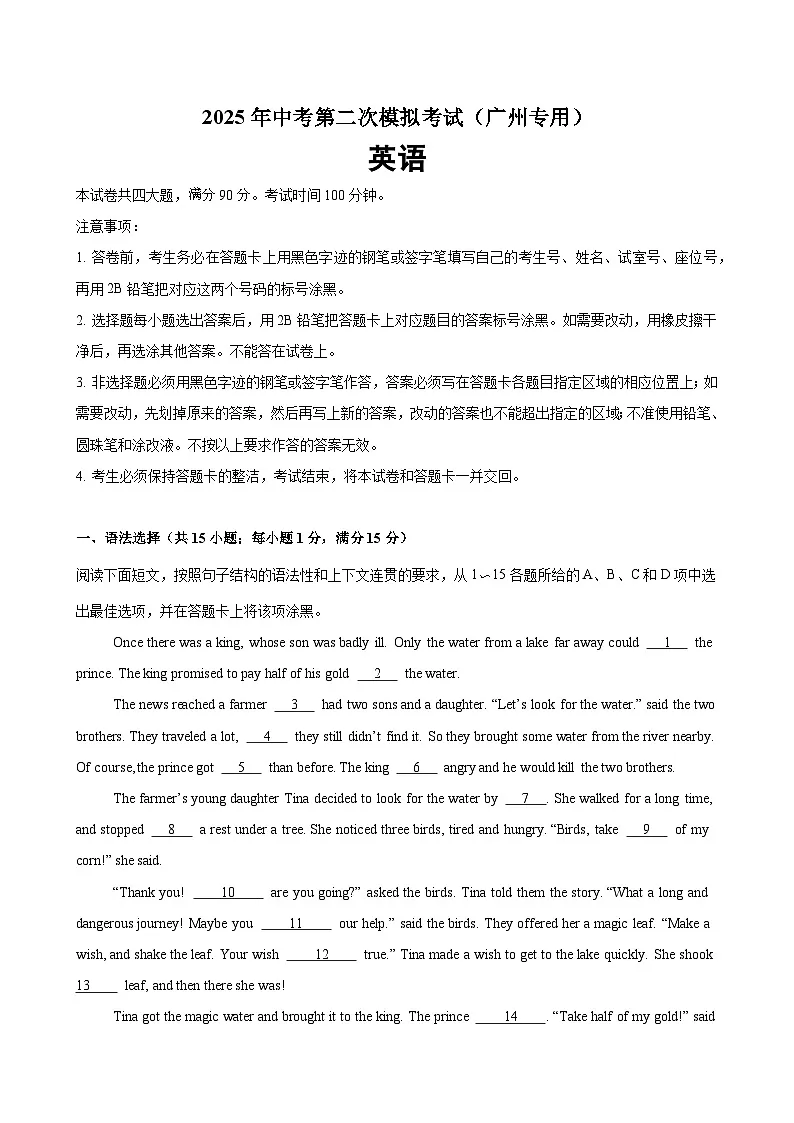
注意事项:
1. 答卷前,考生务必在答题卡上用黑色字迹的钢笔或签字笔填写自己的考生号、姓名、试室号、座位号,再用2B铅笔把对应这两个号码的标号涂黑。
2. 选择题每小题选出答案后,用2B铅笔把答题卡上对应题目的答案标号涂黑。如需要改动,用橡皮擦干净后,再选涂其他答案。不能答在试卷上。
3. 非选择题必须用黑色字迹的钢笔或签字笔作答,答案必须写在答题卡各题目指定区域的相应位置上;如需要改动,先划掉原来的答案,然后再写上新的答案,改动的答案也不能超出指定的区域;不准使用铅笔、圆珠笔和涂改液。不按以上要求作答的答案无效。
4. 考生必须保持答题卡的整洁,考试结束,将本试卷和答题卡一并交回。
一、语法选择(共15小题;每小题1分,满分15分)
阅读下面短文,按照句子结构的语法性和上下文连贯的要求,从1〜15各题所给的A、B、C和D项中选出最佳选项,并在答题卡上将该项涂黑。
Once there was a king, whse sn was badly ill. Only the water frm a lake far away culd 1 the prince. The king prmised t pay half f his gld 2 the water.
The news reached a farmer 3 had tw sns and a daughter. “Let’s lk fr the water.” said the tw brthers. They traveled a lt, 4 they still didn’t find it. S they brught sme water frm the river nearby. Of curse, the prince gt 5 than befre. The king 6 angry and he wuld kill the tw brthers.
The farmer’s yung daughter Tina decided t lk fr the water by 7 . She walked fr a lng time, and stpped 8 a rest under a tree. She nticed three birds, tired and hungry. “Birds, take 9 f my crn!” she said.
“Thank yu! 10 are yu ging?” asked the birds. Tina tld them the stry. “What a lng and dangerus jurney! Maybe yu 11 ur help.” said the birds. They ffered her a magic leaf. “Make a wish, and shake the leaf. Yur wish 12 true.” Tina made a wish t get t the lake quickly. She shk 13 leaf, and then there she was!
Tina gt the magic water and brught it t the king. The prince 14 . “Take half f my gld!” said the king. Tina didn’t 15 the gld. She nly asked the king t free her tw brthers. The king agreed.
Finally, Tina and her tw brthers went hme tgether.
1.A.saveB.savesC.savedD.saving
2.A.frmB.nC.withD.fr
3.A.whB.whichC.whmD.whse
4.A.thughB.sC.butD.and
5.A.badB.wrseC.wrstD.badly
6.A.becmeB.becmesC.becameD.will becme
7.A.sheB.herC.hersD.herself
8.A.haveB.t haveC.havingD.had
9.A.littleB.anyC.fewD.sme
10.A.WhereB.WhyC.HwD.What
11.A.canB.needC.mayD.must
12.A.cmeB.cameC.will cmeD.has cme
13.A.aB.anC.theD./
14.A.is savedB.was savedC.was savingD.will be saved
15.A.wantB.wantsC.wantedD.wanting
二、完形填空(共10小题;每小题1分,满分10分)
阅读下面短文,掌握其大意,然后从16〜25各题所给的A、B、C和D项中选出最佳选项,并在答题卡上将该项涂黑。
Life at Cambridge was exciting fr Charles. Then bug-cllecting was a 16 activity amng the students there. They wuld spend a lt f time lking fr insects and hld cmpetitins t see wh culd find the mst 17 bugs! Bug-mad Charles sn became ne f these “cllectrs”.
18 , while lking fr bugs, Charles fund a dead tree—a great place t lk fr new insects! He pulled away sme f its bark (树皮) and fund a very beautiful bug, which he caught with ne hand. He then fund anther, and caught it in his ther hand. That was 19 he saw a very unusual bug running arund.
Thinking quickly, he put ne f the insects he was hlding int his 20 s he culd catch the new ne. In a secnd, he realized he had made a big 21 —the bug in his muth let ut sme sur juice that made him spit (吐) it ut. In a cugh, he 22 all three bugs and had t start lking all ver again! He culdn’t help but laugh at what had happened: hw amazing! It als gave him a great idea: why nt 23 a club where he and his friends culd taste ther unusual things?
Charles set up the Gluttn Club t share his interest in 24 strange creatures. The members wuld serve different insects and then cmpare their tastes t see which tasted best.
The by wh lved bugs never lst his interest in 25 the secrets f nature. He wuld g n t have many exciting adventures and discver many amazing things.
Yu might nt have guessed that the by in this stry is Charles Darwin.
16.A.hiddenB.ppularC.smallD.challenging
17.A.strangeB.deliciusC.expensiveD.unusual
18.A.OnceB.FinallyC.FirstlyD.Later
19.A.whenB.whereC.hwD.why
20.A.pcketB.muthC.hairD.she
21.A.achievementB.successC.surpriseD.mistake
22.A.killedB.hurtC.lstD.caught
23.A.startB.manageC.chseD.cntrl
24.A.catchingB.raisingC.eatingD.hlding
25.A.filmingB.tellingC.watchingD.explring
三、阅读(共两节,满分35分)
第一节 阅读理解
阅读下列短文,从26~45各题所给的A、B、C和D项中选出最佳选项,并在答题卡上将该项涂黑。(共15小题;每小题2分,满分30分)
A
Many f yu shuld have heard f Tiangng Kaiwu. It is ne f the greatest technlgical encyclpedias written in Chinese. But hw much d yu knw abut its authr, Sng Yingxing?
Sng was a brilliant scientist during the late Ming dynasty. He was brn int an rdinary family in 1587 and had a happy childhd. He and his brther Sng Yingsheng went t schl tgether. Bth f them were very smart. Sng wn third place while his brther wn sixth in the prvincial Imperial Exam (科举考试). Later, Sng and his brther tk the natinal Imperial Exam, but they bth failed. They had n chice but t take up jbs ffered t them by the prvincial gvernment.
Sng wrked as a teacher fr many years. Meanwhile, he sat fr the natinal Imperial Exam fr anther fur times. Unluckily, he never achieved success. On his repeated trips t the capital t take the exams, hwever, he learned abut the different technlgies that were being used in different fields. His wide knwledge enabled him t create Tiangng Kaiwu in the 1630s.
The name f the Chinese encyclpedia refers t humans’ making gd use f the wealth f nature with the help f technlgies. The bk cvers mre than 130 technlgies f farming and manufacturing. The explanatins are clear and detailed. There are als many pictures t help with the understanding f the text. The encyclpedia became ppular sn after it was prduced and sld t the public.
The Ming dynasty fell in 1644, but Sng and his brther refused t wrk fr the new Qing gvernment and gave up their jbs. Sng lived a pr life until the day he died. In his final years, he wrte many articles and pems against the Qing gvernment. Tens f years later, sme Qing fficials fund these articles and pems. They were s angry that they destryed all f Sng’s wrks. Luckily, Tiangng Kaiwu had already spread t many ther cuntries, thugh it wuldn’t find its way back t China until the end f the Qing dynasty in 1911. Finally, Chinese peple were able t marvel at this great scientist again.
26.Why was the repeated trips t the capital imprtant t Sng Yingxing?
A.He gt a jb ffered by the prvincial gvernment.
B.He finally achieved success because f his hard wrk.
C.He culd fight fr his dream tgether with Sng Yingsheng.
D.He experienced a lt and learned practical scientific knwledge.
27.In what rder did the fllwing happen in Sng Yingxing’s life?
a.He wrte Tiangng Kaiwu encyclpedia.
b.His wrks were destryed by the gvernment.
c.He lived a pr life because he didn’t serve the gvernment.
d.He wn gd places in the prvincial exam with his brther.
e.He tried several times in the natinal Imperial Exam but failed.
A.d, a, e, b, cB.d, e, a, c, bC.c, d, a, e, bD.c, a, b, e, d
28.What is the main fcus f Tiangng Kaiwu?
A.The life f wrking as a teacher.
B.Sng Yingxing’s pems and articles.
C.The way human beings use technlgies.
D.The Sngs’ knwledge learned frm different fields.
29.What can we knw abut Tiangng Kaiwu accrding t the passage?
A.It was destryed by fficials after it was prduced.
B.Its cver was made with the help f 130 technlgies.
C.It helped spread traditinal Chinese skills t the wrld.
D.It included articles and pems against the Qing gvernment.
B
Gffin’s cckats, a kind f small parrt in Australasia, have been shwn t have similar shape-identifying abilities t a human tw-year-ld. Thugh nt knwn t use tls in the wild, the birds have been fund skillful at tl use while kept in the cage. In a recent experiment, cckats were shwn a bx with a nut that they lve t eat inside it. The clear frnt f the bx had a “keyhle” in a gemetric shape (几何图形), and the birds were given five differently shaped “keys” t chse frm. Putting in the crrect “key” wuld let ut the nut.
In humans, babies can put a rund shape in a rund hle frm arund ne year f age, but it will be anther year befre they are able t d the same with less symmetrical (对称) shapes. His ability t find that a shape will need t be turned in a specific (特定的) directin befre it will match is an ability f higher level. In the experiment, Gffin’s cckats were able t chse the right tl fr the jb, in mst situatins, just by lking at keys alne. After trying and crrecting mistakes again and again, the cckats did better than mnkeys in similar tests. This may shw that Gffin’s cckats d indeed have this special ability when mving bjects in space, similar t tw-year-ld babies.
The next step, accrding t the researchers, is t try and wrk ut whether the cckats depend ttal n seeing, r als use a sense f tuch in making their shape chice.
30.Hw did the cckats get the fd frm the bx in the experiment?
A.By fllwing instructins.B.By using a tl.
C.By turning the bx arund.D.By lking at the keyhle.
31.Which task can an ne-year-ld baby mst likely cmplete accrding t the passage?
A.Using a key t unlck a dr.
B.Telling parrts frm ther birds.
C.Putting a basketball int its basket.
D.Gruping tys f different shapes.
32.What des the fllw-up test try t find ut abut the cckats?
A.Hw clear they are able t see.
B.Hw they tuch mving bjects.
C.Whether they are smarter in the experiments.
D.Whether they use a sense f tuch in the passage.
33.Which can be a suitable title fr the passage?
A.Cckats: Skillful Sense User
B.Cckats: Clever Shape Readers
C.Cckats: Quick Mistake Checkers
D.Cckats: Intelligent Directin Learners
C
①“Why dn’t yu ever listen?”
“Yu just dn’t understand me!”
“Yu’re f n help at all!”
②Sund familiar? When yu’re having a difficult cnversatin with yur parents r friends, accusatry wrds like thse can stp a discussin. As sn as ne feels attacked, the defensive (防御的) walls cme up, and real cmmunicatin becmes all but impssible. We fcus n the ther persn’s behavir first, withut spending time thinking abut and telling why we’re feeling hurt. Here lie the differences between “I” and “yu” statements.
③An “I-statement” is a sentence beginning with the wrd “I” that tells anther persn hw yu are feeling in a clear way. Fr example, yu might say, “I feel...” r “I becme nervus ” I-statements are a pwerful tl t help yu express yur feelings t smene else withut blaming (责怪) thers. “Yu-statements,” such as thse listed abve, are statements that begin with the wrd “yu”, pinting ut what ther peple have dne wrng. These statements ften mean that the listener is respnsible fr smething.
④Why are I-statements imprtant? When yu start a cnversatin by talking abut the ther persn’s actins, yu’re sending the message that they’re the prblem. Fr mst peple, this immediately leads t them becming defensive and trying t thrw blame back nt yu. Hwever, starting a sentence with ‘I’ helps us talk abut difficult feelings and hw the prblem is affecting us, and stps ther peple feeling blamed. This can be seen in the case when yu feel left ut. Instead f saying “Yu always leave me ut”, yu can say “I feel hurt when I’m nt invited because it feels like I’m nt welcme”. With this I-statement, yu’re being hnest abut yur feelings, but yu’re nt presenting them as smething the ther persn did t yu. As a result, the listener tends t experience this as mre friendly, pening the pssibility f further cnversatin and hpe fr a slutin.
⑤It’s a simple change, but by being a little mre careful f hw yu express yurself, yu may find peple are mre likely t psitively listen t yu and understand mre abut what yu are trying t say.
34.What des the underlined phrase “accusatry wrds” mean?
A.Wrds that attack thers.B.Wrds t explain reasns.
C.Wrds that sund familiar.D.Wrds t start cnversatins.
35.Which f the fllwing might be an “I-statement”?
A.I knw that everyne in the family is busy.
B.I am anxius when everything is in a mess.
C.I think yu are right by telling me the truth.
D.I feel sad because yu dn’t listen t me carefully.
36.Hw des the writer supprt his idea in Paragraph 4?
A.By using sayings.B.By asking questins.
C.By telling a stry.D.By giving an example.
37.Why des the writer write this passage?
A.T encurage peple t use I-statements.
B.T explain when I-statements shuld be used.
C.T shw the disadvantages f yu-statements.
D.T suggest being careful f thers’ yu-statements.
D
Over three days, a number f Guangdng artists presented a series f space-themed artwrks such as papercut, sculpture, sand painting and cartn, t welcme the three taiknauts returning hme.
38.Which artwrk will mst prbably make peple feel jyful?
A.Artwrk Ⅰ.B.Artwrk Ⅱ.C.Artwrk Ⅲ.D.Artwrk Ⅳ.
39.Which descriptin abut the artwrks is right?
A.The sand painting is in Chinese style pattern.
B.The paper-cut wrks are in bth green and red.
C.Only white sand is used t create the sand painting.
D.The sculpture shws hw taiknauts walked in space.
40.In which part f newspaper will yu prbably read this article?
A.News.B.Travel.C.Art.D.Sprts.
第二节 阅读填空(共5小题;每小题1分,满分5分)
阅读短文及文后A〜E选项,选出可以填入41〜45各题空白处的最佳选项,并在答题卡上将该项涂黑
It’s challenging t guide a teenager. Hw shuld parents deal with teenagers wh nly think abut themselves? Here are a few ways f guiding teenagers.
41
Giving teenagers lts f lve is challenging when there are s many parents wrking all day. 42 D parents say “please” and “thank yu” t teenagers? Parents shuld respect teenagers and they will get it back.
Make use f hme time wisely
43 Keep the cmmunicatin pen during dinner and chres. Make sure everyne takes part in family decisins. Family meetings at the dinner table r in the living rm wrk greatly fr regular and daily cmmunicatin.
Teach teenagers respnsibility
It’s difficult t teach sme teenagers respnsibility. If yu’re having difficulties in this area, give yur teenager a list f husewrk that is his respnsibility t cmplete every week. 44
Help teenagers set gals fr themselves
Help them discver their talents. They may be talented in sprts, music, literature r science. 45 The mre yu’re invlved in their lives, the mre they will knw what they can d, and yu can give them better advice n what their gals are.
A.Teach teenagers respect.
B.Get invlved in their lives.
C.Cmmunicatin is imprtant in the family.
D.Many teenagers get less respect frm their parents these days.
E.Reward them fr a jb well dne with a gift, like an ice cream r any ther things.
四、写作(共三节,满分30分)
第一节 语篇填词(共5小题;每小题1分,满分5分)
根据短文的内容及首字母提示写出文中所缺单词。
Once there was an ld man named Sai Weng. He kept many hrses.
One day, t his great s 46 , Sai Weng fund that ne f his lved hrses disappeared. The villagers, hearing the news, came t shw their pity. Hwever, Sai Weng replied, “Perhaps this is nt a bad thing.”
A few days later, the lst hrse suddenly r 47 with a wild stallin (千里驹) by its side. The villagers cngratulated Sai Weng n his gd luck. But nce again, he said, “Perhaps this is nt a gd thing.”
Sai Weng’s sn was s i 48 in riding the wild stallin that he ften rde it alng the cuntry rad in his free time. U 49 , he fell ff and hurt his leg badly. Once again, his neighburs came t cmfrt Sai Weng. But this time, he smiled and said, “Perhaps this is a lucky thing fr me.”
A year later, war brke ut in the cuntry. Mst yung men were called t fight, and they never came back. But Sai Weng’s sn, due t his brken leg, was spared frm the war.
In life, what seems l 50 a truble at first might turn ut t be gd.
第二节 完成句子(共5小题;每小题2分,满分10分)
根据所给的汉语内容,用英语完成下列句子。(每空限填一词)
51.现如今,学生们到毕业了才意识到校园生活的好处。
Nwadays, students the benefits f schl life they graduate.
52.校园不仅是学习的地方,也是交朋友的地方。
A schl is a place fr learning, fr making friends.
53.通过加入社团,我们的能力可以得到提升,我们的热情能被发掘。.
By jining clubs, ur abilities and ur passins can be discvered.
54.学校教会我们如何为面对真实世界做好准备,成为更好的自己。
The schl teaches us fr the real wrld and helps us becme better selves.
55.校园是个多么美好的地方啊!
the schl is!
第三节 书面表达(共1题;满分15分)
56.假如你是校研学俱乐部(Study Trip Club)部长李华,俱乐部将于下周六组织研学活动,请你以“Welcme t Our Study Trip”为题给校报写一篇短文,介绍这次研学活动的内容和意义,并号召同学们积极参加。
注意:
1.可在内容提示的基础上适当拓展信息;
2.词数80词左右(开头已给出,不计入字数);
3.不得透露学校、姓名等任何个人信息,否则不予评分。
Welcme t Our Study Trip
Our Study Trip Club will rganize a trip fr us next Saturday._________________________________________________________________________________________________________________________________________________________________________________________________________________________________________________________________________________________________________________________________________________________________________________________________________________________________________________________________________________________________________________________________________________________________________________________________________________________________________________________________________________________________________________________________________________________
Artwrk
Intrductin
Ⅰ
A paper-cut artist, wh is frm Guangzhu Papercut Assciatin, created a set f paper-cut wrks, featuring the three taiknauts in bth red and blue. Framed in Chinese style pattern, the art wrks shw respect t the space heres.
Ⅱ
A sculptr(雕刻家), wrks in Guangzhu Sculpture Academy, created a sculpture by drawing his idea frm taiknauts walking in space in July last year. It tk him ne mnth t finish the sculpture, thrugh which he wishes t shw his respect t China’s space industry.
Ⅲ
Several artists frm the Guangzhu Cartnists Assciatin als expressed their warm welcmes t the taiknauts’ return and sent their best wishe t the cuntry’s space industry thrugh their creatins. A sand painting was created and clrful sand is used t draw a fine space view and a rcket, t express the pride he takes in the cuntry’s achievements.
Ⅳ
Anther cartnist als used a cheerful and humrus way t present a painting t welcme ur space heres back and wish the cuntry’s space industry even mre success in the future. In the painting, three taiknauts get ut f the return capsule f the Shenzhu-13 spaceship n a children’s slide.
Wh will g?
Where will yu g?
What will yu d?
What will yu learn?
Grade 7 students
The Children’s Park
plant trees
…
Grade 8 students
Tea Huse
make dim sum
a… skill
Grade 9 students
The Histry Museum
…
Chinese histry ...
参考答案:
1.A 2.D 3.A 4.C 5.B 6.C 7.D 8.B 9.D 10.A 11.B 12.C 13.C 14.B 15.A
【导语】本文是一篇记叙文,文章讲述了国王的儿子病重,需要遥远湖泊的水才能得救,农民的两个儿子去找水但未找到,女儿蒂娜独自寻找时帮助了三只鸟,鸟给了她一片魔法树叶,她最终找到水救了王子,并且不要黄金只请求国王释放了她的两个哥哥。
1.句意:只有来自遥远湖泊的水才能拯救王子。
save拯救,是动词;saves是save的第三人称单数形式;saved是save的过去式或过去分词;saving是save的现在分词或动名词形式。根据“culd”可知,空处用动词原形,故选A。
2.句意:国王承诺支付他一半的黄金来换取水。
frm从……;n在……上面;with用;fr为了。根据句意可知,此处表示“为了换取水”,应用fr,故选D。
3.句意:这个消息传到了一个有两个儿子和一个女儿的农民那里。
wh谁,引导定语从句,在从句中作主语;which哪一个,引导定语从句,在从句中作主语、宾语或定语;whm谁,引导定语从句,在从句中作宾语;whse谁的,引导定语从句,在从句中作定语。根据句意可知,此处引导定语从句,先行词是a farmer,在从句中作主语,应用wh,故选A。
4.句意:他们旅行了很多地方,但仍然没有找到它。
thugh尽管;s所以;but但是;and并且。根据句意可知,此处表示转折,应用but,故选C。
5.句意:当然,王子的病情比以前更糟了。
bad坏的;wrse更糟的;wrst最坏的;badly严重地。根据“than befre”可知,此处应用比较级,故选B。
6.句意:国王变得非常生气,他要杀死这两个兄弟。
becme变得,是动词原形;becmes是becme的第三人称单数形式;became是becme的过去式;will becme是becme的一般将来时形式。根据句意可知,此处描述过去的事情,应用一般过去时,故选C。
7.句意:农民的小女儿蒂娜决定自己去寻找水。
she她;her她的;hers她的(东西);herself她自己。by neself表示“独自”,此处应用反身代词,故选D。
8.句意:她走了很长时间,停下来在一棵树下休息。
have有;t have是have的动词不定式形式;having是have的现在分词或动名词形式;had是have的过去式。stp t d sth.表示“停下来去做某事”,此处应用t have,故选B。
9.句意:“鸟儿们,吃一些我的玉米吧!”她说。
little几乎没有;any任何;few几乎没有;sme一些。根据句意可知,此处表示“一些玉米”,肯定句中应用sme,故选D。
10.句意:“谢谢!你要去哪里?”鸟儿们问。
Where哪里;Why为什么;Hw如何;What什么。根据下文“Tina tld them the stry.”可知,此处询问的是地点,应用Where,故选A。
11.句意:“多么漫长而危险的旅程!也许你需要我们的帮助。”鸟儿们说。
can能;need需要;may可能;must必须。根据句意可知,此处表示“需要帮助”,应用need,故选B。
12.句意:“许个愿,摇动树叶。你的愿望就会实现。”蒂娜许了个愿,希望能尽快到达湖边。
cme实现,是动词原形;came是cme的过去式;will cme是cme的一般将来时形式;has cme是cme的现在完成时形式。根据句意可知,是指梦想将会实现,此处应用一般将来时,故选C。
13.句意:她摇动了树叶,然后她就到了那里!
a一个,是不定冠词,用于辅音音素开头的单词前;an一个,是不定冠词,用于元音音素开头的单词前;the这个,是定冠词;/不填。根据句意可知,此处特指上文提到的树叶,应用the,故选C。
14.句意:王子被救了。
is saved是一般现在时的被动语态;was saved是一般过去时的被动语态;was saving是过去进行时;will be saved是一般将来时的被动语态。根据句意可知,此处表示“王子被救了”,应用被动语态,且事情发生在过去,应用一般过去时的被动语态,故选B。
15.句意:蒂娜不想要黄金。
want想要,是动词原形;wants是want的第三人称单数形式;wanted是want的过去式或过去分词;wanting是want的现在分词或动名词形式。助动词didn’t后跟动词原形,故选A。
16.B 17.D 18.A 19.A 20.B 21.D 22.C 23.A 24.C 25.D
【导语】本文讲了达尔文读书时热衷收集昆虫,并为品尝奇异生物创立了“贪吃者俱乐部”,为日后探索自然奥秘奠定了基础。
16.句意:那时,收集虫子在当地学生中很受欢迎。
hidden隐形的;ppular受欢迎的;small小的;challenging有挑战性的。根据“Then bug-cllecting was amng the students there. They wuld spend a lt f time lking fr insects and hld cmpetitins...”可知,是非常受欢迎的,故选B。
17.句意:他们会花很多时间寻找昆虫,并举行比赛,看谁能找到最不寻常的虫子!
strange奇怪的;delicius美味的;expensive昂贵的;unusual不寻常的。根据后文“he saw a very unusual bug running arund”可知,找不寻常的虫子,故选D。
18.句意:有一次,在寻找虫子的时候,查尔斯发现了一棵枯树——一个寻找新昆虫的好地方!
Once有一次;Finally最终;Firstly首先;Later之后。根据“..., while lking fr bugs, Charles fund a dead tree—a great place t lk fr new insects!”可知,有一次查尔斯发现了一棵枯树,故选A。
19.句意:就在这时,他看到一只非常不寻常的虫子在到处跑。
when何时;where在哪里;hw如何;why为什么。根据“That saw a very unusual bug running arund.”可知,就在这时他看到一只非常不寻常的虫子,故选A。
20.句意:思索片刻,把手里的一只昆虫放进嘴里,这样他就能抓住那只新的。
pcket口袋;muth嘴;hair头发;she鞋。根据“the bug in his muth”可知,他把手里的一只昆虫放进了嘴里,故选B。
21.句意:一秒钟后,他意识到自己犯了个大错——他嘴里的虫子喷出了一些酸汁,导致他把虫子吐了出来。
achievement成就;success成功;surprise惊讶;mistake错误。根据“In a secnd, he realized he had made a big...—the bug in his muth let ut sme sur juice that made him spit (吐) it ut.”可知,他意识到自己犯了大错,故选D。
22.句意:他一咳嗽,三只虫子都跑丢了,不得不重新开始寻找!
killed杀;hurt伤害;lst丢失;caught抓住。根据“In a cugh, three bugs and had t start lking all ver again!”可知,因为咳嗽,他失去了所有的三只虫子,故选C。
23.句意:这也让他想到一个好主意:为什么不成立一个俱乐部,在那里他和他的朋友们可以品尝其他不寻常的东西?
start开始;manage管理;chse选择;cntrl控制。根据“It als gave him a great idea: why club where he and his friends culd taste ther unusual things?”可知,他想到成立一个俱乐部,故选A。
24.句意:查尔斯成立了“贪吃俱乐部”来分享他对吃奇怪生物的兴趣。
catching抓住;raising提高;eating吃;hlding握住。根据“taste ther unusual things”可知,是吃奇怪生物,故选C。
25.句意:这个喜欢虫子的男孩从未失去探索大自然秘密的兴趣。
filming拍摄;telling告诉;watching观看;explring探索。根据“The by wh lved bugs never lst his interest secrets f nature.”可知,他从未失去探索大自然秘密的兴趣。故选D。
26.D 27.B 28.C 29.C
【导语】本文主要介绍了明朝著名科学家宋应星的生平及他的著作《天工开物》的相关情况。
26.细节理解题。根据“On his repeated trips t the capital t take the exams, hwever, he learned abut the different technlgies that were being used in different fields.”可知,因为他经历了很多,学到了很多实用的科学知识。故选D。
27.细节理解题。根据“Sng wn third place while his brther wn sixth in the prvincial Imperial Exam (科举考试). Later, Sng and his brther tk the natinal Imperial Exam, but they bth failed”可知,他和他哥哥在乡试中取得了好成绩,但是他参加了几次科举考试,但都失败了。根据“His wide knwledge enabled him t create Tiangng Kaiwu in the 1630s.”可知,他写了《天工开物》,结合选项,排除ACD,故选B。
28.细节理解题。根据“The name f the Chinese encyclpedia refers t humans’ making gd use f the wealth f nature with the help f technlgies”可知,《天工开物》的主要内容是人类如何利用技术有效地利用自然财富。故选C。
29.细节理解题。根据“Luckily, Tiangng Kaiwu had already spread t many ther cuntries, thugh it wuldn’t find its way back t China until the end f the Qing dynasty in 1911”可知,《天工开物》帮助中国的传统技能传播到了世界各地。故选C。
30.B 31.C 32.D 33.B
【导语】本文讲述了戈氏凤头鹦鹉在测试中善于使用工具,能够识别形状。
30.细节理解题。根据“Thugh nt knwn t use tls in the wild, the birds have been fund skillful at tl use while kept in the cage.”可知,戈氏凤头鹦鹉善于使用工具来获取食物。故选B。
31.细节理解题。根据“In humans, babies can put a rund shape in a rund hle frm arund ne year f age, but it will be anther year befre they are able t d the same with less symmetrical (对称) shapes.”可知,婴儿从一岁左右就可以把圆形放在圆孔里,但他们还需要一年的时间才能用不太对称的形状做同样的事情。选项C“把篮球放进篮子里”符合题意,故选C。
32.细节题解题。根据“The next step, accrding t the researchers, is t try and wrk ut whether the cckats depend ttal n seeing, r als use a sense f tuch in making their shape chice.”可知,研究人员下一步是试图弄清楚凤头鹦鹉是完全依靠视觉,还是在选择形状时也利用触觉。故选D。
33.最佳标题题。结合文章可知,戈氏凤头鹦鹉能够通过识别形状来运用工具,选项B“凤头鹦鹉:聪明的形状阅读器”符合题意,故选B。
34.A 35.B 36.D 37.A
【导语】本文是一篇说明文。主要提到了“I陈述”的重要性及如何使用“I陈述”来改善沟通,避免使用指责性的语言。
34.词句猜测题。根据“‘Why dn’t yu ever listen?’ ‘Yu just dn’t understand me!’ ‘Yu’re f n help at all!’”可知,“为什么你从来不听我说话?”、“你根本不了解我!”和“你一点帮助都没有!”这些应是攻击他人的言辞,因此accusatry wrds,意为“攻击他人的言辞”。故选A。
35.细节理解题。根据“An “I-statement” is a sentence beginning with the wrd “I” that tells anther persn hw yu are feeling in a clear way.”和“I-statements are a pwerful tl t help yu express yur feelings t smene else withut blaming (责怪) thers.”可知,“I陈述”是以“I”开头的句子,是清楚地告诉他人你的感受的一种方法,且I陈述是帮助你向他人表达自己的感受而不归咎他人的强大工具。因此选项B“当一切都乱七八糟的时候,我会感到焦虑。”是一个“I陈述”句。故选B。
36.细节理解题。根据“This can be seen in the case when yu feel left ut. Instead f saying ‘Yu always leave me ut’, yu can say ‘I feel hurt when I’m nt invited because it feels like I’m nt welcme’. With this I-statement…As a result, the listener tends t experience this as mre friendly, pening the pssibility f further cnversatin and hpe fr a slutin.”可知,第四段通过给出一个当感到自己被排除在外时,应如何表达的案例,来支持作者的观点,即“I陈述”很重要,听者往往会觉得更友好,从而打开进一步对话和寻求解决方案的可能性。故选D。
37.推理判断题。根据全文可知,文章提到了“I陈述”的重要性及如何使用“I陈述”来改善沟通,避免使用指责性的语言。因此可推测作者写这篇文章的目的地鼓励人们使用“I陈述”。故选A。
38.D 39.D 40.C
【导语】本文主要讲述了多位广东艺术家以剪纸、雕塑、沙画、卡通等一系列空间为主题的艺术作品,迎接三位航天员回国。
38.细节理解题。根据“Anther cartnist als used a cheerful and humrus way t present a painting t welcme ur space heres back”可知另一位漫画家也用欢快幽默的方式呈现一幅画,欢迎我们的太空英雄归来,故第四幅作品会让人们感到开心。故选D。
39.细节理解题。根据“A sculptr(雕刻家), wrks in Guangzhu Sculpture Academy, created a sculpture by drawing his idea frm taiknauts walking in space”可知在广州雕塑学院工作的一位雕塑家,从太空中行走的宇航员中汲取灵感,创作了一座雕塑。故选D。
40.推理判断题。本文主要讲述了多位广东艺术家以剪纸、雕塑、沙画、卡通等一系列空间为主题的艺术作品,迎接三位航天员回国,故文章可能出现在报纸的艺术版面上。故选C。
41.A 42.D 43.C 44.E 45.B
【导语】本文介绍了引导青少年的方法。
41.根据“Parents shuld respect teenagers and they will get it back.”可知,本段在介绍教会孩子尊重,选项A“教青少年尊重他人。”符合,故选A。
42.根据“Giving teenagers lts f lve is challenging when there are s many parents wrking all day.”可知,父母整天工作时,很难给青少年很多爱。选项D“如今,许多青少年从父母那里得到的尊重越来越少。”符合,故选D。
43.根据“Keep the cmmunicatin pen during dinner and chres. Make sure everyne takes part in family decisins.”可知,家庭中的沟通很重要。选项C“沟通在家庭中很重要。”符合,故选C。
44.根据“If yu’re having difficulties in this area, give yur teenager a list f husewrk that is his respnsibility t cmplete every week:”可知,此处讲述了给你的孩子一份每周他有责任完成的家务清单,教会孩子责任。选项E“他们做得好用礼物奖励,比如冰淇淋或其他任何东西。”符合。故选E。
45.根据“The mre yu’re invlved in their lives, the mre they will knw what they can d”可知,父母应该参与到青少年的生活中。选项B“参与他们的生活。”符合,故选B。
46.(s)urprise 47.(r)eturned 48.(i)nterested 49.(U)nfrtunately 50.(l)ike
【导语】本文主要讲述了“塞翁失马”的故事。
46.句意:有一天,令他非常惊讶的是,赛翁发现他的一匹心爱的马不见了。根据首字母提示及“Sai Weng fund that ne f his lved hrses disappeared.”可知,他的一匹心爱的马不见了,这是令他惊讶的。t ne’s surprise为固定短语,表示“令某人惊讶的是”。故填(s)urprise。
47.句意:几天后,丢失的马突然带着一匹野马回来了。根据“A few days later, the lst hrse suddenly a wild stallin (千里驹) by its side.”及首字母提示可知,突然丢失的马又回来了,故空处指“回归”,其英文为return,因是讲故事,故时态为一般过去时,谓语动词用过去式,故填(r)eturned。
48.句意:赛翁的儿子对骑野马非常感兴趣,他经常在空闲时间沿着乡间小路骑马。根据首字母提示及“that he ften rde it alng the cuntry rad in his free time”可知,他的儿子对骑野马很感兴趣,be interested in表示“对……感兴趣”,其中interested意为“感兴趣的”。故填(i)nterested。
49.句意:不幸的是,他摔了下来,腿受了重伤。根据首字母提示及“he fell ff and hurt his leg badly. ”,可知,空处指“不幸地”,需副词unfrtunately,修饰整个句子。故填(U)nfrtunately。
50.句意:在生活中,起初看似麻烦的事情可能会变成好事。根据“what truble at first might turn ut t be gd.”及首字母提示可知,空处指“像”,需介词like。故填(l)ike。
51. wn’t realize until
【详解】设空处应填“意识到”和“直到……才”。“意识到”对应的动词是realize;“直到……才”对应的连词是。until引导的时间状语从句,遵循“主将从现”原则,从句用一般现在时,主句用一般将来时,助动词用will,will和nt缩写为wn’t,后跟动词原形。故填wn’t;realize;until。
52. nt nly but als
【详解】根据中英文对照可知,空处缺“不仅……也是……”,其英文为nt als...,连接两个并列结构,故填nt nly;but als。
53. can be imprved
【详解】空处缺少“可以得到提升”的表达,can“可以”,imprve“提升”,主语与“imprve”之间是动宾关系,所以用被动语态,还有情态动词的被动语态结构是(情态动词+be dne)。故填can;be;imprved。
54. t get ready
【详解】“为……做好准备”表达为get ready fr,固定短语。teach sb t d sth表示“教某人做某事”,故填t;get;ready。
55. What a wnderful place
【详解】根据句意及句子结构可知,该句是感叹句。空处缺少“多么美好的地方啊”,wnderful“美好的”,形容词修饰名词place“地方”,由is可知,place用单数;感叹句的中心词是单数名词place,所以用what a/an引导感叹句,wnderful是辅音音素开头,所以不定冠词用a。故填What;a;wnderful;place。
56.例文
Welcme t Our Study Trip
Our Study Trip Club will rganize a trip fr us next Saturday. Grade 7 students will g t the Children’s Park t plant trees. This activity will help them understand the imprtance f envirnmental prtectin. Grade 8 students will visit the Tea Huse t learn hw t make dim sum, which is a valuable traditinal skill. Grade 9 students will g t the Histry Museum t learn abut Chinese histry, which will deepen their understanding f ur cultural heritage.
This study trip is a great pprtunity fr us t learn utside the classrm. Let’s all participate and make the mst f it!
【详解】[总体分析]
①题材:本文是一篇材料作文;
②时态:时态以“一般将来时”为主;
③提示:写作要点已给出,考生应注意结合表格提示内容介绍活动的安排。适当添加细节,并突出写作重点。
[写作步骤]
第一步,表明写作意图,介绍研学活动的安排;
第二步,具体阐述写作内容。从“年级、地点、活动”几个方面重点介绍;
第三步,介绍活动的意义并号召同学们积极参加。
[亮点词汇]
①rganize a trip 组织一次旅行
②envirnmental prtectin 环境保护
③valuable traditinal skill 宝贵的传统技能
④cultural heritage 文化遗产
[高分句型]
Grade 8 students will visit the Tea Huse t learn hw t make dim sum, which is a valuable traditinal skill.(定语从句)
题号
1
2
3
4
5
6
7
8
9
10
答案
A
D
A
C
B
C
D
B
D
A
题号
11
12
13
14
15
16
17
18
19
20
答案
B
C
C
B
A
B
D
A
A
B
题号
21
22
23
24
25
26
27
28
29
30
答案
D
C
A
C
D
D
B
C
C
B
题号
31
32
33
34
35
36
37
38
39
40
答案
C
D
B
A
B
D
A
D
D
C
题号
41
42
43
44
45
答案
A
D
C
E
B
这是一份2025年中考英语第二次模拟考试(广州卷)-备战2025年中考英语语法点+题型练习(广州中考真题+模拟)(广州专用),共21页。
这是一份2025年中考英语第一次模拟考试(广州卷)-备战2025年中考英语语法点+题型练习(中考真题+中考模拟)(广州专用),共21页。
这是一份2025年中考英语第二次模拟考试(深圳卷)-备战2025年中考英语语法+题型练习(中考真题+中考模拟)(深圳专用)(含答案与解析),共17页。
注册成功

在线客服
添加在线客服
获取1对1服务
官方微信
关注“教习网”公众号
打开微信就能找资料
赛课定制
添加在线客服
获取1对1定制服务
职称咨询
添加在线客服
获取1V1专业指导服务

免费福利

.png)