 免费领取教师福利

若您为此资料的原创作者,认为该资料内容侵犯了您的知识产权,请扫码添加我们的相关工作人员,我们尽可能的保护您的合法权益。


这是一份人教版新版九年级上册英语 Unit 3 Smart Learning 暑假预习知识练习单解析版+原卷版,共13页。试卷主要包含了 ability n, active adj, advantage n, believe v, challenge n, cnfident adj, cnnect v, efficient adj等内容,欢迎下载使用。
① 学习目标(内容提要)
• 掌握本单元20个核心词汇的词形变换、常用搭配及用法
• 掌握10个核心词组的意义、用法并能熟练运用
• 掌握宾语从句的三种引导词(that、if/whether、wh-词)及语序、时态规则
• 能运用宾语从句表达观点、询问信息
•练习题(基础闯关--点拨培优--高分冲刺)
• 能运用所学词汇和句型完成关于“英语学习经验”的书面表达
② 核心词汇精讲
1. ability n.能力;才能
• 词形变换:复数 abilities;形容词形式 able(有能力的);反义词 unable(无能力的)
• 搭配:have the ability t d sth. 有能力做某事;shw ne's ability 展示某人的能力;develp ne's ability 发展某人的能力
• 例句:Everyne has the ability t learn, but nt everyne realizes it.
2. active adj.积极的;主动的
• 词形变换:副词 actively(积极地);名词 activity(活动);反义词 inactive(不活跃的)
• 搭配:active learner 主动学习者;be active in 积极参与;an active part 积极的作用
• 例句:An active learner practises English all the time and never waits t be pushed.
3. advantage n.优势;有利条件
• 词形变换:复数 advantages;反义词 disadvantage(劣势;不利条件)
• 搭配:take advantage f 利用;have an advantage ver 比……有优势;t ne's advantage 对某人有利
• 例句:Take advantage f the best tls and resurces t learn wisely and efficiently.
4. believe v.相信;认为
• 词形变换:过去式/过去分词 believed;现在分词 believing;名词 belief(信念;信仰)
• 搭配:believe in neself 相信自己;believe that... 认为……
• 例句:Studies shw that the first key t becming a successful learner is t believe in yurself.
5. challenge n./v.挑战;质疑
• 词形变换:过去式/过去分词 challenged;现在分词/形容词 challenging(具有挑战性的)
• 搭配:meet a challenge 迎接挑战;take n a challenge 接受挑战;a challenging task 一项具有挑战性的任务
• 例句:Peple with a grwth mindset see mistakes as chances fr learning, and they are nt afraid f challenges.
6. cnfident adj.自信的;有信心的
• 词形变换:名词 cnfidence(信心;自信);副词 cnfidently(自信地)
• 搭配:be cnfident abut 对……有信心;have cnfidence in 对……有信心;build cnfidence 建立信心
• 例句:A friend tld me that I shuld have cnfidence in myself when giving a speech.
7. cnnect v.连接;联系
• 词形变换:过去式/过去分词 cnnected;现在分词 cnnecting;名词 cnnectin(联系;关系)
• 搭配: 把……和……联系起来;be cnnected t 与……相连;make a cnnectin 建立联系
• 例句:By ding hands-n experiments, Peter finds that he can cnnect physics with smething in real life.
8. efficient adj.高效的;有效率的
• 词形变换:副词 efficiently(高效地);名词 efficiency(效率);反义词 inefficient(低效的)
• 搭配:learn efficiently 高效地学习;an efficient methd 高效的方法;imprve efficiency 提高效率
• 例句:Take advantage f the best tls and resurces t learn wisely and efficiently.
9. feedback n.反馈;反馈意见
• 词形变换:不可数名词,无复数形式;相关词 feed(喂养;供给)
• 搭配:give feedback 给予反馈;receive/get feedback 收到反馈;imprtant feedback 重要的反馈
• 例句:A teacher r cach can shw us the right way t practise and give us imprtant feedback.
10. guidance n.指导;引导
• 词形变换:动词形式 guide(指导;引导);名词 guide(指南;向导)
• 搭配:under sb.'s guidance 在某人的指导下;give guidance 给予指导;prvide guidance 提供指导
• 例句:It is als imprtant t get guidance frm a teacher r a cach.
11. habit n.习惯
• 词形变换:复数 habits;形容词 habitual(习惯性的)
• 搭配:develp/frm a habit 养成习惯;a gd/bad habit 好习惯/坏习惯;learning habits 学习习惯
• 例句:Successful learners see learning as a habit f daily life.
12. methd n.方法;办法
• 词形变换:复数 methds;形容词 methdical(有条理的)
• 搭配:learning methd 学习方法;an effective methd 有效的方法;teaching methd 教学方法
• 例句:There are a lt f learning methds, but yu need t knw which suits yu.
13. mindset n.心态;思维方式
• 词形变换:复合词 mind(思维)+ set(设定)
• 搭配:grwth mindset 成长型心态;fixed mindset 固定型心态;change ne's mindset 改变心态
• 例句:The first key t becming a successful learner is t have a grwth mindset.
14. review v./n.复习;回顾;评论
• 词形变换:过去式/过去分词 reviewed;现在分词 reviewing;名词 reviewer(评论员)
• 搭配:review lessns 复习功课;review key ideas 复习要点;under review 在审查中
• 例句:I study by reviewing my ntes. I think it helps me remember better.
15. strategy n.策略;战略
• 词形变换:复数 strategies;形容词 strategic(战略的)
• 搭配:learning strategy 学习策略;an effective strategy 有效的策略;develp a strategy 制定策略
• 例句:Discuss ways f learning actively and express pinins n learning strategies.
16. succeed v.成功
• 词形变换:名词 success(成功);形容词 successful(成功的);副词 successfully(成功地);反义词 fail(失败)
• 搭配:succeed in ding sth. 成功做某事;a successful learner 成功的学习者
• 例句:If yu take things step by step and never lse heart, yu will succeed.
17. summarize v.总结;概括
• 词形变换:过去式/过去分词 summarized;现在分词 summarizing;名词 summary(总结;摘要)
• 搭配:summarize the key pints 总结要点;in summary 总而言之;write a summary 写摘要
• 例句:Hua Lugeng suggested that learners shuld read and take ntes carefully, then summarize the key pints.
18. technlgy n.技术
• 词形变换:形容词 technlgical(技术的);副词 technlgically(技术上地)
• 搭配:new technlgy 新技术;infrmatin technlgy 信息技术;technlgy and resurces 技术与资源
• 例句:In the 21st century, this means using new technlgy and resurces, nt just textbks.
19. wise adj.明智的;聪明的
• 词形变换:比较级 wiser;最高级 wisest;副词 wisely(明智地);名词 wisdm(智慧)
• 搭配:a wise chice 明智的选择;chse wisely 明智地选择;wrds f wisdm 智慧之语
• 例句:Think carefully and chse wisely what and hw yu study.
20. experiment n.实验;试验
• 词形变换:动词 experiment(做实验);名词 experimenter(实验者);形容词 experimental(实验的)
• 搭配:d/perfrm an experiment 做实验;hands-n experiment 动手实验;a scientific experiment 科学实验
• 例句:By ding hands-n experiments, Peter finds that he can cnnect physics with real life.
③ 核心词组精讲
1. take ntes 记笔记(take可换为write/make)
• 例句:Fu Xing takes ntes a lt and tests herself n the key pints.
2. step by step 一步一步地;循序渐进地(副词短语,修饰动词)
• 例句:Yu just have t take things step by step. Start simple and build up.
3. grwth mindset 成长型心态(固定搭配,心理学概念)
• 例句:Studies shw that the first key is t have a grwth mindset.
4. lse heart 灰心;泄气(否定形式更常见:never lse heart)
• 例句:Never lse heart. The rad ahead may be lng, but it als has great treasure.
5. 把……和……联系起来(也可用表示连接到)
• 例句:By ding experiments, Peter finds that he can cnnect physics with smething in real life.
6. take advantage f 利用(后接名词或动名词)
• 例句:Take advantage f the best tls and resurces t learn wisely.
7. as well as 也;还;和(连接并列成分,强调前者)
• 例句:Teaching thers is a gd methd t learn actively as well as a way t get a deeper understanding.
8. in additin 此外;另外(副词短语,常用于句首,后加逗号)
• 例句:In additin, studies shw that students learn mre when they study with thers.
9. build up 逐步建立;逐渐增强(短语动词,可拆开使用)
• 例句:Start simple and build up. Yu dn't need t d everything at nce.
10. mind map 思维导图(可数名词,create/use a mind map)
• 例句:I create mind maps t rganize infrmatin and review key ideas.
④ 语法精讲
(一) 宾语从句 Object Clause
★ 定义:宾语从句就是在句子中充当宾语的从句,通常放在及物动词、介词或某些形容词后面。本单元的核心是三种引导词:that、if/whether 和 wh-词(what/wh/where/when/hw/why等)。
★ 引导词1:that 引导的宾语从句
that 本身没有实际意义,在口语和非正式书面语中可以省略
常见主句动词:think, believe, hpe, say, knw, find, suggest, wnder
例:I believe that reading is imprtant fr learning.
例:Peter finds (that) he can cnnect physics with smething in real life.
★ 引导词2:if/whether 引导的宾语从句(意为「是否」)
if 和 whether 大多数情况下可以互换使用
只能用 whether 的情况(必记):
① 与 r nt 连用时:I wnder whether r nt he will cme.
② 介词后面:It depends n whether yu wrk hard.
③ 不定式前:I'm nt sure whether t g r stay.
例:I want t knw whether he finished his hmewrk r nt.
★ 引导词3:wh-词 引导的宾语从句(what/wh/where/when/hw/why)
wh-词在从句中充当一定的成分,但从句一律用陈述语序
例:I dn't knw what he said.(what做宾语,从句陈述语序)
例:Can yu tell me where the library is?(where做状语,从句陈述语序)
例:I wnder hw he learns s fast.(hw做方式状语)
(二) 宾语从句 的时态呼应与易错点
★ 时态呼应规则:
① 主句是现在时态 → 从句用所需要的任何时态
例:I think he went hme yesterday.(主句现在时,从句过去时 ✅)
② 主句是过去时态 → 从句也要用过去相关的时态
例:He said he was reading a bk.(主句过去时,从句过去进行时 ✅)
③ 特例(必记):客观真理、自然规律或格言 → 从句用一般现在时,不受主句时态影响
例:The teacher tld us that the earth ges arund the sun. ✅
★ 易错点1:宾语从句必须用陈述语序,不能用疑问语序
❌ I dn't knw what is his style.
✅ I dn't knw what his style is.
★ 易错点2:think、believe等动词的否定转移——否定词要放在主句
❌ I think he isn't right.
✅ I dn't think he is right.
★ 易错点3:与 r nt 连用时只能用 whether,不能用 if
❌ I wnder if r nt he will cme.
✅ I wnder whether r nt he will cme.
★ 易错点4:宾语从句的时态要和主句呼应——主句过去时,从句也要用过去的某种时态(客观真理除外)
❌ He said that the earth went arund the sun.
✅ He said that the earth ges arund the sun.(客观真理用一般现在时)
★ 易错点5:that 在口语中可省略,但在正式书面语中建议保留;从句较长时,that不宜省略
⑤ 基础闯关
A. 根据句意及中文提示完成单词(每空一词)
1. Everyne has the ___________(能力)t learn, but nt everyne realizes it.
答案:ability
解析:have the ability t d 有能力做某事,ability为名词。
2. An ___________(积极的)learner practises English all the time.
答案:active
解析:active learner 主动学习者,active为形容词。
3. Take ___________(利用)f the best tls and resurces t learn wisely.
答案:advantage
解析:take advantage f 利用,固定搭配。
4. Peple with a grwth mindset are nt afraid f ___________(挑战).
答案:challenges
解析:challenge 复数形式challenges,与f搭配。
5. A friend tld me that I shuld have ___________(信心)in myself.
答案:cnfidence
解析:have cnfidence in 对……有信心,cnfidence为名词。
6. It is als imprtant t get ___________(指导)frm a teacher r a cach.
答案:guidance
解析:get guidance frm 从……获得指导,guidance为不可数名词。
7. Successful learners see learning as a ___________(习惯)f daily life.
答案:habit
解析:see learning as a habit 把学习看作习惯。
8. There are a lt f learning ___________(方法), but yu need t knw which suits yu.
答案:methds
解析:a lt f 后接复数名词methds。
9. If yu take things step by step and never lse heart, yu will ___________(成功).
答案:succeed
解析:succeed in ding sth. 成功做某事,succeed为动词。
10. In the 21st century, this means using new ___________(技术)and resurces.
答案:technlgy
解析:new technlgy 新技术,technlgy为不可数名词。
B. 单项选择
1. I believe ______ reading is imprtant fr learning English.
A. that B. what C. if D. which
答案:A
解析:从句reading is imprtant是完整的陈述句,用that引导。
2. — Culd yu tell me ______ the library is? — It's next t the teaching building.
A. what B. where C. that D. which
答案:B
解析:答语回答的是地点,所以用where引导,从句用陈述语序the library is。
3. I wnder ______ he has finished his hmewrk r nt.
A. if B. that C. whether D. what
答案:C
解析:与r nt连用时只能用whether,不能用if。
4. I dn't think ______ he can pass the exam withut studying hard.
A. that B. what C. if D. whether
答案:A
解析:从句是完整的陈述句,用that引导;否定词dn't已转移到主句。
5. The teacher tld us that light ______ faster than sund.
A. traveled B. travels C. has traveled D. will travel
答案:B
解析:客观真理不受主句过去时影响,仍用一般现在时。
6. She asked me ______ I was frm.
A. that B. what C. where D. whether
答案:C
解析:从句I was frm缺少地点信息,用where引导。
7. I dn't knw ______ tk my pen. Can yu help me find it?
A. wh B. whm C. whse D. which
答案:A
解析:从句缺少主语,用wh引导,wh在从句中做主语。
8. He said that he ______ the bk the day befre.
A. reads B. read C. has read D. had read
答案:D
解析:主句said是过去时,从句动作发生在said之前,应用过去完成时。
9. Take advantage ______ the best tls and resurces t learn wisely.
A. in B. n C. f D. at
答案:C
解析:take advantage f 利用,固定搭配。
10. If yu take things step by step and never lse _______, yu will succeed.
A. heart B. mind C. hpe D. curage
答案:A
解析:lse heart 灰心;泄气,固定搭配。
⑥ 点拨培优
A. 用所给单词的适当形式填空
1. I believe that ______ (review) ntes after class helps me remember better.
答案:reviewing
解析:考查动名词做宾语从句主语。that从句中缺主语,review需变成动名词reviewing。
2. He wndered whether he ______ (can) learn maths n his wn.
答案:culd
解析:主句wndered是过去时,从句can要变成过去式culd。
3. My mther tells me that ______ (read) pens up new wrlds.
答案:reading
解析:动名词reading做宾语从句主语,表示阅读这件事。
4. She suggested that we ______ (study) step by step.
答案:(shuld) study
解析:suggest that sb. (shuld) d sth.,shuld可以省略,动词用原形。
5. I dn't think that ______ (make) mistakes is a bad thing.
答案:making
解析:否定转移到主句dn't think,从句中making mistakes做主语。
6. Culd yu tell me hw ______ (imprve) my reading speed?
答案:t imprve
解析:「疑问词+不定式」结构,hw t imprve相当于hw I can imprve。
7. He asked if the exam ______ (be) easy.
答案:was
解析:主句asked是过去时,从句is要变成过去式was。
8. I find that learning English ______ (be) nt difficult if I find the right methds.
答案:is
解析:主句find是现在时,从句根据需要用一般现在时,learning English做主语视为单数。
B. 句型转换
1. "I will cme tmrrw," she tld me. → She tld me that ________________________.
答案:she wuld cme the next day / the fllwing day.
解析:直接引语变间接引语:will→wuld,tmrrw→the next day,I→she。
2. When is the next test? → Can yu tell me ________________________?
答案:when the next test is.
解析:when引导宾语从句,从句必须用陈述语序:the next test is。
3. Why is it easy t frget a wrd? → Culd yu tell me ________________________?
答案:why it is easy t frget a wrd.
解析:why引导宾语从句,从句用陈述语序:it is easy t frget a wrd。
4. Will it rain tmrrw? → I wnder ________________________.
答案:if/whether it will rain tmrrw.
解析:一般疑问句变宾语从句,用if或whether引导,从句用陈述语序。
5. I think he is wrng.(改否定句)→ I ________________________ right.
答案:dn't think he is.
解析:think的否定要转移到主句,变成I dn't think he is right。
6. "Where des he live?" she asked. → She asked ________________________.
答案:where he lived.
解析:直接引语变间接引语:主句过去时,从句时态变为过去时,语序变为陈述语序。
7. He asked, "D yu like English?" → He asked ________________________.
答案:if/whether I liked English.
解析:一般疑问句变宾语从句用if/whether引导,主句过去时从句也变过去时。
8. The teacher tld us. The earth ges arund the sun.(合并为一句)→ The teacher tld us ________________________.
答案:that the earth ges arund the sun
解析:客观真理不受主句过去时影响,从句仍用一般现在时。
⑦ 高分冲刺
A. 完形填空
Li Ming is a middle schl student wh used t struggle with English. He ften wndered 1______ he culd ever learn it well. One day, his teacher tld him that the key t success was t have a grwth 2______ and believe in himself.
At first, Li Ming didn't think that he had the 3______ t learn English well. But his teacher 4______ him t try new methds. She suggested that he 5______ ntes carefully in class and review them after schl. She als tld him that taking advantage 6______ gd learning materials was imprtant.
Li Ming started t use flashcards and mind maps. He fund that these tls helped him remember new wrds mre 7______. He als began t cnnect new wrds with things in real life. In 8______, he started studying with his classmates, and they helped each ther with difficult prblems.
After a few mnths, Li Ming's English imprved a lt. He learned that if yu take things step by step and never lse 9______, yu will succeed. He believes that everyne has the ability t learn well — yu just need t find the right 10______ and keep ging.
( ) 1. A. that B. whether C. what D. which
( ) 2. A. mindset B. habit C. methd D. strategy
( ) 3. A. challenge B. guidance C. ability D. feedback
( ) 4.A. encuraged B. reviewed C. cnnected D. summarized
( ) 5. A. takes B. tk C. take D. taking
( ) 6. A. in B. f C. fr D. with
( ) 7. A. efficiently B. actively C. wisely D. cnfidently
( ) 8. A. additin B. fact C. part D. summary
( ) 9. A. curage B. heart C. habit D. mind
( ) 10. A. technlgy B. feedback C. methd D. experiment
【答案与解析】
1. B whether 是否,wnder whether 想知道是否能,符合语境。
2. A mindset 心态,grwth mindset 成长型心态,固定搭配。
3. C ability 能力,have the ability t d 有能力做某事,符合语境。
4. A encuraged 鼓励,encurage sb. t d 鼓励某人做某事。
5. C suggest that sb. (shuld) d sth.,shuld省略,动词用原形take。
6. B take advantage f 利用,固定搭配,介词用f。
7. A efficiently 高效地,帮助更高效地记住新词,符合语境。
8. A in additin 此外,表示递进关系。
9. B lse heart 灰心泄气,never lse heart 永不灰心,固定搭配。
10. C methd 方法,find the right methd 找到正确的方法,符合语境。
B. 阅读理解
Have yu ever wndered why sme students learn faster than thers? Scientists believe that the way yu learn is just as imprtant as hw hard yu wrk. Let's lk at tw different ways f learning and see which ne wrks better.
The first way is called 'passive learning'. Passive learners usually just listen t the teacher and write dwn what the teacher says. They believe that if they spend enugh time reading and re-reading their textbks, they will remember everything. Hwever, studies shw that this methd is nt very efficient. Students wh nly re-read their ntes ften frget what they have learned after a shrt time.
The secnd way is called 'active learning'. Active learners d mre than just listen. They take ntes in their wn wrds, ask questins in class, and cnnect new knwledge with what they already knw. They als use tls like mind maps and flashcards t help them review. Studies shw that active learners remember 50% mre than passive learners after ne week.
Prfessr Zhang, an expert in educatin, says, 'I believe that the best learners are thse wh have a grwth mindset. They see mistakes as chances fr learning, nt as failures.' She als suggests that students shuld take advantage f new technlgy, such as learning apps, t make their study mre efficient. In additin, she pints ut that getting guidance frm teachers and studying with classmates can help a lt.
S, if yu want t learn better, try t be an active learner. Remember: it's nt abut hw many hurs yu spend — it's abut hw wisely yu use yur time. Step by step, yu will build up yur ability and succeed.
( )1. What is 'passive learning' accrding t the passage?
A. Learning by ding experiments.
B. Learning by just listening and re-reading.
C. Learning by asking questins in class.
D. Learning by using mind maps.
答案:B
解析:文章第二段指出 Passive learners usually just listen t the teacher and write dwn... spend enugh time reading and re-reading。
( )2. Hw much mre d active learners remember than passive learners after ne week?
A. 20% mre.
B. 30% mre.
C. 50% mre.
D. 80% mre.
答案:C
解析:文章第三段明确指出 active learners remember 50% mre than passive learners after ne week。
( )3. What des Prfessr Zhang suggest students shuld d?
A. Spend mre time re-reading textbks.
B. Avid making any mistakes.
C. Take advantage f new technlgy and get guidance frm teachers.
D. Study alne withut any help.
答案:C
解析:文章第四段指出 she suggests that students shuld take advantage f new technlgy... getting guidance frm teachers。
( )4. What des the underlined phrase 'build up' in the last paragraph mean?
A. T destry smething.
B. T gradually develp r increase smething.
C. T give up smething.
D. T frget smething cmpletely.
答案:B
解析:build up 逐步建立;逐渐增强,与gradually develp意思一致。
( )5. What is the main idea f this passage?
A. Passive learning is better than active learning.
B. Only technlgy can help students learn well.
C. Active learning and a grwth mindset can help yu learn better.
D. Students shuld study fr mre hurs every day.
答案:C
解析:文章对比两种学习方式,强调主动学习和成长型心态的重要性。
⑧ 书面表达
书面表达
英语学习是初中阶段的重要科目。请以「Hw I Learn English」为题,分享你的英语学习经验。
内容包括:
1. 介绍你认为最好的英语学习方法;
2. 具体描述你使用的2-3种学习方法和做法;
3. 谈谈你在学习中遇到的困难及解决办法;
4. 适当使用宾语从句。
注意:
1. 词数80-100词;
2. 可以适当增加细节;
3. 开头和结尾已给出。
参考词汇(可选用):believe active methd review take advantage f step by step never lse heart
Hw I Learn English
I believe that learning English is nt difficult if yu find the right methds.
___________________________________________________________________________________________________________________________________________________________________________________________________________________________________________________________________________________________________________________________________________________________________________________________________________________________________________________________________________________________________________________________________________________________________________________________________________________________________________________
I believe that if we never lse heart, we will find mre jy in learning.
【参考范文】
Hw I Learn English
I believe that learning English is nt difficult if yu find the right methds. Everyne has the ability t learn well, but many students dn't realize this.
I think that the best way t learn English is t use it as much as pssible. First, I take ntes in every class and review them after schl. Secnd, I read English bks utside class. My mther always tells me that reading pens up new wrlds. I start with simple bks and build up gradually. Third, I practise speaking with my friends. I believe that making mistakes is nt a bad thing — I see mistakes as chances fr learning.
Smetimes I find it difficult t remember new wrds. I wnder if using flashcards can help. In fact, I have fund that flashcards are useful because I can take them anywhere and review anytime.
I believe that if we never lse heart, we will find mre jy in learning.
【写作要点分析】
1. 第一段用I believe that...开头,表明对学习的态度,自然引出宾语从句
2. 第二段用I think that...和First/Secnd/Third展开具体学习方法
3. 第三段用I wnder if...表达遇到的困难,I have fund that...分享发现
4. 注意宾语从句的引导词选择:陈述句用that,一般疑问句用if/whether,特殊疑问句用wh-词
这是一份人教版新版九年级上册英语 Unit 3 Smart Learning 暑假预习知识练习单解析版+原卷版,共12页。试卷主要包含了 ability n, active adj, advantage n, believe v, challenge n, cnfident adj, cnnect v, efficient adj等内容,欢迎下载使用。
这是一份英语九年级全册Unit 3 Could you please tell me where the restrooms are?综合与测试课堂检测,共7页。试卷主要包含了单项选择题,完形填空,阅读理解,词汇运用,补全对话,书面表达等内容,欢迎下载使用。
这是一份人教版新版九年级上册英语 Unit 2 Inspiring People 暑假预习知识练习单(解析版+原卷版),共8页。试卷主要包含了 inspiring adj, admire v, curage n, wisdm n, curisity n, creative adj, pineer n, hunger n等内容,欢迎下载使用。
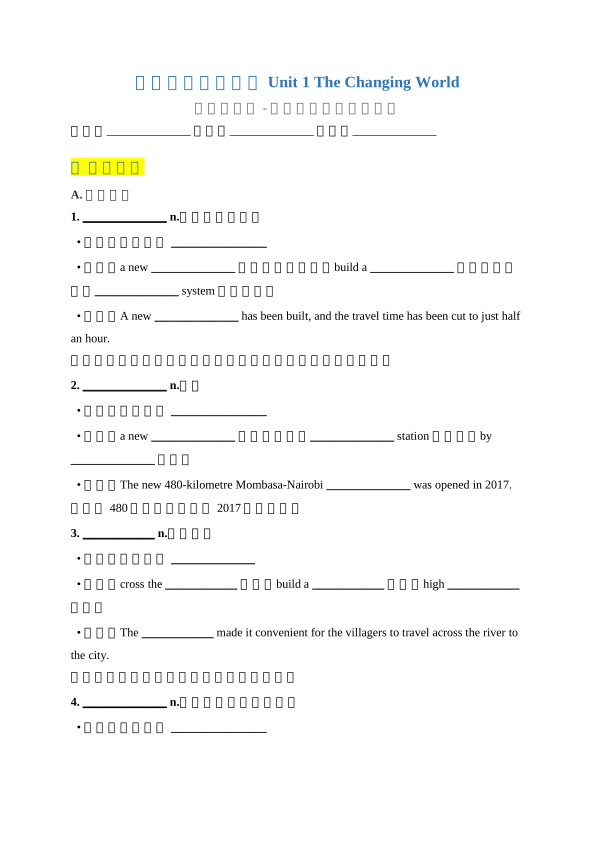
人教版新版九年级上册英语 Unit 1 The Changing World 暑假预习知识练习单(解析版+原卷版)
人教新目标 (Go for it) 版Unit 3 Could you please tell me where the restrooms are?综合与测试巩固练习
初中英语Unit 3 Could you please tell me where the restrooms are?综合与测试测试题
人教新目标 (Go for it) 版九年级全册Unit 3 Could you please tell me where the restrooms are?综合与测试练习题
注册成功

在线客服
添加在线客服
获取1对1服务
官方微信
关注“教习网”公众号
打开微信就能找资料
赛课定制
添加在线客服
获取1对1定制服务
职称咨询
添加在线客服
获取1V1专业指导服务

免费福利

.png)
.png)
