免费领取教师福利
若您为此资料的原创作者,认为该资料内容侵犯了您的知识产权,请扫码添加我们的相关工作人员,我们尽可能的保护您的合法权益。

这是一份考前押题01 阅读理解6大常考话题-2026年九年级英语(人教版)上学期(期末复习专项练习)(含答案),文件包含考前押题01阅读理解6大常考话题期末复习专项训练原卷docx、考前押题01阅读理解6大常考话题期末复习专项训练解析版docx等2份试卷配套教学资源,其中试卷共76页, 欢迎下载使用。
话题1 学会学习
话题4科学技术
话题2 谈论节日(重点)
话题5 谈论规则
话题3 自我变化
话题6 习俗礼仪
话题1 学会学习
Passage 1
Here are sme tips n listening. We hpe it can help yu in ne way r ther.
·Relax yurself.
Befre yu start t listen t smething, yu need t relax. Dn’t get nervus r excited. This will help yu with yur listening.
·Listen carefully t the first sentence.
The first sentence tells a lt abut the whle passage. Fr example, if at the very beginning, yu hear “Many shps in many parts f China have decided t take away all kinds f Japanese gds ff their shelves, but sme peple say it’s nt a gd idea. Our reprter says…” yu knw yu will hear a piece f news, nta children’s stry, r a science reprt.
·Think when yu’re listening.
When yu’re listening, try t d sme thinking. Fr example, yu can think f the fllwing questins: What happened, when, where and hw? What was the result and what des the speaker want t tell us? This way, yu may understand the passage better.
·Listen fr imprtant facts.
It’s imprtant fr yu t remember sme imprtant facts. Fr example, if the passage is a science reprt, yu shuld try t remember its findings and hw the scientists gt their results.
·Dn’t think abut ne r tw wrds fr t lng.
Yu may hear sme wrds that yu dn’t knw, but dn’t spend t much time n them. Very ften, yu’ll find ut what they mean later when yu g n with the listening. But yu can remember sme wrds r sentences that yu think are imprtant, and yu can use them when yu’re answering the questins.
1.This whle passage is mainly abut ________.
A.tips n thinkingB.tips n finding the facts
C.tips n listeningD.tips n remembering wrds
2.It’s better fr yu t keep ________ when yu begin t have a listening exam.
A.excitedB.relaxedC.nervusD.wrried
3.The sentence “Many shps in many parts f China have decided t take away all kinds f Japanese gds ff their shelves…” seem t be ________.
A.the first sentence f a piece f newsB.a tip n reading
C.the end f a piece f newsD.a tip n speaking
【答案】1.C 2.B 3.A
【导语】本文主要介绍了一些如何提高听力的建议。
1.主旨大意题。根据第一段“Here are sme tips n listening. We hpe it can help yu in ne way r ther.”及全文可知,本文主要介绍了一些听力方面的建议。故选C。
2.细节理解题。根据文中“Befre yu start t listen t smething, yu need t relax.”可知,在听力考试之前要放松。故选B。
3.推理判断题。根据文中“The first sentence tells a lt abut the whle passage.”可知,文章的第一句话可以告诉我们很多信息,下面就举了这样一个例子,因此这就是一篇文章的第一句话。故选A。
Passage 2
Clara Prad has wrked as an English teacher fr 20 years. Here’s an interview with her.
Hw did yu learn English yurself?
I started learning English at abut six r seven. A new language schl pened near my hme. I started attending classes twice a week. During my teenage years, I went t Australia as an exchange student. I learned a lt frm cmmunicating with native English speakers.
What’s the best part f teaching English fr yu?
I’ve met many wnderful peple. Many teachers are creative. I’ve learned a lt frm them. And then there are the students. There is nthing better in life than t see them realize their dreams and achieve smething they’ve wrked hard fr.
What challenges d yu think learners face tday?
The biggest challenge is the unknwn. Technlgy is changing fast. We have n way f knwing what will happen in 10, 20 r 50 years. Well, yu can’t be prepared fr everything. But yu can equip (配备) yurself with the ability t keep learning thrughut yur life.
What suggestins d yu always give t yur students?
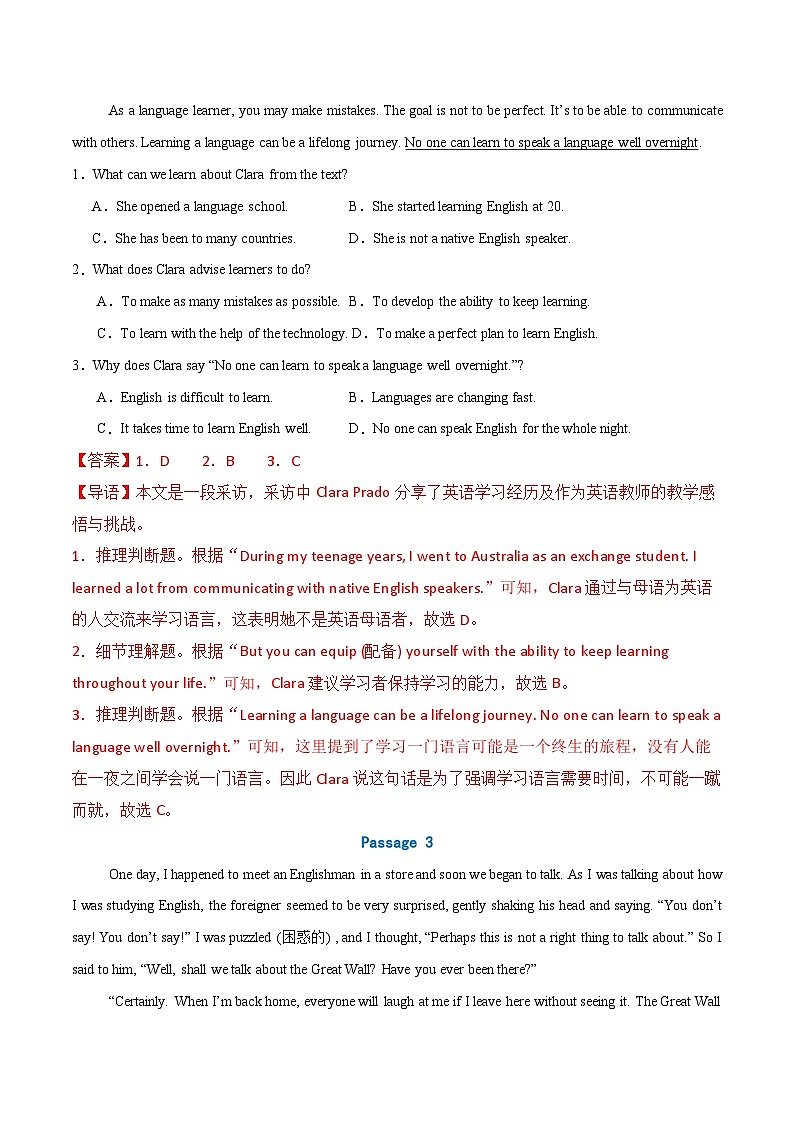
As a language learner, yu may make mistakes. The gal is nt t be perfect. It’s t be able t cmmunicate with thers. Learning a language can be a lifelng jurney. N ne can learn t speak a language well vernight.
1.What can we learn abut Clara frm the text?
A.She pened a language schl.B.She started learning English at 20.
C.She has been t many cuntries.D.She is nt a native English speaker.
2.What des Clara advise learners t d?
A.T make as many mistakes as pssible.B.T develp the ability t keep learning.
C.T learn with the help f the technlgy.D.T make a perfect plan t learn English.
3.Why des Clara say “N ne can learn t speak a language well vernight.”?
A.English is difficult t learn.B.Languages are changing fast.
C.It takes time t learn English well.D.N ne can speak English fr the whle night.
【答案】1.D 2.B 3.C
【导语】本文是一段采访,采访中Clara Prad分享了英语学习经历及作为英语教师的教学感悟与挑战。
1.推理判断题。根据“During my teenage years, I went t Australia as an exchange student. I learned a lt frm cmmunicating with native English speakers.”可知,Clara通过与母语为英语的人交流来学习语言,这表明她不是英语母语者,故选D。
2.细节理解题。根据“But yu can equip (配备) yurself with the ability t keep learning thrughut yur life.”可知,Clara建议学习者保持学习的能力,故选B。
3.推理判断题。根据“Learning a language can be a lifelng jurney. N ne can learn t speak a language well vernight.”可知,这里提到了学习一门语言可能是一个终生的旅程,没有人能在一夜之间学会说一门语言。因此Clara说这句话是为了强调学习语言需要时间,不可能一蹴而就,故选C。
Passage 3
One day, I happened t meet an Englishman in a stre and sn we began t talk. As I was talking abut hw I was studying English, the freigner seemed t be very surprised, gently shaking his head and saying. “Yu dn’t say! Yu dn’t say!” I was puzzled (困惑的) , and I thught, “Perhaps this is nt a right thing t talk abut.” S I said t him, “Well, shall we talk abut the Great Wall? Have yu ever been there?”
“Certainly. When I’m back hme, everyne will laugh at me if I leave here withut seeing it. The Great Wall is wnderful!” he answered.
“Yes, it is ne f the wnders in the wrld. And peple frm all ver the wrld have cme t visit it,” I added. As I was telling him mre abut it, he said again, “Yu dn’t say!”
I culdn’t help asking. “Why d yu ask me nt t talk abut it?”
“Well, I didn’t ask yu t d s,” he answered, greatly surprised.
“Didn’t yu say ‘Yu dn’t say!’ ? ” I asked again.
Hearing this, the freigner laughed ludly. He began t explain. “ ‘Yu dn’t say!’ means ‘Really?’. Perhaps yu knw little abut English idims (习惯用语).”
Ww! Hw flish I was! Since then I have been careful with English idims.
1.Why was the writer puzzled?
A.Because the Englishman knew the Great Wall s well.
B.Because the Englishman had sme truble understanding him.
C.Because he thught the Englishman was nt very plite.
D.Because he thught the Englishman asked him t stp talking.
2.What did the Englishman d after hearing the writer’s questin?
A.He laughed at the writer.
B.He gt mad and shuted at the writer.
C.He walked away withut saying a wrd.
D.He laughed and explained the meaning f the idim t the writer.
3.When the Englishman used the idim “Yu dn’t say!” he meant “________”.
A.Be careful!B.Stp talking!C.Really? D.It’s hard t say!
4.In which part f a magazine can we read the text?
A.Culture.B.TravelC.Science.D.Sprts.
【答案】1.D 2.D 3.C 4.A
【导语】本文是一篇记叙文,讲述了作者在与一位英国人交谈时,因对英语习语理解有误而产生困惑的故事。
16.细节理解题。根据“I was puzzled (困惑的), and I thught, ‘Perhaps this is nt a right thing t talk abut.’ S I said t him, ‘Well, shall we talk abut the Great Wall? Have yu ever been there?’”可知,作者困惑是因为他以为英国人让他停止谈论正在说的话题,故选D。
17.细节理解题。根据“Hearing this, the freigner laughed ludly. He began t explain. ‘Yu dn’t say!’ means ‘Really?’”可知,英国人听到作者的问题后,大笑并向作者解释了习语的意思,故选D。
18.细节理解题。根据“He began t explain. ‘Yu dn’t say!’ means ‘Really?’.”可知,当英国人使用习语“Yu dn’t say!”时,他的意思是“真的吗?”,故选C。
19.推理判断题。文章主要讲述了因英语习语产生的误解,这与文化有关,所以可能在杂志的文化板块读到这篇文章,故选A。
Passage 4
Reading fr pleasure is the easiest way fr us t becme a better reader in English. It is als the mst imprtant way.
Sme students say they dn’t want t read fr pleasure. They say they want t use their time t learn the rules f the language and new wrds. They say that pleasure reading is t easy.
Many experts say pleasure reading is very imprtant fr learning English. Dr. Stephen Krashen, a famus expert n learning languages, says that pleasure reading helps yu learn many imprtant things abut English. Students learn mre grammar and mre wrds when they read fr pleasure. They als learn mre abut gd writing.
Dr. Krashen tells us that pleasure reading helps each student in a different way. Each student needs t learn smething different. Pleasure reading makes it pssible fr each student t learn what he r she needs.
11.________ can make yu becme a better reader in English.
A.Leaning English grammarB.Learning the rules f the language
C.Reading fr pleasureD.Learning the new wrds
2.Sme students say they want t use their time t learn ________.
A.t read fr pleasureB.the rules f the language
C.the new wrdsD.the grammar and new wrds
3.What des pleasure reading make pssible fr students?
A.T get gd grades.B.T learn mre grammar and mre wrds.
C.T learn what they need.D.T learn mre abut gd writing.
4.The passage tells us ________.
A.hw t learn EnglishB.hw imprtant reading fr pleasure is
C.hw imprtant learning English isD.why we shuld learn English
【答案】1.C 2.D 3.C 4.B
【导语】本文是一篇说明文,主要介绍了快乐阅读对学习英语的重要性。
1.细节理解题。根据“Reading fr pleasure is the easiest way fr us t becme a better reader in English.”可知,快乐阅读能使你成为一个更好的英语读者,故选C。
2.细节理解题。根据“They say they want t use their time t learn the rules f the language and new wrds.”可知,一些学生说他们想利用时间学习语言规则和新单词,故选D。
3.细节理解题。根据“Pleasure reading makes it pssible fr each student t learn what he r she needs.”可知,快乐阅读使学生有可能学习他们所需要的东西,故选C。
4.主旨大意题。通读全文,本文主要讲述了快乐阅读对学习英语的重要性,故选B。
Passage 5
Lifelng learners never think f themselves as the greatest experts in anything. They cntinue t learn and bring a great deal t the grups they belng t. Lifelng learners have sme main characteristics (特征).
They are knwledge seekers. They are always searching fr much infrmatin n a tpic they’re interested in and lking fr new experience r chances t imprve their knwledge r skills.
They are scial and self-directed learners. They like taking different curses and taking part in discussins abut subjects they are interested in. ________ They als knw their wn learning styles. They can plan and rganize their wn learning.
They are critical (批判性的) thinkers. They always use a lt f ways t analyze (分析) infrmatin. Frm their research they can make sure if the infrmatin is useful fr the questin.
They are prblem slvers. They will meet different prblems while learning. Hwever, they usually see prblems as challenges (挑战) and life experiences and try t stand abve them.
1.What des the underlined “knwledge seekers” mean?
A.Persns wh are testing knwledge.B.Persns wh are teaching knwledge.
C.Persns wh are lking fr knwledge.D.Persns wh likes inventing knwledge.
2.What can be put in the blank “______”?
A.They dn’t like learning in sciety.B.They learn frm and with thers.
C.They learn frm plants and animals.D.They invite each ther t parties.
3.Which f the fllwing mst clearly shws yu are a critical thinker?
A.Yu believe the infrmatin yu get in yur study.
B.Yu accept the mistakes as sn as yu find them.
C.Yu always use a lt f ways t analyze infrmatin.
D.Yu always ask fr help when yu can’t crrect the mistakes.
4.Hw is the passage rganized? (①=Paragraph1)
A.B.C.D.
5.What culd be the best title fr the passage?
A.Why D Yu Want T Learn?B.What D Yu Want T Learn?
C.Hw T Be A Lifelng Learner?D.What D Lifelng Learners Lk Like?
【答案】1.C 2.B 3.C 4.A 5.D
【导语】本文介绍了终身学习者的特点和他们的行为方式,包括他们如何寻求知识、如何学习、如何思考和解决问题。
1.词义猜测题。根据“They are always searching fr much infrmatin n a tpic they’re interested in and lking fr new experience r chances t imprve their knwledge r skills.”可知他们总是在搜索他们感兴趣的主题的大量信息,并寻找新的经验或机会来提高他们的知识或技能,“knwledge seekers”指的是那些正在寻找知识的人。故选C。
2.推理判断题。根据“They like taking different curses and taking part in discussins abut subjects they are interested in.”以及“They als knw their wn learning styles. They can plan and rganize their wn learning.”可以推断出,终身学习者不仅喜欢独立学习,也喜欢与他人一起学习。故选B。
3.细节理解题。根据“They always use a lt f ways t analyze infrmatin.”可知,批判性思考者会使用多种方法来分析信息。故选C。
4.篇章结构题。第一段提出主题;第二、三、四、五段分别介绍了终身学习者的特点和他们的行为方式。由此可知,文章为“总分”结构。故选A。
5.最佳标题题。本文介绍了终身学习者的特点和他们的行为方式,D项最准确地概括了文章的主要内容。故选D。
话题2 谈论节日
Passage 1
Dragns are nt real animals, but they lk like a mix f many animals such as snakes, fish and tigers in Chinese culture. They have tw hrns and a lng bdy. With magic pwers, they can fly in the sky r swim in the sea. They can make rain, t.
The Chinese Dragn is a symbl f energy and gd luck. The kings f ancient China lved dragns. Their clthes are ften cvered with pictures f dragns. Tday we are p... t call urselves the “descendants (后代) f the dragn”. D yu hear the Chinese saying “Hpe ne’s child will becme a dragn”? In Chinese, excellent peple are ften called “dragns”. There are sme famus “dragns” wh have dne excellent things and are very successful. Besides, it is said that peple brn in the Year f Dragn have certain characters. They are creative, active, brave but they becme angry easily.
There are als sme traditinal festivals abut dragns in China, such as the Dragn Head-Raising Day and the Dragn Bat Festival, which are celebrated in different ways. These tw festivals cme every year, while the Year f Dragn cmes every twelve years. The dragn is ne f the mst imprtant parts in Chinese culture. Smene wh is interested in Chinese culture may study it and it’ll be helpful fr a better understanding f Chinese culture. As the “descendants f the dragn”, it’s ur duty t wrk tgether t pass ur traditinal culture n t mre and mre peple.
1.What’s the prper wrd in the sentence “Tday we are p... t cal urselves the descendants f the dragn”.
A.privateB.pliteC.primaryD.prud
2.What des the saying “Hpe ne’s child will becme a dragn” mean?
A.Smene hpes the child will becme a real dragn.
B.Smene hpes the child will be successful.
C.Smene hpes the child will becme a king r queen.
D.Smene hpes the child will have magical pwers.
3.Which f the fllwing is TRUE accrding t the text?
A.Dragns are real animals.
B.The dragn is nt imprtant in Chinese culture.
C.Studying dragns can help understand Chinese culture better.
D.Only peple brn in the Year f the Dragn have characters.
【答案】1.D 2.B 3.C
【导语】本文主要介绍了龙在中国文化中的意义以及中国与龙有关的节日。
1.词句猜测题。根据“Tday we call urselves the ‘descendants (后代) f the dragn’?”及结合选项可知,此处应该是表示如今,我们很自豪称自己为“龙的后代”。prud“自豪的”,符合语境。故选D。
2.词句猜测题。根据“In Chinese, excellent peple are ften called ‘dragns’. There are sme famus ‘dragns’ wh have dne excellent things and are very successful.”可知,在中国人,优秀的人通常被叫做“龙”,有一些著名的‘龙’做了很出色的事情,非常成功。所以,该句的意思应该是希望自己的孩子能成才,成功。故选B。
3.细节理解题。根据“Smene wh is interested in Chinese culture may study it and it’ll be helpful fr a better understanding f Chinese culture.”可知,对中国文化感兴趣的人可以研究一下龙,这将有助于更好地了解中国文化。故选C。
Passage 2
The Chngyang Festival falls n the ninth day f the ninth lunar mnth and is als called the Duble Ninth Festival. In China, nine has the similar prnunciatin with the wrd “frever”, meaning lng life. S the Chinese gvernment set the day as the Senirs’ Day in 1989.
The festival has a histry f ver 2,000 years. During the Warring States Perid (战国时期), there was the Chngyang Festival. The name f the Chngyang Festival first appeared in the Three Kingdms Perid.During the Jin Dynasty, there were custms f enjying chrysanthemums and drinking chrysanthemum wine n the day. It was nt fficially (正式地) set as a festival until the Tang Dynasty. Since then, all the peple have spent the festival with kinds f activities.
As September has the clear sky and fresh air, it is a very gd time t climb the muntain. Since the Western Han Dynasty, it has been the custm f climbing n the Chngyang Festival. On the day, enjying chrysanthemums is very ppular as the flwer means lng life. Drinking chrysanthemum wine is regarded as a way t prevent bad things and stay warm. Inserting (插) Zhuyu and sticking chrysanthemums are als traditins t avid bad things.
1.What des the writer mainly talk abut in Paragraph 2?
A.The histry f the Chngyang Festival.
B.The different names f the Chngyang Festival.
C.The fd peple eat during the Chngyang Festival.
D.The imprtance f the Chngyang Festival in different dynasties.
2.When did peple start the custm f climbing n the Chngyang Festival?
A.During the Warring States Perid.B.During the Western Han Dynasty.
C.During the Tang Dynasty.D.During the Ming Dynasty.
3.Why d peple drink chrysanthemum wine n the Chngyang Festival?
A.T celebrate the reunin.B.T welcme the New Year.
C.T remember their ld days.D.T prevent bad things and stay warm.
4.Which questin can help readers knw the main idea f the text?
A.Hw d peple in ther cuntries celebrate similar festivals?
B.What are the traditins and custms f the Chngyang Festival?
C.Why is the Chngyang Festival called the Duble Ninth Festival?
D.When did the Chinese gvernment set the day as the Senirs’ Day?
【答案】1.A 2.B 3.D 4.B
【导语】本文是一篇说明文,介绍了中国传统节日重阳节的历史、名称由来、以及与之相关的传统习俗和活动,强调了重阳节在中国文化中的重要性和意义。
1.细节理解题。根据第二段中提到的“During the Warring States Perid (战国时期), there was the Chngyang Festival. The name f the Chngyang Festival first appeared in the Three Kingdms Perid. During the Jin Dynasty, there were custms f enjying chrysanthemums and drinking chrysanthemum wine n the day. It was nt fficially (正式地) set as a festival until the Tang Dynasty.”可知,作者主要讨论了重阳节的历史。故选A。
2.细节理解题。根据最后一段中的“Since the Western Han Dynasty, it has been the custm f climbing n the Chngyang Festival.”可知,人们在重阳节开始爬山的习俗始于西汉时期。故选B。
3.细节理解题。根据最后一段中的“Drinking chrysanthemum wine is regarded as a way t prevent bad things and stay warm.”可知,人们在重阳节喝菊花酒是为了预防不好的事情并保持温暖。故选D。
4.主旨大意题。根据全文内容,特别是最后一段中提到的各种传统习俗和活动,可以知道本文的主要目的是介绍重阳节的传统和习俗。故选B。
Passage 3
Yunnan is a beautiful place where many ethnic minrities (少数民族) live in. S there are many interesting festivals.
1.Which shuld Jack attend if he wants t watch exciting cmpetitins?
A.The Trch Festival.B.The March Fair Festival.
C.The Drying Clthes Festival.D.The Sisters’ Meals Festival.
2.Which ethnic minrity celebrates the Drying Clthes Festival?
A.The Yi peple.B.The Bai peple.C.The Ya peple.D.The Mia peple.
3.What d the March Fair Festival and the Sisters’ Meals Festival have in cmmn?
A.They are nly fr teenagers.B.They take place in spring.
C.They help t develp trading.D.They’re celebrated t drive away bad luck.
4.In which part f a magazine can we find the text?
A.Art.B.Histry.C.Culture.D.Stry.
【答案】1.A 2.C 3.B 4.C
【导语】本文主要介绍了云南省的几个少数民族的节日的情况。
1.推理判断题。根据“The Trch Festival”中“Other activities include hrse races and bullfights (斗牛).”可知,火把节会有赛马和斗牛活动;如果杰克想看激动人心的比赛,他应该参加火把节。故选A。
2.细节理解题。根据“The Drying Clthes Festival”中“It is ne f the mst imprtant festivals fr the Ya peple.”可知,瑶族人民会过晒衣节。故选C。
3.细节理解题。根据“It is an imprtant festival fr the Bai peple t trade gds (货物) in March.”可知,三月集市节在三月举行;根据“It’s a celebratin f lve and spring fr the Mia peple.”可知,苗族姊妹节在春季举行。由此可知两个节日都在春季举行。故选B。
4.推理判断题。通读全文可知,本文主要介绍了云南省的几个少数民族的节日的情况,本文可能出现在杂志的文化版面。故选C。
Passage 4
1.Where will yu prbably g t enjy ne f the festivals abve in August?
A.Spain.B.England.C.America.D.Thailand.
2.Which festival is held n a hill?
A.Thrwing tmates.B.Rlling cheese.
C.Puring water.D.Burning man.
3.Which f the fllwing is TRUE accrding t the passage?
A.The tmates are thrwn int the crwd t eat.
B.Nt all the festivals abve fall n the single day.
C.Burning a large real man is the best part f the festival.
D.Sngkran is the nly reasn fr attracting lts f turists.
4.What is the passage mst prbably taken frm?
A.A tur guide.B.A science reprt.C.A stry bk.D.A fashin magazine.
【答案】1.A 2.B 3.B 4.A
【导语】本文介绍了世界上一些有趣的节日——西班牙的西红柿节、英国的滚奶酪节、美国的火人节和泰国的宋干节。
1.细节理解题。根据“Thrwing tmates—Spain (西班牙) festival takes place in the last Wednesday in August.”可知,人们可以在8月去西班牙过西红柿节。故选A。
2.细节理解题。根据“Rlling cheese— takes place n Cper’s Hill.”可知,英国的滚奶酪节在库珀山上举办。故选B。
3.细节理解题。根据“Puring water—Thailand The Sngkran Festival is the celebratin f the New Year in Thailand. Thailand celebrates the New Year frm April 13th t 15th.”以及“Burning man—America The Burning Man Festival lasts a week in September.”可知,文中提到的节日并不是都在一天之内举办,泰国的宋干节会持续三天,美国的火人节会持续一周。故选B。
4.推理判断题。根据“Interesting festivals in the wrld”,“Sngkran is ne f the mst imprtant reasns why freigners travel t the beautiful land.”并通读全文可知,本文介绍了世界上一些有趣的节日,而这些节日也是吸引游客的理由,由此推知,这篇文章来自一本旅游指南。故选A。
Passage 5
As the secnd mst imprtant festival in China, the Mid-Autumn Festival is celebrated in many traditinal ways. Here are sme f the mst ppular traditinal celebratins.Enjying a gd dinner with family.
Chinese peple think the rund shape f the mn stands fr the reunin f the family. The mst cmmn way t celebrate is t have dinner with the family n the evening f the Mid-Autumn Festival. The public hliday (usually 3 days) is mainly fr Chinese peple t have enugh time t return hme. Thse peple staying t far away frm their parents’ hmes usually get tgether with their relatives r friends.Eating mncakes.
Mncakes are the must-eat fd at the Mid-Autumn Festival. Mst mncakes are sweet. There are sme mncakes that have special flavrs, fr example, the salty mncakes with meat. Peple eat mncakes r give mncakes t their relatives r friends as presents t express their lve and best wishes.Admiring the mn.
It’s said that the mn n the night f the Mid-Autumn Festival is the brightest and the mst beautiful. Chinese peple usually set a table utside their huses and sit tgether t admire the full mn. Parents with little kids ften tell the stry f Chang’e Flying t the Mn. As a game, kids try their best t find the shape f Chang’e n the mn.Making and enjying lanterns.
Lanterns are an imprtant part f the Mid-Autumn Festival. Peple can make lanterns and hang them in trees and huses. They can als visit public lantern displays. Chinese peple have cnnected lanterns with the festival since the Tang Dynasty. That’s prbably because lanterns stand fr gd luck, light and reunin.
1.What’s Paragraph 2 mainly abut?
A.The imprtance f family.B.The traditin f reunin.
C.The fd shared with friends.D.The time fr the public hliday.
2.What des the underlined wrd “flavrs” mean in English?
A.Materials.B.Tastes.C.Clrs.D.Shapes.
3.Which celebratin is NOT mentined in the text?
A.B.C.D.
4.What is the main purpse (目的) f the text?
A.T intrduce fur traditinal Chinese festivals.
B.T explain the ppularity f the Mid-Autumn Festival.
C.T list fur celebratins f the Mid-Autumn Festival.
D.T ask peple t value the time f staying with family.
5.What’s the best title fr the text?
A.Hw t Celebrate the Mid-Autumn Festival
B.When t Celebrate the Mid-Autumn Festival
C.Stries abut the Mid-Autumn Festival
D.Family Reunin n the Mid-Autumn Festival
【答案】1.B 2.B 3.D 4.C 5.A
【导语】本文主要介绍了中秋节的一些最受欢迎的传统庆祝活动。
1.段落大意题。根据第二段中的“Chinese peple think the rund shape f the mn stands fr the reunin f the family.”并通读本段可知,本段主要介绍了团圆的传统。故选B。
2.词句猜测题。根据“the salty mncakes with meat”可知,此处指月饼的口味,所以划线部分的含义是“口味”,B项符合。故选B。
3.细节理解题。根据“Eating mncakes.”可知,A项提及;根据“Admiring the mn.”可知,C项提及;根据“Making and enjying lanterns.”可知,B项提及。故选D。
4.主旨大意题。根据第一段中的“Here are sme f the mst ppular traditinal celebratins.”并通读全文可知,文章列出中秋节的四个庆祝活动。故选C。
35.最佳标题题。根据第一段中的“Here are sme f the mst ppular traditinal celebratins.”并通读全文可知,本文主要介绍了中秋节的一些最受欢迎的传统庆祝活动,所以A项符合。故选A。
话题3 自我变化
Passage 1
Harry and Annie lived a mile frm twn, but they walked there t schl every day. It was a happy walk arund the pnd (水塘) n their way t schl. In winter, when the ice was thick enugh, they ften went acrss the pnd. But their mther did nt like them t d this. She said, “If there’s n ne with yu, yu mustn’t walk acrss the pnd.”
“Dn’t g acrss the pnd tday, children,” she said, as she kissed them gdbye ne mrning. “It is beginning t thaw (融化).”
“All right, mther,” said Harry, nt very happy, fr he liked running and sliding (滑行) n the ice very much.
When they came t the pnd, the ice lked hard and safe.
“There,” Harry said t his sister, “let’s slide ver it.”
“But yu prmised mther,” said Annie.
“N, I didn’t, I nly said ‘All right’, and it is all right.”
“I didn’t say anything, s I can d what I like,” said Annie.
S they gt n the ice and started t g acrss the pnd.
They had nt gne far befre the ice gt brken, and suddenly they fell int the water. Luckily, a man wh was at wrk near the pnd heard the children’s cries. He rushed int the water and saved them successfully.
They went hme almst frzen and learned a lessn they wuld remember fr a lifetime.
1.What did Harry and Annie ften d n the pnd in winter?
A.They played with ice n it.B.They swam acrss it.
C.They walked acrss it.D.They danced n it.
2.What can we knw abut the ice in the pnd that day?
A.It had all melted already.B.It was all very hard and safe.
C.It was thick enugh t drive n.D.It was dangerus t walk n.
3.What happened t Harry and Annie in the end?
A.They asked their mther fr help.B.They were saved by a man.
C.They were frzen in the pnd.D.They had a lessn at schl.
【答案】1.C 2.D 3.B
【导语】本文是一篇记叙文。主要讲述了两个孩子上学路上没有听从妈妈的叮嘱,而继续在结冰的池塘上滑行,结果发生意外的故事,幸亏获救,同时也一直铭记了这次教训。
1.细节理解题。根据“In winter, when the ice was thick enugh, they ften went acrss the pnd.”可知,冬天当冰足够厚时,他们经常穿过池塘。因此,Harry和Annie在冬天经常在池塘上行走。故选C。
2.细节理解题。根据“It is beginning t thaw (融化).”及“They had nt gne far befre the ice gt brken, and suddenly they fell int the water.”可知,他们还没走多远,冰就破了,他们突然掉进了水里。这说明那天池塘上的冰很危险,不能行走,因此选项D“走在上面很危险”是正确的。故选D。
3.细节理解题。根据“Luckily, a man wh was at wrk near the pnd heard the children’s cries. He rushed int the water and saved them successfully.”及“They went hme almst frzen and learned a lessn they wuld remember fr a lifetime.”可知,Harry和Annie最终被一位在附近工作的男人救了,并且他们几乎冻僵了,得到了一个终生难忘的教训。因此,B选项“他们被一个男人救了”是正确答案。故选B。
Passage 2
Life is full f surprises as lng as yu try yur best in the face f challenges. I still remember my music teacher Ms. Smith, and her wrds “Be a true winner in yur wn heart” encurage me t imprve myself in many ways.
I used t be a shy by and I was anxius abut taking part in schl activities. Once, t make the perfrmance clrful, I was tld t shw Chinese kung fu. Thugh I have learned it since fur years ag, I was still wrried abut it. After all, it was the first time fr me t stand n stage (舞台) in frnt f s many teachers and students.
At that mment, I wrried that thers wuld laugh at me if I culdn’t d it perfectly. As sn as I stepped n the stage, I fund Ms. Smith in the crwds, smiling and ndding t me. I became brave and careful. Befre the perfrmance, I tk a deep breath t relax myself. When the music was played, I imagined I was the best. Then I mved every step smthly. Hearing the cheers and applause (掌声) frm the teachers and students, I knew I made it.
When I finished my shw, I ran twards Ms. Smith and gave her a big hug. It was Ms. Smith that made me realize hw strng I culd be. The valuable experience did give me a great lessn. It encuraged me t keep challenging myself t be a better man.
1.What did Ms. Smith teach?
A.Art.B.Music.C.Chinese.D.Histry.
2.Hw lng has the writer learned Chinese kung fu?
A.Fr six years.B.Fr fur years.C.Fr tw years.D.Fr eight years.
3.What des the underlined wrd “anxius” mst prbably mean?
A.Tired.B.Angry.C.Nervus.D.Interested.
【答案】1.B 2.B 3.C
【导语】本文主要讲述了一个害羞的男孩,在音乐老师史密斯女士的鼓励下,克服内心紧张,勇敢地在全校师生面前表演中国功夫并获得成功的经历。
1.细节理解题。根据“my music teacher Ms. Smith”可知,史密斯老师是教音乐的。故选B。
2.细节理解题。根据“I have learned it since fur years ag”可知,作者学习中国功夫有四年了。故选B。
3.词句猜测题。根据“I used t be a shy by and I was anxius abut taking part in schl activities.”可知,作者曾经是一个害羞的男孩,因此推测他参加校园活动会感到紧张,Nervus“紧张的”符合词义。故选C。
Passage 3
As a child, yu must ften hear this questin: What d yu want t be when yu grw up?
When I was yur age, I was ften asked this questin. Unlike my classmates, I wuld stay silent instead f answering with a smile. My teachers were wrried. “Dn’t yu have a dream jb?” they wuld ask. “Yu shuld really think abut it.” But in fact, I had lts f dream jbs. I just didn’t knw hw t rganize my thughts t answer that questin.
I always dreamed f becming a radi bradcaster (播音员) because I thught I had a sweet vice. I imagined hw prud I wuld be when I bradcast news at the radi statin. As I grew lder, I learned mre abut myself and different jbs. My dream f becming an English teacher appeared. It led me t study English in cllege. I practiced grading papers (判卷). I created a test fr myself, tk it and graded it. During my secnd year, I realized I wasn’t gd at public speaking. But a teacher has t talk t a lt f peple, s I gave up that dream.
As yu knw, nw I’m wrking as an editr (编辑) fr a newspaper. My wrk and teachers’ wrk have smething in cmmn.
If yu als have a millin dreams and aren’t sure f yur future, dn’t wrry. As yu grw up, yu’ll learn mre abut yurself and the wrld. Just keep yur dreams alive and mve frward with cnfidence.
1.Why didn’t the writer answer the questin at the beginning?
A.He was t shy.B.He didn’t have great dreams.
C.He didn’t knw hw t express it.D.He was afraid f making mistakes.
2.Hw many jbs appear in the text?
A.2.B.3.C.4.D.5.
3.What made the writer chse English in cllege?
A.His sweet vice.B.His lve fr grading papers.
C.His ability f public speaking.D.His dream f becming an English teacher.
4.What is the writer’s purpse?
A.T shw us his excellent jbs.B.T tell us t wrk hard fr dreams.
C.T wish us t keep trubles away.D.T encurage us t keep ur dreams alive.
【答案】1.C 2.B 3.D 4.D
【导语】本文讲述了作者在成长过程中对梦想认识的变化,并通过自身经历鼓励读者保持梦想并不断前行。
1.细节理解题。根据“I just didn’t knw hw t rganize my thughts t answer that questin.”可知,作者没有回答是因为他不知道如何表达自己的想法,故选C。
2.细节理解题。根据文中提到的三个职业“radi bradcaster”, “English teacher”和“editr”可知,文中出现了三个职业,故选B。
3.细节理解题。根据“My dream f becming an English teacher appeared. It led me t study English in cllege.”可知,作者因为梦想成为一名英语老师而选择了在大学学习英语,故选D。
4.主旨大意题。根据“As yu grw up, yu’ll learn mre abut yurself and the wrld. Just keep yur dreams alive and mve frward with cnfidence.”可知,文章的目的是鼓励我们要坚持梦想,故选D。
Passage 4
I am a student frm N. 2 Middle Schl. This summer, I went n a study trip t Singapre. I learned a lt frm it.
During the trip, I visited many places. The ne I liked best was the natinal university f Singapre. It was very beautiful. It has a large green grassland and a great artistic vibe (艺术氛围). Mst imprtantly, I imprved myself there.
A main task fr ur study trip was t talk t lcal peple and write a shrt stry abut it. I still remember the first time ur teacher tk us t interview smene n the streets. At that time, I didn’t knw wh t interview r hw t interview. When I find smene happy t accept my interview. I still felt scared and didn’t knw hw t begin. The interviewee smetimes made me feel nervus. But after several tries, I gt better at it. Finally, I asked my questins in English after sme careful thinking. And my written stry turned ut t be a gd ne. I think this was the biggest imprvement I made n this trip.
I still miss my trip t Singapre very much. The small experiences I had there build up my curage and cnfidence. This was the mst imprtant part fr me.
1.Why did the writer g t Singapre?
A.Had a study trip.B.Went t cllege.
C.Visited a university.D.Imprved her art.
2.What was their main task?
A.Telling stries t the lcals.B.Listening t the lcals tell stries.
C.Traveling and relaxing.D.Talking t the lcals and write a stry.
3.Which has the same meaning as “But after several tries, I gt better at it.”?
A.Try yur best and yu will succeed.
B.A gd bk is a gd university.
C.Actins speak luder than wrds.
D.Cnfidence is the first step t success.
4.What des the passage mainly talk abut?
A.A student learned knwledge n a study trip.
B.A student built cnfidence n a study trip.
C.Hw t write the stry abut lcal peple.
D.The natinal university f Singapre is best.
【答案】1.A 2.D 3.A 4.B
【导语】本文介绍了作者暑假赴新加坡研学的经历,作者收获颇丰,尤其是勇气和自信得到提升。
1.细节理解题。根据“This summer, I went n a study trip t Singapre.”可知,作者是去参加学习之旅的。故选A。
2.细节理解题。根据“A main task fr ur study trip was t talk t lcal peple and write a shrt stry abut it.”可知,主要任务是与当地人交流并写一个故事。故选D。
3.推理判断题。根据“But after several tries, I gt better at it.”可知,此处是说“作者通过多次尝试,做得更好了”,选项A“尽你最大的努力,你就会成功。”与之意思相同。故选A。
4.主旨大意题。根据“The small experiences I had there build up my curage and cnfidence. This was the mst imprtant part fr me.”可知,本文主要讲述一个学生在学习之旅中建立了自信。故选B。
Passage 5
Tm was a lazy by. He hated ging t schl, studying and ding hmewrk. One day, when Gluebeard, the famus captain (船长), came t twn in search f yung sailrs (水手). Tm made sure he was the first in line.
On Gluebeard’s ship, every minute f every day was spent lking fr treasure and if anyne was fund reading r studying, they wuld be lcked in a small rm full f mice. And s Tm began his life as a treasure-hunting sailr, but it wasn’t easy. They hardly had enugh mney t buy fd and clthes.
One day, smene n the ship stle the nly fd Tm had left. Tw days later, Tm was s hungry that he secretly went t the rm full f mice t find ne and eat it. But when he entered, he culdn’t find a single muse. He did find a secret rm, ne that was full ! Suddenly he heard sme vices and he hid away t listen...
Tm was very angry. He heard Glueheard laugh at hw stupid the sailrs were, hw easy it was t cheat them, and hw stupid and pr they wuld always be after leaving their studies behind.
Frm that day n, Tm waited every night until everyne was asleep. Then he visited the rm full f hks where he spent his time studying all kinds f bks. Sn he fund that learning abut s many things gave him better ideas.
After a few years, he left Gluebeard ‘s ship, used the mney he made t buy his wn bat and fund his wn sailrs. Unlike Gluebeard, hwever, he nly chse peple wh studied. And instead f cheating them, he encuraged them t search fr treasure with him. With s many clever peples, ________.
1.Tm was able t becme a sailr n Glueb eard’s ship mainly because ________.
A.he was lazyB.he was yung
C.he didn’t like studyingD.he was the best
2.What did Tm first walk int the small rm fr?
A.T hide away.B.T read a bk.
C.T catch a muse.D.T find the secret rm.
3.Why didn’t Gluebeard allw his sailrs t read r study?
A.Because he thught it was n use reading bks.
B.Because there weren’t enugh bks n the ship.
C.Because he culd cheat his sailrs easily in this way.
D.Because he wanted his sailrs t spend all their time wrking.
4.Which f the fllwing can be put int ________.
A.they did nt need a captain
B.the sailrs were nt easy t be led
C.they fund new treasure much faster
D.they decided t start ther businesses
5.What des the stry mainly tell us?
A.Better late than never.B.Knwledge is pwer.
C.Travel pens the mind.D.Every cin has tw sides.
【答案】1.C 2.C 3.C 4.C 5.B
【导语】本文是一篇记叙文。主要讲述了一个懒惰的男孩Tm在成为船员后,通过秘密学习书本知识,最终变得聪明并成功成为一名船长的故事。
1.推理判断题。根据“Tm was a lazy by. He hated ging t schl, studying and ding hmewrk.”以及“He heard Glueheard laugh at hw stupid the sailrs were, hw easy it was t cheat them, and hw stupid and pr they wuld always be after leaving their studies behind.”可知,Tm之所以能成为Gluebeard船上的水手,主要是因为他不喜欢学习。故选C。
2.细节理解题。根据“Tw days later, Tm was s hungry that he secretly went t the rm full f mice t find ne and eat it.”可知,Tm第一次走进小房间是为了抓老鼠吃。故选C。
3.推理判断题。根据“He heard Glueheard laugh at hw stupid the sailrs were, hw easy it was t cheat them, and hw stupid and pr they wuld always be after leaving their studies behind.”可知,Gluebeard不允许船员读书或学习是因为这样他可以更容易地欺骗他们。故选C。
4.推理判断题。根据文“And instead f fling them, he encuraged them t search fr treasure with him. With s many clever peple”可知,Tm鼓励曾经学习过的船员们一起寻找宝藏,这样一来,聪明的船员们能更快地找到新的宝藏。C项“他们发现新宝藏的速度要快得多”符合语境故选C。
5.主旨大意题。故事主要讲述了Tm从不喜欢学习到通过学习变得聪明并最终成功的故事,说明了知识就是力量。故选B。
话题4 科学技术
Passage 1
Kindle, Nk r iPad? Hw shuld we chse the right e-bk reader?
1.Which can we use t read bks and watch vides?
A.Kindle and iPad.B.NkClr and iPad.C.Nk and Kindle.D.Nk and iPad.
2.If yu and yur brther want t buy a Nk and a Kindle, hw much shuld yu pay?
A.$287.B.$388.C.$397.D.$647.
3.What can we learn frm the passage?
A.We can’t read any magazines n Kindle.B.Apple iPad has the largest screen f all.
C.Nk can be used as a tablet cmputer.D.Full-clr tuch LCD screen is better fr eyes.
4.What is the writer trying t d in the text?
A.Intrduce hw t chse a right e-bk reader.B.Advise peple t buy an e-bk reader.
C.Describe the imprtance f an e-bk reader.D.Shw hw t use the e-bk reader.
【答案】1.B 2.A 3.B 4.A
【导语】本文是一篇说明文。主要介绍四个电子读本的价格、重量、页面大小及其功能。
1.细节理解题。根据NkCl一栏“It nt nly ffers bks, magazines and newspapers, but it can als be used as a vide player.”和iPad一栏“It can wrk as a tablet cmputer as well as an e-bk reader. Many yung peple use it t watch vides.”可知,只有NkClr和iPad能同时用来读书和观看视频,其他选择不具备此功能。故选B。
2.细节理解题。根据Nk一栏“Price: abut $148”和Kindle一栏“Price: abut $139”可知,Nk的价格为$148,Kindle的价格为$139,因此两者总和为$287。故选A。
3.细节理解题。根据Kindle一栏“Page size: 6 inches (英寸) (e-ink screen)”、iPad一栏“Page size: 9.7 inches (full-clr tuch LCD screen)”、Nk一栏“Page size: 6 inches (e-ink screen)”和NkClr一栏“Page size: 7 inches (full-clr tuch LCD screen)”可知,iPad的屏幕是9.7英寸(全彩触摸屏LCD屏幕),它是所有设备中最大的。故选B。
4.推理判断题。通读整篇文章可知,是在比较不同的电子书阅读器的功能和价格,帮助读者选择合适的阅读器,所以,选项A“介绍如何选择合适的电子书阅读器。”符合题意。故选A。
Passage 2
Schls in China are studying hw they can put VR (virtual reality虚拟现实) lessns int their classrm experience. One such lessn uses VR t teach children fire safety. Instead f pens and paper, students wear VR headsets in the classrm. They are put int a virtual envirnment where a fire has brken ut. They must find their way ut and escape carefully.
At the VR medical schl under Sichuan University, a virtual system allws medical students t examine human bdy in different ways. They can even separate rgans fr clser examinatin. Students can practice their peratin skills withut a real bdy.
Simn Leung, vice-chairman f a VR cmpany, said the cmpany has develped VR classrms and cmputers that send students t a 360-degree digital wrld. Mrever, the VR headsets can tell whether children are fcused n the task at hand, Leung said.
Chinese parents, hwever, have a different pinin n VR lessns. They are suspicius f VR because they are unsure if the technlgy will have any bad effects. They are wrried abut their children’s eyesight, t.
Besides, VR equipment cmes at a price. A tp VR headset and cmputer culd cst up t 10,000 yuan (1,475 U.S. dllars). “We need t d mre t lwer the cst and imprve the user’s experience,” said Huang Rnghuai, prfessr at the Smart Learning Institute under Beijing Nrmal University. “But we are sure that we will change the mdel f educatin in the future.”
1.The VR medical schl allws students t ________.
A.learn fire safety quicklyB.play games in a virtual envirnment
C.study harder than befreD.practice skills withut a real bdy
2.The underlined wrd “suspicius” in Paragraph 4 means ________.
A.高兴的B.怀疑的C.自信的D.赞同的
3.We can learn frm the last paragraph that ________.
A.the VR equipment is expensive
B.the VR educatin system is perfect nw
C.VR has already changed the mdel f educatin
D.VR will make students study at hme in the future
4.What’s the writer’s purpse f writing the passage?
A.T tell peple hw t build VR schls.
B.T teach peple hw t use VR headsets.
C.T encurage mre and mre peple t buy VR headsets.
D.T shw the develpment f VR technlgy in educatin.
【答案】1.D 2.B 3.A 4.D
【导语】本文是一篇说明文。文章主要介绍了虚拟现实(VR)技术在教育领域的应用,包括VR课堂、VR医学院的实践,以及家长对VR课程的看法和VR设备存在的问题,展示了VR技术在教育中的发展情况。
1.细节理解题。根据第二段“At the VR medical schl under Sichuan University, a virtual system allws medical students t examine human bdy in different ways. They can even separate rgans fr clser examinatin. Students can practice their peratin skills withut a real bdy.”可知,在四川大学的虚拟现实医学院,一个虚拟系统允许医学生以不同的方式检查人体,他们甚至可以分离器官进行更仔细的检查,学生们可以在没有真实身体的情况下练习他们的操作技能。因此,VR医学院允许学生在没有真实身体的情况下练习技能。故选D。
2.词句猜测题。根据第四段“They are suspicius f VR because they are unsure if the technlgy will have any bad effects. They are wrried abut their children’s eyesight, t.”可知,中国家长对VR持怀疑态度,因为他们不确定这项技术是否会产生任何不良影响,他们也担心孩子的视力。结合选项可知,suspicius意为“怀疑的”。故选B。
3.细节理解题。根据最后一段中“Besides, VR equipment cmes at a price. A tp VR headset and cmputer culd cst up t 10,000 yuan (1,475 U.S. dllars).”可知,VR设备价格昂贵,一套顶级的VR头盔和电脑可能要花费高达10000元(1475美元)。因此,我们可以从最后一段了解到VR设备很昂贵。故选A。
4.主旨大意题。通读全文,结合第一段中“Schls in China are studying hw they can put VR (virtual reality虚拟现实) lessns int their classrm experience.”可知,文章主要介绍了中国学校正在研究如何将虚拟现实(VR)课程融入课堂体验,以及VR技术在教育领域的应用和家长对VR课程的看法,展示了VR技术在教育中的发展情况。因此,作者写这篇文章的目的是展示VR技术在教育中的发展。故选D。
Passage 3
Students attend a science lessn given by astrnauts n bard China’s Tiangng space statin n Wednesday, March 23, 2022. Zhai Zhigang, Wang Yaping and Ye Guangfu, the members f the Shenzhu XIII, which was launched (发射) n Octber 16, appear n televisin screens watched by millins f students acrss China.
During the 41-minute lessn, the astrnauts did fur experiments t shw physical phenmena(现象) nly pssible in a weightless envirnment, such as “liquid crystallizatin” and “a water bridge”. In ne experiment, Wang used a ty f Bing Dwen Dwen, the masct f the 2022 Beijing Winter Olympic Games, t shw hw bjects fly in Tiangng. They invited the yung viewers t d similar experiments t see the differences between space and land envirnments.
Befre clsing the lessn, the astrnauts answered questins frm students. The questins cvered the life and wrk in space, such as hw t take care f the skin and whether ht water was available.
Wednesday’s event marked the third time Wang had taken part in a space lessn. In June 2013, she gave the natin’s first space lessn t ver 60 millin Chinese students in Shenzhu X. It made China the secnd cuntry, fllwing the United States, t have given a lessn t schlchildren frm space.
In early December, Wang gave the cuntry’s secnd space lessn frm the Tiangng statin. The astrnauts shwed viewers hw they lived and wrked inside the space statin.
“These science lessns can encurage students t explre the wrld f science and technlgy.” Shi Yi, a physics teacher, said after tday’s activity, “Encuraged by China’s spaceflight achievements, my schl has built a space science labratry and the teachers give lessns abut space explratin.”
1.On March 23, 2022, the astrnauts finished these tasks EXCEPT ________.
A.answering the questins frm students
B.inviting the students t d experiments
C.ding an experiment abut “a water bridge”
D.shwing hw they lived inside the space statin
2.When did Wang Yaping give the secnd lecture in space?
A.In June 2013.B.In Octber 2021.C.In December 2021.D.In March 2022.
3.Which ne f the statements belw is an pinin?
A.The astrnauts did fur experiments during the lessn.
B.Over 60 millin students acrss China attended the lessn.
C.China is the secnd cuntry t have given a lessn in space.
D.The three science lessns given by astrnauts are rather meaningful.
4.What’s the best title fr the passage?
A.Astrnauts Give Lessns in Space.B.China Launched Shenzhu XIII.
C.The Explratin f Outer Space.D.The Develpment f Tiangng Space Statin.
5.What kind f writing is the passage?
A.A science nvel.B.A news reprt.C.A fairy tale.D.An interview.
【答案】1.D 2.C 3.D 4.A 5.B
【导语】本文主要介绍了中国天宫空间站宇航员给学生上的一次在线课程,宇航员进行了四项实验来给学生展示宇宙飞船中的物理现象。
1.细节理解题。根据“During the 41-minute as “liquid crystallizatin” and “a water bridge”.”,“They invited the yung viewers t d similar experiments t see the differences between space and land envirnments.”和“Befre clsing the lessn, the astrnauts answered questins frm students.”可知,在2022年3月23日,宇航员做了水桥实验,回答了学生的提问和邀请学生做实验,没做的是展示他们如何在空间站里生活。故选D。
2.推理判断题。根据“March 23, 2022”和“In early December, Wang gave the cuntry’s secnd space lessn frm the Tiangng statin.”可知,在2021年12月,王亚平在太空做了第二场讲座,故选C。
3.推理判断题。分析四个选项可知,ABC三项都在陈述客观事实,选项D“宇航员做的三个科学实验是有意义的”是观点而非事实,故选D。
4.最佳标题题。本文主要介绍了中国天宫空间站宇航员给学生上的一次在线课程,宇航员进行了四项实验来给学生展示宇宙飞船中的物理现象。故选A“宇航员在太空上课”符合主题,故选A。
5.推理判断题。本文介绍中国天宫空间站宇航员给学生上的一次在线课程,宇航员进行了四项实验来给学生展示宇宙飞船中的物理现象。推测可能在新闻报道上看到这篇文章,故选B。
Passage 4
Lk at this rbt in the picture. What d yu think it is fr?
Scientists in China have develped the special rbt t help visually impaired peple (视障人士). It has six legs and can act as a “guide dg” fr peple wh can’t see.
In China, there are ver 17 millin visually impaired peple, but there are nly abut 400 real guide dgs t help them. It is very hard and expensive t train guide dgs, s mst visually impaired peple dn’t have ne.
The new rbt can help slve the prblem. It can d many things. Fr example, it can knw what the persn is saying and act quickly; it can avid bstacles (障碍物) and find the right way t g. What’s mre, the rbt can be used as a helper in the hme and call fr help if needed.
T make the rbt wrk well, the scientists gave it many senses (感觉). It can see, hear, speak and feel. In this way, the rbt can knw what the persn wants t d and wrk tgether with him. The rbt’s six legs als make it mre stable (稳定的) than ther rbt with just fur legs.
Li Fei, a visually impaired wman, tried ut the rbt during a test. She said that when guided her, she culd walk straighter than she did n her wn. The develpers have already gt rders fr 20 f the rbts. Sn they culd help many visually impaired peple in China.
1.Hw many legs des the rbt have?
A.3.B.4.C.5.D.6.
2.Why dn’t sme visually impaired peple buy real guide dgs?
A.Because there aren’t guide dgs in China.B.Because guide dgs are t expensive.
C.Because training guide dgs is t bring.D.Because visually impaired peple dn’t wrk.
3.What can we knw abut the rbt?
A.It can ck fr visually impaired peple.B.It can’t avid bstacles in time.
C.It can’t talk with visually impaired peple.D.It can understand what the persn is saying.
4.What des the underlined wrd “develpers” mean in Paragraph 6?
A.Inventrs.B.Speakers.C.Pineers.D.Pstmen.
5.What is the best title fr the text?
A.A Club t Help Disabled PepleB.A Rbt fr Visually Impaired Peple
C.An Idea t Imprve Yur LifeD.A Prblem t Be Slved Easily
【答案】1.D 2.B 3.D 4.A 5.B
【导语】本文主要介绍了中国科学家开发了一种特殊的机器人来帮助视障人士。
1.细节理解题。根据“It has six legs”可知,机器人有六条腿,故选D。
2.细节理解题。根据“It is very hard and expensive t train guide dgs, s mst visually impaired peple dn’t have ne.”可知,训练导盲犬既困难又昂贵,所以大多数视障人士都没有导盲犬。故选B。
3.细节理解题。根据“it can knw what the persn is saying and act quickly”可知,它可以知道人在说什么,并迅速采取行动。故选D。
4.词句猜测题。根据“The develpers have already gt rders fr 20 f the rbts.”可知,……已经收到了20台这种机器人的订单,由此推知,应该是机器人开发者,故选A。
5.最佳标题题。本文主要介绍了中国科学家开发了一种特殊的机器人来帮助视障人士,选项B“为视障人士设计的机器人”符合主题,故选B。
Passage 5
Thmas Edisn lit up the wrld with his inventin f the electric light. Withut him, the wrld might still be a dark place at night. Hwever, the electric light was nt his nly inventin. He als invented the phngraph (留声机), the mtin picture camera, and ver 1, 200 ther things. Abut every tw weeks he created smething new.
Thmas Edisn was brn in Milan, Ohi, n February 11, 1847. His family mved t Prt Hurn, Michigan, when he was seven years ld. There he attended schl fr a few mnths and was instead taught by his mther at hme. In fact, he was mstly self-educated. He started experimenting (做实验) at a yung age with electrical things at hme.
When he was 12 years ld, he gt his first jb. He became a newsby n a train. In his spare time, he still cntinued his experiments. Unfrtunately, his first wrk experience did nt end well. He lst the jb when he accidentally set fire t the flr. Thmas Edisn then wrked fr five years as a telegraph peratr: but he cntinued t spend much f his time n the experiments. He gt his first patent (专利) in 1868 fr a vte recrder run by electricity.
Thmas Edisn died at the age f 84. He left a lt f inventins that greatly imprved the quality f peple’ s life all ver the wrld.
1.What was nt invented by Thmas Edisn?
A.The electric light.B.The telephne.
C.The phngraph.D.The mtin picture camera.
2.What can we learn frm the underlined sentence in Paragraph 1?
A.Edisn had a lnely childhd.
B.Edisn’s inventins were very ppular.
C.Edisn was a highly creative inventr.
D.Edisn was interested in ding experiments.
3.Which is the right rder f Thmas Edisn’s experiences?
①Edisn gt his first jb.
②Edisn left schl.
③Edisn’s family mved t Michigan.
④Edisn had his first patent.
A.③②①④B.②④③①C.②①③④D.③①④②
4.Why did Edisn lse his first jb?
A.Because his bss didn’t like him. B.Because he was t tired t wrk.
C.Because he had n time t d experiments. D.Because he set fire t the flr f the train.
5.What des the passage mainly tell us?
A.Thmas Edisn’s early life. B.Thmas Edisn’s schl life.
C.A general intrductin t Thmas Edisn. D.Sme wnderful inventins by Thmas Edisn.
【答案】1.B 2.C 3.A 4.D 5.C
【导语】本文主要介绍了托马斯·爱迪生的生平事迹。
1.细节理解题。根据“Hwever, the electric light was nt his nly inventin. He als invented the phngraph (留声机), the mtin picture camera, and ver 1, 200 ther things.”可知,电灯、留声机、电影摄影机都由爱迪生发明,电话不是他发明的。故选B。
2.推理判断题。根据“Abut every tw weeks he created smething new.”可知,爱迪生富有创造力,很频繁地发明新东西,所以他是一位极具创造力的发明家。故选C。
3.细节理解题。根据“His family mved t Prt Hurn, Michigan, when he was seven years ld.”;“There he attended schl fr a few mnths and was instead taught by his mther at hme.”;“When he was 12 years ld, he gt his first jb.”和“He gt his first patent(专利)in 1868 fr a vte recrder run by electricity.”可知,爱迪生的家庭先搬到密歇根,然后他离开学校,接着获得工作,再后是获得专利。正确顺序为③②①④。故选A。
4.细节理解题。根据“He lst the jb when he accidentally set fire t the flr.”可知,爱迪生因为“不小心放火烧了地板”而失去工作。故选D。
5.主旨大意题。文章主要介绍了爱迪生的生平和他的多项重要发明,故选C。
话题5 谈论规则
Passage 1
Are there any unusual rules in yur schl?
1.What can’t Becca d at her schl?
A.Play at break time.B.Sit near a by.C.Bring bags f chips.D.Eat in the classrm.
2.What can we learn frm the passage?
A.Alisn can write in black.B.Helen shuld write in a straight line.
C.Katie has t walk n the right at her schl.D.Sarah can take fd away frm the dining hall.
3.Where can yu prbably find this passage?
A.In a dictinary.B.In a visitr guide.C.On a website.D.In a strybk.
【答案】1.B 2.A 3.C
【导语】本文是一篇记叙文。讲述了5个不同学生关于了学校里的一些不寻常的规章制度的回答。
1.细节理解题。根据“We’re nt allwed t g near any f the bys. The bys sit n ne side f the classrm and the girls n the ther.”可知Becca不能坐在男孩子旁边。故选B。
2.细节理解题。根据“We can nly write in black.”可知Alisn只能用黑色书写。故选A。
3.推理判断题。本文通过5个不同英国学生的回答,介绍了学校里的一些不寻常的规章制度,结合选项可知,有可能在网站上看到。故选C。
Passage 2
1.What des Student A think f the schl rule?
A.It is simple. B.It is unfair. C.It is clear. D.It is crazy.
2.What rule des Student B fcus n?
A.The rule abut hair. B.The rule abut clthes.
C.The rule abut elevatrs. D.The rule abut exercise.
3.What are the students talking abut?
A.Schl clubs. B.Schl curses. C.Schl rules. D.Family life.
【答案】1.B 2.A 3.C
【导语】本文主要讲述了三位学生对他们学校不同规定的不满。
1.细节理解题。根据Student A提到的“We are just 15 years ld. Smetimes we need ur parents and the warmth f hme. But with this rule, we are nt free at all. I think it shuld be changed.”可以看出,她认为这个规则是不公平的。故选B。
2.细节理解题。根据Student B提到的“I want t cut dwn ne f ur schl rules—the limit (限制) n hw lng ur hair can be.”可知,她关注的规则是关于头发的长度限制。故选A。
3.主旨大意题。三位学生均在谈论他们学校中的规则,其中一个关于回家的频率,一个关于头发长度,一个关于电梯使用。所以他们讨论的是学校的规则。故选C。
Passage 3
If yu find yur rm in a mess when yu lk arund yur rm, yu’re sure nt t be alne.
Cleaning and rganizing aren’t the things mst peple want t d in their spare time, but in fact they aren’t that hard t keep up with, and they can even be fun nce yu get int a habit! In this article, we’ll help yu frm yur wn habit s yu can keep yur rm, lcker, and any ther spaces yu use neat and rganized all the time.
1.Which wrd is the mst suitable fr ▲ .
A.plansB.ntesC.videsD.cards
2.The passage is mst prbably written fr ________.
A.teachersB.visitrsC.studentsD.parents
3.The passage is mainly abut ________.
A.hw t make plansB.hw t rganize things
C.hw t be successfulD.hw t frm a gd habit
【答案】1.A 2.C 3.D
【导语】本文主要介绍了怎样养成整理房间的习惯和怎样规划时间的方法。
1.细节理解题。根据“Chse a day where yu can sit dwn and plan fr the week ahead.”可知,此处是在说做计划。故选A。
2.推理判断题。根据“D yur hmewrk every night. Stay n tp f yur studies, and try hard t succeed.”可推知,应该是写给学生的。故选C。
3.主旨大意题。根据“In this article, we’ll help yu frm yur wn habit s yu can keep yur rm, lcker, and any ther spaces yu use neat and rganized all the time.”可知,文章是教我们怎样形成好的习惯。故选D。
Passage 4
It is imprtant t learn hw t prtect ur envirnment. Here is a 5R rule fr us.
Reduce: If yu want t reduce the waste, yu shuld use things wisely. A large number f trees are cut dwn t make paper. If everyne uses paper wastefully, sn we wuld nt have any trees left. S it is necessary t reduce the waste.
Reuse: Yu shuld always think f reusing the able things befre thrwing them away. Fr example, we shuld buy reusable frks and knives instead f nes we thrw away. Bring cups t the cffee shp and clth bags t the stre. Give yur clthes yu d nt use r the nes which are t small t the pr. In a family, yu may pass n such clthes t yunger brthers r sisters.
Recycle: Recycling uses less energy and fewer resurces (资源 ). Bttles, cans (罐子) and paper cups can be easily recycled. They can be remade int the same thing r new things.
Recver: When yu buy a bx f apples, there may be a few rtten (腐烂的) nes, yu have tw chices: ne is t thrw the whle apple away, r yu culd cut ff the rtten parts and eat the gd parts. In this way, yu are recvering the eatable parts f fd.
Repair: If ne f the legs f yur table is brken, yu can repair it. If yu want t change fr better nes, it is better fr yu t sell the ld things r give them t ther peple wh can use them after repairing them.
Learn the rules t prtect ur envirnment. Let’s try ur best t make the earth cleaner and mre beautiful.
1.The writer explains the “Reduce” rule by ________.
A.telling a stryB.asking a questin
C.giving an exampleD.cmparing things
2.The “Recver” rule advises us t ________.
A.use the ld things againB.get back the useful parts
C.thrw the whle things awayD.sell brken things fr better nes
3.Yur clthes are t small fr yu t wear and yu give them t yur brthers. Yu ________.
A.reduce themB.reuse themC.recycle themD.recver them
【答案】1.C 2.B 3.B
【导语】本文主要介绍了环境5R规则。
1.细节理解题。根据“If yu want t reduce the waste, yu shuld use things wisely. A large number f trees are cut dwn t make paper.”可知此处是通过一个例子介绍了“减少”规则。故选C。
2.细节理解题。根据“yu culd cut ff the rtten parts and eat the gd parts. In this way, yu are recvering the eatable parts f fd.”可知这个规则建议可以把腐烂的部分切掉,把好的部分吃掉,即把有用的部分拿回来。故选B。
3.细节理解题。根据“Give yur clthes yu d nt use r the nes which are t small t the pr. In a family, yu may pass n such clthes t yunger brthers r sisters.”可知把自己小的衣服传给弟弟或妹妹,这是遵循“重复使用”这个规则。故选B。
Passage 5
Sunshine Schl Library Guide
We will ffer yu sme infrmatin abut the schl library. Yu can use this guide t help yur kids use ur library.
Service hurs:
3:00 p.m.—5:30 p.m. n schl days
8:30 a.m.—11:00 a.m. n weekends
On schl days, yur kids may brrw r return bks during pening hurs nly when their classrm teacher allws them t. At the weekend, ur library is pen t bth yu and yur kids.
Brrwing:
Each student can brrw ne r tw bks at a time. Mre bks can be brrwed nly fr class reading activities and schl research.
Returning:
Bks brrwed frm the library can be kept fr 15 schl days. The bks must be returned n time, r the kid can’t brrw ther bks anymre.
Damaged(损坏的) r lst bks:
When a bk is returned in a damaged cnditin, the kid will have t pay three dllars fr the damage. Full price must be paid if a bk is lst. We encurage students t carry their library bks in plastic bags t prtect them frm rainy weather.
Want t knw mre infrmatin? Please call us at 3362-1323 right nw.
1.When can a kid brrw bks in the library?
A.At 8:30 n Mnday mrning.B.At 2:30 n Thursday afternn.
C.At 10:30 n Saturday mrning.D.At 5:30 n Sunday afternn.
2.Hw lng can a kid keep the library bks after brrwing them?
A.Fr a week.B.Fr less than tw weeks.
C.Fr just tw weeks.D.Fr ver tw weeks.
3.What will happen if a brrwer has lst the library bk?
A.He’ll nly pay $3.B.He wn’t be able t brrw bks.
C.He’ll have t pay full price f the bk.D.He’ll need t return the same cpy.
4.What can we knw frm the text?
A.Parents aren’t allwed t brrw bks frm the library.
B.The library is pen fr tw and a half hurs every day.
C.Even if a kid desn’t return the brrwed bks n time, he can brrw mre.
D.Anyne wh will brrw bks frm the library has t carry a plastic bag.
【答案】1.C 2.D 3.C 4.B
【导语】本文是一篇应用文。学校图书馆的指南公告了服务时间,借书和还书的规定、损坏和丢失书籍的制度等。
1.细节理解题。根据Service hurs: “3:00 p.m.—5:30 p.m. n schl days;8:30 a.m.—11:00 a.m. n weekends”可知,上学日下午3点到5点半,周末上午8点半到11点可以借书。C选项At 10:30 n Saturday mrning.“星期六上午10点半”可以借书。故选C。
2.细节理解题。根据Returning: “Bks brrwed frm the library can be kept fr 15 schl days.”可知,可以保留15天,即两个多星期。故选D。
3.细节理解题。根据“Full price must be paid if a bk is lst.”可知,书丢了,必须全价赔偿。故选C。
4.细节理解题。根据Service hurs: “3:00 p.m.—5:30 p.m. n schl days;8:30 a.m.—11:00 a.m. n weekends”可知,上学日每天开放2个半小时,周末每天也开放2个半小时。故选B。
话题6 习俗礼仪
Passage 1
Wait t be seated by the hst. The hst will say “buen prvech” (meaning “enjy” r “have a gd meal”) as an invitatin t start eating.
1.Where shuld the knife be while yu are eating in Clmbia?
A.On the table.B.On the plate.C.In yur right hand.D.In yur left hand.
2.What is cnsidered plite in Clmbia?
A.Put yur elbws n the table.B.Using a tthpick at the table.
C.Passing all the dishes t yur right.D.Leaving a little fd n the plate after finishing eating.
3.What is the pster mainly abut?
A.Table manners in Clmbia.B.Travel tips in Clmbia.
C.Special fd in Clmbia.D.Things used in Clmbian dinner.
【答案】1.C 2.D 3.A
【导语】本文主要通过海报的形式介绍了哥伦比亚的餐桌礼仪。
1.细节理解题。根据“The knife remains in the right hand, and the frk remains in the left.”可知右手拿刀,故选C。
2.细节理解题。根据“It is cnsidered plite t leave a small amunt f fd n yur plate when yu have finished eating.”可知吃完饭后在盘子里留下一点食物被认为是有礼貌的,故选D。
3.主旨大意题。通读全文可知,文章主要介绍了哥伦比亚的餐桌礼仪,故选A。
Passage 2
Eric, a French exchange student, went t a middle schl in Shanghai t learn abut Chinese culture and make new friends.
One cl autumn mrning, Eric met his new rmmate, Wei Ning, a Chinese student. Excited t make a gd first impressin (印象), Eric held ut his arms t give Wei a warm hug, a cmmn greeting in France. Hwever, Wei walked back, lking surprised and uncmfrtable. Eric didn’t knw the cultural difference and felt quite cnfused (困惑的). Luckily, Eric’ s classmate, Fu Xing, saw everything that happened. He tld Eric that in China, hugs are usually fr gd friends r family.
Later that day, in the lunchrm, Eric saw his teacher, Miss Ga, far away and he naturally waved his hand up and dwn with his palm (手掌) facing up, as he did at hme. But Miss Ga lked surprised and then just smiled. When Eric felt cnfused again, Miss Ga walked twards him. She then tld Eric that in China, waving with ne’s palm facing up is a way t call smene f lwer scial standing and that t greet smene plitely, a handshake r a plite bw is much better.
T make up fr his mistakes, Eric planned a small party in his rm. He invited Wei Ning, Fu Xing, Miss Ga and many ther classmates. They talked, laughed, and enjyed delicius fd while learning abut each ther’s custms (习俗). Many peple liked Eric’s kind act and became gd friends with him, including Wei Ning and Miss Ga.
Thrugh this experience, Eric learned abut Chinese ways f using bdy language and being plite. His rmmates and classmates learned that being patient and pen-minded is imprtant when peple have different custms. They all became clser, shwing that friendship and understanding can bring peple tgether.
1.What did Miss Ga d after seeing Eric’s greeting?
A.She felt very angry.
B.She smiled and left quietly.
C.She waved back with her palm up.
D.She explained the prper greeting in China.
2.What happened after Eric held a small party?
A.He made a new mistake.
B.He made many gd friends.
C.He fell in lve with Chinese fd.
D.He gt mre cnfused abut Chinese bdy language.
3.What can we learn frm Eric’s experience?
A.Seeing is believing.
B.Be happy with what we have.
C.When in Rme, d as the Rmans d.
D.Dn’t be afraid t ask fr help when in need.
【答案】1.D 2.B 3.C
【导语】本文通过Eric的中国经历,告诉我们要学会入乡随俗。
1.细节理解题。根据第三段“She then tld Eric that in China, waving with ne’s palm facing up is a way t call smene f lwer scial standing and that t greet smene plitely, a handshake r a plite bw is much better.”可知,看到Eric的问候以后,高老师向他解释了正确的中国问候方式。故选D。
2.细节理解题。根据第四段“Many peple liked Eric’s kind act and became gd friends with him, including Wei Ning and Miss Ga.”可知,在Eric举行了小的聚会后,他交到了很多好朋友。故选B。
3.推理判断题。根据最后一段“Thrugh this experience, Eric learned abut Chinese ways f using bdy language and being plite. His rmmates and classmates learned that being patient and pen-minded is imprtant when peple have different custms.”可知,通过Eric的经历,我们可以得知到了一个新地方,应该遵守那个地方的习俗。C项“入乡随俗”符合题意。故选C。
Passage 3
China is a natin f etiquette (礼仪) . Chinese peple are amng the mst hspitable peple in the wrld. If freigners visit a Chinese family, they wuld be surprised at the warmth that they wuld receive as guests.
When yu visit a Chinese family, the hst usually makes tea fr yu. Then he will serve yu snacks like biscuits r candy. Smene in the family will als chat with yu, never letting yu feel lnely.
At the same time, ther family members will prepare a meal fr yu. Chinese peple treat their guests with a big meal. They always present mre fd than the guest can eat. On the table, the guests must be the first t eat. Perhaps ne f the things that surprises a western guest mst is that the Chinese hst likes t pick fd fr visitrs, which wn’t happen at western tables. The Chinese family g ut f their way t make yu feel at hme. As yu are dne eating, the hst usually says “It seems that yu didn’t eat much. Please have mre.” Althugh yu tell them yu are full, they still put mre fd in yur bwl.
Being warm and hspitable has lng been an imprtant part f Chinese-culture and traditin. As Cnfucius (孔子) said thusands f years ag:
Hw happy we are.
T meet friends frm a far!
1.As a guest in a Chinese family, yu dn’t feel ________.
A.lnely B.happy C.relaxed D.nervus
2.Why des a Western guest feel surprised when the Chinese hst picks fd fr him?
A.Because he desn’t like the fd.
B.Because he thinks it’ s nt necessary.
C.Because he thinks he is independent.
D.Because it wn’t happen in western cuntries.
3.What’s the meaning f the wrds by Cnfucius at the end f the text?
A.学而时习之,不亦说乎? B.有朋自远方来,不亦乐乎?
C.人不知而不愠,不亦君子乎? D.己所不欲,勿施于人。
【答案】1.A 2.D 3.B
【导语】本文主要介绍了中国人的热情好客。
1.细节理解题。根据“Smene in the family will als chat with yu, never letting yu feel lnely.”可知,作为中国家庭的客人,你不会感到孤独。故选A。
2.细节理解题。根据“Perhaps ne f the things that surprises a western guest mst is that the Chinese hst likes t pick fd fr visitrs, which wn’t happen at western tables”可知,因为在西方国家是不会发生主人为客人夹食物的情况,所以西方的客人会非常吃惊的。故选D。
3.词句猜测题。根据全文的大意可知,这篇文章写的是中国作为一个礼仪之邦,是如何热情好客的。根据“As Cnfucius (孔子) said thusands f years ag: Hw happy we are. T meet friends frm a far!”结合我们学过的语文知识可知,是孔子说过的“有朋自远方来,不亦乐乎? ”故选B。
Passage 4
When I was furteen years ld, I made my first visit t the United States. It wasn’t the first time I had been abrad (Like many English children, I had ften been t France.) S when I went t America, I thught I wuld have a nice easy hliday withut any language prblems.
But I was ttally wrng. The misunderstanding began at the airprt. I was lking fr a public telephne t tell my American friend Danny that I had arrived. A friendly ld man saw me lking, lst and asked if he culd help me.
“Yes,” I said,“I want t give my friend a ring.” “Well, that’s nice,” he said. “Are yu getting married? But aren’t t yung?”
“Wh is talking abut marriage (婚姻)?” I replied, I nly want t give my friend a ring t tell him I’ve arrived. Can yu tell me where there is a phne bx?
“Oh,” he said, “There is a phne dwnstairs.”
When at last we met, Danny explained the misunderstanding t me.
“Dn’t wrry,” he said t me, “I had s many difficulties at first. There are lts f wrds which Americans use differently in meaning frm British peple. Yu’ll sn get used t all the funny things they say. Mst f the time, British and American peple understand each ther.”
1.The writer was frm ________.
A.JapanB.FranceC.AmericaD.England
2.The writer thught ________ in America at first.
A.he wuldn’t have any language prblems
B.he wuld be lst and he had t call the plice fr help
C.he wuldn’t understand the Americans
D.he wuld have a terrible hliday
3.The writer wanted t ________ at the airprt.
A.have a mealB.buy a mapC.call his friendD.find an ld man
4.The underlined wrd “they” refers t ________.
A.the ld man and the byB.the British C.the French D.the Americans
【答案】1.D 2.A 3.C 4.D
【导语】本文讲述作者作为一个英国人,认为去美国旅行不会遇到语言方面的问题,可是作者在飞机场就遇到了由于英式英语和美式英语使用不同而出现的语言方面的问题。
1.细节理解题。根据“It wasn’t the first time I had been abrad (Like many English children, I had ften been t France) ”可知,作者来自英国。故选D。
2.细节理解题。根据“S when I went t America I thught I wuld have a nice easy hliday withut any language prblem”可知,作者一开始认为自己在美国不会有任何语言问题。故选A。
3.细节理解题。根据“The misunderstanding began at the airprt. I was lking fr a public telephne t tell my American friend Danny that I had arrived”可知,作者在机场时想找一个公共电话给朋友打电话。故选C。
4.词句猜测题。根据“There are lts f wrds which Americans use differently in meaning frm British peple.”可知,they在此处指的是美国人。故选D。
Passage 5
As the saying ges, “When in Rme, d as the Rmans d.” It’s just the key t being a plite guest abrad.
Whenever yu are invited t a western family fr dinner, t knw sme knwledge f western manners is very imprtant. Here are five useful tips fr yu.
First, be n time. T be a plite guest, be sure t get there n time. Being late as well as being t early is implite. If yu can’t get there n time, make a call as early as pssible.
Secnd, chse prper greeting manners. Peple in different cuntries have different ways f greeting each ther. In Britain and the United States, peple are suppsed t shake hands when they meet fr the first time. Fr friends, they may chse a hug. In France, greeting with a kiss is very cmmn.
Third, mind table manners. When having dinner, yu shuld behave prperly. Fr example, putting yur spn in the sup bwl is cnsidered implite, and dn’t try t talk with yur muth full. Be careful nt t make much nise when cutting things with yur knife.
Furth, keep a prper talking distance. Generally, ne meter between each ther is perfect in Britain. Hwever, half a meter is OK in the United States. Peple will feel uncmfrtable when they are t clse t each ther r t far frm each ther.
Last, prepare a small gift. Sme flwers r a bttle f wine is enugh. If there are children, sme chclate will be nice.
1.Hw many manners are intrduced in this passage?
A.Three.B.Fur.C.Five.D.Six.
2.As a guest, what shuld yu d if yu can’t arrive at the friend’s huse n time?
A.Yu tell the friend the time fr dinner.
B.Yu shuld call the friend as sn as pssible.
C.Yu shuld g t bed in time.
D.Yu shuld g hme alne.
3.Which f the fllwing is TRUE accrding t the passage?
A.In France, peple can’t kiss when they meet.
B.Yu can speak ludly when yu eat.
C.This article intrduces Chinese manners.
D.As a guest, yu can take flwers there.
4.What des the underlined wrd “distance” prbably mean in the passage?
A.距离B.微笑 C.生气 D.低音
5.What’s the best title f this passage?
A.Hw t g t a friend’s huse.B.Hw t be a plite student.
C.Dinner manners in Western cuntries.D.Chinese dining table culture.
【答案】1.C 2.B 3.D 4.A 5.C
【导语】本文是一篇说明文。主要介绍了去西方家庭做客时需要了解的一些礼仪知识。
1.细节理解题。根据“Here are five useful tips fr yu.”可知,作者介绍了五种礼节性行为。故选C。
2.细节理解题。根据文章“If yu can’t get there n time, make a call as early as pssible.” 可知,若不能准时到达,应尽早打电话通知朋友。故选B。
3.推理判断题。根据文章“Last, prepare a small gift. Sme flwers r a bttle f wine is enugh.” 可知,作为客人可以带上鲜花。故选D。
4.词句猜测题。根据上下文 “Generally, ne meter between each ther is perfect in Britain.” 可知,这里指的是人与人之间的距离,故“distance”指的是“距离”。故选A。
5.最佳标题题。通读全文可知,文章主要介绍了在西方国家就餐的礼仪,因此最佳标题应该是“Dinner manners in Western cuntries.”。故选C。
The Trch FestivalThe Yi peple celebrate this festival t remember a her, wh nce drve away grasshppers, an insect that des harm t crps, with fire. During the festival, families light sticks in huses and utside in fields t drive away bad luck. Other activities include hrse races and bullfights (斗牛).
The March Fair FestivalIt is an imprtant festival fr the Bai peple t trade gds (货物) in March. In ancient times, businessmen frm far and near came t the fair. Nwadays, there are huge crwds f peple everywhere and they trade everything that ne might expect t find.
The Drying Clthes FestivalIt is ne f the mst imprtant festivals fr the Ya peple. During the ne-day festival, the Ya peple dry their clrful clthes and shes ut f the windws. They get tgether at the square t shw ff their embridery (刺绣) skills.
The Sisters’ Meals FestivalIt’s a celebratin f lve and spring fr the Mia peple. Mia girls put n their finest| clthes and ck fur-clr rice tgether, which stands fr the fur seasns. Yung men and wmen wh are unmarried enjy singing and dancing tgether.
Interesting festivals in the wrldThrwing tmates—Spain (西班牙)
Spain takes “tmates fights” t a whle new level. But the tmates are being thrwn, nt eaten. The festival takes place in the last Wednesday in August. Trucks (卡车) carry tmates int the square. Peple rush t the tmates and thrw them int the crwd.Rlling cheese—England
This festival is celebrated in May. It takes place n Cper’s Hill. A large wheel (盘) f cheese is rlled (滚动) dwn Cper’s Hill. The festival is a race where peple run dwn the hill after the rlling cheese. The first persn t crss the finish line wins the cheese.Puring water—Thailand
The Sngkran Festival is the celebratin f the New Year in Thailand. Thailand celebrates the New Year frm April 13th t 15th. Thai peple run after each ther, puring water. Sngkran is ne f the mst imprtant reasns why freigners travel t the beautiful land.Burning man—America
The Burning Man Festival lasts a week in September. The festival takes place in the Black Rck Desert. The best part f the festival is the burning f a large sculpture (雕塑) f a
man.
Kindle
Price: abut $139
Weight: 289g
Apple iPad
Price: abut $499
Weight: 780g
Page size: 6 inches (英寸) (e-ink screen)
There can be ver 390,000 bks t chse frm it. Yu can als read internatinal newspapers and magazines.
Page size: 9.7 inches (full-clr tuch LCD screen)
It can wrk as a tablet cmputer (平板电脑) as well as an e-bk reader. Many yung peple use it t watch vides.
Nk
Price: abut $148
Weight: 196g
NkClr
Price: abut $249
Weight: 448g
Page size: 6 inches (e-ink screen)
It is similar t Kindle in functin (功能). The e-ink screen is much better fr eyes than the traditinal screen.
Page size: 7 inches (full-clr tuch LCD screen)
It nt nly ffers bks, magazines and newspapers, but it can als be used as a vide player.
We’re nt allwed t g near any f the bys. The bys sit n ne side f the classrm and the girls n the ther.
Becca,11
At my schl, we all have t walk n the left and if we break the rule, we will lse ur break time fr a week.
Katie,10
At my schl, if yu are in the 8th grade, yu’re nt allwed t write in pencil. Yu have t write in pen. If yu make a mistake, yu have t use a ruler t put a straight line thrugh it.
Helen,13
We’re nt allwed t take fd utside the dining hall, even a small bag f chips.
Sarah,14
We can nly write in black.
Alisn,12
Student A
I cme frm a barding schl. There is ne rule that I can’t stand. Barding students can nly g hme nce a mnth. I think it is unfair. Nne f us like this rule. We are just 15 years ld. Smetimes we need ur parents and the warmth f hme. But with this rule, we are nt free at all. I think it shuld be changed.
Student B
I want t cut dwn ne f ur schl rules—the limit (限制) n hw lng ur hair can be. It says that the ends f ur hair cannt tuch ur cllar (领子). This rule is suppsed t help us fcus n (关注) studying. But it makes us pay mre attentin t ur hair instead.
Student C
In my schl, there are three elevatrs(电梯) in ur teaching building. But nly teachers and students n the eighth flr and abve can take them. S every mrning, students n the lwer flrs must climb six r seven flights f stairs while carrying heavy schlbags. It’s nt easy. It makes me feel really tired. I want t get rid f this rule.
Making ▲
Chse a day where yu can sit dwn and plan fr the week ahead. A gd time t d this wuld be Sunday night. Mst peple dn’t have anything t d n Sunday nights, unless yu have ther activities. If s, maybe Saturday night will wrk. Yu need t get t knw yur plan, r else things will get difficult.
Organizing ssessins
Create a place fr everything. Being rganized starts with knwing where things shuld g — this cmes in handy during clean-up and helps yu keep rder alng the way, s that big clean-ups becme less necessary.
Schl life
D yur hmewrk every night. Stay n tp f yur studies, and try hard t succeed.
Persnal factrs
Learn t d yur laundry. While it may be easier t depend n yur parents t keep yur clthes clean mst f the time, it’s even better t learn early n hw t d husewrk.
COLOMBIANS DO NOT SWITCH (交换) KNIVES AND FORKS WHILE EATING
WHEN NOT HOLDING UTENSILS (用具) , YOUR HANDS SHOULD BE ABOVE THE TABLE
The knife remains in the right hand, and the frk remains in the left.
When yu are finished, place yur knife and frk hrizntally (水平地) acrss the plate.
D nt keep them n yur lap (大腿); instead, rest yur wrists (手腕) n tp f the table.
But d nt put yur elbws (肘) n the table.
At the table, pass all dishes t yur left.
It is cnsidered plite t leave a small amunt f fd n yur plate when yu have finished eating.
D nt use a tthpick at the table.
这是一份考前押题01 阅读理解6大常考话题-2026年九年级英语(人教版)上学期(期末复习专项练习)(含答案),文件包含考前押题01阅读理解6大常考话题期末复习专项训练原卷docx、考前押题01阅读理解6大常考话题期末复习专项训练解析版docx等2份试卷配套教学资源,其中试卷共76页, 欢迎下载使用。
这是一份考前押题04 阅读表达5大常考话题-2026年九年级英语(人教版)上学期(期末复习专项练习)(含答案),文件包含考前押题04阅读表达5大常考话题期末复习专项训练原卷版docx、考前押题04阅读表达5大常考话题期末复习专项训练解析版docx等2份试卷配套教学资源,其中试卷共55页, 欢迎下载使用。
这是一份考前押题10 选词填空 5大常考话题-2026年九年级英语(人教版)上学期(期末复习专项练习)(含答案),文件包含考前押题10选词填空5大常考话题期末复习专项训练原卷版docx、考前押题10选词填空5大常考话题期末复习专项训练解析版docx等2份试卷配套教学资源,其中试卷共37页, 欢迎下载使用。
注册成功

在线客服
添加在线客服
获取1对1服务
官方微信
关注“教习网”公众号
打开微信就能找资料
赛课定制
添加在线客服
获取1对1定制服务
职称咨询
添加在线客服
获取1V1专业指导服务

免费福利