 免费领取教师福利



若您为此资料的原创作者,认为该资料内容侵犯了您的知识产权,请扫码添加我们的相关工作人员,我们尽可能的保护您的合法权益。

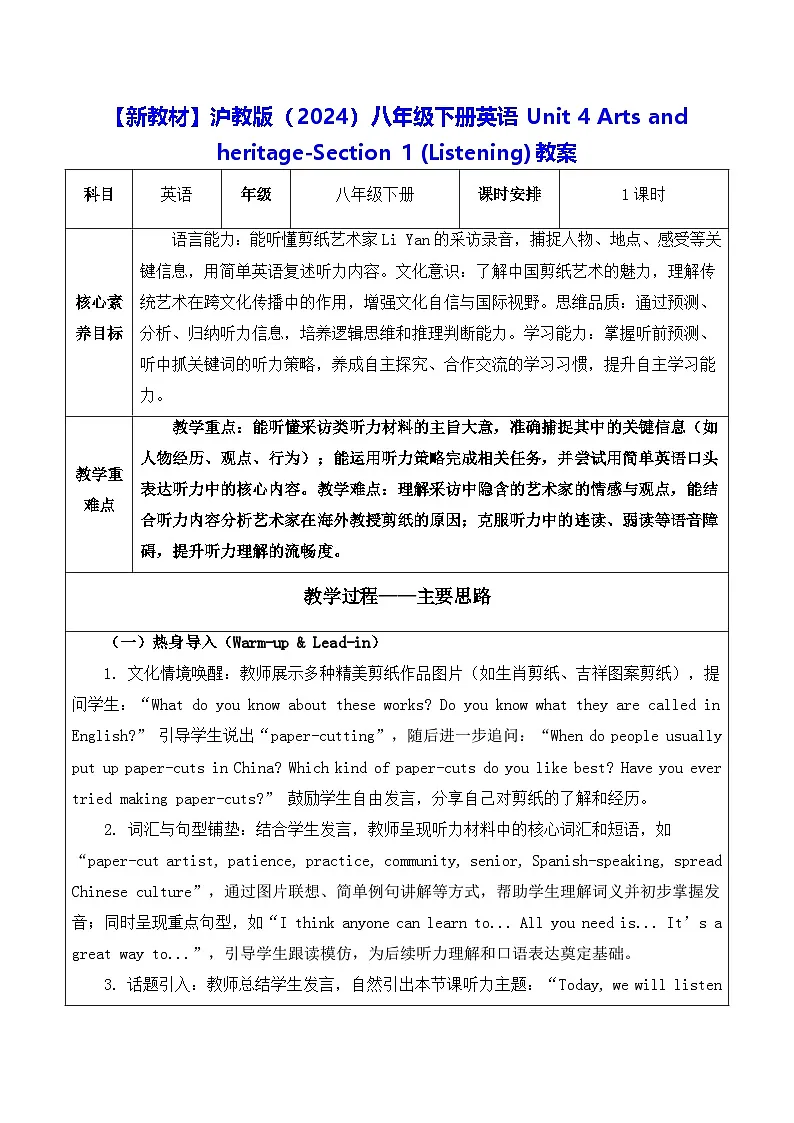
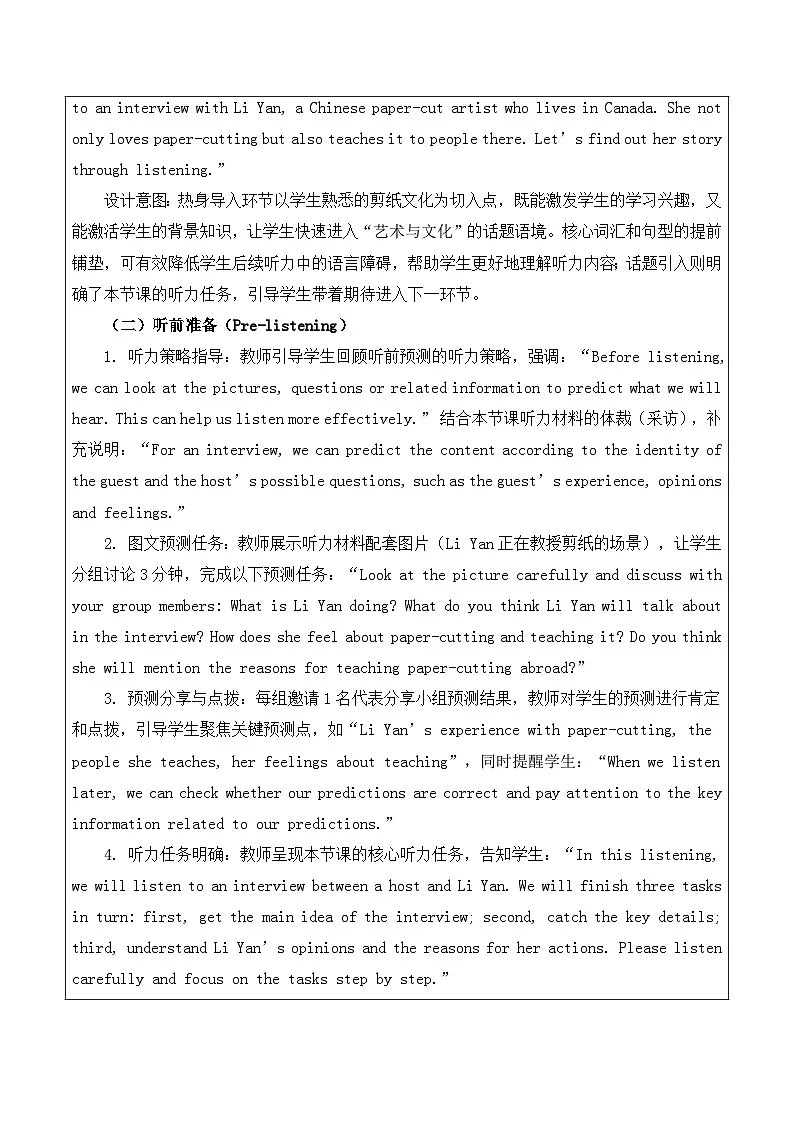
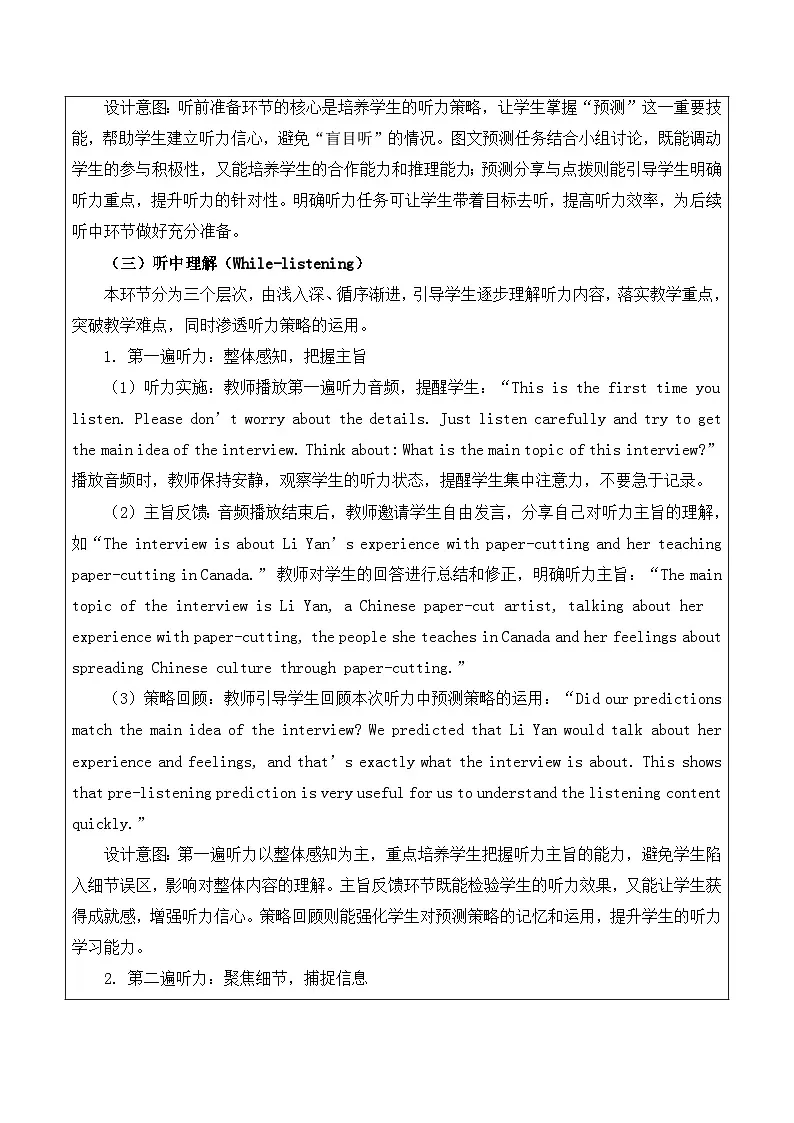
这是一份初中英语沪教牛津版(2024)八年级下册(2024)Listening表格教案,共10页。
科目
英语
年级
八年级下册
课时安排
1课时
核心素养目标
语言能力:能听懂剪纸艺术家Li Yan的采访录音,捕捉人物、地点、感受等关键信息,用简单英语复述听力内容。文化意识:了解中国剪纸艺术的魅力,理解传统艺术在跨文化传播中的作用,增强文化自信与国际视野。思维品质:通过预测、分析、归纳听力信息,培养逻辑思维和推理判断能力。学习能力:掌握听前预测、听中抓关键词的听力策略,养成自主探究、合作交流的学习习惯,提升自主学习能力。
教学重难点
教学重点:能听懂采访类听力材料的主旨大意,准确捕捉其中的关键信息(如人物经历、观点、行为);能运用听力策略完成相关任务,并尝试用简单英语口头表达听力中的核心内容。教学难点:理解采访中隐含的艺术家的情感与观点,能结合听力内容分析艺术家在海外教授剪纸的原因;克服听力中的连读、弱读等语音障碍,提升听力理解的流畅度。
教学过程——主要思路
(一)热身导入(Warm-up & Lead-in)
1. 文化情境唤醒:教师展示多种精美剪纸作品图片(如生肖剪纸、吉祥图案剪纸),提问学生:“What d yu knw abut these wrks? D yu knw what they are called in English?” 引导学生说出“paper-cutting”,随后进一步追问:“When d peple usually put up paper-cuts in China? Which kind f paper-cuts d yu like best? Have yu ever tried making paper-cuts?” 鼓励学生自由发言,分享自己对剪纸的了解和经历。
2. 词汇与句型铺垫:结合学生发言,教师呈现听力材料中的核心词汇和短语,如“paper-cut artist, patience, practice, cmmunity, senir, Spanish-speaking, spread Chinese culture”,通过图片联想、简单例句讲解等方式,帮助学生理解词义并初步掌握发音;同时呈现重点句型,如“I think anyne can learn t... All yu need is... It’s a great way t...”,引导学生跟读模仿,为后续听力理解和口语表达奠定基础。
3. 话题引入:教师总结学生发言,自然引出本节课听力主题:“Tday, we will listen t an interview with Li Yan, a Chinese paper-cut artist wh lives in Canada. She nt nly lves paper-cutting but als teaches it t peple there. Let’s find ut her stry thrugh listening.”
设计意图:热身导入环节以学生熟悉的剪纸文化为切入点,既能激发学生的学习兴趣,又能激活学生的背景知识,让学生快速进入“艺术与文化”的话题语境。核心词汇和句型的提前铺垫,可有效降低学生后续听力中的语言障碍,帮助学生更好地理解听力内容;话题引入则明确了本节课的听力任务,引导学生带着期待进入下一环节。
(二)听前准备(Pre-listening)
1. 听力策略指导:教师引导学生回顾听前预测的听力策略,强调:“Befre listening, we can lk at the pictures, questins r related infrmatin t predict what we will hear. This can help us listen mre effectively.” 结合本节课听力材料的体裁(采访),补充说明:“Fr an interview, we can predict the cntent accrding t the identity f the guest and the hst’s pssible questins, such as the guest’s experience, pinins and feelings.”
2. 图文预测任务:教师展示听力材料配套图片(Li Yan正在教授剪纸的场景),让学生分组讨论3分钟,完成以下预测任务:“Lk at the picture carefully and discuss with yur grup members: What is Li Yan ding? What d yu think Li Yan will talk abut in the interview? Hw des she feel abut paper-cutting and teaching it? D yu think she will mentin the reasns fr teaching paper-cutting abrad?”
3. 预测分享与点拨:每组邀请1名代表分享小组预测结果,教师对学生的预测进行肯定和点拨,引导学生聚焦关键预测点,如“Li Yan’s experience with paper-cutting, the peple she teaches, her feelings abut teaching”,同时提醒学生:“When we listen later, we can check whether ur predictins are crrect and pay attentin t the key infrmatin related t ur predictins.”
4. 听力任务明确:教师呈现本节课的核心听力任务,告知学生:“In this listening, we will listen t an interview between a hst and Li Yan. We will finish three tasks in turn: first, get the main idea f the interview; secnd, catch the key details; third, understand Li Yan’s pinins and the reasns fr her actins. Please listen carefully and fcus n the tasks step by step.”
设计意图:听前准备环节的核心是培养学生的听力策略,让学生掌握“预测”这一重要技能,帮助学生建立听力信心,避免“盲目听”的情况。图文预测任务结合小组讨论,既能调动学生的参与积极性,又能培养学生的合作能力和推理能力;预测分享与点拨则能引导学生明确听力重点,提升听力的针对性。明确听力任务可让学生带着目标去听,提高听力效率,为后续听中环节做好充分准备。
(三)听中理解(While-listening)
本环节分为三个层次,由浅入深、循序渐进,引导学生逐步理解听力内容,落实教学重点,突破教学难点,同时渗透听力策略的运用。
1. 第一遍听力:整体感知,把握主旨
(1)听力实施:教师播放第一遍听力音频,提醒学生:“This is the first time yu listen. Please dn’t wrry abut the details. Just listen carefully and try t get the main idea f the interview. Think abut: What is the main tpic f this interview?” 播放音频时,教师保持安静,观察学生的听力状态,提醒学生集中注意力,不要急于记录。
(2)主旨反馈:音频播放结束后,教师邀请学生自由发言,分享自己对听力主旨的理解,如“The interview is abut Li Yan’s experience with paper-cutting and her teaching paper-cutting in Canada.” 教师对学生的回答进行总结和修正,明确听力主旨:“The main tpic f the interview is Li Yan, a Chinese paper-cut artist, talking abut her experience with paper-cutting, the peple she teaches in Canada and her feelings abut spreading Chinese culture thrugh paper-cutting.”
(3)策略回顾:教师引导学生回顾本次听力中预测策略的运用:“Did ur predictins match the main idea f the interview? We predicted that Li Yan wuld talk abut her experience and feelings, and that’s exactly what the interview is abut. This shws that pre-listening predictin is very useful fr us t understand the listening cntent quickly.”
设计意图:第一遍听力以整体感知为主,重点培养学生把握听力主旨的能力,避免学生陷入细节误区,影响对整体内容的理解。主旨反馈环节既能检验学生的听力效果,又能让学生获得成就感,增强听力信心。策略回顾则能强化学生对预测策略的记忆和运用,提升学生的听力学习能力。
2. 第二遍听力:聚焦细节,捕捉信息
(1)任务布置:教师呈现细节任务单(如下),告知学生:“This is the secnd time yu listen. Please listen carefully and catch the key details t finish the task. Yu can take simple ntes, such as using abbreviatins r symbls t recrd the key infrmatin, like ‘Li Y’ fr Li Yan, ‘CC’ fr Canada.”
细节任务单:
① Where did Li Yan first discver paper-cutting? _________________________________
② When did she first discver paper-cutting? _________________________________
③ Wh can learn t make paper-cuts, accrding t Li Yan? _________________________
④ What d peple need t learn t make paper-cuts? ____________________________
⑤ Wh des Li Yan teach t make paper-cuts in her cmmunity? ___________________
⑥ Hw des Li Yan feel abut teaching paper-cuts? _____________________________
(2)听力实施:教师播放第二遍听力音频,播放过程中,教师可适当放慢语速(若学生基础较弱),提醒学生运用“抓关键词”的策略,重点关注疑问词(where, when, wh, what, hw)对应的信息,同时鼓励学生快速记录关键信息,培养记笔记的习惯。
(3)小组核对与讲解:音频播放结束后,让学生以小组为单位,核对彼此的答案,讨论有争议的问题,时间3分钟。小组讨论结束后,教师邀请每组负责1-2个问题,分享小组答案,同时播放音频中对应的片段,逐题核对答案,讲解易错点和重点:
① 易错点:学生可能会遗漏“next dr t the dance class”,教师需强调听力中的细节:“Li Yan first discvered paper-cutting at a Chinese art and culture centre, next dr t the dance class her parents tk her t.”
② 重点解析:针对“Wh can learn t make paper-cuts?”,教师引导学生关注Li Yan的观点:“Anyne can learn t make paper-cuts.”,并结合句型“I think anyne can learn t...”,让学生跟读模仿,巩固句型运用;针对“What d peple need?”,强调“patience and practice”,区分“patience”(名词,耐心)和“patient”(形容词,有耐心的),帮助学生掌握词汇用法。
(4)语音点拨:教师针对听力材料中的连读、弱读等语音现象,如“paper-cutting class”“next dr”“patience and practice”,进行示范朗读,引导学生跟读,帮助学生克服语音障碍,提升听力理解的准确性。
设计意图:第二遍听力聚焦细节信息,落实教学重点,让学生掌握“抓关键词”“记笔记”的听力策略,提升捕捉细节信息的能力。小组核对环节能培养学生的合作交流能力,让学生在讨论中解决问题,加深对听力内容的理解;逐题核对与讲解则能针对性地解决学生的易错点,强化学生对关键信息的记忆,同时渗透词汇和语音知识,实现“听中积累”。
3. 第三遍听力:深入理解,推理判断
(1)任务布置:教师呈现深层理解任务,告知学生:“This is the third time yu listen. Please listen carefully again, fcus n Li Yan’s pinins and feelings, and try t answer the fllwing questins. These questins need yu t think and infer based n the listening cntent.”
深层理解任务:
① Is paper-cutting ppular in Canada nw? Hw d yu knw? _______________________
② Why des Li Yan teach paper-cuts t peple in Canada? _________________________
③ What des Li Yan think f paper-cutting? ____________________________________
(2)听力实施:教师播放第三遍听力音频,提醒学生:“Pay attentin t Li Yan’s tne and the key sentences that express her pinins, such as ‘I think...’ ‘It’s a great way t...’ ‘Unfrtunately...’”,引导学生结合语境推理判断Li Yan的观点和行为原因。
(3)师生互动,突破难点:音频播放结束后,教师引导学生逐一回答问题,针对难点问题进行重点点拨,帮助学生深入理解听力内容:
① 针对“Is paper-cutting ppular in Canada nw?”,引导学生找到听力中的关键句:“Nt yet, unfrtunately. This art frm is still nt very well-knwn in Canada. Hwever, things have started t change recently. Mre and mre peple are interested in traditinal Chinese arts.”,帮助学生总结答案:“N, it isn’t ppular yet, but mre and mre peple are becming interested in it.”,培养学生的归纳能力。
② 针对“Why des Li Yan teach paper-cuts in Canada?”(教学难点),教师引导学生结合听力内容和文化背景,进行推理分析:“Li Yan lves paper-cutting, and she thinks teaching paper-cuts is a great way t help peple experience and understand Chinese culture. She wants t spread traditinal Chinese arts t peple in Canada and make mre peple knw abut paper-cutting.” 同时,教师补充说明:“This shws that traditinal Chinese arts are precius, and we shuld try ur best t spread them t the wrld.”,渗透文化意识。
③ 针对“What des Li Yan think f paper-cutting?”,引导学生梳理Li Yan的观点:“She thinks paper-cutting is great fun and a frm f strytelling. She als thinks it’s a useful way t spread Chinese culture.”,帮助学生全面理解Li Yan对剪纸艺术的热爱和认可。
(4)听力文本跟读:教师播放听力音频,逐句引导学生跟读,让学生模仿音频中的语音、语调和语气,感受采访的语境,同时巩固听力内容,加深对文本的理解。跟读过程中,教师及时纠正学生的发音和语调问题,提升学生的口语表达规范性。
设计意图:第三遍听力聚焦深层理解,突破教学难点,培养学生的推理判断能力和逻辑思维能力。引导学生关注说话人的观点和情感,能帮助学生更好地理解听力材料的深层含义,而不是仅仅停留在表面信息的捕捉。师生互动点拨则能针对性地解决学生的理解困难,同时渗透文化意识,实现核心素养的培养;听力文本跟读则能实现“听”与“说”的结合,提升学生的语音语调水平,巩固听力成果。
(四)听后巩固与拓展(Pst-listening)
本环节旨在通过多样化的活动,巩固学生的听力成果,拓展学生的思维,提升学生的综合语言运用能力,同时深化学生对文化主题的理解,落实四维核心素养。
1. 活动一:听力内容复述(Individual Wrk & Grup Wrk)
(1)任务布置:让学生结合听力笔记和任务单,先独立思考2分钟,尝试用自己的话复述听力内容,要求涵盖以下核心信息:Li Yan’s discvery f paper-cutting, her pinin n learning paper-cutting, the peple she teaches in Canada, her feelings and reasns fr teaching. 随后,学生以小组为单位,每人复述一部分内容,合作完成完整的听力内容复述,时间5分钟。
(2)复述展示与点评:每组邀请1组代表进行小组复述展示,教师对学生的复述进行点评,肯定学生的优点,如“Yur retelling is cmplete and clear.” “Yu used the key wrds crrectly.”,同时针对存在的问题进行指导,如“Please pay attentin t the tense. Li Yan discvered paper-cutting when she was five, s we shuld use the past tense.” “Yu can use the sentence ‘I think...’ t express Li Yan’s pinin mre clearly.”
(3)示范复述:教师进行示范复述,帮助学生梳理复述思路,规范复述语言:“Li Yan is a Chinese paper-cut artist wh lives in Canada. She first discvered paper-cutting when she was five years ld at a Chinese art and culture centre. She thinks anyne can learn t make paper-cuts with patience and practice. She teaches senirs and Spanish-speaking students in her cmmunity. She lves teaching because it’s a great way t spread Chinese culture.”
设计意图:复述活动是巩固听力成果的有效方式,既能检验学生对听力内容的理解和记忆,又能提升学生的口语表达能力和逻辑思维能力。独立思考与小组合作结合,既能培养学生的自主学习能力,又能培养学生的合作交流能力;教师的点评和示范则能引导学生规范语言表达,提升复述质量,同时巩固听力中的核心词汇和句型。
2. 活动二:话题讨论(Grup Discussin)
(1)讨论任务:教师呈现讨论话题:“Li Yan is spreading Chinese paper-cutting t peple in Canada. What ther traditinal Chinese arts can we spread t the wrld? Hw can we spread them? Discuss with yur grup members and share yur ideas.” 同时,教师提供一些表达模板,帮助学生克服口语表达障碍,如:“I think we can spread... because... ” “One way t spread traditinal Chinese arts is t... ” “We can teach freigners t... s that they can understand... ”
(2)小组讨论:学生以4人小组为单位,围绕话题展开讨论,时间6分钟。讨论过程中,教师巡视各小组,及时给予指导和帮助,如引导学生思考传统艺术的种类(如calligraphy, Beijing Opera, Chinese painting),鼓励学生结合自身经历和生活实际,提出具体的传播方法;提醒学生运用所学词汇和句型,规范口语表达。
(3)分享交流:每组邀请1名代表分享小组讨论结果,如:“We think we can spread Chinese calligraphy t the wrld. We can hld calligraphy exhibitins in freign cuntries and teach freigners t write Chinese characters. This can help them understand Chinese culture better.” 教师对学生的分享进行肯定和补充,引导学生认识到传播传统文化的重要性,增强学生的文化自信。
设计意图:话题讨论环节既能拓展学生的思维,又能实现“听”与“说”的深度结合,提升学生的综合语言运用能力。讨论话题围绕“传统文化传播”展开,与听力主题紧密相关,能深化学生对文化意识的理解,培养学生的文化自信和国际视野。表达模板的提供的则能照顾到不同层次的学生,让基础较弱的学生也能积极参与讨论,提升口语表达的信心。
3. 活动三:词汇与句型巩固(Individual Wrk & Pair Wrk)
(1)词汇巩固:教师呈现听力中的核心词汇和短语,让学生进行配对练习(左边是英文词汇,右边是中文释义),完成后与同桌核对答案。随后,教师随机抽查学生,让学生用核心词汇造句,如用“patience”造句:“We need patience t learn English well.”,巩固词汇的用法。
(2)句型巩固:教师呈现听力中的重点句型,如“I think anyne can learn t... ” “All yu need is... ” “It’s a great way t... ”,让学生两人一组,模仿句型进行对话练习,结合剪纸或其他传统艺术话题,如:
S1: D yu think anyne can learn t d Chinese painting?
S2: Yes, I think anyne can learn t d Chinese painting. All yu need is patience and practice.
S1: Hw can we spread Chinese painting t the wrld?
S2: I think it’s a great way t teach freigners t d Chinese painting.
对话练习结束后,邀请几组学生进行展示,教师进行点评和指导,规范学生的句型运用,提升学生的口语表达流畅度。
设计意图:词汇与句型巩固环节是对听力内容的进一步延伸和落实,能帮助学生巩固所学语言知识,提升语言运用能力。配对练习和造句练习能让学生扎实掌握词汇的含义和用法,对话练习则能让学生在真实的语境中运用重点句型,实现“学用结合”,同时兼顾不同层次学生的需求,让每个学生都能有所收获。
4. 活动四:文化拓展(Whle Class Activity)
(1)文化介绍:教师简要介绍剪纸艺术的历史和文化内涵,如“Paper-cutting is a traditinal Chinese art with a histry f mre than 1,500 years. It is ften used t express peple’s wishes fr happiness and gd luck. In 2006, Chinese paper-cutting was listed as an intangible cultural heritage by UNESCO.” 同时,展示几张不同风格的剪纸作品(如北方剪纸的粗犷、南方剪纸的细腻),让学生感受剪纸艺术的多样性。
(2)情感升华:教师引导学生思考:“Li Yan is using her wn way t spread Chinese paper-cutting. As a Chinese student, what shuld we d t prtect and spread ur traditinal arts?” 鼓励学生自由发言,分享自己的想法,如“We shuld learn mre abut traditinal Chinese arts.” “We can intrduce traditinal arts t ur freign friends.” “We shuld try t learn t make paper-cuts r d Chinese painting.” 教师总结:“Traditinal Chinese arts are ur precius cultural heritage. We shuld lve them, prtect them and try ur best t spread them t the wrld, s that mre peple can knw abut the beauty f Chinese culture.”
设计意图:文化拓展环节能深化学生对剪纸艺术的理解,拓宽学生的文化视野,增强学生的文化自信和文化认同感。情感升华环节则能引导学生树立保护和传播传统文化的意识,落实文化意识核心素养,同时培养学生的责任感和使命感,实现“立德树人”的教学目标。
(五)总结与作业(Summary & Hmewrk)
1. 课堂总结:教师引导学生共同回顾本节课的内容,总结收获:“Tday, we listened t an interview with Li Yan, a paper-cut artist. We learned abut her experience with paper-cutting and her stry f teaching paper-cuts in Canada. We als mastered sme listening strategies, such as pre-listening predictin and catching key wrds. In additin, we talked abut hw t spread traditinal Chinese arts. I hpe all f yu can remember what we learned tday and lve ur traditinal arts.”
同时,教师再次强调本节课的重点和难点,提醒学生:“Please remember the key wrds and sentences in the listening, and practice the listening strategies we learned tday. Try t use yur wn wrds t retell the listening cntent and express yur pinins n spreading traditinal Chinese arts.”
2. 分层作业:结合学生的学情,设计分层作业,兼顾不同层次学生的需求,让每个学生都能在原有基础上有所提升。
(1)基础作业(必做):① 听本节课听力音频,每天跟读10分钟,模仿语音、语调和语气,录制1分钟的跟读音频,提交给老师;② 完成听力任务单的所有题目,整理本节课的核心词汇和句型,抄写并背诵;③ 用3-5句话复述听力内容,写在英语笔记本上。
(2)提升作业(选做):① 查阅资料,了解一种其他的传统中国艺术(如书法、京剧、国画),用英语写5-8句话介绍这种艺术形式;② 采访自己的家人或朋友,了解他们对传统中国艺术的看法,用英语记录下来(至少3句话);③ 和同桌合作,根据听力内容,编写一段简短的采访对话,下次课进行展示。
设计意图:课堂总结能帮助学生梳理本节课的知识体系,巩固所学内容,强化记忆,同时回顾听力策略和核心素养的落实情况。分层作业的设计能照顾到不同层次学生的需求,基础作业侧重巩固听力内容和语言知识,提升作业侧重拓展学生的思维和综合语言运用能力,鼓励学生自主探究、自主学习,培养学生的学习能力,同时延伸课堂内容,让学生在课后继续积累和提升。
(六)板书设计
Unit 4 Arts and heritage-Sectin 1 Listening
1. Key Wrds & Phrases:
paper-cut artist, patience, practice, cmmunity, senir, Spanish-speaking
spread Chinese culture, a frm f strytelling
2. Key Sentences:
I think anyne can learn t make paper-cuts.
All yu need is patience and practice.
It’s a great way t help peple experience and understand Chinese culture.
3. Listening Strategies:
Pre-listening: Predict
While-listening: Catch key wrds, take ntes
4. Main Cntent:
Li Yan → paper-cut artist → discvered at 5 → teaches senirs & Spanish-speaking students → lves teaching (spread Chinese culture)
这是一份初中英语沪教牛津版(2024)八年级下册(2024)Listening表格教案,共10页。
这是一份初中英语沪教牛津版(2024)八年级下册(2024)Reading表格教案,共7页。
 新教材
新教材
注册成功

在线客服
添加在线客服
获取1对1服务
官方微信
关注“教习网”公众号
打开微信就能找资料
赛课定制
添加在线客服
获取1对1定制服务
职称咨询
添加在线客服
获取1V1专业指导服务

免费福利

.png)
.png)
.png)
