 免费领取教师福利



若您为此资料的原创作者,认为该资料内容侵犯了您的知识产权,请扫码添加我们的相关工作人员,我们尽可能的保护您的合法权益。

这是一份初中英语人教版(2024)七年级上册(2024)Unit 2 We're Family! Section A教案设计,共6页。
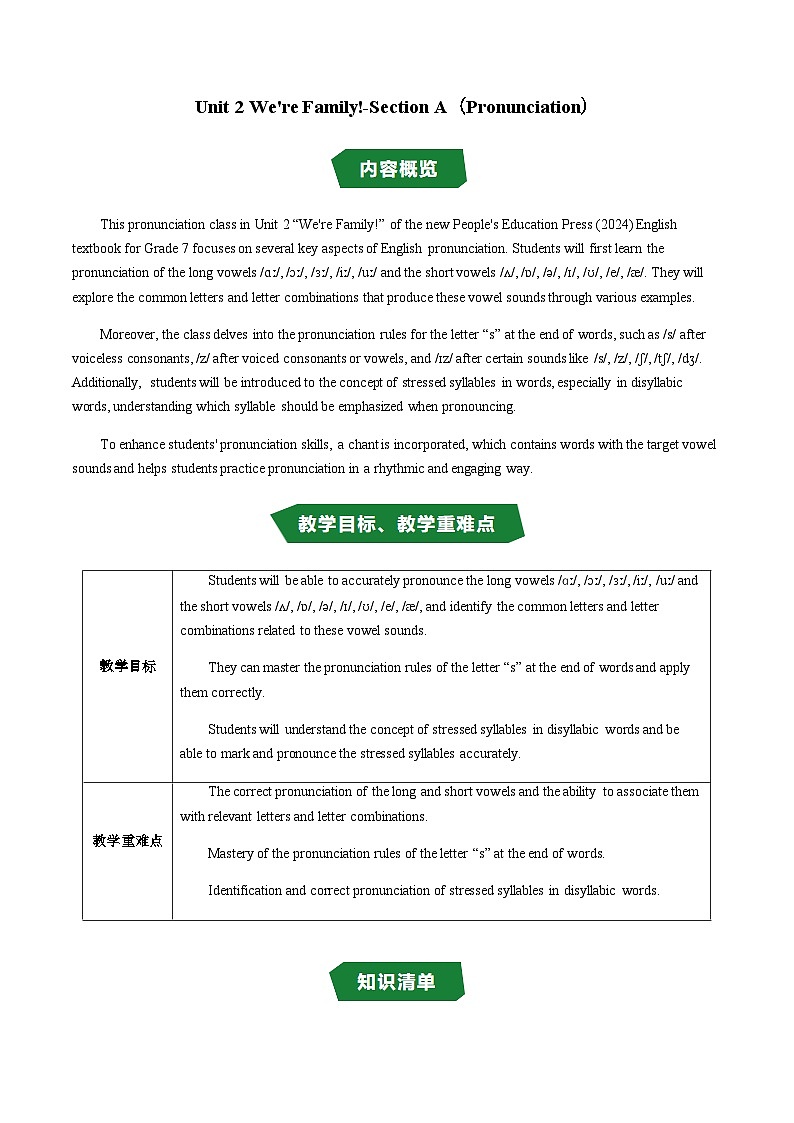
This prnunciatin class in Unit 2 “We're Family!” f the new Peple's Educatin Press (2024) English textbk fr Grade 7 fcuses n several key aspects f English prnunciatin. Students will first learn the prnunciatin f the lng vwels /ɑː/, /ɔː/, /ɜː/, /iː/, /uː/ and the shrt vwels /ʌ/, /ɒ/, /ə/, /ɪ/, /ʊ/, /e/, /æ/. They will explre the cmmn letters and letter cmbinatins that prduce these vwel sunds thrugh varius examples.
Mrever, the class delves int the prnunciatin rules fr the letter “s” at the end f wrds, such as /s/ after viceless cnsnants, /z/ after viced cnsnants r vwels, and /ɪz/ after certain sunds like /s/, /z/, /ʃ/, /tʃ/, /dʒ/. Additinally, students will be intrduced t the cncept f stressed syllables in wrds, especially in disyllabic wrds, understanding which syllable shuld be emphasized when prnuncing.
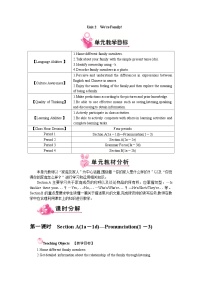
T enhance students' prnunciatin skills, a chant is incrprated, which cntains wrds with the target vwel sunds and helps students practice prnunciatin in a rhythmic and engaging way.
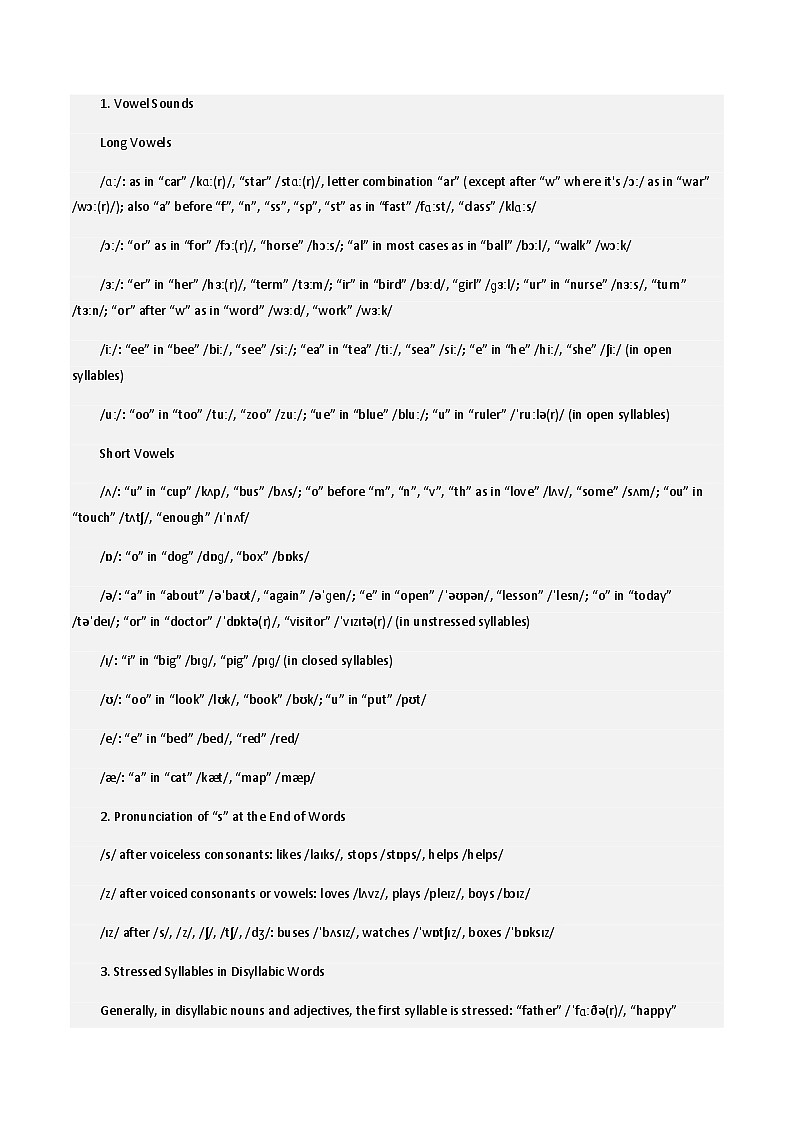
1. Vwel Sunds
Lng Vwels
/ɑː/: as in “car” /kɑː(r)/, “star” /stɑː(r)/, letter cmbinatin “ar” (except after “w” where it's /ɔː/ as in “war” /wɔː(r)/); als “a” befre “f”, “n”, “ss”, “sp”, “st” as in “fast” /fɑːst/, “class” /klɑːs/
/ɔː/: “r” as in “fr” /fɔː(r)/, “hrse” /hɔːs/; “al” in mst cases as in “ball” /bɔːl/, “walk” /wɔːk/
/ɜː/: “er” in “her” /hɜː(r)/, “term” /tɜːm/; “ir” in “bird” /bɜːd/, “girl” /ɡɜːl/; “ur” in “nurse” /nɜːs/, “turn” /tɜːn/; “r” after “w” as in “wrd” /wɜːd/, “wrk” /wɜːk/
/iː/: “ee” in “bee” /biː/, “see” /siː/; “ea” in “tea” /tiː/, “sea” /siː/; “e” in “he” /hiː/, “she” /ʃiː/ (in pen syllables)
/uː/: “” in “t” /tuː/, “z” /zuː/; “ue” in “blue” /bluː/; “u” in “ruler” /ˈruːlə(r)/ (in pen syllables)
Shrt Vwels
/ʌ/: “u” in “cup” /kʌp/, “bus” /bʌs/; “” befre “m”, “n”, “v”, “th” as in “lve” /lʌv/, “sme” /sʌm/; “u” in “tuch” /tʌtʃ/, “enugh” /ɪˈnʌf/
/ɒ/: “” in “dg” /dɒɡ/, “bx” /bɒks/
/ə/: “a” in “abut” /əˈbaʊt/, “again” /əˈɡen/; “e” in “pen” /ˈəʊpən/, “lessn” /ˈlesn/; “” in “tday” /təˈdeɪ/; “r” in “dctr” /ˈdɒktə(r)/, “visitr” /ˈvɪzɪtə(r)/ (in unstressed syllables)
/ɪ/: “i” in “big” /bɪɡ/, “pig” /pɪɡ/ (in clsed syllables)
/ʊ/: “” in “lk” /lʊk/, “bk” /bʊk/; “u” in “put” /pʊt/
/e/: “e” in “bed” /bed/, “red” /red/
/æ/: “a” in “cat” /kæt/, “map” /mæp/
2. Prnunciatin f “s” at the End f Wrds
/s/ after viceless cnsnants: likes /laɪks/, stps /stɒps/, helps /helps/
/z/ after viced cnsnants r vwels: lves /lʌvz/, plays /pleɪz/, bys /bɔɪz/
/ɪz/ after /s/, /z/, /ʃ/, /tʃ/, /dʒ/: buses /ˈbʌsɪz/, watches /ˈwɒtʃɪz/, bxes /ˈbɒksɪz/
3. Stressed Syllables in Disyllabic Wrds
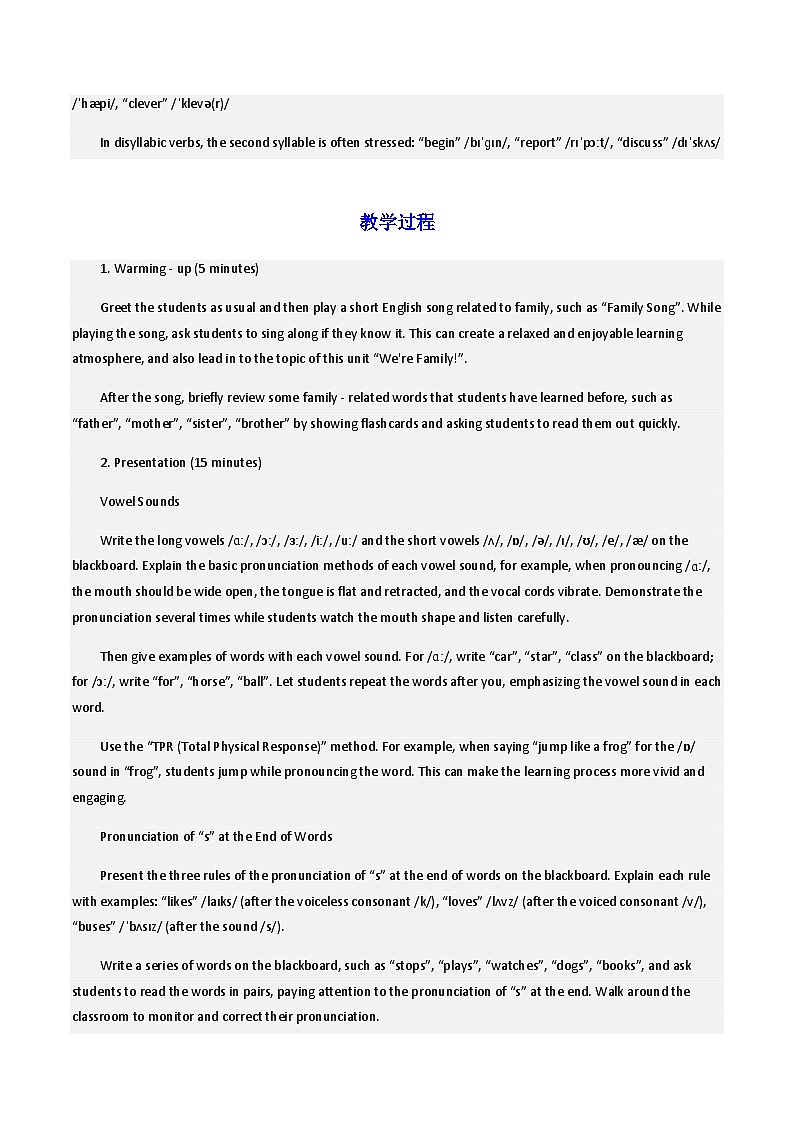
Generally, in disyllabic nuns and adjectives, the first syllable is stressed: “father” /ˈfɑːðə(r)/, “happy” /ˈhæpi/, “clever” /ˈklevə(r)/
In disyllabic verbs, the secnd syllable is ften stressed: “begin” /bɪˈɡɪn/, “reprt” /rɪˈpɔːt/, “discuss” /dɪˈskʌs/
教学过程
1. Warming - up (5 minutes)
Greet the students as usual and then play a shrt English sng related t family, such as “Family Sng”. While playing the sng, ask students t sing alng if they knw it. This can create a relaxed and enjyable learning atmsphere, and als lead in t the tpic f this unit “We're Family!”.
After the sng, briefly review sme family - related wrds that students have learned befre, such as “father”, “mther”, “sister”, “brther” by shwing flashcards and asking students t read them ut quickly.
2. Presentatin (15 minutes)
Vwel Sunds
Write the lng vwels /ɑː/, /ɔː/, /ɜː/, /iː/, /uː/ and the shrt vwels /ʌ/, /ɒ/, /ə/, /ɪ/, /ʊ/, /e/, /æ/ n the blackbard. Explain the basic prnunciatin methds f each vwel sund, fr example, when prnuncing /ɑː/, the muth shuld be wide pen, the tngue is flat and retracted, and the vcal crds vibrate. Demnstrate the prnunciatin several times while students watch the muth shape and listen carefully.
Then give examples f wrds with each vwel sund. Fr /ɑː/, write “car”, “star”, “class” n the blackbard; fr /ɔː/, write “fr”, “hrse”, “ball”. Let students repeat the wrds after yu, emphasizing the vwel sund in each wrd.
Use the “TPR (Ttal Physical Respnse)” methd. Fr example, when saying “jump like a frg” fr the /ɒ/ sund in “frg”, students jump while prnuncing the wrd. This can make the learning prcess mre vivid and engaging.
Prnunciatin f “s” at the End f Wrds
Present the three rules f the prnunciatin f “s” at the end f wrds n the blackbard. Explain each rule with examples: “likes” /laɪks/ (after the viceless cnsnant /k/), “lves” /lʌvz/ (after the viced cnsnant /v/), “buses” /ˈbʌsɪz/ (after the sund /s/).
Write a series f wrds n the blackbard, such as “stps”, “plays”, “watches”, “dgs”, “bks”, and ask students t read the wrds in pairs, paying attentin t the prnunciatin f “s” at the end. Walk arund the classrm t mnitr and crrect their prnunciatin.
Stressed Syllables in Disyllabic Wrds
Write several disyllabic wrds n the blackbard, divided int nuns/adjectives and verbs, fr example, nuns/adjectives: “father”, “mther”, “happy”; verbs: “begin”, “reprt”, “discuss”.
Explain that generally, in disyllabic nuns and adjectives, the first syllable is stressed, while in disyllabic verbs, the secnd syllable is ften stressed. Mark the stressed syllables with a “ˈ” n the blackbard.
Read the wrds alud, exaggerating the stressed syllables, and let students listen and repeat. Then ask students t practice reading the wrds in grups, and each grup selects a representative t read the wrds in frnt f the class.
3. Practice (15 minutes)
Vwel Sund Practice
Hand ut a wrksheet with a list f wrds. Instruct students t circle the vwel letters in each wrd and write dwn the crrespnding vwel sund abve the letter. Fr example, fr the wrd “cake”, students circle “a” and write /eɪ/ abve it. Walk arund t assist students wh may have difficulties.
After they finish, check the answers tgether as a class. Then ask students t read the wrds alud, fcusing n the crrect prnunciatin f the vwel sunds.
“s” Prnunciatin Practice
Create a game called “Prnunciatin Relay”. Divide the class int several grups. The first student in each grup reads a wrd with “s” at the end, such as “likes”. The next student in the grup has t quickly say anther wrd with the same prnunciatin f “s” at the end, like “stps”. If a student makes a mistake r can't cme up with a wrd within a certain time limit, the grup gets a minus pint. The grup with the mst crrect answers and the fewest mistakes wins.
Stressed Syllable Practice
Play a recrding f a passage that cntains many disyllabic wrds. Ask students t listen carefully and mark the stressed syllables f the disyllabic wrds in the passage n their wrksheets. After listening, play the recrding again, and students read the passage alng with the recrding, emphasizing the stressed syllables.
4. Chant (5 minutes)
Present the chant related t family activities n the blackbard r thrugh a PPT. The chant might be like this:
“Father plays ball, /ˈfɑːðə(r) pleɪz bɔːl/
Mther reads bk, /ˈmʌðə(r) riːdz bʊk/
Sister draws picture, /ˈsɪstə(r) drɔːz ˈpɪktʃə(r)/
Brther rides bike. /ˈbrʌðə(r) raɪdz baɪk/
Family members tgether, /ˈfæməli ˈmembəz təˈɡeðə(r)/
Having fun every day. /ˈhævɪŋ fʌn ˈevri deɪ/”
Explain that this chant cntains many wrds with the vwel sunds and stressed syllables they have learned. First, read the chant alud slwly, shwing the crrect prnunciatin and rhythm. Then let students repeat after yu several times.
Divide students int tw grups. One grup reads ne line, and the ther grup reads the next line, and then switch. This can make the chant - reading mre interesting and help students practice prnunciatin in a grup - based way.
5. Summary and Hmewrk (5 minutes)
Summary
Summarize the key pints f this class with students, including the prnunciatin f lng and shrt vwels, the prnunciatin rules f “s” at the end f wrds, and the stressed syllables in disyllabic wrds. Ask students t share what they have learned in this class.
Hmewrk
Ask students t recrd themselves reading the chant at hme and send the recrding t the class grup chat. They shuld pay attentin t the crrect prnunciatin f vwel sunds, “s” at the end f wrds, and stressed syllables.
Let students find at least 10 new disyllabic wrds frm their English bks r ther reading materials, mark the stressed syllables, and write dwn the prnunciatin f each wrd.
教学反思
After this class, I need t reflect n several aspects. First, in terms f students' participatin, did all students actively engage in the varius activities? If sme students were left ut, I shuld cnsider mdifying the activity design in the future t make it mre inclusive. Fr example, in the “Prnunciatin Relay” game, sme students might be t shy t participate due t fear f making mistakes. I culd prvide mre encuragement and guidance befre the game t bst their cnfidence.
Secndly, regarding students' understanding and mastery f knwledge, frm the practice exercises and the chant - reading, I can bserve whether students have truly grasped the prnunciatin f vwel sunds, the rules f “s” prnunciatin, and the stressed syllables. If many students still make mistakes in distinguishing similar vwel sunds like /ɪ/ and /iː/, I need t design mre targeted practice activities, such as mre listening discriminatin exercises r muth - shape imitatin cmpetitins.
Finally, in terms f teaching methds, were the “TPR” methd, grup - wrk, and game - based learning effective? If nt, I shuld explre ther teaching methds r adjust the existing nes t better meet the learning needs f students. Fr instance, if the grup - wrk during the chant - reading was nt well - rganized and sme grups were chatic, I need t clarify the grup - wrk rules and prcedures mre clearly in the next class. Overall, cntinuus reflectin and imprvement are crucial t enhance the quality f English prnunciatin teaching.
教学目标
Students will be able t accurately prnunce the lng vwels /ɑː/, /ɔː/, /ɜː/, /iː/, /uː/ and the shrt vwels /ʌ/, /ɒ/, /ə/, /ɪ/, /ʊ/, /e/, /æ/, and identify the cmmn letters and letter cmbinatins related t these vwel sunds.
They can master the prnunciatin rules f the letter “s” at the end f wrds and apply them crrectly.
Students will understand the cncept f stressed syllables in disyllabic wrds and be able t mark and prnunce the stressed syllables accurately.
教学重难点
The crrect prnunciatin f the lng and shrt vwels and the ability t assciate them with relevant letters and letter cmbinatins.
Mastery f the prnunciatin rules f the letter “s” at the end f wrds.
Identificatin and crrect prnunciatin f stressed syllables in disyllabic wrds.
这是一份初中英语人教版(2024)七年级上册(2024)Unit 2 We're Family! Section A教案设计,共6页。
这是一份英语人教版(2024)Unit 2 We're Family! Section A教学设计及反思,共5页。教案主要包含了教学内容分析,核心素养目标,教学重难点,教学方法,教学过程,教学资源,教学反思等内容,欢迎下载使用。
这是一份初中英语人教版(2024)七年级上册(2024)Unit 2 We're Family! Section A教学设计,共7页。教案主要包含了教学目标,教学重难点,教学方法,教学过程,教学反思等内容,欢迎下载使用。
注册成功

在线客服
添加在线客服
获取1对1服务
官方微信
关注“教习网”公众号
打开微信就能找资料
赛课定制
添加在线客服
获取1对1定制服务
职称咨询
添加在线客服
获取1V1专业指导服务

免费福利

.png)
.png)
.png)
