 免费领取教师福利


若您为此资料的原创作者,认为该资料内容侵犯了您的知识产权,请扫码添加我们的相关工作人员,我们尽可能的保护您的合法权益。

这是一份英语八年级下册(2024)Reading教学设计,共5页。教案主要包含了单元课前预习,教学过程,课后作业等内容,欢迎下载使用。
【单元课前预习】
头脑风暴:学生填写课本第51页First thughts的思维导图,课前进行小组交流分享。在完成思维导图前,教师可让学生先查阅词典,写下单元主题词arts, heritage等的定义。
鼓励学生课前思考以下问题,并在课前预习单上简单回答,课堂分享。
D yu knw any famus paintings /artwrks? Name sme f them.
Which painting / artwrk d yu like best?Why?
【教学过程】
Step 1 读前激活背景知识
What d yu knw abut traditinal art frms?
匹配游戏
教师呈现课本第52~53页上不同传统艺术形式的图片,也可补充本单元所提及的其他著名艺术作品(如国画、雕塑、壁画),通过提问让学生进行猜测匹配。
T: Which traditinal art frm is this?
S: It is calligraphy / mural / paper-cutting / ...
T: D yu knw the name f this artwrk?
S: It’s the Lanting Xu.
*接龙游戏
学生分为小组,各小组有1分钟时间讨论并列出各种不同的艺术形式及对应的代表作品。接着,按小组顺序进行接龙,各小组轮流指定一名成员用英文说出一种艺术形式和艺术作品,如“The Lngmen Caves are famus fr their sculptures.” “Dwelling in the Fuchun Muntains is a famus Chinese painting.”。组内不能重复本组已提过的艺术作品,但可重复其他组提过的艺术作品,若小组成员5秒内无法接龙则被淘汰,最终选出优胜小组。
自由对话
教师可依托教材对话示范,结合前两个活动的主题内容拓展问题链设计,让学生进行同桌对话交流,介绍书上的五种艺术形式。问题如下:
What kind f traditinal art frms d yu like? Why?
D yu knw any famus artwrks? What are they abut? Where can we see them?
What d yu think f traditinal arts?
Step 2 了解主阅读语篇的大意
What d yu knw abut this masterpiece?
Watch and check
播放有关《富春山居图》的视频或展示画作细节图,提醒学生留意画作的细节内容(如自然景观、人文元素等),然后呈现介绍画作内容的的句子,各小组抢答判断正误,有能力的小组还可以改正,答对最多题的小组获胜。
The painting shws a bright summer day with clurful flwers everywhere.
There are many tall muntains cvered with snw in the distance.
A fisherman is fishing alne.
There are many peple walking in the muntains.
The artist used nly black ink t paint the muntains and water.
Think and share
教师提供结构化句式“It is a ______ Chinese painting because ______”,学生基于上个活动进行个性化观点输出,随后通过对比分享不同见解。教师展示语篇标题的用词“legendary”,引导学生思考:“What makes it legendary?”。
Brainstrm
教师组织学生通过结对或小组活动进行头脑风暴,探讨介绍名画的多个维度,形成思维导图。思维导图范例可参考教学课件。
Read and check
学生细读文章,完成课本第54页活动2。教师核对答案。
Read and rder
学生利用思维导图,梳理文章的结构,明确文章是围绕“创作背景—画作内容—传承经历”展开进行介绍的。
Step 3 分段细读,深入梳理文章的结构化知识
Hw is this masterpiece intrduced?
Read and think (Para. 1)
学生阅读首段, 回答以下问题:
Hw des the writer describe the painting? Which adjectives did he / she use?
D these adjectives make yu mre curius abut the painting? What wuld yu like t knw abut it?
What d yu think the rest f the article will be abut?
Read and think (Para. 2)
学生阅读第二段。教师通过问题链进行追问,引导学生领悟名家的匠人精神。问题如下:
Why d yu think Huang began wrking n this painting when he was almst 80? What d mst peple d at that age?
Hw lng did it take him t finish the painting?
Why d yu think Huang wrked n the painting fr s lng? Culd yu wrk that lng n a task?
Read and think (Para. 3)
学生阅读第三段。教师呈现画作的图片,并通过问题链进行追问,引导学生欣赏画作所体现的天人合一的意境。问题如下:
What makes this a beautiful painting?
What d yu think f when yu see the landscape in the painting?
Hw d yu feel when yu see the man fishing ?
Read and think (Paras. 4–6)
学生阅读第四至六段,并回答以下问题:
(1)What happened t the painting when it was cmpleted?
(2)What did peple think f the painting? Hw des the writer shw this?
Read and rder:
学生完成课本第54页活动1 ,把句子进行排序,校对完答案后,教师可引导学生关注句中呈现的被动语态,初步感知本单元语法。
Read, cmplete and retell:
学生再次阅读课文,利用关键词梳理文本,完成思维导图的绘制,构建结构化知识。同时,学生可以结对利用思维导图开展复述活动。
Step 4 深入阅读,分析语篇的内涵
What d yu think f the painting?
Think and share
学生根据问题再次阅读文本,通过Think–Share 的方式进行分享交流。问题如下:
Why d yu think the writer used the wrd “legendary” and “masterpiece” t describe the painting?
What d yu think f the painting? D yu agree that it is a masterpiece? Why r why nt?
Why is it imprtant t prtect artwrks?
What can we d t prevent artwrks frm being damaged?
Hw d museums make sure that their artwrks are safe?
Step 5 超越语篇,运用所学解决问题
Hw can yu intrduce this masterpiece?
Cnduct an interview
学生时空穿越到过去,向黄公望提问,了解更多名画的信息。学生以结对的形式,一位学生扮演画家黄公望,另一位学生扮演采访者,对黄公望进行采访,了解其名画《富春山居图》。
Student: Gd mrning, Master Huang. We are really interested in yur masterpiece Dwelling in the Fuchun Muntains. When did yu paint it?
Huang: Well, I began painting it when I was almst eighty years ld.
Student: Ww, that’s amazing! Hw lng did it take yu t paint it?
Master Huang: It tk me ...
Student: What can we see in the painting?
Master Huang: ...
Intrduce the painting
小组合作,在学校文化交流活动中,结合思维导图的内容及本课所学,用英语向外国友人介绍中国名画《富春山居图》。
Example:
Gd mrning! Tday, I wuld like t talk abut a legendary Chinese painting called Dwelling in the Fuchun Muntains. It is ...
..
【评价】
课后指导学生填写以下学习评价表:
【课后作业】
基础作业:
模仿课文录音中的语音、语调,朗读课文。
借助思维导图复述课文。
思考与表达:D yu think Dwelling in the Fuchun Muntains is an imprtant painting? Why r why nt?请充分结合阅读语篇的内容,思考此问题并写下答案。
拓展作业:
查找更多关于介绍《富春山居图》的资料或视频,口头补充介绍有关此画的更多信息。
选择一幅中国古代名画,进行简单介绍。
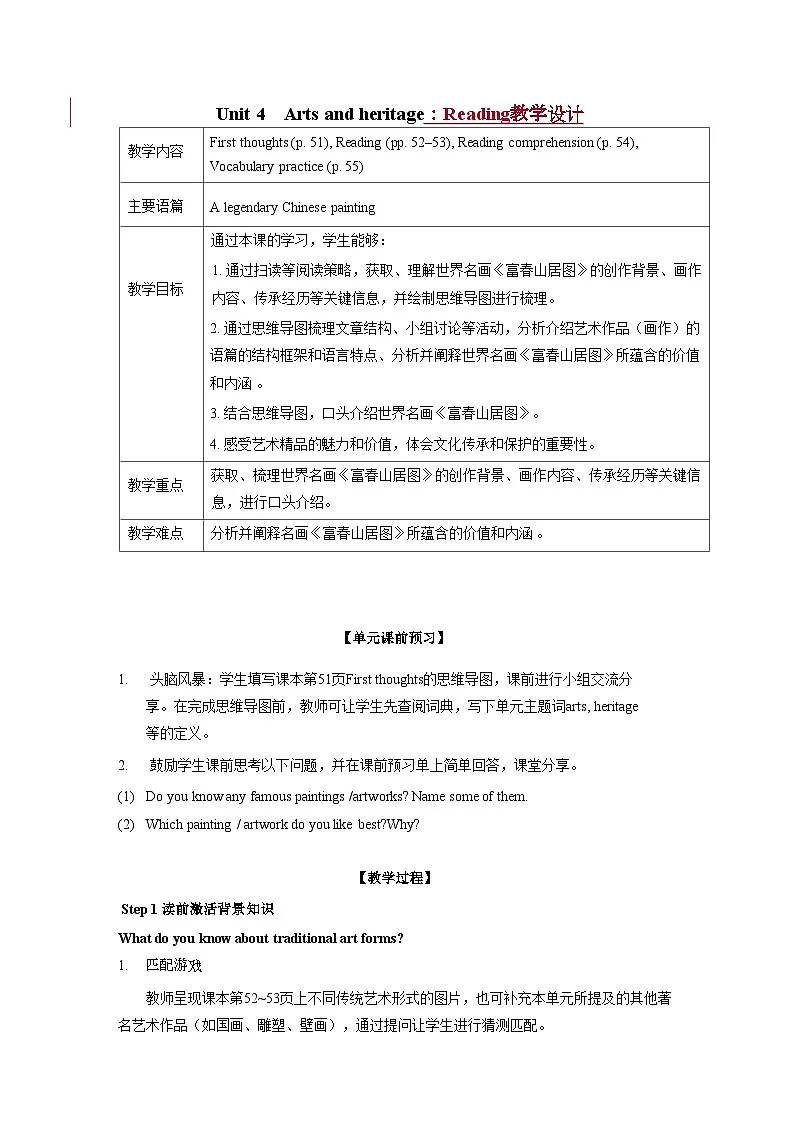
教学内容
First thughts (p. 51), Reading (pp. 52–53), Reading cmprehensin (p. 54), Vcabulary practice (p. 55)
主要语篇
A legendary Chinese painting
教学目标
通过本课的学习,学生能够:
1. 通过扫读等阅读策略,获取、理解世界名画《富春山居图》的创作背景、画作内容、传承经历等关键信息,并绘制思维导图进行梳理。
2. 通过思维导图梳理文章结构、小组讨论等活动,分析介绍艺术作品(画作)的语篇的结构框架和语言特点、分析并阐释世界名画《富春山居图》所蕴含的价值和内涵 。
3. 结合思维导图,口头介绍世界名画《富春山居图》。
4. 感受艺术精品的魅力和价值,体会文化传承和保护的重要性。
教学重点
获取、梳理世界名画《富春山居图》的创作背景、画作内容、传承经历等关键信息,进行口头介绍。
教学难点
分析并阐释名画《富春山居图》所蕴含的价值和内涵 。
评价内容
评分 (1–5)
1. 我能理解并能介绍传奇画作《富春山居图》的创作背景、画作内容和传承经历等主要信息。
1 2 3 4 5
2. 我了解了介绍画作的文章的结构特点和写作方式,并能运用该结构分析文章。
1 2 3 4 5
3. 我能理解、领悟名家名画的魅力、价值和内涵,体悟到匠人精神和文化传承的力量。
1 2 3 4 5
4. 我能运用扫读等策略获取关键词,并能绘制思维导图梳理文章核心内容。
1 2 3 4 5
这是一份英语八年级下册(2024)Reading教学设计,共5页。教案主要包含了单元课前预习,教学过程,课后作业等内容,欢迎下载使用。
这是一份沪教牛津版(2024)八年级下册(2024)Writing教学设计,共4页。教案主要包含了教学过程,课后作业等内容,欢迎下载使用。
这是一份初中英语沪教牛津版(2024)八年级下册(2024)Speaking教案,共2页。教案主要包含了教学过程,课后作业等内容,欢迎下载使用。
注册成功

在线客服
添加在线客服
获取1对1服务
官方微信
关注“教习网”公众号
打开微信就能找资料
赛课定制
添加在线客服
获取1对1定制服务
职称咨询
添加在线客服
获取1V1专业指导服务

免费福利


.png)
.png)
.png)
