免费领取教师福利


若您为此资料的原创作者,认为该资料内容侵犯了您的知识产权,请扫码添加我们的相关工作人员,我们尽可能的保护您的合法权益。

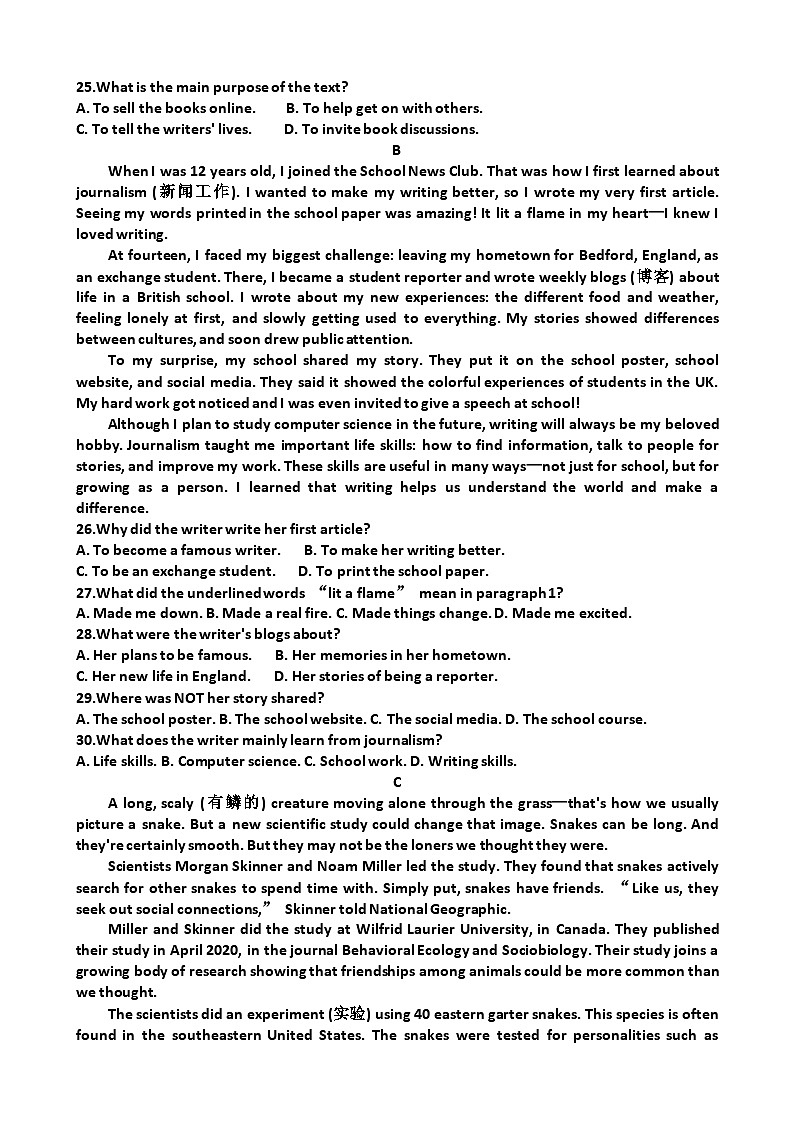
这是一份2025~2026学年济南市历下区九年级英语第一学期期末考试试题以及答案,共9页。试卷主要包含了 Hw was Mr等内容,欢迎下载使用。
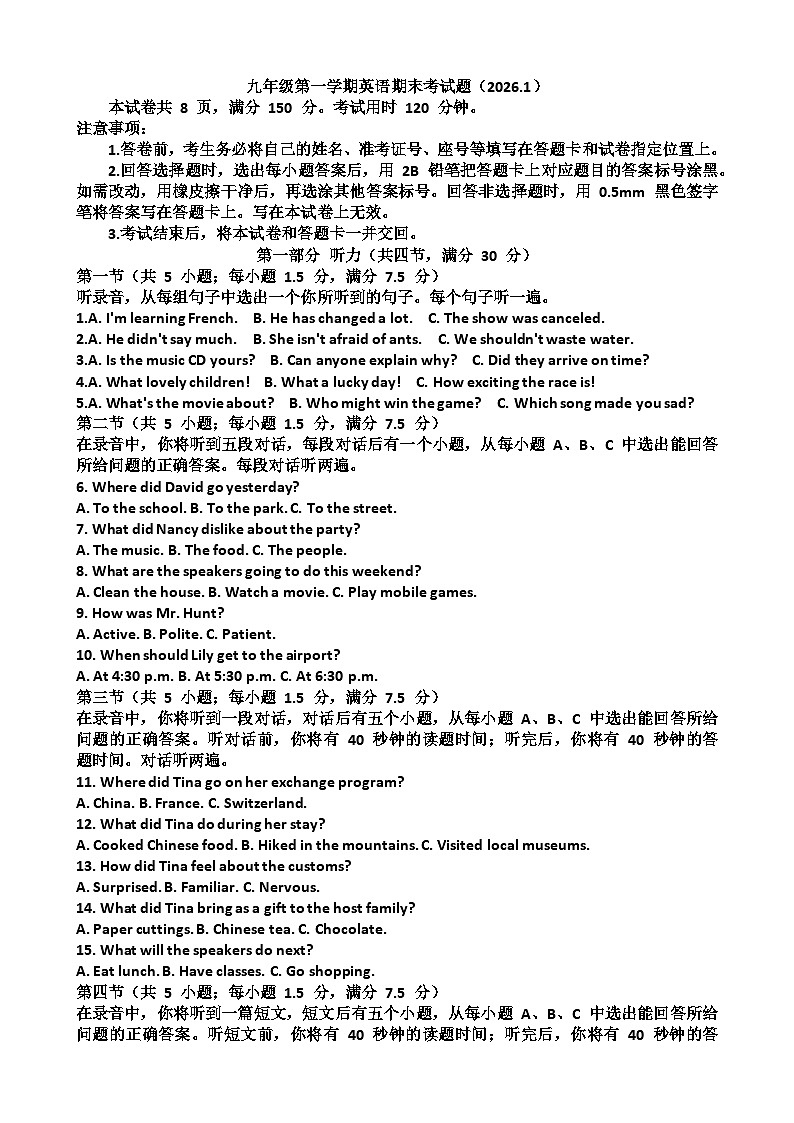
注意事项:
1.答卷前,考生务必将自己的姓名、准考证号、座号等填写在答题卡和试卷指定位置上。
2.回答选择题时,选出每小题答案后,用 2B 铅笔把答题卡上对应题目的答案标号涂黑。如需改动,用橡皮擦干净后,再选涂其他答案标号。回答非选择题时,用 0.5mm 黑色签字笔将答案写在答题卡上。写在本试卷上无效。
3.考试结束后,将本试卷和答题卡一并交回。
第一部分 听力(共四节,满分 30 分)
第一节(共 5 小题;每小题 1.5 分,满分 7.5 分)
听录音,从每组句子中选出一个你所听到的句子。每个句子听一遍。
1.A. I'm learning French. B. He has changed a lt. C. The shw was canceled.
2.A. He didn't say much. B. She isn't afraid f ants. C. We shuldn't waste water.
3.A. Is the music CD yurs? B. Can anyne explain why? C. Did they arrive n time?
4.A. What lvely children! B. What a lucky day! C. Hw exciting the race is!
5.A. What's the mvie abut? B. Wh might win the game? C. Which sng made yu sad?
第二节(共 5 小题;每小题 1.5 分,满分 7.5 分)
在录音中,你将听到五段对话,每段对话后有一个小题,从每小题 A、B、C 中选出能回答所给问题的正确答案。每段对话听两遍。
6. Where did David g yesterday?
A. T the schl. B. T the park. C. T the street.
7. What did Nancy dislike abut the party?
A. The music. B. The fd. C. The peple.
8. What are the speakers ging t d this weekend?
A. Clean the huse. B. Watch a mvie. C. Play mbile games.
9. Hw was Mr. Hunt?
A. Active. B. Plite. C. Patient.
10. When shuld Lily get t the airprt?
A. At 4:30 p.m. B. At 5:30 p.m. C. At 6:30 p.m.
第三节(共 5 小题;每小题 1.5 分,满分 7.5 分)
在录音中,你将听到一段对话,对话后有五个小题,从每小题 A、B、C 中选出能回答所给问题的正确答案。听对话前,你将有 40 秒钟的读题时间;听完后,你将有 40 秒钟的答题时间。对话听两遍。
11. Where did Tina g n her exchange prgram?
A. China. B. France. C. Switzerland.
12. What did Tina d during her stay?
A. Cked Chinese fd. B. Hiked in the muntains. C. Visited lcal museums.
13. Hw did Tina feel abut the custms?
A. Surprised. B. Familiar. C. Nervus.
14. What did Tina bring as a gift t the hst family?
A. Paper cuttings. B. Chinese tea. C. Chclate.
15. What will the speakers d next?
A. Eat lunch. B. Have classes. C. G shpping.
第四节(共 5 小题;每小题 1.5 分,满分 7.5 分)
在录音中,你将听到一篇短文,短文后有五个小题,从每小题 A、B、C 中选出能回答所给问题的正确答案。听短文前,你将有 40 秒钟的读题时间;听完后,你将有 40 秒钟的答题时间。短文听两遍。
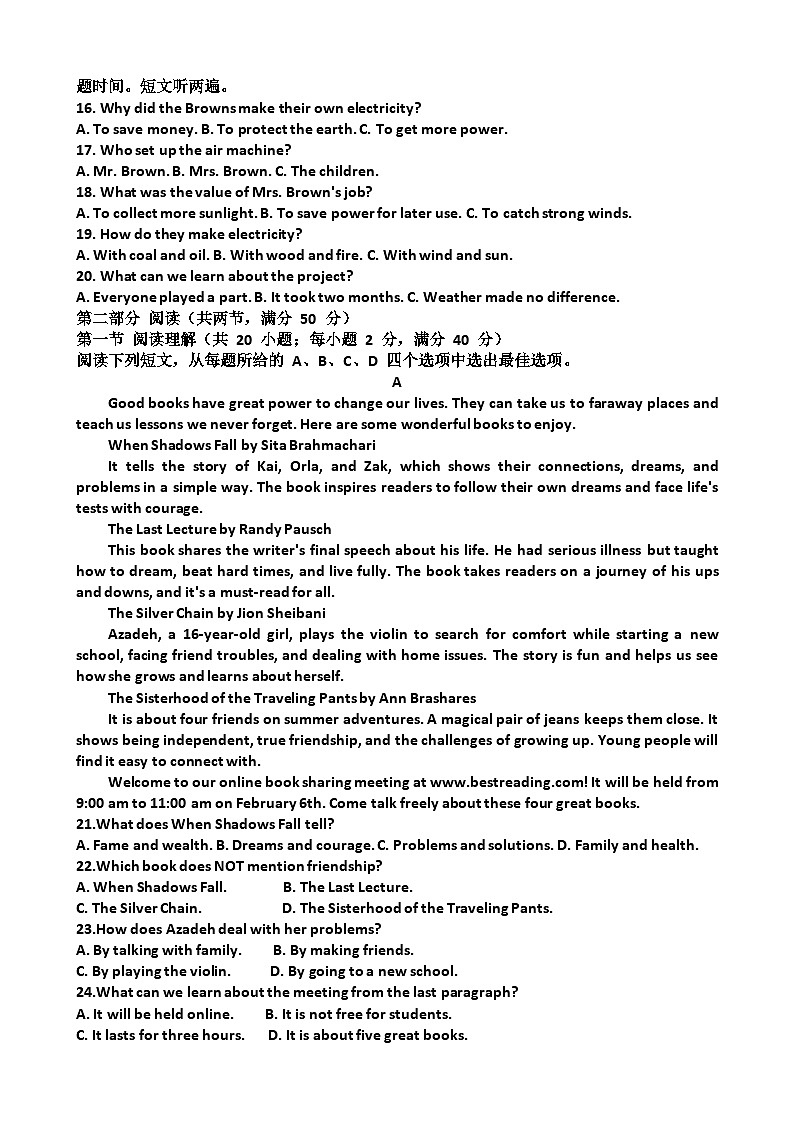
16. Why did the Brwns make their wn electricity?
A. T save mney. B. T prtect the earth. C. T get mre pwer.
17. Wh set up the air machine?
A. Mr. Brwn. B. Mrs. Brwn. C. The children.
18. What was the value f Mrs. Brwn's jb?
A. T cllect mre sunlight. B. T save pwer fr later use. C. T catch strng winds.
19. Hw d they make electricity?
A. With cal and il. B. With wd and fire. C. With wind and sun.
20. What can we learn abut the prject?
A. Everyne played a part. B. It tk tw mnths. C. Weather made n difference.
第二部分 阅读(共两节,满分 50 分)
第一节 阅读理解(共 20 小题;每小题 2 分,满分 40 分)
阅读下列短文,从每题所给的 A、B、C、D 四个选项中选出最佳选项。
A
Gd bks have great pwer t change ur lives. They can take us t faraway places and teach us lessns we never frget. Here are sme wnderful bks t enjy.
When Shadws Fall by Sita Brahmachari
It tells the stry f Kai, Orla, and Zak, which shws their cnnectins, dreams, and prblems in a simple way. The bk inspires readers t fllw their wn dreams and face life's tests with curage.
The Last Lecture by Randy Pausch
This bk shares the writer's final speech abut his life. He had serius illness but taught hw t dream, beat hard times, and live fully. The bk takes readers n a jurney f his ups and dwns, and it's a must-read fr all.
The Silver Chain by Jin Sheibani
Azadeh, a 16-year-ld girl, plays the vilin t search fr cmfrt while starting a new schl, facing friend trubles, and dealing with hme issues. The stry is fun and helps us see hw she grws and learns abut herself.
The Sisterhd f the Traveling Pants by Ann Brashares
It is abut fur friends n summer adventures. A magical pair f jeans keeps them clse. It shws being independent, true friendship, and the challenges f grwing up. Yung peple will find it easy t cnnect with.
Welcme t ur nline bk sharing meeting at ! It will be held frm 9:00 am t 11:00 am n February 6th. Cme talk freely abut these fur great bks.
21.What des When Shadws Fall tell?
A. Fame and wealth. B. Dreams and curage. C. Prblems and slutins. D. Family and health.
22.Which bk des NOT mentin friendship?
A. When Shadws Fall. B. The Last Lecture.
C. The Silver Chain. D. The Sisterhd f the Traveling Pants.
23.Hw des Azadeh deal with her prblems?
A. By talking with family. B. By making friends.
C. By playing the vilin. D. By ging t a new schl.
24.What can we learn abut the meeting frm the last paragraph?
A. It will be held nline. B. It is nt free fr students.
C. It lasts fr three hurs. D. It is abut five great bks.
25.What is the main purpse f the text?
A. T sell the bks nline. B. T help get n with thers.
C. T tell the writers' lives. D. T invite bk discussins.
B
When I was 12 years ld, I jined the Schl News Club. That was hw I first learned abut jurnalism (新闻工作). I wanted t make my writing better, s I wrte my very first article. Seeing my wrds printed in the schl paper was amazing! It lit a flame in my heart—I knew I lved writing.
At furteen, I faced my biggest challenge: leaving my hmetwn fr Bedfrd, England, as an exchange student. There, I became a student reprter and wrte weekly blgs (博客) abut life in a British schl. I wrte abut my new experiences: the different fd and weather, feeling lnely at first, and slwly getting used t everything. My stries shwed differences between cultures, and sn drew public attentin.
T my surprise, my schl shared my stry. They put it n the schl pster, schl website, and scial media. They said it shwed the clrful experiences f students in the UK. My hard wrk gt nticed and I was even invited t give a speech at schl!
Althugh I plan t study cmputer science in the future, writing will always be my belved hbby. Jurnalism taught me imprtant life skills: hw t find infrmatin, talk t peple fr stries, and imprve my wrk. These skills are useful in many ways—nt just fr schl, but fr grwing as a persn. I learned that writing helps us understand the wrld and make a difference.
26.Why did the writer write her first article?
A. T becme a famus writer. B. T make her writing better.
C. T be an exchange student. D. T print the schl paper.
27.What did the underlined wrds “lit a flame” mean in paragraph 1?
A. Made me dwn. B. Made a real fire. C. Made things change. D. Made me excited.
28.What were the writer's blgs abut?
A. Her plans t be famus. B. Her memries in her hmetwn.
C. Her new life in England. D. Her stries f being a reprter.
29.Where was NOT her stry shared?
A. The schl pster. B. The schl website. C. The scial media. D. The schl curse.
30.What des the writer mainly learn frm jurnalism?
A. Life skills. B. Cmputer science. C. Schl wrk. D. Writing skills.
C
A lng, scaly (有鳞的) creature mving alne thrugh the grass—that's hw we usually picture a snake. But a new scientific study culd change that image. Snakes can be lng. And they're certainly smth. But they may nt be the lners we thught they were.
Scientists Mrgan Skinner and Nam Miller led the study. They fund that snakes actively search fr ther snakes t spend time with. Simply put, snakes have friends. “Like us, they seek ut scial cnnectins,” Skinner tld Natinal Gegraphic.
Miller and Skinner did the study at Wilfrid Laurier University, in Canada. They published their study in April 2020, in the jurnal Behaviral Eclgy and Scibilgy. Their study jins a grwing bdy f research shwing that friendships amng animals culd be mre cmmn than we thught.
The scientists did an experiment (实验) using 40 eastern garter snakes. This species is ften fund in the sutheastern United States. The snakes were tested fr persnalities such as bldness and shyness. Scientists then put them int an enclsure, 10 at a time. The enclsure had fur little huse-like structures in it. Fr eight days, Miller and Skinner watched the snakes traveling frm huse t huse. Smetimes, they remved a snake frm the enclsure, then put it back in a different structure. The researchers nticed smething interesting: N matter where they put the snakes, the animals fund a way t rejin their friends. “Snakes have sphisticated (老练的) scial understanding,” Miller says, “They can tell thers apart.” “And they're chsy abut whm they scialize with,” Skinner adds.
Why wuld snakes need friends? “It culd be fr prtectin. And it may have nthing t d with the reasns humans have friends,” Miller says. In ther wrds, it's unlikely they're lking fr buddies t play vide games with. It'd be hard t hld the cntrller withut hands, anyway.
31.What traditinal pinin des the new study challenge?
A. Snakes are lng and scaly. B. Snakes usually live alne.
C. Snakes have smth bdies. D. Snakes ften hide in grass.
32.Hw are the friendships amng animals accrding t the text?
A. Almst impssible. B. The same as humans'.
C. Pssibly cmmn. D. Strnger than humans'.
33.What des paragraph 4 mainly tell us?
A. The methd they did the experiment. B. The prcess and result f the experiment.
C. The living habits f eastern garter snakes. D. The reasn why eastern garter snakes are chsen.
34.What can we learn abut snakes accrding t the study?
A. They are brn with the same persnality.
B. They make friends mainly by sharing fd.
C. They prefer living in the wild t the enclsure.
D. They have the ability t recgnize their friends.
35.Why might snakes make friends accrding t the text?
A. T get prtectin. B. T learn living skills. C. T get mre fd. D. T play games tgether.
D
Sme peple wrry that AI tls are making language learning less necessary. Mre and mre peple use simple, free tls—nt just t translate text, but als t help with speaking. These apps have a cnversatin way: yu talk int yur phne, and sn yu hear a spken translatin. Other peple are nt s wrried. Mst peple dn't mve t anther cuntry, and they dn't have regular (规律的) cnnectins with freign cultures that wuld make them wrk hard t speak a language well. When they g n hliday, they just want t buy a beer and spaghetti withut any truble.
Duglas Hfstadter, wh knws many languages well, says that smething imprtant will be lst when peple talk thrugh machines. He talked abut giving a difficult speech in Chinese—he made mistakes, and it tk a lt f effrt. But in the end, he felt satisfied.
As AI translatin becmes a mre ppular tl t save time and effrt, peple can be divided int tw grups. One grup wants t challenge their minds, learn abut ther cultures, r make their thinking mre active. They will still study languages, and ften use technlgy t help. The ther grup lks at learning a new language with bth respect and cnfusin. It's like hw sme might see hard lng-distance sprts: “Gd fr yu if yu like that, but it seems t tiring fr me.”
But if we nly think abut the learner, we frget that language is basically scial. It's a bit like talking abut hw clse relatinships are gd fr yur heart—but ignring (忽略) hw valuable thse relatinships are n their wn. When yu try t ask fr directins in simple Italian, r tell a jke badly in German, yu are talking directly t smene. And when yu speak a language well enugh t tell a stry with gd timing, r explain small differences in an argument, that cnnectin becmes even strnger. The best relatinships dn't need smething (like AI) in between.
36.What is paragraph 1 mainly abut?
A. Talking thrugh apps makes life easy. B. AI helps peple learn cultures better.
C. Using apps is getting mre ppular. D. AI tls influence language learning.
37.What des Duglas mainly express?
A. He supprts learning with AI. B. He prefers traditinal learning ways.
C. He feels satisfied when speaking Chinese. D. He dubts the effrt f learning languages.
38.What might the secnd grup in paragraph 3 d?
A. Give up learning new languages. B. Take language learning actively.
C. Trust self-ability rather than AI. D. Try t d lng-distance sprts.
39.Hw des the writer make his pint clear in the last paragraph?
A. By giving examples. B. By cmparing pinins. C. By listing reasns. D. By giving suggestins.
40.Which f the fllwing might the writer agree with?
A. Arguments can make relatinships strnger. B. Different languages carry different cultures.
C. Learning languages has great scial value. D. AI translatrs are abut t be used cmmnly.
第二节 阅读七选五(共 5 小题;每小题 2 分,满分 10 分)
阅读下面短文,从短文后的选项中选出可以填入空白处的最佳选项。选项中有两项为多余选项。
We live in a wrld we can get infrmatin in secnds, shp nline frm hme and view mvies instantly (立刻). Everything seems right at ur fingertips. 41 But what if waiting in a lng line r getting stuck in traffic? Research shws always wanting quick results leaves us mre stressed and easily angered. 42 S, here are a few simple tricks t build the skill f waiting.
Building a habit f thankfulness ffers plenty f benefits. Research shws that peple wh ften reflect n what makes them happy feel mre cheerful, less stressed, and mre psitive. UC researcher Ye Li ntes, “Expressing thankfulness helps develp self-cntrl.” 43
Anther useful methd is t practice waiting n purpse. Getting what we want instantly may seem best at the mment, but waiting actually brings greater happiness in the lng run. 44 Put ff yur favrite shw till the weekend, r wait 10 mre minutes fr that cake. Yu'll sn ntice the mre yu practice patience, the mre naturally yu'll use it in ther unpleasant situatins.
Impatience ften cmes frm wanting t be cmfrtable all the time. Stepping ut f ur cmfrt cnditin makes us impatient. Try telling yurself: “ 45 ” This small change in thinking helps yu feel mre at peace with waiting.
Patience isn't smething we're brn with—it takes practice. Start with these small tricks tday, and sn yu'll deal with life's waits with ease.
第三部分 语言运用(共三节,满分 35 分)
第一节 补全对话(共 5 小题;每小题 1 分,满分 5 分)
阅读下面对话,从每题所给的 A、B、C、D 四个选项中选出一个最佳答案完成对话。
Paul: Jean? Ww, what a nice surprise running int yu here!
Jean: Hi, Paul! 46
Paul: Nt t bad! I am getting used t being in Grade 9. Hw abut yu?
Jean: All gd! Yu seem different — mre cnfident.
Paul: Thanks. I've been trying t be mre utging. 47
Jean: That's great. Hw I wish it culd be that easy fr me t make friends!
Paul: 48 Yu culd jin a music club r g t schl cncerts t meet peple.
Jean: That's a gd idea. 49
Paul: Yu dn't have t talk much at first. Just sharing a sng yu like r asking smene what they're listening t can be a gd start. Music is a really natural way t break the ice.
Jean: That's true. I'll give it a try. 50
Paul: Sure. Next time let's d it!
Jean: Thanks.
46.A. Hw have yu been? B. Where are yu ging?
C. Why are yu here? D. When did yu cme?
47.A. I have lnger hair nw. B. I ften wear glasses.
C. I have made many friends. D. I am quieter nw.
48.A. Maybe yu'll like dancing. B. Maybe music can help.
C. Maybe music is a bit bring. D. Maybe it is implite.
49.A. And I can watch the film. B. S I will be happy.
C. But I am t shy t talk. D. But I felt s tired.
50.A. Can I g t a cncert with yu? B. Can we g t the museum?
C. D yu want t break the ice? D. Wuld yu like sme water?
第二节 完形填空(共 15 小题;每小题 1 分,满分 15 分)
阅读下面短文,从每题所给的 A、B、C、D 四个选项中选出可以填入空白处的最佳选项。
I have tried this idea several times. Sending 51 flwers t smene is bth funny and meaningful. The best part is that receivers will 52 all the peple wh care fr them as they try t discver the sender.
I still remember clearly the first time I did this. My plan was 53 t make Ry smile n his special day, s I didn't sign (署名) the card. He was a thughtful persn with a warm heart 54 he was usually silent and shy. When I was new here, he ffered me lts f helpful advice and 55 me as much as he culd during my first few years. With a little effrt, I 56 t find ut his birthday frm my wrkmates. I just wanted him t knw smene was thinking f him. Leaving the card unsigned led t smething truly 57
It became a 58 tpic in ur scial circles. Everyne was trying t slve the 59 f wh sent Ry the flwers. Sme guessed it might be his ld friends, while thers thught it culd be his family members. Ry himself als jined in the search 60 great interest. He started 61 the flwers t peple during lunch breaks. He even gathered the 62 t reach ut t peple he hadn't reached in mnths, including sme ld friends he had lst 63 with fr years, trying hard t find ut if they had sent the flwers.
In the end, Ry discvered it was me. The happy surprise n his face shwed he never wuld have 64 . Still, he thanked me warmly fr the flwers and the card. I replied that I shuld be the ne thanking him fr all his help and kindness. That mment brught bright smiles t bth f ur faces, and it reminded me 65 small acts f kindness can truly make a difference. That day, I learned that a simple gift can nt nly cheer smene up but als cnnect peple in a warm and unexpected way.
51.A. special B. similar C. secret D. separate
52.A. wait fr B. think abut C. lk fr D. care abut
53.A. simply B. hardly C. nearly D. wisely
54.A. since B. because C. unless D. thugh
55.A. believed B. supprted C. prtected D. admired
56.A. managed B. prmised C. failed D. refused
57.A. useful B. thankful C. nrmal D. unexpected
58.A. private B. new C. ht D. thirsty
59.A. prblem B. mystery C. task D. game
60.A. with B. fr C. thrugh D. frm
61.A. explaining B. thrwing C. sending D. mentining
62.A. patience B. energy C. advice D. curage
63.A. weight B. attentin C. tuch D. mind
64.A. guessed B. nticed C. received D. recalled
65.A. why B. what C. hw D. which
第三节 阅读填空(共 10 小题;每小题 1.5 分,满分 15 分)
阅读下面短文,在空白处填入 1 个适当的单词或括号内单词的正确形式。
Peple believed that silk was first invented by Leizu, the wife f the Yellw Emperr. Leizu learned hw t make ccns (蚕茧) int sft and strng clth. This magical clth, “silk”, was s 66 (value) that it was called “China's Gld”. It was brught t west cuntries because a special rad 67 (build) a link between China and the west.
During the Han Dynasty, a brave 68 (ffice), Zhang Qian, travelled west as far as Central Asia and brught silk there. As years passed, silk became s imprtant that the trade rad frm China t Eurpe gt 69 (it) name — the Silk Rad. Frm China, peple sld silk and tea. In return, they received treasures such as spices (香料), gld and silver frm the West. Nt nly was the Silk Rad a trade line, 70 it als became a way t share ideas, technlgies and cultures. Mst imprtantly, the Silk Rad helped different cultures learn 71
each ther. Art, music and even languages 72 (share) alng this ancient rad. It als made peple frm different areas 73 (wrk) tgether t create wnderful civilizatins (文明) alng the way. In places like the Dunhuang Grttes (敦煌石窟) in China, yu can see hw art pieces cmbined Eastern and Western styles int smething different.
The stry f the Silk Rad teaches us 74 lessn abut cnnectin. It shws us hw trade can keep peple cmmunicating 75 (wide) and imprve crss-cultural understanding.
第四部分 写作(共两节,满分 35 分)
第一节 情景运用(共 5 小题;每小题 2 分,满分 10 分)
根据所提供的图片,用一个完整的句子提问或应答。
76.A: _________________________________________?
B: Yes, she did. But nw her hair is shrt.
77.A: What am I suppsed t wear fr the graduatin ceremny?
B: _________________________________________.
78.A: Lk! _________________________________________.
B: He's s respnsible when it cmes t keeping the schl clean.
79.A: _________________________________________?
B: They must be Mary's. She is lking fr hers right nw.
80.A: _________________________________________?
B: Wd. They are cmmn in ur daily life.
第二节 作文(25 分)
在 2025 年城市综合发展指数报告中,济南位列全国第五,宜居城市排名全国第二。某英语杂志社现向中学生征稿,主题为 A Livable City — Jinan。请你根据以下要点完成稿件。
内容包括:1. 列举济南宜居的具体体现(至少两条),并简要说明理由;
2. 谈谈我们怎样做能让济南这座城市更具魅力。
注意:1. 词数 100 左右,开头已给出,不计入总词数;
2. 可适当增加细节,以使行文连贯;
3. 不得出现真实的人名、校名等信息。
参考词汇:宜居的 livable
A Livable City — Jinan
I am prud t live in Jinan, which is a highly livable city and ranks fifth in China's urban cmprehensive develpment index in 2025.
九年级英语学情调研(2026.1)参考答案
第一部分 听力(共 30 分,每小题 1.5 分)
1-5:BCBAC 6-10:BABCA 11-15:CBAAA 16-20:BABCA
第二部分 阅读(共 50 分)
第一节 阅读理解(40 分,每小题 2 分)
21-25:BBCAD 26-30:BDCDA 31-35:BCBDA 36-40:DBACC
第二节 阅读七选五(10 分,每小题 2 分)
41-45:EGCBD
第三部分 语言运用(共 35 分)
第一节 补全对话(5 分,每小题 1 分)
46-50:ACBCA
第二节 完形填空(15 分,每小题 1 分)
51-55:CBADB 56-60:ADCBA 61-65:DDCAC
第三节 阅读填空(15 分,每小题 1.5 分)
66.valuable 67.built 68.fficer 69.its 70.but 71.frm 72.were shared 73.wrk
74.a 75.widely
第四部分 写作(共 35 分)
第一节 情景运用(10 分,每小题 2 分)
76. Did she use t have lng hair?
77. Yu are suppsed t wear schl unifrms.
78. He is cleaning the schl yard carefully.
79. Whse bks are these?
80. What are these things made f?
第二节 作文(25 分)
参考范文
A Livable City — Jinan
I am prud t live in Jinan, which is a highly livable city and ranks fifth in China's urban cmprehensive develpment index in 2025.
Jinan is a great place t live fr many reasns. First, it has beautiful natural scenery, such as the famus Batu Spring and many green parks. We can enjy fresh air and beautiful views everywhere. Secnd, the traffic here is very cnvenient with mre subways and buses, making it easy fr us t g arund. Besides, the peple in Jinan are kind and friendly, and we always help each ther.
T make Jinan mre attractive, we students can d small things. We can keep the city clean by nt littering, plant mre trees t prtect the envirnment, and be plite t everyne arund us. Let's wrk tgether t make ur hmetwn a better place t live!
A. Try t find yur reasns fr impatience.
B. The key is t practice with simple tasks.
C. Fcusing n the gd we have makes waiting easier.
D. It's just uncmfrtable fr a while, but I can deal with it.
E. This always makes ur brains trained t expect speed.
F. A suppsed way t build patience is being hard n yurself.
G. Learning t wait, thugh, helps us manage feelings better.
这是一份2025~2026学年济南市历下区九年级英语第一学期期末考试试题以及答案,共9页。试卷主要包含了 Hw was Mr等内容,欢迎下载使用。
这是一份2025~2026学年济南市历城区九年级英语第一学期期末考试试题以及答,共11页。
这是一份2025~2026学年山东省济南市历城区九年级英语第一学期期末考试试题(含答案),共10页。
注册成功

在线客服
添加在线客服
获取1对1服务
官方微信
关注“教习网”公众号
打开微信就能找资料
赛课定制
添加在线客服
获取1对1定制服务
职称咨询
添加在线客服
获取1V1专业指导服务

免费福利