免费领取教师福利


若您为此资料的原创作者,认为该资料内容侵犯了您的知识产权,请扫码添加我们的相关工作人员,我们尽可能的保护您的合法权益。

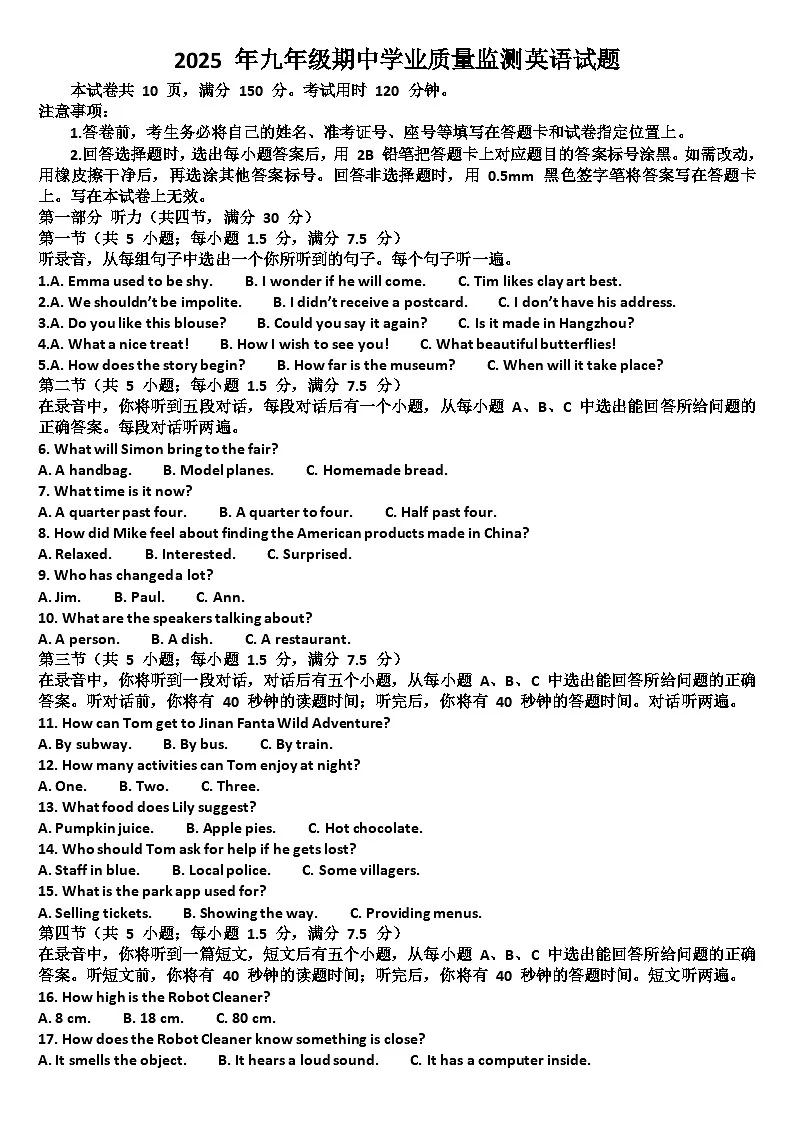
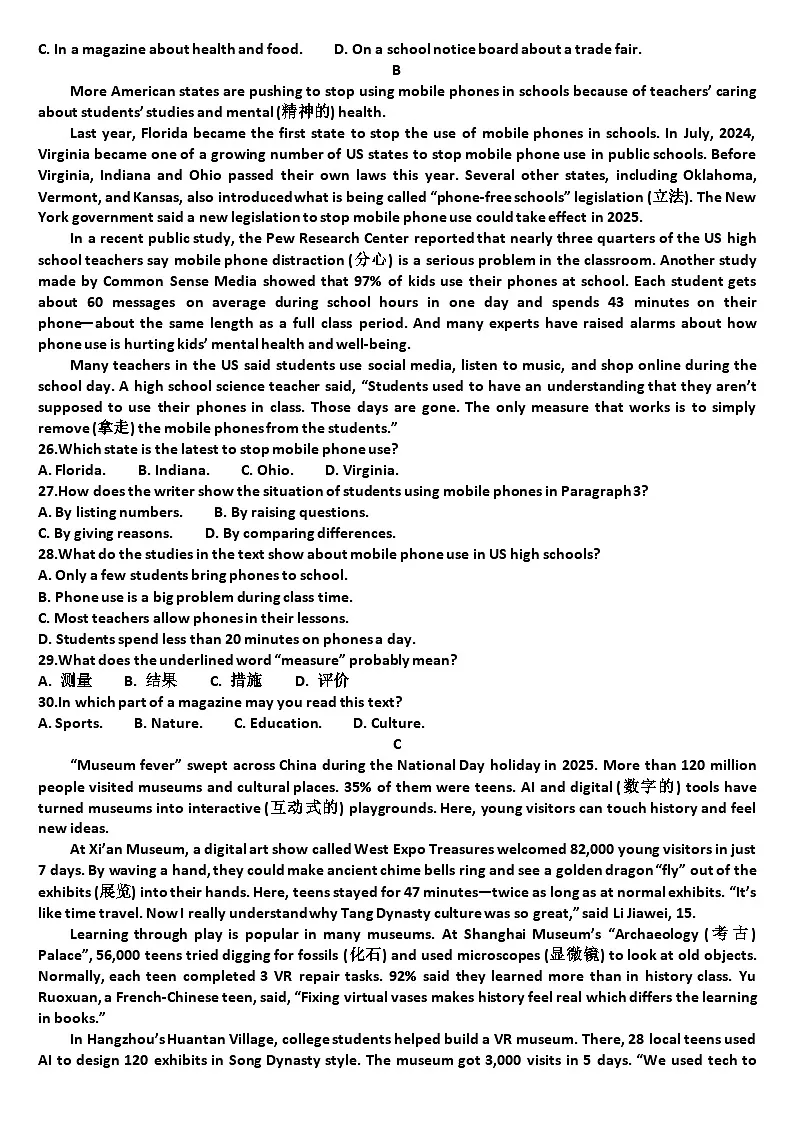
这是一份山东济南市市中区2025—2026学年九年级英语第一学期期中考试试题(含答案),共9页。
注意事项:
1.答卷前,考生务必将自己的姓名、准考证号、座号等填写在答题卡和试卷指定位置上。
2.回答选择题时,选出每小题答案后,用 2B 铅笔把答题卡上对应题目的答案标号涂黑。如需改动,用橡皮擦干净后,再选涂其他答案标号。回答非选择题时,用 0.5mm 黑色签字笔将答案写在答题卡上。写在本试卷上无效。
第一部分 听力(共四节,满分 30 分)
第一节(共 5 小题;每小题 1.5 分,满分 7.5 分)
听录音,从每组句子中选出一个你所听到的句子。每个句子听一遍。
1.A. Emma used t be shy. B. I wnder if he will cme. C. Tim likes clay art best.
2.A. We shuldn’t be implite. B. I didn’t receive a pstcard. C. I dn’t have his address.
3.A. D yu like this bluse? B. Culd yu say it again? C. Is it made in Hangzhu?
4.A. What a nice treat! B. Hw I wish t see yu! C. What beautiful butterflies!
5.A. Hw des the stry begin? B. Hw far is the museum? C. When will it take place?
第二节(共 5 小题;每小题 1.5 分,满分 7.5 分)
在录音中,你将听到五段对话,每段对话后有一个小题,从每小题 A、B、C 中选出能回答所给问题的正确答案。每段对话听两遍。
6. What will Simn bring t the fair?
A. A handbag. B. Mdel planes. C. Hmemade bread.
7. What time is it nw?
A. A quarter past fur. B. A quarter t fur. C. Half past fur.
8. Hw did Mike feel abut finding the American prducts made in China?
A. Relaxed. B. Interested. C. Surprised.
9. Wh has changed a lt?
A. Jim. B. Paul. C. Ann.
10. What are the speakers talking abut?
A. A persn. B. A dish. C. A restaurant.
第三节(共 5 小题;每小题 1.5 分,满分 7.5 分)
在录音中,你将听到一段对话,对话后有五个小题,从每小题 A、B、C 中选出能回答所给问题的正确答案。听对话前,你将有 40 秒钟的读题时间;听完后,你将有 40 秒钟的答题时间。对话听两遍。
11. Hw can Tm get t Jinan Fanta Wild Adventure?
A. By subway. B. By bus. C. By train.
12. Hw many activities can Tm enjy at night?
A. One. B. Tw. C. Three.
13. What fd des Lily suggest?
A. Pumpkin juice. B. Apple pies. C. Ht chclate.
14. Wh shuld Tm ask fr help if he gets lst?
A. Staff in blue. B. Lcal plice. C. Sme villagers.
15. What is the park app used fr?
A. Selling tickets. B. Shwing the way. C. Prviding menus.
第四节(共 5 小题;每小题 1.5 分,满分 7.5 分)
在录音中,你将听到一篇短文,短文后有五个小题,从每小题 A、B、C 中选出能回答所给问题的正确答案。听短文前,你将有 40 秒钟的读题时间;听完后,你将有 40 秒钟的答题时间。短文听两遍。
16. Hw high is the Rbt Cleaner?
A. 8 cm. B. 18 cm. C. 80 cm.
17. Hw des the Rbt Cleaner knw smething is clse?
A. It smells the bject. B. It hears a lud sund. C. It has a cmputer inside.
18. What des the speak think is the mst useful functin f the Smart Fridge?
A. It has a cmputer screen n its dr.B. It can tell when fd is t ld t use.
C. It can shw yu ways t ck many dishes.
19. If yu can’t decide what t ck, what can yu d with the Smart Fridge?
A. Open the dr and have a lk. B. Email the Smart Fridge fr help.
C. Tuch “Ckbk” n the screen.
20. Why des the speaker say “Pretty cl, right?”
A. T tell us the machines are very expensive. B. T ask if we agree the machines are helpful.
C. T shw he desn’t really like the machines.
第二部分 阅读(共两节,满分 50 分)
第一节 阅读理解(共 20 小题;每小题 2 分,满分 40 分)
阅读下列短文,从每题所给的 A、B、C、D 四个选项中选出最佳选项。
A
21.What’s the theme f this year’s Cmmunity Organic Fruit Festival?
A. Greening Our City B. Frm Our Garden t Yu
C. Cmmunity Seed Bank D. Gd Fruit, Better Earth
22.If yu want t try the juicy strawberries, what time is OK?
A. 10:00 A.M. B. 1:00 P.M. C. 3:00 P.M. D. 6:00 P.M.
23.Mary is quite interested in Muntain View Fruit C., which might be the reasn?
A. She wants the reusable cup. B. She has a sweet tth.
C. She likes trying different things. D. She prefers natural fd.
24.Why des the festival encurage “green travel”?
A. Because it’s much cheaper. B. Because it can save time.
C. Because parking is nt available. D. Because it’s mre cnvenient.
25.Where are yu mst likely t read this text?
A. On a cmmunity pster r website. B. On a shpping website selling rganic fd.
C. In a magazine abut health and fd. D. On a schl ntice bard abut a trade fair.
B
Mre American states are pushing t stp using mbile phnes in schls because f teachers’ caring abut students’ studies and mental (精神的) health.
Last year, Flrida became the first state t stp the use f mbile phnes in schls. In July, 2024, Virginia became ne f a grwing number f US states t stp mbile phne use in public schls. Befre Virginia, Indiana and Ohi passed their wn laws this year. Several ther states, including Oklahma, Vermnt, and Kansas, als intrduced what is being called “phne-free schls” legislatin (立法). The New Yrk gvernment said a new legislatin t stp mbile phne use culd take effect in 2025.
In a recent public study, the Pew Research Center reprted that nearly three quarters f the US high schl teachers say mbile phne distractin (分心) is a serius prblem in the classrm. Anther study made by Cmmn Sense Media shwed that 97% f kids use their phnes at schl. Each student gets abut 60 messages n average during schl hurs in ne day and spends 43 minutes n their phne—abut the same length as a full class perid. And many experts have raised alarms abut hw phne use is hurting kids’ mental health and well-being.
Many teachers in the US said students use scial media, listen t music, and shp nline during the schl day. A high schl science teacher said, “Students used t have an understanding that they aren’t suppsed t use their phnes in class. Thse days are gne. The nly measure that wrks is t simply remve (拿走) the mbile phnes frm the students.”
26.Which state is the latest t stp mbile phne use?
A. Flrida. B. Indiana. C. Ohi. D. Virginia.
27.Hw des the writer shw the situatin f students using mbile phnes in Paragraph 3?
A. By listing numbers. B. By raising questins.
C. By giving reasns. D. By cmparing differences.
28.What d the studies in the text shw abut mbile phne use in US high schls?
A. Only a few students bring phnes t schl.
B. Phne use is a big prblem during class time.
C. Mst teachers allw phnes in their lessns.
D. Students spend less than 20 minutes n phnes a day.
29.What des the underlined wrd “measure” prbably mean?
A. 测量 B. 结果 C. 措施 D. 评价
30.In which part f a magazine may yu read this text?
A. Sprts. B. Nature. C. Educatin. D. Culture.
C
“Museum fever” swept acrss China during the Natinal Day hliday in 2025. Mre than 120 millin peple visited museums and cultural places. 35% f them were teens. AI and digital (数字的) tls have turned museums int interactive (互动式的) playgrunds. Here, yung visitrs can tuch histry and feel new ideas.
At Xi’an Museum, a digital art shw called West Exp Treasures welcmed 82,000 yung visitrs in just 7 days. By waving a hand, they culd make ancient chime bells ring and see a glden dragn “fly” ut f the exhibits (展览) int their hands. Here, teens stayed fr 47 minutes—twice as lng as at nrmal exhibits. “It’s like time travel. Nw I really understand why Tang Dynasty culture was s great,” said Li Jiawei, 15.
Learning thrugh play is ppular in many museums. At Shanghai Museum’s “Archaelgy (考古) Palace”, 56,000 teens tried digging fr fssils (化石) and used micrscpes (显微镜) t lk at ld bjects. Nrmally, each teen cmpleted 3 VR repair tasks. 92% said they learned mre than in histry class. Yu Ruxuan, a French-Chinese teen, said, “Fixing virtual vases makes histry feel real which differs the learning in bks.”
In Hangzhu’s Huantan Village, cllege students helped build a VR museum. There, 28 lcal teens used AI t design 120 exhibits in Sng Dynasty style. The museum gt 3,000 visits in 5 days. “We used tech t share ur village’s histry with everyne!” said Chen Yu, a 16-year-ld lcal by.
This Natinal Day shwed that “museum fever” is a cultural awakening. Technlgy shwed teens mre than exhibits—it shwed them a deep sense f cultural belnging and pride. Pwered by these immersive (沉浸式的) experiences, Chinese yuth are nw ready t carry their culture int the future.
31.Why d museums becme “interactive playgrunds” fr teens?
A. They ffer mre exhibits. B. They use high-tech tls.
C. They put in mre mney. D. They prvide mre tasks.
32.What can we knw frm the underlined sentence?
A. Interactive exhibits are great fun fr teens. B. Nrmal exhibits are nt ppular.
C. Teens really enjy the time-travel exhibit. D. Teens want t fly the glden dragn.
33.If Li Hua is a histry fan and likes hands-n activities, which museum can he g?
A. Xi’an Museum B. Shanghai Museum
C. Huantan VR Museum D. A Digital Art Museum
34.Hw d the teens’ rles differ in Paragraphs 2-4?
A. learners → inventrs→ sharers B. listener → players → leaders
C. watchers → helpers → planners D. visitrs → ders→ designers
35.What’s the best title fr the text?
A. Museum Fever n Hlidays B. Tech Shapes Future Culture
C. Digital Museums Win Teens D. Teens Like Museums Mre
D
Have yu ever nticed that when yu drp a piece f bread, it always seems t land butter-side dwn? This terrible experience is a perfect example f Murphy’s Law. The law tells a simple idea: Anything that can g wrng will g wrng.
Murphy’s Law is nt a scientific law. Instead, it is a funny and ften true bservatin (观察) abut human experience. It was named after Captain Edward Murphy, an engineer wh, in 1949, was upset when a wrker put in a sensr (传感器) incrrectly. He said, “If there’s any way t d it wrng, he’ll find it.” His wrds were later reprted as “Murphy’s Law.”
Why d we feel this law is true? One reasn is that we remember ur unluckiness mre than ur gd luck. Yu remember the ne time yur tast landed butter-side dwn, nt the nine times it landed butter-side up. A study even lked at this. Researchers drpped tast thusands f times. The result? The tast landed butter-side dwn abut half the time. The real prblem is that we nly ntice and feel upset when it creates a mess.
S, is Murphy’s Law all bad? Nt really. It can be a useful guide. In engineering, sftware develpment, and even planning a party, thinking abut Murphy’s Law helps peple prepare fr the unexpected difficulties. It pushes us t be careful, duble-check ur wrk, and always have a Plan B. Fr example, because a pwer-ff can happen, we might save ur cmputer wrk ften.
Understanding Murphy’s Law can actually reduce ur stress. It reminds us that life is full f small, unexpected events, and it has nthing t d with us. Instead f getting angry, we can learn t laugh at these little failures. Accrding t this mindset (思维方式), what shuld we d next when smething ges wrng? Prbably, accept it, clean up the mess, and mve n.
36.What is the main idea f Murphy’s Law?
A. If ne is wrng, all will be wrng. B. One shuld take lessns frm the past.
C. One small mistake can grw bigger. D. If anything can g wrng, it will g wrng.
37.Accrding t the text, why des Murphy’s Law feel s true?
A. The wrld is becming messy. B. We are always unlucky in ur life.
C. It is a well-knwn scientific fact. D. We pay mre attentin t bad results.
38.What did the tast-drpping study find?
A. Tast always lands butter-side up. B. Tast lands butter-side dwn 50% chance.
C. Tast seldm lands butter-side dwn. D. Tast ften lands butter-side up by accident.
39.Hw can Murphy’s Law be helpful?
A. It can bring us gd luck and success. B. It guides us t knw life is unfair.
C. It reminds us t prepare fr prblems. D. It tells us t avid all the prblems.
40.What might the writer tell us next?
A. Mre examples in daily life. B. Sme famus peple’s pinins.
C. Mre scientific studies n facts. D. Suggestins after making mistakes.
第二节 阅读七选五(共 5 小题;每小题 2 分,满分 10 分)
阅读下面短文,从短文后的选项中选出可以填入空白处的最佳选项。选项中有两项为多余选项。
Have yu ever wndered where a memry ges when yu learn smething new? The answer lies in yur brain. Learning isn’t magic. 41
Imagine yur brain is a frest. When yu learn smething fr the first time, it’s like walking thrugh the grass and creating a new path (小路). If yu nly walk that path nce, the grass will spring back. 42 This is what happens when yu frget.
But if yu walk the same path again and again—by practising a math prblem, reviewing vcabulary, r playing a sng n the pian, the path will be clear, wide, and lasting. It becmes a rad.In yur brain, these “rads” are real cnnectins between brain cells called neurns (神经元). The mre yu use a cnnectin, the strnger it gets. 43 This term cmes frm tw wrds: “neur” (related t the brain) and “plasticity” (the ability t change)—which means yur brain is “plastic”.
What makes these cnnectins strng? There are tw key factrs (因素) invlved. One factr is fcusing. 44 Yur brain lets ut a chemical that acts like “glue” when yu pay clse attentin. It can make the new cnnectin strnger. And while yu sleep, yur brain is busy replaying the day’s learning and using the new rads repeatedly. S a gd night’s sleep isn’t lazy. It’s the ther factr that makes the cnnectin strnger.
45 Every time yu learn smething new, yur brain actually grws and frms new cnnectins. S learning isn’t just abut trying hard—it’s abut knwing hw yur brain wrks and using that t make new knwledge stick.
第三部分 语言运用(共四节,满分 35 分)
第一节 补全对话(共 5 小题;每小题 1 分,满分 5 分)
阅读下面对话,从每题所给的 A、B、C、D 四个选项中选出一个最佳答案完成对话。
Paul: Hey, Bill! I saw yur vlg nline. Hw’s yur winter hliday in China?
Bill: 46 The Spring Festival Temple Fair (庙会) was the mst unfrgettable.
Paul: 47
Bill: It’s fr celebrating the Spring Festival! Peple g there fr fun and traditins.
Paul: I see. 48
Bill: Right. The lantern riddles, the lin dances, traditinal fd and handcrafts ... all attracted me.
Paul: By the way! The flk pera perfrmance in yur vlg really caught my eye. 49
Bill: Yes, there was. It was a flk stry abut the 12 zdiac animals (生肖).
Paul: Ww, culd yu tell me a little mre abut it?
Bill: 50 It mainly talks abut hw the 12 animals cmpeted t be in the zdiac. The actrs’ perfrmance was wnderful, t.
Paul: Cl! I can’t wait t watch it in persn.
Bill: I bet yu will lve it.
peple there were friendly. B. It was fantastic and amazing.
C. The weather was cld and windy. D. It was cnvenient t g there.
47.A. Where was the fair? B. When was the fair? C. Why was it special? D. What was the fair fr?
48.A. But I dislike crwded places. B. I never heard it befre.
C. Yu d lve Chinese culture. D. It was hard t buy tickets.
49.A. Was there a stry behind it? B. Did yu take any phts?
C. Did the perfrmers act a stry? D. Was that a traditinal stry?
50.A. With pleasure. B. My pleasure. C. That’s all right. D. Never mind.
第二节 完形填空(共 15 小题;每小题 1 分,满分 15 分)
阅读下面短文,从每题 A、B、C、D 四个选项中选出可以填入空白处的最佳选项。
Mrs. Everett’s music studi always filled with the smell f ld wd and lemn plish. Fr 12-year-ld Nah, the metrnme’s (节拍器) sund felt like a cunt dwn t failure. His fingers, s sure 51 a sccer ball, turned all wrng n the pian keys.
“I’ll never get this,” he sighed (叹气) after practising the same Mzart phrase ver and ver again. Mrs. Everett wasn’t 52 . She placed a chclate n the pian. “Fr when yu play it thrugh nce withut stpping,” she said. “The mistake desn’t matter. The nt-giving-up des.”
Nah 53 his head. “But it sunds terrible.”
“Let me shw yu smething.” She pened a wrn ntebk filled with her wn 54 ntes.
The early ntes were full f red crrectins: smething 55 here, r smething missing there. “See this?” She pinted t the page. “That day I 56 .”
“But lk at this later ne.” She turned t where the 57 piece was marked with a star. “The beauty wasn’t in the star—it was in all these terrible pages that came 58 .”
Nah 59 the ntebk and then his wn practice ntebk. He nticed his mistakes were always in the same tw parts. He fcused n and nly 60 the tw parts. His fingers finally fund the right keys, 61 the satisfactin was deeper than that frm any sccer gal.
He never did get the 62 that day. But he still felt happy abut his prgress. The next week, when he played the phrase 63 , Mrs. Everett smiled. “The music was always in yur hands. Yu just had t give it time t find 64 way ut.”
S mistakes dn’t matter—what 65 is crrecting them and sticking with patience t finally succeed, just as Nah did with his pian practice.
51.A. in B. n C. by D. at
52.A. happy B. nervus C. angry D. excited
53.A. shk B. ndded C. raised D. held
54.A. class B. music C. practice D. perfrmance
55.A. wrng B. right C. easy D. hard
56.A. fell B. lst C. wn D. cried
57.A. same B. different C. new D. ld
58.A. after B. next C. befre D. within
59.A. brught back B. put dwn C. pinted at D. lked thrugh
60.A. chse B. repeated C. understd D. changed
61.A. and B. but C. s D. r
62.A. chclate B. ntebk C. key D. star
63.A. directly B. crrectly C. quickly D. simply
64.A. her B. his C. its D. yur
65.A. cunts B. happens C. means D. fits
第三节 阅读填空(共 10 小题;每小题 1.5 分,满分 15 分)
阅读下面短文,在空白处填入 1 个适当的单词或括号内单词的正确形式。
Lngjing Tea, als knwn as West Lake Dragn Well Tea, is a kind f famus green tea in China. It has a histry f ver 1,200 years. It (66) ______ (name) after an ancient village called Dragn Well t the suthwest f the West Lake in Hangzhu, Zhejiang. I wnder (67) ______ yu have tasted Lngjing Tea befre. Nw let me intrduce it t yu.
Lngjing Tea is famus fr its green clr, beautiful shape and fragrance (芳香). There is a legend (传说) abut it. It is said that Emperr Qianlng f the Qing Dynasty nce visited Shifeng Muntain during his visit t Hangzhu. At the ft f the muntain, he fund that sme ladies (68) ______ (pick) the tea. He was s interested that he decided t pick the tea (69) ______ (he). While picking the tea, he received the news f his (70) ______ (mther) illness, s he put the leaves in his right sleeve (袖子) carelessly and left Hangzhu t Beijing. He visited his mther as sn as he arrived in Beijing. When his mther (71) ______ (smell) the fragrance f the leaves (72) ______ his sleeve, she was quite s surprised at such a pleasant smell that she wanted t have a taste right away. T everyne’s surprise, she was (73) ______ (cmplete) refreshed (精神恢复的) after drinking a cup f Lngjing Tea. What magical tea! Since then, peple (74) ______ (regard) Shifeng Lngjing Tea as the tribute tea (贡茶).
Nw peple nt nly spread this high-quality tea but als share the rich culture behind it. It has wn the hearts f many tea lvers. Its grwing ppularity arund the wrld brings (75) ______ (prud) t its prducers.
第四部分 写作(共两节,满分 35 分)
第一节 情境运用(共 5 小题;每小题 2 分,满分 10 分)
根据所提供的图片,用一个完整的句子提问或应答。
76.A: What is Emma’s favrite way f learning?
B: ____________________.
77.A: Culd yu please tell me where the parking lt is?
B: Sure. ____________________.
78.A: ____________________?
B: In Yunnan.
79.A: ____________________?
B: N, he didn’t. He used t be quiet and wear glasses.
80.A: ____________________?
B: Yes, they are. S they feel s cmfrtable.
第二节 作文(满分 25 分)
某科技公司计划推出一款面向 12-15 岁中国学生的课后英语伴学 App,现面向中学生征集 “金点子”。假如你是李华,请用英语给该公司写一封邮件投稿,介绍你的设计构想。
内容包括:
1.app 的名称;
2.app 推广创意口号(≤10 词);
3.核心功能(写 1-2 个最打动人的场景);
4.竞争优势(用数据或对比,突出其优势)。
写作要求:
1.文中应包括所给内容要点,可适当发挥,使文章连贯;
2.文中不得出现考生的真实姓名、校名等信息;
3.词数 100 左右,开头结尾已给出,不计入总词数。
Dear sir,Here is my design fr the new app. ________________________________________
I hpe my ideas will be valuable.
Yurs truly,Li Hua
2025年九年级学业水平质量检测英语试题参考答案
第一部分听力
第一节1.A 2.C 3.B 4.C 5.A
第二节6.B 7.A 8.C 9.B 10.C
第三节11.A 12.B 13.C 14.A 15.B
第四节16.A 17.C 18.B 19.C 20.B
第二部分阅读
第一节阅读理解
21.A 22.B 23.D 24.C 25.A 26.D 27.A 28.B 29.C 30.C 31.B 32.A 33.B 34.D 35.C 36.D 37.D 38.B 39.C 40.A
第二节阅读七选五
41.E 42.A 43.G 44.F 45.C
第三部分语言运用
第一节补全对话
46.B 47.D 48.C 49.A 50.A
第二节完形填空
51.B 52.C 53.B 54.C 55.A 56.D 57.A 58.C 59.D 60.B 61.A 62.D 63.B 64.C 65.A
第三节阅读填空
66.was named 67.if 68. were picking 69.himself 70.mther' s 71.smelt 72.fr m
73.cmpletely 74. have regarded 75. pride
第四部分写作
第一节情境运用
76. She likes explaining t thers ( best ).Her favrite way ( f learning ) is explaining t thers .
77. It is between the bkstre and the public restrms / tilets .
78. Where is the Water Festival celebrated ?
79. Did David use t be utging / cnfident / lively / talkative ? Did David use t talk much ?
Did David use t be the center f attentin ?
80. Are the glves made f cttr ?A.The path will disappear.
B. The ther factr is sleeping.
C. Brain science is an amazing kind f life science.
D. Instead, if yu use mre, the rads then will be clear.
E. It’s a physical prcess that changes yur brain’s structure.
F. It requires yu t put all yur attentin n what yu’re learning.
G. There’s a special term scientists use t describe brain change.
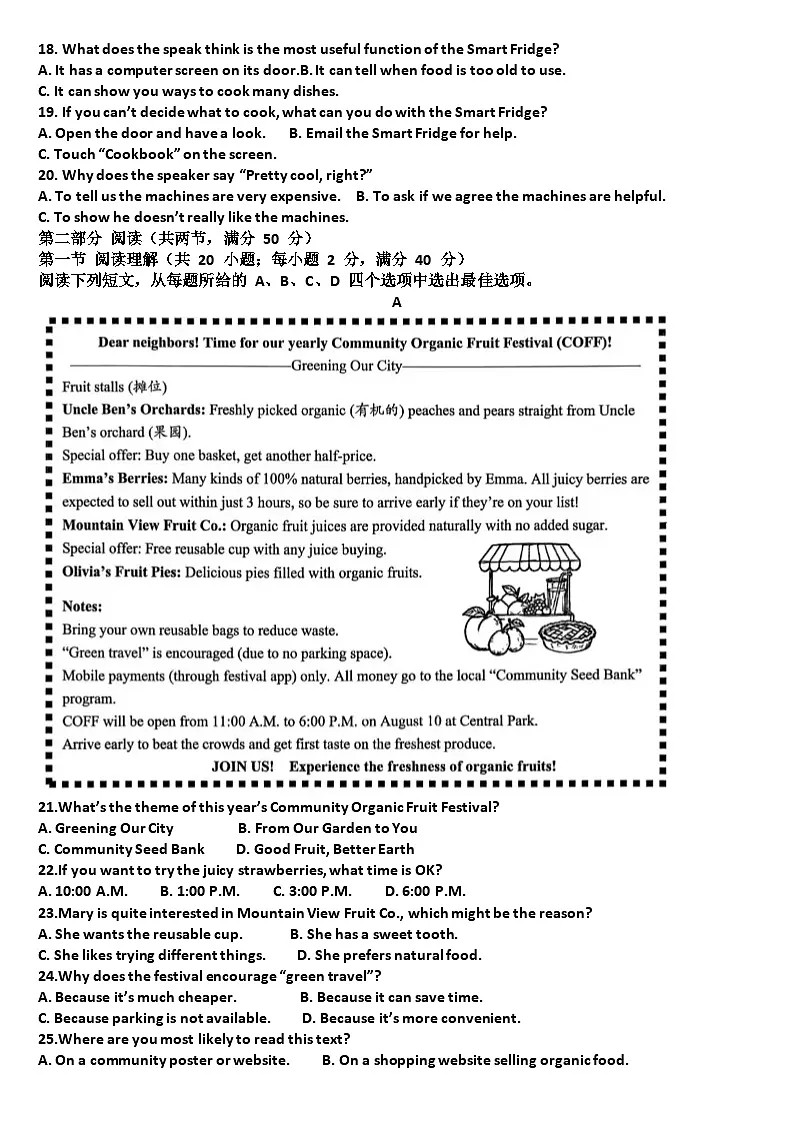
这是一份山东济南市市中区2025—2026学年九年级英语第一学期期中考试试题(含答案),共9页。
这是一份山东济南历城区2025—2026学年九年级英语第一学期期中考试试题(含答案),共8页。
这是一份2025~2026学年济南市”市中区“九年级英语第一学期期末考试试题以及答案,共10页。
注册成功

在线客服
添加在线客服
获取1对1服务
官方微信
关注“教习网”公众号
打开微信就能找资料
赛课定制
添加在线客服
获取1对1定制服务
职称咨询
添加在线客服
获取1V1专业指导服务

免费福利

(1).png)