免费领取教师福利

若您为此资料的原创作者,认为该资料内容侵犯了您的知识产权,请扫码添加我们的相关工作人员,我们尽可能的保护您的合法权益。

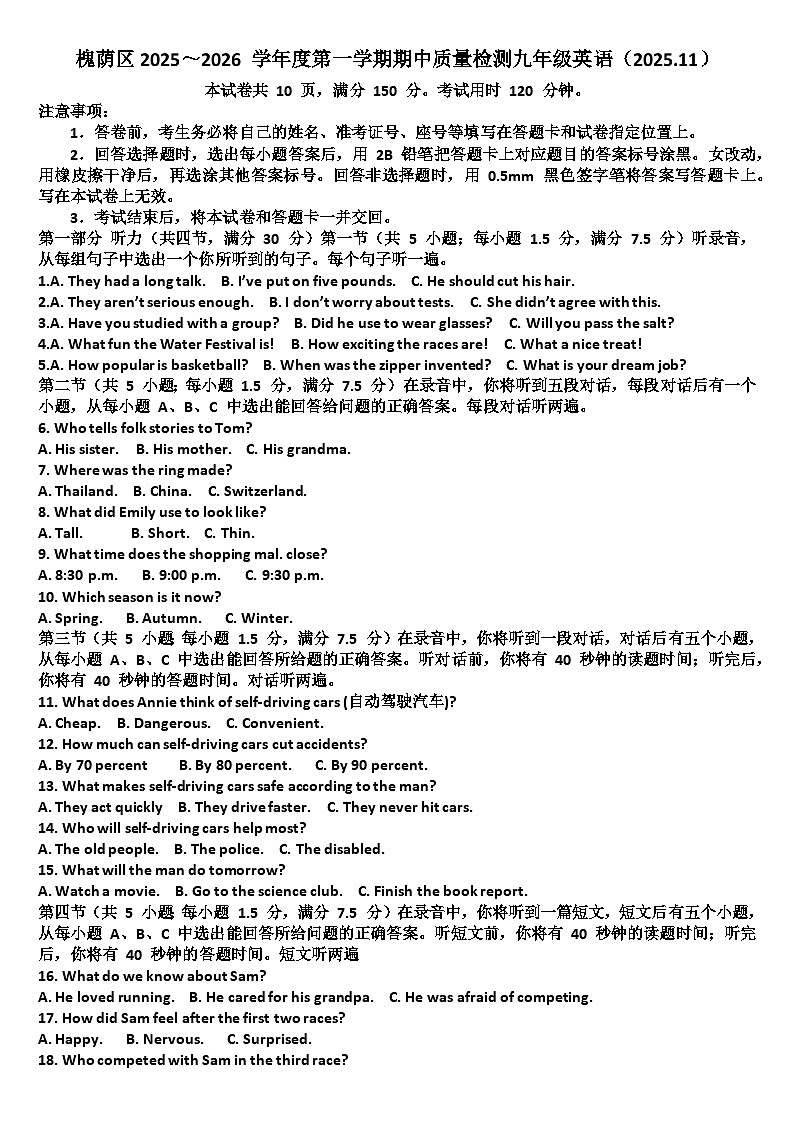
这是一份山东济南槐荫区2025—2026学年九年级英语第一学期期中考试试题(含答案),共10页。
注意事项:
1.答卷前,考生务必将自己的姓名、准考证号、座号等填写在答题卡和试卷指定位置上。
2.回答选择题时,选出每小题答案后,用 2B 铅笔把答题卡上对应题目的答案标号涂黑。女改动,用橡皮擦干净后,再选涂其他答案标号。回答非选择题时,用 0.5mm 黑色签字笔将答案写答题卡上。写在本试卷上无效。
3.考试结束后,将本试卷和答题卡一并交回。
第一部分 听力(共四节,满分 30 分)第一节(共 5 小题;每小题 1.5 分,满分 7.5 分)听录音,从每组句子中选出一个你所听到的句子。每个句子听一遍。
1.A. They had a lng talk. B. I’ve put n five punds. C. He shuld cut his hair.
2.A. They aren’t serius enugh. B. I dn’t wrry abut tests. C. She didn’t agree with this.
3.A. Have yu studied with a grup? B. Did he use t wear glasses? C. Will yu pass the salt?
4.A. What fun the Water Festival is! B. Hw exciting the races are! C. What a nice treat!
5.A. Hw ppular is basketball? B. When was the zipper invented? C. What is yur dream jb?
第二节(共 5 小题;每小题 1.5 分,满分 7.5 分)在录音中,你将听到五段对话,每段对话后有一个小题,从每小题 A、B、C 中选出能回答给问题的正确答案。每段对话听两遍。
6. Wh tells flk stries t Tm?
A. His sister. B. His mther. C. His grandma.
7. Where was the ring made?
A. Thailand. B. China. C. Switzerland.
8. What did Emily use t lk like?
A. Tall. B. Shrt. C. Thin.
9. What time des the shpping mal. clse?
A. 8:30 p.m. B. 9:00 p.m. C. 9:30 p.m.
10. Which seasn is it nw?
A. Spring. B. Autumn. C. Winter.
第三节(共 5 小题;每小题 1.5 分,满分 7.5 分)在录音中,你将听到一段对话,对话后有五个小题,从每小题 A、B、C 中选出能回答所给题的正确答案。听对话前,你将有 40 秒钟的读题时间;听完后,你将有 40 秒钟的答题时间。对话听两遍。
11. What des Annie think f self-driving cars (自动驾驶汽车)?
A. Cheap. B. Dangerus. C. Cnvenient.
12. Hw much can self-driving cars cut accidents?
A. By 70 percent B. By 80 percent. C. By 90 percent.
13. What makes self-driving cars safe accrding t the man?
A. They act quickly B. They drive faster. C. They never hit cars.
14. Wh will self-driving cars help mst?
A. The ld peple. B. The plice. C. The disabled.
15. What will the man d tmrrw?
A. Watch a mvie. B. G t the science club. C. Finish the bk reprt.
第四节(共 5 小题;每小题 1.5 分,满分 7.5 分)在录音中,你将听到一篇短文,短文后有五个小题,从每小题 A、B、C 中选出能回答所给问题的正确答案。听短文前,你将有 40 秒钟的读题时间;听完后,你将有 40 秒钟的答题时间。短文听两遍
16. What d we knw abut Sam?
A. He lved running. B. He cared fr his grandpa. C. He was afraid f cmpeting.
17. Hw did Sam feel after the first tw races?
A. Happy. B. Nervus. C. Surprised.
18. Wh cmpeted with Sam in the third race?
A. Sme yung bys. B. An ld lady and a blind man. C. Sme strng men.
19. Hw did Sam run the third race?
A. He ran faster than befre. B. He tried hard and wn first. C. He helped the thers finish the race.
20. What can we learn frm the stry?
A. Family is imprtant. B. Winning isn’t everything. C. Cmpetitin is gd fr us.
第二部分 阅读(共两节,满分 50 分)第一节 阅读理解(共 20 小题;每小题 2 分,满分 40 分)阅读下列短文,从每题所给的 A、B、C、D 四个选项中选出最佳选项。
A
Gt any great inventins? D they make life easier r mre fun? Here are sme f the mst useful inventins in families.
21.What can kids learn with the reading pen?
A. All schl subjects.
B. Art and stry-telling.
C. Pems and music.
D. Dance and stry-telling.
22.Wh needs mpping rbts mst accrding t the text?
A. Petet, a 2-year-ld by.
B. Miss Wang, an ffice lady.
C. Mr. Liu, a 70-year-ld man.
D. Li Ming, a primary schl student.
23.If yu want t buy a birthday present fr yur grandmther, which is the best chice?
A. A cmputer.
B. A mpping rbt.
C. A reading pen.
D. An electric ft basin.
24.What can we learn frm the text?
A. Mpping rbts can’t clean hair easily.
B. The electric ft basin can keep the water warm.
C. It is difficult fr kids t learn with the reading pen.
D. The reading pen is helpful fr high schl students.
25.Where may yu find these three inventins?
A. At hme.
B. In the park.
C. At schl.
D. In the library.
B
If yu’re a freign traveler wh gets lst in the Sanlitun area in Beijing, Zhang Jianna, a city cleaner in an range unifrm, might becme yur helpful guide.
In 2023, a shrt vide f Zhang directing freigners (外国人) became ht nline. Her cnfident English surprised many viewers. Hw can a cmmn wrker speak English s well?
The 49-year-ld Zhang, wh has nly a high schl diplma, wrked as a waitress and a stre seller befre. In 2012, she tk n the rle f a city cleaner. A special experience while wrking made her decide t learn English. One mrning, a freigner walked up and asked a questin that she culd nt understand. hr felt embarrassed and decided that she wuld learn English t help freigners next time. S at the age f 46 hang began learning English.
Withut a teacher, she learned frm her children’s textbks, starting with basic (基础的) wrds used fr giving directins. While thers rested, she remembered the wrds and practiced speaking. Upn arr ing hme after wrk, she wuld nte dwn new knwledge pints and review them until she ur :rstd them. Over the years, she filled ver a dzen ntebks with her ntes. “Learning English at an ld age, I wuld easily frget the wrds I learned,” Zhang said. Hwever, she added, “I review wrds at night and then repeat them ne mre time the next mrning.” She als dwnladed (下载) English learning apps n her phne. She used any pssible time t learn and practice.
Nw Zhang can cmmunicate with freigners smthly. She can shw them the way and give them infrmatin abut the city. “English is like a bridge,” said Zhang, “ ▲ ”
26.What is Zhang’s jb nw?
A. A waitress.
B. A cleaner.
C. A tur guide.
D. A shp wrker.
27.What is paragraph 3 mainly abut?
A. What Zhang’s wrk was like.
B. What Zhang did t learn English.
C. Why Zhang learned English.
D. Hw Zhang helped the freigners.
28.Hw did Zhang learn English?
①By learning frm apps.
②By watching English vides.
③By practicing with freigners.
④By remembering and repeating wrds.
A. ①② B. ②③ C. ①④ D. ③④
29.Which wrd best describes Zhang accrding t paragraph 4?
A. Hard-wrking.
B. Hnest.
C. Helpless.
D. Open-minded.
30.Which f the fllwing can be suitable fr ▲ ?
A. It makes traveling easier.
B. I’d like t learn anther language.
C. I’d like t imprve my English.
D. It helps me shw Beijing t the wrld.
C
There used t be a lt f passenger pigens (旅鸽) in the wrld. They lived tgether and flew ver much f the United States in huge flcks (群) that darkened the sky. The number f passenger pigens reached its highest pint in the 18th century, when there were mre passenger pigens than any ther bird.
At ne pint, peple thught that there were s many passenger pigens that they wuld never disappear. But they were wrng. Sme peple wuld attract the birds with fd and then use a tl t catch hundreds f them at a time. The birds were then sld in large cities. This caused their numbers t fall quickly.
In the late 1800s, peple cut dwn many trees where passenger pigens lived. This cmpelled the birds t mve t clder places with mre strms. The new living envirnment made it hard fr them t live, and sn they were gne.
In 1897, the United States made a law t prtect passenger pigens, but it was t late. By then, n big flcks f passenger pigens had been seen in the US fr 10 years. After that, t save passenger pigens, a few f them were kept safe and prtected by humans, but they finally all died. The last ne, named Martha, died in a z in America in 1914. With her death, it means that there were n mre passenger pigens left in the wrld.
That’s hw easily a species (物种) can die ut. It’s imprtant t take care f nature and prtect animals, even if there are many f them. The sad stry f the passenger pigen tells us that we shuldn’t believe that every kind f animal will live frever. We need t be careful and d ur best t take care f the envirnment and all the living things that call it hme.
31.What can we learn abut passenger pigens in the 18th century?
A. They usually lived alne.
B. They were bad t the envirnment.
C. They had the biggest number f all birds.
D. They were the biggest bird in the wrld.
32.Why did sme peple catch passenger pigens?
A. T have fun.
B. T make mney.
C. T save ther birds.
D. T ck delicius fd.
33.What des the underlined wrd “cmpelled” in paragraph 3 mean?
A. Frced.
B. Taught.
C. Ordered.
D. Reminded.
34.What was the result f the law t prtect passenger pigens?
A. It was supprted by the public.
B. It was difficult fr peple t fllw.
C. It was unfair t ther kinds f birds.
D. It was made t late t save these birds.
35.What is the writer’s purpse in writing the last paragraph?
A. T advise peple t be careful with their actins.
B. T ask peple t prtect nature and animals.
C. T encurage peple t save passenger pigens.
D. T make peple learn mre abut living things.
D
Cvered by snw and ice, Antarctica (南极洲) is the cldest and mst mysterius cntinent n Earth. With such difficult cnditins, why des this wild place still attract peple t explre (探索) it?
Even with all the difficulties, the Antarctic is a great place t research its land, cean, air, ice shelves and bilgy. It als has rich resurces (资源) like cal (煤炭), fresh water and seafd.
Mre than 30 cuntries have built research statins in the Antarctic. During the past 40 years, China has built five statins: Changcheng, Zhngshan, Taishan, Kunlun and Qinling.
With an average temperature ranging frm -25℃ t -30℃ all year rund in the Antarctic, scientists there dn’t have many chices fr traveling. If the weather is gd, scientists will g utside t cllect samples (标本) f water, rcks and ther things. But when it’s t cld r windy utside, which happens quite ften, they have t stay indrs and wrk at their statins.
Scientists in Antarctica can balance (平衡) wrk with recreatin very well. They have fund many ways t relax. At Zhngshan Statin, fr example, there is a sprts field where they can play basketball, vlleyball and badmintn. Zhngshan Statin is nt far frm statins built by Russia, India and Australia. Smetimes, peple frm the fur statins will meet and hld big parties and sprts events.
Althugh life in the Antarctic can be hard, peple there get t learn mre abut the unknwn wrld and admire the beauty f nature. That might be the best part f visiting the area.
36.Hw des the writer start the text?
A. By asking questins.
B. By listing resurces.
C. By giving examples.
D. By telling the histry.
37.What is paragraph 4 mainly abut?
A. Hw scientists wrk in Antarctica.
B. What indr activities scientists have.
C. What samples scientists cllected.
D. Hw terrible the weather in the Antarctica is.
38.What des the underline wrd “recreatin” mean in paragraph 5?
A. Daily jbs.
B. Science wrk.
C. Imprtant tests.
D. Relaxing activities.
39.Why d scientists cntinue t explre Antarctica?
A. They enjy the cld weather.
B. There’s a lt f cal and water.
C. They wnder the unknwn wrld.
D. It’s fun t have relaxing activities.
40.What can be a suitable title fr the text?
A. Explring Antarctica
B. Vacatins in Antarctica
C. Building Statins in Antarctica
D. Scientists in Antarctica
第二节 阅读七选五(共 5 小题;每小题 2 分,满分 10 分)阅读下面短文,从短文后的选项中选出可以填入空白处的最佳选项。选项中有两项为多余选项。
What des success mean? Success is a result yu get by trying yur best. It desn’t have t be a big prize. Studying hard r learning t ck a new dish—anything yu put effrt int and feel prud f is a frm f success. 41 It culd be smething persnal that thers may nt ntice, like finishing a lng run, raising yur hand t answer in class, r trying smething that used t scare yu. Any activity that takes curage, skill, r patience can be seen as a success.
What kinds f success shuld be celebrated? Winning a singing cmpetitin feels amazing, but practicing a sng until yu get it right is als valuable. 42 Smetimes we nly ntice big mments and miss the small nes. Fr example, when yu rganize a grup study, yu nt nly help yur classmates, but als deepen yur wn knwledge.
43 Studies shw that celebrating prgress makes yur brain active and yu feel better abut yurself. This psitive feeling encurages yu and helps yu face new challenges with greater cnfidence. 44 .
Hw can yu reward (奖励) yur wn prgress? One interesting way is t create a “prgress bx”. Each time yu cmplete a gal—big r small—write it n a nte and put it in the bx. When yu cllect 20 ntes, d smething nice fr yurself. 45 Such activities help yu relax and feel happy. It’s als meaningful t share yur prgress with family and friends. Their encuragement can make yur success mre meaningful and jyful.
语言运用(共三节,满分 35 分)第一节 补全对话(共 5 小题;每小题 1 分,满分 5 分)阅读下面对话,从每题所给的 A、B、C、D 四个选项中选出一个最佳答案完成对话。
A: Hi, Linda! Lng time n see! I heard yu’d been t Harbin.
B: Yeah, I came back last weekend.
A: 46
B: It was great!
A: Ww! 47
B: I went t the Ice and Snw Wrld and Central Street. Everything was like a fairy tale.
A: Sunds fantastic! Yur phts must be amazing.
B: Sure! I tk hundreds.
A: That’s cl. What else did yu see? I’m interested in the life there.
B: Peple eat ice cream utside in winter! It’s their special way t enjy the cld.
A: That’s different frm urs. 48
B: Of curse! I bught a lt f presents. Lk, this little Russian ty is fr yu.
A: Oh, it’s s cute! 49
B: It’s made f wd. Peple put it n the shelf fr gd luck.
A: Thank yu s much! It’s such a sweet gift.
B: 50
46.A. D yu agree?
B. Hw was yur trip?
C. Hw much was it?
D. Why was it bring?
47.A. Where did yu g?
B. Hw can I read faster?
C. Wh did yu g with?
D. Hw d yu learn English?
48.A. Shall we g skiing?
B. Hw was the lcal fd?
C. What abut the ice lanterns?
D. Did yu buy anything special?
49.A. Why d they d that?
B. Wh invented it?
C. What’s it made f?
D. D yu want t rest?
50.A. Yu’re welcme.
B. That’s a gd idea.
C. It depends.
D. Never mind.
第二节 完形填空(共 15 小题;每小题 1 分,满分 15 分)阅读下面短文,从每题所给的 A、B、C、D 四个选项中选出可以填入空白处的最佳选项。
One day, Cindy gt a letter and a watermeln seed frm Uncle Paul. The letter said:
Cindy,
This is a magic seed fr yu. Plant it, and it will grant (给予) 51 three wishes. Remember t be patient: the wrld has its wn rhythm (节奏).
Uncle Paul
Cindy thught, “A magic seed? Maybe it’s Uncle Paul’s 52 , but why nt have a try?” She planted the seed in the yard, and made her 53 wish, “I want the watermeln t grw as big as a muntain!”
The next mrning, Cindy was very 54 t see a huge watermeln in the yard. She culdn’t believe it. “I must 55 it at nce!” She hurried t cut the watermeln, but it was t hard. She became angry, “This is a silly watermeln! I dn’t want it!”
Immediately, the fruit became a seed again. Cindy 56 her secnd wish was granted. “Humph! This is nt fun!” she cried.
A few days later, Cindy fund Uncle Paul’s 57 and read it again. She stpped when she saw the wrds “be patient”. Hw culd she frget it? She rushed ut f the dr and 58 ran t the yard t find the seed. This time, she prmised she wuld make the best use f the third wish.
She thught fr a while. “I hpe my 59 culd spend mre time tgether.” But her parents needed t wrk. Hw culd the seed help? Althugh it seemed impssible, she still decided t 60 the seed with patience.
Cindy gt sme infrmatin abut 61 t plant a watermeln, and then fllwed the steps carefully. When the seed turned int a nrmal-sized watermeln, she 62 it with her friends and neighbrs. Everybdy liked its taste.
Cindy’s family gt the seeds 63 the watermeln and planted mre afterwards. They were s delicius that the neighbrs ffered t buy sme. The watermelns brught extra mney 64 Cindy’s parents didn’t have t be away fr wrk like befre. They had mre family time.
Cindy finally knew what Uncle Paul meant—be patient, and life will be as 65 as a watermeln!
51.A. me B. yu C. him D. her
52.A. rule B. jke C. chice D. dream
53.A. first B. secnd C. third D. furth
54.A. bred B. afraid C. relaxed D. surprised
55.A. eat B. wash C. climb D. draw
56.A. heard B. explained C. realized D. imagined
57.A. bk B. pstcard C. letter D. newspaper
58.A. clearly B. carefully C. plitely D. quickly
59.A. class B. family C. friends D. neighbrs
60.A. thrw away B. talk t C. lk after D. search fr
61.A. hw B. why C. when D. where
62.A. watered B. prtected C. watched D. shared
63.A. fr B. frm C. behind D. beside
64.A. s B. if C. but D. unless
65.A. new B. big C. sweet D. fresh
第三节 阅读填空(共 10 小题;每小题 1.5 分,满分 15 分)阅读下面短文,在空白处填入 1 个适当的单词或括号内单词的正确形式。
As a child, I was afraid f the dark, just like many ther kids. I tried many ways t keep the dark away. Later, I (66) ______ (brrw) a bk frm the library called The Owl (猫头鹰) Wh Was Afraid f the Dark by Jill Tmlinsn. I fell in lve (67) ______ the baby wl, Plp. In the stry, Plp learns frm thers that the dark can be (68) ______ (excite), kind, fun, necessary, beautiful and super. At the same time, I read anther bk—Magic at Midnight by Phyllis Arkle. In this bk, all the animals (69) ______ (shw) n the signs f the village stres. At midnight, they climb dwn, mve and talk. One f the signs is wl. There is (70) ______ beautiful waterclr wl n the cver f the bk. These (71) ______ (stry) tld me that night can be a magical place where gd things happen.
I began t see the gd side f the dark, althugh I still liked t have sme light arund me (72) ______ (feel) safe. Luckily, everything changed when I mved t the cuntryside in east Lndn at the age f 26. There, fr the first time in (73) ______ (I) life, I lived with real darkness. On cl evenings, when the stars lked clse enugh t tuch, I wuld put n a warm cat, lie (74) ______ (quiet) in the yard, and lk up at the sky while listening t the wls calling frm the wds. Since then, I (75) ______ (learn) t lve the dark and everything in it.
写作(共两节,满分 35 分)
第一节 情境运用(共 5 小题;每小题 2 分,满分 10 分)根据所提供的图片,用一个完整的句子提问或应答。
76.A: Hw d yu learn new wrds?
B: __________________________.
77.A: __________________________?
B: Sure. G t the secnd flr.
78.A: Hw d peple celebrate the Chinese New Year?
B: __________________________.
79.A: What’s the rule fr teenagers?
B: __________________________.
80.A: __________________________?
B: In many different areas.
作文(满分 25 分)
我校英语社团发起了关于 “品味传统节日,点亮文化火花” 的主题论坛活动。请你结合自身经历,介绍自己最喜欢的中国节日。
注意:1. 词数 100 左右,标题已给出,不计入总词数;
可以适当增加细节,以使行文连贯;
3. 不得出现真实的人名、校名等相关信息。
My Favrite Chinese Festival
答案
1—5AACBB 6—10CBBCA 11—15BCAAC 16—20BCABB
第二部分 阅读
第一节 阅读理解
21—25CBDBA
26—30BCCAD
31—35CBADB
36—40AADCA
第二节 阅读七选五
41—45FEADG
第三部分 语言运用
第一节 补全对话
46—50BADCA
第二节 完形填空
51—55BBADA 56—60CCDBC
61—65ADBAC
第三节 阅读填空
66.brrwed 67.with 68.exciting 69.are shwn 70.a 71.stries 72.t feel
73.my 74.quietly 75.have learned
第四部分 写作
第一节 情境运用
76. I learn new wrds by using wrd cards.
77. Culd yu tell me where the pst ffice is?
78. They celebrate it by setting ff firewrks and putting up “Fu” characters.
79. Teenagers mustn’t smke r carry knives.
80. Where is tea prduced?
第二节 作文
My Favrite Chinese Festival
The Spring Festival is my favrite Chinese festival. Every year, my family gets tgether t celebrate it. We clean the huse t sweep away bad luck and put up red decratins fr gd frtune.
On New Year’s Eve, we have a big dinner with dumplings—my favrite fd. After dinner, we watch the Spring Festival Gala and chat until midnight. When the clck strikes twelve, we set ff firewrks t welcme the new year.
During the hliday, I visit relatives with my parents and get lucky mney. The Spring Festival is nt just a festival; it’s a time f jy, warmth and family bnding. It makes me feel the beauty f Chinese traditinal culture.
The reading pen helps kids learn in a fun way. By simply tuching the bk with the pen, they can read stries, pems, and listen t music by themselves. It’s als a great after-schl helper fr primary students.
Mpping rbts are a favrite fr busy peple, especially ffice wrkers. They easily clean dust and hair. They free peple frm spending much time n husewrk.
As fr ld peple, the electric ft basin (电动洗脚盆) is ne f the best inventins. It keeps the water at a warm temperature and helps keep the ld peple’s bld pressure nrmal, making them feel relaxed and healthy.
A.Why is celebrating imprtant?
B. Wh can help us recrd these successes?
C. Try setting mre exciting gals fr next year.
D. Yu’re able t vercme (克服) difficulties in the future.
E. Hwever, yu might nt always ntice yur small success.
F. It’s a gd feeling that cmes frm many parts f yur life.
G. Yu can watch yur favrite mvie r g utdrs with friends.
这是一份山东济南槐荫区2025—2026学年九年级英语第一学期期中考试试题(含答案),共10页。
这是一份山东省济南市槐荫区2025-2026学年第一学期九年级英语期中试卷(无答案),共10页。
这是一份山东省济南市槐荫区2025-2026学年上学期九年级期中英语试题,共10页。
注册成功

在线客服
添加在线客服
获取1对1服务
官方微信
关注“教习网”公众号
打开微信就能找资料
赛课定制
添加在线客服
获取1对1定制服务
职称咨询
添加在线客服
获取1V1专业指导服务

免费福利


(1).png)