免费领取教师福利
若您为此资料的原创作者,认为该资料内容侵犯了您的知识产权,请扫码添加我们的相关工作人员,我们尽可能的保护您的合法权益。

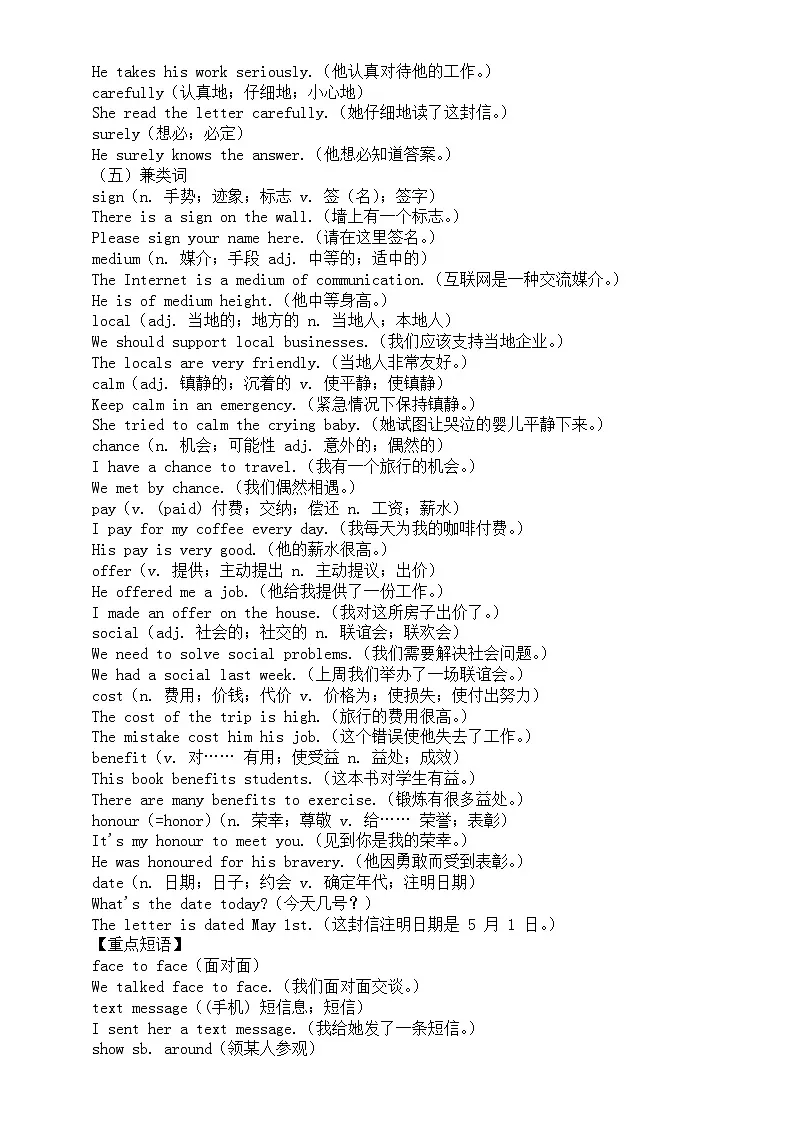
这是一份人教版(2024)八年级上册(2024)Unit 8 Let's Communicate! Section A Pronunciation导学案,共5页。学案主要包含了重点单词,重点短语,重点句型,重点语法等内容,欢迎下载使用。
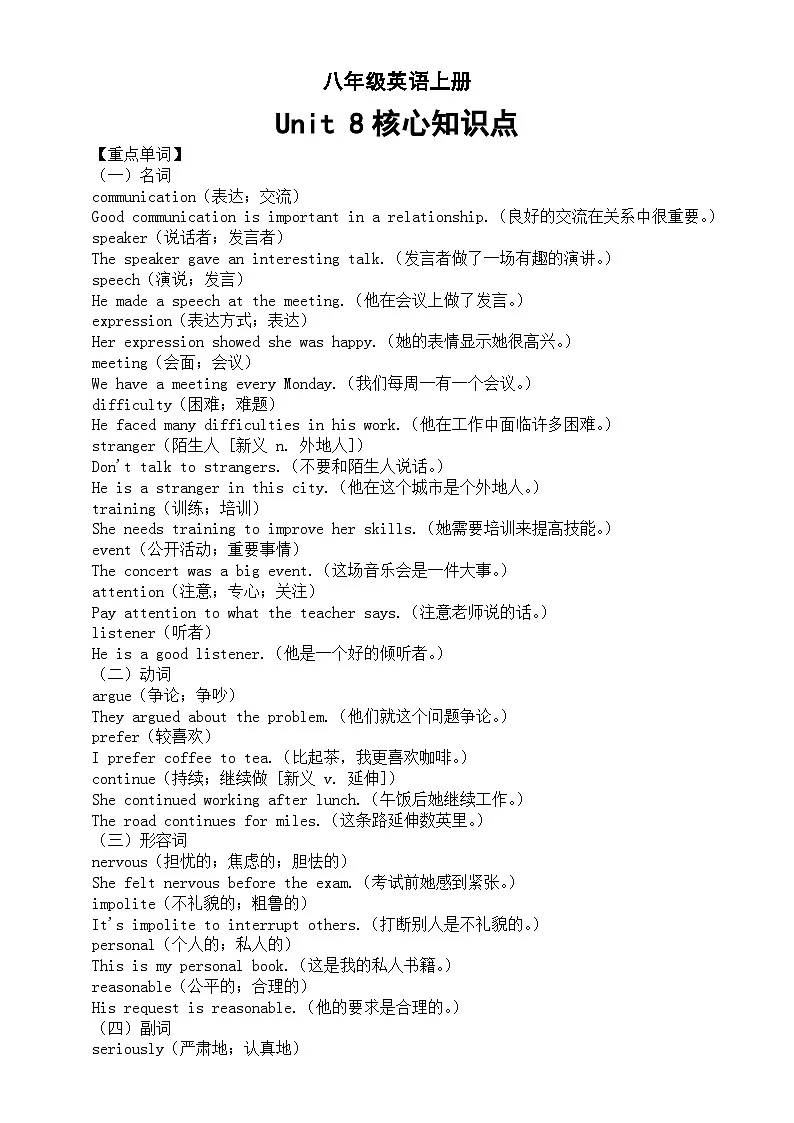
【重点单词】
(一)名词
cmmunicatin(表达;交流)
Gd cmmunicatin is imprtant in a relatinship.(良好的交流在关系中很重要。)
speaker(说话者;发言者)
The speaker gave an interesting talk.(发言者做了一场有趣的演讲。)
speech(演说;发言)
He made a speech at the meeting.(他在会议上做了发言。)
expressin(表达方式;表达)
Her expressin shwed she was happy.(她的表情显示她很高兴。)
meeting(会面;会议)
We have a meeting every Mnday.(我们每周一有一个会议。)
difficulty(困难;难题)
He faced many difficulties in his wrk.(他在工作中面临许多困难。)
stranger(陌生人 [新义 n. 外地人])
Dn't talk t strangers.(不要和陌生人说话。)
He is a stranger in this city.(他在这个城市是个外地人。)
training(训练;培训)
She needs training t imprve her skills.(她需要培训来提高技能。)
event(公开活动;重要事情)
The cncert was a big event.(这场音乐会是一件大事。)
attentin(注意;专心;关注)
Pay attentin t what the teacher says.(注意老师说的话。)
listener(听者)
He is a gd listener.(他是一个好的倾听者。)
(二)动词
argue(争论;争吵)
They argued abut the prblem.(他们就这个问题争论。)
prefer(较喜欢)
I prefer cffee t tea.(比起茶,我更喜欢咖啡。)
cntinue(持续;继续做 [新义 v. 延伸])
She cntinued wrking after lunch.(午饭后她继续工作。)
The rad cntinues fr miles.(这条路延伸数英里。)
(三)形容词
nervus(担忧的;焦虑的;胆怯的)
She felt nervus befre the exam.(考试前她感到紧张。)
implite(不礼貌的;粗鲁的)
It's implite t interrupt thers.(打断别人是不礼貌的。)
persnal(个人的;私人的)
This is my persnal bk.(这是我的私人书籍。)
reasnable(公平的;合理的)
His request is reasnable.(他的要求是合理的。)
(四)副词
seriusly(严肃地;认真地)
He takes his wrk seriusly.(他认真对待他的工作。)
carefully(认真地;仔细地;小心地)
She read the letter carefully.(她仔细地读了这封信。)
surely(想必;必定)
He surely knws the answer.(他想必知道答案。)
(五)兼类词
sign(n. 手势;迹象;标志 v. 签(名);签字)
There is a sign n the wall.(墙上有一个标志。)
Please sign yur name here.(请在这里签名。)
medium(n. 媒介;手段 adj. 中等的;适中的)
The Internet is a medium f cmmunicatin.(互联网是一种交流媒介。)
He is f medium height.(他中等身高。)
lcal(adj. 当地的;地方的 n. 当地人;本地人)
We shuld supprt lcal businesses.(我们应该支持当地企业。)
The lcals are very friendly.(当地人非常友好。)
calm(adj. 镇静的;沉着的 v. 使平静;使镇静)
Keep calm in an emergency.(紧急情况下保持镇静。)
She tried t calm the crying baby.(她试图让哭泣的婴儿平静下来。)
chance(n. 机会;可能性 adj. 意外的;偶然的)
I have a chance t travel.(我有一个旅行的机会。)
We met by chance.(我们偶然相遇。)
pay(v. (paid) 付费;交纳;偿还 n. 工资;薪水)
I pay fr my cffee every day.(我每天为我的咖啡付费。)
His pay is very gd.(他的薪水很高。)
ffer(v. 提供;主动提出 n. 主动提议;出价)
He ffered me a jb.(他给我提供了一份工作。)
I made an ffer n the huse.(我对这所房子出价了。)
scial(adj. 社会的;社交的 n. 联谊会;联欢会)
We need t slve scial prblems.(我们需要解决社会问题。)
We had a scial last week.(上周我们举办了一场联谊会。)
cst(n. 费用;价钱;代价 v. 价格为;使损失;使付出努力)
The cst f the trip is high.(旅行的费用很高。)
The mistake cst him his jb.(这个错误使他失去了工作。)
benefit(v. 对…… 有用;使受益 n. 益处;成效)
This bk benefits students.(这本书对学生有益。)
There are many benefits t exercise.(锻炼有很多益处。)
hnur(=hnr)(n. 荣幸;尊敬 v. 给…… 荣誉;表彰)
It's my hnur t meet yu.(见到你是我的荣幸。)
He was hnured fr his bravery.(他因勇敢而受到表彰。)
date(n. 日期;日子;约会 v. 确定年代;注明日期)
What's the date tday?(今天几号?)
The letter is dated May 1st.(这封信注明日期是 5 月 1 日。)
【重点短语】
face t face(面对面)
We talked face t face.(我们面对面交谈。)
text message((手机) 短信息;短信)
I sent her a text message.(我给她发了一条短信。)
shw sb. arund(领某人参观)
He shwed us arund the museum.(他领我们参观了博物馆。)
in persn(亲自;亲身)
She went t the meeting in persn.(她亲自去参加了会议。)
make up (with sb.)(与…… 言归于好)
They made up with each ther after the argument.(争吵后他们言归于好了。)
right away(立即;马上)
He left right away.(他马上离开了。)
wrry abut(为…… 担心)
Dn't wrry abut me.(不要为我担心。)
argue with sb.(与某人争论)
He argued with his friend abut the game.(他和朋友就比赛争论。)
drp sb. a line(给…… 写信):
Drp me a line when yu arrive.(你到达时给我写封信。)
scial media(社交媒体)
Many peple use scial media every day.(许多人每天使用社交媒体。)
find ut(查明;弄清(情况))
We need t find ut the truth.(我们需要查明真相。)
be yurself(行为自然;不做作)
Just be yurself in the interview.(面试时只要做你自己。)
benefit... frm...(从…… 获益)
We can benefit a lt frm reading.(我们能从阅读中获益良多。)
take place(发生;进行)
The cncert will take place next week.(音乐会将于下周举行。)
pay attentin (t...)(注意;关注)
Pay attentin t the teacher's explanatin.(注意老师的讲解。)
shw interest in sth.(对…… 表现出兴趣)
He shws interest in science.(他对科学表现出兴趣。)
mve n (t sth.)(换话题;开始做(别的事))
Let's mve n t the next tpic.(让我们换个话题。)
keep(...) away frm...((使) 远离;避免…… 靠近)
Keep children away frm the fire.(让孩子远离火。)
make a vide call(进行视频通话)
We made a vide call t ur grandparents.(我们和祖父母进行了视频通话。)
sign language(手语)
She can speak sign language.(她会打手语。)
n time(准时)
He arrived at the meeting n time.(他准时到达了会议。)
pick up(开车接(某人))
I'll pick yu up at the statin.(我会去车站接你。)
lcal fd(当地食物)
We tried sme delicius lcal fd.(我们尝了一些美味的当地食物。)
the speech n...(关于…… 的演讲)
There will be a speech n envirnment.(将有一场关于环境的演讲。)
stay calm(保持冷静)
Stay calm when yu face difficulties.(面对困难时保持冷静。)
build trust(建立信任)
It takes time t build trust.(建立信任需要时间。)
be careful with sth.(谨慎 / 小心(对待)某事)
Be careful with the glass.(小心这个玻璃杯。)
【重点句型】
if 引导的条件状语从句
If it rains tmrrw, we will stay at hme.(如果明天下雨,我们将待在家里。)
find it + adj. + t d sth.
I find it easy t learn English.(我发现学英语很容易。)
It is implite t d sth.
It is implite t talk ludly in public.(在公共场合大声说话是不礼貌的。)
It wuld be a great hnur t have yu speak at ur schl.
It wuld be a great hnur t have yu visit ur city.(您能访问我们的城市是我们极大的荣幸。)
【重点语法】
if 引导的条件状语从句
if 意为 “如果”,引导条件状语从句时,从句放在主句前后均可。若放在主句前,从句后面要用逗号与主句隔开。
1、时态
在含有 if 引导的条件状语从句的复合句中,主句有下列情况时,从句用一般现在时表将来。
主句为一般将来时(主将从现):
If he cmes, I will invite him t dinner.(如果他来,我会邀请他吃晚饭。)
主句是祈使句(主祈从现):
Call me if yu need help.(如果你需要帮助,给我打电话。)
主句含有情态动词(主情从现):
If yu study hard, yu can get gd grades.(如果你努力学习,你能取得好成绩。)
2、与其他句式之间的转换
与“祈使句 + and/r + 一般将来时的句子” 进行转换,and 在句意上表示顺承关系,r 表示转折关系。
If yu wrk hard, yu will succeed. = Wrk hard, and yu will succeed. = Wrk hard, r yu wn't succeed.(如果你努力工作,你会成功。= 努力工作,你就会成功。= 不努力工作,你就不会成功。)
借助介词 withut 或 with 来转换条件状语从句:
If there is n air, we can't live. = We can't live withut air.(如果没有空气,我们不能生存。= 没有空气我们不能生存。)
If yu help me, I can finish it. = With yur help, I can finish it.(如果你帮助我,我能完成它。= 有你的帮助,我能完成它。)
if 引导的条件状语从句的否定形式可以借助连词 unless 来改写:
unless 引导条件状语从句,表示 “除非,如果不”,相当于 if... nt。如果主句为一般将来时、祈使句或者含有情态动词的句子时,unless 引导的条件状语从句用一般现在时表示将来。
Yu wn't pass the exam if yu dn't study hard. = Yu wn't pass the exam unless yu study hard.(如果你不努力学习,你不会通过考试。= 除非你努力学习,否则你不会通过考试。)
3、if 引导的条件状语从句和宾语从句的辨析
if 引导的条件状语从句意为 “如果……”,其时态遵循 “主将从现” 原则:
If she cmes tmrrw, I will tell her the news.(如果她明天来,我会告诉她这个消息。)
if 引导的宾语从句意为 “是否……”,其时态受主句谓语动词的限制:
若主句谓语动词为一般过去时,if 引导的宾语从句要用相应的过去时态;若主句谓语动词为一般现在时,if 引导的宾语从句要根据实际情况来使用恰当的时态。
He asked if I was free.(他问我是否有空。);I dn't knw if he will cme.(我不知道他是否会来。)
这是一份人教版(2024)八年级上册(2024)Unit 8 Let's Communicate! Section A Pronunciation导学案,共5页。学案主要包含了重点单词,重点短语,重点句型,重点语法等内容,欢迎下载使用。
这是一份人教版(2024)八年级上册(2024)Unit 8 Let's Communicate! Section A导学案,共16页。学案主要包含了单元词汇,单元重点,完形填空等内容,欢迎下载使用。
这是一份英语八年级上册(2024)Unit 8 Let's Communicate! Section B导学案及答案,共15页。学案主要包含了单元词汇,单元重点,完形填空等内容,欢迎下载使用。
注册成功

在线客服
添加在线客服
获取1对1服务
官方微信
关注“教习网”公众号
打开微信就能找资料
赛课定制
添加在线客服
获取1对1定制服务
职称咨询
添加在线客服
获取1V1专业指导服务

免费福利

.png)