免费领取教师福利


若您为此资料的原创作者,认为该资料内容侵犯了您的知识产权,请扫码添加我们的相关工作人员,我们尽可能的保护您的合法权益。

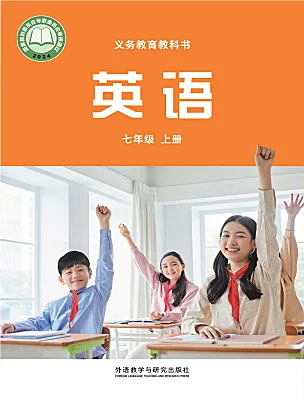
这是一份外研版(2024)七年级上册(2024)Unit 1 A new start优秀达标测试,文件包含七年级上册StarterUnit1单元培优测试题docx、外研版2024七年级上册StarterUnit1单元培优测试题听力原文及参考答案docx等2份试卷配套教学资源,其中试卷共20页, 欢迎下载使用。
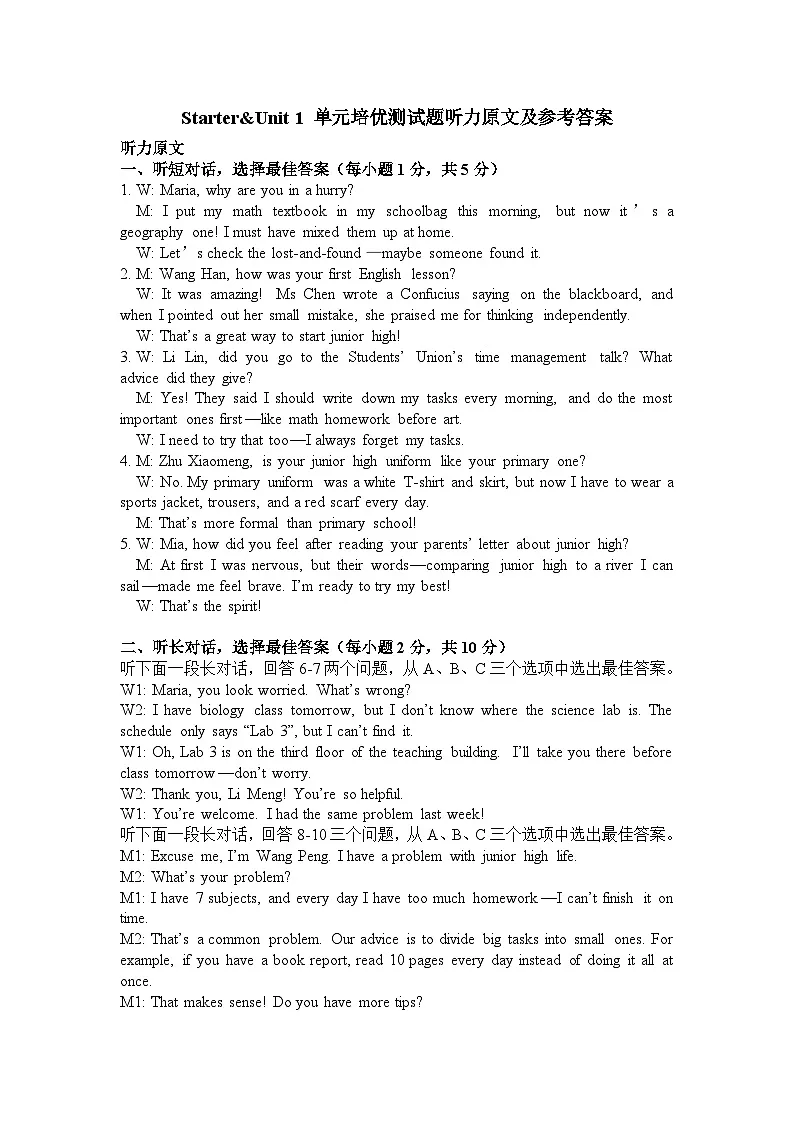
听力部分(共25分)
一、听短对话,选择最佳答案(每小题1分,共5分)
听下面5段短对话,每段对话后有一个问题,从A、B、C三个选项中选出最佳答案。
( )1. What d we knw abut Maria’s prblem with her schl things?
A. She frgt her pencil case and brrwed ne frm Li Meng.
B. She mixed up her math textbk with her gegraphy textbk.
C. She can’t find her red scarf and needs t buy a new ne.
( )2. Why des Wang Han think his first English lessn is special?
A. Ms Chen taught them a Cnfucius saying and encuraged them t think independently.
B. They played English games all class and didn’t have any hmewrk.
C. Ms Chen gave them beautiful ntebks as gifts fr their first lessn.
( )3. What advice des the Students’ Unin give t Li Lin abut time management?
A. She shuld finish all hmewrk befre jining after-schl activities.
B. She shuld write dwn tasks and fcus n the mst imprtant nes first.
C. She shuld ask her parents t help plan her daily schedule.
( )4. What is the difference between Zhu Xiameng’s junir high unifrm and her primary schl unifrm?
A. Her junir high unifrm has a red scarf, while her primary ne didn’t.
B. Her junir high unifrm is blue, while her primary ne was white.
C. Her junir high unifrm has a sprts jacket, while her primary ne was a T-shirt.
( )5. What can we infer abut Mia’s feeling after reading her parents’ letter?
A. She feels scared because she thinks junir high is t difficult.
B. She feels encuraged and ready t face challenges in junir high.
C. She feels angry because her parents wn’t prtect her anymre.
二、听长对话,选择最佳答案(每小题2分,共10分)
听下面一段长对话,回答6-7两个问题,从A、B、C三个选项中选出最佳答案。
( )6. What prblem des Maria have with her schl schedule?
A. She can’t tell the difference between gegraphy and bilgy classes.
B. She ften mixes up the time f her math and English classes.
C. She desn’t knw where the science lab is fr her bilgy class.
( )7. Hw des Li Meng help Maria slve this prblem?
A. She draws a map f the schl and marks the science lab.
B. She gives Maria a cpy f her wn schedule with class lcatins.
C. She prmises t take Maria t the science lab befre the first bilgy class.
听下面一段长对话,回答8-10三个问题,从A、B、C三个选项中选出最佳答案。
( )8. What des Wang Peng think is the hardest part f junir high?
A. Having t many subjects and nt enugh time t finish hmewrk.
B. Making new friends with classmates frm different primary schls.
C. Understanding difficult tpics in histry and gegraphy classes.
( )9. What advice des the Students’ Unin member give Wang Peng?
A. He shuld jin a study grup t get help with difficult subjects.
B. He shuld divide big tasks int small nes and finish them step by step.
C. He shuld ask his teacher t reduce the amunt f hmewrk.
( )10. When will Wang Peng attend the Students’ Unin’s time management wrkshp?
A. This Wednesday afternn after schl.
B. This Friday mrning befre the first class.
C. This Saturday afternn at 2:00 p.m. in the library.
三、听短文,选择最佳答案(每小题2分,共10分)
听下面一段短文,短文后有5个问题,从A、B、C三个选项中选出最佳答案。
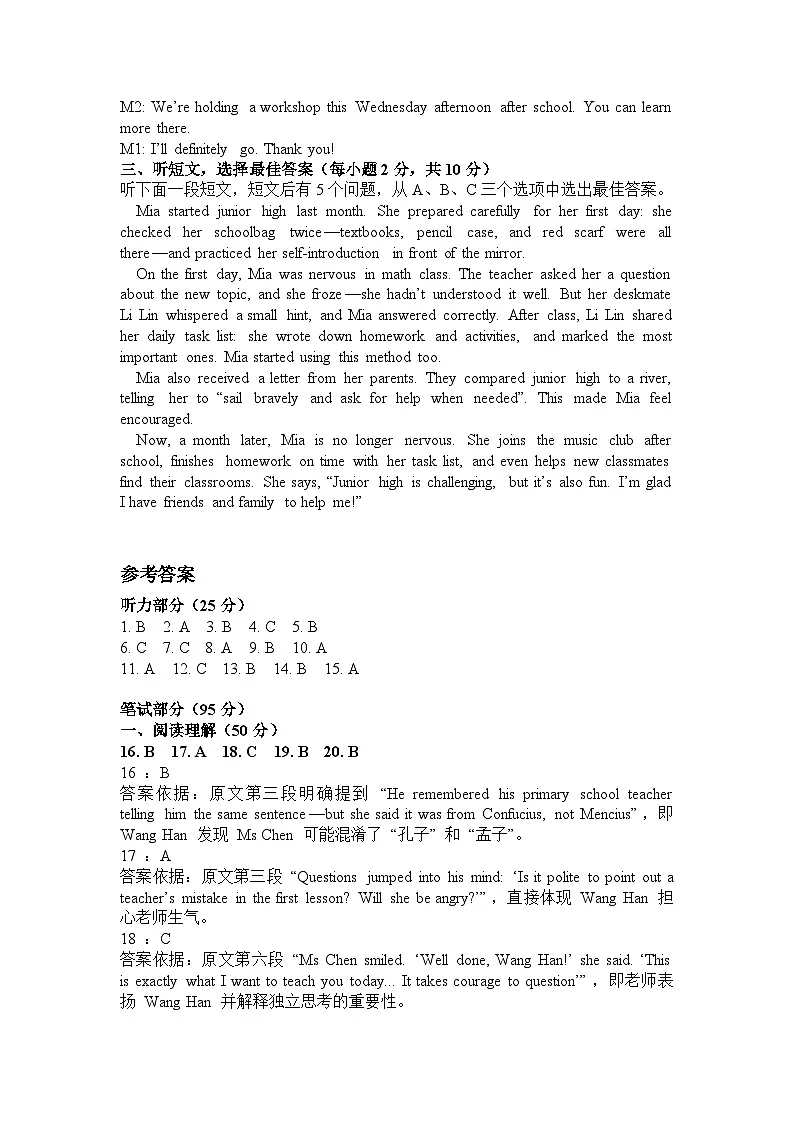
( )11. What did Mia d t prepare fr her first day f junir high?
A. She checked her schlbag twice and practiced intrducing herself.
B. She asked her primary schl teacher fr advice n junir high life.
C. She bught a new pencil case and a pair f sprts shes.
( )12. Why did Mia feel nervus in her first math class?
A. She culdn’t understand the teacher’s explanatin f the new tpic.
B. She frgt t bring her math textbk and had t share with a classmate.
C. She was asked t answer a questin but didn’t knw the answer.
( )13. Wh helped Mia slve her prblem with time management?
A. Her parents, wh wrte a letter with time-planning tips.
B. Her deskmate Li Lin, wh shared her daily task list.
C. Her English teacher Ms Chen, wh taught her t make a schedule.
( )14. Hw des Mia feel abut junir high life nw?
A. She feels bred because there are t many classes.
B. She feels cnfident and enjys bth studying and activities.
C. She feels tired because she has t stay up late ding hmewrk.
( )15. What is the main purpse f this passage?
A. T tell readers hw Mia adapted t junir high life with help.
B. T explain why junir high is mre difficult than primary schl.
C. T intrduce the different subjects Mia has in junir high.
笔试部分(共95分)
一、阅读理解(共50分)
(一)选择题阅读(每小题2分,共40分)
A
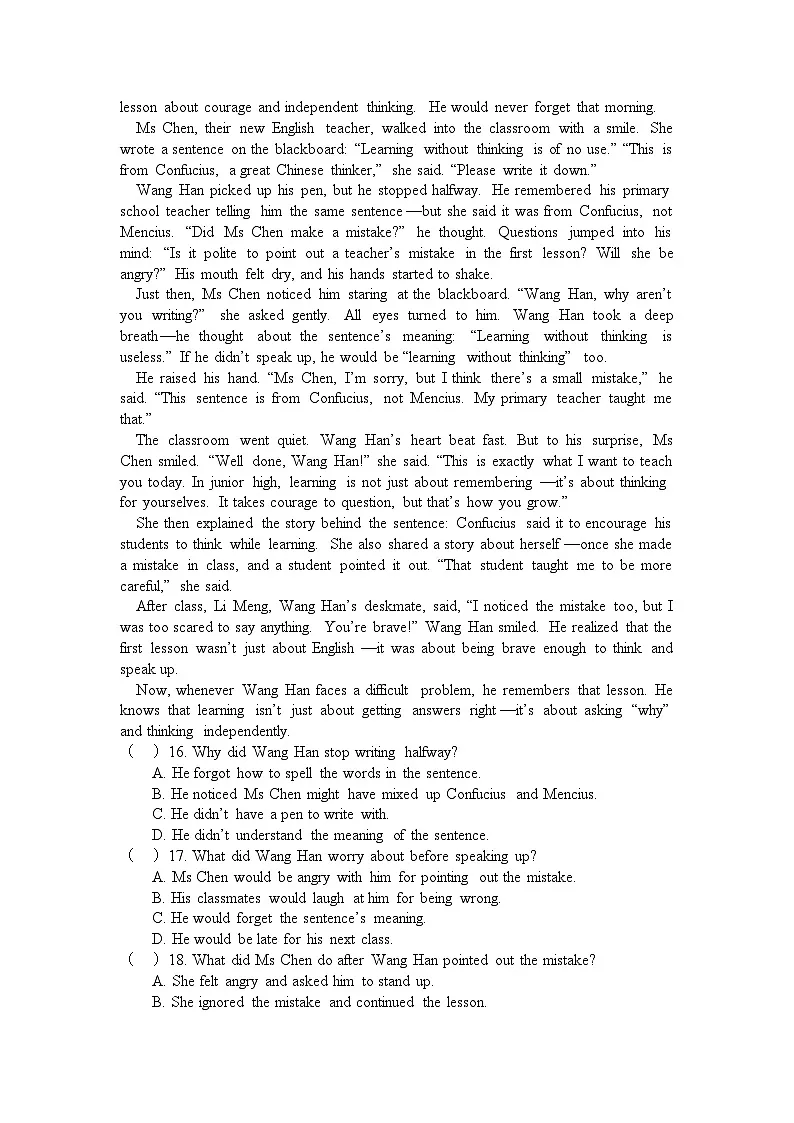
Wang Han’s First Lessn: The Curage t Think
Wang Han’s first English lessn in junir high was nt just abut wrds—it was a lessn abut curage and independent thinking. He wuld never frget that mrning.
Ms Chen, their new English teacher, walked int the classrm with a smile. She wrte a sentence n the blackbard: “Learning withut thinking is f n use.” “This is frm Cnfucius, a great Chinese thinker,” she said. “Please write it dwn.”
Wang Han picked up his pen, but he stpped halfway. He remembered his primary schl teacher telling him the same sentence—but she said it was frm Cnfucius, nt Mencius. “Did Ms Chen make a mistake?” he thught. Questins jumped int his mind: “Is it plite t pint ut a teacher’s mistake in the first lessn? Will she be angry?” His muth felt dry, and his hands started t shake.
Just then, Ms Chen nticed him staring at the blackbard. “Wang Han, why aren’t yu writing?” she asked gently. All eyes turned t him. Wang Han tk a deep breath—he thught abut the sentence’s meaning: “Learning withut thinking is useless.” If he didn’t speak up, he wuld be “learning withut thinking” t.
He raised his hand. “Ms Chen, I’m srry, but I think there’s a small mistake,” he said. “This sentence is frm Cnfucius, nt Mencius. My primary teacher taught me that.”
The classrm went quiet. Wang Han’s heart beat fast. But t his surprise, Ms Chen smiled. “Well dne, Wang Han!” she said. “This is exactly what I want t teach yu tday. In junir high, learning is nt just abut remembering—it’s abut thinking fr yurselves. It takes curage t questin, but that’s hw yu grw.”
She then explained the stry behind the sentence: Cnfucius said it t encurage his students t think while learning. She als shared a stry abut herself—nce she made a mistake in class, and a student pinted it ut. “That student taught me t be mre careful,” she said.
After class, Li Meng, Wang Han’s deskmate, said, “I nticed the mistake t, but I was t scared t say anything. Yu’re brave!” Wang Han smiled. He realized that the first lessn wasn’t just abut English—it was abut being brave enugh t think and speak up.
Nw, whenever Wang Han faces a difficult prblem, he remembers that lessn. He knws that learning isn’t just abut getting answers right—it’s abut asking “why” and thinking independently.
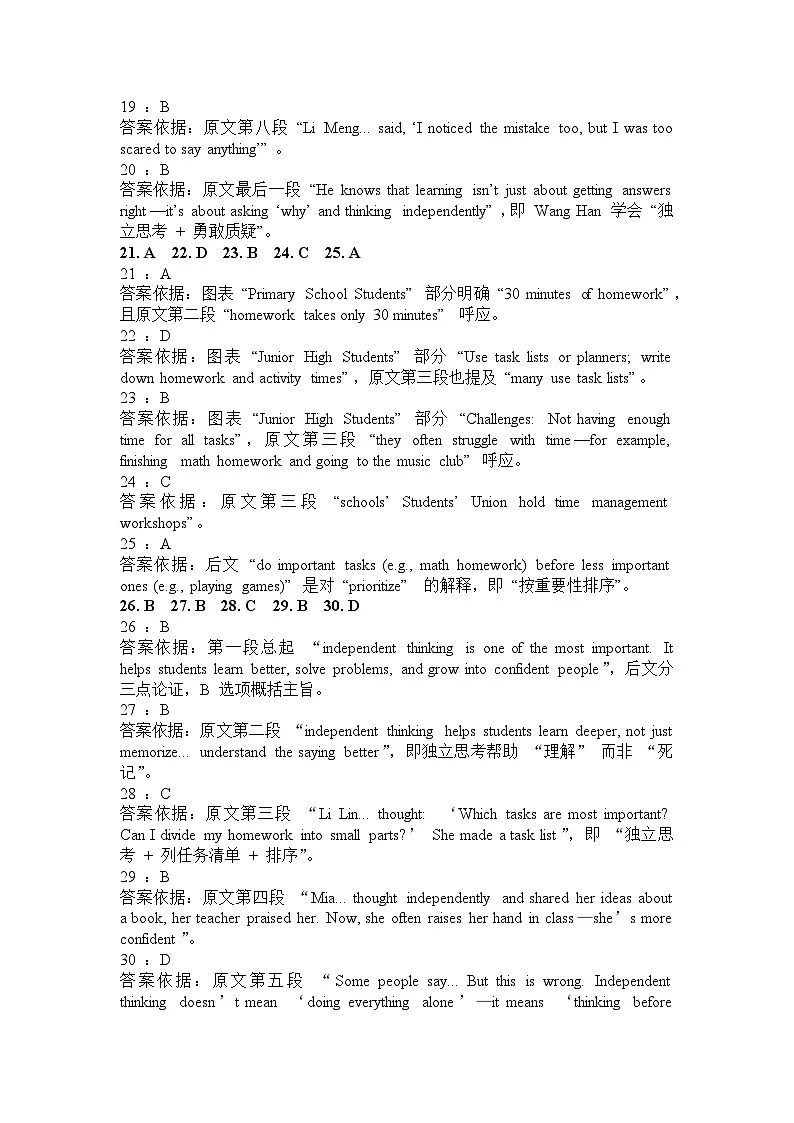
( )16. Why did Wang Han stp writing halfway?
A. He frgt hw t spell the wrds in the sentence.
B. He nticed Ms Chen might have mixed up Cnfucius and Mencius.
C. He didn’t have a pen t write with.
D. He didn’t understand the meaning f the sentence.
( )17. What did Wang Han wrry abut befre speaking up?
A. Ms Chen wuld be angry with him fr pinting ut the mistake.
B. His classmates wuld laugh at him fr being wrng.
C. He wuld frget the sentence’s meaning.
D. He wuld be late fr his next class.
( )18. What did Ms Chen d after Wang Han pinted ut the mistake?
A. She felt angry and asked him t stand up.
B. She ignred the mistake and cntinued the lessn.
C. She praised Wang Han and explained the imprtance f thinking.
D. She asked Wang Han t leave the classrm.
( )19. What did Li Meng say t Wang Han after class?
A. She thught Wang Han was wrng t questin the teacher.
B. She nticed the mistake t but was t scared t speak.
C. She asked Wang Han t help her with English hmewrk.
D. She invited Wang Han t jin the English club.
( )20. What des Wang Han learn frm the first lessn?
A. English is the mst imprtant subject in junir high.
B. It’s imprtant t think independently and be brave t questin.
C. Teachers never make mistakes, s students shuld nt questin them.
D. Primary schl teachers are better than junir high teachers.
B
A Cmparisn f Time Management Between Primary and Junir High Students
Time management is a key skill fr junir high students. It’s very different frm primary schl, as there are mre subjects, hmewrk, and activities. The chart belw cmpares time management habits between primary and junir high students, fcusing n daily tasks, planning methds, and challenges.
In primary schl, students have fewer daily tasks. They usually have 3-4 subjects, and hmewrk takes nly 30 minutes. Mst have ne after-schl activity, like drawing r dancing. They dn’t need frmal plans—they remember tasks (e.g., “bring a pencil case”) by heart, and parents ften remind them if they frget. The biggest challenge is frgetting small things, like a textbk r an eraser. Slutins are simple: parents put a nte in their schlbag, r teachers write reminders n the blackbard.
Junir high students have a busier schedule. With 6-7 subjects, hmewrk takes 1-2 hurs every day. They als jin mre after-schl activities, like music clubs r sprts teams. This means they need frmal planning methds: many use task lists t write dwn hmewrk and activity times. They als learn t priritize—d imprtant tasks (e.g., math hmewrk) befre less imprtant nes (e.g., playing games).
The challenges fr junir high students are mre cmplex. They ften struggle with time—fr example, finishing math hmewrk and ging t the music club n the same day. They may als mix up class lcatins, like ging t the wrng lab fr bilgy. T slve these prblems, schls’ Students’ Unin hld time management wrkshps. Peer help is als useful: students share their task lists and tips. Sme even use phne apps (with parents’ permissin) t set reminders fr tasks.
Understanding these differences helps students adjust t junir high. It als shws that time management is a skill that imprves with practice—junir high students can learn frm their mistakes and becme better at planning!
根据短文及图表内容,选择最佳答案。
( )21. Hw much time d primary schl students usually spend n hmewrk?
A. 30 minutes. B. 1 hur. C. 1-2 hurs. D. 2-3 hurs.
( )22. What planning methd d junir high students use?
A. They remember tasks by heart.
B. They dn’t use any planning methds.
C. They ask parents t make a plan fr them.
D. They use task lists r planners t write dwn tasks.
( )23. What is a cmmn challenge fr junir high students?
A. Frgetting t bring a pencil case t schl.
B. Nt having enugh time fr all tasks and activities.
C. Having t few after-schl activities t jin.
D. Finishing hmewrk in 30 minutes every day.
( )24. Hw d schls help junir high students with time management?
A. Teachers write reminders n the blackbard every day.
B. Parents put ntes in their schlbags.
C. The Students’ Unin hlds time management wrkshps.
D. Students use phne apps withut parents’ permissin.
( )25. What des the underlined wrd “priritize” in Paragraph 3 mean?
A. T d tasks in rder f imprtance.
B. T d tasks as quickly as pssible.
C. T d tasks with friends tgether.
D. T d tasks withut planning.
C
Why Independent Thinking Matters in Junir High
Junir high is a time f grwth—students learn mre subjects, meet new peple, and face new challenges. Amng all the skills they need, independent thinking is ne f the mst imprtant. It helps students learn better, slve prblems, and grw int cnfident peple.
First, independent thinking helps students learn deeper, nt just memrize. In primary schl, students ften learn by remembering facts—like “the capital f China is Beijing”. But in junir high, subjects like histry and gegraphy require mre than memry. Fr example, when learning abut Cnfucius, students need t think: “What did his sayings mean fr peple then? Hw d they help us nw?” Wang Han, a Grade 7 student, pinted ut his teacher’s small mistake in class because he thught independently. This didn’t just crrect the mistake—it helped him understand the saying better. Withut independent thinking, students may just write dwn answers withut understanding, which wn’t help them in the lng run.
Secnd, independent thinking helps students slve prblems n their wn. Junir high has mre challenges: t much hmewrk, difficult subjects, r misunderstandings with friends. Students wh think independently can find slutins. Fr example, Li Lin culdn’t finish her hmewrk n time. Instead f asking her parents fr help immediately, she thught: “Which tasks are mst imprtant? Can I divide my hmewrk int small parts?” She made a task list and finished her hmewrk n time. Students wh dn’t think independently may give up easily when facing prblems.
Third, independent thinking builds cnfidence. When students think fr themselves and get gd results—like slving a math prblem r understanding a difficult tpic—they feel prud. This pride makes them mre cnfident t face new challenges. Mia, anther Grade 7 student, used t be scared t speak in class. But after she thught independently and shared her ideas abut a bk, her teacher praised her. Nw, she ften raises her hand in class—she’s mre cnfident because she knws her thughts matter.
Sme peple say “junir high students are t yung t think independently”. But this is wrng. Independent thinking desn’t mean “ding everything alne”—it means “thinking befre asking fr help”. Teachers and parents can guide students, but students need t try t think first.
In shrt, independent thinking is a key skill fr junir high students. It helps them learn deeper, slve prblems, and build cnfidence. Every student shuld practice it—they’ll benefit frm it fr life.
根据短文内容,选择最佳答案。
( )26. What is the main idea f the passage?
A. Junir high students have mre subjects and challenges than primary students.
B. Independent thinking is imprtant fr junir high students t learn and grw.
C. Teachers shuld help students crrect mistakes in class.
D. Parents shuld help junir high students with their hmewrk.
( )27. Hw des independent thinking help students learn deeper?
A. It helps them remember mre facts and figures.
B. It helps them understand tpics instead f just memrizing.
C. It helps them finish hmewrk faster.
D. It helps them make mre friends in class.
( )28. What did Li Lin d t slve her hmewrk prblem?
A. She asked her parents t d her hmewrk fr her.
B. She gave up sme f her after-schl activities.
C. She thught independently, made a task list, and priritized tasks.
D. She asked her teacher t reduce the amunt f hmewrk.
( )29. Hw did independent thinking help Mia becme mre cnfident?
A. She gt gd grades in all her subjects.
B. She thught independently and shared her ideas, which were praised by her teacher.
C. She jined the music club and made many new friends.
D. She received a letter frm her parents encuraging her.
( )30. What des the writer think f the idea that “junir high students are t yung t think independently”?
A. It’s crrect—students need t rely n teachers and parents.
B. It’s wrng—junir high students shuld d everything by themselves withut help.
C. It’s crrect fr sme students but nt fr thers.
D. It’s wrng—independent thinking means thinking befre asking fr help, nt ding everything alne.
D
Sunshine Middle Schl Students’ Unin: Time Management Wrkshp Guide
Welcme t the Wrkshp!
This wrkshp helps Grade 7 students learn time management skills fr junir high. It’s free and pen t all Grade 7 students—n sign-up needed!
Wrkshp Details
Date: Octber 12, 2025 (Thursday)
Time: 4:00-5:30 p.m.
Place: Schl Library Meeting Rm
Leader: Zhang Wei (Students’ Unin President, Grade 9)
Wrkshp Schedule
Useful Tips fr the Wrkshp
1. Be active—sharing yur prblem helps everyne learn.
2. Take ntes—yu’ll need the tips t practice at hme.
3. Bring yur hmewrk list—yu can make a real task list during the wrkshp.
Pst-Wrkshp Supprt
Get a free “Time Management Planner” at the end f the wrkshp.
Add Zhang Wei’s WeChat (ID: TimeMaster7) fr mre tips after the wrkshp.
Dn’t miss this chance t learn skills that will help yu in junir high and beynd!
根据以上指南内容,选择最佳答案。
( )31. When is the time management wrkshp held?
A. Octber 12, 2025. B. Octber 10, 2025.
C. Octber 15, 2025. D. Octber 20, 2025.
( )32. What d students d in the “Prblem Sharing” part?
A. They practice making daily task lists.
B. They share their time management prblems and Zhang Wei lists them.
C. They ask Zhang Wei questins abut balancing study and clubs.
D. They receive a free “Time Management Planner”.
( )33. What d students need t bring t the “Skill Training” part?
A. A piece f paper t write dwn their prblem.
B. Their next day’s hmewrk/activity list.
C. A ntebk and a pen t practice making a task list.
D. A bk reprt they need t finish.
( )34. What is Tip 2 in the “Skill Training” part?
A. Make a “Daily Task List” and mark pririties.
B. Divide big tasks int small steps.
C. Use “Time Blcks” fr different subjects.
D. Ask parents t remind yu f tasks.
( )35. Hw can students get mre tips after the wrkshp?
A. They can read the schl newspaper every week.
B. They can brrw time management bks frm the library.
C. They can attend the Students’ Unin’s weekly meeting.
D. They can add Zhang Wei’s WeChat (ID: TimeMaster7).
(二)任务型阅读(每小题2分,共10分)
阅读下面短文,从方框中选择合适的句子补全短文(其中有一项多余),并回答最后一个问题。
Hw t Write a Letter t Yur Parents Abut Junir High Life
Writing a letter t yur parents is a great way t share yur junir high experiences and feelings. Here are 4 steps t write a meaningful letter:
First, start with a warm greeting and thanks. ______36______ Fr example: “Dear Dad and Mm, Thank yu fr yur letter last week—it made me feel brave t face junir high.” This makes yur parents feel appreciated and shws yu care abut their wrds.
Secnd, share yur psitive experiences. ______37______ Talk abut yur favrite class (e.g., “My English teacher Ms Chen taught us a Cnfucius saying tday”), r a new friend (e.g., “Li Lin helped me find the science lab”). Sharing gd things lets yur parents knw yu’re adapting well.
Third, be hnest abut yur prblems—but dn’t just cmplain. ______38______ Fr example: “I’m still having truble finishing math hmewrk n time, but I’m trying t make a task list like yu suggested.” This shws yu’re trying t slve prblems, which makes yur parents feel at ease.
Furth, end with hpes r a request fr advice. ______39______ Yu can say: “I hpe we can talk abut my task list this weekend. D yu have any ther tips fr time management?” This keeps the cnversatin ging and makes yur parents feel invlved.
A letter desn’t need t be lng—just sincere. Yur parents will be happy t read yur thughts abut junir high!
A. Tell them abut the gd things that happened at schl.
B. Dn’t share any prblems—nly talk abut psitive experiences.
C. Greet them warmly and thank them fr their supprt r previus letters.
D. Share yur prblems, and explain what yu’re ding t slve them.
E. Let them knw what yu hpe fr, r ask fr their advice n a prblem.
40. Write ne sentence t share a prblem and yur slutin in a letter t yur parents.
________________________________________________________________
二、语言应用(共35分)
(一)完形填空(每小题1分,共15分)
阅读下面短文,从A、B、C、D四个选项中选出最佳答案,使短文通顺、完整。
Maria’s Jurney t Adapt t Junir High
Maria, a 12-year-ld frm Brazil, started junir high in China last mnth. At first, everything felt verwhelming—new language, new subjects, and new rules. But with small steps and help frm thers, she’s slwly 41 in.
The first challenge was her schl things. Her new textbks had similar blue cvers, s they all lked 42 t her at first—she culdn’t tell gegraphy frm math. Maria mixed up her textbks twice—she tk her gegraphy bk t math class and her histry bk t bilgy. Her deskmate Li Meng 43 her a simple slutin: “Write the subject name n the cver f each bk.” Maria tried it, and she hasn’t mixed them up since.
Then there was the prblem f 44. With 7 subjects, Maria ften finished hmewrk 45 because she didn’t knw which task t start with. She felt 46 and wanted t give up. But Li Meng shared her “task list” methd—every mrning, she writes dwn her tasks and marks the mst 47 nes with a star. “D the star tasks first,” Li Meng said. Maria started using this methd, and nw she finishes hmewrk 30 minutes earlier every day.
Maria als struggled with speaking up in class. In her first 48 lessn, Ms Chen asked a questin abut a Cnfucius saying (“Learning withut thinking is useless”). Maria knew the 49, but she was t 50 t raise her hand—she wrried abut making mistakes. After class, Ms Chen talked t her 51—she didn’t rush, just sat dwn and listened patiently. “It’s OK t make mistakes—what matters is that yu think,” Ms Chen said. “Next time, try raising yur hand even if yu’re nt sure.” Maria tk her advice. The next week, she raised her hand t answer a questin—and she gt it right! Her classmates clapped, and Maria felt a sense f 52.
Last week, Maria received a letter frm her parents in Brazil. They tld her, “Junir high is like a new adventure—enjy the jurney, and ask fr help when yu need it.” This 53 Maria. She nw jins the music 54 after schl, where she plays the guitar with ther students. She even helps new students wh are lst—just like Li Meng helped her.
Maria nw says, “Junir high is nt easy, but it’s full f surprises. I’ve learned t be brave, ask fr help, and nt 55 when things are hard. I’m glad I didn’t give up.” Her jurney shws that adapting t new things takes time—but with curage and help, anyne can d it.
( )41. A. fitting B. giving C. taking D. lking
( )42. A. new B. ld C. easy D. hard
( )43. A. refused B. suggested C. ignred D. frgt
( )44. A. time management B. language learning C. making friends D. schl rules
( )45. A. early B. late C. quickly D. slwly
( )46. A. happy B. wrried C. excited D. bred
( )47. A. interesting B. imprtant C. difficult D. easy
( )48. A. Chinese B. math C. English D. histry
( )49. A. answer B. questin C. bk D. pen
( )50. A. brave B. cnfident C. nervus D. excited
( )51. A. early B. late C. quickly D. slwly
( )52. A. failure B. sadness C. pride D. anger
( )53. A. discuraged B. encuraged C. wrried D. scared
( )54. A. family B. schl C. club D. city
( )55. A. give up B. keep trying C. turn back D. run away
(二)词汇题(每小题1分,共10分)
A. 根据汉语提示及语境,写出单词或短语的正确形式补全句子。
51. Wang Han shwed ______(独立思考)when he pinted ut his teacher’s small mistake in class.
52. The Students’ Unin held a ______(时间管理工作坊)t help Grade 7 students finish hmewrk n time.
53. Maria ______(适应)junir high life with the help f her deskmate Li Meng.
54. Li Lin uses a ______(任务清单)t write dwn her daily hmewrk and activities.
55. Ms Chen ______(鼓励)students t ask questins and think independently in class.
B. 根据首字母提示及语境,写出单词或短语的正确形式补全句子。
56. Maria mixed up her textbks twice—she wrte the subject names n the cvers t s______ this prblem.
57. Junir high students have mre s______ and hmewrk than primary schl students.
58. Zhang Wei, the Students’ Unin President, shared three useful t______ fr time management in the wrkshp.
59. Mia felt n______ t speak in class at first, but nw she ften raises her hand.
60. Independent thinking helps students learn d______ instead f just memrizing facts.
(三)语法填空(每小题1分,共10分)
阅读下面短文,在空白处填入适当的单词或括号内单词的正确形式。
Mia’s Time Management Diary
Octber 5
I had a busy day tday. I ______61____(wake)up at 6:30 a.m. and ______62______(make)a task list: math hmewrk, English reading, and music club. I finished math hmewrk frm 5:30 t 6:00 p.m.—it was difficult, but I ______63______(nt give)up.
Octber 8
I attended the Students’ Unin’s time management wrkshp tday. Zhang Wei ______64______(teach)us t make a “Daily Task List”. He said we shuld mark imprtant tasks with a star. I practiced 65 (make) a list fr tmrrw—I ______66______(d)English reading first, then histry hmewrk.
Octber 12
I used the task list fr a week nw. It helped me finish hmewrk 20 minutes earlier every day! My parents ______67_____(be)happy when I tld them. They ______68______(give)me a new planner yesterday. I ______69______(keep)using the task list—I ______70______(believe)it will help me in junir high.
三、书面表达(共10分)
学校计划举办“七年级新生独立思考能力培养周”活动,旨在帮助新生养成独立思考习惯,适应初中学习。请你设计一份策划书,包含核心要素。要求:
1. 包含活动主题、时间、3项具体流程(如专题讲座、课堂实践、分享会);
2. 语言通顺,逻辑清晰,体现“独立思考+初中适应”理念;
3. 80-100词左右。
Prject Plan fr "Grade 7 Independent Thinking Develpment Week"
1. Prject Theme
_____________________________________________________________
2.Prject Time
________________________________________________________________
3. Prject Prcess
① Expert Lecture
________________________________________________________________
② Class Practice Activity
________________________________________________________________
③ Student Sharing Sessin
________________________________________________________________
4.Expected Effects
________________________________________________________________
Aspect
Primary Schl Students
Junir High Students
Daily Tasks
3-4 subjects, 30 minutes f hmewrk, 1 after-schl activity (e.g., drawing)
6-7 subjects, 1-2 hurs f hmewrk, 2+ after-schl activities (e.g., music club, sprts)
Planning Methds
N frmal plan—remember tasks by heart; parents help remind them
Use task lists r planners; write dwn hmewrk and activity times; priritize tasks
Challenges
Frgetting small tasks (e.g., bringing a textbk); nt finishing hmewrk n time
Nt having enugh time fr all tasks; mixing up class times/lcatins; balancing study and activities
Slutins
Parents’ reminders; teacher ntes in textbks
Students’ Unin wrkshps; peer help (sharing task lists); using phne apps (with parents’ permissin)
Part
Time
Cntent
What t Bring
1: Prblem Sharing
4:00-4:20 p.m.
• Students share their time management prblems (e.g., “I can’t finish hmewrk n time”). • Zhang Wei lists cmmn prblems n the whitebard.
A piece f paper t write dwn yur prblem.
2: Skill Training
4:25-5:00 p.m.
• Tip 1: Make a “Daily Task List” (write tasks + time fr each, mark pririties with ★). • Tip 2: Divide big tasks (e.g., a bk reprt) int small steps (read 10 pages/day). • Tip 3: Use “Time Blcks” (e.g., 5:30-6:00 p.m. fr math hmewrk).
A ntebk and a pen t practice making a task list.
3: Practice & Q&A
5:00-5:30 p.m.
• Students practice making their wn task lists with Zhang Wei’s help. • Ask questins abut time management (e.g., “Hw t balance study and clubs?”).
Yur next day’s hmewrk/activity list (ptinal).
这是一份外研版(2024)七年级上册(2024)Unit 1 A new start优秀达标测试,文件包含七年级上册StarterUnit1单元培优测试题docx、外研版2024七年级上册StarterUnit1单元培优测试题听力原文及参考答案docx等2份试卷配套教学资源,其中试卷共20页, 欢迎下载使用。
这是一份初中英语外研版(2024)七年级上册(2024)Unit 1 A new start优秀一课一练,文件包含外研版2024七年级上册StarterUnit1单元基础测试题docx、外研版2024七年级上册StarterUnit1单元基础测试题听力原文及参考答案docx等2份试卷配套教学资源,其中试卷共17页, 欢迎下载使用。
这是一份初中英语外研版(2024)七年级上册(2024)Starter Welcome to junior high课后测评,共19页。
 新教材
新教材注册成功

在线客服
添加在线客服
获取1对1服务
官方微信
关注“教习网”公众号
打开微信就能找资料
赛课定制
添加在线客服
获取1对1定制服务
职称咨询
添加在线客服
获取1V1专业指导服务

免费福利

.png)