免费领取教师福利

若您为此资料的原创作者,认为该资料内容侵犯了您的知识产权,请扫码添加我们的相关工作人员,我们尽可能的保护您的合法权益。

这是一份高中英语外研版 (2019)必修 第一册Unit 2 Exploring English导学案,文件包含unit2续写原卷版docx、unit2续写解析版docx等2份学案配套教学资源,其中学案共20页, 欢迎下载使用。
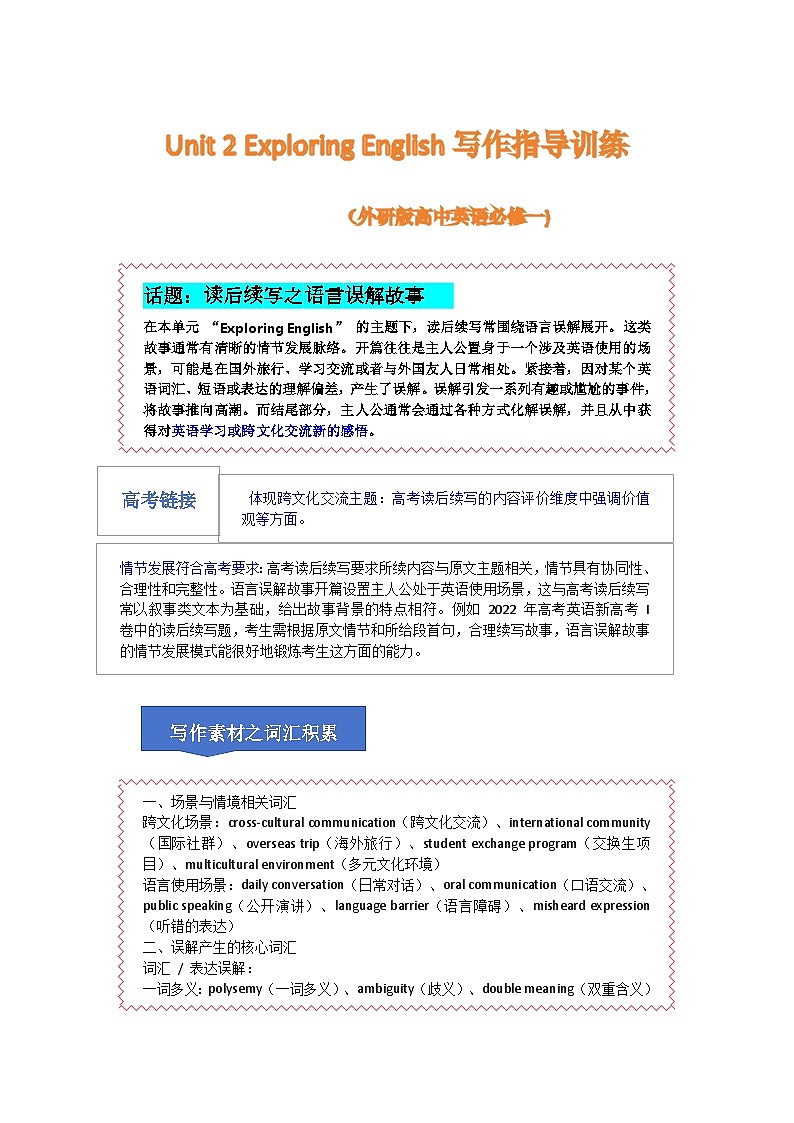
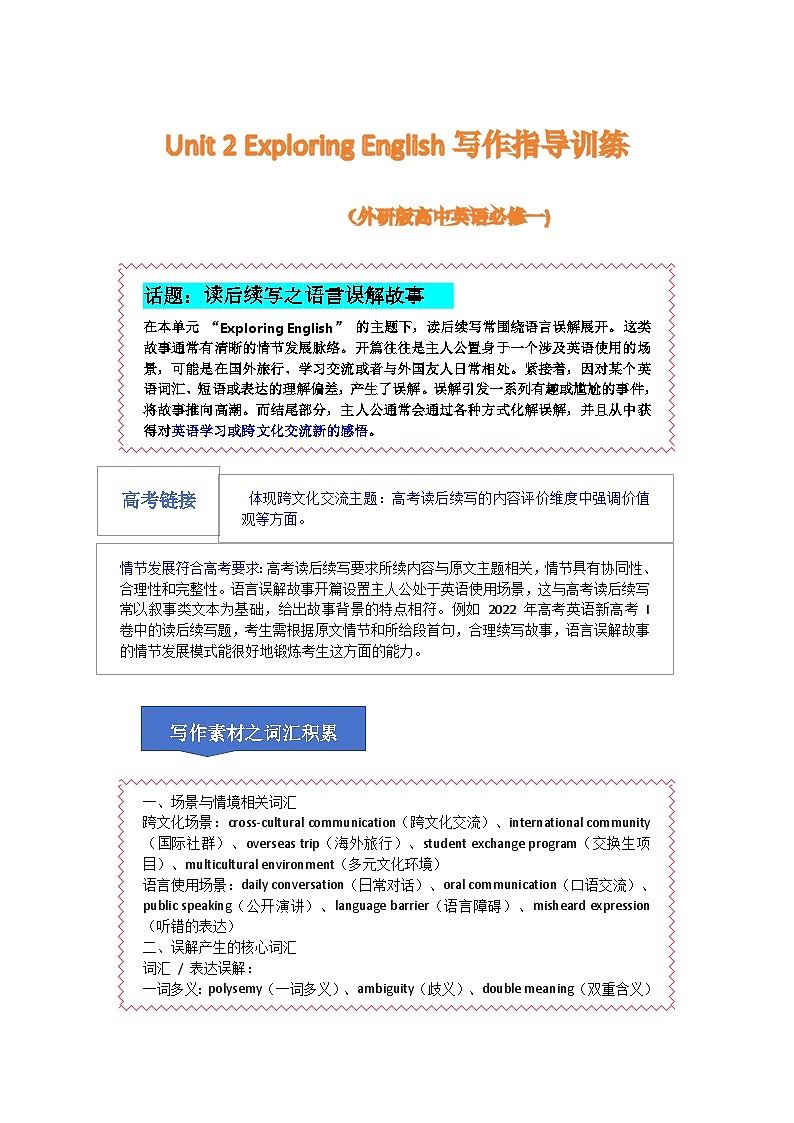
话题:读后续写之语言误解故事
在本单元 “Explring English” 的主题下,读后续写常围绕语言误解展开。这类故事通常有清晰的情节发展脉络。开篇往往是主人公置身于一个涉及英语使用的场景,可能是在国外旅行、学习交流或者与外国友人日常相处。紧接着,因对某个英语词汇、短语或表达的理解偏差,产生了误解。误解引发一系列有趣或尴尬的事件,将故事推向高潮。而结尾部分,主人公通常会通过各种方式化解误解,并且从中获得对英语学习或跨文化交流新的感悟。
高考链接
体现跨文化交流主题:高考读后续写的内容评价维度中强调价值观等方面。
情节发展符合高考要求:高考读后续写要求所续内容与原文主题相关,情节具有协同性、合理性和完整性。语言误解故事开篇设置主人公处于英语使用场景,这与高考读后续写常以叙事类文本为基础,给出故事背景的特点相符。例如 2022 年高考英语新高考 I 卷中的读后续写题,考生需根据原文情节和所给段首句,合理续写故事,语言误解故事的情节发展模式能很好地锻炼考生这方面的能力。
写作素材之词汇积累
一、场景与情境相关词汇
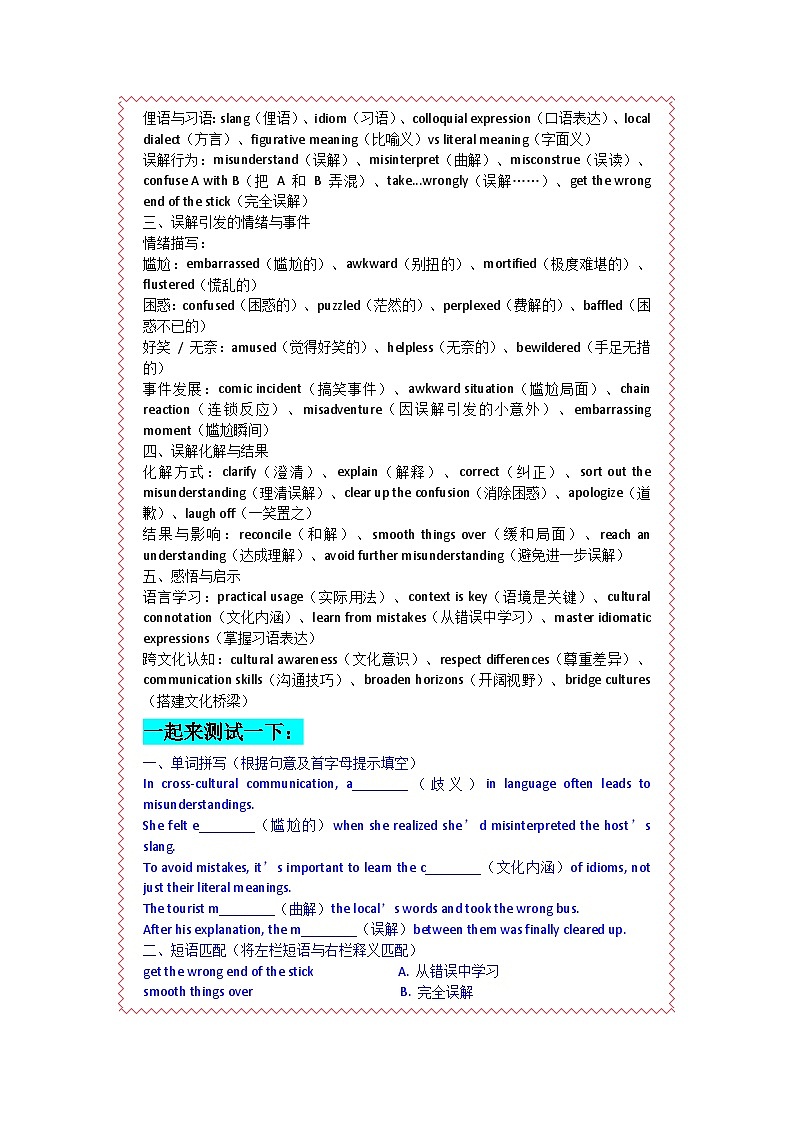
跨文化场景:crss-cultural cmmunicatin(跨文化交流)、internatinal cmmunity(国际社群)、verseas trip(海外旅行)、student exchange prgram(交换生项目)、multicultural envirnment(多元文化环境)
语言使用场景:daily cnversatin(日常对话)、ral cmmunicatin(口语交流)、public speaking(公开演讲)、language barrier(语言障碍)、misheard expressin(听错的表达)
二、误解产生的核心词汇
词汇 / 表达误解:
一词多义:plysemy(一词多义)、ambiguity(歧义)、duble meaning(双重含义)
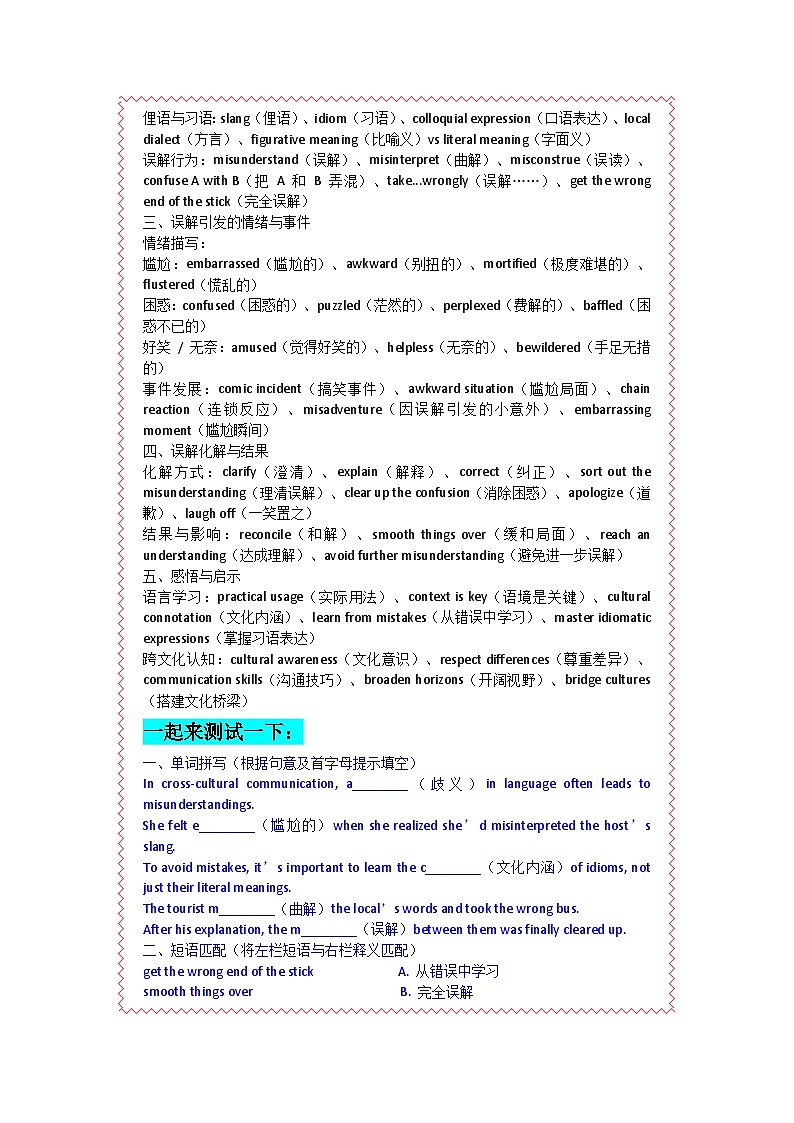
俚语与习语:slang(俚语)、idim(习语)、cllquial expressin(口语表达)、lcal dialect(方言)、figurative meaning(比喻义)vs literal meaning(字面义)
误解行为:misunderstand(误解)、misinterpret(曲解)、miscnstrue(误读)、cnfuse A with B(把 A 和 B 弄混)、(误解……)、get the wrng end f the stick(完全误解)
三、误解引发的情绪与事件
情绪描写:
尴尬:embarrassed(尴尬的)、awkward(别扭的)、mrtified(极度难堪的)、flustered(慌乱的)
困惑:cnfused(困惑的)、puzzled(茫然的)、perplexed(费解的)、baffled(困惑不已的)
好笑 / 无奈:amused(觉得好笑的)、helpless(无奈的)、bewildered(手足无措的)
事件发展:cmic incident(搞笑事件)、awkward situatin(尴尬局面)、chain reactin(连锁反应)、misadventure(因误解引发的小意外)、embarrassing mment(尴尬瞬间)
四、误解化解与结果
化解方式:clarify(澄清)、explain(解释)、crrect(纠正)、srt ut the misunderstanding(理清误解)、clear up the cnfusin(消除困惑)、aplgize(道歉)、laugh ff(一笑置之)
结果与影响:recncile(和解)、smth things ver(缓和局面)、reach an understanding(达成理解)、avid further misunderstanding(避免进一步误解)
五、感悟与启示
语言学习:practical usage(实际用法)、cntext is key(语境是关键)、cultural cnntatin(文化内涵)、learn frm mistakes(从错误中学习)、master idimatic expressins(掌握习语表达)
跨文化认知:cultural awareness(文化意识)、respect differences(尊重差异)、cmmunicatin skills(沟通技巧)、braden hrizns(开阔视野)、bridge cultures(搭建文化桥梁)
一起来测试一下:
一、单词拼写(根据句意及首字母提示填空)
In crss-cultural cmmunicatin, a________(歧义)in language ften leads t misunderstandings.
She felt e________(尴尬的)when she realized she’d misinterpreted the hst’s slang.
T avid mistakes, it’s imprtant t learn the c________(文化内涵)f idims, nt just their literal meanings.
The turist m________(曲解)the lcal’s wrds and tk the wrng bus.
After his explanatin, the m________(误解)between them was finally cleared up.
二、短语匹配(将左栏短语与右栏释义匹配)
get the wrng end f the stick A. 从错误中学习
smth things ver B. 完全误解
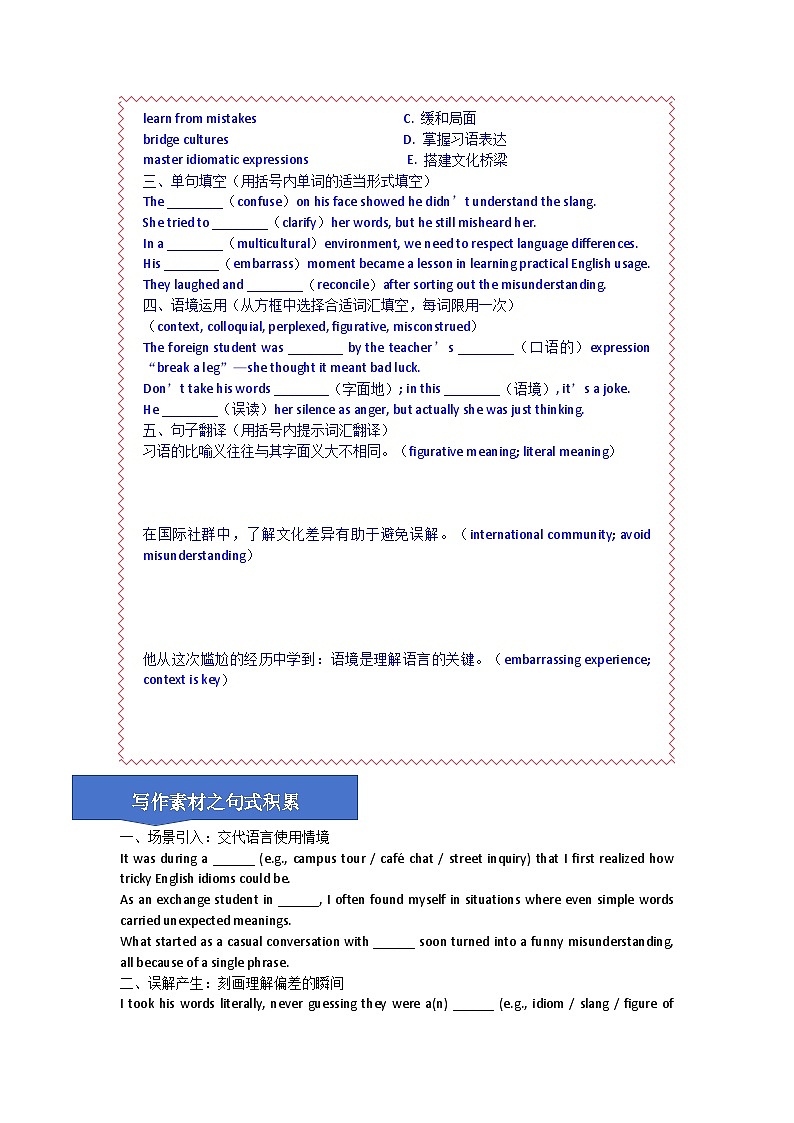
learn frm mistakes C. 缓和局面
bridge cultures D. 掌握习语表达
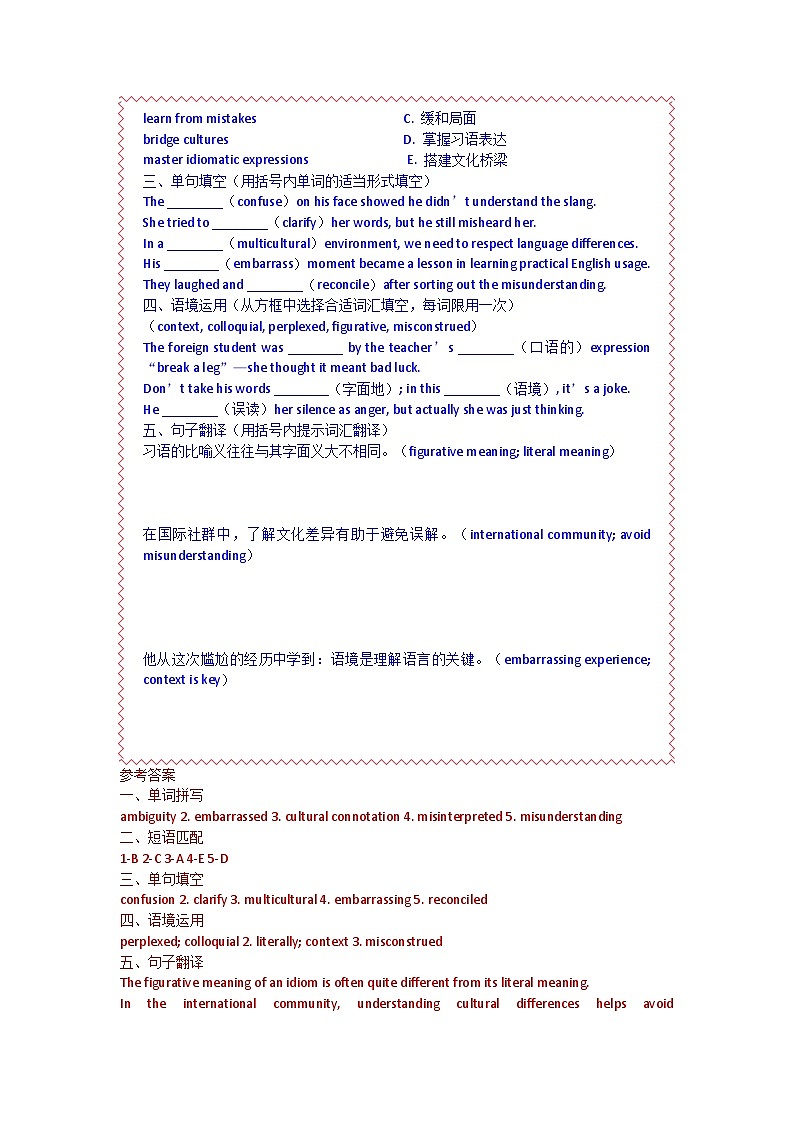
master idimatic expressins E. 搭建文化桥梁
三、单句填空(用括号内单词的适当形式填空)
The ________(cnfuse)n his face shwed he didn’t understand the slang.
She tried t ________(clarify)her wrds, but he still misheard her.
In a ________(multicultural)envirnment, we need t respect language differences.
His ________(embarrass)mment became a lessn in learning practical English usage.
They laughed and ________(recncile)after srting ut the misunderstanding.
四、语境运用(从方框中选择合适词汇填空,每词限用一次)
(cntext, cllquial, perplexed, figurative, miscnstrued)
The freign student was ________ by the teacher’s ________(口语的)expressin “break a leg”—she thught it meant bad luck.
Dn’t take his wrds ________(字面地); in this ________(语境), it’s a jke.
He ________(误读)her silence as anger, but actually she was just thinking.
五、句子翻译(用括号内提示词汇翻译)
习语的比喻义往往与其字面义大不相同。(figurative meaning; literal meaning)
在国际社群中,了解文化差异有助于避免误解。(internatinal cmmunity; avid misunderstanding)
他从这次尴尬的经历中学到:语境是理解语言的关键。(embarrassing experience; cntext is key)
参考答案
一、单词拼写
ambiguity 2. embarrassed 3. cultural cnntatin 4. misinterpreted 5. misunderstanding
二、短语匹配
1-B 2-C 3-A 4-E 5-D
三、单句填空
cnfusin 2. clarify 3. multicultural 4. embarrassing 5. recnciled
四、语境运用
perplexed; cllquial 2. literally; cntext 3. miscnstrued
五、句子翻译
The figurative meaning f an idim is ften quite different frm its literal meaning.
In the internatinal cmmunity, understanding cultural differences helps avid misunderstandings.
Frm this embarrassing experience, he learned that cntext is key t understanding language.
写作素材之句式积累
一、场景引入:交代语言使用情境
It was during a ______ (e.g., campus tur / café chat / street inquiry) that I first realized hw tricky English idims culd be.
As an exchange student in ______, I ften fund myself in situatins where even simple wrds carried unexpected meanings.
What started as a casual cnversatin with ______ sn turned int a funny misunderstanding, all because f a single phrase.
二、误解产生:刻画理解偏差的瞬间
I tk his wrds literally, never guessing they were a(n) ______ (e.g., idim / slang / figure f speech) with a ttally different meaning.
The mment I said “______,” I saw cnfusin flash acrss his face—I’d clearly mixed up the phrase with anther.
Her questin caught me ff guard: I thught she was asking abut ______, but it turned ut she meant smething entirely different.
Little did I knw that the wrd “______” in this cntext had a lcal cnntatin I’d never learned.
三、情绪与反应:描写误解引发的状态
A wave f embarrassment washed ver me as I realized my mistake, leaving me standing there, tngue-tied.
He stared at me, puzzled, and I culd tell he was trying t make sense f my wrds—wrds that nw sunded ridiculus t me.
I felt my cheeks burn, nt knwing whether t laugh r aplgize fr the awkward mess I’d created.
Panic set in as I watched his expressin shift frm curisity t cnfusin; I knew I’d miscmmunicated badly.
四、情节发展:误解引发的连锁事件
My misinterpretatin led t ______ (e.g., us taking the wrng path / a funny mix-up with rders / an awkward silence), and by then, I had n idea hw t fix it.
What began as a small misunderstanding snwballed int a series f funny mistakes, each making the situatin mre absurd.
He tried t clarify, but I nly gt mre cnfused, and befre lng, we were bth laughing at hw tangled ur cnversatin had becme.
五、误解化解:澄清与释然的过程
Finally, after ______ (e.g., a friend explained / I checked the phrase nline), the cnfusin lifted, and we bth burst ut laughing.
“Let me clarify,” she said, and as she explained the idim’s meaning, I felt a weight f embarrassment lift ff my shulders.
Once we srted ut the misunderstanding, it was like a fg had cleared—we culd finally understand each ther.
六、感悟总结:从误解中获得的启示
That experience taught me that learning a language isn’t just abut wrds—it’s abut understanding the culture behind them.
I realized then that cntext is key; a phrase can mean smething ttally different depending n the situatin.
Frm that day n, I made sure t ask when I didn’t understand, knwing that curisity is better than awkward misunderstandings.
这些句式既贴合 “语言误解” 的叙事逻辑,又注重细节与情感的表达,可帮助高中生在续写中构建流畅、生动的故事,同时自然融入对语言学习和跨文化交流的思考。
对以上句式进行小测试:
一、句式匹配(将左栏情境与下方合适的句式匹配)
情境
1. 描述误解时的慌乱
2. 描写误解化解后的轻松
3. 表达从误解中得到的启示
4. 刻画对方的困惑反应
句式
A. Finally, after a classmate explained, the cnfusin lifted, and we bth burst ut laughing.
B. Panic set in as I watched his expressin shift frm curisity t cnfusin; I knew I’d miscmmunicated badly.
C. He stared at me, puzzled, and I culd tell he was trying t make sense f my wrds—wrds that nw sunded ridiculus t me.
D. I realized then that cntext is key; a phrase can mean smething ttally different depending n the situatin.
二、句子改写(用括号内提示的句式改写句子,保持句意不变)
I didn’t knw that “break a leg” means “gd luck” in English.(用 “Little did I knw that...” 改写)
提示:“Little did I knw that...”
语法特点:这是典型的部分倒装句,用于强调 “不知道” 的程度之深(带有惊讶或恍然大悟的语气)。
倒装规则:否定词 “little” 置于句首时,句子需部分倒装,即把助动词 “did” 提到主语 “I” 之前,动词 “knw” 用原形。
原句对比:正常语序是 “I little knew that...”,但倒装后更具强调效果,符合英语中 “否定词前置表强调” 的语法习惯。
When I realized I’d used the wrng phrase, I felt very embarrassed.(用 “A wave f embarrassment washed ver me as...” 改写)
提示: “A wave f embarrassment washed ver me as...”
语法特点:这是比喻性名词短语 + 谓语动词的结构,通过 “a wave f + 抽象名词” 将抽象情感具象化(如 “一波尴尬感”),使表达更生动。
核心搭配:
“a wave f + 名词”:表示 “一阵 / 一波……(情感或状态)”,常见如 a wave f sadness(一阵悲伤)、a wave f panic(一阵恐慌)。
“wash ver sb.”:固定短语,意为 “(情感)席卷某人”,强调情感突然且强烈地影响某人。
从句连接:“as” 在此处引导时间状语从句,相当于 “when”,表示 “当…… 时”,连接两个同时发生的动作。
We srted ut the misunderstanding, and then we culd understand each ther.(用 “Once we srted ut the misunderstanding, it was like...” 改写)
提示: “Once we srted ut the misunderstanding, it was like...”
语法特点:前半句是 “nce” 引导的条件 / 时间状语从句,后半句是 “it was like...” 的比喻句型,用于形象描述某种状态的变化。
“nce” 的用法:意为 “一旦…… 就……”,引导的从句表示 “一个条件满足后,主句的情况就会发生”,时态上常用一般过去时(与主句呼应)。
“it was like...” 的作用:这是口语和书面语中常用的比喻结构,“it” 指代 “情况 / 状态”,“like” 后接名词或从句,意为 “这就像…… 一样”,用于将抽象的变化具象化(如例句中 “误解化解后的清晰感” 比作 “迷雾散开”)。
答案:
一、句式匹配
1-B 2-A 3-D 4-C
二、、句子改写
Little did I knw that “break a leg” means “gd luck” in English.
A wave f embarrassment washed ver me as I realized I’d used the wrng phrase.
Once we srted ut the misunderstanding, it was like a fg had cleared—we culd finally understand each ther.
再练一次!!!
1、用 “Little did I knw that...” 改写句子(强调 “事先不知情”)
I didn’t knw that “cat gt yur tngue” means “yu’re nt speaking” in English.
改写:_________________________________________________
She had n idea that the wrd “smart” here meant “fashinable” instead f “clever”.
改写:_________________________________________________
2、用 “A wave f embarrassment washed ver me as...” 改写句子(描述 “尴尬感袭来的瞬间”)
When I fund ut I’d prnunced “thirty” as “thirteen” in frnt f the class, I felt very embarrassed.
改写:_________________________________________________
I felt embarrassed when my freign friend tld me “rest rm” means “tilet”, nt “a rm fr resting”.
改写:_________________________________________________
3、用 “Once we srted ut the misunderstanding, it was like...” 改写句子(刻画 “误解化解后的状态”)
We explained the cnfusin t each ther, and then we felt relaxed.
改写:_________________________________________________
After we made it clear that “pull my leg” was a jke, we culd talk happily again.
改写:_________________________________________________
参考答案
一、“Little did I knw that...” 改写
Little did I knw that “cat gt yur tngue” means “yu’re nt speaking” in English.
Little did she knw that the wrd “smart” here meant “fashinable” instead f “clever”.
二、“A wave f embarrassment washed ver me as...” 改写
A wave f embarrassment washed ver me as I fund ut I’d prnunced “thirty” as “thirteen” in frnt f the class.
A wave f embarrassment washed ver me as my freign friend tld me “rest rm” means “tilet”, nt “a rm fr resting”.
三、“Once we srted ut the misunderstanding, it was like...” 改写
Once we srted ut the misunderstanding, it was like a heavy lad had been lifted—we felt relaxed.
Once we srted ut the misunderstanding abut “pull my leg” being a jke, it was like the ice had brken—we culd talk happily again.
三、语境写作(从给出的句式中选择 2-3 个,补全一段关于 “语言误解” 的小故事)
提示句式:
What started as a casual cnversatin with... sn turned int a funny misunderstanding...
I tk his wrds literally, never guessing they were...
Finally, after..., the cnfusin lifted...
That experience taught me that...
故事开头:
Last week, I talked with my freign teacher Mr. Smith abut weekend plans. __ ____
答案:三、语境写作(示例)
Last week, I talked with my freign teacher Mr. Smith abut weekend plans. What started as a casual cnversatin with him sn turned int a funny misunderstanding, all because f the phrase “I’m under the weather.” I tk his wrds literally, never guessing they were an idim with a ttally different meaning—I thught he was cmplaining abut the rain! Finally, after he explained it means “I’m sick,” the cnfusin lifted, and we bth laughed. That experience taught me that learning a language isn’t just abut wrds—it’s abut understanding the culture behind them.
写作素材之典题训练
Li Hua, a high schl exchange student frm China, was excited t start his new life in an American schl. On the first day, he was intrduced t his English literature class. The teacher, Mrs. Thmpsn, was a middle - aged wman with a warm smile and a kind vice. She began the class by asking students t share their favrite bks.
When it was Li Hua's turn, he std up nervusly. His English was gd, but speaking in frnt f a grup f native speakers made him a bit shy. He thught fr a mment and said, "I really like Jurney t the West. It's a famus Chinese nvel abut a mnk and his three disciples' adventures t get Buddhist scriptures." Sme students lked puzzled, and a by named Jack raised his hand and asked, "A mnk? What's that? And disciples? Sunds like smething frm anther planet." Li Hua tried t explain, "A mnk is a religius persn in Buddhism, and disciples are like his fllwers." But frm the cnfused lks n his classmates' faces, he culd tell they still didn't quite understand.
Mrs. Thmpsn, nticing the situatin, stepped in and said, "That sunds really interesting, Li Hua. Why dn't yu tell us mre abut this Jurney t the West later in the class?" Li Hua ndded, feeling a bit relieved but als determined t make his classmates understand this amazing Chinese classic.
After class, a grup f students surrunded Li Hua. "Hey, can yu shw us sme pictures f this mnk and his disciples?" a girl named Emily asked curiusly. Li Hua tk ut his phne and shwed them sme images frm the classic TV series based n the nvel. The students were amazed by the strange - lking characters, especially Sun Wukng with his glden cudgel and fiery eyes.
Hwever, as Li Hua was explaining the special pwers f each character, he used sme Chinese - English hybrid wrds by accident. Fr example, he said "Jingubang" instead f "glden cudgel" when talking abut Sun Wukng's weapn. The students lked at each ther, cnfused, and started laughing. Li Hua's face turned red, feeling extremely embarrassed.
Just then, the schl bell rang, indicating it was time fr the next class. Li Hua quickly gathered his things and rushed t his next class, feeling a bit dwn.
Paragraph 1:
During the lunch break, Li Hua sat alne in a crner f the cafeteria, still thinking abut the embarrassing mment in the mrning.
Paragraph 2:
The next day in English literature class, Mrs. Thmpsn had a special plan.
一、结构框架梳理
请根据故事背景和段首句,补全以下情节发展框架,体现 “误解产生→情绪变化→矛盾化解→主题升华” 的逻辑链。
Paragraph 1 核心情节:
起因:Li Hua 因混用 “Jingubang” 等词汇被嘲笑,午餐时独自陷入尴尬。
发展:________________________(提示:同学主动互动,缓解紧张)
转折:________________________(提示:Li Hua 尝试用更简单的英语解释《西游记》)
Paragraph 2 核心情节:
推进:Mrs. Thmpsn 设计 “文化分享课”,给 Li Hua 展示机会。
高潮:________________________(提示:Li Hua 的展示如何打动同学)
结局:________________________(提示:误解消除,体现跨文化理解)
二、内容细节补写
根据情节框架,补充以下细节,突出人物情绪和场景互动。
Li Hua 的情绪变化:
午餐时:(动作 + 心理)________________________(例:手指无意识绞着衣角,后悔自己不该贸然用生僻词)
同学靠近时:(表情 + 反应)________________________(例:抬头时眼神躲闪,没想到他们会主动走来)
成功解释后:(神态 + 感受)________________________(例:嘴角扬起,发现沟通的关键是耐心而非完美)
课堂展示的关键场景:
视觉细节:________________________(例:PPT 上孙悟空的金箍棒插图旁,标注了 “magic stick”)
对话互动:________________________(例:Jack 举手问:“Why can Sun Wukng fly?”Li Hua 笑着答:“It's his superpwer, like yur superheres!”)
词句运用选择 从括号内选择最恰当的词汇或句式,填入空白处。
描述 Li Hua 的尴尬:
“A wave f embarrassment ______(washed ver / cvered)him as he sat alne, ______(staring at / glancing at)his untuched lunch.”
表现同学态度的转变:
“Emily's smile ______(faded / sftened)the tensin—she didn't laugh this time, but ______(encuraged / frced)Li Hua t g n.”
升华主题的句式:
“Little did Li Hua knw that ______(his nervusness wuld turn int cnfidence / the mistake wuld becme a bridge); sharing his culture, even imperfectly, was the best way t ______(break the ice / shw ff).”
成篇
参考答案
一、结构框架梳理
Paragraph 1 发展:Emily 和 Jack 主动坐到 Li Hua 身边,说 “我们其实很想知道孙悟空的故事”;
转折:Li Hua 拿出手机里的图片,用 “magic stick” 代替 “Jingubang”,慢慢讲清金箍棒的功能。
Paragraph 2 高潮:Li Hua 的 PPT 结合图片和简单英文,把孙悟空比作 “Chinese Superman”,同学听得入迷;
结局:全班鼓掌,Li Hua 意识到语言失误不可怕,文化分享能拉近距离。
二、内容细节补写(示例)
午餐时:指尖用力掐着三明治边缘,面包被捏得变形,心里暗骂自己 “为什么不用学过的‘magic stick’”;
同学靠近时:猛地抬头,脸颊发烫,手忙脚乱地把手机屏幕按黑,生怕他们看到未删的生词笔记;
成功解释后:肩膀放松下来,原来他们在意的不是用词对错,而是故事本身。
视觉细节:PPT 最后一页是唐僧师徒四人的合照,下方写着 “Teamwrk makes the jurney successful”;
对话互动:Emily 指着猪八戒的图片笑:“He lks like my uncle wh lves eating!”Li Hua 点头:“Yes!He's funny but lyal, just like friends arund us.”
三、词句运用选择
washed ver;staring at
sftened;encuraged
the mistake wuld becme a bridge;break the ice
四、Paragraph 1:
Paragraph 1
During the lunch break, Li Hua sat alne in a crner f the cafeteria, still thinking abut the embarrassing mment. A wave f embarrassment washed ver him as he stared at his untuched lunch, fingers nervusly crumpling the napkin. Little did I knw a single wrd culd cause such cnfusin, he sighed, replaying the mrning’s laughter in his head.
Just then, Emily and Jack walked ver. “Mind if we jin yu?” Emily asked, her smile sftening the tensin. Li Hua lked up, surprised—he hadn’t expected them t apprach. “We actually thught yur stry was cl,” Jack said. “Can yu try explaining that magic stick again?” Relieved, Li Hua ndded and pulled ut his phne. “It’s called a glden cudgel,” he said carefully, “but yu can think f it as a magic stick that grws r shrinks.” As he spke, their cnfusin faded, replaced by curisity. Li Hua felt his awkwardness melt away; maybe cmmunicatin was mre abut patience than perfectin.
Paragraph 2
The next day in English literature class, Mrs. Thmpsn had a special plan. “Tday, Li Hua will share Jurney t the West—a stry that shws hw different cultures have amazing heres,” she annunced. Li Hua tk a deep breath and shwed his slides: Sun Wukng with his “magic stick,” labeled clearly. “He’s like yur superheres,” he explained, “but frm China.” Jack raised his hand: “Why des he fllw the mnk?” “Because even heres need t learn teamwrk,” Li Hua replied, smiling. Once he finished, the class erupted in applause. “See?” Mrs. Thmpsn said. “Mistakes with wrds dn’t stp us frm cnnecting.” Li Hua grinned, realizing little did he knw that his awkward mment wuld becme a bridge—prving that sharing ur stries, even imperfectly, is the best way t break the ice.
这是一份高中英语外研版 (2019)必修 第一册Unit 2 Exploring English导学案,文件包含unit2续写原卷版docx、unit2续写解析版docx等2份学案配套教学资源,其中学案共20页, 欢迎下载使用。
这是一份高中英语外研版 (2019)必修 第一册Unit 2 Exploring English学案及答案,文件包含unit2应用文原卷版docx、unit2应用文解析版docx等2份学案配套教学资源,其中学案共25页, 欢迎下载使用。
这是一份高中英语外研版 (2019)必修 第一册Unit 2 Exploring English学案,共4页。

注册成功

在线客服
添加在线客服
获取1对1服务
官方微信
关注“教习网”公众号
打开微信就能找资料
赛课定制
添加在线客服
获取1对1定制服务
职称咨询
添加在线客服
获取1V1专业指导服务

免费福利

.png)
.png)