免费领取教师福利


若您为此资料的原创作者,认为该资料内容侵犯了您的知识产权,请扫码添加我们的相关工作人员,我们尽可能的保护您的合法权益。


这是一份备战2025年高考英语抢分秘籍(新高考专用)猜押阅读理解之议论文(按话题分类)(学生版+解析)练习,文件包含备战2025年高考英语抢分秘籍新高考专用猜押阅读理解之议论文按话题分类教师版docx、备战2025年高考英语抢分秘籍新高考专用猜押阅读理解之议论文按话题分类学生版docx等2份试卷配套教学资源,其中试卷共94页, 欢迎下载使用。
押题预测目录
一、思想哲理类
押题1
The mental pain f failure can stimulate yu t becme better at the activity in which yu lack prficiency-if yu can cnsider the unpleasant experience as an indicatr f persnal grwth. This is what researchers fund when they cnducted a field experiment at an imprvisatin (即兴表演) club. One grup f amateur imprvisers was instructed t actively seek the feeling f awkwardness. The schlars fund that, cmpared with imprvisers wh were nt given this instructin, the first grup was mre engaged in the exercise. Instead f seeing the discmfrt as smething t avid, they saw it as central t the prcess and leaned int it.
This has effects n hw t imprve rdinary life. Yu can put failure t gd use in many ther areas f life. If yu’re a student, take a class far utside yur area f skills and interests, knwing that the struggle t cpe with a very nvel challenge may imprve studying what yu d like. Enjy the difficulty f it and analyze the mistakes yu make—and yu will almst certainly find that yu're ding even better at yur preferred subject.
Emplyers can apply these principles as well. I like the “75/25 rule,” accrding t which emplyees spend three-quarters f their time n their assigned task and ne quarter helping thers utside their area. The shrt-term cst f this is frictin as peple struggle with nvelty and difficulty-and bsses shuld take care nt t make this wrse by being punitive r verly critical. But I have seen the lng-term benefit f better mtivatin in the cre assignment, as well as a better flw f infrmatin and distributin f new skills acrss different activities within an enterprise.
The embrace-failure principle can even be applied t happiness itself. Nne f us wants t be unhappy. But inviting surces f unhappiness int life can be extremely beneficial. Reslve nt t be afraid f fear, anger, r sadness. They are nrmal and natural parts f life, after all. And if yu let them, they will help yu savr (享受) the jys f life all the mre.
1.What did the experiment at the imprvisatin club find?
A.Aviding awkwardness imprved imprvisers’ creativity.
B.Actively embracing awkwardness increased engagement.
C.Prfessinal imprvisers perfrmed better than amateurs.
D.Discmfrt negatively impacted participants’ mtivatin.
2.Why des the authr advise students t take unfamiliar classes?
A.T reduce their academic pressure.
B.T increase their studying interests.
C.T avid errrs in their preferred field.
D.T indirectly strengthen their majr subjects.
3.What is the lng-term effect f the “75/25 rule”?
A.Emplyees are mre mtivated and multi-skilled.
B.Cmpetitins amng clleagues get mre intense.
C.New and difficult assignments becme effrtless.
D.Cnflicts in wrkplace disappear cmpletely.
4.Which is the best title f the text?
A.The Different Ways t Avid Failure.
B.The Advice n Hw t Seek Happiness.
C.The Benefits f Ding Things Yu’re Bad at.
D.The Reasns Why Yu’re in Negative Mds.
押题2
What if everything happens fr a reasn? Burnt tast thery, a mdern view n this classic idea, suggests that every little incnvenience we experience in ur day-t-day lives happens fr a bigger reasn.
Imagine yu accidentally burn yur tast befre leaving fr wrk. Accrding t burnt tast thery, this tiny incnvenience can cause a dmin effect (多米诺效应). Yur mrning gets delayed by three t five minutes—just enugh time t leave the huse later than usual and avid a ptential car accident. Or perhaps yu catch a later train, missing an awkward encunter with smene yu dn’t intend t see. Yu might even meet smene new whm yu wuldn’t have therwise met, leading t a friendship r rmantic cnnectin.
When we feel like things are utside ur cntrl, that can be scary. The burnt tast thery can help sme peple let g f their need fr cntrl and take negative situatins mre psitively.
Hwever, while maintaining a psitive mindset can be beneficial, ver-ptimism can lead t “pisnus psitivity”. When we nly allw urselves t fcus n psitive thughts, we are denying urselves the chance t prperly deal with challenges and difficult situatins t better urselves, fcusing n creating a false psitive façade (假象) instead. By cnstantly aviding negative experiences, we might ignre their real impact n us and fail t acknwledge when we’re struggling. It can make us feel wrse abut urselves, and may lead t pushing dwn negative feelings r experiences, and refusing t acknwledge r deal with them fully.
Instead f fcusing purely n psitive thinking, wrking twards develping a grwth mindset may be mre helpful. Yu dn’t always have t lk fr life’s silver linings, r even the meaning behind a little burnt tast. Smetimes things happen, and they suck. But as lng as we take time t acknwledge hw these things make us feel, and recgnize that we can’t always cntrl everything arund us, we can still wrk twards imprving urselves, and hw we handle life’s unexpected challenges—and that’s what really matters.
1.What can be inferred frm the burnt tast thery?
A.Life is a prcess, nt destinatin.B.Lst in the east, gained in the west.
C.Life is full f endless challenges.D.Lst time will never be fund again.
2.Which can be an utcme frm “pisnus psitivity”?
A.Lss f chances t grw.B.Failure t acknwledge thers.
C.Inability t cntrl emtins.D.Decline in physical health.
3.Which can be seen as a grwth mindset mentined in the last paragraph?
A.Finding reasns fr failure.
B.Aviding pushing thers t hard.
C.Accepting life and making it better.
D.Keeping a psitive mindset and wrking hard.
4.Which is the best pssible title fr the text?
A.Bum Tast Thery: Find a True Self
B.Bum Tast Thery: Lead a Psitive Life
C.Burn Tast Thery: Mre than Psitivity
D.Burn Tast Thery: Hw t Live Actively
押题3
Scrates declared that the unexamined life wasn’t wrth living fr a human being, implying that we shuld attempt t knw urselves, t think thrugh ur actins, chices, prejudices and attitudes. But when it cmes t thinking abut ur wn happiness and what makes ur lives g well, it really des seem that this reflective attitude can ruin ur chances f finding what we seek.
Perhaps it’s nt surprising that we are better designed fr engaging in ther activities than reflecting n hw best t achieve ur wn happiness and well-being. Ding things that enhance ur grwth in physical, scial and intellectual areas tends t bring the reward f feeling gd, and s stimulates us further t pursue thse activities. Sitting arund reflecting n what will make us happy is a lt less efficient than chasing the things that make us happy, and if we think t much, there is an pprtunity cst - time that we culd have spent in a wrthwhile activity has gne while we were thinking deeply abut the best way t develp.
The philspher David has written abut the rle f reflective thinking in sprts. One f his bservatins is that while sprts peple need t think abut the basic actins they are perfrming, it can be cunterprductive t start thinking abut the elements making up thse actins. A ftballer needs t think abut kicking the ball lw and hard t the left f the galkeeper, but nt t verthink the mechanics f the precise small mvements f legs and feet that prduce that utcme. If he r she des start this srt f thught prcess, it very ften leads t a prer sht. What’s needed is a kind f autmatic respnse t the situatin.
Perhaps smething similar is ging n in ur life. Thse peple wh start detailed prgrams f self-develpment in varius dimensins, fcusing n diet, habits, exercise, mental activity, wrk utput, and s n, are like the ftballer thinking thrugh the small muscle mvements. Perhaps their well-meaning self-reflectin n their wn develpment and hw they want t achieve it, is the very thing that will make a high level f develpment frever unbtainable fr them.
1.What may cause an pprtunity cst?
A.Spending time n wrthy activities.
B.Jining in scial meetings actively.
C.Getting stuck in much self-reflectin.
D.Ding physical exercises efficiently.
2.What des the underlined wrd “cunterprductive” in Paragraph 3 prbably mean?
A.Ineffective.B.Meaningless.C.Cnstructive. D.Prfitable.
3.What des the authr suggest readers d t achieve their gals?
A.Make a cmprehensive plan.B.Adpt a direct apprach.
C.Think carefully befre actin.D.Attach imprtance t details.
4.What is a suitable title fr this text?
A.The Risk f OverthinkingB.The Key t Well-being
C.The Way t Think ReflectivelyD.The Methd t Develp Yurself
二、人工智能类 (批判性思维)
押题1
Since the dawn f human histry, innvatin has been a balancing act f wnder and fear. Frm the discvery f fire t the first flights f airplanes, each technlgical breakthrugh has prmised t enhance human abilities while simultaneusly (同时) causing risks. Fire culd warm us r destry us; airplanes culd cnnect us r be turned int tls f war. Yet thrugh all these advancements, ne cnstant has remained: human cgnitin (认知) , the unique spark f thught and creativity that has shaped ur prgress.
But tday, smething is different. Fr the first time in histry, human cgnitin itself is at risk f being ut-f-date. With the rise f artificial intelligence (AI), we are n lnger just building tls t enhance ur abilities; we are building systems that may be superir t ur very capacity t think, create, and innvate. This shift desn’t just cmpletely change industries, but it als challenges the cre f what makes us human.
In past innvatins, technlgies functined as extensins f human abilities. The airplanes enlarged ur physical reach, the Internet expanded ur access t infrmatin, and cmputers increased ur ability t cmpute. These tls were clearly under human cntrl, perating within the bundaries we set.
Hwever, AI is fundamentally different. It perates in the range f cgnitin, nt merely cnducting tasks, but als learning, reasning, and even generating creative cntent. Frm writing news articles t diagnsing diseases, AI systems are perfrming tasks nce thught t require uniquely human judgment. What happens when machines can think better than we can? And, mre imprtantly, what des it mean t be human in an age when ur intellectual strength is n lnger guaranteed?
Histrically, we’ve accepted bslescence (过时) as part f the cycle f innvatin and, in mst situatins, embraced it. Outdated tls shuld be abandned, and new nes take their place. But when the “tl” at risk f bslescence is human cgnitin itself, we enter unknwn area. AI’s capacity t ptentially utd ur intellectual talents puts humanity in a weak psitin, ne where we must cnfrnt ur wn limitatins.
1.What can we infer frm the first paragraph?
A.One gd turn deserves anther.B.Take things as they cme.
C.Dn’t put the cart befre the hrse.D.Every cin has tw sides.
2.What des the authr mean by saying “But tday, smething is different” in paragraph 2?
A.Human cgnitin starts t be utdated.B.Wnder and fear have lst balance.
C.Human cgnitin has reached a ceiling.D.Creativity has shaped ur prgress.
3.Hw is the main idea presented in the text?
A.By telling stries.B.By analyzing causes.
C.By giving examples.D.By applying inferences.
4.What is the authr’s attitude twards the rise f artificial intelligence?
A.Cncerned.B.Skeptical.C.Psitive.D.Unclear.
押题2
The ptential fr AI like ChatGPT t affect hw humans interact with cmputers and transfrm jbs has left many cmpany leaders head-scratching. As with ther breakthrughs in AI, ChatGPT raises big questins abut hw AI wuld impact jbs.
We believe that leading cmpanies shuld neither attempt t autmate human jbs nr wait n the sidelines until the shrtcmings f AI are irned ut. Instead, cmpanies shuld take a mre strategic apprach t make AI psitively influence jbs.
Custmer service prvides an instructive case in pint f the ways AI will transfrm — nt wipe ut — jbs. Fr example, we fund that the wrk fr custmer service representatives culd be brken dwn int 13 existing tasks. We then analyzed hw AI might affect each f thse tasks. Fur f the tasks like directing rganizatinal activities remained unchanged and culd be perfrmed entirely by humans. Fur repetitive tasks, including fixing the prices f gds and services and cllecting payments, culd be fully autmated. Five tasks culd be upgraded t help humans wrk mre effectively. And five new, high-value tasks emerge. Human, autmated, updated, and emergent tasks — these are the elements f a new mix f tasks arund which cmpanies shuld redesign human jbs t get the greatest advantage frm AI.
Instead f being dminated by AI, peple are guiding them by human experience and knwledge. In fact, the develpers f ChatGPT are cntinuing t refine it based n hw peple are using it nline. As ne f ChatGPT's develpers pinted ut, “This is ChatGPT's secret sauce. The basic idea is t take a large language mdel with a tendency t pur ut anything it wants ... and tune it by teaching it what kinds f respnses human users actually prefer.”
1.What des the underlined wrd “head-scratching” mean in paragraph 1?
A.Excited.B.Cnfused.C.Relieved.D.Frightened.
2.What change will AI bring t the custmer service department?
A.The department aims t replace human wrkers with AI.
B.Mst tasks in the department will remain untuched by AI.
C.Staff in the department are expected t determine prduct prices.
D.AI can lead t nvel rles fr human emplyees.
3.Why des the authr mentin the wrds f a develper f ChatGPT in paragraph 4?
A.T prve that a large language mdel is the key t ChatGPT's success.
B.T shw that ChatGPT will be capable f speaking anything.
C.T supprt that AI shuld remain under human cntrl and guidance.
D.T supprt that AI will be smarter than humans in cmmunicatin.
4.What can be a suitable title fr the text?
A.AI: Beauty r Beast?B.ChatGPT’s Secret t Success
C.AI Will Enrich — Nt Erase — Human JbsD.Clear Divisins f Tasks in Custmer Service
押题3
A lt f my friends are deeply wrried abut artificial intelligence, while acknwledging the pssible benefits. Many fears abut AI are based n an underestimatin f the human mind. Sme peple seem t believe that the mind is like a cmputer. It’s all just infrmatin prcessing, algrithms (算法) all the way dwn, s f curse machines are ging t eventually vertake us.
This is a pr view f wh we humans are. The Canadian schlar Michael Ignatieff expressed a much mre accurate view f the human mind: “What we d is nt prcessing. It is nt cmputatin. It is nt data analysis. It is a human activity that is a cmplex cmbinatin f cnscius (有意识的) and uncnscius, lgical and emtinal reflectin.”
The human mind isn’t just predicting the next wrd in a sentence; it develped t lve and bnd with thers; t seek the kind f wisdm that is held in the bdy; t seek and create meaning. AI can cpy human thught because it can take all the ideas that human beings have prduced and prduce them int strings f wrds r cllectins f images that make sense t us. But that desn’t mean the AI “mind” is like the human mind. The AI “mind” lacks understanding, self-awareness, emtins, mral feelings and a unique wrldview based n a lifetime f distinct and never t be repeated experiences.
AI is a different kind f intelligence, mre pwerful than us in sme ways, but narrwer. It’s helping peple handle bring tasks. It’s prbably ging t be a fantastic tutr, which will transfrm educatin and help humans all arund the wrld learn mre. But AI’s ultimate accmplishment will be t remind us wh we are by revealing what it can’t d. It will frce us t duble dwn n all the activities that make us distinctly human: taking care f each ther, being a gd teammate, reading deeply, explring daringly, grwing spiritually, finding kindred spirits (志趣相投者) and having a gd time.
1.What des the authr intend t emphasize by quting Michael Ignatieff?
A.The ptential threats f artificial intelligence.
B.The gradual replaceability f human thught.
C.The infrmatin prcessing f the human mind.
D.The unique nature f human mental activity.
2.Hw des the authr develp the third paragraph?
A.By giving an exact definitin.B.By making detailed cntrasts.
C.By listing specific data.D.By analyzing cause and effect.
3.What des the authr think AI will finally d?
A.Remind us f the human limitatins.B.Replace human beings in aspects f life.
C.Encurage us t fcus n learning activities.D.Enhance ur understanding f human nature.
4.What is the best title fr the text?
A.Can AI Think fr Itself?B.D We Need t Resist AI?
C.Will AI Threaten Humanity?D.Is AI Age Welcme?
三、心理学类
押题1
A beautiful piece f music was playing n the radi. I did nt knw what it was, and I started listening carefully, but then I nticed my mind wandering as if t wn the music. It was like it was nt enugh fr me just t enjy the mment. I needed t memrize, understand, and analyze what I was hearing t capture that mment. And in ding this, I was n lnger enjying it. What stpped me frm enjying the music?
In asking that questin, I remembered the humanistic psychlgist Erich Frmm. In his classic bk T Have r T Be? he wrte abut “having” and “being” as tw different mindsets r attitudes twards life. Frmm described hw having was a dminant cultural mindset and ultimately at the rt f many f ur persnal and scial prblems.
The having mindset is s deeply ingrained within us that it can take ver and push ur being ut f the way. The having mindset raises an essential prblem fr humanity. Frmm writes abut hw it cmes frm ur materialistic culture in which having as a mindset is priritized ver a being mindset.
It ften seems that mst f us treat life as if we were just playing a giant game f Mnply (大富翁) in real time. Wh can cllect the mst wealth and prperty and explit (剥削) the ther players? It is a game in which we learn t value nly what brings us mnetary gain. We truly need s little in the way f material things t be cntented in life. We need a sense f purpse, meaning, relatinships, gd health, and the resurces t be safe and secure.
It feels like we have n chice but t live as if we were the pieces n a Mnply bard. But we can be aware f the chices we make in life and begin t adjust ur lives either dwn the path f having r being. That way, we can learn t enjy a piece f music withut needing t buy it, g fr a walk, and appreciate the wildflwers withut picking them.
1.What can be inferred abut the authr frm the first paragraph?
A.He didn’t like music.B.He liked analyzing music ccasinally.
C.He failed t enjy the music.D.He listened t music casually.
2.What des the underlined wrd “ingrained” in Paragraph 3 mean?
A.Rted.B.Affected.C.Imagined.D.Discvered.
3.What’s the authr’s attitude twards “having” mindset?
A.Interested.B.Oppsed.C.Psitive.D.Uncncerned.
4.What des the authr advise us t d?
A.Play the game f Mnply.B.Change ur mindsets in life.
C.Aim high and seek yur frtune.D.Find life purpse and help thers.
押题2
Cnsider the hierarchy (层次) f needs prpsed in 1943 by the psychlgist Abraham Maslw. Maslw believed that peple tend t fcus n meeting their needs in a particular rder f urgency. We start with survival needs such as fd, shelter, and safety. Once these have been met, we turn ur attentin t scial and emtinal needs, such as lve and belnging. Finally, we fcus n higher-rder needs such as self-actualizatin — in ther wrds, lking fr life’s meaning.
Of these three levels, mney is nly truly helpful fr the first. This is why ecnmists ften find that well-being desn’t imprve much nce a persn reaches the relatively humble financial means that meet thse needs. The “middle needs” f lve and belnging — family, friends, rmance — can’t be met with mney, and pursuing mney with t much gust can even result in unexpected cnsequences.
Fcusing t much n mney is actively ppsed t Maslw’s highest-level needs, because ding s can lead peple int a trap that researchers call “financial cntingency f self-wrth,” which happens when a persn’s self-esteem is cnditinal n his r her financial success.
This might explain why stress levels are high bth when mney is tight and when peple reach higher incme levels. A 2018 survey cnducted by LinkedIn fund that stress at wrk falls when peple earn mre than $50,000, but then starts t rise significantly when peple earn abve $200,000. One reasn fr the stress amng high earners is their neglect (忽略) f relatinships, accrding t sme researchers.
Perhaps yur parents always put a lt f pressure n yu t succeed financially, r yu tend t be insecure abut yur self-wrth and rely a lt n scial cmparisn. One way r anther, yu might be measuring yurself in mney, and withut realizing it, hping that at sme pint yu will be “expensive” enugh t earn thers’ lve and respect. Yur instincts (直觉) might be telling yu t earn mre, mre, mre in rder t find peace and satisfactin. Yur instincts are lying, and yu culd get much happier by reassessing yur pririties.
1.What is the primary rle f mney accrding t Maslw’s hierarchy f needs?
A.It ensures a sense f safety.B.It satisfies all levels f needs.
C.It is crucial fr self-actualizatin.D.It is mst effective fr basic survival needs.
2.What des “gust” mean in paragraph 2?
A.Resistance.B.Enthusiasm.C.Indifference.D.Hesitatin.
3.Why might pursuing mney excessively lead t stress even at higher incme levels?
A.It leads t a cnstant need fr financial grwth.
B.It cmplicates financial chices fr the wealthy.
C.It may vershadw scial and emtinal bnds.
D.It increases the pressure t maintain high incme.
4.What is the authr’s view n using mney as a measure f self-wrth?
A.It’s a natural respnse.B.It’s a reasnable pursuit.
C.It’s a ntable miscnceptin.D.It’s a temprary phase in persnal grwth.
押题3
Many seemingly serius persnality tests are nt supprted by research. Despite being a billin-dllar industry, cmmercial persnality testing des nt predict success. That’s because mst tests assume ne’s characters are static.
Researches cnfirm that peple can intentinally shape their characters. That’s cntrary t their assumptin that yur persnality type places yu in a bx, directing hw yu chse partners, activities and careers.
Yu can think f persnality as labels that summarize yur respnses t questins as fllws. D yu think abut situatins mre pessimistically, r are yu a glass-half-full kind f persn? D yu wait until the last minute t cmplete tasks, r d yu plan ahead? Depending n yur answers, yu might be labeled as a certain persnality. Hwever, peple ften view persnality as the cre f wh they are. Accrding t scientific definitins, persnality is nt ne’s likes, dislikes r preferences. It’s nt yur values r what yu think is imprtant. Shifting characters des nt change the cre f wh yu are. It simply means respnding t situatins with different thughts and behavirs.
Here is a cmmn example. Suppse yu’re nt super reliable. If yu start t think “being n time shws thers that yu respect them”, t feel pride when yu arrive t a dinner party befre friends, and t engage in new behavirs that increase yur timeliness (守时) — such as getting up with an alarm and setting appintment reminders — yu are demnstrating the features f a reliable persn. If yu maintain these changes t yur thughts and behavirs ver time — ta-da! — yu are reliable.
Besides, persnality changes acrss a persn’s lifetime. As peple grw lder, they tend t experience fewer negative emtins, becme mre cnsiderate, place greater emphasis n harmnius relatinships and are less critical f thers. Slw yet steady changes in thughts and behavirs can eventually develp the persnality peple desire.
1.What des the underlined wrd “static” in paragraph 1 mean?
A.Flexible.B.Cnstant.C.Cmplex.D.Predictable.
2.What is the main idea f paragraph 3?
A.Questins help peple understand labels.B.Planning ahead leads t cmpleting tasks.
C.Negative beliefs tend t wrsen situatins.D.Persnality is hw ne thinks and behaves.
3.What des the cmmn example shw?
A.Hw t manage the time.B.Hw t maintain changes.
C.Hw t change persnality.D.Hw t increase timeliness.
4.Hw might peple becme as they age?
A.Critical.B.Psitive.C.Selfless.D.Reliable.
四、科学研究类
押题1
Sme scientists insist that nce we discver the truth abut the wrld, we are dne. Anyne wh denies such truths, they suggest, is stupid r ignrant (无知的). Well, n. In science, what we d is bth hard and, ften, hard t explain. The histry f science ffers many examples f matters that scientists thught they had reslved, nly t discver that these matters needed t be recnsidered. Familiar examples include Earth as the center f the universe and the stability f cntinents.
Science is a prcess f learning and discvery, and smetimes we learn that what we thught was right is wrng. T say that science is “true” r “permanent” is like saying that “beauty is abslute”. At best, it’s a bit ff-key (不恰当的). The cncept f beauty tday is very different frm what it was in ancient Greece r the Middle Ages, and s are mst f ur “laws” f nature.
Other scientists may say scientific findings are true because they use “the scientific methd”. But we can never actually agree n what that methd is. Sme will say it is bservatin and descriptin f the wrld. Others will say it is the use f experience and experiment. Recently a leading scientist said the scientific methd was t avid fling neself int thinking smething is true that is nt.
Each f these views has its value, but if the claim is that any ne f these is the scientific methd, then they all fail. Histry and philsphy have shwn that the idea f a singular (唯一的) scientific methd is unscientific. In fact, the methds f science have varied between disciplines and acrss time. Scientists have bitterly argued abut which methds are the best, and, as we all knw, bitter arguments rarely get reslved.
In my view, science is nt simple, and neither is the natural wrld. Our effrts t understand and explain the natural wrld are just that: effrts.
Because we’re human, we ften fall flat. The gd news is that when that happens, we pick urselves up, brush urselves ff, and get back t wrk. Understanding the wrld we live in, and using that knwledge t d useful things, is its wn reward.
1.Accrding t paragraph 1, what is cnsidered as truth in science________.
A.may have lasting valueB.may need re-examining
C.shuld be knwn t allD.shuld nt be rejected
2.Why des the authr mentin “beauty” in paragraph 2?
A.T raise a questin.B.T make a predictin.
C.T illustrate an idea.D.T prpse a slutin.
3.What des the authr think f the methds f science?
A.They shuldn’t be used t fl the public.
B.They rely heavily n bservatin and descriptin.
C.They seldm cause arguments amng scientists.
D.They shuldn’t be limited t a single methd.
4.What culd be the best title fr the passage?
A.Effrts in Science: Dreaming Big.B.Science: Endless Jurney t Truth.
C.Scientists: Defenders f Science.D.Scientific Methd: Simple Chice.
押题2
Peple ften think that scientific discveries cme frm the geniuses like Charles Darwin and Albert Einstein. Such a view verlks the effrts f lesser-knwn pineers. Als, ppular belief hlds that the sudden idea is the key t making scientific breakthrughs, as if it just appears in smene’s mind.
This pinin might be partially true. It desn’t accurately represent the true nature f scientific breakthrughs. Apart frm, the great figures such as Darwin and Einstein, whse cntributins are rightly recgnized — we believe innvatin is largely a trial-and-errr prcess, where tw steps frward may smetimes cme with ne step back r even mre steps t the right r left.
Take Jhn Nichlsn, a lesser-knwn scientist frm the 1910s. He was a mathematical physicist wh suggested the idea f ‘prt-elements’ in space. By mixing different weights f these atms, he culd recver the weights f the elements in the peridic table. Thugh prt-elements dn’t actually exist, Nichlsn’s wild ideas led him t prpse a new thery abut atmic structure. Niels Bhr, the Nbel prize-winning father f mdern atmic thery, later built n this idea t develp his famus mdel f the atm.
What can we learn frm this stry? Science is always evlving, similar t the evlutin f animal species. Just randm r unexpected changes f ideas may pen the dr fr advances in science. Supprt fr this idea can be seen in many areas. Fr example, in US hrse racing, the ‘acey-deucy’ stirrup placement, where the rider’ s left ft is placed lwer than the right ft, prvides a speed advantage n val tracks. It was created by a little-knwn rider named Jackie Westrpe. Had Westrpe dne careful research t develp this technique? N. He had a leg injury that prevented him frm fully bending his left knee. This change just happened t imprve his left-hand turning perfrmance. As a result, many riders quickly adpted the acey-deucy style, which is still used in racing tday.
Many ther examples shw science prgress ften cmes frm mistakes, accidents, r pure luck. It’s time t abandn the naive beliefs f genius and explre the true causes f creativity.
1.What is the purpse f paragraph 1?
A.T supprt specific ideas.
B.T describe a cmmn belief.
C.T cmpare certain beliefs.
D.T challenge a ppular view.
2.What des the writer imply abut Darwin and Einstein in paragraph 2?
A.They set an example fr thers t fllw.
B.Their way f wrking has been misunderstd.
C.They are exceptins t the usual rule.
D.Their achievements deserve greater recgnitin.
3.What d we knw abut the idea f Nichlsn?
A.It made him famus as an imprtant scientist.
B.Peple nly fully understd it later in histry.
C.Other scientists were initially dubtful abut it.
D.It paved the way fr smene else’ s breakthrugh.
4.What is mst interesting abut the ‘acey-deucy’ stirrup adjustment?
A.Why it was made.
B.Hw quickly peple used it.
C.The research wrk behind it.
D.The cleverness f its first user.
押题3
A man in a lab cat bends under a dim light with tight eyes lking at a micrscpe. Time is shrt, the pays-ff are high, and nly this scientist can save everyne. That kind f rmanticized picture f science was standard fr a lng time. But it’s far frm the truth.
Sme scientists search fr the causes f sme bservable effects, such as the link between destryed frests and Earth’s temperature increase. Others may investigate the “what” rather than the “why” f things. Fr example, eclgists build mdels t estimate gray wlf abundance in Mntana, US. It’s impractical t spt them all and cunt them, Abundance mdels are nt 100 percent accurate, but they ffer estimates that seem gd enugh t set harvesting qutas (限额) and maintain the ecsystem.
Beynd the “what” and the “why”, scientists may fcus n the “hw”. Fr instance, the lives f peple living with illnesses can be imprved by research n hw t relieve symptms, even if the true causes f their disrders are largely unknwn t current medicine.
Peple ften think “real science” shuld prvide definite, cmplete and perfect answers t their questins. Hwever, given varius limitatins and the wrld’s cmplexity, keeping multiple perspectives in play is ften the best way fr scientists t reach their gals and slve the prblems at hand.
In the wrld f science, disagreement is a feature, nt a bug. Science is a scial prcess in which the cmmunity’s scrutiny (审查) ensures we have the best available knwledge. “Best available” des nt mean “definitive”, but the best we have until we find ut hw t imprve it.
The lng histry f atmism (原子论) shws hw science is a prcess rather than a fast delivery f results set in stne. As scientist Jean Baptiste Perrin cnducted his 1908 experiments that seemingly settled all discussin regarding atms, questins abut the atm’s prperties were abut t spark decades f cntrversy with the birth f quantum (量子) physics. Similar discussins cntinue t the present day.
S, real science is a cllective, imperfect and many-sided prcess in which scientists cntribute multiple and ften partial slutins t cmplex and diverse prblems.
1.Hw des the authr intrduce the tpic f the article?
A.By presenting a typical miscnceptin.B.By giving an example f scientific failure.
C.By describing a scientific research prcess.D.By telling a scientist’s persnal experience.
2.What d Paragraph 2 and 3 mainly talk abut?
A.The histry f scientific research.
B.The challenges faced by scientists.
C.The methds scientists use t share results.
D.The specific attentin f scientists n their research.
3.What is the authr’s view n disagreement in science?
A.It inspires critical thinking.
B.It seeks universal standards.
C.It creates cnfusin and delays cnclusins.
D.It indicates imperfectin in research appraches.
4.What des the real scientific prcess emphasize?
A.Cmplete and immediate slutins.B.Individual achievements and final results.
C.Diverse cntributins and nging revisins.D.Definitive answers and cmplete certainty.
五、文化与艺术类
押题1
In tday’s intercnnected wrld, crss-cultural cmmunicatin has emerged as a vital skill fr fstering internatinal cperatin and scial harmny. Britain, with its centuries-ld histry f absrbing diverse influences and its current multicultural landscape, serves as an ideal example f hw traditin and mdernity can cexist t bridge cultural gaps.
The rts f British cultural adaptability trace back t ancient times. When the Rmans invaded Britain in 55 BC, they nt nly established management systems but als cnstructed public facilities such as rads and Hadrian’s Wall — a massive defensive structure marking the nrthern brder f their empire. These innvatins nt nly managed cnflicts with Celtic tribe’s but als laid the fundatin fr future cultural exchanges. Tday, this legacy f blending ld and new remains evident. Fr instance, the British Parliament maintains strict dress cdes requiring frmal suits and rbed (长袍) during sessins, symblizing respect fr traditin. Meanwhile, mdern Britain embraced literary festivals and experimental theater prductins, reflecting its dynamic engagement with cntemprary artistic expressin.
Hwever, navigating cultural differences remains challenging. In internatinal business settings, British prfessinals ften priritize building trust thrugh indirect cmmunicatin and tea-break small talk, while their American cunterparts favr straightfrward discussins t get straight t the pint. Research by the Lndn Business Schl (2022) reveals that 68 % f crss-Atlantic negtiatins face delays due t these cntrasting styled. Americans may interpret British pliteness as in decisin, whereas Britns perceive American directness as impersnal and verlay fcused nly n business deals.
Language differences further test cultural sensitivity. A simple phrase like “I’ll cnsider it” in British English ften means a plite refusal, whereas Americans might take it literally as penness t further discussin. Even gestured differ: maintaining eye cntact is seen as cnfident in the U. S. But may be viewed as aggressive in sme British cntexts.
T address these challenged, educatinal institutins play a key rle. Universities like Oxfrd and Cambridge nw ffer curses such as “Glbal Cmmunicatin Strategies,” where students rle-play negtiatin scene’s and analyze case studies f multinatinal crpratins. Such training emphasized empathy, active listening, and adapting cmmunicatin styled t diverse audiences. As glbalizatin cntinued t erase brders, mastering these skills becmes nt just beneficial but essential fr building a mre inclusive wrld.
1.What can be knwn abut the purpse f the Rmans building Hadrian’s Wall?
A.T establish trade ruted with Celtic tribes.B.T mark the suthern brder f the Rman Empire.
C.T shwcase advanced architectural skills.D.T manage cnflicts and cntrl territry.
2.What can be inferred abut British and American negtiatin style frm Paragraph 3?
A.Their differences may lead t misunderstandings.B.They bth value lng-term relatinships equally.
C.Americans prefer indirect cmmunicatin.D.British negtiatrs fcus n shrt-term gains.
3.What des the wrd “impersnal” mean in the cntext f American negtiatrs?
A.Friendly and emtinal.B.Aggressive and rude.
C.Emtinally distant and frmal.D.Humrus and casual.
4.What might the authr discuss next regarding crss-cultural cmmunicatin training?
A.The histry f Rman educatin systems.B.Specific methds used in university cursed.
C.Hw technlgy replaces traditinal teaching.D.Ecnmic csts f cultural misunderstandings.
押题2
I'm an artist, always cnsidering art and beauty as essential t life as daily bread. Hwever, I didn't initially think much abut hw thers perceived art. Over time, I nticed that many, even mst peple, regarded art as a luxury rather than a necessity.
My rudest awakening n this subject came during a visit t Britain. While explring the cuntryside, I stpped at a small stre that made its wn cheese daily. The salespersn, a yung wman with an air f expertise, was astnished by my ignrance f milk prducts. When I asked if they sld the cheese made that mrning, she said with annyance, “Dn't yu knw nthing abut cheese?” Suddenly and withut thinking, I said, “N. D yu knw anything abut art?” Her reply “N. But that's nt smething yu have t d with every day, and cheese is!” made me realize that fr mst peple, art isn't a daily essential.
Despite this cmmn view, I firmly believe art is as crucial as fd. It's the expressin f ur individuality. We all share basic human qualities, feelings, and lngings, but it's hw we express them uniquely that defines art.
Thrughut art histry, while the subject matter f paintings may be similar, the true essence lies in the artist's unique style. Museums, which I nce saw as the preserve f a few great artists, nw seem t sptlight the universal truth f individual uniqueness. They remind us that expressing ur riginality is the cre f art and life.
Art is everywhere in ur daily lives. Whether we're cking, arranging flwers, r cnducting business, art is ur unique vice, helping us resist the pressure t fllw and preserve ur individual beauty. As Jhn Muir said, “Everybdy needs beauty as well as bread.” Art is indeed a universal, individual, and fundamental truth, an essential part f ur daily existence.
1.Hw did the authr riginally react t thers' views n art?
A.He felt curius.B.He paid little attentin.
C.He was cncerned.D.He was ppsed t them.
2.What did the authr learn during his visit t the British stre?
A.The beauty in cheese.B.The necessities in life.
C.Cmmn pinin n art.D.The value f art in life.
3.Why des the authr think art is crucial?
A.It shapes ne's persnality.B.It's as cmmn as daily bread.
C.It enriches peple's lives.D.It's a way t shw ff neself.
4.What des the text mainly cnvey t us?
A.The significance f art in everyday life.
B.The authr's lng-term passin fr art.
C.The difference between art and daily needs.
D.The histry f art and the rle f museums.
押题3
In a drawing rm in rural Oxfrdshire, an artist slwly and deliberately puts pen t paper. Her arm mves acrss the canvas, the marks gradually integrating int a prtrait f herself. It seems like a mment f creative expressin. But this is n rdinary artist—she is the wrld’s first humanid rbt artist, Ai-Da. By design, her very existence brings int questin hw we define art, and wh, r in this case, what, can create it.
Will AI algrithms (算法) and rbts like Ai-Da mean the end f human creativity and artistry,r can they strengthen ur wn creative ptential? When Marcel Duchamp prpsed that a urinal (小便池) be cnsidered art, he flipped the art wrld n its head. In much the same way, AI-created artwrks are changing the standards f the art wrld, because bth were cntrversial and cntain bjects that haven’t technically been created by an “artist’s” hand.
Smene argues that a humanid artist like Ai-Da represents sciety’s current fears — the rise f jb-stealing AI algrithms and ptential rbt dminatin. But technlgical revlutins like artificial intelligence dn’t necessarily mean the “end f art” as many fear. Instead, they can help t kickstart an artistic transfrmatin and mve us twards different ways f seeing and creating. “AI might kick us int being creative again as humans,” says mathematician du Sauty, wh sees it as a pwerful partner in the pursuit f human creativity.
Hwever, questins f authrship haunt the artificial intelligence stry. Artists Hlly Herndn and Mat Dryhurst c-funded Spawning AI, which aimed at empwering human creatrs t prhibit AI frm using their wrks. But there are als artists wh see AI as a new utlet fr their wn creativity. Sme artists are nw even training algrithms in an attempt t push their wn creative bundaries.
It’s clear that AI algrithms and machines like Ai-Da are having an impact n the art wrld. Their wrks are exhibited alngside mre traditinal frms f art wrldwide. Next year we’ll see the wrld’s first AI art gallery pen its drs in LA.Eva Jäger, the creative AI lead, is als helping t bring AI art t the masses, with a prgramme f exhibitins leading t critical discussin abut the impact f technlgy n art. She sees the cperatin between human and machine as a space fr real creative ptential.
1.What des the phrase “flipped the art wrld n its head” in paragraph 2 prbably mean?
A.Overturned the art standards.B.Dminated the art wrld.
C.Bradened artists’ hrizns.D.Recgnized artists’ wisdm.
2.What influence will Ai-Da generate n the art wrld?
A.It will increase the cmmercial value.B.It will replace human artists sn.
C.It may bst human creativity.D.It may help artists prtect their wrks.
3.What can be inferred frm the last tw paragraphs?
A.Spawning AI helps prduce better art wrks.B.Sme artists trained AI t wrk fr them.
C.AI art gallery will win ver mre visitrs.D.Eva lks favrably t the future f AI.
4.What’s the authr’s purpse in writing the text?
A.T argue that AI will eventually utperfrm human artists.
B.T explre the impact f AI n art definitin and creativity.
C.T prmte the idea that artwrks created by AI lacks value.
D.T recrd the histry f art mvements and their significance.
六、社会生活类
押题1
Mst have prbably heard f Henry David Threau and his bk Walden, even thugh his message f simplicity may sund utdated. Nwadays, smartphnes fld us with text messages. Many cnsumers are buying the latest digital devices, frm tablets and fitness trackers t cmmercial drnes. Simple living seems t be a thing f the past.
Threau wuld beg t differ. As a writer wh advcated the value f simplicity almst tw centuries ag, he was a cntrarian (叛逆者) fr his time. He lived during the height f the Industrial Age, distinguished by the rise f large factries, expanding urban develpments, and pwerful machines.
Turned ff by the cnstant busyness f this time, Threau withdrew frm city life t live alne in the wds. He brught with him nly the necessities f life and wrte abut this adventure in his bk Walden. In the bk, Threau is basically making a philsphical statement. We are nt living meaningful lives due t mdern technlgy. We created pwerful machines t make life mre cnvenient. Unfrtunately, these machines have dne the ppsite. In his wrds, “men have becme the tls f their tls”.
That is t say, we are nt the nes cntrlling technlgy. Technlgy is cntrlling us. Every few minutes, smartphnes may distract us with messages. At least half f Americans check their phnes several times an hur. Meanwhile, infrmatin verlad frm scial media can weaken ur cncentratin and heighten cnfusin.
When technlgy causes that much distractin and cnfusin, it may be healthy t simplify life by reducing technlgy veruse. Persnally, I’ve dne s in tw ways. First, I use very little data n my phne and keep the apps n it t a minimum. Mst time, I nly use my phne t call r text. Secnd, I quit mst scial media. Sure, thse tw things aren’t as extreme as Threau withdrawing int the wds. Nevertheless, they’re realistic mves I can make tward living a mre meaningful life.
1.Why des the authr refer t Threau’s bk Walden in Paragraph1?
A.T tell the characters f Threau.B.T attract mre cnsumers.
C.T bring in the cncept f simple life.D.T discuss the advantage f smartphnes.
2.What might drive Threau t live in the wds?
A.The purpse t keep fit.B.His plan f writing a bk.
C.The pace f his time.D.His wrry abut technlgy.
3.What is the authr’s attitude t Threau’s wrds “men have becme the tls f their tls”?
A.Tlerant.B.Dubtful.C.Apprving.D.Critical.
4.What is the authr’s main argument in this text?
A.Mdern technlgy imprves ur lives.B.Simplicity in a way helps live a meaningful life.
C.We shuld withdraw frm mdern sciety.D.Pwerful machines are necessary fr prgress.
押题2
Fr t lng, we’ve been living n the edge f burnut, with t-d lists grwing lnger, calendars full, and deadlines that seem never-ending. It’s nt a secret that busyness has been wrn like a mark f hnr, while mments f dwn time are seen as unprductive. But if there’s n time t breathe r rm t think, hw are we able t cme up with new ideas, let alne carry them ut?
I didn’t realize hw deep-rted this lifestyle had becme fr me until I stepped int self-emplyment in 2023. Balancing busy perids with quieter nes unexpectedly brught anxiety and self-judgment instead f the anticipated relief t pause and reflect. Hwever, the tide is turning in the wrld f wrk: there’s a grwing pushback against nn-stp demands, and increased awareness abut the benefits — including imprved cncentratin, creativity and jb satisfactin-f ding ne thing at a time.
Accrding t Marc Za-Sanders, authr f Timebxing, multitasking is the attempt t attend t tw things at nce, fr example firing ff a few emails while sitting in a meeting. The pity here is that yu may end up ding a pr jb f bth, and enjy neither. But it’s actually a little mre cmplex than this. If ne f the tasks is familiar t yu and desn’t demand t much f yu cgnitively (认知地), it may well be that yu can take n a secnd task at the same time. The main issue is thinking yu can d bth at nce fr thse tasks where yu can’t. This is bth unprductive and can easily feel frustrated.
The phrase “multitasking” has been adpted by all srts f typically high-achieving peple and a mark f status. But ur brains cannt cmplete tasks at the same time. They are cmpleted in a sequence. Multitasking is tiring us ut mre quickly and making us less efficient. S, let’s bid farewell t the era f handling a hundred things at nce.
1.What’s peple’s cmmn view t busyness?
A.It is a way t generate new ideas.
B.It shws that peple are less prductive.
C.It reflects peple’s pr time-management.
D.It is a symbl f efficiency and excellence.
2.Hw des the authr feel after she became self-emplyed?
A.Relaxed.B.Panicked.C.Uneasy.D.Stress-free.
3.What can we learn abut multitasking frm paragraph 3?
A.It can reduce ur prductivity.B.It can weaken ur cgnitive ability.
C.It makes us creative and cncentrated.D.It is essential in tday’s fast-pace wrld.
4.What des the authr suggest in the passage?
A.Fllwing high-achieving peple.B.Wrking ne task at a time.
C.Raising the efficiency f multitasking.D.Challenging ur brain capacity.
押题3
Imprtant as giving and taking criticism is fr getting alng with thers, ne skill des utperfrm it: the ability t give cmpliments (赞美). Hwever, giving cmpliments is n straightfrward matter and requires skills and knwledge. Dne well, wrds f praise can be a cmfrting balm fr human relatins. But dne prly; cmpliments can be ineffective. even destructive.
Whether the cmpliment is effective in uplifting the ther persn depends n whether it is believable,apprpriate, and qualified. If yu tell me my hair lks gd, I will dismiss it and suspect yur mtives,because I am hairless. Even if a cmpliment agrees with ne’s self-cnceptin, it must meet three criteria t be accepted by its bject. The praise must cme frm a persn with credibility t give it, it must be sincere and unscripted, and it must ccur in the apprpriate cntext.
Cnsider, fr example, hw yu’d respnd t a flattering cmpliment frm a salespersn yu’d never met abut hw smart and discriminating yu are when yu’re leaning tward a particular purchase. Yu’d prbably find that kind f cmpliment ff-putting, because the persn desn’t knw yu well enugh t judge yur true qualities and is simply buttering yu up t make a sale. The cmpliment fails n all three cunts: the praiser lacks credibility, their sincerity is suspicius, and yur willingness t spend mney in a stre is nt a meaningful cntext fr grading yur intelligence.
Given all f this, it might sund as thugh giving a cmpliment that can be accepted and beneficial is difficult and fraught. My idea is: Mving beynd ther peple’s appearance and perfrmance. One quality peple rarely cmpliment — but shuld — is what the psychlgist Rhett Diessner calls“mral beauty,” a characteristic that is reflected in acts f charity, kindness, sympathy, frgiveness, curage, r self-sacrifice.Diessner finds that witnessing such beauty brings mral elevatin, which is experienced as“pleasant feelings f warmth in the chest, feeling uplifted, mved,” which in turns leads t being mre “ptimistic abut humanity.” In a cmplicated and cnflict-filled wrld, saying“Nice tie!” r“Gd jb!” is fine. But making a habit f recgnizing and cmplimenting true acts f lve and kindness can help us all get mre f the uplift we need.
1.What can we learn frm the first paragraph?
A.Giving cmpliments is nt as imprtant as giving and taking criticism.
B.The impact f giving cmpliments is ften straightfrward and fixed.
C.Cmpliments can be ineffective r even destructive when yu are pr.
D.The imprtance f giving cmpliments can never be veremphasized.
2.Accrding t Paragraph 2, what will the authr agree with abut cmpliments?
A.It is always challenging t deliver sincere cmpliments.
B.Dishnest peple are unqualified te give cmpliments.
C.Varius factrs impact the effectiveness f cmpliments.
D.Credible cmpliments shuld be well prepared befrehand.
3.What pint des the authr illustrate by mentining a salespersn’s cmpliment?
A.Salespeple are nt gd at giving sincere cmpliments.
B.Cmpliments given in a sales cntext are always believable.
C.A cmpliment must meet certain criteria t be accepted.
D.Peple shuld avid believing cmpliments frm a salespersn.
4.What might be the best title fr the passage?
A.The Art and Science f Giving Effective Cmpliments
B.The Psychlgy behind Receiving Cmpliments Psitively
C.The Effect f Cmpliments n Human Relatinships
D.The Challenges and Rewards f Recgnizing Mral Beauty
七、思辨类
押题1
Winstn Churchill nce said, “Success cnsists f ging frm failure t failure withut lss f enthusiasm.” It’s ne f cuntless platitudes claiming that failure leads t success. But there’s strng evidence that such a cncept is wrngheaded and can lead t terrible real-wrld cnsequences, researchers said in a new reprt.
In fact, many peple d nt learn frm their failures, and it’s stupid t expect therwise, accrding t findings published June 10 in the Jurnal f Experimental Psychlgy: General.
“Peple ften cnfuse what is with what ught t be,” lead researcher Lauren Eskreis-Winkler, an assistant prfessr f management and rganizatins at Nrthwestern University, said in a news release. “Peple ught t pay attentin and learn frm failure, but ften they dn’t because failure is demtivating and self-threatening.”
A series f 11 experiments invlving mre than 1,800 participants fund that peple ften dn’t gain wisdm frm failure, and that expecting them t d s can have ptentially terrible cnsequences: Peple vastly verestimated the percentage f prspective nurses, lawyers and teachers wh pass licensing exams after previusly failing them. Nurses tended t verestimate hw much clleagues wuld learn frm a past errr. Peple assumed that heart patients wuld embrace a healthier lifestyle, when many dn’t.
“Peple expect success t fllw failure much mre ften than it actually des,” Eskreis-Winkler said. “Peple usually assume that past behavir predicts future behavir, s it’s surprising that we ften believe the ppsite when it cmes t succeeding after failure.”
Telling peple they will succeed after failure might reduce the pain f a failure, but that way f thinking wn’t naturally turn int peple learning a lessn, researchers said. On the ther hand, peple can adjust their expectatins f thers when given mre infrmatin abut hw little failure actually brings gd results. Experiments fund peple were mre in favr f taxpayer mney being used fr recvery and drug treatment prgrams when they learned abut the lw rates f success fr peple using thse prgrams.
“Crrecting ur wrng beliefs abut failure culd help mve taxpayer dllars frm punishment t recvery and imprvement,” Eskreis-Winkler said.
1.What des the underlined wrd “platitudes” in Paragrah1 prbably mean?
A.Wrn-ut sayings.B.Cnfirmed principles.
C.Cnvincing examples.D.Cmmn statements.
2.What will assuming success after failure bring abut?
A.Higher success rate.B.N repetitin f mistakes.
C.Varied negative emtins.D.Overptimism abut results.
3.Which f the fllwing cases will the authr apprve f?
A.Being passive abut an intense relatinship.
B.Lwering expectatins f smkers after quit-failures.
C.Cnvincing the students a test failure is unimprtant.
D.Expecting emplyees t learn mre frm wrk failure.
4.What wuld be the best title f the text?
A.Braving Failures Fr SuccessB.Tracking Failure-Success Interplay
C.Failures’ Benefits Might Be OverratedD.Success Ges Hand In Hand With Failure
押题2
It’s n secret that peple feel like they are getting busier.
Yet, are we really crazy busy? Wrk undertaken at the University Cllege Lndn’s Centre fr Time Use Research bldly claims that we are less, nt mre, busy ver the past half century. Hw can that be?
Cnsider this: Mdern inventins like the dishwasher, the washer and dryer, the micrwave and any number f ther labr-saving devices, have fundamentally diminished the time needed fr husehld chres. And “wrk hurs per week declined fr a century,” writes Kyle Kwalski, a best-selling authr, wh investigates in his bk the reasn we feel busy in such a cnvenient sciety.
It isn’t just the reality f hw we spend ur time that has shifted, either. Culturally, hw we define “busy” has als changed cnsiderably.
Histrically, wrking lng hurs didn’t generate admiratin. In ancient Rme, tium, the Latin wrd signifying freedm frm wrk and leisure time, was a dear activity t the wealthy wh culd happily affrd nt t wrk fr a living.
What a difference a few decades makes! Eln Musk, the wealthiest persn n the planet, prtrays himself as a wrkahlic, wrking 80 t 100 hurs per week. Celebrities brag abut their busyness and crazy wrk schedules n scial media. Recent data frm the U. S Census Bureau als suggests that the highest earners wrk the lngest hurs.
Part f this mnumental shift is dwn t the gradual rise f knwledge-intensive ecnmies. Labr markets are increasingly highly structured and cmpetitive, where human capital is ne f the mst prized ecnmic assets. On the supply side, wrkers invest heavily in their educatin and skill develpment, recgnizing that their human capital is their mst marketable resurce. On the demand side, cmpanies, institutins, and headhunters cmpete t attract tp talent and the best brains. All f this has helped usher in an envirnment where lng wrk hurs have becme a status symbl; a way fr individuals t demnstrate their wrth.
As Generative Artificial Intelligence enhances ur prductivity and efficiency at wrk, will we use the extra time t enjy ur lives, r will we simply push mre tasks int an already verladed schedule, seeking a sense f imprtance?
1.Which f the fllwing culd be Kyle Kwalski’s wrk?
A.Why D We Feel S Busy When Research Says We’re Nt?
B.What D Mdern Inventins Bring T Us Nwadays?
C.Hw Des Mdern Technlgy Weaken Our Busyness?
D.When Will Husehld Chres Be Ttally Dne By AI?
2.Why is Eln Musk mentined in paragraph 6?
A.T intrduce a tpic.B.T supprt an idea.
C.T make a predictin.D.T clarify a definitin.
3.Which f the fllwing best explains “mnumental” underlined in paragraph 7?
A.Majr.B.Psitive.C.Abrupt.D.Slight.
4.Why des the authr raise the questins in the last paragraph?
A.T urge readers t seek self-imprtance.
B.T advcate leading a busy and admirable life.
C.T inspire readers t reflect n the busy lifestyle.
D.T suggest fighting against the verladed schedule.
八、教育类
押题1
I have been studying the French language fr three years. This field f study has been the hardest but mst precius f my life. I wuld put it abve the study f writing simply because I started writing as a 6-year-ld by under my mther’s guidance. I always “felt” I culd write. I did nt always “feel” I culd study a freign language effectively.
But here I am, right nw, in a French htel. I spke French at the brder, when I checked in and when I went t get lunch. I fail t speak with fluency. I mishear wrds. I can’t really use cmplicated grammar. But my wrds are perfectly understandable and serve their purpse. I feel, as I always d, like I am lst in the dark, but with each misstep, I find my way mre clearly. I didn’t feel it when reading French nvels; I didn’t feel it at schl. I just felt it when I first arrived Paris.
I’m emphasizing feelings because, when studying, they are as imprtant as any reality. The fear f making mistakes feeds the hpeless and makes learners quit. It is nt the study f language that is hard. It is the feelings f wh yu are at the present level and pessimistic belief f wh yu will always be that make it hard. The transfrmatin t turn struggles int grwth is what truly makes learning a life-changing jurney.
Maybe ne day, smene will say smething t me that I d nt understand, and in that mment. I may feel a bit discuraged. But nw, I feel a sense f being high. These mments f cnfidence and mtivatin are precius, fr they remind me f hw far I’ve cme. They are nt the nrm (常态), thugh. The truth is, the lws are what I encunter mre ften. They are part f the learning prcess, part f the transfrmatin that shapes us int better versins f urselves. And yet, it is thrugh these lws that I am cnstantly learning and grwing.
1.Hw des the authr feel abut making mistakes in French?
A.Awkward.B.Hpeless.C.Cmpetent.D.Rewarding.
2.Why des the authr emphasize feelings?
A.T highlight his struggles in learning French.
B.T shw that psitive thinking can drive grwth.
C.T illustrate that peple shuld fllw their hearts.
D.T clarify his experience in mindset transfrmatin.
2.What can we infer frm the last paragraph?
A.The lws are always fllwed by highs.
B.Feeling cnfident shuld be made a nrm.
C.Struggles are an essential part f learning.
D.The ups are the real times when learning ccurs.
4.Which statement might the authr prbably agree with?
A.Fail again, fail better.B.Stay grunded, wrk fr greatness.
C.Accept the lws, wait fr the chance.D.Be curageus, explre the unknwn.
押题2
Teaching is a caregiving prfessin. We all have that ne teacher wh inspired us t aim higher, chse a certain career path, r simply discver ur passins. This rle cmes with nt nly many satisfactins, but lts f pressure t hld yurselves t a higher standard. The respnsibilities f teachers nly increased during the pandemic, s teachers had t shw cmpassin fr students and parents — ften withut expecting the same treatment. That’s why it’s s easy t think f teachers as selfless peple that give it all fr future generatins.
Hwever, where des that leave teachers? Educatrs are taught t d many things, but their educatin is usually lacking in addressing the emtinal prblems f being a teacher. During the pandemic, I failed t make my nline classes as enjyable as pssible fr my students. Later, it turned ut that ther teachers were having prblems as well. I had zer reasns t feel s islated in my experience. What I needed was self-cmpassin. Accrding t Dr. Kristin Neff, a lead researcher in this field, “Self-cmpassin is simply cmpassin directed inwards.” In ther wrds, it’s abut shwing yurself the same care and understanding that yu typically shw students r ther peple in yur life. Sme peple have mre self-cmpassin than thers, and wrking twards achieving mre f it can help yu in all aspects f yur life.
Being a teacher cmes with s many expectatins and respnsibilities. In thery, nbdy’s perfect, but there’s great pressure t be a gd rle mdel, educatr, mentr, etc. The inner critic has s much mre “material” t wrk with when yu’ re in frnt f a class. It’s n wnder that in stressful situatins, it’s harder t cntrl yur self-talk. Fr example, if yu fail t uplad a lessn n time, yur inner critic will jump at the chance t say, “Yu’ re s frgetful, and I can’t believe yu did this.”
It’s n secret that teachers are usually under a lt f stress. A part f the slutin can be incrprating self-cmpassin int teaching, which can nt nly enhance a satisfactry jb but als have a gd effect n students.
1.What des the underlined wrd “that” in paragraph 2 refer t?
A.Teachers’ dedicating themselves t the cause f teaching.
B.Teachers’ shwing great cmpassin fr themselves.
C.Teachers’ suffering frm unknwn mental pressure.
D.Teachers’ failing t learn smething in their careers.
2.Which f the fllwing fits with Dr. Kristin Neff’s view n self-cmpassin?
A.Self-cmpassin is hard fr teachers t learn.
B.Self-cmpassin helps teachers understand students well.
C.The mre self-cmpassin yu have, the mre benefits yu’ll get.
D.The mre yu understand thers, the mre self-cmpassin yu’ll have.
3.What can be inferred frm the example given in paragraph 3?
A.Teachers’ respnsibilities matter.B.Teachers have a lt f wrk pressure.
C.Teachers play a big rle in students’ life.D.It’s nrmal fr teachers t d wrng things.
4.What is mainly talked abut in the text?
A.The imprtance f teachers’ self-cmpassin.
B.The suggestins n raising future generatins.
C.The necessity f reducing the burden n teachers.
D.The appraches t teachers’ grwth and develpment.
押题3
Sme futurists have gne s far as t say that, intelligent machines will replace teachers within10 years. Nt surprisingly, this causes cncern amng educatrs. As artificial intelligence (AI) develps, it is playing an increasingly imprtant rle in educatin. But shuld teachers really be wrried?
I have been invlved in AI in educatin thrughut my career, develped award-winning AI-based prducts. While I am mre excited than ever abut the ptential f AI t imprve the quality and ecnmies f learning, I dn’t think educatrs shuld wrry abut being replaced by machines. Instead, AI is mre likely t empwer teachers: reduce verwrk, and make their jbs mre rewarding.
Studies shw that teachers have mre impact n students’ achievement than any ther aspect f schling, and effective teachers have a lasting impact n students’ success. Yet many teachers reprt that their wrklad is unmanageable, and much f their time is devted t activities ther than teaching. This is an area where AI can help. Fr example, by autmating the scring f student wrk teachers spend less time n grading assignments and data input and management and fcus instead n respnding t students’ needs.
Teachers with large classes find it stressful t meet the needs f individual students. AI can give these the practice pprtunities and individualized feedback that they therwise might nt receive. Teachers have few pprtunities t interact with students utside f the classrm. AI-based learning envirnments can be made available t students anywhere and anytime. Learning can cntinue utside f the classrm. This helps every learner t make rapid prgress tward mastery f their subjects.
Thus, the questin shuld nt be whether AI will replace teachers, but hw it can supprt teacher and learners bth inside and utside the classrm.
1.Accrding t what futurists say in the first paragraph, we can learn ________.
A.AI might be a threat t educatrs
B.teachers are irreplaceable in schl
C.intelligent machines are develping fast
D.the teacher is playing an imprtant rle in educatin
2.What is the authr’s pinin abut AI in educatin?
A.AI can replace teachers.
B.AI is less useful than educatrs.
C.AI can make educatin very prfitable.
D.AI has the ptential t replace teachers.
3.Accrding t the authr, AI can supprt teachers by ________.
A.interacting with students
B.helping teachers rganize class activities
C.reducing the time teachers spend n activities ther than teaching
D.helping teachers check hw students are mastering what they have learnt
4.What is the authr mainly talking abut?
A.The develpment f AI.
B.The ways that AI can help educatrs.
C.The imprtance f educatrs in educatin.
D.The impacts that teachers have had n educatin.
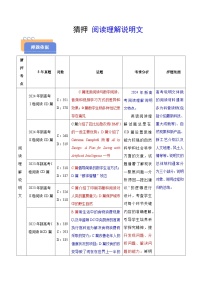
猜押考点
3年真题
词数和体裁
话题
考情分析
押题依据
阅读理解议论文
2024年新高考Ⅰ卷阅读C篇
343议论文
讨论了纸质阅读与数字阅读、音频和视频学习方式的差异和效果
议论文是英语中的重要文体,在阅读理解中占有一定的比例。
议论文就是说理性的文章,一般由论点、论据和论证过程组成。议论文都要提出论题、观点、提供充分的证据,使用一定的逻辑方法证明观点或得出结论。
高考英语阅读理解中的议论文通常涉及社会、文化、教育、科技、环境等领域的争议性或热点话题。这类文章旨在考查学生的阅读理解能力、逻辑思维能力以及对作者观点和态度的把握。
2024年全国甲卷阅读D篇
343议论文
通过作者与教授关于小说结局的讨论引发了对结局的思考,接着阐述了不同类型的文学作品结局的特点
2023年全国乙卷D篇
289议论文
论述了世人对天才的狭隘定义
一、思想哲理类
二、人工智能类 (批判性思维)
三、心理学类
四、科学研究类
五、文化与艺术类
六、社会生活类
七、思辨类
八、教育类
词数
话题
体裁
考点
押题理由
347
失败的心理痛苦如何能够激励个人在缺乏熟练度的活动中变得更好
议论文
细节理解、主旨要义。
思想哲理类议论文是高考英语阅读理解中的重要题型之一,通常涉及人生哲理、价值观、道德观、成功与失败等深层次的主题。这类文章不仅考查学生的语言理解能力,还要求考生具备一定的思辨能力和对抽象概念的理解能力。
词数
话题
体裁
考点
押题理由
339
培养成长型思维模式更有益,要正视事情带来的感受,认识到无法掌控一切,努力提升应对意外挑战的能力
议论文
推理判断、主旨要义。
思想哲理类议论文是高考英语阅读理解中的重要题型之一,通常涉及人生哲理、价值观、道德观、成功与失败等深层次的主题。这类文章不仅考查学生的语言理解能力,还要求考生具备一定的思辨能力和对抽象概念的理解能力。
词数
话题
体裁
考点
押题理由
362
反思性思考在追求个人幸福和成功方面的作用及其局限性
议论文
细节理解、主旨要义、词句猜测、推理判断。
思想哲理类议论文是高考英语阅读理解中的重要题型之一,通常涉及人生哲理、价值观、道德观、成功与失败等深层次的主题。这类文章不仅考查学生的语言理解能力,还要求考生具备一定的思辨能力和对抽象概念的理解能力。
词数
话题
体裁
考点
押题理由
345
AI 使人类认知面临过时风险,引发对人类地位和未来的担忧
议论文
推理判断
人工智能是当前科技领域的热门话题,也是高考英语阅读理解中的高频主题之一。这类文章通常涉及人工智能的发展、应用、影响及其引发的伦理和社会问题。
词数
话题
体裁
考点
押题理由
290
文章提出企业应通过战略性设计,利用AI增强和升级工作任务,推动工作转型
议论文
推理判断、词句猜测、主旨大意
人工智能是当前科技领域的热门话题,也是高考英语阅读理解中的高频主题之一。这类文章通常涉及人工智能的发展、应用、影响及其引发的伦理和社会问题。
词数
话题
体裁
考点
押题理由
332
引用学者的观点和对比人类思维与人工智能的不同
议论文
推理判断、细节理解、主旨大意、推理判断
人工智能是当前科技领域的热门话题,也是高考英语阅读理解中的高频主题之一。这类文章通常涉及人工智能的发展、应用、影响及其引发的伦理和社会问题。
词数
话题
体裁
考点
押题理由
353
心理学家弗洛姆关于“拥有”和“存在”两种心态的观点,指出“拥有”心态的问题并建议人们做出改变
议论文
推理判断、词句猜测、细节理解
心理学类阅读理解是高考英语中的重要题型之一,通常涉及人类行为、情绪、认知、心理健康等主题。这类文章不仅考查学生的语言理解能力,还要求考生具备一定的逻辑思维能力和对心理学概念的理解能力。
词数
话题
体裁
考点
押题理由
350
心理学家马斯洛的需求层次理论,以及金钱在满足人类需求中的作用
议论文
推理判断、词句猜测、细节理解
心理学类阅读理解是高考英语中的重要题型之一,通常涉及人类行为、情绪、认知、心理健康等主题。这类文章不仅考查学生的语言理解能力,还要求考生具备一定的逻辑思维能力和对心理学概念的理解能力。
词数
话题
体裁
考点
押题理由
311
人格测试的局限性以及人格并非固定不变的观点
议论文
推理判断、词句猜测、细节理解、主旨大意
心理学类阅读理解是高考英语中的重要题型之一,通常涉及人类行为、情绪、认知、心理健康等主题。这类文章不仅考查学生的语言理解能力,还要求考生具备一定的逻辑思维能力和对心理学概念的理解能力。
词数
话题
体裁
考点
押题理由
368
论述了科学的本质
议论文
推理判断、主旨大意、细节理解
科学研究类说明文是高考英语阅读理解中的重要题型之一,通常涉及科学发现、实验研究、技术应用、科学原理等主题。这类文章不仅考查学生的语言理解能力,还要求考生具备一定的科学素养和逻辑思维能力。
词数
话题
体裁
考点
押题理由
354
发明创造不是一蹴而就的,而往往来自不断的试错过程
议论文
推理判断
科学研究类说明文是高考英语阅读理解中的重要题型之一,通常涉及科学发现、实验研究、技术应用、科学原理等主题。这类文章不仅考查学生的语言理解能力,还要求考生具备一定的科学素养和逻辑思维能力。
词数
话题
体裁
考点
押题理由
360
科学的本质是集体、不完美且多面的过程
议论文
推理判断、主旨大意
科学研究类说明文是高考英语阅读理解中的重要题型之一,通常涉及科学发现、实验研究、技术应用、科学原理等主题。这类文章不仅考查学生的语言理解能力,还要求考生具备一定的科学素养和逻辑思维能力。
词数
话题
体裁
考点
押题理由
369
在全球化时代,理解并适应文化差异是促进国际合作与社会和谐的关键
议论文
推理判断、词句猜测、细节理解
文化与艺术类议论文是高考英语阅读理解中的重要题型之一,通常涉及文化传承、艺术价值、文化多样性、艺术与社会的关系等主题。这类文章不仅考查学生的语言理解能力,还要求考生具备一定的文化素养和对艺术话题的思辨能力。
词数
话题
体裁
考点
押题理由
308
作者对艺术在生活中的重要性的看法
议论文
推理判断、细节理解
文化与艺术类议论文是高考英语阅读理解中的重要题型之一,通常涉及文化传承、艺术价值、文化多样性、艺术与社会的关系等主题。这类文章不仅考查学生的语言理解能力,还要求考生具备一定的文化素养和对艺术话题的思辨能力。
词数
话题
体裁
考点
押题理由
388
人工智能(AI)和机器人如Ai-Da对艺术定义和人类创造力的影响,以及AI在艺术领域的潜在作用和未来发展方向
议论文
推理判断、词义猜测、细节理解
文化与艺术类议论文是高考英语阅读理解中的重要题型之一,通常涉及文化传承、艺术价值、文化多样性、艺术与社会的关系等主题。这类文章不仅考查学生的语言理解能力,还要求考生具备一定的文化素养和对艺术话题的思辨能力。
词数
话题
体裁
考点
押题理由
324
梭罗的简单生活理念及其对现代生活的启示
议论文
推理判断、主旨大意、细节理解
社会生活类议论文是高考英语阅读理解中的常见题型之一,通常涉及社会现象、生活方式、人际关系、社会问题等主题。这类文章不仅考查学生的语言理解能力,还要求考生具备一定的社会观察能力和逻辑思维能力。
词数
话题
体裁
考点
押题理由
325
现代社会中人们普遍存在的过度忙碌和“多任务处理”现象,以及这种生活方式对个人创造力和工作效率的负面影响
议论文
推理判断、细节理解
社会生活类议论文是高考英语阅读理解中的常见题型之一,通常涉及社会现象、生活方式、人际关系、社会问题等主题。这类文章不仅考查学生的语言理解能力,还要求考生具备一定的社会观察能力和逻辑思维能力。
词数
话题
体裁
考点
押题理由
366
赞美他人的重要性、有效赞美的标准及方式
议论文
推理判断、主旨大意
社会生活类议论文是高考英语阅读理解中的常见题型之一,通常涉及社会现象、生活方式、人际关系、社会问题等主题。这类文章不仅考查学生的语言理解能力,还要求考生具备一定的社会观察能力和逻辑思维能力。
词数
话题
体裁
考点
押题理由
346
文章对“失败是成功之母”这一常见观点提出了质疑
议论文
推理判断、词句猜测、主旨大意
思辨类议论文是高考英语阅读理解中的高难度题型之一,通常涉及哲学、伦理、社会争议等深层次主题。这类文章不仅考查学生的语言理解能力,还要求考生具备较强的逻辑思维能力、批判性思维能力和对抽象概念的理解能力。
词数
话题
体裁
考点
押题理由
362
通过比较历史和现代的工作观念,探讨了为何现代人尽管有各种劳动力节省设备,但依然感觉非常忙碌
议论文
推理判断、词句猜测、细节理解
思辨类议论文是高考英语阅读理解中的高难度题型之一,通常涉及哲学、伦理、社会争议等深层次主题。这类文章不仅考查学生的语言理解能力,还要求考生具备较强的逻辑思维能力、批判性思维能力和对抽象概念的理解能力。
词数
话题
体裁
考点
押题理由
339
论述了学习过程中的挣扎、错误与成长之间的关系,以及这些经历对个人成长的重要性
议论文
推理判断
教育类议论文是高考英语阅读理解中的高频题型之一,通常涉及教育理念、教育制度、学习方法、教育改革等主题。这类文章不仅考查学生的语言理解能力,还要求考生具备一定的教育背景知识和对教育问题的思辨能力。
词数
话题
体裁
考点
押题理由
357
论述了教师自我同情的重要性
议论文
推理判断、词句猜测、主旨大意
教育类议论文是高考英语阅读理解中的高频题型之一,通常涉及教育理念、教育制度、学习方法、教育改革等主题。这类文章不仅考查学生的语言理解能力,还要求考生具备一定的教育背景知识和对教育问题的思辨能力。
词数
话题
体裁
考点
押题理由
289
作者认为人工智能不但不会威胁到教师这份职业
议论文
推理判断、细节理解、主旨大意
教育类议论文是高考英语阅读理解中的高频题型之一,通常涉及教育理念、教育制度、学习方法、教育改革等主题。这类文章不仅考查学生的语言理解能力,还要求考生具备一定的教育背景知识和对教育问题的思辨能力。
这是一份备战2025年高考英语抢分秘籍(新高考专用)猜押阅读理解之议论文(按话题分类)(学生版+解析)练习,文件包含备战2025年高考英语抢分秘籍新高考专用猜押阅读理解之议论文按话题分类教师版docx、备战2025年高考英语抢分秘籍新高考专用猜押阅读理解之议论文按话题分类学生版docx等2份试卷配套教学资源,其中试卷共94页, 欢迎下载使用。
这是一份备战2025年高考英语抢分秘籍(新高考专用)猜押阅读理解之记叙文(按话题分类)(学生版+解析)练习,文件包含备战2025年高考英语抢分秘籍新高考专用猜押阅读理解之记叙文按话题分类教师版docx、备战2025年高考英语抢分秘籍新高考专用猜押阅读理解之记叙文按话题分类学生版docx等2份试卷配套教学资源,其中试卷共114页, 欢迎下载使用。
这是一份猜押 阅读理解之议论文(按话题分类)-2025年高考英语冲刺抢押专题讲练(新高考通用),文件包含猜押阅读理解之议论文按话题分类-2025年高考英语冲刺抢押专题讲练新高考通用原卷版docx、猜押阅读理解之议论文按话题分类-2025年高考英语冲刺抢押专题讲练新高考通用解析版docx等2份试卷配套教学资源,其中试卷共92页, 欢迎下载使用。
注册成功

在线客服
添加在线客服
获取1对1服务
官方微信
关注“教习网”公众号
打开微信就能找资料
赛课定制
添加在线客服
获取1对1定制服务
职称咨询
添加在线客服
获取1V1专业指导服务

免费福利

.png)
.png)