 免费领取教师福利

若您为此资料的原创作者,认为该资料内容侵犯了您的知识产权,请扫码添加我们的相关工作人员,我们尽可能的保护您的合法权益。


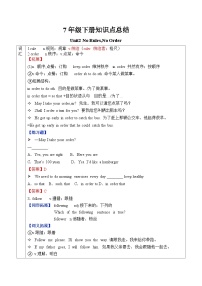
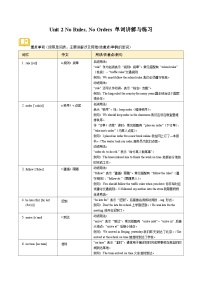
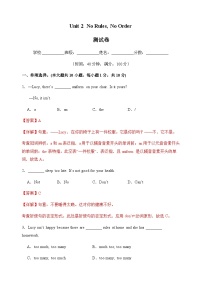
这是一份人教版(2024)Unit 2 No Rules, No Order练习题,文件包含Unit2NoRulesNoOrder原卷版docx、Unit2NoRulesNoOrder解析版docx等2份试卷配套教学资源,其中试卷共24页, 欢迎下载使用。
第一部分:知识点讲练
Sectin A What rules d we fllw?
第一部分:知识点讲练
第二部分:综合练习:巩固与提升
1. N Rules, N rder. 没有规矩,就没有秩序。
知识点讲解:
rule 作名词表示 “规则”
例如:We shuld fllw the traffic rules.(我们应该遵守交通规则。)
rule 作动词表示 “统治”
例如:The king rules the cuntry.(国王统治这个国家。)
fllw rules 意为 “遵守规则”
ruler 作名词表示 “尺子;统治者”
rder 作名词有 “点菜;顺序,次序” 的意思
例如:Take my rder, please.(请为我点菜。)
rder 作动词表示 “点菜,命令”
take ne's rder 表示 “点菜”
in rder 表示 “有序地”
例如:Put the bks in rder n the shelf.(把书在书架上摆放整齐。)
rder sb t d sth 表示 “命令某人做某事”
题目:
①We must ______ (遵守规则) in the library.
②The queen ______ (统治) the kingdm fr decades.
答案 + 解析:
①fllw the rules。“遵守规则” 用 fllw the rules,must 后接动词原形。
②has ruled。根据 “fr decades” 可知用现在完成时,“统治” 用 rule,其现在完成时形式为 has ruled。
2. Dn’t be late fr schl. Arrive n time. 上学不要迟到,准时到达。
知识点讲解:
be late fr 表示 “迟到”,强调状态
例如:He is ften late fr meetings.(他经常开会迟到。)
同义短语是 arrive late fr,强调动作
arrive 是不及物动词,近义词是 get 和 reach
arrive at + 小地方
例如:We arrived at the statin early.(我们很早就到达了车站。)
arrive in + 大地方
例如:They will arrive in New Yrk tmrrw.(他们明天将到达纽约。)
get 后接 t + 地点
例如:Hw can I get t the park?(我怎么去公园?)
reach 后直接接地点
例如:Finally, we reached the tp f the muntain.(最后,我们到达了山顶。)
当地点是 here/there/hme/abrad/upstairs/dwnstairs 时,介词省略
题目:
①She ______ (到达) the airprt just nw.
②They ______ (到达) hme safely last night.
答案 + 解析:
①reached/gt t/arrived at。“到达机场”,airprt 是小地方,reach 后直接接地点,get 后接 t + 地点,arrive 后接 at + 小地方,根据 “just nw” 可知用一般过去时,所以这三个答案都可以。
②gt/arrived/reached。hme 是地点副词,前面的介词省略,根据 “last night” 可知用一般过去时,所以这三个答案都可以。
3. Dn’t use yur phne in class. 上课不要用你的手机。
知识点讲解:
use 作动词和名词表示 “使用”
例如:I use a pen t write.(我用钢笔写字。)
useful 是形容词 “有用的”
例如:This bk is useful fr learning English.(这本书对学习英语很有用。)
useless 是 “无用的”
use sth t d... 表示 “使用某物做...”
例如:We use knives t cut things.(我们用刀切割东西。)
make use f... 表示 “利用”
题目:
①Can yu ______ (使用) this cmputer t d yur wrk?
②This tl is ______ (无用的) fr this jb.
答案 + 解析:
①use。“使用” 用 use,情态动词 can 后接动词原形。
②useless。“无用的” 用 useless,这里用形容词作表语。
4. Be plite and treat everyne with respect. 礼貌待人,尊重他人。
知识点讲解:
plite 是形容词 “礼貌的”
例如:She is a plite girl.(她是一个礼貌的女孩。)
plitely 是副词 “礼貌地”
例如:He speaks plitely.(他说话很有礼貌。)
反义词是 implite(不礼貌的)或 rude
be plite t sb 表示 “对某人礼貌的”
treat 作动词表示 “对待;招待;治疗”
例如:We shuld treat thers kindly.(我们应该友善地对待他人。)
treatment 是名词 “治疗”
respect 作动词和名词表示 “尊敬;敬重”
例如:We shuld respect ur parents.(我们应该尊敬我们的父母。)
shw respect fr... 表示 “表示对... 的尊敬”
题目:
①Yu shuld be ______ (礼貌的) t the ld.
②The dctr gave him special ______ (治疗).
答案 + 解析:
①plite。“礼貌的” 用 plite,be plite t sb 是固定用法。
②treatment。“治疗” 用 treatment,这里用名词作宾语。
5. Sally mustn’t wear her wn jacket. She has t wear schl the unifrm. Sally 在学校禁止穿自己的夹克衫。她必须要穿校服。
知识点讲解:
must 是情态动词,“必须”,不能单独作谓语,后必须加动词原形
例如:Yu must d yur hmewrk nw.(你现在必须做作业。)
其否定形式为 mustn’t,“禁止,千万不要”
例如:Yu mustn't smke here.(你千万不要在这里吸烟。)
以 must 开头的一般疑问句的否定回答不用 mustn’t,而用 needn’t 或者 dn’t/desn’t have t,意为 “不必”
题目:
①Yu ______ (必须) wear a helmet when riding a bike.
②—Must I clean the classrm tday? —N, yu ______ (不必).
答案 + 解析:
①must。“必须” 用 must,这里表示规定。
②needn't/dn't have t。根据语法规则,以 must 开头的一般疑问句的否定回答用 needn't 或者 dn't/desn't have t。
6. Be n time. Dn’t be late fr class. 准时,上课不要迟到。
知识点讲解:
n time 表示 “按时,准时”
例如:The train always arrives n time.(火车总是准时到达。)
拓展的 time 相关短语有 in time(及时)
例如:He gt t the statin in time.(他及时赶到了车站。)
at times(有时)
例如:At times, I like t read bks alne.(有时,我喜欢独自看书。)
at the same time(同时)
例如:We can sing and dance at the same time.(我们可以同时唱歌和跳舞。)
frm time t time(不时)
例如:She visits her grandparents frm time t time.(她不时去看望她的祖父母。)
all the time(一直)
例如:He is busy all the time.(他一直很忙。)
have a gd time(玩得开心)
题目:
①Please cme t the meeting ______ (准时).
②We shuld be careful ______ (一直).
答案 + 解析:
①n time。“准时” 用 n time。
②all the time。“一直” 用 all the time。
7. Keep the rules and let’s have fun! 遵守规则,让我们玩得开心!
知识点讲解:
let 表示 “让”,let’s = let us
let sb d sth 表示 “让某人做某事”
例如:Let the children play utside.(让孩子们在外面玩。)
have fun 表示 “玩得开心”,相当于 have a gd time 或 enjy neself
例如:We had a lt f fun at the party.(我们在聚会上玩得很开心。)
have fun ding sth 表示 “做某事玩得开心”
题目:
①Let's ______ (玩) ftball tgether.
②I had fun ______ (爬山) last weekend.
答案 + 解析:
①play。let's 后接动词原形 play,表示 “踢足球”。
②climbing。have fun ding sth 表示 “做某事玩得开心”,“爬山” 用 climb,其动名词形式是 climbing。
8. Here, I can lend yu my pen. 来,我可以借给你我的钢笔。
知识点讲解:
lend 表示 “借给”,lend sb sth = lend sth t sb 表示 “借给某人某物”
例如:I lent my friend my bk.(我把我的书借给了我的朋友。)
辨析:lend(借出)、brrw(借入,brrw sth frm sb 向某人借某物,短暂性动作,不与一段时间连用)、keep(保存(借用一段时间),常与一段时间连用)
题目:
①My sister ______ (借给) me her umbrella yesterday.
②I ______ (借) a nvel frm the library last week.
答案 + 解析:
①lent。根据 “yesterday” 可知用一般过去时,“借给” 用 lent。
②brrwed。根据 “last week” 可知用一般过去时,“借入” 用 brrwed。
9. We have t turn them ff and put them in ur lckers. 我们必须关掉手机,把它们放在储物柜里。
知识点讲解:
turn ff 表示 “关闭”,相当于 switch ff
例如:Turn ff the lights when yu leave the rm.(离开房间时关灯。)
当宾语为代词时,放在中间
拓展的 turn 相关短语有 turn n(打开)
例如:Turn n the TV, please.(请打开电视。)
turn dwn(调小;拒绝)
例如:Turn dwn the music. It's t lud.(把音乐调小,太吵了。)
turn up(调大;出现)
例如:Turn up the radi. I can't hear it clearly.(把收音机调大,我听不清楚。)
(转变成...)
题目:
①Please ______ (关掉) the cmputer.
②Can yu ______ (打开) the air cnditiner? It's t ht.
答案 + 解析:
①turn ff。“关掉” 用 turn ff,祈使句用动词原形。
②turn n。“打开” 用 turn n,情态动词 can 后接动词原形。
10. Thanks fr telling me, Anne. 谢谢你告诉我,安妮。Yu’re welcme, Tm. 不客气,汤姆。
知识点讲解:
Thank yu fr... 意为 “为... 而感谢你(们)”,相当于 thanks fr...
例如:Thank yu fr yur help.(感谢你的帮助。)
fr 是介词,表示原因,后接名词、代词或动词 -ing 形式
Yu’re welcme“别客气,不用谢”,用于礼貌地回答别人的感谢
拓展的常用答语还有 Nt at all. / That’s OK. / That’s all right. / (It’s) my pleasure...
题目:
①Thanks fr ______ (帮助) me with my prject.
②—Thank yu fr the gift. —______ (不客气).
答案 + 解析:
①helping。thanks fr 后接动词 -ing 形式,“帮助” 用 help,其动名词形式是 helping。
②Yu're welcme/Nt at all/That's OK/That's all right/(It's) my pleasure。这些都是常见的回答感谢的用语。
Sectin B Hw can rules help us?
1. I have t make my bed befre breakfast. 早餐前我必须整理床铺。
知识点讲解:
have t 表示 “必须;不得不”,后接动词原形
例如:I have t get up early.(我必须早起。)
make ne's bed 表示 “整理某人的床”
make 作动词表示 “使,让”,make sb + adj. 表示 “使某人...”
例如:The mvie made me happy.(这部电影让我开心。)
make sb d sth 表示 “使某人做某事”
题目:
①I ______ (必须) wash the dishes after dinner.
②My mther makes me ______ (学习) hard.
答案 + 解析:
①have t。“必须” 用 have t,这里表示客观需要。
②study。make sb d sth 表示 “使某人做某事”,“学习” 用 study,动词原形。
2. I have t hurry t schl because I can’t be late fr schl. 我必须赶紧去学校因为我不能迟到。
知识点讲解:
hurry 作动词和名词表示 “匆忙;急忙”
例如:He is in a hurry t leave.(他急着离开。)
hurry t + 地方表示 “匆忙去某地”
例如:She hurried t the ffice.(她匆忙赶到办公室。)
hurry t d sth 表示 “匆忙做某事”
in a hurry 表示 “匆忙地”
题目:
①He ______ (匆忙) t catch the early bus.
②They left ______ (匆忙地) this mrning.
答案 + 解析:
①hurried。根据语境,这里用一般过去时,“匆忙” 用 hurried。
②in a hurry。“匆忙地” 用 in a hurry,作状语。
3. I can nly play basketball after I practise the pian. 我练习完钢琴后才能打篮球。
知识点讲解:
practise 表示 “练习”,practice 是名词 “练习”
例如:I need mre practice.(我需要更多练习。)
practise ding sth 表示 “练习做某事”
例如:I practise speaking English every day.(我每天练习说英语。)
play basketball 表示 “打篮球”,play + 球 / 棋类
例如:We play ftball n weekends.(我们在周末踢足球。)
play the + 乐器类
题目:
①Yu shuld ______ (练习) reading alud.
②He likes ______ (弹) the vilin.
答案 + 解析:
①practise。“练习” 用 practise,shuld 后接动词原形。
②playing。like ding sth 表示 “喜欢做某事”,“弹小提琴” 用 play the vilin,这里 play 用动名词形式 playing。
4. They can help yu t becme a better persn. 它们能帮助你成为一个更好的人。
知识点讲解:
help 作动词和名词表示 “帮助”
例如:Can yu help me?(你能帮助我吗?)
help sb with sth 表示 “在某方面帮助某人”
例如:She helps me with my math.(她在数学方面帮助我。)
help sb (t) d sth 表示 “帮助某人做某事”
例如:He helps me (t) clean the rm.(他帮助我打扫房间。)
ask fr help 表示 “请求帮助”
拓展的 helpful 是形容词 “有帮助的”
例如:This bk is helpful.(这本书很有帮助。)
helpless 是 “无助的”
becme 表示 “开始变得,变成”
例如:She becmes mre beautiful.(她变得更漂亮了。)
better 是 gd/well 的比较级
persn 表示 “人”,可数名词单数
peple 表示 “人们(复数形式)”,作主语时,谓语动词用复数
例如:Peple are friendly here.(这里的人们很友好。)
peple 也可作名词单数,意为 “民族,种族”
题目:
①Can yu ______ (帮助) me find my lst keys?
②He ______ (变成) mre respnsible after that incident.
答案 + 解析:
①help。“帮助” 用 help,情态动词 can 后接动词原形。
②became。根据语境,这里用一般过去时,“变成” 用 becme 的过去式 became,表示在那件事情之后他变得更有责任感了。
5. Yu can’t use yur phne in class because yu need t fcus n learning. 你不能在课堂上使用手机,因为你需要专注于学习。
知识点讲解:
need 作动词和名词表示 “需要”,既可作情态动词,也作实义动词。作情态动词时,其否定形式为:needn’t;作实义动词时,其否定形式为:dn’t/desn’t need 。
例如:Yu needn't wrry abut it.(你不必为此担心。) / I dn't need a new bike.(我不需要一辆新自行车。)
need t d sth 表示 “需要做某事”
例如:I need t buy sme bks.(我需要买一些书。)
in need 表示 “有需要地”
fcus n... 表示 “将(注意力)集中于...”
例如:We shuld fcus n ur study.(我们应该专注于我们的学习。)
题目:
①Yu ______ (需要) d mre exercise t keep healthy.
②He ______ (需要) sme help with his hmewrk.
答案 + 解析:
①need t。这里 need 作实义动词,“需要做某事” 用 need t d sth,根据语境用一般现在时。
②needs。这里 need 作实义动词,主语是 he,“需要” 用 needs,一般现在时的第三人称单数形式。
6. Yu can relax after yu finish yur hmewrk. 你完成作业后可以放松。
知识点讲解:
relax 作动词表示 “放松”,relaxing 是形容词 “令人放松的”(修饰物),relaxed 是形容词 “感到放松的”(修饰人)。
例如:The music is relaxing.(这音乐令人放松。) / I feel relaxed.(我感到放松。)
finish 作动词表示 “完成”,finish ding sth 表示 “完成做某事”。
例如:I finished reading the bk yesterday.(我昨天读完了这本书。)
题目:
①Let's ______ (放松) fr a while.
②He ______ (完成) writing the reprt last week.
答案 + 解析:
①relax。let's 后接动词原形 relax,表示 “放松一下”。
②finished。根据 last week 可知用一般过去时,“完成” 用 finish 的过去式 finished。
7. I knw it can be difficult t fllw many rules. 我知道遵守很多规则可能很困难。
知识点讲解:
difficult 是形容词 “困难的”,It is difficult fr sb t d sth. 表示 “对某人来说做某事很困难”。
例如:It is difficult fr me t learn math.(对我来说学数学很困难。)
difficulty 是名词 “困难”,have difficulty (in) ding sth 表示 “做某事有困难”。
例如:I have difficulty in remembering new wrds.(我记新单词有困难。)
fllw 作动词表示 “遵守;追随”,fllwing 是形容词 “接下来的”,as fllws 表示 “如下所示”。
题目:
①It's ______ (困难的) t slve this prblem.
②I have ______ (困难) understanding this passage.
答案 + 解析:
①difficult。“困难的” 用 difficult,It's + 形容词 + t d sth 是固定句型。
②difficulty。“有困难” 用 have difficulty (in) ding sth,这里用名词 difficulty。
8. Say “please” when yu ask fr help. 当你寻求帮助时,说 “请”。
知识点讲解:
ask fr help 表示 “请求帮助”,ask 作动词表示 “问;要求”,ask a questin 表示 “问问题”,ask sb(nt)t d sth 表示 “要求某人(不)做某事”。
例如:She asks me t clean the classrm.(她要求我打扫教室。)
题目:
①He ______ (请求) help frm his teacher.
②My father ______ (要求) me t study hard.
答案 + 解析:
①asks fr。“请求帮助” 用 ask fr help,主语是 he,一般现在时用 asks fr。
②asks。“要求某人做某事” 用 ask sb t d sth,主语是 my father,一般现在时用 asks。
9. Dn’t fight with yur classmates. 不要和你的同学打架。
知识点讲解:
fight 作动词表示 “打架;战斗”,fight with sb 表示 “和某人打架”,fight against sb 表示 “和某人作战”,fight fr... 表示 “为... 而斗争”。
例如:We shuld fight against pllutin.(我们应该与污染作斗争。)
题目:
①We shuldn't ______ (打架) with thers.
②They ______ (为... 而斗争) freedm.
答案 + 解析:
①fight。shuldn't 后接动词原形 fight,表示 “打架”。
②fught fr。根据语境,这里用一般过去时,“为... 而斗争” 用 fight fr,其过去式为 fught fr。
10. Nthing can be achieved withut rules. 没有规则什么也做不了。
知识点讲解:
achieve 作动词表示 “(努力)达到;完成;实现”,achieve ne’s dream 表示 “实现梦想”。
例如:He achieved his gal.(他实现了他的目标。)
withut 作介词表示 “不,没有”,后接名词,代词或 V - ing。
例如:I can't d it withut yur help.(没有你的帮助我做不了这件事。)
题目:
①He ______ (实现) his dream thrugh hard wrk.
②We can't live ______ (没有) water.
答案 + 解析:
①achieved。根据语境,这里用一般过去时,“实现” 用 achieve 的过去式 achieved。
②withut。“没有” 用 withut,后接名词 water。
第二部分:综合练习:巩固与提升
一、单项选择
1. Yu ______ be late fr schl. It's imprtant t arrive n time.
A. mustn't B. can't C. dn't have t D. needn't
答案:A。解析:根据语境,这里表示 “禁止,不允许” 迟到,mustn't 有此含义。
2. —Must I clean my rm nw?
—N, yu ______. Yu can d it later.
A. mustn't B. can't C. dn't have t D. needn't
答案:D。解析:以 must 开头的一般疑问句的否定回答用 needn't 或 dn't have t。
3. We ______ fllw the traffic rules when we crss the rad.
A. must B. can C. may D. shuld
答案:A。解析:这里表示必须遵守交通规则,must 符合语境。
4. She ______ get up early t catch the first bus.
A. has t B. have t C. must t D. had t
答案:A。解析:主语是 she,是第三人称单数,一般现在时中用 has t 表示 “不得不”。
5. ______ yur hmewrk befre yu watch TV.
A. Finish B. Finishing C. T finish D. Finished
答案:A。解析:这里是祈使句,用动词原形开头,“完成作业” 用 finish yur hmewrk。
6. Dn't ______ in class. Listen carefully!
A. talk B. talking C. t talk D. talked
答案:A。解析:这是祈使句的否定形式,Dn't 后接动词原形 talk。
7. —Can I ______ yur eraser?
—Sure. Here yu are.
A. lend B. brrw C. keep D. use
答案:B。解析:这里表示 “借入”,用 brrw,brrw sth frm sb 表示 “向某人借某物”。
8. He ______ his bike t me yesterday.
A. lent B. brrwed C. kept D. used
答案:A。解析:这里表示 “借出”,用 lent,lend sth t sb 表示 “把某物借给某人”。
9. It's implite t ______ thers.
A. be plite t B. be rude t C. be kind t D. be friendly t
答案:B。解析:根据前面的 “implite” 可知这里是 “对别人粗鲁”,be rude t 符合。
10. The teacher asks us ______ the classrm clean.
A. keep B. t keep C. keeping D. kept
答案:B。解析:ask sb t d sth 表示 “要求某人做某事”,“保持教室干净” 用 keep the classrm clean,这里用 t keep。
二、用所给词的适当形式填空
1. Yu must ______ (arrive) at schl n time.
答案:arrive。解析:must 后接动词原形 arrive。
2. Dn't ______ (make) nise in the library.
答案:make。解析:祈使句的否定形式,Dn't 后接动词原形 make。
3. She ______ (have t) stay at hme because she is ill.
答案:has t。解析:主语是 she,是第三人称单数,一般现在时用 has t。
4. We shuld ______ (fllw) the schl rules.
答案:fllw。解析:shuld 后接动词原形 fllw。
5. It's ______ (plite) t cut in line.
答案:implite。解析:根据常识,插队是不礼貌的,用 plite 的反义词 implite。
6. The mvie is very ______ (relax). I like it.
答案:relaxing。解析:这里修饰 mvie,用 relaxing 表示 “令人放松的”。
7. He ______ (lend) me a bk last week.
答案:lent。解析:根据 last week 可知用一般过去时,lend 的过去式是 lent。
8. I need ______ (buy) a new pen.
答案:t buy。解析:need t d sth 表示 “需要做某事”。
9. They have difficulty ______ (slve) this prblem.
答案:slving。解析:have difficulty (in) ding sth 表示 “做某事有困难”,这里用 slving。
10. She ______ (becme) mre cnfident after the speech.
答案:became。解析:根据语境,这里用一般过去时,becme 的过去式是 became。
三、完成句子
1. 我们必须按时完成作业。We must ______ (按时完成作业).
答案:finish ur hmewrk n time。解析:“完成作业” 用 finish ur hmewrk,“按时” 用 n time。
2. 不要在图书馆里大声喧哗。Dn't ______ (在图书馆里大声喧哗).
答案:make nise in the library。解析:“制造噪音” 用 make nise,“在图书馆里” 用 in the library。
3. 他不得不早起去上班。He ______ (不得不早起去上班).
答案:has t get up early t g t wrk。解析:“不得不” 用 has t,“早起” 用 get up early,“去上班” 用 g t wrk。
4. 我们应该对老师有礼貌。We shuld ______ (对老师有礼貌).
答案:be plite t ur teachers。解析:“对某人有礼貌” 用 be plite t sb。
5. 请把书还给我。Please ______ (把书还给我).
答案:return the bk t me。解析:“归还” 用 return,return sth t sb 表示 “把某物还给某人”。
6. 她每天练习弹钢琴。She ______ (每天练习弹钢琴).
答案:practises playing the pian every day。解析:“练习做某事” 用 practise ding sth,“弹钢琴” 用 play the pian,主语是 she,一般现在时用 practises。
7. 没有规则,我们的生活将会一团糟。Withut rules, ur life ______ (将会一团糟).
答案:will be in a mess。解析:这里表示假设的情况,用一般将来时,“一团糟” 用 be in a mess。
8. 我需要一些帮助来完成这个项目。I ______ (需要一些帮助来完成这个项目).
答案:need sme help t finish the prject。解析:“需要帮助” 用 need help,“完成项目” 用 finish the prject,这里用 t finish 表示目的。
9. 他努力学习实现了他的梦想。He ______ (努力学习实现了他的梦想).
答案:achieved his dream by studying hard。解析:“实现梦想” 用 achieve ne's dream,“通过努力学习” 用 by studying hard,这里用一般过去时 achieved。
10. 我们应该专注于我们的学习。We shuld ______ (专注于我们的学习).
答案:fcus n ur study。解析:“专注于” 用 fcus n,“我们的学习” 用 ur study。
四、语法填空
Michelle is a middle schl student. She is in the schl swimming club and she’s really gd at swimming.
Every mrning, Michelle gets 1 at 6: 00. Then she des sprts fr an hur at hme. After that she ges t schl at 7: 30. Classes 2 (be) frm 8: 00 am t 3: 30 pm. Michelle has fur lessns in the mrning 3 tw lessns in the afternn. She studies hard in 4 (she) lessns. After schl, she ges t 5 swimming club at 4: 00 pm, and practices there fr an hur. Then she ges hme.
After dinner, she always 6 (finish) her hmewrk first. Then she 7 (usual) watches swimming games n TV. She wants t learn frm the great swimming 8 (star). She always ges t bed early, because she thinks 9 (get) enugh sleep is very imprtant. On weekends, Michelle ges t a sprts center t exercise and practice swimming. She swims tw hurs a day there.
Althugh the swimming training is very hard, she isn’t afraid f it, and even never feels 10 (bre). Her dream is t be a swimming star and she is trying her best t make her dream cme true.
【答案】
1. up 2. are 3. and 4. her 5. the
6. finishes 7. usually 8. stars 9. getting 10. bred
【解析】
1. up
解析:get up 是固定短语,意为 “起床”,根据后面的时间 6:00 可知这里是说起床时间,所以填 up。
2. are
解析:主语是 Classes,是复数形式,一般现在时中 be 动词用 are。
3. and
解析:这里表示并列关系,“上午有四节课” 和 “下午有两节课” 是并列的,用 and 连接。
4. her
解析:这里需要用形容词性物主代词修饰名词 lessns,she 的形容词性物主代词是 her,表示 “她的”。
5. the
解析:这里的 swimming club 是特指她所在的学校游泳俱乐部,所以用定冠词 the。
6. finishes
解析:主语是 she,是第三人称单数,一般现在时中动词要用第三人称单数形式,finish 的第三人称单数形式是 finishes。
7. usually
解析:这里需要用副词修饰动词 watches,usual 的副词形式是 usually,表示 “通常”。
8. stars
解析:根据语境可知这里不是指一个游泳明星,而是泛指很多游泳明星,所以用复数形式 stars。
9. getting
解析:这里的 “getting enugh sleep” 是动名词短语作宾语从句的主语,动词 get 要用动名词形式 getting。
10. bred
解析:这里表示 “感到厌烦的”,用来修饰人,用 bred,bring 用来修饰物。
五、完形填空
Henry was interested in wild animals. He 1______ t learn mre abut wlves (狼). D they kill peple?
He tk a plane and gt t a far place withut huses r peple. But there were lts f animals and wlves. Peple always say wlves like t 2______ and eat peple. Henry remembered these wrds 3______ he was afraid. He had his gun (枪) with him 4______.
Then ne day, he saw a grup f wlves. There was a mther wlf with fur little wlves. A father wlf and anther yung wlf lived with 5______.
Henry watched these wlves every day. The mther was a very 6______ mther. She gave milk t her kids. She gave them lessns abut life. They learned hw t get fd. The father wlf gt fd fr the mther. The yung wlf played 7______ the children. They were a happy family! Henry did nt need his 8______ any mre. In a shrt time, he gt n well with the family. Henry watched them fr five mnths. He learned that many wrds abut the wlves were nt true. Wlves d nt like t eat peple. They 9______ have family and lve like human (人类).
Later, Henry wrte a bk abut wlves. He wanted peple t 10______ the wlves and nt t kill them.
1. A. gt B. wanted C. grew
2. A. kill B. lve C. help
3. A. but B. because C. s
4. A. sme times B. all the time C. nce a week
5. A. them B. him C. us
6. A. gd B. hungry C. thirsty
7. A. f B. t C. with
8. A. fd B. gun C. plane
9. A. t B. als C. either
10. A. grw B. have C. understand
【答案】
1-5 BACBA 6-10 ACBBC
【解析】
1. 句意:他想更多地了解狼。gt 意为 “得到”;wanted 意为 “想要”;grew 意为 “成长”。根据 “He…t learn mre abut wlves.” 可知,他想知道更多关于狼的知识,因此 “wanted” 符合题意。故选 B。
2. 句意:人们总是说狼喜欢杀人、吃人。kill 意为 “杀死”;lve 意为 “爱”;help 意为 “帮助”。根据 “Peple always say wlves like t…and eat peple.” 可知,人们总是说狼喜欢杀人,故选 A。
3. 句意:亨利记住了这些话,所以他很害怕。but 意为 “但是”;because 意为 “因为”;s 意为 “所以”。根据 “Henry remembered these wrds…he was afraid.” 可知,亨利记住了这些话,所以他很害怕,前后是因果关系,故选 C。
4. 句意:他一直带着枪。sme times 意为 “几次”;all the time 意为 “一直”;nce a week 意为 “一周一次”。根据 “he was afraid” 可知,他总是带着枪,故选 B。
5. 句意:一只狼爸爸和另一只狼幼崽和它们住在一起。them 指代上文提到的 “a mther wlf with fur little wlves”;him 意为 “他”;us 意为 “我们”。这里指和母狼及小狼一起住,因此需用 them,故选 A。
6. 句意:母亲是一位非常好的母亲。gd 意为 “好的”;hungry 意为 “饥饿的”;thirsty 意为 “口渴的”。根据 “She gave milk t her kids. She gave them lessns abut life.” 可知,说明它是一位好母亲,故选 A。
7. 句意:年轻的狼和狼幼崽们玩耍。play with 意为 “和…… 一起玩”,是固定搭配,故选 C。
8. 句意:亨利不再需要枪了。根据前文 “He had his gun (枪) with him…” 以及 “He learned that many wrds abut the wlves were nt true.” 可知,他了解到狼并不像传言那样,就不再需要枪了,故选 B。
9. 句意:他们也有像人类一样的家庭和爱。t 意为 “也”,用于句末;als 意为 “也”,用于句中;either 意为 “也”,用于否定句。此处是肯定句,此空位于句中,故选 B。
10. 句意:他希望人们了解狼,而不是杀死它们。grw 意为 “成长”;have 意为 “有”;understand 意为 “理解”。根据 “and nt t kill them” 可知,是指他希望人们去了解狼,而不是杀害它们,故选 C。
这是一份人教版(2024)Unit 2 No Rules, No Order练习题,文件包含Unit2NoRulesNoOrder原卷版docx、Unit2NoRulesNoOrder解析版docx等2份试卷配套教学资源,其中试卷共24页, 欢迎下载使用。
这是一份人教版(2024)七年级下册(2024)Unit 2 No Rules, No Order练习题,文件包含Unit2NoRulesNoOrder-Grammar原卷版docx、Unit2NoRulesNoOrder-Grammar解析版docx等2份试卷配套教学资源,其中试卷共22页, 欢迎下载使用。
这是一份人教版(2024)七年级下册(2024)Unit 2 No Rules, No Order测试题,共15页。
注册成功

在线客服
添加在线客服
获取1对1服务
官方微信
关注“教习网”公众号
打开微信就能找资料
赛课定制
添加在线客服
获取1对1定制服务
职称咨询
添加在线客服
获取1V1专业指导服务

免费福利

.png)
.png)
.png)
