免费领取教师福利

若您为此资料的原创作者,认为该资料内容侵犯了您的知识产权,请扫码添加我们的相关工作人员,我们尽可能的保护您的合法权益。


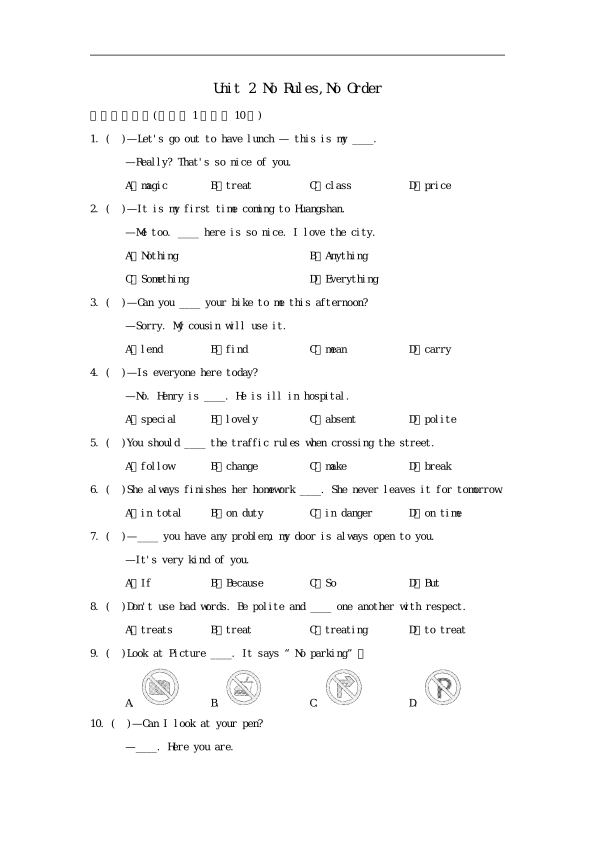
这是一份初中英语人教版(2024)七年级下册(2024)Unit 2 No Rules, No Order巩固练习,共14页。
I. 短对话理解(共5 小题; 每小题1 分, 满分5 分)
( ) 1. What des Helen have t d in the evening?
A. B. C.
( ) 2. What is the latest time fr the girl t get hme?
A. B. C.
( ) 3. When can the by watch TV at hme?
A. On Sunday. B. On Saturday. C. On Friday.
( ) 4. What des Jim ften d n the bus?
A. He ften reads bks. B. He ften talks ludly. C. He ften sleeps.
( ) 5. What can’t the by wear at schl?
A. T-shirts. B. Shrts. C. Jeans.
II. 长对话理解(共5 小题; 每小题1 分, 满分5 分)
听下面一段对话, 回答第6、7 题。
( ) 6. What rules are they talking abut?
A. Family rules.
B. Library rules.
C. Dining hall rules.
( ) 7. What can Mike d there?
A. He can take a ntebk. B. He can eat.C. He can talk.
听下面一段对话, 回答第8 至10 题。
( ) 8. Where can they watch the sccer game?
A. In the schl.
B. In the park.
C. In the sprts center.
( ) 9. When can’t Frank see friends?
A. On schl days.
B. After schl.
C. On weekends.
( ) 10. What des Mary have t d at hme?
A. She has t finish her hmewrk befre watching TV.
B. She has t help her mther make lunch every day.
C. She has t clean her rm every Saturday.
III. 短文理解(共5 小题; 每小题1 分, 满分5 分)
( ) 11. When des Cindy get up every mrning?
A. At 6:30. B. At 6:00. C. At 7:00.
( ) 12. Where des Cindy ften eat when she is at schl?
A. In the dining hall.
B. In the library.
C. In the classrm.
( ) 13. What des Cindy have t wear at schl?
A. Her sprts shes.
B. Her glasses.
C. Her schl unifrm.
( ) 14. What des Cindy d first after schl?
A. She des her hmewrk.
B. She cleans the classrm.
C. She helps her mther make dinner.
( ) 15. What des Cindy d after she reads bks?
A. She ges t be
B. She watches TV.
C. She eats sme fd.
IV. 信息转换(共5 小题; 每小题1 分, 满分5 分)
第二部分 语言知识运用(共三大题, 满分35 分)
V. 单项填空(共10 小题; 每小题1 分, 满分10 分)
( ) 21. Mr. Lee always gave me sme ________ n hw t study English well when I had sme truble.
A. advice B. questins C. rules D. clthes
( ) 22. Alice thinks sme rules are imprtant, but she feels sme are ________.
A. interesting B. great C. awful D. easy
( ) 23. [六安阶段练] — Des Mr. Green always listen t light music t ________ after hard wrk?
— Yes. It can make him feel happy.
A. wrk B. sleep C. relax D. prepare
( ) 24. — I dn’t like the game. It can’t make me feel cmfrtable.
— I dn’t like it, ________.
A. als B. t C. as well D. either
( ) 25. — Mm, ________ I hang ut with my friends?
— Sure, but yu get hme befre 9:00 p.m.
A. can; might B. can; have t C. must; have t D. must; might
( ) 26. Yu shuld ________ yur wrk, nt just yur appearance (外貌).
A. turn n B. fcus n C. live n D. call n
( ) 27. [宿州期中] Tny, d yur hmewrk ________ in yur rm. Yur grandpa is sleeping.
A. quietly B. exactly C. usually D. really
( ) 28. — D yu think we can get t the airprt n time?
— Yes, ________ the car desn’t break dwn.
A. but B. if C. thugh D. until
( ) 29. —________ the living rm blue, Andrew.
— OK, Mum. What abut range?
A. Desn’t paint B. Didn’t paint C. Nt paint D. Dn’t paint
( ) 30. — Can I try n this pair f shes?
—________. Here yu are.
A. That’s right B. Of curse C. That’s all right D. I’m srry
VI. 完形填空(共20 小题; 每小题1 分, 满分20 分)
A [宿州期中]
There are sme rules in David’s family. Nt playing ftball at hme is ne f them. David desn’t like the 31 . He thinks it is t 32 .
Tday, his mum 33 . David is happy t play ftball in the rm. His dg, Rusty, 34 him in playing it. They run with the ball. Oh, n! The ball hits a cup.
After that, Mum cmes hme. David tells his mum Rusty runs at hme and breaks the cup.
“Rusty,” Mum says, “n 35 fr yu this evening.”
Rusty desn’t have dinner. David feels 36 when Rusty lks at him. He knws he needs t d sme things. He 37 t his mum with the ftball.
“Srry, Mum,” he says, “Rusty desn’t break the cup. I break the cup 38 I play ftball in the rm.”
“Yu can’t g t watch the ftball game with Dad and me tmrrw. It’s a punishment (惩罚),” Mum says.
It’s imprtant t 39 the rules. He says t his mther, “I will 40 play ftball at hme again, Mum.”
( ) 31. A. race B. talk C. habit D. rule
( ) 32. A. helpful B. strict C. dirty D. perfect
( ) 33. A. ges ut B. writes dwn C. calls back D. gets up
( ) 34. A. saves B. leaves C. jins D. teaches
( ) 35. A. water B. music C. fd D. luck
( ) 36. A. awful B. interested C. happy D. relaxed
( ) 37. A. listens B. drinks C. walks D. asks
( ) 38. A. r B. s C. befre D. because
( ) 39. A. practise B. fllw C. finish D. thank
( ) 40. A. never B. smetimes C. usually D. always
B
Dear Dr. Knw,
There are s many rules at my hme. When my mther says, “Dn’t be 41 !”I have t stp playing the game and keep quiet. Every time I 42 an ice cream, my father will say, “N, Frank!” I think they’re t strict 43 me.
Why can’t I make sme rules fr them?
My first rule is “Dn’t 44 phnes t much!” My parents are always tired after a day’s wrk, s they want t 45 their phnes t relax. But we need t talk with each ther abut ur life. It’s very 46 t a family, I think.
The secnd rule is abut 47 n the weekend. Tday is Saturday. But nw my father is watching TV and my mther is ding the dishes in the 48 . If we have this rule, we can g swimming, ride bikes r 49 g fr a walk in the park. It nt nly helps us keep healthy, but als makes us have fun tgether.
I hpe that these rules can wrk in my family. If all f us 50 them, we can have a happy life. D yu think s, Dr. Knw?
Frank
( ) 41. A. dirty B. late C. nisy D. afraid
( ) 42. A. draw B. eat C. drink D. sell
( ) 43. A. t B. with C. in D. fr
( ) 44. A. use B. have C. make D. shw
( ) 45. A. g ut B. knw abut C. think abut D. play with
( ) 46. A. scary B. bring C. difficult D. imprtant
( ) 47. A. wrk B. symbl C. life D. study
( ) 48. A. kitchen B. classrm C. library D. z
( ) 49. A. als B. just C. still D. really
( ) 50. A. see B. find C. read D. fllw
VII. 补全对话, 其中有两项多余(共5 小题; 每小题1 分, 满分5 分)
A: Hi, my name is Jane.
B: Hi, Jane. I’m Cnnie. Nice t meet yu. Are yu a new student here?
A: Yeah. 51. ________
B: Sure. Dn’t shut r run in the hallways.
A: Aha, I dn’t think I’ll d that. Can we eat fd in class?
B: N, we can’t.
A: OK. 52. ________ What else?
B: 53. ________ If yu dn’t, the teachers n duty at the gate wn’t let yu in.
A: I see. 54. ________
B: When yu g t the library, yu shuld take it.
A: 55. ________
B: Try t wrk hard at all yur subjects. If yu fail (不及格) any f them, the teachers will call yur parents.
A: Thank yu, Cnnie. I think if I wrk hard, I wn’t fail any subjects.
第三部分 阅读(共两节, 满分40 分)
VIII. 阅读理解(共20 小题; 每小题2 分, 满分40 分)
第一节 阅读下列短文, 从每小题所给的A、B、C、D 四个选项中选出最佳选项。
A[福建泉州期末]
T build a great cuntry, everyne shuld fllw rules. Here is sme advice n
hw t d well in public places.
( ) 56. What shuld we NOT d when waiting fr the bus?
A. Wait in a line. B. Push thers.
C. Shw respect fr thers. D. Help keep rder.
( ) 57. Which f the fllwing can be put in ▲?
A. B.
C. D.
( ) 58. What des the passage mainly talk abut?
A. Rules fr building a great cuntry.
B. Rules fr eating habits in public.
C. Rules fr taking public transprtatin.
D. Rules fr helping thers.
B
( ) 59. What des the underlined wrd “rar” mean?
A. Clse. B. Shut. C. Eat. D. Whisper.
( ) 60. What des the writer think f the rules?
A. We dn’t need t fllw rules at hme.
B. Rules help make the wrld a better place.
C. It’s terrible t have rules everywhere.
D. We shuld fllw the rules we like.
( ) 61. What is the best title f this pem?
A. Always be n time B. A better wrld
C. Rules are everywhere D. Be plite
C
“Ben, brush yur teeth befre breakfast!”
“Ben, dn’t run in the classrm!”
All day lng, parents and teachers keep telling Ben what t d and what nt t d. At night, Ben lies (躺) in his bed and thinks, “Dn’t d this, and dn’t d that! I dn’t want any rules. They’re terrible!”
Suddenly, Ben is in his classrm. The classrm is nisy. Sme students are eating. Sme are running. But the teachers dn’t say anything. “Ha ha, it’s s great!” Ben says. “There are n rules! Nw I can g ut t play!”
Ben ges t the cinema, and his favurite mvie is n. But peple talk a lt and walk here and there. Ben can’t see r hear the mvie well. He asks them t stp, but n ne listens because there are n rules.
Ben ges t the z t watch animals. Many peple feed fd t animals there. Ben feels bad. Suddenly, a bear runs at him. There are n rules in the z and smene lets it ut! Ben is very afraid and he runs away...
Then he wakes up. “Oh, it is just a dream!”
( ) 62. Where is Ben first in his dream?
A. In the z. B. In the kitchen.
C. In the cinema. D. In the classrm.
( ) 63. What can we knw abut Ben frm the fifth paragraph?
A. He desn’t like the mvie.
B. He watches the mvie happily.
C. He desn’t have fun at the cinema.
D. He ges t the cinema with his friends.
( ) 64. What des the underlined wrd “it” in Paragraph 6 refer t?
A. Sme fd.B. The bear.C. The z. D. The rule.
( ) 65. What’s the main idea f the passage?
A. Rules are imprtant t us.
B. Students shuldn’t run in the classrm.
C. All students must fllw the same rules.
D. It’s imprtant t make new rules.
D
Family rules are imprtant. They help yur children t knw what is OK and what isn’t OK in the family. But hw can yu make gd family rules fr yur children?
When yu make family rules, it’s gd fr yu t let yur children jin in. When yu talk abut rules with them, they are mre likely t fllw them.
First, yu need t tell yur children what t d, nt what nt t d. Fr example, “G t bed befre 9:30 p.m.!” is gd. “Dn’t g t bed late!” isn’t gd.
Secnd, rules need t be clear fr children t fllw. Fr example, “Eat an egg every mrning!” is gd. “It’s imprtant t eat well!” isn’t gd.
Als, it’s gd fr yu t write dwn the rules t help children remember them. Fr little children, yu can draw pictures t help them understand the rules.
Smetimes we need t change family rules. Fr example, when yur children get lder, yu can make rules abut helping with husewrk. When yu change rules, it’s gd t let yur children jin yu in making changes t the rules.
( ) 66. Accrding t the passage, which f the fllwing is a gd rule?
A. Dn’t g ut in the evening.
B. Dn’t wear yur skirts in schl.
C. It’s imprtant t get up early in the mrning.
D. G t bed befre 9:30 p.m.!
( ) 67. Why is it gd t draw pictures abut rules fr little children?
A. Because pictures are easy t understand.
B. Because drawing can help parents relax.
C. Because pictures can make children happy.
D. Because pictures can help children make rules.
( ) 68. What’s the structure (结构) f the passage? (P=Paragraph)
E
Rules are everywhere in ur lives. They help us stay safe, wrk tgether, and make ur wrld a better place. Let’s talk abut sme cmmn rules and why they matter.
Schl Rules Every schl has rules. Fr example, students must arrive n time. Why? Because being late distracts (使分心) thers and wastes learning time. Anther rule is “N phnes in class.” Phnes can cause students t lse themselves in games r chatting instead f (而不是) fcusing n lessns.
Hme Rules Families have rules, t. Parents may say, “ ▲ ” This teaches their kids time management (管理). Sme families have a rule like “Have dinner tgether at 7:00 p.m.” Eating tgether helps make family members clser.
Public Rules Public places need rules t keep peple safe and happy. In libraries, we must stay quiet. The lud nise distracts thers. On buses, seats near the drs are fr ld r disabled (残疾的) peple wh need help. Parks ften have signs like “Dn’t pick flwers.” Prtecting nature lets everyne enjy its beauty.
What Happens with N Rules? Imagine (想象) a ftball game withut rules. Players might push (推) each ther, and n ne wuld knw hw t play the game. At a crssing, if drivers didn’t fllw the traffic lights, rads wuld becme dangerus. Rules bring us rder and fairness.
Gd Rules vs. Bad Rules Mst rules are helpful, but sme can be unfair. Fr example, a rule like “N caps in schl.” may be unnecessary. Students can suggest changes plitely if they have different thughts. Respectful cmmunicatin (交流) helps imprve rules.
( ) 69. Why d schls have a “N phnes in class.” rule?
A. Because phnes make students late fr schl.
B. Because phnes distract students frm learning.
C. Because phnes are easy t lse.
D. Because phnes make classrms lk messy.
( ) 70. Which f the fllwing can be put in ▲ ?
A. Be careful in the street.
B. Turn ff the light when leaving a rm.
C. Dn’t fight with thers.
D. D yur hmewrk befre watching TV.
( ) 71. What d we knw abut rules accrding t the text?
A. Rules bring peple advantages and prblems.
B. Rules allw ftball players t push each ther.
C. Rules can help students study better.
D. Rules ask all families t have dinner tgether at 7:00 p.m.
( ) 72. What can students d if they think a rule is unfair?
A. Break the rule freely.
B. Give plite suggestins t teachers.
C. Just fllw the rule.
D. Call the plice fr help.
第二节 阅读下面短文, 并用英语回答问题(请注意每小题的词数要求)。
F
The fllwing are sme f the new rules fr middle schl students.
Tell the truth (说实话). Dn’t cpy smene else’s wrk in an exam. It is nt right fr an hnest student t d that. Dn’t tell yur mther that yu are ding yur hmewrk when yu are playing cmputer games.
D mre at schl. Gd students lve animals and peple. China’s Bird-Lving Week is in April. Is yur schl ding anything fr the week? Yu shuld jin! Yu can learn mre abut animals and hw t prtect them. When mre peple wrk tgether, it makes mre fun fr everyne.
Be friendly! D yu argue with yur classmates when yur class lses the game? Arguing with them will nt help yu make yur class strng. Be friendly t yur classmates. Try t think f thers, nt nly yurself.
Be pen t new ideas. Dn’t lk dwn n (看不起) new ideas. Everyne’s new ideas are imprtant. Yu shuld welcme them, because new ideas make life better fr everyne.
Use the Internet carefully. Sme things n the Internet are nt gd, s lk at the gd things. The gd things n it can be useful fr yur studies.
73. What shuld an hnest student NOT d in an exam?(不超过5 个词)
________________________________________________________________
74. Why shuld we welcme new ideas?(不超过10 个词)
________________________________________________________________
75. What shuld yu d if yur class lses a game?(不超过15 个词)
________________________________________________________________
第四部分 写(共两大题, 满分25 分)
IX. 单词拼写(共5 小题; 每小题1 分, 满分5 分)
76. Please help me t h (悬挂) these wet clthes n the rpe.
77. Mei Ling is a gd student and she is never a (缺席的) frm schl.
78. My bss always t (招待) us t a very gd dinner n New Year’s Day.
79. The white n (噪音) can help sme peple fcus.
80. We shuld pass n the Olympic s (精神) t everyne in the wrld.
X. 书面表达(满分20 分)
假如你是Alice, 这周日你约了在你校学习的英国交换生Helen去一个新公园游玩。你在预约门票时看到了公园的一些规定。请你根据提示写一封邮件, 将这些规定告知Helen。
要求: 1. 要点齐全, 语句通顺, 语法正确, 可适当发挥; 2. 词数: 70 左右(开头和结尾已给出, 不计入总词数)。
提示词: thrw rubbish 扔垃圾, walk dgs 遛狗, ride bikes 骑自行车
Dear Helen,
Hw are yu? We’ll g t the new park this Sunday. D yu remember that?
_______________________________________________________________________________________________________________________________________________________________________________________________________________________________________________________________________________________________________________________________________________________________________________________________________________________________________________________________________________________________________________________________________________________________________________________________________________________________________________________________________________________________________________________________________________________________________________________
What abut meeting at the bus stp at 9:00 a.m.? Write t me sn.
Yurs,
Alice
Unit 2 单元拔尖检测
I. 短对话理解
你将听到五段对话, 每段对话后有一个小题。请在每小题所给的A、B、C 三个选项中选出一个最佳选项。每段对话读两遍。
1. M: What d yu have t d in the evening, Helen?
W: I have t d my hmewrk.
2. M: My mm asks me t get hme befre seven every day. What abut yu?
W: Yu are lucky. I have t get hme befre half past six.
3. W: Can yu watch TV n weekdays?
M: N, I can’t. I can nly watch TV n Sunday.
4. W: Jim ften reads bks n the bus.
M: Oh, it’s bad fr his eyes.
5. W: We have t wear schl unifrms at schl every day. What abut yu?
M: We can wear T-shirts and jeans, but we can’t wear shrts.
II. 长对话理解
你将听到两段对话, 每段对话后有几个小题。请在每小题所给的A、B、C 三个选项中选出一个最佳选项。每段对话读两遍。
听下面一段对话, 回答第6、7 题。
W: Hi, Mike. Let’s g t the library.
M : That’s a gd idea.
W: Well, what are the rules in the library?
M: We can’t eat in the library.
W: Can we take a ntebk int the library?
M: Yes, we can.
W: Can we talk in the reading rm?
M: N, we can’t. We must keep quiet.
W: OK, I knw.
听下面一段对话, 回答第8 至10 题。
W: Hell, Frank!
M: Hi, Mary!
W: D yu want t watch the sccer game in the park this evening?
M: Srry, Mary. I’d lve t, but I can’t g ut n schl nights.
W: Oh, that’s t bad. What ther rules d yu have at hme?
M: I must finish hmewrk befre watching TV. And I can’t see friends n schl days. What abut the rules at yur hme, Mary?
W: I have t help my mther make breakfast every mrning and I must clean my rm every Saturday.
M: Yur parents are als very strict.
W: Yes, yu’re right.
III. 短文理解
你将听到一篇短文, 短文后有五个小题。请根据短文内容, 在每小题所给的A、B、C 三个选项中选出一个最佳选项。短文读两遍。
Cindy is an American girl. Every mrning, she gets up at six ’clck. She ften eats in the dining hall when she is at schl. And she has t wear her schl unifrm at schl. She studies hard. After schl, she des her hmewrk first. Then she cleans the rm. Befre she ges t bed, she usually reads sme bks. Then she ges t bed at abut ten ’clck. She thinks that her days are gd!
IV. 信息转换
你将听到一篇短文。请根据短文内容, 写出下面表格中所缺的单词, 每空仅填一词。短文读两遍。
Welcme t ur museum. Here are sme f the museum rules.
When yu are visiting the museum, yu have t wear clean and tidy clthes. Dn’t run when yu get int the museum. Yu can’t take fd r drinks int the museum, either. Please dn’t talk when visiting. Yu can’t take phts here. Please remember t write dwn yur name when yu leave ur museum.
Unit 2 单元拔尖检测
第一部分 听力
I. 1~5 CBAAB
II. 6~10 BABAC
III. 11~15 BACAA
IV. 16. tidy 17. drinks 18. talk 19. phts 20. leave
第二部分 语言知识运用
V.
21. A 【点拨】根据“hw t study English well”可知, 此处指学好英语的建议。故选A。
22. C 【点拨】由“sme rules are imprtant, but...”可 知, Alice 认为一些规则很重要, 但她觉得有些规则很糟糕。故选C。
23. C 【点拨】根据“It can make him feel happy.”可知, 听轻音乐让他感到快乐, 让他放松。故选C。
24. D
25. B 【点拨】根据“Sure”可知, 第一空用情态动词can; 再由“get hme befre 9:00 p.m.”可知, 晚上九点前必须到家, 第二空用have t。故选B。
26. B
27. A 【点拨】根据“Yur grandpa is sleeping.”可知, 托尼的爷爷正在睡觉, 所以托尼要“安静地”写作业。故选A。
28. B 【点拨】根据“the car desn’t break dwn”可知, 此处指如果汽车不抛锚, 会准时到达机场, 故选B。
29. D
30. B 【点拨】根据“Here yu are.”可知, 此处表达同意试穿。故选B。
VI. A 【主旨大意】本文讲述了大卫违反家规在家踢足球打破杯子, 最终向妈妈承认错误并承诺遵守规则的故事。
31. D 【点拨】根据“There are sme rules in David’s family. Nt playing ftball at hme is ne f them.”可知, 大卫不喜欢“不能在家里踢足球” 这一个规则。故选D。
32. B 【点拨】根据“Nt playing ftball at hme is ne f them. David desn’t like the...”可知, 大卫不喜欢“不能在家里踢足球”这一个规则, 他认为这个规则太严格了。故选B。
33. A 【点拨】根据“David is happy t play ftball in the rm.”可知, 大卫在房间里踢足球, 说明妈妈外出了。故选A。
34. C 【点拨】根据“They run with the ball.”可知, 狗加入了大卫, 他们一起踢球。故选C。
35. C 【点拨】根据“Rusty desn’t have dinner.”可知, 狗晚上没有食物吃。故选C。
36. A 【点拨】根据“David tells his mum Rusty runs at hme and breaks the cup.”和“Rusty desn’t have dinner.”可知, 大卫冤枉狗, 狗晚上没有食物吃。结合下文“Rusty desn’t break the cup.”可知, 大卫内心感觉非常糟糕, 所以去找妈妈说明真相。故选A。
37. C 【点拨】根据“ his mum with the ftball.” 可知, 大卫走向妈妈。故选C。
38. D 【点拨】大卫打破杯子, 是因为他在房间里踢足球, 前后是因果关系, 后文是原因, 用because 连接。故选D。
39. B 【点拨】根据“the rules”可知, 此处指遵守规则。故选B。
40. A 【点拨】根据“I will... play ftball at hme again”可知, 大卫认识到了错误, 向妈妈保证再也不在家踢足球, 用never。故选A。
B 【主旨大意】本文是一封书信, 弗兰克在信中抱怨了家里父母规矩多, 他也想为父母制定一些规矩。
41. C 【点拨】根据“I have t stp playing the game and keep quiet.”可知, 此处指不要吵闹。故选C。
42. B 【点拨】根据“ice cream”可知是吃冰激凌, 故选B。
43. B 【点拨】be strict with sb.“对某人要求严格”。故选B。
44. A 【点拨】根据“Dn’t... phnes t much!”可知要少使用手机。故选A。
45. D 【点拨】根据“their phnes t relax”可知是玩手机放松。故选D。
46. D 【点拨】根据“But we need t talk with each ther abut ur life.”可知, 弗兰克认为家人之间应该聊天, 这很重要。故选D。
47. C 【点拨】根据语境可知是周末生活。故选C。
48. A 【点拨】根据“my mther is ding the dishes”可 知, 妈妈在厨房洗碗。故选A。
49. B 【点拨】根据“we can g swimming, ride bikes r ...”可知, 此处指只是在公园里散散步。故选B。
50. D 【点拨】根据“I hpe that these r ules can wrk in my family.”可知, 此处指遵守这些规则。故选D。
VII. 51~55 DBGEF
第三部分 阅读
VIII. A 【主旨大意】本文主要介绍了要建设一个伟大的国家, 每个人都应该遵守规则, 文章就如何在公众场合表现得体提出了一些建议。
56. B 【点拨】细节理解题。根据“When waiting in a line fr the bus, we shuld nt push r jump the line.”可知, 我们在等公交车的时候不应该推其他人, 故选B。
57. C 【点拨】图文转换题。根据“When we take a bus r a subway, remember nt t eat fd.”可知, 在乘坐公交车或地铁的时候, 不要吃东西, 选项C 图片符合, 故选C。
58. A 【点拨】主旨大意题。根据“T build a great cuntry, everyne shuld fllw rules. Here is sme advice n hw t d well in public places.”可知, 本文主要介绍了要建设一个伟大的国家, 每个人都应该遵守规则, 文章就如何在公众场合表现得体提出了一些建议, 故选A。
B 【主旨大意】本文是一首诗, 讲述了到处都是规则。遵守规则, 生活就会公平, 世界就会变得更美好。文中还列举了一些我们应该遵守的规则。
59. B 【点拨】词义猜测题。根据“In restaurants, speak sftly and never shut. We shuld eat quietly when we dine ut. We shuldn’t eat like greedy (贪婪的) lins—rar!”可知, “rar”的意思是“喊叫”。故选B。
60. B 【点拨】推理判断题。根据“Fllw the rules and yu will sn see” 及“The wrld is a better place fr yu and me.”可知, 作者认为这些规则有助于让世界变得更美好。故选B。
61. C 【点拨】最佳标题题。根据“Rules, rules, rules! They’re everywhere. Fllw the rules and life will be fair. Here are sme rules yu shuld bey. Try and fllw these rules tday.”可知, 这首诗讲述了规则, 所以这首诗的最佳标题是“到处都是规则”。故选C。
C 【主旨大意】本文主要讲述了Ben 对规则的不满和他的一次无规则的梦境体验。最终, 他意识到了规则的重要性。
62. D 【点拨】细节理解题。根据“Suddenly, Ben is in his classrm.”可知, Ben 在他的梦里最先去的教室。故选D。
63. C 【点拨】推理判断题。根据“Ben can’t see r hear the mvie well.”可知, Ben 不能很好地看或听这部电影, 所以他在电影院不开心。故选C。
64. B 【点拨】代词指代题。根据“Suddenly, a bear runs at him.”可知, 画线单词“it”指的是这只熊。故选B。
65. A 【点拨】主旨大意题。通读全文可知, 本文想要告诉我们规则对我们很重要。故选A。
D 【主旨大意】本文主要讲述了如何制定良好的家庭规则, 并给出了具体的建议。
66. D 【点拨】细节理解题。根据“First, yu need t tell yur children what t d, nt what nt t d.” 和“Secnd, rules need t be clear fr children t fllw.”可知, 好的规则应该告诉孩子“要做什么”, 而不是“不要做什么”; 规则应当清晰, 便于孩子遵守。选项D 符合要求, 故选D。
67. A 【点拨】细节理解题。根据“Fr little children, yu can draw pictures t help them understand the rules.”可知, 为小孩子画关于规则的图画可以帮助他们理解规则, 因为图画很容易理解。故选A。
68. C 【点拨】篇章结构题。通读全文可知, 第1 段介绍家庭规则的重要性; 第2 段建议让孩子参与制定规则; 第3、4、5 段提出让孩子参与制定规则的具体做法; 第6 段提到规则需要根据孩子的成长进行调整。文章的结构为① / ② / ③④⑤ / ⑥。故选C。
E 【主旨大意】本文围绕生活中无处不在的规则展开, 介绍了学校规则、家庭规则、公共规则, 阐述了规则的缺失会导致混乱, 还提及规则有好有坏, 不合理的规则可通过礼貌沟通改进, 强调规则帮助人们保持安全、协作, 让世界更美好。
69. B 【点拨】细节理解题。根据“Anther rule is ‘N phnes in class.’ Phnes can cause students t lse themselves in games r chatting instead f (而不是) fcusing n lessns.”可知, 手机会让学生沉迷游戏或聊天, 而非专注课程。故选B。
70. D 【点拨】推理判断题。根据“This teaches their kids time management (管理).”可知, 该规则教孩子时间管理。D 选项“看电视前先做作业”符合时间管理逻辑, 故选D。
71. C 【点拨】推理判断题。根据“students must arrive n time. Why? Because being late distracts (使分心) thers and wastes learning time... ‘N phnes in class.’ Phnes can cause students t lse themselves in games... ”可知, 规则能帮助学生更好地学习。故选C。
72. B 【点拨】细节理解题。根据“Students can... if they have different thughts. Respectful cmmunicatin (交流) helps imprve rules.”可知, 学生可礼貌地提出一些修改建议。B 选项“向老师提出礼貌的建议”符合题意。故选B。
F【主旨大意】本文主要介绍了中学生应遵守的新规则, 包括诚实、参与活动、友善待人、接纳新思想和正确使用互联网。
73. Cpy smene else’s wrk.
74. Because new ideas make life better fr everyne.
75. Be friendly t my classmates and try t think f thers.
第四部分 写
IX. 76. hang 77. absent 78. treats 79. nise 80. spirit
X. 范文:
Dear Helen,
Hw are yu? We’ll g t the new park this Sunday. D yu remember that?
There are sme rules in the park. Let me tell yu abut them. First, dn’t walk dgs in the park. Secnd, put rubbish int a dustbin. Third, the park is pen frm 6 a.m. t 10 p.m. Furth, dn’t swim in the lake. It’s very dangerus. Finally, yu can’t ride yur bike in the park. These are the park rules. We need t fllw them.
What abut meeting at the bus stp at 9:00 a.m.? Write t me sn.
Yurs,
Alice
Sme rules f the museum
Rule 1
Wear clean and 16. ________ clthes when visiting.
Rule 2
Dn’t run in the museum.
Rule 3
Dn’t take fd r 17. ________ int the museum.
Rule 4
Dn’t 18. ________ when visiting.
Rule 5
Dn’t take 19. ________ in the museum.
Rule 6
Please write dwn yur name when yu 20. ________ the museum.
A. What can I d fr yu?
B. I’ll remember that.
C. The teacher will punish (惩罚) yu if yu d that.
D. Culd yu tell me sme f the schl rules?
E. When d we have t use ur student ID card?
F. Is there anything imprtant at this schl?
G. Remember t wear yur schl unifrm every day.
When waiting in a line fr the bus, we shuld nt push r jump the line. This shws respect fr thers and als helps keep rder.
When crssing the street, we shuld use the crsswalk and wait fr the green light. This helps keep us safe and shws respect fr drivers and walkers.
When we take a bus r a subway, remember nt t eat fd. It may make the air dirty and thers unhappy.
If we see an ld persn r a child, we shuld ffer ur seat. This is a plite and kind act.
If we see smene in need, we shuld ffer ur help. It can help thers and bring us jy (愉快).
Rules, rules, rules! They’re everywhere.
Fllw the rules and life will be fair.
Here are sme rules yu shuld bey.
Try and fllw these rules tday.
Wait at the bus stp patiently in a queue.
There are lts f seats, fr me and yu.
We shuldn’t push like shppers in the sales.
Dn’t run arund; mve as slwly as snails.
In restaurants, speak sftly and never shut.
We shuld eat quietly when we dine ut.
We shuldn’t eat like greedy (贪婪的) lins—rar!
Keep yur muth clsed. N fd n the flr!
In the classrm, we must wait fr ur turn.
If everyne has a g, we can all learn.
Listen when yur teacher tells yu what t d.
Yur teacher always wants the best fr yu.
We shuldn’t play music ludly n the MTR.
It’s a public place, nt a private car.
Peple mustn’t smke, eat r drink.
All these things make the MTR stink.
Always be n time; we shuldn’t be late.
It is nt plite t make peple wait.
Fllw the rules and yu will sn see
The wrld is a better place fr yu and me.
这是一份初中英语人教版(2024)七年级下册(2024)Unit 2 No Rules, No Order巩固练习,共14页。
这是一份初中英语人教版(2024)七年级下册(2024)Unit 2 No Rules No Order练习,共14页。试卷主要包含了短对话理解,长对话理解,短文理解,信息转换,单项填空,完形填空,补全对话,有两项多余,阅读理解等内容,欢迎下载使用。
这是一份初中英语人教版(2024)七年级下册(2024)Unit 2 No Rules, No Order当堂检测题,共14页。试卷主要包含了 A等内容,欢迎下载使用。
 新教材
新教材注册成功

在线客服
添加在线客服
获取1对1服务
官方微信
关注“教习网”公众号
打开微信就能找资料
赛课定制
添加在线客服
获取1对1定制服务
职称咨询
添加在线客服
获取1V1专业指导服务

免费福利


.png)