免费领取教师福利


若您为此资料的原创作者,认为该资料内容侵犯了您的知识产权,请扫码添加我们的相关工作人员,我们尽可能的保护您的合法权益。

这是一份外研版(2024)八年级下册(2024))Understanding ideas评课课件ppt,共34页。PPT课件主要包含了Contents,语言能力,思维品质,学习能力,文化意识,教学重点,教学难点,教学重难点,director ,froze 等内容,欢迎下载使用。
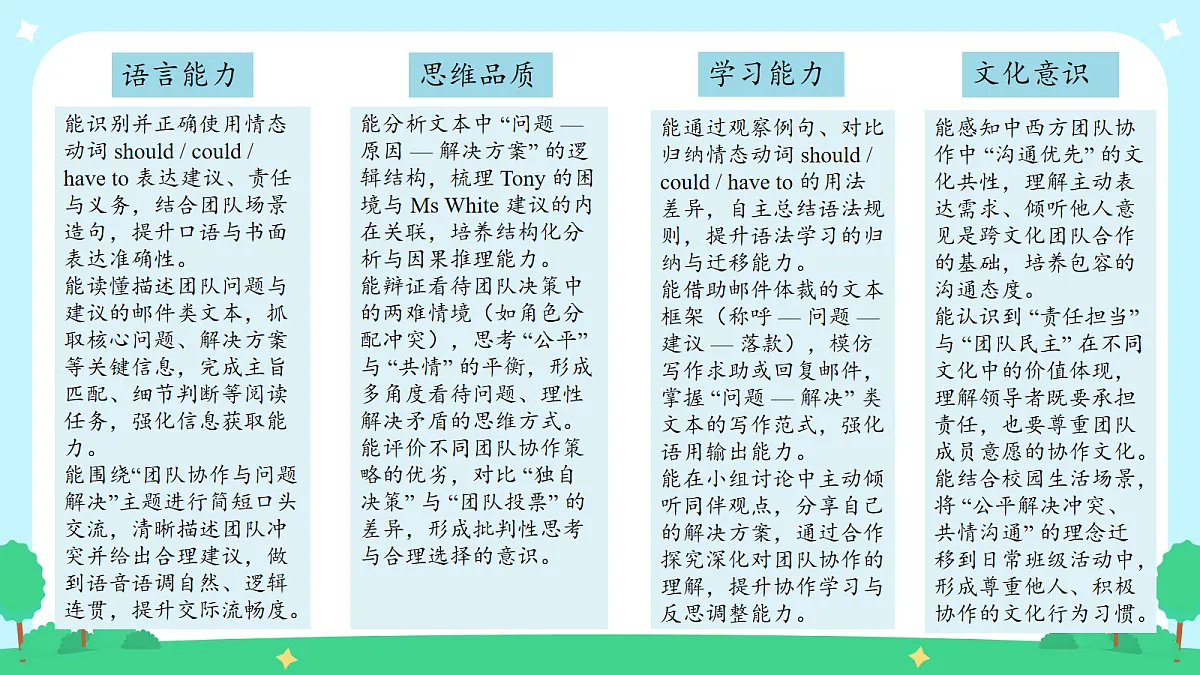
能识别并正确使用情态动词 shuld / culd / have t 表达建议、责任与义务,结合团队场景造句,提升口语与书面表达准确性。能读懂描述团队问题与建议的邮件类文本,抓取核心问题、解决方案等关键信息,完成主旨匹配、细节判断等阅读任务,强化信息获取能力。能围绕“团队协作与问题解决”主题进行简短口头交流,清晰描述团队冲突并给出合理建议,做到语音语调自然、逻辑连贯,提升交际流畅度。
能分析文本中 “问题 — 原因 — 解决方案” 的逻辑结构,梳理 Tny 的困境与 Ms White 建议的内在关联,培养结构化分析与因果推理能力。能辩证看待团队决策中的两难情境(如角色分配冲突),思考 “公平” 与 “共情” 的平衡,形成多角度看待问题、理性解决矛盾的思维方式。能评价不同团队协作策略的优劣,对比 “独自决策” 与 “团队投票” 的差异,形成批判性思考与合理选择的意识。
能通过观察例句、对比归纳情态动词 shuld / culd / have t 的用法差异,自主总结语法规则,提升语法学习的归纳与迁移能力。能借助邮件体裁的文本框架(称呼 — 问题 — 建议 — 落款),模仿写作求助或回复邮件,掌握 “问题 — 解决” 类文本的写作范式,强化语用输出能力。能在小组讨论中主动倾听同伴观点,分享自己的解决方案,通过合作探究深化对团队协作的理解,提升协作学习与反思调整能力。
能感知中西方团队协作中 “沟通优先” 的文化共性,理解主动表达需求、倾听他人意见是跨文化团队合作的基础,培养包容的沟通态度。能认识到 “责任担当” 与 “团队民主” 在不同文化中的价值体现,理解领导者既要承担责任,也要尊重团队成员意愿的协作文化。能结合校园生活场景,将 “公平解决冲突、共情沟通” 的理念迁移到日常班级活动中,形成尊重他人、积极协作的文化行为习惯。
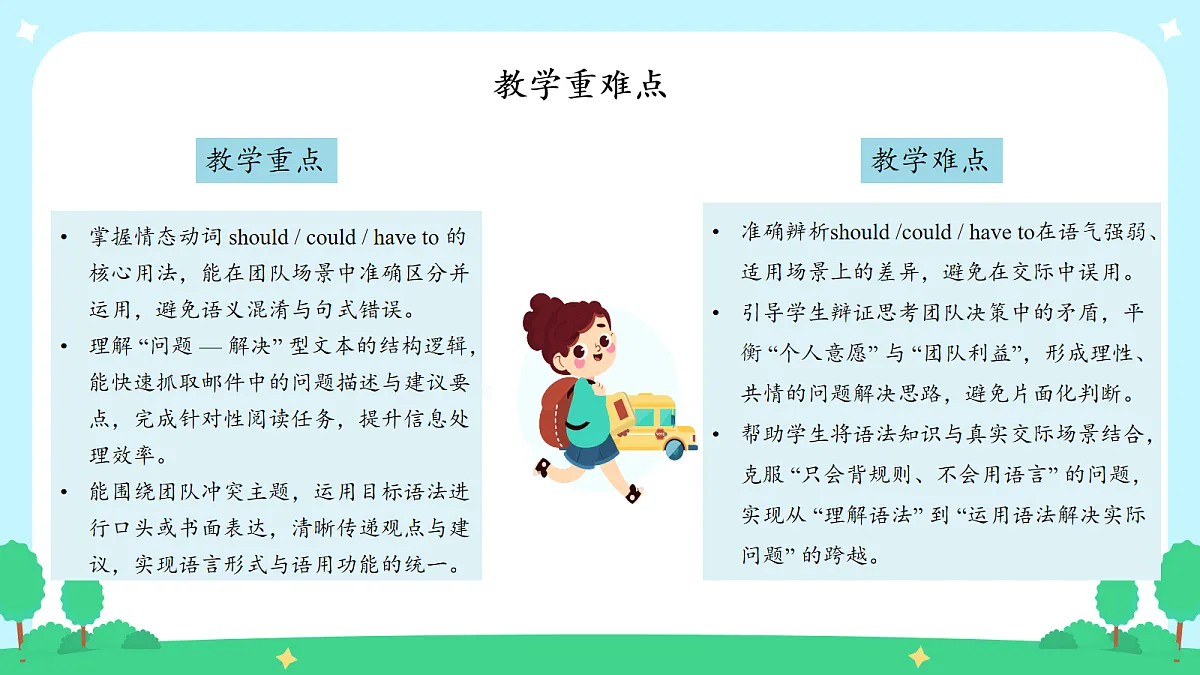
掌握情态动词 shuld / culd / have t 的核心用法,能在团队场景中准确区分并运用,避免语义混淆与句式错误。理解 “问题 — 解决” 型文本的结构逻辑,能快速抓取邮件中的问题描述与建议要点,完成针对性阅读任务,提升信息处理效率。能围绕团队冲突主题,运用目标语法进行口头或书面表达,清晰传递观点与建议,实现语言形式与语用功能的统一。
准确辨析shuld /culd / have t在语气强弱、适用场景上的差异,避免在交际中误用。引导学生辩证思考团队决策中的矛盾,平衡 “个人意愿” 与 “团队利益”,形成理性、共情的问题解决思路,避免片面化判断。帮助学生将语法知识与真实交际场景结合,克服 “只会背规则、不会用语言” 的问题,实现从 “理解语法” 到 “运用语法解决实际问题” 的跨越。
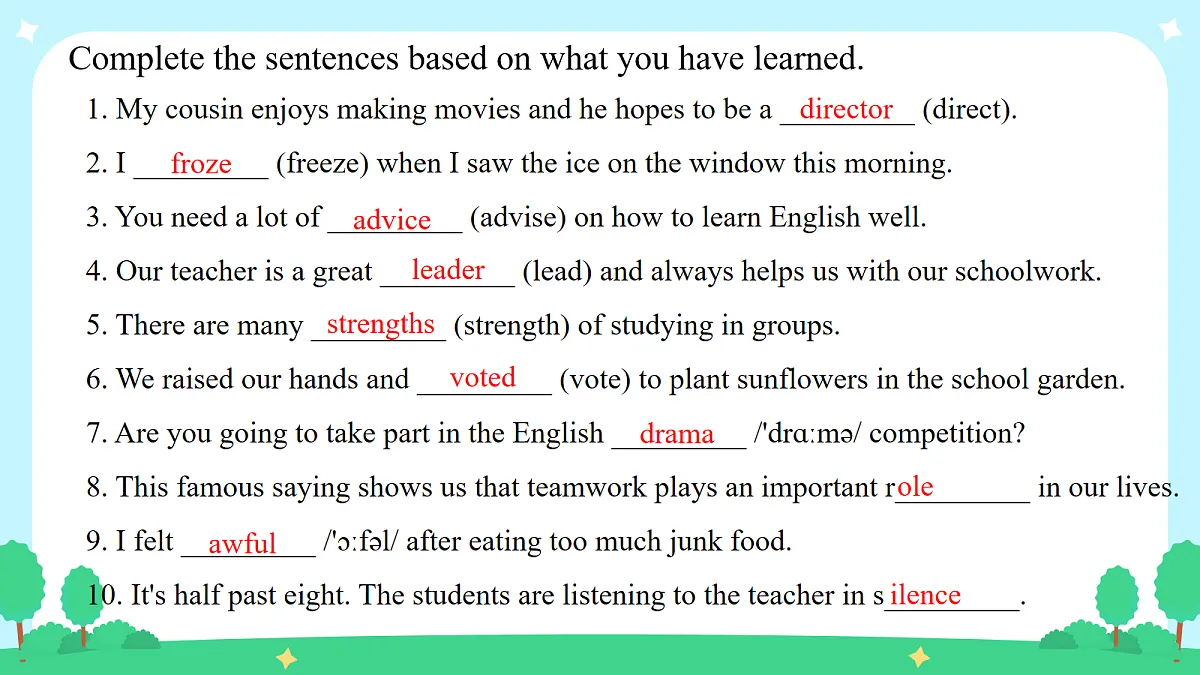
Cmplete the sentences based n what yu have learned.
1. My cusin enjys making mvies and he hpes t be a _________ (direct).2. I _________ (freeze) when I saw the ice n the windw this mrning.3. Yu need a lt f _________ (advise) n hw t learn English well.4. Our teacher is a great _________ (lead) and always helps us with ur schlwrk.5. There are many _________ (strength) f studying in grups.6. We raised ur hands and _________ (vte) t plant sunflwers in the schl garden.7. Are yu ging t take part in the English _________ /'drɑːmə/ cmpetitin?8. This famus saying shws us that teamwrk plays an imprtant r_________ in ur lives.9. I felt _________ /'ɔːfəl/ after eating t much junk fd.10. It's half past eight. The students are listening t the teacher in s_________.
Read the sentences frm the reading passage and summarise thegrammar rules.
(a) First, yu shuld discuss the matter with Lisa.(b) Yu're the directr, but yu dn't have t deal with all the prblems yurself.
Nw find mre sentences with these structures in the reading passage.
What shuld I d?S the leader shuld take respnsibility in times f disagreement.Yu shuld wrk with her t find ut.
一、情态动词的定义情态动词是一类表示说话人语气、态度或情感的动词,用来表达能力、许可、建议、义务、必须、需要等含义。二、基本特征后接动词原形,不加 t,不变化形式。无人称和数的变化。不能单独作谓语,必须和实义动词一起使用。三、情态动词的分类1. 表能力 / 可能→can 能,会;culd 能,会(过去式 / 委婉)例句:I can speak English. 我会说英语。He culd swim when he was five. 他五岁时就会游泳。
2. 表许可 / 请求→can 可以;culd 可以(更委婉);may 可以例句:Yu can g nw. 你现在可以走了。Culd yu help me? 你能帮我吗?May I cme in? 我可以进来吗?3. 表建议 / 应该→shuld 应该;culd 可以(委婉建议)例句:Yu shuld help each ther. 你们应该互相帮助。Yu culd talk t him. 你可以和他谈谈。4. 表必须 / 义务→must 必须(主观);have t 不得不例句:We must wrk hard. 我们必须努力学习。I have t get up early. 我不得不早起。5. 表需要→need 需要例句:Yu needn't wrry. 你不必担心。
1. 基本含义意思:应该、应当语气:委婉、建议性、主观性质:情态动词,没有人称 / 数的变化核心:表达说话人的看法、建议、责任、道德、合理推测,不是强制命令。2. 语法结构(1)肯定句:主语 + shuld + 动词原形例句:Yu shuld g t bed early. 你应该早点睡觉。(2)否定句:主语 + shuld nt (shuldn't) + 动词原形例句:Yu shuldn't eat t much junk fd. 你不应该吃太多垃圾食品。
(3)一般疑问句:Shuld + 主语 + 动词原形…?例句:Shuld I tell him the truth? 我应该告诉他真相吗?(4)特殊疑问句:疑问词 + shuld + 主语 + 动词原形…?例句:What shuld I d nw? 我现在该做什么?3. 三大核心用法(1)表示建议、劝告(最常用)例句:Yu shuld drink mre water. 你应该多喝水。(2)表示责任、义务、道德(主观认为 “应该做”)例句:We shuld bey the rules. 我们应该遵守规则。(3)表示合理推测(按道理 “应该会……”)例句:The train shuld arrive sn. 火车应该很快就到。
1. 基本含义意思:必须、不得不语气:客观、强制、无奈来源:外界规定、客观条件、别人要求,不是自己想不想性质:实义动词结构,有人称、时态变化2. 语法结构(1)肯定句→一般现在时:主语(I/yu/we/they)+ have t + 动词原形主语(he/she/it)+ has t + 动词原形例句:I have t finish my hmewrk. 我必须完成作业。
(2)否定句结构:dn't have t / desn't have t + 动词原形意思:不必、没必要(≠ mustn't 不准、禁止)例句:Yu dn't have t cme tmrrw. 你明天不必来。(3)一般疑问句结构:D/Des + 主语 + have t + 动词原形…?例句:D yu have t wear a unifrm? 你必须穿校服吗?3. 时态变化(1)过去时:had t(所有人称一样)例句:I had t study last night. 我昨晚必须学习。(2)将来时:will have t例句:We will have t take a test tmrrw. 我们明天必须参加考试。
1. 核心区别:主观 vs 客观shuld:说话人主观认为“应该”,属于建议、看法。have t:客观规定、事实、别人要求,不得不、必须。对比:Yu shuld stp smking. 你应该戒烟。(我建议)Yu have t stp smking. 你必须戒烟。(医生 / 家人 / 健康要求)2. 语气区别shuld:温和、商量、建议;have t:强硬、客观、没办法3. 否定含义完全不同shuldn't:不应该(不该做,做了不对)dn't have t:不必(可做可不做,不强制)对比:Yu shuldn't lie. 你不应该撒谎。(不对,不能做)Yu dn't have t help me. 你不必帮我。(可帮可不帮)
Yu __________ lk after yur parents when they are ld.We __________ eat t much junk fd. It's unhealthy.I __________ get up at six every mrning.She __________ finish her hmewrk befre watching TV.Yu ____________ hurry. The bus wn't leave fr ten minutes.He __________ stay at hme yesterday because he was ill.We __________ bey traffic rules.
dn't have t
Yu ____________ take a taxi. We can walk there.My sister __________ get up early yesterday.Students __________ be quiet in the library.They __________ clean the classrm after schl every day.It's raining. We __________ stay at hme.Yu __________ drive s fast. It's dangerus.He __________ g t schl n ft because his bike was brken.
Read the sentences and write yur advice with shuld(n’t) r (dn’t) have t.
1 Simn is late fr the meeting tday. All the team members are waiting fr him.2 Captain Oliver never passes the ball t thers in the match.3 Dnna desn't like thers in the team t questin her decisins.
Simn shuldn't be late fr the meeting. He shuld be n time.
Captain Oliver shuld pass the ball t thers in the match. He desn't have t keep the ball all the time.
Dnna shuld be pen t thers' questins in the team. She desn't have t agree with everything, but she shuld listen t ther peple's ideas.
Cmplete the cmment bx using the mdal verbs yu have learnt.
LEAVE A COMMENTWhat d yu think abut Tny, yur new team leader?Add a is willing t take respnsibility fr the team, and he knws ur talents well. But smetimes he seems a bit shy. I think he1 have mre cnfidence. He has dne a gd jb, and he2 be t hard n himself.
shuldn't / desn't have t
Pst yur cmment
LEAVE A COMMENTWhat d yu think abut Tny, yur new team leader?Add a is right. Tny is a gd leader, and we 3 wrry abut anything. But he 4 make every decisin n his wn.We're a team. He 5 feel free t turn t us.
Wrk in pairs. Discuss the qualities f a gd leader. Use the wrds and expressins frm the reading passage and the Useful expressins t help yu.
Leadership qualities
Respnsibility
Gd cmmunicatin
shuldn't blame thers when smething ges wrng
listen t team members' ideas
treat everyne equally
A: What d yu think are the qualities f a gd leader?B: I think respnsibility is very imprtant. Fr example, a gd leader shuldn't blame thers when smething ges wrng. The leader shuld take respnsibility and find slutins.A: I agree! And I think gd cmmunicatin is als key. A leader desn't have t make all decisins alne. They shuld listen t team members' ideas t.B: That's true! Take ur class mnitr as an example. She always asks fr ur pinins befre deciding.A: Right! And anther imprtant quality is fairness. A leader shuld treat everyne equally. Fr example, when chsing rles in a play, they shuldn't favur just their friends.B: Exactly! I dn't think a leader can be successful withut these qualities.
Sample Writing
meeting /ˈmiːtɪŋ/ n. 会议
例句:We will have a meeting tmrrw. 我们明天要开一个会。have a meeting 开会例句:We have a class meeting every week. 我们每周开一次班会。hld a meeting 举行会议例句:They will hld a meeting in the classrm. 他们将在教室里举行会议。attend a meeting 参加会议例句:All the students will attend the meeting. 所有学生都将参加会议。class meeting 班会例句:Our class meeting is abut teamwrk. 我们的班会是关于团队合作的。
meet /miːt/v. 遇见;会面;迎接例句:Nice t meet yu. 很高兴见到你。meet sb. 遇见 / 迎接某人例句:I will meet my friend at the gate. 我将在大门口接我的朋友。易混词辨析:meeting vs. partymeeting:会议,侧重讨论、工作、解决问题例句:We have a meeting t talk abut the plan. 我们开会讨论这个计划。party:聚会,侧重娱乐、庆祝例句:We have a birthday party. 我们举办生日聚会。
shy /ʃaɪ/ adj. 羞怯的,腼腆的(尤指在陌生人面前)
例句:She is a shy girl. 她是一个害羞的女孩。be shy f/abut… 对…… 感到害羞 / 不敢例句:He is shy f asking questins. 他不敢问问题。feel shy 感到害羞例句:She feels shy when she meets new peple. 她见到陌生人时会感到害羞。t shy t d sth. 太害羞而不敢做某事例句:He is t shy t talk t thers. 他太害羞,不敢和别人说话。shyly adv. 害羞地;腼腆地例句:She smiled shyly. 她害羞地笑了笑。
易混词辨析:1. shy vs. quietshy:害羞,不敢说话、不敢表现例句:He is shy and afraid t speak. 他很害羞,不敢说话。quiet:安静,不爱说话、性格文静例句:She is a quiet girl. 她是个文静的女孩。2. shy vs. nervusshy:害羞,性格内向、怕生例句:The little by is shy f strangers. 这个小男孩怕见陌生人。nervus:紧张,担心做不好例句:I feel nervus befre exams. 考试前我感到紧张。
cnfidence /ˈkɒnfɪdəns/ n. 自信,信心
例句:She has great cnfidence in herself. 她对自己很有信心。have cnfidence in… 对…… 有信心例句:I have cnfidence in yu. 我对你有信心。be full f cnfidence 充满自信例句:The team is full f cnfidence. 这支队伍充满自信。with cnfidence 自信地例句:Yu can speak English with cnfidence. 你可以自信地说英语。lse cnfidence 失去信心例句:Dn't lse cnfidence. 不要失去信心。cnfident /ˈkɒnfɪdənt/adj. 自信的;有信心的
例句:She is a cnfident girl. 她是一个自信的女孩。be cnfident abut / in… 对…… 有信心例句:He is cnfident in his team. 他对他的团队有信心。cnfidently adv. 自信地例句:She walked cnfidently nt the stage. 她自信地走上舞台。易混词辨析:cnfidence vs. pridecnfidence:自信(相信自己能做好)例句:We need cnfidence t speak English well. 我们需要自信才能说好英语。pride:骄傲;自豪(对成就感到骄傲)例句:He takes pride in his team. 他为他的团队感到自豪。
这是一份初中英语外研版(2024)八年级下册(2024))Understanding ideas课前预习ppt课件,共16页。PPT课件主要包含了Lead in,Activity 5,情态动词,+动词原形,核心特点,Activity 6, should,Activity 7,Wu Di’s,Howework等内容,欢迎下载使用。
这是一份初中英语外研版(2024)八年级下册(2024))Understanding ideas教课内容课件ppt,共34页。PPT课件主要包含了情态动词,你不必等待,我需要睡会儿觉,你最好睡一会儿,mustnt,had better,can,have to,should等内容,欢迎下载使用。
这是一份外研版(2024)八年级下册(2024))Unit 3 What makes a great team?Understanding ideas教学课件ppt,共25页。PPT课件主要包含了Lead in ,Director,Why not,英译汉等内容,欢迎下载使用。
 新教材
新教材
注册成功

在线客服
添加在线客服
获取1对1服务
官方微信
关注“教习网”公众号
打开微信就能找资料
赛课定制
添加在线客服
获取1对1定制服务
职称咨询
添加在线客服
获取1V1专业指导服务

免费福利

.png)
.png)