免费领取教师福利



若您为此资料的原创作者,认为该资料内容侵犯了您的知识产权,请扫码添加我们的相关工作人员,我们尽可能的保护您的合法权益。

这是一份人教版(2024)七年级上册(2024)Unit 1 You and Me Section B教案,共5页。
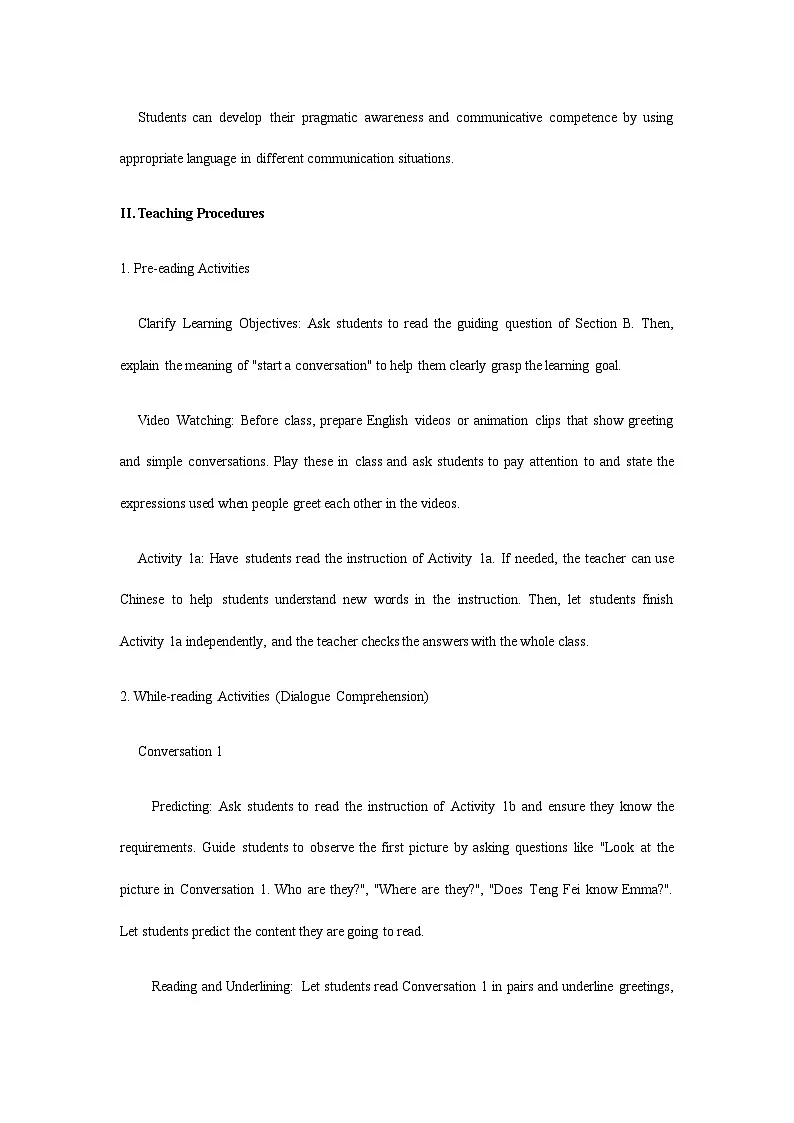
教学设计
I. Teaching Objectives
1. Language Knwledge Objectives
Students can accurately master and use cmmn expressins fr starting, cntinuing, and ending a cnversatin, such as "Gd mrning.", "Hell. / Hi.", "May I have yur name?", "Hw d yu spell yur name?", "Hw are yu?", "Nice t meet yu.", "Gdbye! / Bye!".
Students can understand the differences between English names and Chinese names in terms f structure.
2. Language Skill Objectives
Students can apprpriately use greetings, name asking, and farewell sentences t exchange greetings and have simple cnversatins with thers based n different cmmunicatin bjects (strangers and acquaintances).
Students can cmplete dialgues fr greeting strangers and acquaintances by using simple daily expressins crrectly.
3. Affective Objectives
Students can enhance their cnfidence in ral English expressin thrugh rle playing and dialgue practice.
Students can develp their pragmatic awareness and cmmunicative cmpetence by using apprpriate language in different cmmunicatin situatins.
II. Teaching Prcedures
1. Pre-eading Activities
Clarify Learning Objectives: Ask students t read the guiding questin f Sectin B. Then, explain the meaning f "start a cnversatin" t help them clearly grasp the learning gal.
Vide Watching: Befre class, prepare English vides r animatin clips that shw greeting and simple cnversatins. Play these in class and ask students t pay attentin t and state the expressins used when peple greet each ther in the vides.
Activity 1a: Have students read the instructin f Activity 1a. If needed, the teacher can use Chinese t help students understand new wrds in the instructin. Then, let students finish Activity 1a independently, and the teacher checks the answers with the whle class.
2. While-reading Activities (Dialgue Cmprehensin)
Cnversatin 1
Predicting: Ask students t read the instructin f Activity 1b and ensure they knw the requirements. Guide students t bserve the first picture by asking questins like "Lk at the picture in Cnversatin 1. Wh are they?", "Where are they?", "Des Teng Fei knw Emma?". Let students predict the cntent they are ging t read.
Reading and Underlining: Let students read Cnversatin 1 in pairs and underline greetings, questins, and farewells. After reading, the teacher uses curseware r learning sheets t shw the idea f "Start a cnversatin Cntinue a cnversatin End a cnversatin" and asks students t put the underlined sentences int the crrespnding parts.
Wrd Explanatin: Ask students "D they knw each ther?" and have them answer with reasns. Then, further ask "What's the girl's name? Hw d yu spell Emma Miller?" t guide students t understand the new wrd "spell" thrugh cntext and cmmn sense. Als, explain the difference between English names (like Emma Miller, with the first name cming first) and Chinese names (like Teng Fei).
Rle playing: Let students practice Cnversatin 1 in pairs. Invite several grups t perfrm in frnt f the whle class. After students are familiar with it, randmly select tw students and ask them t have a real cnversatin using their real names by imitating the dialgue.
Cnversatin 2
Scene Understanding: Ask students t bserve the secnd picture. Guide them t understand the scene f the cnversatin by asking questins such as "Lk at this picture. Wh are they?", "Are they in a classrm t?", "What sund des the ludspeaker n the wall make?", "What des it mean when the ludspeaker makes the ringing sund?".
Reading and Underlining: Let students read Cnversatin 2 in pairs and underline greetings, questins, and farewells. After reading, shw the "Start a cnversatin Cntinue a cnversatin End a cnversatin" idea again and ask students t put the underlined sentences int the crrespnding parts. Then ask students "Des Helen knw Yaming?" and let them explain with reasns. Als, guide students t understand the meaning f "Oh, that's the bell" by cmbining cntext and picture details.
Rle playing: Let students practice Cnversatin 2 in pairs. Invite several grups t perfrm in frnt f the whle class.
Cmparisn: Explain t students that bth dialgues start with greetings. When meeting fr the first time, peple can intrduce themselves and plitely ask abut each ther's names. When meeting friends they already knw, they can ask abut each ther's recent situatin. Nte that "Hw are yu?" can be used nt nly t cntinue a cnversatin but als t start ne, and it's generally used amng acquaintances r friends. When ending a cnversatin, "Nice t meet yu!" is fr saying gdbye t friends met fr the first time, while "Gdbye!" r "Bye!" is fr familiar friends. Als, let students feel that "May I have yur name?" is mre frmal and plite than "What's yur name?".
3. Pst reading Activities
Dialgue Rerganizatin: Grup students accrding t their learning abilities. Befre class, print the sentences frm the dialgues n cards, shuffle them, and distribute the cards t each grup. Students wrk in grups t put the cards in the crrect rder and then read the dialgue alud in rles. During the practice, the teacher walks arund the classrm, pays attentin t each grup's practice, and gives prnunciatin guidance if needed.
Activity 1c: Guide students t read the instructin f Activity 1c and make sure they knw the requirements. Then let students read the sentences in the bxes and cmplete Activity 1c. Remind students t first write dwn the parts they can cmplete n the crrespnding lines, and then use the dialgue in 1b t think abut the answers t unfinished sentences. During writing, remind students t pay attentin t the writing nrms f capital and lwercase letters.
Writing and Speaking Practice (Activity 1d)
Pre-writing Practice: Shw students the structure f starting, cntinuing, and ending a cnversatin. Let students practice the dialgue in pairs using their real infrmatin. When students practice, the teacher walks arund the class, gives apprpriate encuragement and praise, r crrects prnunciatin in time. After sufficient practice, invite several grups t perfrm in frnt f the whle class.
Writing Practice: Ask students t cmplete the dialgue in 1d based n the dialgue practice. The teacher can prmpt that the language supprts in 1d are frm the tw dialgues in 1b, and the previus dialgue is a mdel. The teacher checks the whle class, bserves students' writing, and gives necessary help. During inspectin, select hmewrk with standard writing and crrect language, shw it t the class with the student's cnsent, and invite ther students t cmment n writing nrms and language use. After students finish writing, let them practice the dialgue in pairs.
这是一份人教版(2024)七年级上册(2024)Unit 1 You and Me Section B教案,共5页。
这是一份初中英语人教版(2024)七年级上册(2024)Unit 1 You and Me Section A教案,共9页。教案主要包含了教学目标,教学重难点,教学方法,教学准备,教学过程,板书设计,教学反思等内容,欢迎下载使用。
这是一份七年级上册(2024)Unit 1 You and Me Section A教案,共8页。
注册成功

在线客服
添加在线客服
获取1对1服务
官方微信
关注“教习网”公众号
打开微信就能找资料
赛课定制
添加在线客服
获取1对1定制服务
职称咨询
添加在线客服
获取1V1专业指导服务

免费福利

.png)
.png)