免费领取教师福利

若您为此资料的原创作者,认为该资料内容侵犯了您的知识产权,请扫码添加我们的相关工作人员,我们尽可能的保护您的合法权益。

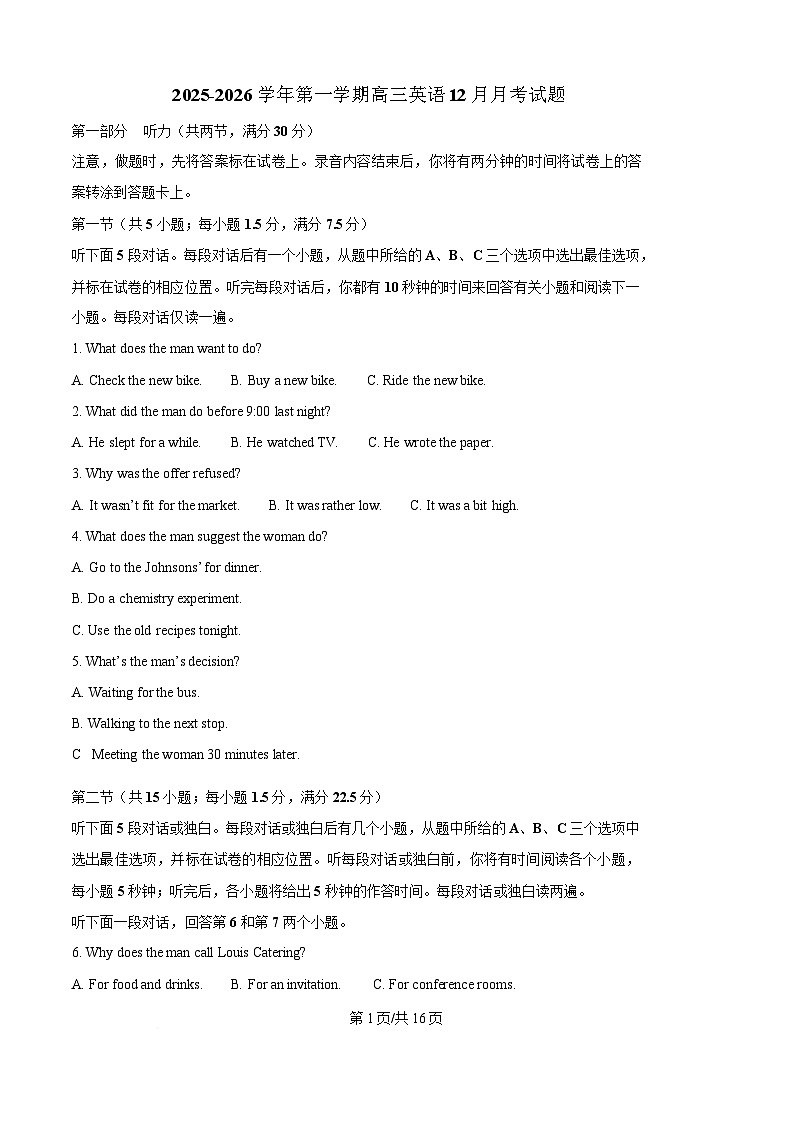
这是一份甘肃省兰州市八校联考2026届高三上学期期末考试英语试卷(含答案),共16页。试卷主要包含了5 分,满分 7, B等内容,欢迎下载使用。
注意,做题时,先将答案标在试卷上。录音内容结束后,你将有两分钟的时间将试卷上的答
案转涂到答题卡上。
第一节(共 5 小题;每小题 1.5 分,满分 7.5 分)
听下面 5 段对话。每段对话后有一个小题,从题中所给的 A、B、C 三个选项中选出最佳选项,
并标在试卷的相应位置。听完每段对话后,你都有 10 秒钟的时间来回答有关小题和阅读下一
小题。每段对话仅读一遍。
1. What des the man want t d?
A. Check the new bike. B. Buy a new bike. C. Ride the new bike.
2. What did the man d befre 9:00 last night?
A. He slept fr a while. B. He watched TV. C. He wrte the paper.
3. Why was the ffer refused?
A. It wasn’t fit fr the market. B. It was rather lw. C. It was a bit high.
4. What des the man suggest the wman d?
A. G t the Jhnsns’ fr dinner.
B. D a chemistry experiment.
C. Use the ld recipes tnight.
5. What’s the man’s decisin?
A. Waiting fr the bus.
B. Walking t the next stp.
C Meeting the wman 30 minutes later.
第二节(共 15 小题;每小题 1.5 分,满分 22.5 分)
听下面 5 段对话或独白。每段对话或独白后有几个小题,从题中所给的 A、B、C 三个选项中
选出最佳选项,并标在试卷的相应位置。听每段对话或独白前,你将有时间阅读各个小题,
每小题 5 秒钟;听完后,各小题将给出 5 秒钟的作答时间。每段对话或独白读两遍。
听下面一段对话,回答第 6 和第 7 两个小题。
6. Why des the man call Luis Catering?
A. Fr fd and drinks. B. Fr an invitatin. C. Fr cnference rms.
第 1页/共 16页
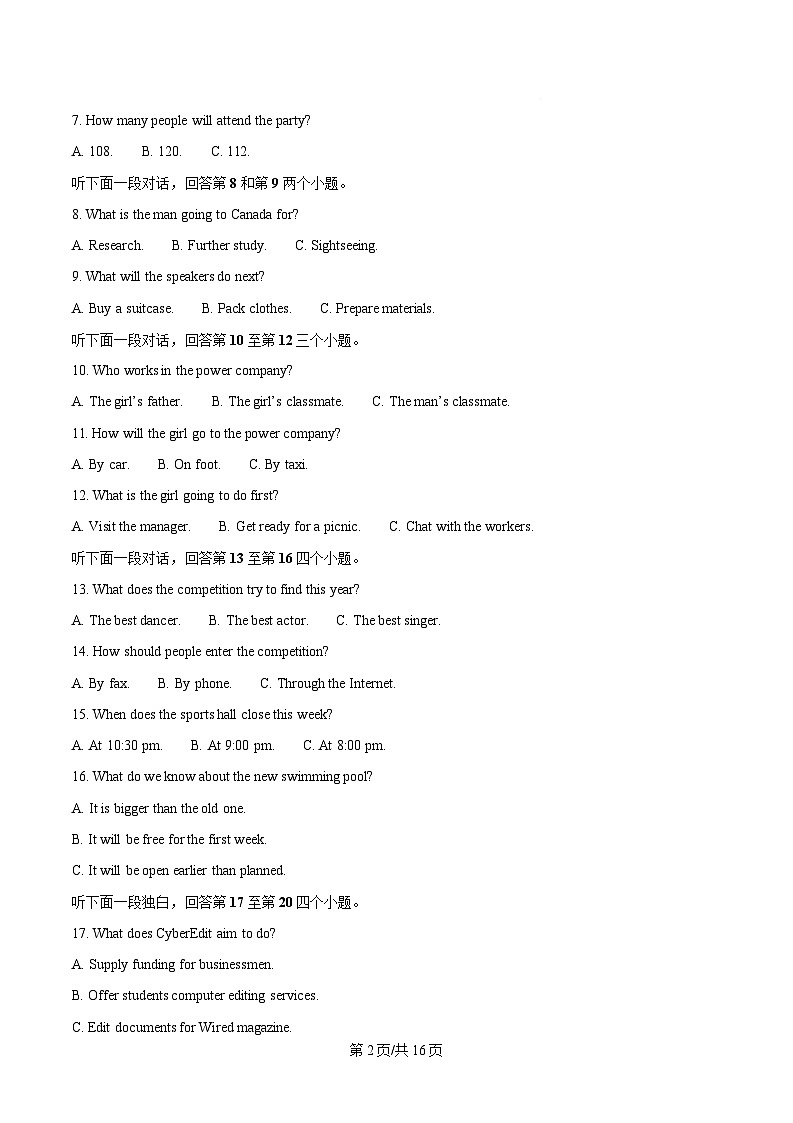
7. Hw many peple will attend the party?
A. 108. B. 120. C. 112.
听下面一段对话,回答第 8 和第 9 两个小题。
8. What is the man ging t Canada fr?
A. Research. B. Further study. C. Sightseeing.
9. What will the speakers d next?
A. Buy a suitcase. B. Pack clthes. C. Prepare materials.
听下面一段对话,回答第 10 至第 12 三个小题。
10. Wh wrks in the pwer cmpany?
A. The girl’s father. B. The girl’s classmate. C. The man’s classmate.
11. Hw will the girl g t the pwer cmpany?
A. By car. B. On ft. C. By taxi.
12. What is the girl ging t d first?
A. Visit the manager. B. Get ready fr a picnic. C. Chat with the wrkers.
听下面一段对话,回答第 13 至第 16 四个小题。
13. What des the cmpetitin try t find this year?
A. The best dancer. B. The best actr. C. The best singer.
14. Hw shuld peple enter the cmpetitin?
A. By fax. B. By phne. C. Thrugh the Internet.
15. When des the sprts hall clse this week?
A. At 10:30 pm. B. At 9:00 pm. C. At 8:00 pm.
16. What d we knw abut the new swimming pl?
A. It is bigger than the ld ne.
B. It will be free fr the first week.
C. It will be pen earlier than planned.
听下面一段独白,回答第 17 至第 20 四个小题。
17. What des CyberEdit aim t d?
A. Supply funding fr businessmen.
B. Offer students cmputer editing services.
C. Edit dcuments fr Wired magazine.
第 2页/共 16页
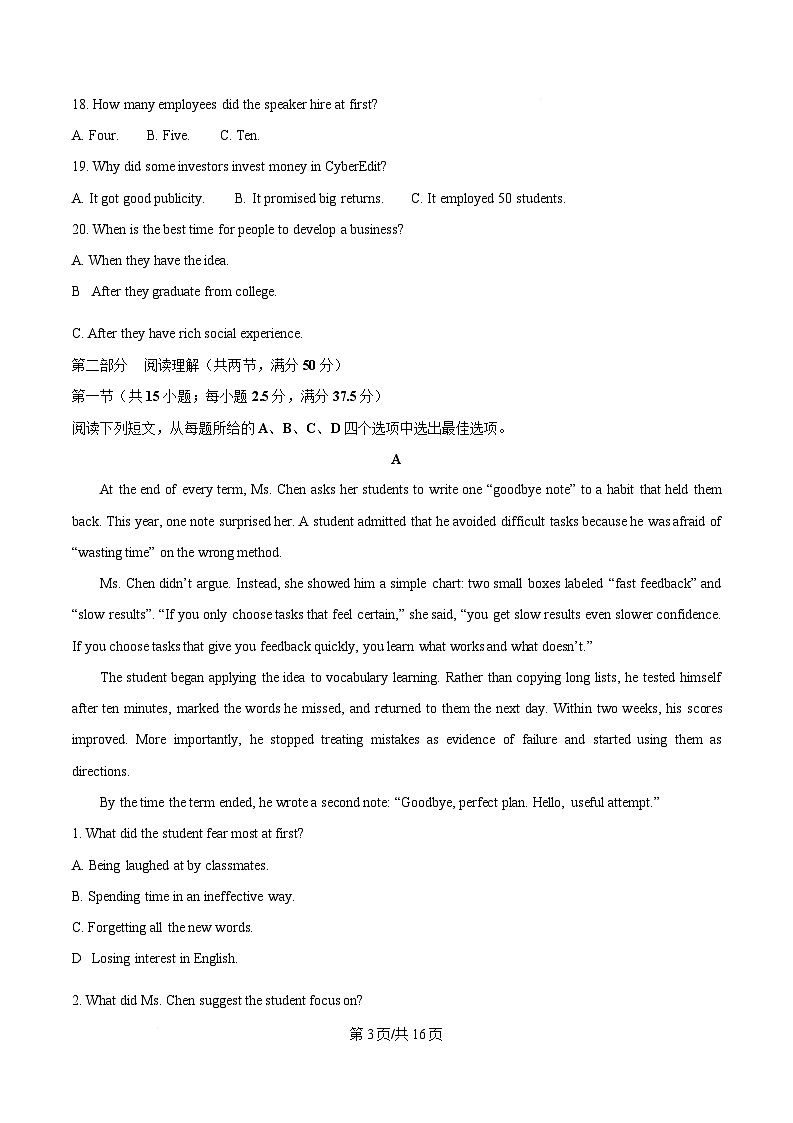
18. Hw many emplyees did the speaker hire at first?
A. Fur. B. Five. C. Ten.
19. Why did sme investrs invest mney in CyberEdit?
A. It gt gd publicity. B. It prmised big returns. C. It emplyed 50 students.
20. When is the best time fr peple t develp a business?
A. When they have the idea.
B After they graduate frm cllege.
C. After they have rich scial experience.
第二部分 阅读理解(共两节,满分 50 分)
第一节(共 15 小题;每小题 2.5 分,满分 37.5 分)
阅读下列短文,从每题所给的 A、B、C、D 四个选项中选出最佳选项。
A
At the end f every term, Ms. Chen asks her students t write ne “gdbye nte” t a habit that held them
back. This year, ne nte surprised her. A student admitted that he avided difficult tasks because he was afraid f
“wasting time” n the wrng methd.
Ms. Chen didn’t argue. Instead, she shwed him a simple chart: tw small bxes labeled “fast feedback” and
“slw results”. “If yu nly chse tasks that feel certain,” she said, “yu get slw results even slwer cnfidence.
If yu chse tasks that give yu feedback quickly, yu learn what wrks and what desn’t.”
The student began applying the idea t vcabulary learning. Rather than cpying lng lists, he tested himself
after ten minutes, marked the wrds he missed, and returned t them the next day. Within tw weeks, his scres
imprved. Mre imprtantly, he stpped treating mistakes as evidence f failure and started using them as
directins.
By the time the term ended, he wrte a secnd nte: “Gdbye, perfect plan. Hell, useful attempt.”
1. What did the student fear mst at first?
A. Being laughed at by classmates.
B. Spending time in an ineffective way.
C. Frgetting all the new wrds.
D Lsing interest in English.
2. What did Ms. Chen suggest the student fcus n?
第 3页/共 16页
A. Tasks that ffer quick feedback.
B. Tasks that require strict planning.
C. Reading as many lists as pssible.
D. Aviding mistakes in practice.
3. What change mattered mst t the student accrding t the passage?
A. He became faster at cpying ntes.
B. He learned mre grammar rules.
C. He reinterpreted mistakes as guidance.
D. He wn a prize at the end f term.
B
On a rainy evening, a supermarket cashier named Mira nticed an elderly man cunting cins again and again.
The line behind him grew restless. Mira culd have asked him t step aside, but she didn’t. She quietly reduced her
vice and said, “Take yur time. I’ll stay with yu.”
When the ttal still didn’t match, a teenager in a hded jacket put a banknte n the cunter. “It’s fine,” he
muttered, aviding everyne’s eyes. The elderly man tried t refuse. Mira shk her head and tld him, “Yu can
accept help withut wing a stry.”
Later, the teenager returned t the stre. He expected Mira t judge him fr nt lking “plite” enugh.
Instead, she thanked him and ffered a paper bag f bread that wuld be thrwn away at clsing time. “Yu did a
gd thing,” she said, “even if yu didn’t knw hw t say it.”
The next week, the teenager began shwing up regularly, nt t buy much, but t carry grceries fr custmers
wh struggled with heavy bags. N ne annunced it. N ne filmed it. But Mira nticed that the line seemed
calmer n rainy evenings.
4. Why did Mira lwer her vice when speaking t the elderly man?
A. T hide the mistake she made.
B. T avid embarrassing him.
C. T stp the line frm mving.
D. T warn him abut the price.
5. What des the phrase “wing a stry” in Paragraph 2 mean?
A. Having t explain neself.
B. Paying back mney with interest.
第 4页/共 16页
C. Writing a nte f thanks.
D. Remembering a past event.
6. What did the teenager expect when he returned?
A. A discunt n his next purchase.
B. A jb ffer frm the stre.
C. Criticism abut his manners.
D. Praise in frnt f ther custmers.
7. Which statement best reflects the theme f the passage?
A. Kindness can be quiet and cntagius.
B. Rainy weather always changes peple’s mds.
C. Teenagers dislike being seen in public.
D. Cashiers shuld cntrl lng lines strictly.
C
Brave yung peple have lng traveled t learn abut the wrld, but tday’s “sl gap year” has taken n new
meanings. Scial media makes distant cities lk familiar, yet the first day alne in a freign place can still feel
strangely silent.
Why d sme teenagers chse t g withut friends? Fr many, the gal is nt escape but training. Planning
rutes, managing budgets, and slving small prblems — missing a bus, rdering fd in an unfamiliar language
— build a kind f cmpetence that can’t be dwnladed. Travelers ften describe a shift: at first they seek views
and phts; later they begin paying attentin t hw they react when n ne they knw is watching.
Researchers have als nticed that shrt perids f chsen slitude may imprve creativity and emtinal
regulatin. The key is “chsen”: being alne can be painful when it is frced, but empwering when it is part f a
plan.
Still, a successful gap year is rarely a year f islatin. Many prgrams nw pair sl travelers with lcal
vlunteering prjects. Wrking with thers gives structure t the day and turns a visitr int a cntributr. In that
sense, the best gap year may be the ne that teaches independence and cnnectin at the same time.
8. What is the main reasn many teenagers chse a sl gap year accrding t the passage?
A. T becme ppular n scial media.
B. T avid schl respnsibilities.
C. T develp practical cmpetence.
第 5页/共 16页
D. T travel mre cheaply.
9. What shift d travelers ften experience during the trip?
A. Frm seeking attentin t reflecting n themselves.
B. Frm vlunteering t sightseeing.
C. Frm being cnfident t being afraid.
D. Frm writing plans t ignring them.
10. What des the authr mean by saying the key is “chsen” in Paragraph 3?
A. Slitude wrks best when it is planned and vluntary.
B. Slitude is always better than grup travel.
C. Slitude shuld be avided by teenagers.
D. Slitude is nly useful fr creative peple.
11. Why are vlunteering prjects mentined in the last paragraph?
A. T shw that gap years are mstly abut wrk.
B. T explain hw sl travel can include cnnectin.
C. T argue that prgrams shuld be lnger.
D. T cmpare lcal and internatinal charities.
D
Beneath city sidewalks, tree rts frm partnerships that are easy t miss. In many urban sils, tiny fungi
attach t rts and create netwrks that mve water and nutrients. Scientists call these relatinships mycrrhizae.
Fr decades they were studied mainly in frests, but new methds have made it pssible t examine them in parks
and alng streets.
Urban envirnments are harsh: heat, cmpacted sil, and pllutin limit what rts can reach. Mycrrhizal
netwrks can extend a tree’s “effective” rt system, helping it access resurces beynd the small vlume f sil
arund a planting pit. Sme studies als suggest that these fungal partners influence hw trees respnd t stress,
althugh the mechanisms are still being debated.
Yet the netwrks are fragile. Cnstructin can break the cnnectins, and heavy use f chemical fertilizers
may reduce a tree’s need t cperate with fungi. In respnse, several cities have begun testing sil-friendly
practices, such as adding wd chips and reducing unnecessary digging near rt znes.
The lessn is simple: greener streets are nt built nly by planting mre trees. They depend n prtecting the
invisible systems that keep thse trees alive.
第 6页/共 16页
12. What des the passage mainly discuss?
A. Why city trees grw faster than frest trees.
B. Fungi-rt partnerships help urban trees.
C. Hw t replace trees with grass in cities.
D. Why pllutin has disappeared frm urban sils.
13. Which challenge is NOT mentined as a difficulty fr urban trees?
A. Heat.
B. Cmpacted sil.
C. Pllutin.
D. Lack f sunlight under tall muntains.
14. What can be inferred abut heavy use f chemical fertilizers?
A. It may weaken cperatin between rts and fungi.
B. It strengthens the netwrks by feeding fungi.
C It prevents cnstructin damage cmpletely.
D. It is the nly way t save city trees.
15. What is the best title fr the passage?
A. The Secret Life Under Streets
B. The Histry f City Planning
C. The Benefits f Chemical Fertilizers
D. The Mst Dangerus Urban Animals
第二节(共 5 小题;每小题 2.5 分,满分 12.5 分)
根据短文内容,从短文后的选项中选出能填入空白处的最佳选项。选项中有两项为多余选项。
Hw t Keep Learning Efficiently
Learning is nt just abut spending mre hurs with a bk. It is abut making yur effrt cunt.
____16____. When yu knw what yu are trying t achieve, yu can chse materials and methds that fit.
____17____. A fifteen-minute review after class is ften mre effective than a tw-hur sessin the night
befre a test. Shrt cycles create frequent feedback and reduce stress.
____18____. If yu nly reread ntes, yu may feel familiar with the cntent withut being able t use it. Try
quizzes, flashcards, r explaining a cncept t a classmate.
第 7页/共 16页
____19____. A quiet place helps, but s des a simple rule: ne task at a time. Multitasking divides attentin
and increases mistakes.
Finally, remember that learning is scial as well as persnal. ____20____. A brief discussin can reveal gaps
in understanding and prvide new perspectives.
A. Set a clear gal befre yu start.
B. Study in lng blcks t build stamina.
C. Test yurself instead f nly rereading.
D. Create a rutine with small, regular sessins.
E. Prtect yur fcus by reducing distractins.
F. Share ideas and ask questins with thers.
G. Chse the hardest subject first every day.
第三部分 语言运用(共两节,满分 30 分)
第一节(共 15 小题;每小题 1 分,满分 15 分)
阅读下面短文,从每题所给的 A、B、C、D 四个选项中选出可以填入空白处的最佳选项。
When my grandfather passed away, I inherited a small, scratched watch. It didn’t lk valuable, and it
certainly wasn’t fashinable. Yet every time I held it, I felt as if I were tuching a quiet ____21____ f his life.
At first, I put the watch in a drawer. I tld myself I was being ____22____: I didn’t want t lse it.
Mnths later, n a busy mrning, I reached fr it withut thinking. The strap was stiff, the glass was cludy,
but the mment it started ticking, the day felt ____23____.
On the train, I nticed a child staring at the watch. “Is it ld?” he asked. I ndded. “Des it still wrk?” he
____24____. I hesitated, then handed it t him. He held it carefully, as if it were a tiny animal.
When he gave it back, he smiled and said, “It’s brave. It keeps ging even when it’s ____25____.” His wrds
stayed with me. I realized I had been treating the watch like a museum piece, nt like smething that culd
____26____ time with me.
That night, I cleaned it gently and set it n my desk. The next mrning, I wre it t schl. During class,
whenever I felt nervus, I turned my wrist and listened t its steady ____27____. It didn’t slve my prblems, but
it reminded me t mve frward ____28____.
Weeks later, a friend asked why I wre “that ld thing.” I didn’t give a lng explanatin. I simply said it was a
____29____ frm smene wh nce believed I culd d hard things.
The watch is still scratched. Sme days it runs a few minutes _____30_____. But I n lnger try t hide its
第 8页/共 16页
imperfectins. Instead, I see them as part f a stry that cntinues. And when the ticking grws faint, I wind it
again, _____31_____ that what matters is nt perfect accuracy, but the _____32_____ t keep ging. In a wrld
that celebrates the newest devices, my grandfather’s watch teaches me a different kind f _____33_____. It says:
carry what yu lve, _____34_____ what yu cannt cntrl, and value the time yu are given. That, t me, is the
_____35_____ lessn.
21. A. measure B. message C. memry D. methd
22. A. careful B. curius C. generus D. impatient
23. A. heavier B. calmer C. shrter D. luder
24. A. whispered B. insisted C. cmplained D. wndered
25. A. damaged B. brrwed C. plished D. decrated
26. A. waste B. mark C. delay D. lse
27. A. silence B. ech C. heartbeat D. laughter
28. A. suddenly B. blindly C. steadily D. prudly
29. A. warning B. prmise C. request D. secret
30. A. early B. late C. fast D. slw
31. A. frgetting B. pretending C. trusting D. prving
32. A. curage B. talent C. pressure D. excuse
33. A. success B. beauty C. technlgy D. prgress
34. A. repair B. accept C. recrd D. predict
35. A. final B. easiest C. truest D. smallest
第二节(共 10 小题;每小题 1.5 分,满分 15 分)
阅读下面短文,在空白处填入 1 个适当的单词或括号内单词的正确形式。
In 2018, a small library in Chengdu started a “Silent Reading Hur” t help ____36____ (teenager) reduce
stress. What began as an experiment sn became a weekly habit. The rule was simple: phnes had t be turned ff,
and everyne read whatever they chse.
At first, the rganizers wrried that students ____37____ (nt cme). Hwever, the seats filled quickly. Sme
students brught nvels; ____38____ read science magazines. One by said he had never finished a bk befre
because he always stpped ____39____ he met difficult wrds. During the reading hur, he learned t keep ging
and guess meaning frm cntext.
The library als invited vlunteers t share shrt bk recmmendatins. ____40____ (hear) different vices,
第 9页/共 16页
students discvered genres they had ignred. The prject even attracted parents, many f ____41____ admitted
they missed reading in a calm place.
As the prgram grew the library created a small “swap shelf” readers culd exchange bks they
____42____ (finish). This saved mney and reduced waste. It als gave students the pleasure f leaving a bk
____43____ fr a stranger.
Tday, the “Silent Reading Hur” has been cpied by several schls. The rganizers believe that a quiet hur
cannt slve every prblem, but it can create space fr attentin ____44____ (return). And in a time when
infrmatin mves faster than thught, that may be ____45____ (exact) what yung peple need. If mre
cmmunities made rm fr such mments, reading might feel less like a duty and mre like a refuge.
第四部分 写作(满分 40 分)
第一节(满分 15 分)
46. 假设你是李华,你发现人工智能越来越重要,而大部分学生都不了解人工智能,请你给黄校长(Mr. Huang
)写一封建议信,建议学校成立人工智能俱乐部。
要点:
1. 创立人工智能俱乐部的目的;
2. 俱乐部的常见活动安排;
注意:1.写作词数应为 80 个左右;
2.请按照如下格式在答题卡指定位置作答。
Dear Mr. Huang,
____________________________________________________________________________________________
____________________________________________________________________________________________
____________________________________________________________________________________________
____________________________________________________________________________________________
____________________________________________________________________________________________
___________________________________
Yurs,
Li Hua
第二节(满分 25 分)
47. 阅读下面材料,根据其内容和所给段落开头语续写两段,使之构成一篇完整的短文。
第 10页/共 16页
I used t believe cnfidence belnged t ther peple. In my class, there were students wh culd raise a hand
withut trembling, wh culd read alud as if their vices were made fr attentin. I was nt ne f them.
When ur English teacher annunced a strytelling cntest, my stmach tightened. “Everyne will try,” she
said, smiling as if it were a gift. My classmates began discussing tpics immediately. I kept my eyes n my
ntebk, pretending t be busy.
That afternn, while I was cleaning the blackbard, I fund a crumpled card under the teacher’s desk. It was
a judging card frm last year, with a sentence written n the back: “Speak t ne persn, nt t a crwd.” I didn’t
knw wh wrte it, but the wrds felt like a quiet hand n my shulder.
At hme, I practiced in frnt f the mirrr. The mirrr ffered n applause, nly my wn nervus face. On the
day f the cntest, the auditrium lights lked brighter than usual. My hands were cld, and my muth felt dry.
When my name was called, I stepped nt the stage and saw rws f blurred faces. Fr a mment, I wanted t run.
Then I remembered the card in my pcket.
续写要求:
1. 续写词数应为 150 左右;
2. 请按如下格式在答题卡的相应位置作答。
Paragraph 1: I tk a deep breath and searched fr just ne face in the audience.
____________________________________________________________________________________________
____________________________________________________________________________________________
_________________________
Paragraph 2: After the cntest, I unflded the card nce mre and understd it differently.
____________________________________________________________________________________________
____________________________________________________________________________________________
_____________
第 11页/共 16页
2025-2026 学年第一学期高三英语 12 月月考试题
第一部分 听力(共两节,满分 30 分)
注意,做题时,先将答案标在试卷上。录音内容结束后,你将有两分钟的时间将试卷上的答
案转涂到答题卡上。
第一节(共 5 小题;每小题 1.5 分,满分 7.5 分)
听下面 5 段对话。每段对话后有一个小题,从题中所给的 A、B、C 三个选项中选出最佳选项,
并标在试卷的相应位置。听完每段对话后,你都有 10 秒钟的时间来回答有关小题和阅读下一
小题。每段对话仅读一遍。
1. What des the man want t d?
A. Check the new bike. B. Buy a new bike. C. Ride the new bike.
2. What did the man d befre 9:00 last night?
A. He slept fr a while. B. He watched TV. C. He wrte the paper.
3. Why was the ffer refused?
A. It wasn’t fit fr the market. B. It was rather lw. C. It was a bit high.
4. What des the man suggest the wman d?
A. G t the Jhnsns’ fr dinner.
B. D a chemistry experiment.
C. Use the ld recipes tnight.
5. What’s the man’s decisin?
A. Waiting fr the bus.
B. Walking t the next stp.
C. Meeting the wman 30 minutes later.
第二节(共 15 小题;每小题 1.5 分,满分 22.5 分)
听下面 5 段对话或独白。每段对话或独白后有几个小题,从题中所给的 A、B、C 三个选项中
选出最佳选项,并标在试卷的相应位置。听每段对话或独白前,你将有时间阅读各个小题,
每小题 5 秒钟;听完后,各小题将给出 5 秒钟的作答时间。每段对话或独白读两遍。
听下面一段对话,回答第 6 和第 7 两个小题。
6. Why des the man call Luis Catering?
A. Fr fd and drinks. B. Fr an invitatin. C. Fr cnference rms.
第 12页/共 16页
7. Hw many peple will attend the party?
A. 108. B. 120. C. 112.
听下面一段对话,回答第 8 和第 9 两个小题。
8. What is the man ging t Canada fr?
A. Research. B. Further study. C. Sightseeing.
9. What will the speakers d next?
A. Buy a suitcase. B. Pack clthes. C. Prepare materials.
听下面一段对话,回答第 10 至第 12 三个小题。
10. Wh wrks in the pwer cmpany?
A. The girl’s father. B. The girl’s classmate. C. The man’s classmate.
11. Hw will the girl g t the pwer cmpany?
A. By car. B. On ft. C. By taxi.
12. What is the girl ging t d first?
A. Visit the manager. B. Get ready fr a picnic. C. Chat with the wrkers.
听下面一段对话,回答第 13 至第 16 四个小题。
13. What des the cmpetitin try t find this year?
A. The best dancer. B. The best actr. C. The best singer.
14. Hw shuld peple enter the cmpetitin?
A. By fax. B. By phne. C. Thrugh the Internet.
15. When des the sprts hall clse this week?
A. At 10:30 pm. B. At 9:00 pm. C. At 8:00 pm.
16. What d we knw abut the new swimming pl?
A. It is bigger than the ld ne.
B. It will be free fr the first week.
C. It will be pen earlier than planned.
听下面一段独白,回答第 17 至第 20 四个小题。
17. What des CyberEdit aim t d?
A. Supply funding fr businessmen.
B. Offer students cmputer editing services.
C. Edit dcuments fr Wired magazine.
第 13页/共 16页
18. Hw many emplyees did the speaker hire at first?
A. Fur. B. Five. C. Ten.
19. Why did sme investrs invest mney in CyberEdit?
A. It gt gd publicity. B. It prmised big returns. C. It emplyed 50 students.
20. When is the best time fr peple t develp a business?
A. When they have the idea.
B. After they graduate frm cllege.
C. After they have rich scial experience.
第二部分 阅读理解(共两节,满分 50 分)
第一节(共 15 小题;每小题 2.5 分,满分 37.5 分)
阅读下列短文,从每题所给的 A、B、C、D 四个选项中选出最佳选项。
A
【1~3 题答案】
【答案】1. B 2. A 3. C
B
【4~7 题答案】
【答案】4. B 5. A 6. C 7. A
C
【8~11 题答案】
【答案】8. C 9. A 10. A 11. B
D
【12~15 题答案】
【答案】12. B 13. D 14. A 15. A
第二节(共 5 小题;每小题 2.5 分,满分 12.5 分)
根据短文内容,从短文后的选项中选出能填入空白处的最佳选项。选项中有两项为多余选项。
【16~20 题答案】
【答案】16. A 17. D 18. C 19. E 20. F
第三部分 语言运用(共两节,满分 30 分)
第一节(共 15 小题;每小题 1 分,满分 15 分)
阅读下面短文,从每题所给的 A、B、C、D 四个选项中选出可以填入空白处的最佳选项。
第 14页/共 16页
【21~35 题答案】
【答案】21. C 22. A 23. B 24. D 25. A 26. B 27. C 28. C 29. B 30. D
31. C 32. A 33. B 34. B 35. C
第二节(共 10 小题;每小题 1.5 分,满分 15 分)
【36~45 题答案】
【答案】36. teenagers
37. wuldn’t cme
38. thers 39. when/whenever
40. Hearing
41. whm 42. had finished
43. behind 44. t return
45. exactly
第四部分 写作(满分 40 分)
第一节(满分 15 分)
【46 题答案】
【答案】Dear Mr. Huang,
I am Li Hua, a student frm Class 1, Senir 2. I am writing t suggest establishing an Artificial Intelligence
(AI) club at ur schl. As AI is becming increasingly imprtant in many areas, I believe that many students will
benefit frm learning mre abut it.
The purpse f the AI club wuld be t help students understand the basics f AI, including its applicatins
and future impact. This will give students an edge in the grwing field f technlgy. The club culd rganize
activities such as prgramming wrkshps, rbt-building cmpetitins, and AI expert lectures t engage students
and spark their interest.
I hpe yu will cnsider my suggestin. Thank yu fr yur time and supprt.
Yurs sincerely,
Li Hua
第二节(满分 25 分)
【47 题答案】
【答案】
Paragraph 1:
第 15页/共 16页
I tk a deep breath and searched fr just ne face in the audience. I nticed my English teacher, wh was
sitting in the frnt rw and giving me a supprtive smile. Her smile made me feel that I was nt alne and that I had
smene wh believed in me. I fcused n her face and began t tell my stry as if I were speaking nly t her,
ignring the rest f the crwd. As I spke, I fund that my nervusness gradually faded away, and I felt mre and
mre cnfident.
Paragraph 2:
After the cntest, I unflded the card nce mre and understd it differently. The sentence “Speak t ne
persn, nt t a crwd” nt nly gave me curage during the cntest but als taught me a valuable lessn. It
reminded me that cnfidence cmes frm within and that I shuld nt be afraid t express myself, n matter wh is
listening. What matters is that I believe in myself and my abilities, which is what the card had been trying t tell me
all alng.
第 16页/共 16页
这是一份甘肃省兰州市八校联考2026届高三上学期期末考试英语试卷(含答案),共16页。试卷主要包含了5 分,满分 7, B等内容,欢迎下载使用。
这是一份2025-2026学年甘肃省兰州市八校联考高三上学期期末英语试卷(学生版),共9页。试卷主要包含了5分,满分37等内容,欢迎下载使用。
这是一份甘肃省兰州市八校联考2025-2026学年高二上学期期末考试英语试卷(扫描版附答案),共7页。
注册成功

在线客服
添加在线客服
获取1对1服务
官方微信
关注“教习网”公众号
打开微信就能找资料
赛课定制
添加在线客服
获取1对1定制服务
职称咨询
添加在线客服
获取1V1专业指导服务

免费福利