 免费领取教师福利

若您为此资料的原创作者,认为该资料内容侵犯了您的知识产权,请扫码添加我们的相关工作人员,我们尽可能的保护您的合法权益。

这是一份英语沪教牛津版(2024)Section 1优秀随堂练习题,共11页。
学校:__________班级:__________姓名:_________ 考号:___________
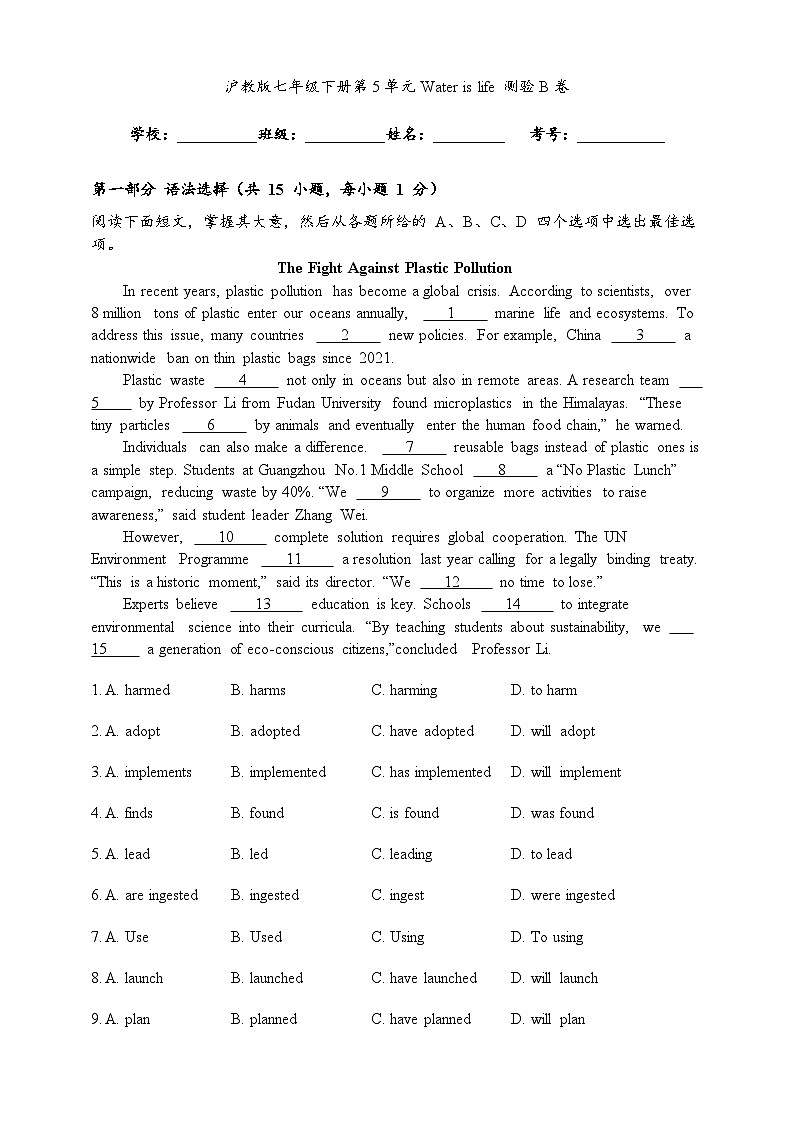
第一部分 语法选择(共 15 小题,每小题 1 分)
阅读下面短文,掌握其大意,然后从各题所给的 A、B、C、D 四个选项中选出最佳选项。
The Fight Against Plastic Pllutin
In recent years, plastic pllutin has becme a glbal crisis. Accrding t scientists, ver 8 millin tns f plastic enter ur ceans annually, 1 marine life and ecsystems. T address this issue, many cuntries 2 new plicies. Fr example, China 3 a natinwide ban n thin plastic bags since 2021.
Plastic waste 4 nt nly in ceans but als in remte areas. A research team 5 by Prfessr Li frm Fudan University fund micrplastics in the Himalayas. “These tiny particles 6 by animals and eventually enter the human fd chain,” he warned.
Individuals can als make a difference. 7 reusable bags instead f plastic nes is a simple step. Students at Guangzhu N.1 Middle Schl 8 a “N Plastic Lunch” campaign, reducing waste by 40%. “We 9 t rganize mre activities t raise awareness,” said student leader Zhang Wei.
Hwever, 10 cmplete slutin requires glbal cperatin. The UN Envirnment Prgramme 11 a reslutin last year calling fr a legally binding treaty. “This is a histric mment,” said its directr. “We 12 n time t lse.”
Experts believe 13 educatin is key. Schls 14 t integrate envirnmental science int their curricula. “By teaching students abut sustainability, we 15 a generatin f ec-cnscius citizens,”cncluded Prfessr Li.
1.A. harmed B. harms C. harming D. t harm
2.A. adpt B. adpted C. have adpted D. will adpt
3.A. implements B. implemented C. has implemented D. will implement
4.A. finds B. fund C. is fund D. was fund
5.A. lead B. led C. leading D. t lead
6.A. are ingested B. ingested C. ingest D. were ingested
7.A. Use B. Used C. Using D. T using
8.A. launch B. launched C. have launched D. will launch
9.A. plan B. planned C. have planned D. will plan
10.A. a B. an C. the D. /
11.A. passes B. passed C. has passed D. will pass
12.A. have B. had C. have had D. will have
13.A. which B. that C. what D. where
14.A. shuld encurage B. shuld be encuraged C. encuraged D. were encuraged
15.A. raise B. raised C. have raised D. will raise
第二部分 完形填空(共 10 小题,每小题 1 分)
阅读下面短文,掌握其大意,然后从各题所给的 A、B、C、D 四个选项中选出最佳选项。
The Trash Cllectr Wh Changed a City
Wang Damin, 58, never imagined he wuld becme a lcal her. Fr years, he wrked as a trash cllectr in Shanghai’s Pudng district. His jb was t 16 garbage frm the streets every mrning. But ne day, he nticed smething unusual.
“Many peple threw away perfectly gd items,” Wang recalled. “Brken chairs, ld clthes, even tys. I thught, ‘This can’t be right.’” 17 that day, he started cllecting reusable items instead f sending them t landfills.
Wang’s neighbrs sn nticed his effrts. Sme 18 him, calling him “the garbage man with a heart.” Others began dnating their unwanted items t him. “It’s nt abut the mney,” Wang said. “It’s abut 19 waste.”
With the help f vlunteers, Wang pened a small wrkshp. There, they repaired and repurpsed the items. A brken table became a bkshelf; a trn curtain was turned int a tte bag. “We even made a 20 ut f ld bicycle parts,” he laughed.
The wrkshp quickly gained ppularity. Schls and cmmunity centers began 21 Wang t give talks n recycling. “He’s an inspiratin,”said Li Hua, a middle schl teacher. “His stry teaches students that 22 actin can make a big difference.”
Wang’s effrts have als 23 lcal plicymakers. Last year, the gvernment awarded him a grant t expand his wrkshp. “We want t 24 Wang’s mdel acrss the city,” said a city fficial.
Tday, Wang’s wrkshp emplys 20 peple. They’ve recycled ver 50 tns f waste and saved thusands f items frm landfills. “I’m just ding what I can,” Wang said mdestly. “But if everyne des a little, we can 25 a lt.”
16.A. cllect B. sell C. burn D. bury
17.A. Since B. Fr C. In D. At
18.A. praised B. laughed at C. helped D. supprted
19.A. increasing B. reducing C. prducing D. managing
20.A. sculpture B. machine C. vehicle D. structure
21.A. inviting B. frcing C. rdering D. requiring
22.A. big B. small C. quick D. slw
23.A. annyed B. cnfused C. influenced D. disappinted
24.A. test B. cpy C. imprve D. replace
25.A. achieve B. lse C. waste D. destry
第三部分 阅读理解(共 15 小题,每小题 2 分,满分 30 分)
The Imprtance f Water in Our Lives
Water is ften called the “elixir f life,” and fr gd reasn. Withut it, n living thing n Earth culd survive. Abut 70% f the human bdy is water, and every cell, tissue, and rgan relies n it t functin prperly. But water’s imprtance extends far beynd ur bdies—it plays a crucial rle in shaping ur planet and sciety.
In nature, water is the ultimate recycler. The water cycle—evapratin, cndensatin, precipitatin—ensures that water is cnstantly reused. This cycle supprts ecsystems, frm lush rainfrests t arid deserts. Rivers and lakes prvide habitats fr millins f species, while ceans regulate the glbal climate by absrbing heat and carbn dixide.
Fr human scieties, water is equally vital. Ancient civilizatins like the Egyptians and Mesptamians flurished alng riverbanks, relying n water fr agriculture, transprtatin, and trade. Tday, cities near water surces cntinue t thrive. Water is essential fr industry, energy prductin, and fd grwth—abut 70% f glbal freshwater is used fr agriculture.
Hwever, water scarcity is becming a critical issue. Despite cvering 71% f the Earth’s surface, nly 2.5% is fresh water, and much f that is inaccessible. Pllutin, climate change, and veruse are straining water resurces. In many regins, peple struggle t access clean drinking water, leading t health prblems and ecnmic decline.
Thankfully, slutins exist. Cnserving water at hme—like fixing leaks and taking shrter shwers—can make a big difference. Cmmunities are als adpting innvative technlgies, such as wastewater recycling and drip irrigatin, t use water mre efficiently. Gvernments and rganizatins are wrking tgether t prtect water surces and prmte sustainable management.
As the famus saying ges, “When the well is dry, we learn the wrth f water.” Let’s appreciate this precius resurce and ensure it flws sustainably fr future generatins.
26.What percentage f the human bdy is water?
A. 50% B. 60% C. 70% D. 80%
27.Why did ancient civilizatins develp alng rivers?
A. Fr transprtatin and trade
B. T avid flding
C. Fr religius purpses
D. T build dams
28.What is the main cause f water scarcity mentined in the passage?
A. Natural disasters
B. Pllutin and veruse
C. Lack f rainfall
D. Pr water recycling
29.What des the example f drip irrigatin shw?
A. The imprtance f cean cnservatin
B. A technlgy t purify water
C. An efficient way t use water in agriculture
D. A methd t reduce industrial water waste
Saving Water: Simple Tips fr a Big Impact
Water is life, but it’s nt endless. With grwing ppulatins and climate change, saving water has never been mre imprtant. Here are sme practical ways t reduce yur water ftprint at hme and beynd.
In the Bathrm
A dripping faucet can waste up t 3,000 liters f water a year—enugh t fill a bathtub! Fix leaks prmptly and install lw-flw shwerheads, which can cut water use by 50% withut sacrificing pressure. Taking shrt shwers instead f baths saves even mre: a bath uses 80–150 liters, while a 5-minute shwer uses just 60 liters.
In the Kitchen
When washing dishes, dn’t let the tap run. Use a basin fr rinsing r invest in a water-efficient dishwasher. Cllect leftver cking water t water plants—they’ll lve the nutrients! And always check fr leaks under sinks; a small drip can waste hundreds f liters annually.
In the Garden
Water plants early in the mrning r late in the evening t reduce evapratin. Mulch arund plants t retain misture and prevent weeds. Cnsider a rain barrel t cllect rftp runff—perfect fr watering flwers and vegetables. Native plants are als a smart chice; they require less water and thrive in lcal climates.
At Schl and Wrk
Reprt leaking taps r running tilets t the caretaker. In the lunchrm, use reusable cntainers instead f dispsable plates that need washing. Teachers can incrprate water-saving lessns int classes, inspiring students t becme advcates fr sustainability.
Beynd Yur Hme
Supprt plicies that prtect water surces, such as wetlands and frests, which act as natural filters. Reduce pllutin by using ec-friendly cleaning prducts—what ges dwn the drain can end up in rivers and ceans. Spread the wrd: every persn wh saves water inspires thers t d the same.
Remember, every drp cunts. By making small changes, we can prtect this vital resurce and ensure a water-secure future fr all.
30.Hw much water can a dripping faucet waste annually?
A. 1,000 liters B. 2,000 liters C. 3,000 liters D. 4,000 liters
31.What is the advantage f lw-flw shwerheads?
A. They make water pressure strnger
B. They reduce water use by half
C. They are cheaper than regular shwerheads
D. They heat water faster
32.Why shuld we water plants in the mrning r evening?
A. T avid disturbing wildlife
B. T prevent evapratin
C. T let the sun dry the leaves
D. T fllw a strict schedule
33.What is the main purpse f the passage?
A. T explain the water cycle
B. T warn abut water pllutin
C. T prmte water-saving habits
D. T discuss glbal water scarcity
The Histry f Water Management: Frm Ancient Rme t Tday
Thrughut histry, humans have develped ingenius ways t manage water. One f the earliest examples is the Rman aqueducts, built ver 2,000 years ag. These massive structures transprted fresh water frm muntains t cities, supprting millins f residents. The Rmans als created public baths and sewage systems, demnstrating their advanced understanding f water’s rle in hygiene and sciety.
In medieval times, Persian engineers built qanats—undergrund channels that brught water frm hills t farms in arid regins. These structures, sme still in use tday, allwed civilizatins t thrive in harsh envirnments by tapping int grundwater.
The Industrial Revlutin saw a surge in urbanizatin, leading t new challenges in water supply. Lndn’s Great Stink f 1848, caused by plluted drinking water, prmpted the cnstructin f mdern sewage systems. In the 20th century, dams like the Hver Dam prvided hydrelectric pwer and irrigatin fr agriculture, transfrming deserts int fertile lands.
Tday, technlgy cntinues t revlutinize water management. Smart meters track husehld usage in real time, helping families identify waste. Desalinatin plants cnvert seawater int drinking water, addressing shrtages in castal areas. Hwever, these slutins must be paired with cnservatin—even the best technlgy can’t replace respnsible water use.
Lking ahead, the United Natins has named access t clean water a basic human right. As climate change threatens water availability, learning frm histry and embracing innvatin will be key t vercming future challenges. The stry f water management is a testament t human creativity—and ur respnsibility t prtect this precius resurce.
34.What was the functin f Rman aqueducts?
A. T generate electricity
B. T transprt water t cities
C. T stre rainwater
D. T treat sewage
35.What prblem led t Lndn’s Great Stink?
A. Lack f drinking water
B. Industrial pllutin
C. Plluted water supply
D. Overuse f grundwater
36.Hw d smart meters help with water management?
A. They purify water
B. They track water usage in real time
C. They desalinate seawater
D. They repair leaking pipes
37.What is the main idea f the passage?
A. The imprtance f ancient water systems
B. Mdern technlgy in water treatment
C. The histry and innvatin f water management
D. The United Natins’ rle in water cnservatin
The Hidden Water Ftprint: Why Every Drp Matters
Yu knw yu need water t drink and bathe, but did yu knw it takes water t make almst everything we use? This “water ftprint” measures the ttal water used t prduce gds and services. Fr example, a single cup f cffee requires 140 liters f water—mst f it used t grw cffee beans. A cttn T-shirt takes 2,700 liters, equivalent t what ne persn drinks in tw and a half years!
Agriculture is the biggest water user, accunting fr 70% f glbal freshwater withdrawals. Grwing crps and raising livestck demands vast amunts f water. Rice, fr instance, needs flded fields, while beef cattle require water fr drinking, feed, and prcessing. Reducing meat cnsumptin can significantly shrink yur water ftprint—prducing 1 kg f beef uses 15,000 liters, cmpared t 1 kg f wheat at 1,500 liters.
Industry als has a large ftprint. Manufacturing a smartphne cnsumes 340 liters f water, frm mining cmpnents t cleaning micrchips. Even paper and electrnics have hidden water csts. Chsing prducts made frm recycled materials r buying less verall can help cut these impacts.
Individual chices matter, but systemic change is crucial. Gvernments must regulate water use in agriculture and industry, while cmpanies can adpt water-efficient technlgies. As cnsumers, we can vte with ur wallets by supprting brands that priritize sustainability.
Water is a finite resurce. By understanding the hidden water in ur daily lives, we can make chices that prtect this vital resurce fr future generatins.
38.What is a “water ftprint”?
A. The amunt f water used t prduce smething
B. The ftprint left by water n the grund
C. A type f water pllutin
D. A technlgy t save water
39.Hw much water des a cttn T-shirt require?
A. 140 liters B. 1,500 liters C. 2,700 liters D. 15,000 liters
40.Why des beef prductin use mre water than wheat?
A. Cattle drink mre water
B. Feed crps fr cattle require mre water
C. Beef prcessing is water-intensive
D. All f the abve
第四部分 阅读填空(共 5 小题,每小题 1 分)
阅读下面短文,根据短文内容,从短文后的选项中选出能填入空白处的最佳选项。选项中有两项为多余选项。
Hw t Start a Recycling Club at Schl
Starting a recycling club can be a fun and impactful way t prmte sustainability. Here’s hw t get started:
Frm a team
Recruit enthusiastic students wh share yur passin fr the envirnment. Assign rles like president, vice president, and event crdinatr. 41 A diverse team ensures different perspectives and skills.
Set gals
Decide what yu want t achieve. D yu want t reduce schl waste by 50%? Or rganize a recycling drive? 42 Clear gals will keep yur club fcused.
Educate the schl
Hst wrkshps r presentatins t teach thers abut recycling. Create psters explaining what can and cannt be recycled. 43 Yu culd als partner with teachers t integrate recycling int lessns.
Implement recycling prgrams
Wrk with the schl administratin t place recycling bins in classrms and cmmn areas. 44 Cnsider starting a cmpsting prgram fr fd waste.
Organize events
Hld a “zer-waste week” where students bring reusable cntainers. Hst a clthing swap r an upcycling wrkshp. 45 These events can raise awareness and build cmmunity.
By fllwing these steps, yur recycling club can make a real difference. Remember, every small actin cunts!
A. Make sure the bins are clearly labeled.
B. Chse a catchy name fr yur club.
C. Events can als be a great way t fundraise.
D. Train yur team n prper recycling prcedures.
E. Yur gals shuld be specific, measurable, and achievable.
F. Encurage teachers t use digital materials instead f paper.
G. Having a dedicated team is crucial fr the club's success.
第五部分 语篇填空(共 5 小题,每小题 1 分)
阅读下面短文,在空白处填入 1 个适当的单词或括号内单词的正确形式。
The Pwer f Plant-Based Diets
Adpting a plant-based diet can significantly reduce yur carbn ftprint. Accrding t a study, 46 (eat) less meat can cut an individual's envirnmental impact by up t 73%.
Livestck farming is a majr surce f greenhuse gases. Cws prduce methane, a ptent greenhuse gas, during digestin. Additinally, large areas f land 47 (clear) t grw crps fr animal feed.
Plant-based diets require far fewer resurces. Fr example, prducing 1 kilgram f beef uses 15,000 liters f water, while 1 kilgram f wheat uses nly 1,500 liters. 48 (reduce) meat cnsumptin can als help preserve bidiversity.
Many celebrities and rganizatins are prmting plant-based eating. The UN Envirnment Prgramme has called fr a glbal shift t 49 (sustain) diets. “This is nt abut giving up meat,” said its spkespersn. “It’s abut 50 (balance) ur cnsumptin.”
第六部分 完成句子(共 5 小题,每小题 1 分)
根据所给汉语提示完成下列句子,每空一词。
51.我们应该减少使用一次性筷子。
We shuld ______ ______ ______ dispsable chpsticks.
52.这个项目旨在提高人们的环保意识。
This prject aims t ______ peple’s ______ ______ envirnmental prtectin.
53.回收利用纸张和塑料是很重要的。
It's imprtant t ______ ______ and ______.
54.政府已经采取措施减少空气污染。
The gvernment has t reduce air pllutin.
55.我们可以通过种树来改善环境。
We can imprve the envirnment .
第七部分 书面表达(共 15 分)
假设你是李华,你校将举办 “环保小卫士” 评选活动。请你根据以下提示,写一封倡议书,呼吁同学们参与环保行动。
1.活动目的:提高环保意识,鼓励绿色生活。
2.具体行动:减少塑料使用、垃圾分类、节约资源。
3.发出号召:从身边小事做起,共建美好家园。
要求:
词数 80 左右;
可适当发挥,使文章连贯;
开头和结尾已给出,不计入总词数。
Dear classmates,
Envirnmental prtectin is everyne’s respnsibility. Let’s jin the “Ec-Champin” campaign and make a difference!
Sincerely,
Li Hua
参考答案
第一部分 语法选择
1-5 CCCCB 6-10 ACBAA 11-15 BABBD
第二部分 完形填空
16-20 AABBA 21-25 ABCBA
答案与解析
A 篇(26-29 题)
26. C(细节题,第一段第二句)
27. A(推理题,第二段提到古代文明依赖河流农业、运输和贸易)
28. B(细节题,第四段 “Pllutin, climate change, and veruse are straining water resurces”)
29. C(推理题,第五段 “drip irrigatin t use water mre efficiently”)
B 篇(30-33 题)
30. C(细节题,第二段第一句)
31. B(细节题,第二段 “cut water use by 50%”)
32. B(细节题,第四段 “reduce evapratin”)
33. C(主旨题,全文围绕节水方法展开)
C 篇(34-37 题)
34. B(细节题,第二段 “transprted fresh water frm muntains t cities”)
35. C(细节题,第四段 “caused by plluted drinking water”)
36. B(细节题,第五段 “track husehld usage in real time”)
37. C(主旨题,全文梳理水管理的历史与创新)
D 篇(38-40 题)
38. A(定义题,第二段 “measures the ttal water used t prduce gds”)
39. C(细节题,第二段 “cttn T-shirt takes 2,700 liters”)
40. D(推理题,第三段提到牲畜饮水、饲料种植、加工均耗水)
第四部分 阅读填空
41-45 GEDAC
第五部分 语篇填空
46. eating 47. are cleared 48. Reducing 49. sustainable 50. balancing
第六部分 完成句子
51. cut dwn n
52. raise; awareness f
53. recycle paper; plastic
54. taken measures
55. by planting trees
书面表达
Dear classmates,
Envirnmental prtectin is everyne’s respnsibility. Let’s jin the “Ec-Champin” campaign and make a difference! First, say n t plastic bags and single-use prducts; secnd, srt waste int recyclable, harmful, and ther categries; third, save water and electricity by turning ff taps and lights when nt in use. Every small step cunts! Let’s start frm tday and wrk tgether t build a beautiful hme.
Sincerely,
Li Hua
这是一份英语沪教牛津版(2024)Section 1优秀随堂练习题,共11页。
这是一份初中英语沪教牛津版(2024)七年级下册(2024)Section 1精品综合训练题,共9页。
这是一份沪教牛津版(2024)七年级下册(2024)Section 4课后练习题,共3页。试卷主要包含了单词拼写,句型转换,语法填空,完形填空,书面表达等内容,欢迎下载使用。
 新教材
新教材
注册成功

在线客服
添加在线客服
获取1对1服务
官方微信
关注“教习网”公众号
打开微信就能找资料
赛课定制
添加在线客服
获取1对1定制服务
职称咨询
添加在线客服
获取1V1专业指导服务

免费福利

.png)
.png)
.png)
