免费领取教师福利
若您为此资料的原创作者,认为该资料内容侵犯了您的知识产权,请扫码添加我们的相关工作人员,我们尽可能的保护您的合法权益。

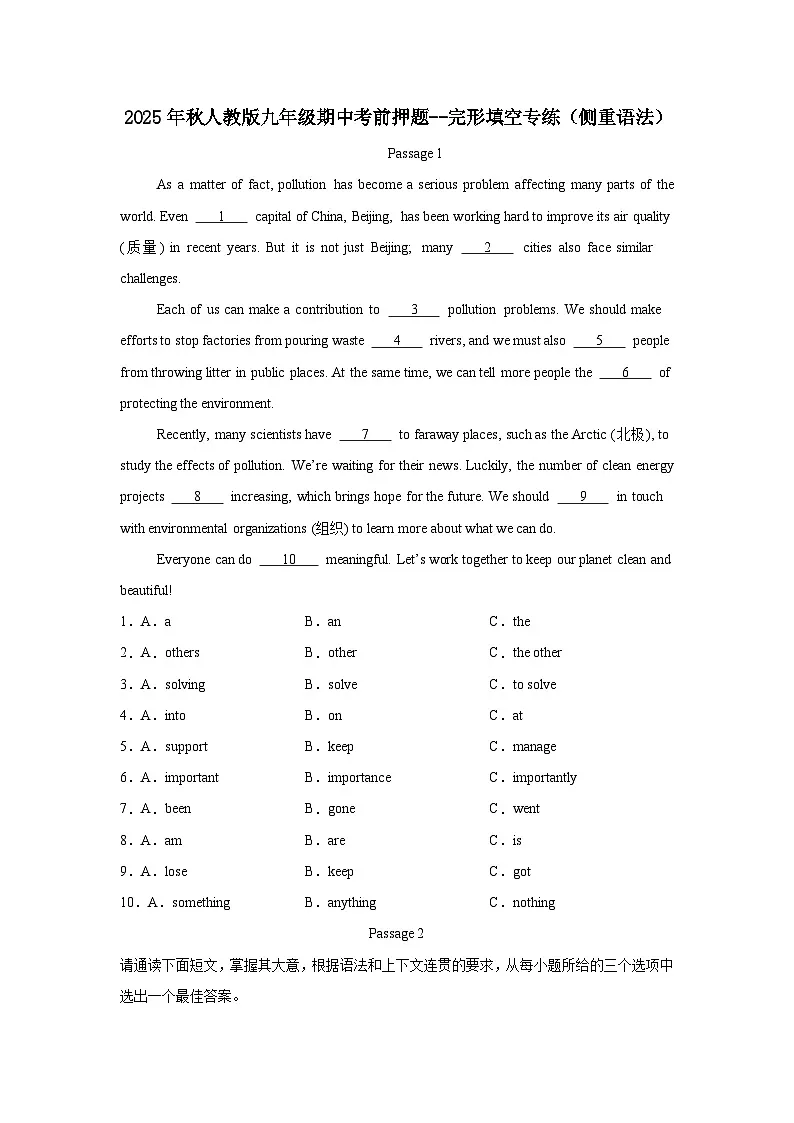
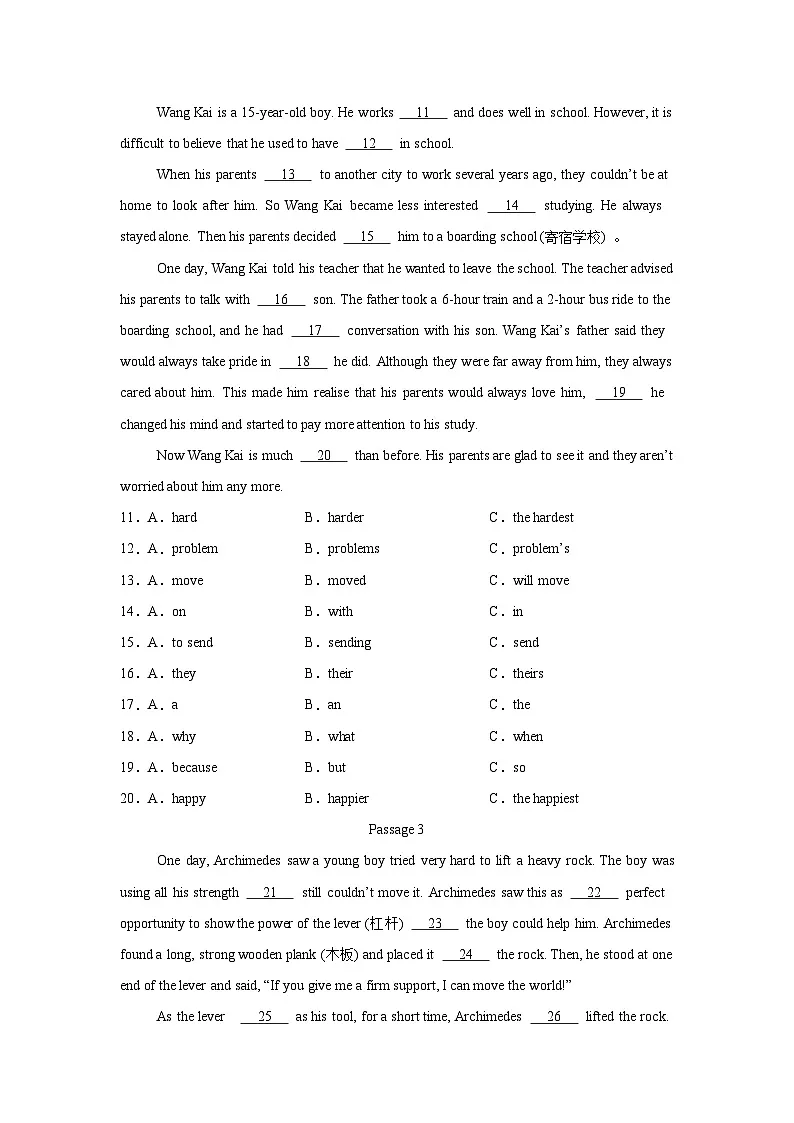
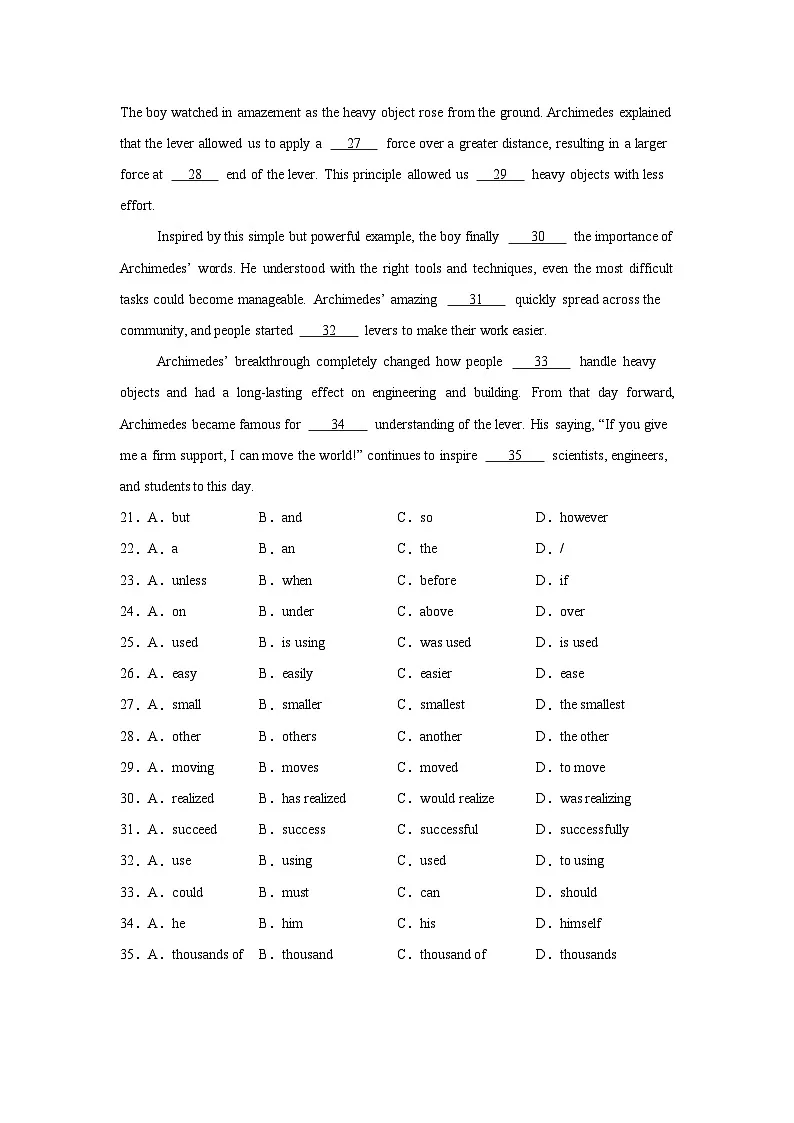
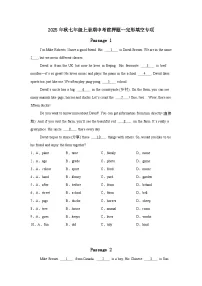
这是一份2025年秋人教版九年级期中考前押题--完形填空专练(侧重语法)(含答案),文件包含2025年秋人教版九年级期中考前押题--完形填空专练侧重语法原卷版docxdocx、2025年秋人教版九年级期中考前押题--完形填空专练侧重语法解析版docxdocx等2份试卷配套教学资源,其中试卷共36页, 欢迎下载使用。
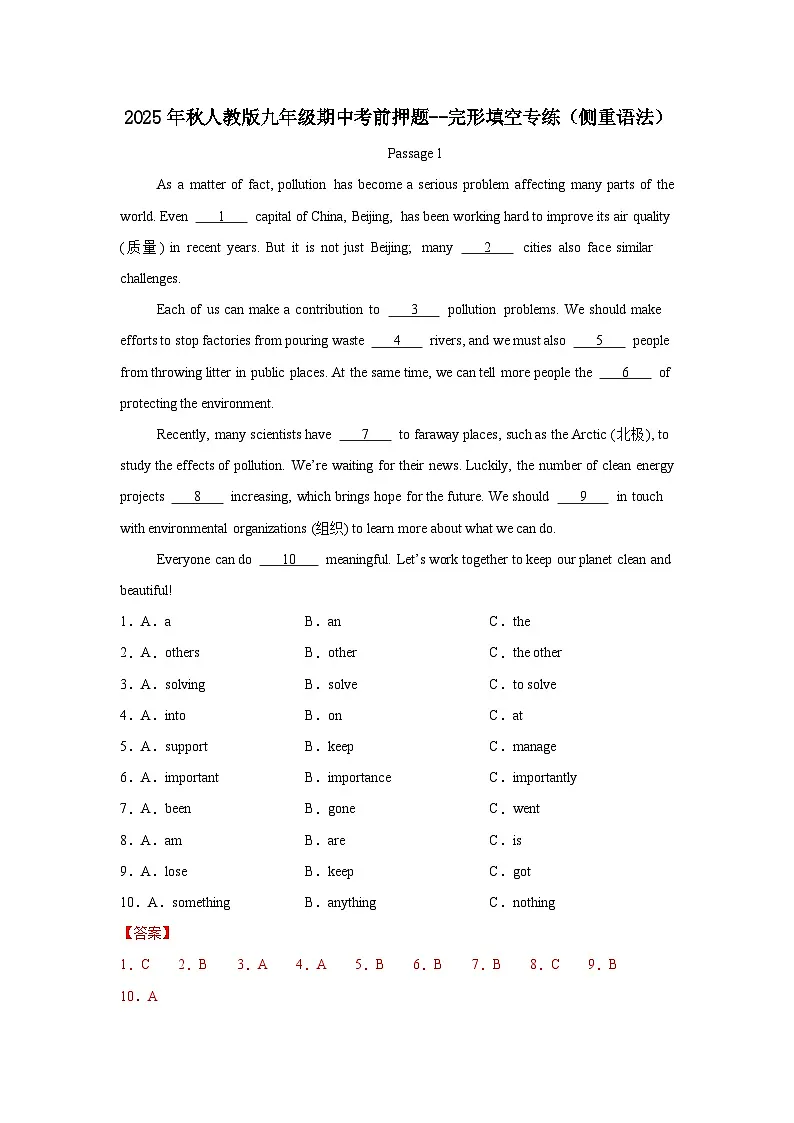
Each f us can make a cntributin t 3 pllutin prblems. We shuld make effrts t stp factries frm puring waste 4 rivers, and we must als 5 peple frm thrwing litter in public places. At the same time, we can tell mre peple the 6 f prtecting the envirnment.
Recently, many scientists have 7 t faraway places, such as the Arctic (北极), t study the effects f pllutin. We’re waiting fr their news. Luckily, the number f clean energy prjects 8 increasing, which brings hpe fr the future. We shuld 9 in tuch with envirnmental rganizatins (组织) t learn mre abut what we can d.
Everyne can d 10 meaningful. Let’s wrk tgether t keep ur planet clean and beautiful!
1.A.aB.anC.the
2.A.thersB.therC.the ther
3.A.slvingB.slveC.t slve
4.A.intB.nC.at
5.A.supprtB.keepC.manage
6.A.imprtantB.imprtanceC.imprtantly
7.A.beenB.gneC.went
8.A.amB.areC.is
9.A.lseB.keepC.gt
10.A.smethingB.anythingC.nthing
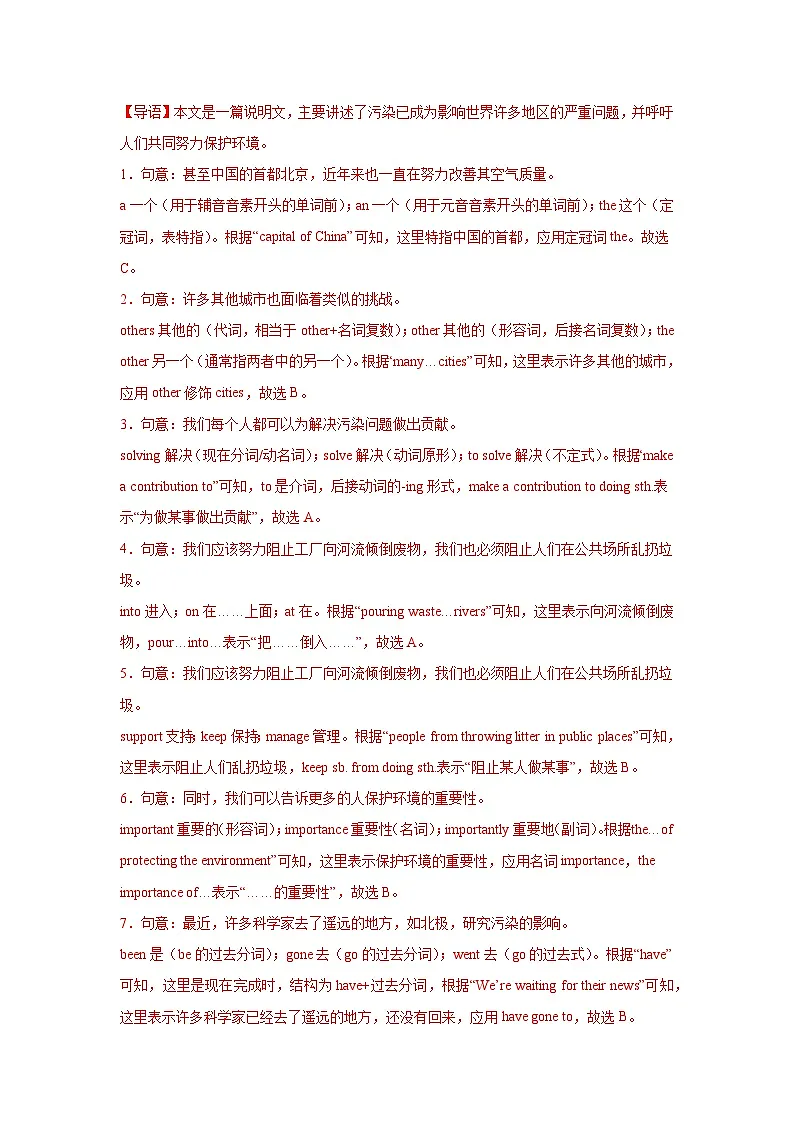
【答案】
1.C 2.B 3.A 4.A 5.B 6.B 7.B 8.C 9.B 10.A
【导语】本文是一篇说明文,主要讲述了污染已成为影响世界许多地区的严重问题,并呼吁人们共同努力保护环境。
1.句意:甚至中国的首都北京,近年来也一直在努力改善其空气质量。
a一个(用于辅音音素开头的单词前);an一个(用于元音音素开头的单词前);the这个(定冠词,表特指)。根据“capital f China”可知,这里特指中国的首都,应用定冠词the。故选C。
2.句意:许多其他城市也面临着类似的挑战。
thers其他的(代词,相当于ther+名词复数);ther其他的(形容词,后接名词复数);the ther另一个(通常指两者中的另一个)。根据“many…cities”可知,这里表示许多其他的城市,应用ther修饰cities,故选B。
3.句意:我们每个人都可以为解决污染问题做出贡献。
slving解决(现在分词/动名词);slve解决(动词原形);t slve解决(不定式)。根据“make a cntributin t”可知,t是介词,后接动词的-ing形式,make a cntributin t ding sth.表示“为做某事做出贡献”,故选A。
4.句意:我们应该努力阻止工厂向河流倾倒废物,我们也必须阻止人们在公共场所乱扔垃圾。
int进入;n在……上面;at在。根据“puring waste…rivers”可知,这里表示向河流倾倒废物,pur…int…表示“把……倒入……”,故选A。
5.句意:我们应该努力阻止工厂向河流倾倒废物,我们也必须阻止人们在公共场所乱扔垃圾。
supprt支持;keep保持;manage管理。根据“peple frm thrwing litter in public places”可知,这里表示阻止人们乱扔垃圾,keep sb. frm ding sth.表示“阻止某人做某事”,故选B。
6.句意:同时,我们可以告诉更多的人保护环境的重要性。
imprtant重要的(形容词);imprtance重要性(名词);imprtantly重要地(副词)。根据“the…f prtecting the envirnment”可知,这里表示保护环境的重要性,应用名词imprtance,the imprtance f…表示“……的重要性”,故选B。
7.句意:最近,许多科学家去了遥远的地方,如北极,研究污染的影响。
been是(be的过去分词);gne去(g的过去分词);went去(g的过去式)。根据“have”可知,这里是现在完成时,结构为have+过去分词,根据“We’re waiting fr their news”可知,这里表示许多科学家已经去了遥远的地方,还没有回来,应用have gne t,故选B。
8.句意:幸运的是,清洁能源项目的数量正在增加,这给未来带来了希望。
am是(主语为I);are是(主语为复数或第二人称);is是(主语为第三人称单数)。根据“the number f”可知,the number f表示“……的数量”,作主语时,谓语动词用单数,故选C。
9.句意:我们应该与环境组织保持联系,了解更多我们能做的事情。
lse失去;keep保持;gt得到(get的过去式)。根据“in tuch with”可知,此处是短语keep in tuch with表示“与……保持联系”,故选B。
10.句意:每个人都可以做一些有意义的事情。
smething一些事情(用于肯定句);anything任何事情(用于否定句或疑问句);nthing没有什么。根据“Everyne can d…meaningful.”可知,这是一个肯定句,表示每个人都可以做一些有意义的事情,应用smething,故选A。
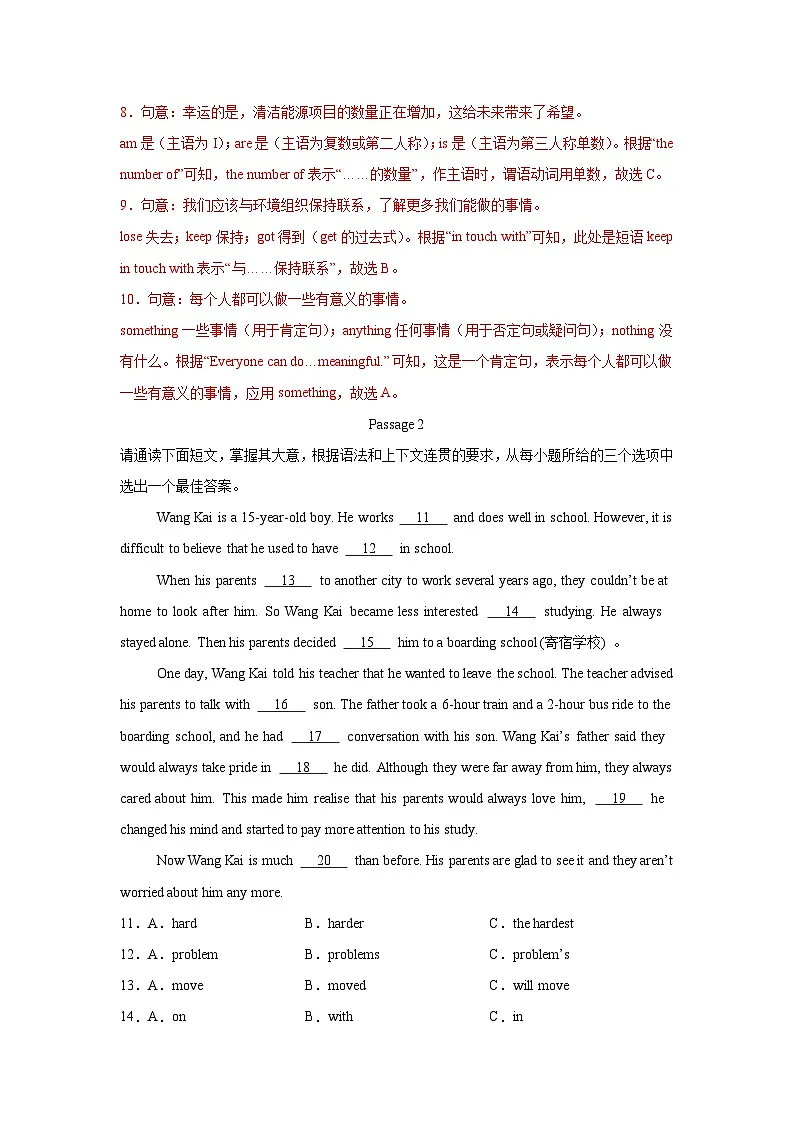
Passage 2
请通读下面短文,掌握其大意,根据语法和上下文连贯的要求,从每小题所给的三个选项中选出一个最佳答案。
Wang Kai is a 15-year-ld by. He wrks 11 and des well in schl. Hwever, it is difficult t believe that he used t have 12 in schl.
When his parents 13 t anther city t wrk several years ag, they culdn’t be at hme t lk after him. S Wang Kai became less interested 14 studying. He always stayed alne. Then his parents decided 15 him t a barding schl (寄宿学校) 。
One day, Wang Kai tld his teacher that he wanted t leave the schl. The teacher advised his parents t talk with 16 sn. The father tk a 6-hur train and a 2-hur bus ride t the barding schl, and he had 17 cnversatin with his sn. Wang Kai’s father said they wuld always take pride in 18 he did. Althugh they were far away frm him, they always cared abut him. This made him realise that his parents wuld always lve him, 19 he changed his mind and started t pay mre attentin t his study.
Nw Wang Kai is much 20 than befre. His parents are glad t see it and they aren’t wrried abut him any mre.
11.A.hardB.harderC.the hardest
12.A.prblemB.prblemsC.prblem’s
13.A.mveB.mvedC.will mve
14.A.nB.withC.in
15.A.t sendB.sendingC.send
16.A.theyB.theirC.theirs
17.A.aB.anC.the
18.A.whyB.whatC.when
19.A.becauseB.butC.s
20.A.happyB.happierC.the happiest
【答案】
11.A 12.B 13.B 14.C 15.A 16.B 17.A 18.B 19.C 20.B
【导语】本文主要讲述了一个名叫王凯的男孩,因父母外出工作而感到孤独,学习退步,但在与父亲深入交谈后,理解了父母的爱,从而重新振作、努力学习的故事。
11.句意:他努力学习,在学校表现很好。
hard努力地 (原级) ;harder更努力地 (比较级) ;the hardest最努力地 (最高级) 。wrk hard是固定搭配,意为“努力学习/工作”,hard在此作副词,修饰动词wrks。故选A。
12.句意:然而,很难相信他过去在学校里有很多问题。
prblem问题 (单数) ;prblems问题 (复数) ;prblem’s问题的 (名词所有格) 。prblem是可数名词,根据“S Wang Kai became less interested in studying. He always stayed alne.”可知,王凯不仅学习兴趣下降,而且感到孤独,说明他面临的是多方面的问题,而不仅仅是一个问题,此处应用复数形式prblems。故选B。
13.句意:几年前,当他的父母搬到另一个城市工作时,他们不能在家里照顾他。
mve搬家 (动词原形) ;mved搬家 (一般过去时) ;will mve搬家(一般将来时)。根据时间状语several years ag可知,此处描述的是过去发生的动作,应用一般过去时。故选B。
14.句意:因此,王凯对学习变得不那么感兴趣了。
n在……方面;with和;in在……里面。固定搭配be interested in sth,意为“对某事感兴趣”。故选C。
15.句意:然后他的父母决定送他去一所寄宿学校。
t send送 (不定式) ;sending送 (动名词) ;send送 (原形) 。固定搭配decide t d sth,意为“决定做某事”。动词decide后面应接动词不定式作宾语,故填t send。故选A。
16.句意:老师建议他的父母和他们的儿子谈谈。
they他们 (主格) ;their他们的 (形容词性物主代词) ;theirs他们的 (名词性物主代词) 。sn是名词,此处需要一个形容词性物主代词来修饰sn,表示“他们的”儿子。故选B。
17.句意:父亲坐了6小时的火车和2小时的公交车到寄宿学校,和他儿子进行了一次交谈。
a一个 (不定冠词,用于辅音音素开头单词前) ;an一个 (不定冠词,用于元音音素开头单词前) ;the那个 (定冠词,表特指) 。此处表示泛指,cnversatin以辅音音素开头,所以用a。故选A。
18.句意:王凯的父亲说,无论他做了什么,他们都会永远为他感到骄傲。
why为什么;what什么;when什么时候。根据“…he wanted t leave the schl”可知,王凯想要离开学校,他认为自己做得不好。父亲的话“…they wuld always take pride in…he did”是对他这种想法的回应。此处需要一个词来引导宾语从句,表示“王凯所做的一切事情”。故选B。
19.句意:这让他意识到他的父母会永远爱他,所以他改变了想法,开始更加关注他的学习。
because因为;but但是;s所以。根据“This made him realise that his parents wuld always lve him…he changed his mind and started t pay mre attentin t his study”可知,前后是因果关系,前者是原因,后者是结果。故选C。
20.句意:现在王凯比以前快乐多了。
happy快乐的 (原级) ;happier更快乐的 (比较级) ;the happiest最快乐的 (最高级) 。根据“Nw Wang Kai is much…than befre.”可知,此处是将“现在”和“以前”进行比较,应用形容词的比较级。故选B。
Passage 3
One day, Archimedes saw a yung by tried very hard t lift a heavy rck. The by was using all his strength 21 still culdn’t mve it. Archimedes saw this as 22 perfect pprtunity t shw the pwer f the lever (杠杆) 23 the by culd help him. Archimedes fund a lng, strng wden plank (木板) and placed it 24 the rck. Then, he std at ne end f the lever and said, “If yu give me a firm supprt, I can mve the wrld!”
As the lever 25 as his tl, fr a shrt time, Archimedes 26 lifted the rck. The by watched in amazement as the heavy bject rse frm the grund. Archimedes explained that the lever allwed us t apply a 27 frce ver a greater distance, resulting in a larger frce at 28 end f the lever. This principle allwed us 29 heavy bjects with less effrt.
Inspired by this simple but pwerful example, the by finally 30 the imprtance f Archimedes’ wrds. He understd with the right tls and techniques, even the mst difficult tasks culd becme manageable. Archimedes’ amazing 31 quickly spread acrss the cmmunity, and peple started 32 levers t make their wrk easier.
Archimedes’ breakthrugh cmpletely changed hw peple 33 handle heavy bjects and had a lng-lasting effect n engineering and building. Frm that day frward, Archimedes became famus fr 34 understanding f the lever. His saying, “If yu give me a firm supprt, I can mve the wrld!” cntinues t inspire 35 scientists, engineers, and students t this day.
21.A.butB.andC.sD.hwever
22.A.aB.anC.theD./
23.A.unlessB.whenC.befreD.if
24.A.nB.underC.abveD.ver
25.A.usedB.is usingC.was usedD.is used
26.A.easyB.easilyC.easierD.ease
27.A.smallB.smallerC.smallestD.the smallest
28.A.therB.thersC.antherD.the ther
29.A.mvingB.mvesC.mvedD.t mve
30.A.realizedB.has realizedC.wuld realizeD.was realizing
31.A.succeedB.successC.successfulD.successfully
32.A.useB.usingC.usedD.t using
33.A.culdB.mustC.canD.shuld
34.A.heB.himC.hisD.himself
35.A.thusands fB.thusandC.thusand fD.thusands
【答案】
21.A 22.A 23.D 24.B 25.C 26.B 27.B 28.D 29.D 30.A 31.B 32.B 33.A 34.C 35.A
【导语】本文介绍了阿基米德用杠杆原理帮助男孩抬起重石的故事。
21.句意:这个男孩用尽了所有的力气,但还是不能移动它。
but但是;and和;s所以;hwever然而。空格前后是转折关系,but是连词,连接两个句子表示转折。hwever 也有转折意思,但通常用于句首或句中加逗号。故选A。
22.句意:阿基米德认为这是展示杠杆力量的绝佳机会,便对男孩说可以帮忙。
a一个;an一个;the这个;/不填。根据“perfect pprtunity”可知,此处第一次提到,名词前用不定冠词,perfect以辅音音素开头,用不定冠词a。故选A。
23.句意:阿基米德认为这是展示杠杆力量的绝佳机会,便对男孩说可以帮忙。
unless 除非;when 当;befre 在之前;if 如果。根据“t shw the pwer f the lever (杠杆) ... the by culd help him.”可知,此处指“展示杠杆的力量,如果男孩能帮助他”。if 表示条件,符合上下文。故选D。
24.句意:阿基米德找来一根又长又结实的木板,将它放在岩石下面。
n 在……上面;under 在……下面;abve 在……上方;ver 在……正上方。杠杆原理中,木板通常置于重物下方作为支点来撬动。故选B。
25.句意:当杠杆作为工具被使用时,阿基米德轻松地撬起了巨石。
used 使用;is using 正在使用;was used 被使用;is used 被使用。lever是被使用的对象,需用被动语态;上下文是过去时,所以 用was used。故选C。
26.句意:当杠杆作为工具被使用时,阿基米德轻松地撬起了巨石。
easy 容易;easily 容易地;easier 更容易;ease 使……容易。lifted是动词,需用副词修饰动词,easily是副词。故选B。
27.句意:阿基米德解释说,杠杆让我们能用较小的力作用于较长距离,从而在另一端产生更大的力。
small小;smaller更小;smallest最小;the smallest最小的。根据“the lever allwed us t apply a ... frce ver a greater distance”可知,此处指“施加较小的力”。杠杆原理是通过较小的输入力产生较大的输出力,smaller 是比较级,与后文“larger frce”形成对比。故选B。
28.句意:阿基米德解释说,杠杆让我们能用较小的力作用于较长距离,从而在另一端产生更大的力。
ther其他;thers其他人;anther另一个;the ther另一个。杠杆有两个端,一端施加力,另一端产生力。这里说at the ther end,特指另一个端。故选D。
29.句意:这个原理使我们能用更少的力气移动重物。
mving 移动;mves 移动;mved 移动了;t mve 去移动。allw sb t d sth“允许某人做某事”,所以用t mve。故选D。
30.句意:这个简单而有力的示范启发了男孩,他终于领悟到阿基米德话语的重要性。
realized意识到;has realized已经意识到;wuld realize将会意识到;was realizing正在意识到。根据“He understd with the right tls ”可知,时态用一般过去时,realized表示“意识到”的动作发生在过去。故选A。
31.句意:阿基米德惊人的成功很快传遍社区,人们开始运用杠杆来减轻工作负担。
succeed成功;success成功;successful成功的;successfully成功地。根据“Archimedes’ amazing”可知,空前有amazing修饰,空处需要填名词。success 是名词。故选B。
32.句意:阿基米德惊人的成功很快传遍社区,人们开始运用杠杆来减轻工作负担。
use使用;using使用;used使用;t using去使用。start ding sth.“开始做某事”,此处表示开始使用杠杆。故选B。
33.句意:阿基米德的突破彻底改变了人们处理重物的方式,对工程建筑产生了深远影响。
culd可以;must必须;can能够;shuld应该。根据“had a lng-lasting effect n engineering and building”可知,时态是一般过去时,此处表示能力或方式。culd 表示过去能够,符合语境。故选A。
34.句意:从那天起,他因对杠杆原理的深刻理解而闻名于世。
he 他;him 他;his 他的;himself 他自己。understanding是名词,需用所有格形容词修饰;his表示阿基米德的所有关系。故选C。
35.句意:他那句“给我一个支点,我能撬动地球”的豪言,至今仍在激励着无数科学家、工程师和学子。
thusands f 成千上万;thusand 千;thusand f 千的;thusands 数千。thusands f “数以千计的”,固定短语,表示不确定的数目。故选A。
Passage 4
Dear Lucy,
First, I’d like t say that I lve yur name. When my teacher asked us t chse 36 English pen pal, I chse a girl named Lucy. I think the name seems very friendly.
I have a happy family. My father 37 in a factry tw years ag, and nw he is a successful businessman. Mm is a teacher. She 38 English fr eighteen years. She takes care f us very well. My father always says 39 my mm is the best ck in the wrld. I have a sister. She is 40 than me. She thinks she knws mre than I d, s she can always tell me what 41 . It really drives me mad.
I live in Chngqing. It 42 the Muntain City. It is a “ht” city, t. It is famus 43 its ht pt and 44 . And it is really ht in summer here. The peple here are kind and hard-wrking. Every year many peple cme t have a visit. Welcme t Chngqing. If yu cme, I’ll be glad t be 45 guide.
I hpe yu can write back sn.
Yur pen pal,
Isabel
36.A.aB.anC.the
37.A.wrkB.wrksC.wrked
38.A.is teachingB.will teachC.has taught
39.A.thatB.ifC.hw
40.A.elderB.lderC.ldest
41.A.dB.dingC.t d
42.A.callsB.is callingC.is called
43.A.tB.frC.as
44.A.ndleB.ndlesC.ndles’
45.A.yuB.yurC.yurs
【答案】
36.B 37.C 38.C 39.A 40.B 41.C 42.C 43.B 44.B 45.B
【导语】本文是一篇书信。Isabel向笔友Lucy介绍了自己的家庭和生活情况,并欢迎Lucy来重庆游玩。
36.句意:当我的老师让我们选择一个英语笔友时,我选择了一个叫Lucy的女孩。
a一个,不定冠词,表泛指,用于辅音音素开头的单词前;an一个,不定冠词,表泛指,用于元音音素开头的单词前;the这个,定冠词,表特指。根据“ chse a girl named Lucy.”可知,此处泛指一个英语笔友,且English是元音音素开头的单词,应用不定冠词an修饰。故选B。
37.句意:我爸爸两年前在一家工厂工作,现在他是一个成功的商人。
wrk工作,动词原形;wrks工作,动词第三人称单数形式;wrked工作,动词过去式。根据“tw years ag”可知,时态为一般过去时,谓语动词用过去式。故选C。
38.句意:她教英语已经18年了。
is teaching正在教,现在进行时;will teach将要教,一般将来时;has taught已经教,现在完成时。根据“fr eighteen years”可知,时态为现在完成时,表示从过去持续到现在的动作或状态。故选C。
39.句意:我爸爸总是说我妈妈是世界上最好的厨师。
that引导宾语从句时,无实义,不作句子成分;if是否,引导宾语从句时,表示疑问;hw如何,引导宾语从句时,表示方式或程度。根据“My father always mm is the best ck in the wrld.”可知,此处为says的宾语从句,从句句意完整,不缺成分,应用that引导。故选A。
40.句意:她比我大。
elder年长的,用于家庭成员之间的比较,且只作定语,不作表语;lder更年长的,用于两者之间的比较,可作定语和表语;ldest最老的,用于三者或三者以上的比较,可作定语和表语。根据“than”可知,此处为两者之间的比较,应用比较级lder,且作表语。故选B。
41.句意:她认为她知道的比我多,所以她总是能告诉我该做什么。
d做,动词原形;ding做,动词现在分词或动名词;t d做,动词不定式。根据“what...”可知,此处为“疑问词+动词不定式”结构,作tell的宾语。故选C。
42.句意:它被称为山城。
calls叫,动词第三人称单数形式;is calling正在叫,现在进行时;is called被称为,一般现在时的被动语态。根据“ Muntain City.”可知,此处指重庆被称为山城,应用一般现在时的被动语态。故选C。
43.句意:它也因它的火锅和面条而出名。
t到,介词;fr因为,介词;as作为,介词。根据“It is ht pt”可知,此处指因火锅而出名,be famus fr“因……而出名”,固定短语。故选B。
44.句意:它也因它的火锅和面条而出名。
ndle面条,可数名词单数;ndles面条,可数名词复数;ndles’面条的,名词所有格。根据“its ht pt and...”可知,此处指重庆的面条,应用复数形式ndles表示泛指。故选B。
45.句意:如果你来,我将很高兴成为你的导游。
yu你,人称代词主格或宾格;yur你的,形容词性物主代词;yurs你的,名词性物主代词。根据“I’ll be glad t ”可知,此处应用形容词性物主代词yur修饰名词guide。故选B。
Passage 5
When I was in primary schl, I fell in lve with reading. The bks brught 46 t a wnderful wrld. Hwever, my parents culdn’t affrd s many bks. I had t slve the prblem myself.
There was 47 bkstre near my hme. One day I walked int the bkstre and picked up a bk. I didn’t knw 48 I culd read there withut buying any bks r nt. T make sure I wasn’t nticed, I just read a few pages and then put it back. 49 , n ne nticed me. After that, I went there t read every day. Several days later, while I 50 , the wner came up and asked, “Yu like reading?” I lked dwn and replied nervusly, “Yes.” “Dn’t wrry,” he said with a smile. “Yu may read bks here 51 yu help me clean the bkstre.” I felt quite 52 .
“Really? It’s very kind f yu.” I was very happy that I was allwed t read there. Frm then n, I spent a little time 53 the bkstre. After that, I quietly read there. That way, I read lts f bks. I became ne f 54 writers in ur schl. I even wn sme prizes in writing. 55 fantastic it is!
Nw studying in high schl, I can brrw bks frm ur schl library. My hbby f reading is kept. I believe it will make a big difference t my life.
46.A.myB.meC.mine
47.A.aB.anC.the
48.A.whyB.whetherC.if
49.A.LuckyB.UnluckyC.Luckily
50.A.readB.readingC.was reading
51.A.ifB.becauseC.althugh
52.A.surpriseB.surprisedC.surprising
53.A.cleanB.t cleanC.cleaning
54.A.gdB.betterC.the best
55.A.WhatB.HwC.What a
【答案】
46.B 47.A 48.B 49.C 50.C 51.A 52.B 53.C 54.C 55.B
【导语】本文是一篇记叙文。文章主要讲述了作者在小学时爱上了阅读,但因为父母买不起很多书,所以自己想办法在书店阅读。后来书店老板允许他在帮忙打扫书店的情况下免费阅读,从此作者阅读了大量的书籍,成为学校最好的作家之一,甚至在写作中获奖。
46.句意:书把我带到了一个美妙的世界。
my我的,形容词性物主代词;me我,宾格;mine我的,名词性物主代词。根据“brught”可知,此处使用人称代词宾格作宾语,bring sb. t“把某人带到……”。故选B。
47.句意:我家附近有一家书店。
a一个,不定冠词,表示泛指,用于以辅音音素开头的单词前;an一个,不定冠词,表示泛指,用于以元音音素开头的单词前;the定冠词,表示特指。根据语境可知,此处泛指一家书店,且bkstre是以辅音音素开头的单词,其前应使用不定冠词a修饰。故选A。
48.句意:我不知道我是否可以在不买任何书的情况下在那里阅读。
why为什么;whether是否;if如果,是否。根据“I didn’t culd read there withut buying any bks r nt”可知,此处为宾语从句,且句中含有r nt,应使用whether引导从句。故选B。
49.句意:幸运的是,没有人注意到我。
Lucky幸运的,形容词;Unlucky不幸的,形容词;Luckily幸运地,副词。根据“n ne nticed me”可知,没有人注意到我,这是幸运的,此处使用副词作状语,修饰整个句子。故选C。
50.句意:几天后,当我正在读书时,店主走过来问:“你喜欢读书吗?”
read读,动词原形;reading读,现在分词;was reading正在读,过去进行时。根据“Several days later, while wner came up and asked”可知,此处使用过去进行时,表示当我正在读书时,店主走了过来。故选C。
51.句意:如果你帮我打扫书店,你可以在这里看书。
if如果;because因为;althugh尽管。根据“Yu may read bks help me clean the bkstre.”可知,此处表示条件关系,即如果你帮我打扫书店,你就可以在这里看书。故选A。
52.句意:我感到很惊讶。
surprise惊讶,名词;surprised感到惊讶的,形容词,修饰人;surprising令人惊讶的,形容词,修饰物。根据“I felt quite...”可知,此处使用形容词作表语,且修饰人,表示我感到很惊讶。故选B。
53.句意:从那时起,我花了一点时间打扫书店。
clean打扫,动词原形;t clean打扫,动词不定式;cleaning打扫,现在分词。根据“spent a little bkstre”可知,此处使用动名词作宾语,spend+时间+ding sth.“花费时间做某事”。故选C。
54.句意:我成了我们学校最好的作家之一。
gd好的,形容词原级;better更好的,形容词比较级;the best最好的,形容词最高级。根据“I became ne in ur schl”可知,此处使用形容词最高级,表示我成了我们学校最好的作家之一,ne f+the+形容词最高级+名词复数“最……之一”。故选C。
55.句意:它是多么奇妙啊!
What什么;Hw多么;What a多么一个。根据“ it is!”可知,此处为感叹句,中心词为形容词fantastic,应使用hw引导感叹句,其结构为“Hw+形容词+主语+谓语!”。故选B。
Passage 6
Have yu ever been t a music festival? Recently, my friends and I went t a 56 music festival in Califrnia.
It 57 Head in the Cluds, a very ppular Asian music festival. All the singers were Asian-American. Best f all, the festival invited the 626 Night Market, 58 Asian-fd night market in the US, t prvide fd I have been lking frward t it fr a very lng time.
The festival was 59 utdr event at the Rse Stadium. It had tw stages and a large part fr eating. My friends and I all 60 gt prk dumplings. And there were still many ther dishes 61 were famus all ver the wrld.
62 I didn’t knw many f the artists, it was exciting t attend the festival. There I gt t knw new artists, such as DPR LIVE and DPR IAN, a Suth Krean band. I als met Bbee, wh I’ve been listening t 63 10 years ag. It felt s gd t meet 64 in persn!
All in all, there I nt nly went ut with my friends and ate great fd, but was able t see yung and excellent Asian musicians. 65 wnderful the festival was I can’t wait t take part in it again.
56.A.tw-daysB.tw daysC.tw-day
57.A.will callB.was calledC.has called
58.A.largeB.largerC.the largest
59.A.aB.anC.the
60.A.happyB.happilyC.happiness
61.A.whB.whenC.which
62.A.IfB.UntilC.Althugh
63.A.frB.frmC.since
64.A.sheB.herC.herself
65.A.HwB.WhatC.What a
【答案】
56.C 57.B 58.C 59.B 60.B 61.C 62.C 63.C 64.B 65.A
【导语】本文主要讲述了作者和朋友们去加利福尼亚参加一个亚洲音乐节的经历,包括音乐节的名称、地点、活动内容以及作者的感受等。
56.句意:最近,我和朋友们去了加利福尼亚一个为期两天的音乐节。
tw-days错误表达,days应用单数形式;tw days两天;tw-day两天的。根据“ festival”可知,此处指为期两天的音乐节,应用复合形容词tw-day作定语。故选C。
57.句意:它被称为Head in the Cluds,是一个非常受欢迎的亚洲音乐节。
will call将会称为,一般将来时;was called被称为,一般过去时的被动语态;has called已经称为,现在完成时。根据“ in the Cluds”可知,此处指音乐节被称为Head in the Cluds,应用被动语态,且动作发生在过去,应用一般过去时的被动语态。故选B。
58.句意:最重要的是,音乐节邀请了美国最大的亚洲美食夜市626夜市来提供我一直期待的食物。
large大的,形容词原级;larger更大的,形容词比较级;the largest最大的,形容词最高级。根据“in the US”可知,此处指美国最大的亚洲美食夜市,应用形容词最高级,且最高级前应加定冠词the。故选C。
59.句意:音乐节是在玫瑰体育场举行的一场户外活动。
a一个,不定冠词,表泛指,用于辅音音素开头的单词前;an一个,不定冠词,表泛指,用于元音音素开头的单词前;the这个,定冠词,表特指。根据“utdr event”可知,此处泛指一场户外活动,且utdr是以元音音素开头的单词,应用不定冠词an。故选B。
60.句意:我和朋友们都开心地吃了猪肉饺子。
happy开心的,形容词;happily开心地,副词;happiness开心,名词。根据“gt prk dumplings”可知,此处指开心地吃猪肉饺子,应用副词happily修饰动词gt。故选B。
61.句意:还有许多其他世界闻名的菜肴。
wh谁,关系代词,指人;when什么时候,关系副词,指时间;which哪个,关系代词,指物。根据“there were still many ther famus all ver the wrld.”可知,此处为定语从句,先行词为dishes,指物,应用关系代词which引导定语从句。故选C。
62.句意:虽然我不认识很多艺术家,但参加这个音乐节还是很令人兴奋的。
If如果,引导条件状语从句;Until直到,引导时间状语从句;Althugh虽然,引导让步状语从句。根据“I didn’t knw many f the artists, it was exciting t attend the festival.”可知,前后句为让步关系,应用althugh引导让步状语从句。故选C。
63.句意:我还遇到了Bbee,我从10年前就开始听她的歌了。
fr为了,介词,后接一段时间;frm从,介词;since自从,介词,后接时间点。根据“10 years ag”可知,此处指自从10年前,应用since。故选C。
64.句意:能亲自见到她感觉真好!
she她,人称代词主格;her她,人称代词宾格或形容词性物主代词;herself她自己,反身代词。根据“ persn”可知,此处指亲自见到她,应用人称代词宾格her作动词meet的宾语。故选B。
65.句意:这个音乐节太棒了,我迫不及待地想再次参加。
Hw多么,感叹词,修饰形容词或副词;What什么,感叹词,修饰名词;What a多么,感叹词,修饰可数名词单数。根据“ the festival was”可知,此处为感叹句,中心词为形容词wnderful,应用hw引导感叹句。故选A。
Passage 7
Have yu ever celebrated Father’s Day with yur father? Father’s Day started 66 the third Sunday f June, 1910. It is nw 67 special day wrldwide and peple celebrate it 68 fathers.
Since the ld times in China, we Chinese peple 69 fathers a lt. In a lt f Chinese pems, peple cnsider fathers brave, strict and great. Fathers’ lve is as 70 as ur mthers’, but the ways ur parents shw 71 lve are different. Mst fathers dn’t chse t shw their feelings. 72 , yu will find yur father lves yu much mre if yu pay attentin t him.
Nwadays, peple enjy surfing n the Internet frm time t time. With the help f the Internet, we can see that there is mre and mre infrmatin abut fathers n Father’s Day. Recently, a vide called My Father Lies has tuched many peple, and at the same time, many peple shw their lve n WeChat and 73 special cards fr their fathers.
In fact, Father’s Day is nt nly abut cards r gifts. We can 74 take ur fathers t the park r the cinema, just like what we d fr ur mthers. Smetimes a simple hug r a saying “I lve yu, Dad” 75 be the perfect gift fr ur fathers. Father’s Day is abut lve. If yu lve yur father, why nt plan a special Father’s Day fr him?
66.A.inB.nC.at
67.A.aB.anC.the
68.A.hnringB.t hnrC.hnr
69.A.respectB.respectedC.have respected
70.A.deepB.deeperC.deeply
71.A.theirsB.themC.their
72.A.AndB.HweverC.Or
73.A.is madeB.makesC.make
74.A.tB.alsC.either
75.A.shuldB.mustC.can
【答案】
66.B 67.A 68.B 69.C 70.A 71.C 72.B 73.C 74.B 75.C
【导语】本文主要讲述了父亲节的起源、在世界范围内的情况、中国人对父亲的尊重、父母表达爱的方式不同、如今人们在父亲节表达爱的方式以及父亲节不仅仅是关于卡片或礼物,还可以通过其他方式表达对父亲的爱。
66.句意:父亲节始于1910年6月的第三个星期日。
in用于年、月、季节等;n用于具体的某一天或某一天的上午、下午、晚上;at用于具体的时刻。根据“the third Sunday f June, 1910”可知,这里是具体的某一天,所以用n,故选B。
67.句意:它现在是全世界一个特殊的日子,人们在这一天向父亲们表达敬意。
a用于辅音音素开头的单词前;an用于元音音素开头的单词前;the表示特指。根据“special day”可知,这里表示一个特殊的日子,special是辅音音素开头,所以用a,故选A。
68.句意:它现在是全世界一个特殊的日子,人们在这一天向父亲们表达敬意。
hnring是现在分词;t hnr是动词不定式;hnr是动词原形。celebrate it t hnr fathers表示“庆祝它是为了向父亲们表达敬意”,这里用动词不定式表目的,故选B。
69.句意:自从中国古代以来,我们中国人一直非常尊重父亲。
respect是动词原形;respected是过去式和过去分词;have respected是现在完成时。根据“Since the ld times in China”可知,这里是现在完成时,其结构是have/has+过去分词,主语是we,所以用have respected,故选C。
70.句意:父亲的爱和我们母亲的爱一样深,但是我们父母表达他们的爱的方式是不同的。
deep深的,形容词原级;deeper更深的,形容词比较级;deeply深深地,副词。中间用形容词或副词原级,根据“Fathers’ lve is ur mthers’”可知,这里表示父亲的爱和母亲的爱一样深,用形容词deep,故选A。
71.句意:父亲的爱和我们母亲的爱一样深,但是我们父母表达他们的爱的方式是不同的。
theirs他们的,名词性物主代词;them他们,宾格;their他们的,形容词性物主代词。根据“the ways ur parents ”可知,这里表示父母的爱,用形容词性物主代词their修饰名词lve,故选C。
72.句意:然而,如果你关注他,你会发现你的父亲更爱你。
And和;Hwever然而;Or或者。根据“Mst fathers dn’t chse t shw their will find yur father lves yu much mre if yu pay attentin t him.”可知,前后是转折关系,用Hwever,故选B。
73.句意:最近,一个名为《我父亲说谎》的视频感动了许多人,同时,许多人在微信上和为父亲制作的特殊卡片上表达他们的爱。
is made被制作,一般现在时的被动语态,主语是单数;makes制作,一般现在时的第三人称单数形式;make动词原形。根据“many peple shw their lve n WeChat cards fr their fathers.”可知,此处表示并列,动词用动词原形与shw保持一致,故选C。
74.句意:事实上,父亲节不仅仅是关于卡片或礼物。我们也可以带我们的父亲去公园或电影院,就像我们为我们母亲做的那样。
t也,用于肯定句句末;als也,用于句中;either也,用于否定句句末。根据“We ur fathers t the park r the cinema”可知,这里表示也可以带父亲去公园或电影院,在句中用als,故选B。
75.句意:有时候一个简单的拥抱或一句“我爱你,爸爸”可以是我们父亲完美的礼物。
shuld应该;must必须;can可以。根据“Smetimes a simple hug r a saying ‘I lve yu, Dad’ the perfect gift fr ur fathers.”可知,这里表示一个简单的拥抱或一句话可以是完美的礼物,用can,故选C。
Passage 8
Fu Ba, the giant panda brn in Suth Krea, was n display fr her final day at the Panda Wrld f Everland Resrt in Yngin City, Suth Krea, n March 3rd.
76 visitrs gathered at the amusement park t say gdbye t the panda, which is ging t return t China this April.
Since the day the female panda was brn, Fu Ba 77 jy and cmfrt t the Suth Krean peple, 78 she has been receiving much attentin and lve frm the public in return.
Zkeepers at the park, Kang Chul-wn and Sng Yung-kwan, knwn 79 Fu Ba’s “grandpas”, prepared 80 delicius bamb sticks and a large buquet f rape flwers as gdbye gifts fr 81 panda.
Accrding t Krea JngAng Daily, crwds 82 n the early mrning f March 3rd t line up t see the 83 panda n her last day.
Fu Ba didn’t appear 84 arund 9:30 a.m. When the mment came, the fans started calling her name 85 . She tk her usual spt beside the pile f bamb sticks and began 86 as usual, nt knwing that this was her last day t meet with the Krean public.
The z directr tld the media 87 Fu Ba wuld mve t China n April 3rd. Being a superstar in Suth Krea, Fu Ba 88 several nicknames by her fans, such as Miss Fu f Yngin, Princess Fu and Chubby Fu.
After Fu Ba returns t China, nly fur giant pandas will remain in Everland’s z, 89 Fu Ba’s mther and father, and 90 twin babies, Rui Ba and Hui Ba, brn last July.
76.A.ThusandsB.ThusandC.Thusands fD.Thusand f
77.A.have brughtB.has brughtC.brughtD.brings
78.A.butB.becauseC.andD.r
79.A.asB.inC.tD.fr
80.A.fewB.littleC.muchD.many
81.A./B.anC.aD.the
82.A.is waitingB.waitsC.waitedD.wait
83.A.4-year-ldB.4 years ldC.4-years-ldD.4 year ld
84.A.sinceB.befreC.untilD.when
85.A.excitinglyB.excitingC.excitedD.excitedly
86.A.ateB.eatenC.eatD.t eat
87.A.thatB.whereC.whenD.what
88.A.gaveB.was givingC.has givenD.was given
89.A.includeB.includedC.includingD.includes
90.A.theirB.theirsC.themD.they
【答案】
76.C 77.B 78.C 79.A 80.D 81.D 82.C 83.A 84.C 85.D 86.D 87.A 88.D 89.C 90.A
【导语】本文介绍了旅韩大熊猫福宝在返回中国前最后一次公开亮相的感人场景,描写了韩国民众对它的喜爱与不舍。
76.句意:成千上万的游客聚集在游乐园向这只将于今年四月返回中国的大熊猫告别。
thusands成千的;thusand千;thusands f成千上万的;thusand f错误。根据空后“visitrs”为名词可知,此处应用thusands f表示“成千上万的”。故选C。
77.句意:从雌性熊猫诞生的那一天起,“福宝”就给韩国人民带来了欢乐和安慰,也得到了公众的关注和喜爱。
have brught带来(复数主语用);has brught带来了(单数主语用);brught过去式;brings带来。根据前文“Since the day”及后文“she has been receiving”可知,此处时态应用现在完成时。故选B。
78.句意:从雌性熊猫诞生的那一天起,“福宝”就给韩国人民带来了欢乐和安慰,也得到了公众的关注和喜爱。
but但是;because因为;and并且;r或者。根据“Fu and cmfrt t the Suth Krean peple, has been receiving much attentin and lve frm the public in return.”可知前后为并列关系,表示“并且”,故选C。
79.句意:公园的动物园管理员姜哲元和被称为“爷爷”的宋永宽为熊猫准备了许多美味的竹竿和一大束油菜花作为告别礼物。
as作为;in在……里;t到;fr为了。根据“ Ba’s grandpas”可知,固定搭配为“be knwn as…”意为“被称作……”。故选A。
80.句意:公园的动物园管理员姜哲元和被称为“爷爷”的宋永宽为熊猫准备了许多美味的竹竿和一大束油菜花作为告别礼物。
few很少的,修饰可数名词;little很少的,修饰不可数名词;much许多,修饰不可数名词;many许多,修饰可数名词。bamb sticks为可数名词,饲养员照顾这只大熊猫,应准备很多食物,需用many。故选D。
81.句意:公园的动物园管理员姜哲元和被称为“爷爷”的宋永宽为熊猫准备了许多美味的竹竿和一大束油菜花作为告别礼物。
/零冠词;an一个,表泛指,用于以元音音素开头的单词前;a一个,表泛指,用于以辅音音素开头的单词前;the为定冠词,表示特指。根据具体熊猫“Fu Ba”且上文提到多次,可知用the特指。故选D。
82.句意:据《韩国中央日报》报道,3月3日凌晨,人们排队等候这只4岁大熊猫的最后一天。
is waiting现在进行时;waits一般现在时;waited过去式;wait原形。根据时间状语“n the early mrning f March 3rd”可知用过去式。故选C。
83.句意:据《韩国中央日报》报道,3月3日凌晨,人们排队等候这只4岁大熊猫的最后一天。
4-year-ld 4岁的(复合形容词);4 years ld 4岁;4-years-ld语法错;4 year ld 4岁的(无连字符)。年龄作定语用连字符复合词4-year-ld。故选A。
84.句意:福宝直到上午9点半才出现。
since自从;befre在……之前;until直到;when当……时。为固定搭配,意为“直到……才”,故选C。
85.句意:那一刻到来时,粉丝们开始激动地叫她的名字。
excitingly令人兴奋地;exciting令人兴奋的;excited感到兴奋的;excitedly兴奋地。修饰动词“calling”,且主语为人,需用副词excitedly。故选D。
86.句意:她像往常一样坐在竹棍堆旁开始吃起来,不知这是最后一天与韩国公众见面。
ate过去式;eaten过去分词;eat原形;t eat不定式。“begin t d/ding”表示”开始做某事“,故选D。
87.句意:动物园园长告诉媒体福宝将于4月3日移居中国。
that引导宾语从句,表示“……的事情”;where哪里;when什么时候;what什么;根据“Fu Ba wuld mve t China n April 3rd”可知此处不是询问时间、地点或内容,而是陈述一件事情,应用that引导宾语从句。故选A。
88.句意:作为韩国的超级明星,她的粉丝给她起了很多绰号。如“龙仁福小姐”、“福公主”和“福胖子”。
gave给;was giving过去进行时;has given现在完成时;was given被给予。句子是一般过去时,主语Fu Ba和动词give之间构成被动关系,所以用一般过去时的被动语态。故选D。
89.句意:在“福宝”返回中国后,爱宝乐园的动物园里只剩下四只大熊猫,包括“福宝”的妈妈和爸爸,以及它们去年7月出生的双胞胎宝宝“睿宝”和“辉宝”。
include包括;included过去式;including包括……在内;includes包括。根据“nly fur giant pandas will remain in Everland’s z, Ba’s mther and father, ”可知,此处应用动词现在分词形式作伴随状语。故选C。
90.句意:在“福宝”返回中国后,爱宝乐园的动物园里只剩下四只大熊猫,包括“福宝”的妈妈和爸爸,以及它们去年7月出生的双胞胎宝宝“睿宝”和“辉宝”。
their他们的;theirs他们的(代词);them他们;they他们。修饰名词“twin babies”需用形容词性物主代词their。故选A。
Passage 9
It’s many peple’s dream t travel arund the wrld, and Cry Lee has already dne it.
Cry’s traveling jurney started early in his life. 91 he had t stay in a wheelchair because f his illness, Cry went n his first trip t Disney Wrld when he was fur. At the age f 15, he traveled abrad fr the first time with his mther, and since then he 92 great interest in traveling.
The fearless yung man never lets his wheelchair stp him frm 93 what he can d. After visiting 37 cuntries all ver the wrld, Cry just became 94 traveler in a wheelchair t visit every cntinent (洲)! “I understand that nt 95 is sure t be pssible,” he said. “But if yu have made up 96 mind t d smething and keep psitive, yu’ll make it.”
It tk 97 research and planning fr Cry t prepare fr his trips, and he said it was plenty f wrk. That’s what made him begin Curb Free with Cry Lee, 98 website where he shares ideas with ther disabled travelers. He als wrte a bk fr 99 —Let’s Explre with Cr Cr. It tells a stry abut a by wh travels t different cuntries in his wheelchair. As yu can imagine, many children 100 by his stry. Just in his wn way, Cry shws the wrld that where there’s a will, there’s a way.
91.A.UnlessB.BecauseC.Althugh
92.A.has shwnB.shwsC.shwed
93.A.dingB.dC.dne
94.A.neB.nceC.the first
95.A.smethingB.anythingC.everything
96.A.yuB.yursC.yur
97.A.carefulB.careC.carefully
98.A.aB.anC.the
99.A.childB.childrenC.children’s
100.A.encurageB.encuragedC.are encuraged
【答案】
91.C 92.A 93.A 94.C 95.C 96.C 97.A 98.A 99.B 100.C
【导语】本文讲述了Cry Lee虽然因病不得不坐轮椅,但从未停止旅行,他成为了坐轮椅访问各大洲的第一人,还创建网站分享经验、写书鼓励残疾儿童的故事。
91.句意:尽管他因为生病不得不坐在轮椅上,但Cry四岁时就进行了第一次去迪士尼世界的旅行。
Unless除非;Because因为;Althugh尽管。“he had t stay in a wheelchair because f his illness”和“Cry went n his first trip t Disney Wrld when he was fur”之间是让步关系,用Althugh引导让步状语从句,故选C。
92.句意:15岁时,他和母亲第一次出国旅行,从那时起,他就对旅行产生了浓厚的兴趣。
has shwn现在完成时;shws一般现在时;shwed一般过去时。根据“since then”可知句子用现在完成时,故选A。
93.句意:这位无畏的年轻人从不让自己的轮椅阻止他做自己能做的事。
ding动名词/现在分词;d动词原形;dne过去分词。stp sb. frm ding sth.“阻止某人做某事”,动词用动名词形式,故选A。
94.句意:在访问了全球37个国家后,Cry刚刚成为第一位坐轮椅访问各大洲的旅行者!
ne一个;nce一次;the first第一。根据“traveler in a wheelchair t visit every cntinent”可知是坐轮椅访问各大洲的第一人,用序数词表示顺序,序数词前加定冠词the,故选C。
95.句意:他说:“我明白不是一切都是可能的。但是如果你下定决心做某事并保持积极的态度,你就会成功。”
smething某事;anything任何事;everything每件事。根据“ sure t be pssible”可知不是一切都是可能的,用everything,故选C。
96.句意:他说:“我明白不是一切都是可能的。但是如果你下定决心做某事并保持积极的态度,你就会成功。”
yu你;yurs你的,名词性物主代词;yur你的,形容词性物主代词。make up ne’s mind t d sth.“下定决心做某事”,此处用形容词性物主代词yur,故选C。
97.句意:Cry为他的旅行做了仔细的研究和规划,他说这是很多工作。
careful仔细的;care照顾;carefully仔细地。此处修饰名词“research and planning”用形容词careful,故选A。
98.句意:这就是他创建Curb Free with Cry Lee的原因,这是一个他与其他残疾旅行者分享想法的网站。
a一个,用于辅音音素开头的单词前;an一个,用于元音音素开头的单词前;the定冠词。此处泛指“一个网站”,website以辅音音素开头,用不定冠词a,故选A。
99.句意:他还为孩子们写了一本书——《和科尔一起探索》。
child孩子,单数;children孩子们,复数;children’s孩子们的。此处表示“为孩子们”,用名词复数children,故选B。
100.句意:正如你所想象的,许多孩子被他的故事所鼓舞。
encurage鼓励,动词原形;encuraged鼓励,过去式;are encuraged被鼓励,一般现在时的被动语态。主语“many children”和动词之间是被动关系,用被动语态,故选C。
Passage 10
I culdn’t wait t have my wn apartment (公寓) and live alne. I have a big family with tw brthers and tw sisters. I lve my family, 101 I really wanted my wn place.
I knew that ne day I 102 have my wn place. That day finally came. When I started my first year f cllege, I 103 t rent (租) an apartment. My parents asked me 104 I wuld d next. I tld them I wanted t decrate (装饰) the rms the way I liked. I bught fd that I liked. It was a very special time! S I called sme friends 105 a party. After the party was ver, I felt 106 than befre. But the next day, I felt a little dwn again, because there wasn’t any family member arund me.
While I 107 n the sfa thinking, the drbell rang. I pened the dr. Brthers and sisters, aunts and uncles, my mther and father all std there. They had cme a lng way t surprise me with a party. 108 happy I was They brught fd and drinks, and we had 109 great time. When the party was ver, I realized that even thugh I had my wn place, I was hmesick (想家的).
After that party, I visited my family nce a week because I learned that there was n place 110 hme.
101.A.sB.rC.but
102.A.culdn’tB.mustn’tC.wuld
103.A.was allwedB.allwedC.is allwed
104.A.whatB.whetherC.why
105.A.haveB.t haveC.having
106.A.gdB.betterC.the best
107.A.will sitB.am sittingC.was sitting
108.A.HwB.WhatC.What a
109.A.aB.anC.the
110.A.behindB.abutC.like
【答案】
101.C 102.C 103.A 104.A 105.B 106.B 107.C 108.A 109.A 110.C
【导语】本文讲述了作者渴望拥有自己的公寓并独居的心情。在大学第一年作者终于租到公寓,开始按照自己的喜好装饰和生活,但感到空虚。一次聚会后,这种感觉更加明显,直到家人意外来访举办惊喜派对,作者才意识到家的重要性,之后每周回家一次,体会到没有什么能比家更温暖。
101.句意:我爱我的家庭,但是我真想要我自己的地方。
s所以;r或者;but但是。根据“I lve my family”和“I really wanted my wn place”可知,这里前后句意发生了转折。故选C。
102.句意:我知道有一天我将会有我自己的地方。
culdn’t不可能;mustn’t禁止;wuld将会。分析句子结构,这是一个宾语从句,根据主句中“I knew”可知,主句使用一般过去时,从句也要使用相应的过去时态。“ne day”表示将来的时间,所以这里要使用过去将来时,结构为wuld+动词原形。故选C。
103.句意:当我开始上大学的第一年,我被允许租一套公寓。
was allwed被允许(一般过去时被动语态);allwed允许(一般过去时主动语态);is allwed(一般现在时被动语态)。分析句子可知,我和允许租公寓是被动关系,且根据前文的“started”,此处表示的是过去的事情。故选A。
104.句意:我父母问我下一步做什么。
what什么;whether是否;why为什么。分析句子可知,此句为宾语从句,缺少d后的宾语,whether和why不能充当宾语成分,且不符合句意。故选A。
105.句意:所以我打电话叫了一些朋友过来开派对。
have举行(原形);t have举行(不定式);having举行(动名词)。根据空前“I called sme friends”可知,我打电话叫朋友来是为了开派对,动词不定式可以表示目的。故选B。
106.句意:聚会结束后,我感觉比以前更好了。
gd好的;better更好的;best最好的。根据空后“than befre”可知,是过去和现在对比,要用比较级。故选B。
107.句意:当我坐在沙发上思考时,门铃响了。
will sit将坐(一般将来时);am sitting正在坐(现在进行时);was sitting正在坐(过去进行时)。根据空后“the drbell rang”可知,从句时态为过去进行时。故选C。
108.句意:我是多么高兴啊!
Hw多么;What多么;What a多么。分析句子结构再根据感叹句句型:Hw+ adj.+主语+谓语!可知,此处要用Hw引导。故选A。
109.句意:他们带来了食物和饮料并且我们玩得很开心。
a一个;an一个;the表特指。have a gd time表示玩得开心,过得愉快,是固定短语。故选A。
110.句意:那次聚会后,我每周去我家一次,因为我知道没有一个地方像家一样。
behind在……之后;abut关于;like像。根据“I visited my family nce a week”可知,因为没有地方像家一样,所以才每周回家一次。故选C。
这是一份2025年秋人教版九年级期中考前押题--完形填空专练(侧重语法)(含答案),文件包含2025年秋人教版九年级期中考前押题--完形填空专练侧重语法原卷版docxdocx、2025年秋人教版九年级期中考前押题--完形填空专练侧重语法解析版docxdocx等2份试卷配套教学资源,其中试卷共36页, 欢迎下载使用。
这是一份2025年秋人教版九年级期中考前押题--语法填空专练(含答案),文件包含2025年秋人教版九年级期中考前押题--语法填空专练原卷版docx、2025年秋人教版九年级期中考前押题--语法填空专练解析版docx等2份试卷配套教学资源,其中试卷共35页, 欢迎下载使用。
这是一份2025年秋人教版八年级上册期中考前押题--完形填空专练(含答案),文件包含2025年秋人教版八年级上册期中考前押题--完形填空专练原卷版docx、2025年秋人教版八年级上册期中考前押题--完形填空专练解析版docx等2份试卷配套教学资源,其中试卷共41页, 欢迎下载使用。
注册成功

在线客服
添加在线客服
获取1对1服务
官方微信
关注“教习网”公众号
打开微信就能找资料
赛课定制
添加在线客服
获取1对1定制服务
职称咨询
添加在线客服
获取1V1专业指导服务

免费福利

(1).png)