免费领取教师福利


若您为此资料的原创作者,认为该资料内容侵犯了您的知识产权,请扫码添加我们的相关工作人员,我们尽可能的保护您的合法权益。

这是一份专题02 首字母填空(期中专项训练)八年级英语上学期新教材译林版 练习含答案,文件包含专题02首字母填空期中专项训练原卷版docx、专题02首字母填空期中专项训练解析版docx等2份试卷配套教学资源,其中试卷共40页, 欢迎下载使用。
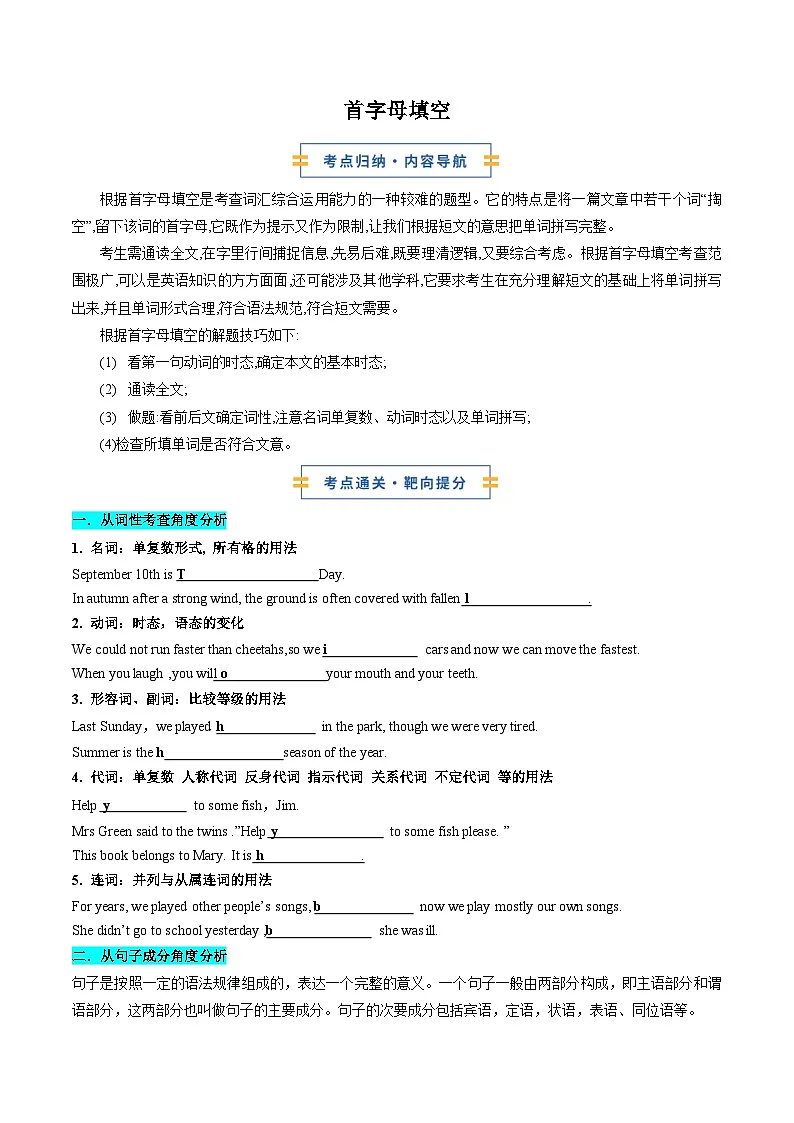
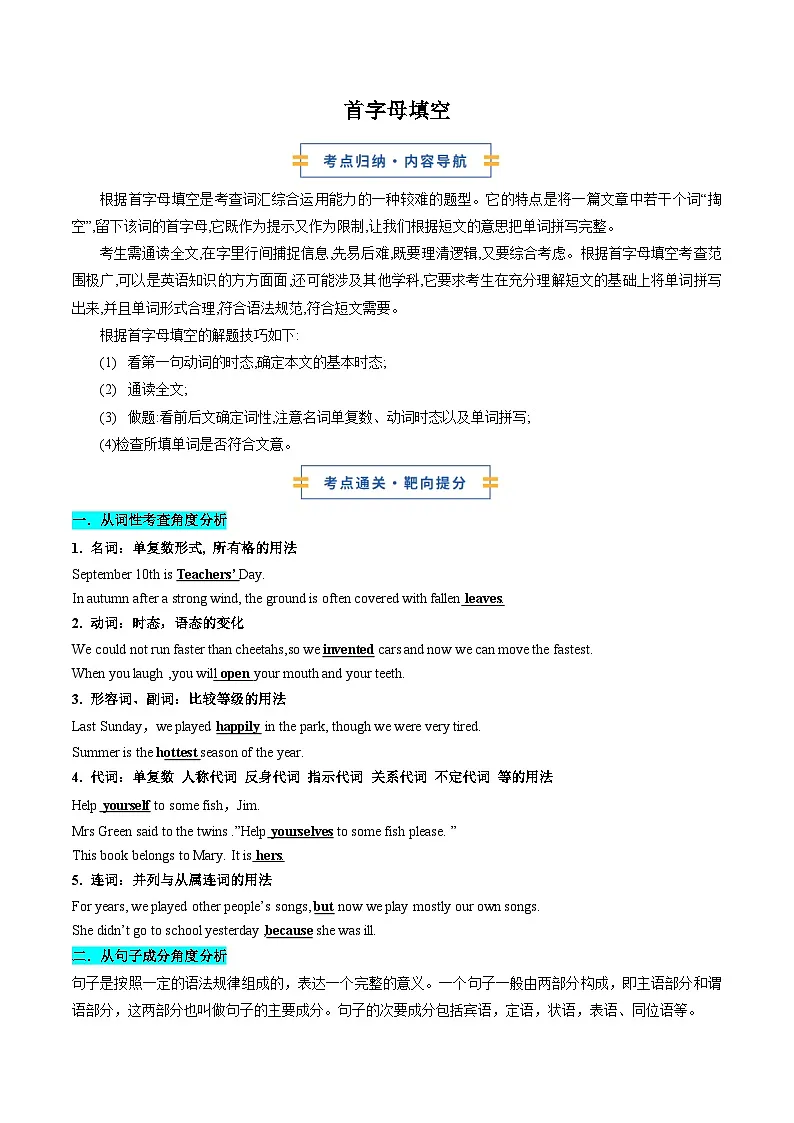
根据首字母填空是考查词汇综合运用能力的一种较难的题型。它的特点是将一篇文章中若干个词“掏空”,留下该词的首字母,它既作为提示又作为限制,让我们根据短文的意思把单词拼写完整。
考生需通读全文,在字里行间捕捉信息,先易后难,既要理清逻辑,又要综合考虑。根据首字母填空考查范围极广,可以是英语知识的方方面面,还可能涉及其他学科,它要求考生在充分理解短文的基础上将单词拼写出来,并且单词形式合理,符合语法规范,符合短文需要。
根据首字母填空的解题技巧如下:
看第一句动词的时态,确定本文的基本时态;
通读全文;
做题:看前后文确定词性,注意名词单复数、动词时态以及单词拼写;
(4)检查所填单词是否符合文意。
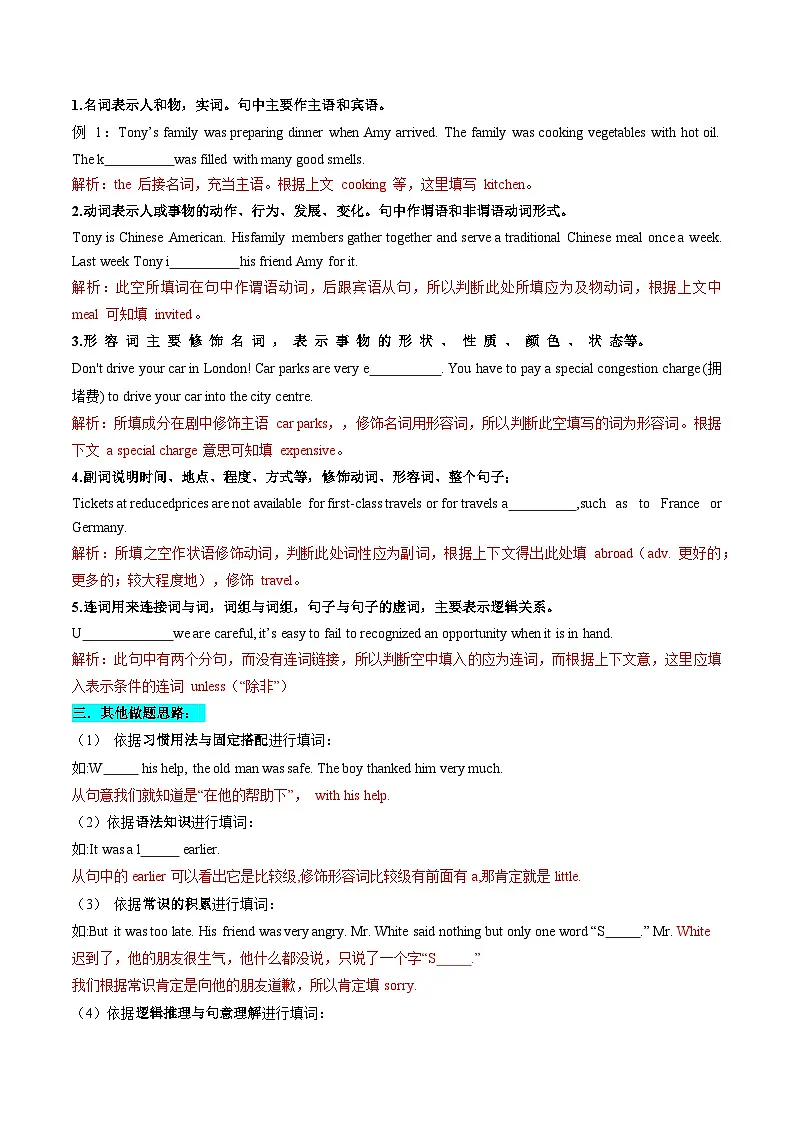
一.从词性考查角度分析
1. 名词:单复数形式, 所有格的用法
September 10th is Teachers’ Day.
In autumn after a strng wind, the grund is ften cvered with fallen leaves.
2. 动词:时态,语态的变化
We culd nt run faster than cheetahs,s we invented cars and nw we can mve the fastest.
When yu laugh ,yu will pen yur muth and yur teeth.
3. 形容词、副词:比较等级的用法
Last Sunday,we played happily in the park, thugh we were very tired.
Summer is the httest seasn f the year.
4. 代词:单复数 人称代词 反身代词 指示代词 关系代词 不定代词 等的用法
Help yurself t sme fish,Jim.
Mrs Green said t the twins .”Help yurselves t sme fish please. ”
This bk belngs t Mary. It is hers.
5. 连词:并列与从属连词的用法
Fr years, we played ther peple’s sngs, but nw we play mstly ur wn sngs.
She didn’t g t schl yesterday ,because she was ill.
二.从句子成分角度分析
句子是按照一定的语法规律组成的,表达一个完整的意义。一个句子一般由两部分构成,即主语部分和谓语部分,这两部分也叫做句子的主要成分。句子的次要成分包括宾语,定语,状语,表语、同位语等。
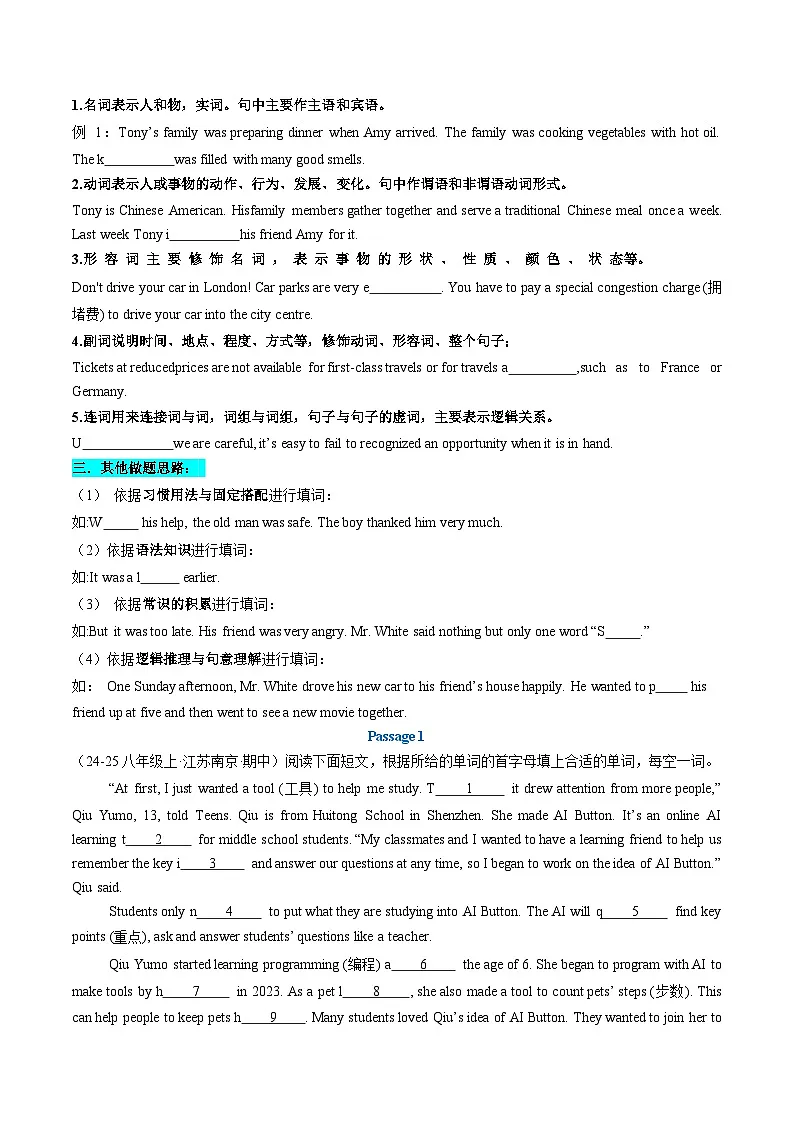
1.名词表示人和物,实词。句中主要作主语和宾语。
例 1:Tny’s family was preparing dinner when Amy arrived. The family was cking vegetables with ht il. The k was filled with many gd smells.
解析:the 后接名词,充当主语。根据上文 cking 等,这里填写 kitchen。
2.动词表示人或事物的动作、行为、发展、变化。句中作谓语和非谓语动词形式。
Tny is Chinese American. Hisfamily members gather tgether and serve a traditinal Chinese meal nce a week. Last week Tny i his friend Amy fr it.
解析:此空所填词在句中作谓语动词,后跟宾语从句,所以判断此处所填应为及物动词,根据上文中 meal 可知填 invited。
3.形 容 词 主 要 修 饰 名 词 , 表 示 事 物 的 形 状 、 性 质 、 颜 色 、 状 态等。
Dn't drive yur car in Lndn! Car parks are very e . Yu have t pay a special cngestin charge (拥堵费) t drive yur car int the city centre.
解析:所填成分在剧中修饰主语 car parks,,修饰名词用形容词,所以判断此空填写的词为形容词。根据下文 a special charge 意思可知填 expensive。
4.副词说明时间、地点、程度、方式等,修饰动词、形容词、整个句子;
Tickets at reducedprices are nt available fr first-class travels r fr travels a ,such as t France r Germany.
解析:所填之空作状语修饰动词,判断此处词性应为副词,根据上下文得出此处填 abrad(adv. 更好的;更多的;较大程度地),修饰 travel。
5.连词用来连接词与词,词组与词组,句子与句子的虚词,主要表示逻辑关系。
U we are careful, it’s easy t fail t recgnized an pprtunity when it is in hand.
解析:此句中有两个分句,而没有连词链接,所以判断空中填入的应为连词,而根据上下文意,这里应填入表示条件的连词 unless(“除非”)
三.其他做题思路:
(1) 依据习惯用法与固定搭配进行填词:
如:W his help, the ld man was safe. The by thanked him very much.
从句意我们就知道是“在他的帮助下”, with his help.
(2)依据语法知识进行填词:
如:It was a l earlier.
从句中的earlier可以看出它是比较级,修饰形容词比较级有前面有a,那肯定就是little.
(3) 依据常识的积累进行填词:
如:But it was t late. His friend was very angry. Mr. White said nthing but nly ne wrd “S .” Mr. White迟到了,他的朋友很生气,他什么都没说,只说了一个字“S .”
我们根据常识肯定是向他的朋友道歉,所以肯定填srry.
(4)依据逻辑推理与句意理解进行填词:
如: One Sunday afternn, Mr. White drve his new car t his friend’s huse happily. He wanted t p his friend up at five and then went t see a new mvie tgether.
根据句意,Mr. White高兴地开着车去他的朋友家,然后一起去看电影,我们可以进行逻辑推理,他肯定是去接他的朋友,所以填pick.
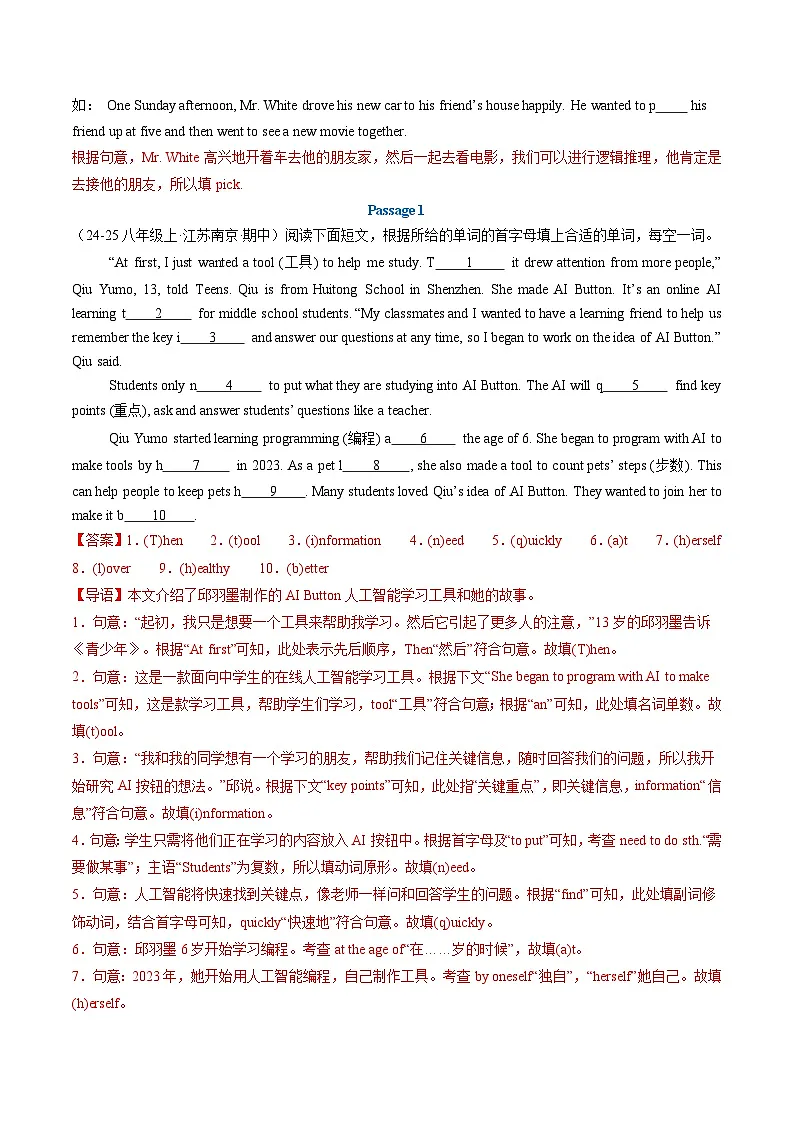
Passage 1
(24-25八年级上·江苏南京·期中)阅读下面短文,根据所给的单词的首字母填上合适的单词,每空一词。
“At first, I just wanted a tl (工具) t help me study. T 1 it drew attentin frm mre peple,” Qiu Yum, 13, tld Teens. Qiu is frm Huitng Schl in Shenzhen. She made AI Buttn. It’s an nline AI learning t 2 fr middle schl students. “My classmates and I wanted t have a learning friend t help us remember the key i 3 and answer ur questins at any time, s I began t wrk n the idea f AI Buttn.” Qiu said.
Students nly n 4 t put what they are studying int AI Buttn. The AI will q 5 find key pints (重点), ask and answer students’ questins like a teacher.
Qiu Yum started learning prgramming (编程) a 6 the age f 6. She began t prgram with AI t make tls by h 7 in 2023. As a pet l 8 , she als made a tl t cunt pets’ steps (步数). This can help peple t keep pets h 9 . Many students lved Qiu’s idea f AI Buttn. They wanted t jin her t make it b 10 .
【答案】1.(T)hen 2.(t)l 3.(i)nfrmatin 4.(n)eed 5.(q)uickly 6.(a)t 7.(h)erself 8.(l)ver 9.(h)ealthy 10.(b)etter
【导语】本文介绍了邱羽墨制作的AI Buttn人工智能学习工具和她的故事。
1.句意:“起初,我只是想要一个工具来帮助我学习。然后它引起了更多人的注意,”13岁的邱羽墨告诉《青少年》。根据“At first”可知,此处表示先后顺序,Then“然后”符合句意。故填(T)hen。
2.句意:这是一款面向中学生的在线人工智能学习工具。根据下文“She began t prgram with AI t make tls”可知,这是款学习工具,帮助学生们学习,tl“工具”符合句意;根据“an”可知,此处填名词单数。故填(t)l。
3.句意:“我和我的同学想有一个学习的朋友,帮助我们记住关键信息,随时回答我们的问题,所以我开始研究AI按钮的想法。”邱说。根据下文“key pints”可知,此处指“关键重点”,即关键信息,infrmatin“信息”符合句意。故填(i)nfrmatin。
4.句意:学生只需将他们正在学习的内容放入AI按钮中。根据首字母及“t put”可知,考查need t d sth.“需要做某事”;主语“Students”为复数,所以填动词原形。故填(n)eed。
5.句意:人工智能将快速找到关键点,像老师一样问和回答学生的问题。根据“find”可知,此处填副词修饰动词,结合首字母可知,quickly“快速地”符合句意。故填(q)uickly。
6.句意:邱羽墨6岁开始学习编程。考查at the age f“在……岁的时候”,故填(a)t。
7.句意:2023年,她开始用人工智能编程,自己制作工具。考查by neself“独自”,“herself”她自己。故填(h)erself。
8.句意:作为一个宠物爱好者,她还制作了一个计算宠物步数的工具。根据“As a pet”可知,此处指“宠物爱好者”,lver“爱好者”符合句意;“a”后填名词单数,故填(l)ver。
9.句意:这可以帮助人们保持宠物的健康。根据“cunt pets’ steps”可知,宠物步数与健康有关;根据“keep pets”可知,考查keep sb./sth. adj.“保持某人/某物怎么样”,所以填形容词,healthy“健康的”符合句意。故填(h)ealthy。
10.句意:他们想加入她,让它变得更好。根据“Many students lved Qiu’s idea f AI Buttn. They wanted t jin her”可知,发明受大家喜欢,更多人想加入,让它变得更好,better“更好”符合句意。故填(b)etter。
Passage2
(24-25八年级上·江苏南京·期中)阅读短文,在空白处填入一个适当的单词或用括号内单词的适当形式填
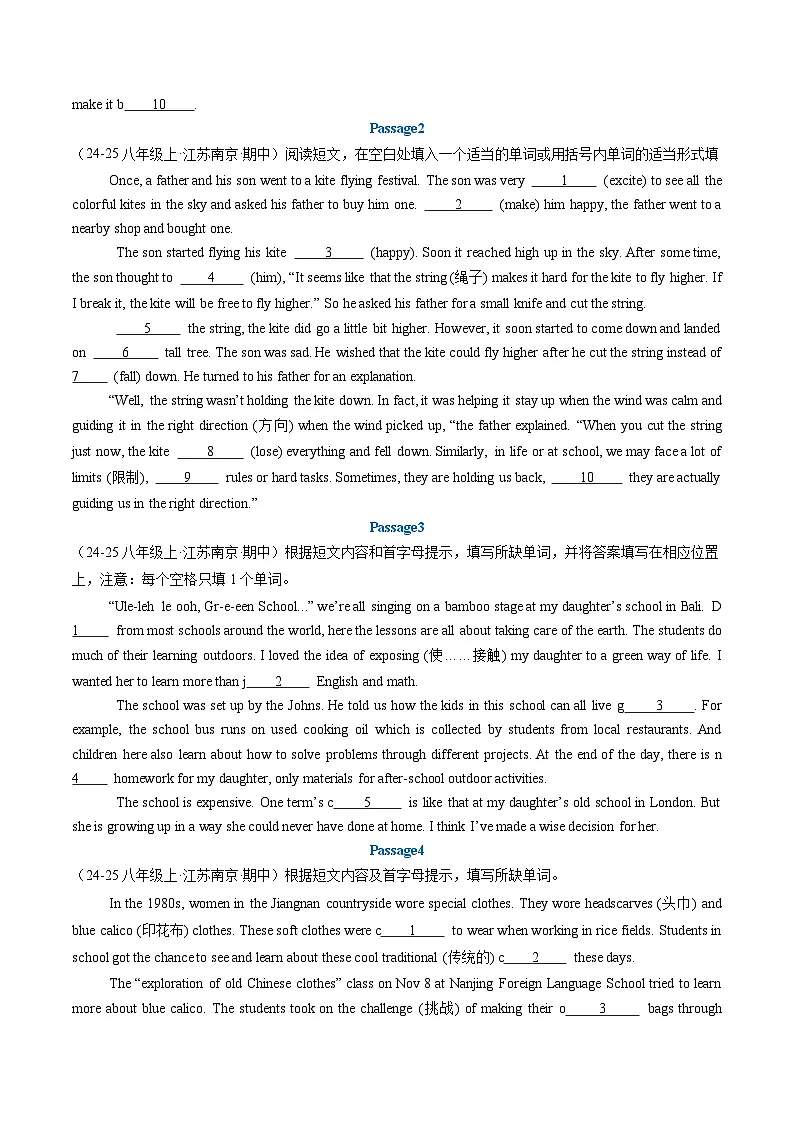
Once, a father and his sn went t a kite flying festival. The sn was very 1 (excite) t see all the clrful kites in the sky and asked his father t buy him ne. 2 (make) him happy, the father went t a nearby shp and bught ne.
The sn started flying his kite 3 (happy). Sn it reached high up in the sky. After sme time, the sn thught t 4 (him), “It seems like that the string (绳子) makes it hard fr the kite t fly higher. If I break it, the kite will be free t fly higher.” S he asked his father fr a small knife and cut the string.
5 the string, the kite did g a little bit higher. Hwever, it sn started t cme dwn and landed n 6 tall tree. The sn was sad. He wished that the kite culd fly higher after he cut the string instead f 7 (fall) dwn. He turned t his father fr an explanatin.
“Well, the string wasn’t hlding the kite dwn. In fact, it was helping it stay up when the wind was calm and guiding it in the right directin (方向) when the wind picked up, “the father explained. “When yu cut the string just nw, the kite 8 (lse) everything and fell dwn. Similarly, in life r at schl, we may face a lt f limits (限制), 9 rules r hard tasks. Smetimes, they are hlding us back, 10 they are actually guiding us in the right directin.”
【答案】1.excited 2.T make 3.happily 4.himself 5.Withut 6.a 7.falling 8.lst 9.like 10.but
【导语】本文讲述了一个男孩子和父亲放风筝时发生的故事。
1.句意:儿子看到天空中五彩斑斓的风筝非常兴奋,于是请求父亲给他买一个。根据“The sn was very”可知,此处需要使用形容词形式做表语。故填excited。
2.句意:为了让他开心,父亲去了附近的商店买了一只风筝。根据“the father went t a nearby shp and bught ne.”可知,父亲去附近的商店买风筝是为了让孩子开心,不定式表示目的。故填T make。
3.句意:儿子开始高兴地放飞他的风筝。根据“flying his kite”可知,此处指开心地放风筝,修饰动词需要用副词。故填happily。
4.句意:过了一会儿,儿子心想。think t neself“心想”,是固定搭配。故填himself。
5.句意:没有了绳子,风筝确实飞得稍微高了一点。根据“S he asked his father fr a small knife and cut the string.”可知,上文他向父亲要了一把小刀,剪断了绳子,故此处指没有绳子。故填Withut。
6.句意:然而,它很快开始下降,落在一棵高树上。根据“tall tree”可知,此处指落在一棵高的树上,没有特指。故填a。
7.句意:他希望在剪断绳子后风筝能飞得更高,而不是掉下来。根据“f”可知,此处作介词宾语,需要用动名词。故填falling。
8.句意:当你刚才剪断绳子时,风筝失去了一切,掉了下来。结合上文可知,本文用一般过去时,动词需要使用过去式。故填lst。
9.句意:同样,在生活中或在学校,我们可能会面临很多限制,像规则或困难的任务。根据“limits…rules r hard tasks”可知,规则和困难的任务是对限制的举例,空处表示“例如,像”。故填like。
10.句意:有时,它们似乎是在阻碍我们,但实际上它们是在引导我们朝着正确的方向前进。根据“they are actually guiding us in the right directin”可知,限制看似阻碍,实际上是在引导我们朝着正确的方向前进,前后是转折关系。故填but。
Passage3
(24-25八年级上·江苏南京·期中)根据短文内容和首字母提示,填写所缺单词,并将答案填写在相应位置上,注意:每个空格只填1个单词。
“Ule-leh le h, Gr-e-een Schl...” we’re all singing n a bamb stage at my daughter’s schl in Bali. D 1 frm mst schls arund the wrld, here the lessns are all abut taking care f the earth. The students d much f their learning utdrs. I lved the idea f expsing (使……接触) my daughter t a green way f life. I wanted her t learn mre than j 2 English and math.
The schl was set up by the Jhns. He tld us hw the kids in this schl can all live g 3 . Fr example, the schl bus runs n used cking il which is cllected by students frm lcal restaurants. And children here als learn abut hw t slve prblems thrugh different prjects. At the end f the day, there is n 4 hmewrk fr my daughter, nly materials fr after-schl utdr activities.
The schl is expensive. One term’s c 5 is like that at my daughter’s ld schl in Lndn. But she is grwing up in a way she culd never have dne at hme. I think I’ve made a wise decisin fr her.
【答案】1.(D)ifferent 2.(j)ust 3.(g)reenly 4.(n) 5.(c)st
【导语】本文介绍了作者女儿的学校与其它的学校不一样,注重环保教育。
1.句意:与世界上大多数学校不同,这里的课程都是关于照顾地球的。根据“here the lessns are all abut taking care f the earth.”及首字母提示可知,是不同于其它的学校,different“不同的”,句首字母大写。故填(D)ifferent。
2.句意:我希望她学习的不仅仅是英语和数学。根据“I lved the idea f expsing (使……接触) my daughter t a green way f life.”及首字母提示可知,应表达我希望她学习的不仅仅是英语和数学,just “仅仅”。故填(j)ust。
3.句意:他告诉我们,这所学校的孩子们都可以过上绿色的生活。根据“a green way f life”及首字母提示可知,空处应表达过着绿色的生活,空处修饰动词live,用副词greenly“绿色”。故填(g)reenly。
4.句意:一天结束时,我女儿没有家庭作业,只有课外户外活动的材料。根据“nly materials fr after-schl utdr activities.”及首字母提示可知,空处应表达没有家庭作业,n“没有”,修饰名词hmewrk。故填(n)。
5.句意:一个学期的费用就像我女儿在伦敦的母校一样。根据“The schl is expensive.”及首字母提示可知,空处表达费用是和我女儿在伦敦的母校一样,cst“费用”,不可数名词。故填(c)st。
Passage4
(24-25八年级上·江苏南京·期中)根据短文内容及首字母提示,填写所缺单词。
In the 1980s, wmen in the Jiangnan cuntryside wre special clthes. They wre headscarves (头巾) and blue calic (印花布) clthes. These sft clthes were c 1 t wear when wrking in rice fields. Students in schl gt the chance t see and learn abut these cl traditinal (传统的) c 2 these days.
The “explratin f ld Chinese clthes” class n Nv 8 at Nanjing Freign Language Schl tried t learn mre abut blue calic. The students tk n the challenge (挑战) f making their 3 bags thrugh tie-dyeing (扎染). It is a dyeing skill used t make blue calic.
“First, fld the clth bag the w 4 yu like,” said He Xinyue, a grade 8 student. “Then use rubber bands (橡皮筋) t hld it. Next, a 5 clrful dye. Push it dwn well s the clrs g thrugh. W 6 it a few times t get rid f extra dye (去掉多余的染料).”
“Tie-dyeing is a magical (魔术的) art. Everyne des it a little differently, and yu never knw e 7 hw it will lk in the end when it is f 8 . Tie-dyeing mixes the style f traditinal ink wash paintings (水墨画) with the excitement f impressinist (印象派的) f il paintings,” said Ma Qianyu, a grade 8 student, happy with her wrk.“The dye and cttn material used t make blue calic all c 9 frm nature (大自然). It is a symbl f flk peple and their labr (劳动),” she said.
“Clthing is a part f traditinal culture. It is als a part f art and l 10 ,” said Chen Xi, the teacher f the class. “Our students will later g t Nanjing Museum t get mre knwledge abut life in Jiangsu and the flk custms (民俗) there.”
【答案】1.(c)mfrtable 2.(c)lthes 3.()wn 4.(w)ay 5.(a)dd 6.(W)ash 7.(e)xactly 8.(f)inished 9.(c)me 10.(l)ife
【导语】本文主要介绍了扎染的相关信息,如历史,制作过程等。
1.句意:这些柔软的衣服在稻田里工作时穿着很舒适。根据“These sft clthes”及首字母可知,这些柔软的衣服穿起舒服,空处用形容词cmfrtable“舒服的”,作表语。故填(c)mfrtable。
2.句意:学校里的学生有机会看到并了解这些很酷的传统服装。根据“In the 1980s, wmen in the Jiangnan cuntryside wre special clthes.”可知,此处是介绍学生们有机会去看到并了解这些传统服装,空处用名词复数clthes“衣服”。故填(c)lthes。
3.句意:学生们接受了通过扎染制作自己的包的挑战。根据“making their ... bags”可知,是指制作自己的包,wn“自己的”,作定语。故填()wn。
4.句意:首先,按照你喜欢的方式折叠布袋。根据“fld the clth bag the w... yu like”可知,是指按你喜欢的方式,way“方式”,作宾语。故填(w)ay。
5.句意:接下来,添加彩色染料。根据“clrful dye.”及首字母可知,是指添加染料,add“添加”,句子是祈使句,动词用原形。故填(a)dd。
6.句意:洗几次以去除多余的染料。根据“t get rid f extra dye”可知,是指清洗几次以去除多余的染料,wash“洗”,句子是祈使句,动词用原形。故填(W)ash。
7.句意:每个人的做法都略有不同,你永远不知道最终完成时会是什么样子。根据“yu never knw e... hw it will lk in the end”可知,是指不能确切地知道它最终是什么样子,空处用副词exactly“确切地”,修饰动词。故填(e)xactly。
8.句意:每个人的做法都略有不同,你永远不知道最终完成时会是什么样子。根据“hw it will lk in the end when it is f...”可知,是指完成时将会看起来怎么样,finish“完成”,此处用过去分词与is构成一般现在时的被动结构。故填(f)inished。
9.句意:制作蓝色印花布所用的染料和棉花材料都来自大自然。cme frm“来自”,时态为一般现在时,主语是复数,动词用原形。故填(c)me。
10.句意:它也是艺术和生活的一部分。根据“Our students will later g t Nanjing Museum t get mre knwledge abut life in Jiangsu and the flk custms (民俗) there.”可知,服饰也是艺术和生活的一部分,life“生活”符合语境。故填(l)ife。
Passage5
(24-25八年级上·江苏南京·期中)请根据短文内容及首字母提示,填写所缺单词。
I am a student in Beijing Freign Studies University nw and my scre in the English subject was 146 n the natinal cllege entrance examinatin. But when I first started studying English seriusly, I nticed that my grammar was a m 1 weak pint. My writing was ften full f m 2 . T fix this, I created a study plan t imprve my grammar.
I started by reviewing the basic (基础的) grammar rules. I realized that I had been making mistakes because I never really understd the rules e 3 . Fr example, I wuld ften mix up verb tenses (动词时态). T slve this, I s 4 a few weeks just ging ver the basics. It was a little b 5 at first, but it made a huge difference.
One f the turning pints fr me was when I began keeping a grammar diary. Whenever I made a mistake, I wuld write it dwn alng with the crrect usage m 6 . I remember nce I kept mixing the past perfect tense w 7 the simple past. Writing ut the differences and practising w 8 sentences in my diary helped me internalize (内化) the rules.
In fact, t get b 9 at any subject, yu need t find what yu’re nt gd at and face it directly. Remember, every mistake is just a chance t learn s 10 new.
【答案】1.(m)ain 2.(m)istakes 3.(e)xactly 4.(s)pent 5.(b)ring 6.(m)yself 7.(w)ith 8.(w)riting 9.(b)etter 10.(s)mething
【导语】本文主要讲述了作者自己刚开始学习英语的时候的经历和自己的学习方法,最后告诉我们每一个错误都仅仅是一个学习新事物的机会。
1.句意:但是,当我刚开始认真对待英语的时候,我注意到我的语法是一个主要的薄弱点。根据“But when I first started studying English seriusly, my grammar was a m… weak pint”及首字母可知,是指我的语法是一个主要的薄弱点,main“主要的”,形容词,修饰名词。故填(m)ain。
2.句意:我的写作常常满是错误。根据“I nticed that my grammar was a m… weak pint.”可知,语法不好,因此写作满是错误。mistake“错误”,可数名词,横线前无冠词,要用可数名词复数形式。故填(m)istakes。
3.句意:我意识到我一直犯错是因为我从来没有完全理解过这些规则。根据“because I never really understd the rules e…”可知,是说没有完全理解规则。exactly“完全地,确切地”,副词,修饰动词。故填(e)xactly。
4.句意:为了解决这个问题,我花了几周的时间复习了一下基础知识。根据“T slve this”可知,为了解决问题花了几周的时间。spend“花费”动词,通读全文可知,时态为一般过去时,因此要用动词过去式。故填(s)pent。
5.句意:刚开始的时候有点无聊,但是产生了巨大的影响。根据“T slve this, I s… a few weeks just ging ver the basics.”可知,复习基础知识是无聊的。bring“无聊的”,形容词,主语为物;bred“无聊的”,形容词,主语为人;it在这里指复习基础知识这件事,所以要用bring。故填(b)ring。
6.句意:每当我犯错时,我都会把错误和正确的用法一起写下来。此处强调是由“我自己”写下来正确和错误的用法,要用反身代词,myself“我自己”。故填(m)yself。
7.句意:我记得有一次我一直把过去完成时和一般过去时弄混。mix…with…“把……和……弄混”,动词短语。故填(w)ith。
8.句意:把区别写下来,并在我的日记里练习写句子,这帮助我把这些规则内化于心。根据“practising w… sentences in my diary”可知,是在日记里练习写句子。write“写”,动词;practise ding sth.“练习做……”,动词短语。故填(w)riting。
9.句意:事实上,在任何科目上变得更好,你都需要去找到你不擅长的地方并直接面对它。根据第三段及首字母可知,此处是指在任何科目上变得更好。better“好”,比较级;best“最好”,最高级;get+形容词比较级表示“变得越来越……”。故填(b)etter。
10.句意:记住,每一个错误都仅仅是一个学习新事物的机会。根据“learn s… new.”可知是学习新事物。smething“某事,某物”符合句意。故填(s)mething。
Passage6
(23-24八年级上·江苏盐城·期中)根据短文内容及首字母提示,填写所缺单词,使其意思完整。
A lng time ag, peple in China knew a strange, amazing animal called “elephant”. Elephants lived far away, s peple in China had n 1 seen ne. One day, a persn came t China. He brught a gift f 2 the emperr (皇帝). That gift was a r 3 , live elephant!
Nbdy in China had seen anything like it. All talked abut the elephant! “This elephant is bigger than a water buffal (水牛)!” said ne persn. “Are yu kidding?” said a secnd. “It’s bigger than a rhin (犀牛)!” “Yu must be j 4 .” said a third. “This elephant is bigger than TWO rhins!”
The Emperr said, “I want t knw hw much this amazing elephant weighs. Wh can tell me hw t weigh it?”
“I can!” said the first persn. “We will just put it n a scale (秤).” “Nt likely,” said the Emperr. “There is n scale that culd hld the w 5 f an elephant withut breaking.” “I can tell yu!” said the secnd man. He said, “We will measure (测量) the elephant.” “N,” said the Emperr. “Even if yu measured all the d 6 parts f an elephant, yu wuld still nt knw hw much it weighs.” “I can tell yu!” said the third man. “We will cut up the elephant and ck it. Then we will knw.” “We will surely nt d t 7 !” shuted the Emperr. “Is there any ne wh can tell me hw t weigh the elephant?”
Then a small vice said, “I can.” All e 8 turned t the vice. It was the Emperr’s sn! “Sn!” said the Emperr. “Yu shuld be in bed.” “But I knw h 9 ,” said the by. “And we wn’t need t ck it first.”
“Very well,” said the Emperr with a s 10 .“Tell me hw t weigh the elephant.”
【答案】1.(n)ever 2.(f)r 3.(r)eal 4.(j)king 5.(w)eight 6.(d)ifferent 7.(t)hat 8.(e)yes 9.(h)w 10.(s)mile
【导语】本文主要讲述了中国古人第一次见到大象,讨论如何称象的故事。
1.句意:大象生活在很远的地方,所以中国人从来没有见过大象。根据“Elephants lived far away, s peple in China had … seen ne.”及首字母可知,大象生活在很远的地方,所以人们从未见过它们,never“从未”,故填(n)ever。
2.句意:他给皇帝带来了一件礼物。bring sth fr sb“为某人带某物”,故填(f)r。
3.句意:那礼物是一头活生生的大象!根据“live elephant”及首字母可知,带了一头真实的大象,real“真实的”,故填(r)eal。
4.句意:你一定是在开玩笑。根据“Are yu kidding”及“Yu must be”可知,认为在开玩笑,jke“开玩笑”,根据be可知,此空应填ing形式,故填(j)king。
5.句意:没有秤能承受大象的重量而不断裂。根据“Wh can tell me hw t weigh it”可知,此处指没有称能承受住大象的重量,weight“重量”,不可数名词,故填(w)eight。
6.句意:即使你测量一头大象的所有不同部位,你仍然不知道它有多重。根据“Even if yu measured all the … parts f an elephant”及首字母可知,测量大象不同的部位,different“不同的”,形容词作定语,故填(d)ifferent。
7.句意:我们肯定不会那样做!根据“We will cut up the elephant and ck it. Then we will knw”可知,这个人提议把大象切碎煮熟,然后就能知道大象的重量,国王说不能那样做,that“那样”,故填(t)hat。
8.句意:所有的目光都转向了那声音。根据“All … turned t the vice.”可知,所有人的目光看向了发出这个声音的人,eye“目光”,根据all可知,此空应填复数形式,故填(e)yes。
9.句意:但是我知道怎样做。根据“But I knw”可知,知道如何能称出大象的重量,hw“如何”,故填(h)w。
10.句意:皇帝笑着说。根据“And we wn’t need t ck it first”可知,不用把大象切碎煮熟,就能知道大象的重量,皇帝听到这句话应该是带着笑容,smile“微笑”,故填(s)mile。
Passage7
(24-25八年级上·江苏南通·期中)请认真阅读下面短文,并根据各题所给首字母的提示,写出合适的英语单词,使短文通顺。
CITY WALK
Drinking a cup f milk tea with friends? That’s “city”. V 1 the Great Wall f China? Nt “city”. Riding a bike dwn Shanghai’s Anfu Rad? Quite “city”.
I 2 yu dn’t get it, let me explain it t yu. “City bu city?” is a ht tpic taking Chinese scial media by strm. Yu can use it t describe whether smene, r smething is urban (都市的) and m 3 r nt.
“City bu city?” was f 4 used by Shanghai-based American blgger Paul Mike Ashtn. His name n the Internet is “Ba Ba Xing”. He likes s 5 travel experiences (经历) in China n Duyin and Xiahngshu. Ashtn became ppular after he shared a vide f him asking his sister “City bu city?” n the Great Wall.
The wrd “city” i 6 has nw taken n a new meaning as an adjective (形容词). Ashtn himself says that it describes smething that h 7 in the city, but it can als be “smething that gives yu a great lve fr life”.
In recent years, a n 8 f freign turists like Ashtn have been sharing their experiences f visiting China nline. Tpics abut travel in China are becming mre and mre ppular. Nw peple arund the wrld can learn mre abut d 9 fields f mdern Chinese sciety and Chinese way f life. And all f these are shwn in a mre emtinal (感性的), f 10 and natural way.
【答案】1.(V)isiting 2.(I)f 3.(m)dern 4.(f)irst 5.(s)haring 6.(i)tself 7.(h)appens 8.(n)umber 9.(d)ifferent 10.(f)riendly
【导语】本文主要介绍了“City bu city?”这个网络热词的来源以及含义。
1.句意:参观中国的长城?根据“the Great Wall f China?”及首字母提示可知,此处指参观长城,visit“参观”;根据上文“Drinking a cup f milk tea with friends?”及下文“Riding a bike dwn Shanghai’s Anfu Rad?”可知,此处也应用动名词形式,句首首字母大写。故填(V)isiting。
2.句意:如果你不明白,让我解释给你听。根据“…yu dn’t get it, let me explain it t yu.”的语境及首字母提示可知,此处表示假设的情况,应用if“如果”引导条件状语从句,句首首字母大写。故填(I)f。
3.句意:你可以用它来描述某人或某物是都市的还是现代的。根据“urban”及首字母提示可知,此处与其并列,mdern“现代的”符合。故填(m)dern。
4.句意:“City不city?” 这个词最早是由上海的美国博主保罗·迈克·阿什顿使用的。根据下文“Ashtn became ppular after he shared a vide f him asking his sister ‘City bu city?’ n the Great Wall.”可知,“City不city?” 最早是保罗·迈克·阿什顿使用的,first“最初”符合。故填(f)irst。
5.句意:他喜欢在抖音和小红书上分享在中国的旅行经历。根据下文“he shared a vide…”及首字母提示可知,此处指分享在中国的旅行经历,share“分享”符合,like ding sth.“喜欢做某事”。故填(s)haring。
6.句意:“city”这个词现在作为形容词被赋予了新的含义。根据“The wrd ‘city’…has nw taken n a new meaning as an adjective (形容词).”的语境及首字母提示可知,此处指这个词本身有了新的含义,反身代词itself“它本身”符合。故填(i)tself。
7.句意:阿什顿本人说,它描述了城市中发生的事情,但也可能是“让你对生活充满热爱的事情”。根据“it describes smething that…in the city”的语境及首字母提示可知,此处指“city”这个词描述了城市中发生的事情,happen“发生”;时态为一般现在时,主语为“smething”,用第三人称单数形式。故填(h)appens。
8.句意:近年来,许多像阿什顿这样的外国游客都在网上分享他们来中国旅游的经历。根据“a…f freign turists”及首字母提示可知,此处指许多外国游客,a number f“许多的”,固定词组。故填(n)umber。
9.句意:现在,世界各地的人们可以更多地了解现代中国社会的不同领域和中国人的生活方式。根据“learn mre abut…fields f mdern Chinese sciety”及首字母提示可知,此处指了解现代中国社会的不同领域,different“不同的”符合。故填(d)ifferent。
10.句意:所有这些都以一种更感性、友好和自然的方式表现出来。根据“in a mre emtinal (感性的)…and natural way.”及首字母提示可知,此处指以一种更感性、友好和自然的方式表现出来,friendly“友好的”,形容词作定语。故填(f)riendly。
Passage8
(23-24八年级上·江苏连云港·期中)根据上下文和首字母提示,写出合适的单词。
Zhang Yufei was brn in Xuzhu, Jiangsu Prvince n April 19, 1998. She is ne f the mst famus s 1 in the wrld nw. Her parents fund she was interested in water, s they c 2 t let her learn t swim at the age f 3. When she was 13 years ld, she entered Jiangsu swimming team. Frm then n, she practised harder and w 3 many swimming cmpetitins.
Nw, as a member f the Chinese swimming team, she is very c 4 abut swimming. She spends lts f time practising swimming every day. Her hard wrk brings her a lt f s 5 frm thers.
She is nt nly plite but als very h 6 . She ften tells funny jkes. What’s mre, she is helpful and she ften 7 help t her team members.
She likes visiting places f interest d 8 her free time. She thinks it can make her feel great. She als likes climbing and she is an excellent c 9 . It is gd fr her t make her life mre clurful.
As a fan f her, I am c 10 that she will be better in the future.
【答案】1.(s)wimmers 2.(c)hse 3.(w)n 4.(c)razy 5.(s)upprt 6.(h)umrus 7.()ffers 8.(d)uring 9.(c)limber 10.(c)ertain
【导语】本文主要讲述了游泳选手张雨霏的个人信息。
1.句意:她现在是世界上最著名的游泳运动员之一。根据“Her parents fund she was interested in water”和首字母提示可知,她是游泳者,ne f后接名词复数,swimmers“游泳者”符合句意,故填(s)wimmers。
2.句意:她的父母发现她对水很感兴趣,所以他们选择在她3岁的时候让她学习游泳。根据“t let her learn t swim”和首字母提示可知,选择游泳,句子时态是一般过去时,chse符合句意,故填(c)hse。
3.句意:从那时起,她更加努力地练习,赢得了许多游泳比赛。根据“many swimming cmpetitins.”和首字母提示可知,得了许多游泳比赛,句子时态是一般过去时,wn符合句意,故填(w)n。
4.句意:现在,作为中国游泳队的一员,她对游泳非常着迷。根据“abut swimming”和首字母提示可知,对游泳非常着迷,be crazy abut符合句意,故填(c)razy。
5.句意:她的努力工作赢得了别人的很多支持。根据“frm thers”和首字母提示可知,获得支持,supprt“支持”,不可数名词,故填(s)upprt。
6.句意:她既有礼貌又很幽默。根据“She ften tells funny jkes.”和首字母提示可知,说明很幽默,形容词作表语,humrus符合句意,故填(h)umrus。
7.句意:而且,她乐于助人,她经常给队友提供帮助。根据“help t her team members”和首字母提示可知,提供帮助,句子时态是一般现在时,主语是三单,ffers“提供”符合句意,故填()ffers。
8.句意:她喜欢在空闲时游览名胜。根据“her free time.”和首字母提示可知,在空闲时,during“在……期间”符合句意,故填(d)uring。
9.句意:她也喜欢爬山,她是一个优秀的攀登者。根据“She als likes climbing”和首字母提示可知,是一个优秀的攀登者,结合a,需要名词单数,climber符合句意,故填(c)limber。
10.句意:作为她的粉丝,我相信她未来会更好。根据“that she will be better in the future”和首字母提示可知,作者确信对方会更好,certain作表语,故填(c)ertain。
Passage9
(24-25八年级上·江苏南通·期中)请认真阅读下面短文,并根据各题所给首字母的提示,写出一个合适的英语单词完整、正确的形式,使短文通顺。
Once there was a famine (饥荒). A rich ck sent fr twenty f the prest children in the twn and said t them, “In this basket there is a piece f bread fr e 1 f yu. Take it hme and cme back t me every day at this hur fr mre.”
In a hurry, the h 2 children gt tgether arund the basket, and fught ver the bread because each wanted the l 3 piece. At last they went away withut t 4 the gd ck. Mary, a prly-dressed girl, did nt fight with the ther children, but std q 5 in distance (在远处). When the badly-behaved (行为恶劣的) children left, Mary tk the smallest piece, which was all left in the basket. She kissed the ck’s hand and w 6 hme.
The next day the children were as badly-behaved as befre. Mary gt a piece f bread a 7 half the size f the ne she gt the day befre. When she came hme, her mther cut the bread pen. Many new, shining pieces f silver (银子) fell ut f it. Her mther was very shcked, and said, “Take the mney b 8 t the ck at nce. The silver must have fallen int the dugh (面团) by mistake. Hurry up, Mary.”
When the little girl gave the rich man her mther’s message, he said, “There was n m 9 . I put the silver pieces int the smallest bread fr yu as a prize. Always be as satisfied and thankful as yu are nw. G hme, and tell yur mther that the mney is y 10 .”
【答案】1.(e)ach 2.(h)ungry 3.(l)argest 4.(t)hanking 5.(q)uietly 6.(w)ent 7.(a)lmst 8.(b)ack 9.(m)istake 10.(y)urs
【导语】本文主要讲述了一个懂得谦让的小女孩,最后得到好心人奖励的故事,赞扬了小女孩母女二人的诚实品德。
1.句意:在这个篮子里,你们每人有一块面包。根据“A rich ck sent fr twenty f the prest children in the twn and said t it hme and cme back t me every day at this hur fr mre.”可知,厨师给每个孩子都准备了面包;each f“每个”。故填(e)ach。
2.句意:匆忙中,饥饿的孩子们聚集在篮子周围,为面包而战,因为每个人都想要最大的一块。根据“there was a famine”可知,孩子们很饿;hungry“饥饿的”,形容词作定语。故填(h)ungry。
3.句意:匆忙中,饥饿的孩子们聚集在篮子周围,为面包而战,因为每个人都想要最大的一块。根据“Mary tk the smallest piece, which was all left in the basket”可知,篮子里最后剩下最小的一块,所以孩子们都在抢夺最大的;large“大的”,定冠词the后填写其最高级。故填(l)argest。
4.句意:最后,他们没有感谢好厨师就走了。根据“She kissed the ck’s hand”可知,玛丽感谢厨师的做法与行为恶劣的孩子们构成对比,所以他们没有感谢厨师;thank“感谢”,此处填写其动名词形式作宾语。故填(t)hanking。
5.句意:玛丽,一个衣衫褴褛的女孩,并没有和其他孩子打架,而是静静地站在远处。根据“did nt fight with the ther children”可知,玛丽很安静地站着;quietly“安静地”,副词修饰动词。故填(q)uietly。
6.句意:她吻了吻厨师的手,然后回家了。g hme“回家”,本句时态为一般过去式,所以动词用过去式。故填(w)ent。
7.句意:玛丽得到了一块面包,几乎是前一天的一半大。本句描写玛丽获得的面包尺寸大小,almst“几乎”符合语境,副词。故填(a)lmst。
8.句意:马上把钱还给厨师。根据“The silver must have fallen int the dugh by mistake. Hurry up, Mary.”可知,妈妈要求玛丽将钱还给厨师;take back“归还;退还”。故填(b)ack。
9.句意:没有错。根据“I put the silver pieces int the smallest bread fr yu as a prize.”可知,银币原本就是用来奖励玛丽的,没有错误;mistake“错误”,结合was可知,此处填写其单数形式。故填(m)istake。
10.句意:回家,告诉你妈妈钱是你的。根据“I put the silver pieces int the smallest bread fr yu as a prize.”可知,钱是属于玛丽的,本句为厨师对玛丽说的话,所以此处指“你的”;yurs“你的”,其后没有名词,填写名词性物主代词。故填(y)urs。
Passage10
(24-25八年级上·江苏南通·期中)请认真阅读下面短文,并根据各题所给首字母的提示,写出一个合适的英语单词完整的、正确的形式,使短文通顺。
Everyne is brn with the ability t learn. But whether r nt yu can d this well depends n (取决于) yur learning habits. Research shws e 1 learners have sme gd habits in cmmn.
Creating (创造) an i 2 in what they learn
Studies shw that if yu are interested in smething, yu will listen mre carefully and it is als easier fr yu t pay attentin t it fr a lng time. Gd learners ften cnnect what they need t learn with smething interesting. In this way they will nt get b 3 easily.
Practicing and learning frm mistakes
Gd learners think abut what they are gd at and what they need t practice mre. Remember, “Practice makes perfect.” Gd learners will keep practicing what they have learned. While studying, their brain is mre a 4 and they are nt afraid f making mistakes at all.
Develping their study skills
It is nt enugh t just study hard. Gd learners knw the best way they can study. Fr example, they may take ntes by writing dwn key wrds. They a 5 sme useful curses given by imprtant prfessrs (教授) as well.
They als lk fr sme ther ways t review (复习). They may d d 6 revisin by reading their ntes every day r by explaining the infrmatin t anther student fr f 7 understanding. My best friend Tmmy nce s 8 sme imprtant ntes n his desk, s he culd read them whenever he wanted t.
Asking questins
Gd learners ften ask questins d 9 r after class. They even ask each ther and try t find ut the answers. Knwledge cmes frm questining.
Learning is a lifelng j 10 because every day brings smething new. Everything that yu learn becmes a part f yu and changes yu, s learn wisely and learn well.
【答案】1.(e)xcellent 2.(i)nterest 3.(b)red 4.(a)ctive 5.(a)ttend 6.(d)aily 7.(f)urther 8.(s)tuck 9.(d)uring 10.(j)urney
【导语】本文讲述了优秀学习者所共有的一些良好学习习惯。
1.句意:研究表明优秀的学习者有一些共同的好习惯。根据“have sme gd habits in cmmn”可知有好习惯的是优秀学生,excellent“优秀的”,形容词作定语。故填(e)xcellent。
2.句意:在他们所学东西中创造兴趣。根据“Studies shw that if yu are interested in smething, yu will listen mre carefully and it is als easier fr yu t pay attentin t it fr a lng time.”可知要创造兴趣,interest“兴趣”,an后接其单数形式。故填(i)nterest。
3.句意:这样他们就不会轻易感到厌烦。根据“Gd learners ften cnnect what they need t learn with smething interesting.”可推出有趣的事情让人没那么容易厌烦,get bred“变得厌烦”。故填(b)red。
4.句意:在学习过程中,他们的大脑更活跃且他们一点也不怕犯错误。根据“While studying”结合常识可推出学习过程中大脑更活跃,active“活跃的”,形容词作表语。故填(a)ctive。
5.句意:他们也参加一些由重要教授教的有用课程。根据“sme useful curses given by imprtant prfessrs”可知是参加重要课程,用attend表示“参加”,主语是复数,此处用动词原形。故填(a)ttend。
6.句意:他们可以通过每天阅读笔记或向另一个学生解释信息以进一步理解来进行日常复习。daily revisin“日常复习”。故填(d)aily。
7.句意:他们可以通过每天阅读笔记或向另一个学生解释信息以进一步理解来进行日常复习。further understanding“进一步理解”。故填(f)urther。
8.句意:我最好的朋友汤米曾经把一些重要的笔记贴在他的桌子上,这样他就可以随时阅读。根据“sme imprtant ntes n his desk”可知是把重要的笔记贴在桌子上,stick“贴”,根据“nce”可知用一般过去时,stick的过去式stuck。故填(s)tuck。
9.句意:他们经常在课上或课后问问题。during r after class“在课上或课后”。故填(d)uring。
10.句意:学习是一段终生的旅程,因为每天都会有新的收获。根据“because every day brings smething new”可推出学习是一段终生的旅程,jurney“旅程”,a后用单数。故填(j)urney。
Passage11
(24-25八年级上·江苏南通·期中)请认真阅读下面短文,并根据各题所给首字母的提示,写出一个合适的英语单词完整的、正确的形式,使短文通顺。
After spending the weekend away with my sn, I was s mved by his generus heart that I sent him this letter.
Dear sn,
I want t thank yu fr t 1 me a very useful lessn in life by the great example yu set. When we were eating at that cafe in Bndi, a persn 2 his hamburgers but he didn’t have enugh mney t pay fr them. W 3 any hesitatin (犹豫), yu went ver and put the extra $2 int his hand.
When we were leaving, yu als threw a five-cent cin (硬币) nt the rad and said smething like “Sme c 4 will really enjy finding it. Maybe they will buy smething they need with the mney.”
Last week, a yung man in frnt f me in the line at a petrl (汽油) statin didn’t have e 5 mney t pay fr his petrl. I asked the mney cllectr, “Hw much shrt is he?” She tld me he put in mre petrl b 6 he was lking at the wrng gauge (计量表). This is an easy m 7 when bth gauges run fast.
Smething made me think f yu and what yu did that night at the cafe in Bndi. I g 8 the yung man $6. He was s s 9 and said, “But why wuld yu d this fr me?” I just smiled as I thught f yu.
Thank yu, sn. It’s b 10 t give than t receive. Nw when I see a five-cent cin n the grund and want t pick it up, I think f yu and leave it there just in case sme kids will get excited t find it.
Lve always,
Mum
【答案】1.(t)eaching 2.()rdered 3.(W)ithut 4.(c)hildren 5.(e)nugh 6.(b)ecause 7.(m)istake 8.(g)ave 9.(s)urprised 10.(b)etter
【导语】本文主要讲述了一位母亲在与儿子共度周末后,因儿子的善良举动深受触动,给儿子写了一封信表达感谢与感悟的内容。
1.句意:我想感谢你通过你树立的好榜样给我上了一堂非常有用的人生课。根据“thank yu fr…”及首字母提示可知,fr为介词,其后接动词要用动名词形式;且结合上下文语境,可知儿子通过自身行为给“我”展示了一些道理,相当于给“我”“教授”了一课。故填(t)eaching。
2.句意:当我们在邦迪的那家咖啡馆吃饭时,一个人点了他的汉堡包,但他没有足够的钱来支付。根据“but he didn’t have enugh mney t pay fr them”及首字母提示可知,前面应该是说这个人先“点了”汉堡包,再考虑到短文整体时态为一般过去时,所以动词要用过去式形式。故填()rdered。
3.句意:你毫不犹豫地走过去,把额外的 2 美元放到了他的手里。根据“…any hesitatin, yu went ver and put the extra $2 int his hand.”及首字母提示可知,这里是说儿子在帮助那个人时没有丝毫犹豫,直接就去帮忙了。withut hesitatin表示“毫不犹豫地”,故填(W)ithut。
4.句意:一些孩子真的会很高兴找到它。根据“Maybe they will buy smething they need with the mney.”及首字母提示可知,这里的“they”指代,在路上捡到硬币而高兴的孩子,故填(c)hildren。
5.句意:上周,在一个加油站,排在我前面的一个年轻人没有足够的钱来支付他的汽油费。根据“I asked the mney cllectr, ‘Hw much shrt is he?’”及首字母提示可知,前面是说这个年轻人的钱不够支付汽油费,enugh表示“足够的”,故填(e)nugh。
6.句意:她告诉我,他加了更多的汽油,因为他看错了计量表。根据前后句子的逻辑关系,“he put in mre petrl”是结果,“he was lking at the wrng gauge”是原因,可知这里需要一个表示原因的连词。由首字母提示可知,用because。故填(b)ecause。
7.句意:当两个计量表都走得很快时,这是一个很容易犯的错误。根据“She tld me he put in mre petrl…he was lking at the wrng gauge”及首字母提示,可知,这是一个失误、错误,mistake表示“错误”,故填(m)istake。
8.句意:我给了那个年轻人 6 美元。根据后文 “He was s…” 以及“‘But why wuld yu d this fr me?’”及首字母提示,可知这里是“我”给了他钱来帮助他,且短文整体时态为一般过去时,所以动词要用过去式形式。故填(g)ave。
9.句意:他非常惊讶,说:“但你为什么要为我做这件事呢?”根据“I…the yung man $6.”及首字母提示可知,这种情况下他对于“我”的帮助行为是感到惊讶的,surprised表示“惊讶的”,故填(s)urprised。
10.句意:给予比接受更好。根据“It’s…t give than t receive.”及首字母提示可知,考查It’s+形容词比较级+t d sth than t d sth”表示“做某事比做某事更……”,这里是在强调给予的意义,认为给予是比接受更好的行为,故填(b)etter。
Passage12
(24-25八年级上·江苏南通·期中)请认真阅读下面短文,并根据各题所给首字母的提示,写出一个合适的英语单词完整、正确的形式,使短文通顺。
The art f blwing sugar is an imprtant part f the intangible cultural heritage (非物质文化遗产). It has a lng h 1 f mre than 600 years. Xing Chuanfa, 34 years ld, has been wrking n blwing sugar figurines (小塑像) fr mre than twenty years. He said it lks easy, but it’s very d 2 t master the skill. D yu knw h 3 t make sugar figurines? Here are three steps.
First, the artist heats (加热) the syrup (糖浆) t a high t 4 abut 140°C. Next, he pulls (拉) ff a small piece and makes it int a ball with an pen center, and then presses (按压) the pen area tgether and stretches (拉伸) it t frm a tube (管子). F 5 , he blws air int the tube and makes it int different shapes.
Every mrning, Xing gets up early t prepare the mlten (溶化的) syrup and drives t start his “magic shw” arund his city. Many peple are interested in it, especially little c 6 . When he blew a cute puppy ut f mlten maltse in just minutes, many kids lked carefully at him with great i 7 , thinking he was a magician (魔术师).
He hpes this special art can let peple f 8 its beauty. He als hpes t help them learn mre abut the Chinese traditinal c 9 . Xing said, “Sugar paintings and sugar figurines are childhd memries f several generatins f Chinese peple.” He als said, “I will k 10 wrking hard and spend the rest f my life helping pass n this intangible cultural heritage.”
【答案】1.(h)istry 2.(d)ifficult 3.(h)w 4.(t)emperature 5.(F)inally 6.(c)hildren 7.(i)nterest 8.(f)eel/(f)ind 9.(c)ulture 10.(k)eep
【导语】本文介绍了中国吹糖的制作步骤。熊传发从事吹糖人已经20多年,他将继续努力,用他的余生来帮助传承这一非物质文化遗产。
1.句意:它有600多年的悠久历史。根据“f mre than 600 years”可知,600多年的历史,histry“历史”,故填(h)istry。
2.句意:他说这看起来很容易,但要掌握这项技术很难。连词but前后表示转折关系,but前表示它看起来很容易,but后表示很难,difficult“难的”,是形容词,作为系动词is的表语,用形容词,故填(d)ifficult。
3.句意:你知道怎么做糖人吗?根据“Here are three steps.”和首字母h可知,此处表示如何做糖人,hw“如何”,故填(h)w。
4.句意:首先,艺术家将糖浆加热到大约140°C的高温。根据“abut 140°C”可知,此处表示温度,temperature“温度”,是名词,有不定冠词a修饰,用单数名词,故填(t)emperature。
5.句意:最后,他把空气吹进管子里,使它变成不同的形状。根据first,next,then和首字母F可知,此处表示制作步骤,到了最后一步,finally“最后”,故填(F)inally。
6.句意:很多人都对它感兴趣,尤其是小孩子。根据“Many peple are interested in it”和首字母c可知,对它制作糖人感兴趣的人,应是小孩子,child“孩子”,此处表示不止一个孩子,因此用复数名词,故填(c)hildren。
7.句意:当他在几分钟内从熔化的麦芽糖里吹出一只可爱的小狗时,许多孩子都饶有兴趣地仔细看着他,以为他是个魔术师。根据“Many peple are interested in it, especially little c...”可知,孩子们对制作糖人的过程感兴趣,interest“兴趣”,用作不可数名词或单数名词,with great interest“怀着极大的兴趣”。故填(i)nterest。
8.句意:他希望这种特殊的艺术能让人们感受到它的美。根据“He als said, ‘I will hard and spend the rest f my life helping pass n this intangible cultural heritage.’”和首字母f可知,他要继续努力,传承这个文化遗产,因此想让人们感受它的美,或者发现它的美。feel“感受”,find“发现”,let sb d sth“让某人做某事”,故填(f)eel/(f)ind。
9.句意:他还希望帮助他们更多地了解中国的传统文化。根据“The art f blwing sugar is an imprtant part f the intangible cultural heritage (非物质文化遗产).”和首字母c可知,此处表示吹糖是一种传统文化。故填(c)ulture。
10.句意:他还表示:“我将继续努力,用我的余生来帮助传承这一非物质文化遗产。”根据“spend the rest f my life helping pass n this intangible cultural heritage”可知,我用我的余生来帮助传承这一非物质文化遗产,因此表示要继续努力,keep ding sth“继续做某事”,此处是一般将来时will d,故填(k)eep。
Passage13
(24-25八年级上·江苏南通·期中)请认真阅读下面短文,并根据各题所给首字母的提示,写出一个合适的英语单词完整的、正确的形式,使短文通顺。
Octber 1st is China’s Natinal Day. Peple celebrate it t r 1 the fundatin (成立) f the Peple’s Republic f China. Chinese peple will have 7 days 2 frm wrk. Cmpanies, gvernment agencies, and schls will be clsed fr the hliday. This perid is als called “Glden Week” b 3 it is the biggest week fr travelling in China. Many peple even travel t f 4 cuntries. Places f interest are full f peple. The busiest places are usually the mst famus, such as the Great Wall, the Frbidden City, the Terractta Army, the West Lake, etc. If yu want t travel, yu need t make a p 5 first. The prices f flights and htels rise d 6 this public hliday.
In Beijing, there are many celebratin activities which attract (吸引) lts f visitrs and lcals. The Natinal Flag-raising ceremny will be held at Tian’anmen Square. As the sun rises, the flag ges up s 7 . Lanterns and flags will hang n streets in cities, shwing peple’s lve and pride fr ur cuntry. Many kinds f cultural perfrmances are held thrughut the city, frm traditinal dance and music t mdern art. Many museums in Beijing hst special shws as well. They 8 a chance t visitrs t learn mre abut China’s histry and culture. The highlight f the Natinal Day celebratin is the military parade (阅兵). The parade is usually held every ten years. T 9 f peple take part in the parade n Natinal Day.
Beijing’s Natinal Day celebratin activities are a clrful display f China’s cultural richness, military strength and natinal pride. They prvide a unique pprtunity fr peple t feel the festival atmsphere and s 10 the jy f celebrating the funding f the Peple’s Republic f China.
【答案】1.(r)emember 2.()ff 3.(b)ecause 4.(f)reign 5.(p)lan 6.(d)uring 7.(s)lwly 8.()ffer 9.(T)husands 10.(s)hare
【导语】本文是一篇说明文。文章主要介绍了中国国庆节的庆祝活动、假期安排、旅游现象以及北京地区的特色庆祝活动。
1.句意:人们庆祝它是为了纪念中华人民共和国的成立。结合“the fundatin f the Peple’s Republic f China”和首字母“r”可知,此处是指人们庆祝国庆节是为了纪念中华人民共和国的成立;考查remember“纪念”,动词;空前有动词不定式符号t,所以这里应用动词原形。故填(r)emember。
2.句意:中国人民将有7天的假期。结合下文“Cmpanies, gvernment agencies, and schls will be clsed fr the hliday.”和首字母“”可知,公司、政府机构和学校都会为这一节日放假,所以此处是指人们有7天的假期;考查“放假,休假”,固定搭配。故填()ff。
3.句意:这一时期也被称为“黄金周”,因为它是中国旅游的高峰期。分析句子结构可知,前后两句为因果关系,后句解释“Glden Week”得名的原因;结合首字母“b”可知,这里应用because引导状语从句。故填(b)ecause。
4.句意:很多人甚至去外国旅游。结合空后“cuntries”和首字母“f”可知,此处是指到国外旅游;考查freign“外国的”,形容词,在句中作定语,修饰名词“cuntries”。故填(f)reign。
5.句意:如果你想旅行,你需要先制定一个计划。结合“If yu want t travel, yu need t make a”和首字母“p”提示可知,此处是指要旅行,应该先制定一下计划;考查make a plan“制定计划”,其中plan“计划”,名词;空前有不定冠词a,这里名词应用单数形式。故填(p)lan。
6.句意:在这个公共假期期间,航班和酒店的价格会上涨。结合“this public hliday”和首字母“d”提示可知,此处是指在国庆黄金周期间;考查during“在……期间”,介词。故填(d)uring。
7.句意:随着太阳升起,国旗缓缓升起。结合“As the sun rises,”和首字母“s”提示可知,此处是指太阳升起,国旗也慢慢地升起;考查slwly“慢慢地”,副词,在句中作状语,修饰动词“ges”。故填(s)lwly。
8.句意:它们为游客提供了一个了解中国历史和文化的机会。结合上文“Many museums in Beijing hst special shws as well.”和首字母“”提示可知,此处是指许多博物馆举办的特别展览给游客提供了一个机会;考查ffer“提供”,动词;句子陈述现在的情况,时态应用一般现在时,且主语“They”为第三人称复数,谓语动词应用原形。故填()ffer。
9.句意:成千上万的人参加国庆阅兵。结合“f peple”、首字母“T”以及生活实际可知,此处是指成千上万的人参加国庆阅兵;考查thusands f“成千上万的”,固定搭配,句首首字母要大写。故填(T)husands。
10.句意:它们为人们提供了一个感受节日氛围和分享庆祝中华人民共和国成立喜悦的独特机会。结合“the jy f celebrating the funding f the Peple’s Republic f China”和首字母“s”提示可知,此处是指分享庆祝中华人民共和国成立的喜悦;考查share“分享”,动词;根据空前“t feel… and”可知,此处应用动词原形与“feel”形成并列关系。故填(s)hare。
Passage14
(23-24八年级上·江苏盐城·期中)
根据短文及首字母提示,填写所缺单词,使其意思完整。
Last weekend, my classmates and I had a day ut, we went t the cuntryside fr a picnic. What a s 1 day! The weather was fine. All f us were excited and happy. We went there by b 2 with fruit, eggs, meat, vegetables, ckers and sme ther things.
Abut half an hur later, we a 3 at the ft f the hill. We culdn’t wait t get ff the bus. There was a big lake and many green trees. Birds were singing sngs. Hw wnderful they were! At nn, all f us were b 4 getting ready fr the picnic. Sme f us were getting the water, sme were cking, and 5 were putting a big clth n the grass. At ne ’clck in the afternn, the lunch was r 6 finally. All f us were very hungry and ate up all the fd.
After lunch, we h 7 a great time singing, dancing, drinking and talking. At three ’clck, we began t c 8 the hill. The hill was quite high, but we all tried t get t the t 9 f it. On the tp f the hill, we felt that we were much clser t the sky, and we saw the flying birds in the sky m 10 clearly.
【答案】1.(s)unny 2.(b)us 3.(a)rrived 4.(b)usy 5.()thers 6.(r)eady 7.(h)ad 8.(c)limb 9.(t)p 10.(m)re
【导语】本文讲述了作者上个周末和同学一起去野餐的经历,重点介绍了准备午餐的过程以及爬到山顶的感受。
1.句意:多么晴朗的一天啊!根据“What a fine day!”可知,天气很好,是晴朗的一天。sunny“晴朗的,阳光充足的”,形容词,修饰后面的名词day。故填(s)unny。
2.句意:我们带着水果、鸡蛋、肉、蔬菜、厨具和其他的东西,乘公共汽车去那里。根据“We culdn’t wait t get ff the bus.”可知,我们是乘公共汽车去的那里。by bus“乘公共汽车”。故填(b)us。
3.句意:大约半小时后,我们到达了山脚下。根据“Abut half an hur later...”,结合上文语境及首字母提示a,可知是半个小时以后,我们到达了山脚下,arrive到达,句子时态为一般过去时。故填(a)rrived。
4.句意:中午我们都忙着为野餐做准备。根据下文“Sme f us were getting the water, sme were cking...”可知,我们都忙着为野餐做准备,be busy ding sth“忙于做某事”。故填(b)usy。
5.句意:我们中的一些人在取水,一些人在做饭,其他人在草地上放一块大布。根据“Sme f us were getting the water, sme were cking...”,结合语境及首字母提示,可知这里考查固定表达“”,意为“有些人……有些人……其他人……”。故填()thers。
6.句意:下午一点,午餐终于准备好了。根据“All f us were very hungry and ate up all the fd.”可知,午餐终于准备好了,be ready fr“准备好,为……做准备”,固定词组,故填(r)eady。
7.句意:午饭后,我们玩得很开心,唱歌、跳舞、喝饮料、聊天。根据“a great time”及首字母提示,可知此处考查固定词组have a great time“玩得开心,过得愉快”,句子时态为一般过去时。故填(h)ad。
8.句意:三点钟的时候,我们开始爬山。由后面的关键词hill,结合首字母提示,可知此处表示开始爬山,climb“爬”,前面有动词不定式符号t,因此这里用动词原形。故填(c)limb。
9.句意:山很高,但我们都想爬到山顶上去。根据“On the tp f the hill...”可知,是我们都想爬到山顶。故填(t)p。
10.句意:到了山顶,我们觉得离天空更近了,我们更清楚地看到了天空中飞翔的鸟儿。根据“we were much clser t...”及首字母提示,可知这里也应该用比较级,clearly的比较级是mre clearly。故填(m)re。
Passage15
(24-25八年级上·江苏连云港·期中)根据短文意思和所给首字母, 写出一个完整正确的单词。
My best friend at schl is Matthew Bruce, an exchange student frm Australia. Matthew lves learning f 1 languages. He can speak Chinese, French and a little Japanese. He has a strng s 2 f humr as well. The jkes he tells are s funny. We are bth big fans f reading. We ften d 3 the bks we read with each ther and share different ideas. We learn a lt frm the interactin (互动). Matthew is als an h 4 by. He never lies t thers. We can always believe in him. Everyne in ur class t 5 him.
Last Saturday, Matthew and I visited Huagu Muntain. We tk the N. 11 bus. There wasn’t much traffic n the way and the j 6 was fun. When we arrived a 7 the muntain, we gt very excited. We s 8 4 hurs climbing it. It was tiring but we enjyed 9 . We planned t visit mre places f i 10 in Lianyungang later.
【答案】1.(f)reign 2.(s)ense 3.(d)iscuss 4.(h)nest 5.(t)rusts 6.(j)urney 7.(a)t 8.(s)pent 9.()urselves 10.(i)nterest
【导语】本文介绍了作者的好友Matthew,以及和好友的一次旅行经历。
1.句意:Matthew喜欢学习外语。根据后文“He can speak Chinese, French and a little Japanese.”以及首字母提示,Matthew喜欢学习外国语言,freign“外国的”,作定语。故填(f)reign。
2.句意:他也有很强的幽默感。根据“The jkes he tells are s funny.”并结合首字母,此处指的是有幽默感,sense“感觉”,sense f humr“幽默感”。故填(s)ense。
3.句意:我们经常互相讨论我们读过的书,分享不同的想法。根据“the bks we read with each ther and share different ideas.”以及首字母提示,此处指的经常讨论读的书,discuss“讨论”,该句是一般现在时,主语是“We”,动词填原形。故填(d)iscuss。
4.句意:Matthew也是一个诚实的男孩。根据“He never lies t thers.”以及首字母提示,此处是说Matthew是一个诚实的男孩,hnest“诚实的”,作定语。故填(h)nest。
5.句意:我们班每个人都信任他。根据“We can always believe in him.”以及首字母提示,此处指的每个人都信任他,trust“相信”,该句是一般现在时,主语是“Everyne in ur class”,动词填三单形式。故填(t)rusts。
6.句意:路上车辆不多,旅途很有趣。根据“Last Saturday, Matthew and I visited Huagu Muntain.”以及首字母提示,此处是说旅程很有趣,jurney“旅程”,结合“was”可知,填单数名词。故填(j)urney。
7.句意:当我们到达那座山时,我们非常兴奋。根据“arrived”并结合首字母a,at符合题意,arrived at“到达”。故填(a)t。
8.句意:我们花了4个小时爬上去。根据“4 hurs climbing it.”以及首字母提示,此处指的花了4个小时爬山,spend“花费”,该句是一般过去时,动词填过去式。故填(s)pent。
9.句意:旅途很累,但我们玩得很开心。 根据“It was tiring but we enjyed”以及首字母提示,此处指的我们都玩得很开心,enjyed neself“玩得开心”,此处主语是“we”,反身代词填urselves。故填()urselves。
10.句意:我们计划晚些时候参观连云港的更多名胜古迹。根据“We planned t visit mre places f…in Lianyungang later.”以及首字母提示,此处指计划游览更多的名胜古迹,interest符合题意,places f interest“名胜古迹”。故填(i)nterest。
Passage16
(24-25八年级上·江苏扬州·期中)根据短文内容和首字母提示,在下文空格处填入适当的词使短文完整。(每空一词)
Space X’s Plaris Dawn team made histry by ding the first-ever cmmercial spacewalk (商业太空行走) n Sep 12. The w 1 was carried ut by nn-gvernment astrnauts (宇航员).
The team was made up f fur astrnauts, i 2 US billinaire Jared Isaacman and engineer Sarah Gillis, wh t 3 part in the spacewalk. E 4 f them spent arund 10 minutes n the spacewalk.
“Frm here, it lks like a perfect wrld,” Isaacman said w 5 he stepped ut int space. The astrnaut team tested SpaceX’s new space suits. They are l 6 than the ld nes and astrnauts can get air and energy mre easily frm tubes (管子) cnnected t the spacecraft.
The team als lked int h 7 space affects (影响) peple’s eyes. They checked their health u 8 wearable devices (设备).
The team stayed in space fr five days befre safely r 9 t Earth. NASA called it “a giant leap (飞跃) frward” fr cmmercial space travel. It als helps SpaceX get c 10 t its gal f making space travel cheaper and mre cmmn.
【答案】1.(w)alk 2.(i)ncluding 3.(t)k 4.(E)ach 5.(w)hen 6.(i)ghter 7.(h)w 8.(u)sing 9.(r)eturning 10.(c)lse/(c)lser
【导语】本文介绍了Space X的Plaris Dawn团队于9月12日进行了有史以来第一次商业太空行走,并进行了其他太空探索活动。
1.句意:这次行走是由非政府宇航员进行的。根据“the first-ever cmmercial spacewalk”可知,此处指的是太空行走,用名词walk。故填(w)alk。
2.句意:这个团队由四名宇航员组成,包括美国亿万富翁Jared Isaacman和工程师Sarah Gillis,他们参加了太空行走。根据“fur astrnauts, ... US billinaire Jared Isaacman and engineer Sarah Gillis”可知,此处指的是包括Jared Isaacman和Sarah Gillis在内的四名宇航员,用介词including。故填(i)ncluding。
3.句意:这个团队由四名宇航员组成,包括美国亿万富翁Jared Isaacman和工程师Sarah Gillis,他们参加了太空行走。根据“part in the spacewalk”可知,此处指的是参加太空行走,用动词短语take part in,由上文“made histry by ding the first-ever cmmercial spacewalk n Sep 12”可知,此处用一般过去时。故填(t)k。
4.句意:他们每个人在太空行走中花了大约10分钟。根据“spent arund 10 minutes n the spacewalk”和“f them”可知,此处指的是他们每个人,用代词Each。故填(E)ach。
5.句意:当Isaacman走出太空时,他说:“从这里看,它看起来像一个完美的世界。”根据“Isaacman said ... he stepped ut int space”可知,此处指当Isaacman走出太空时,用连词when引导时间状语从句。故填(w)hen。
6.句意:它们比旧的更轻,宇航员可以更容易地从与航天器相连的管子中获得空气和能量。根据“than the ld nes”可知,此处用形容词的比较级,结合“astrnauts can get air and energy mre easily”可知,此处指的是更轻,用形容词lighter。故填(l)ighter。
7.句意:这个团队还研究了太空是如何影响人们的眼睛的。根据“space affects (影响) peple’s eyes”可知,此处指的是太空是如何影响人们的眼睛的,用疑问副词hw。故填(h)w。
8.句意:他们用可穿戴设备检查了自己的健康状况。根据“wearable devices”可知,此处指的是用可穿戴设备,用介词using。故填(u)sing。
9.句意:这个团队在太空待了五天,然后安全返回地球。根据“The team stayed in space fr five days”和“t Earth”可知,此处指返回地球,用动词return,由上文“stayed”可知,此处用一般过去时,且befre是介词,后面用动名词。故填(r)eturning。
10.句意:这也帮助SpaceX更接近其使太空旅行更便宜、更普遍的目标。根据“making space travel cheaper and mre cmmn”可知,此处指更接近这个目标,用形容词clse的比较级clser,或者用形容词clse作表语,表示“接近的”。故填(c)lse/(c)lser。
Passage17
(24-25八年级上·江苏扬州·期中)根据短文内容及首字母提示,在下文空格处填入适当的词使短文完整,每空一词。
The next day was als cld and grey. After the breakfast, Mr Brke arrived with the carriage and it was time fr Mrs March t l 1 . She kissed her d 2 ne by ne and said, “Keep busy, my dears, and never lse hpe!”
“Yes, Mther.”
“Meg, lk after yur sisters. If yu need help, ask Hannah r Mr Laurence. J, be patient and cheerful, and write t me ften. Beth and Amy, help with the h 3 and be bedient.”
“Yes, Mther! Dn’t wrry!”
She gt int the carriage and pened the windw.
“Gdbye, my dears!” She called as it drve away. The girls waved their hands cheerfully until the carriage turned the crner. Then, with s 4 faces and heavy hearts, they went back inside.
“The huse seems very empty nw,” said Meg.
“Our mtt is ‘H 5 and keep busy’!”, said J brightly. She was trying t frget hw sad she was f 6 .
Fr a week the girls kept t their mtt and wrked h 7 . Then J gt a bad cld and had t stay at hme. She didn’t mind this at all b 8 she didn’t like ging t Aunt March’s. She was happy t lie n the sfa all day with her bks and medicine. Amy gt b 9 with ding husewrk s she tk ut her pencils and drawing bk again. Meg went t teach the King children every day, and sewed. She s 10 the rest f her time writing lng letters t her mther and reading the letters frm Mr Brke. Only Beth cntinued t lk after the huse. She did her wn jbs and her sister’s jbs, t. She never cmplained.
【答案】1.(l)eave 2.(d)aughter 3.(h)usewrk 4.(s)ad 5.(H)pe 6.(f)eeling 7.(h)ard 8.(b)ecause 9.(b)red 10.(s)pent
【导语】本文节选自《小妇人》,主要讲述的是母亲临行前对孩子们的各种叮咛嘱托以及孩子们牢记母亲叮嘱认真生活的事情。
1.句意:早餐后,布鲁克先生驾着马车抵达,马奇夫人也该离开了。根据下文“‘Gdbye, my dears!’ She called as it drve away.”及首字母提示可知,此处是指马奇夫人要离开了,空前有不定式符号t,应用动词原形leave“离开”。故填(l)eave。
2.句意:她一一亲吻女儿,说道:“亲爱的,继续忙碌,永远不要失去希望!”。根据“She kissed her …ne by ne and said,”及首字母提示可知,此处是指一一吻别她的女儿,应用名词单数daughter表示“女儿”。故填(d)aughter。
3.句意:贝丝和艾米,帮忙做家务,要听话。根据“Beth and Amy, help with the …and be bedient.”及首字母提示可知,此处是指帮忙做家务,应用不可数名词husewrk表示“家务”。故填(h)usewrk。
4.句意:然后,她们面带悲伤,心情沉重地回到了屋里。根据“Then, with …faces and heavy hearts, they went back inside.”及首字母提示可知,她们的母亲走了,所以她们感到悲伤,应用形容词sad“悲伤的”修饰名词faces。故填(s)ad。
5.句意:“我们的座右铭是‘怀有希望并保持忙碌’!”乔欢快地说道。根据前文“Keep busy, my dears, and never lse hpe!”及首字母提示可知,乔重复着母亲说的话,保持忙碌和希望,结合and可知,此处应用动词原形hpe“希望”,位于句首首字母大写。故填(H)pe。
6.句意:她试图忘记自己有多悲伤。根据“She was trying t frget hw sad she was ….”及首字母提示可知,此处是指感受到悲伤,时态为过去进行时,应用动词ing形式feeling表示“感受”。故填(f)eeling。
7.句意:一周来,女孩们恪守她们的座右铭,努力工作。根据“Fr a week the girls kept t their mtt and wrked ….”及首字母提示可知,努力工作,应用副词hard“努力地”修饰动词wrked。故填(h)ard。
8.句意:她对此一点也不介意,因为她不喜欢去马奇姨妈家。根据“She didn’t mind this at all …she didn’t like ging t Aunt March’s.”及首字母提示可知,前半句讲述了结果,后半句讲述原因,应用连词because“因为”来连接。故填(b)ecause。
9.句意:艾米厌倦了做家务,于是她又拿出了铅笔和画本。根据“Amy gt …with ding husewrk s she tk ut her pencils”及首字母提示可知,厌倦了做家务,固定短语get bred with ding sth“厌倦做某事”。故填(b)red。
10.句意:剩下的时间她都给母亲写长信,并阅读布鲁克先生的信。根据“She …the rest f her time writing lng letters t her mther”及首字母提示可知,此处为固定短语spend time ding sth“花时间做某事”,时态为一般过去时,应用动词过去式spent。故填(s)pent。
Passage18
(24-25八年级上·江苏扬州·期中)根据短文内容和首字母提示,在下文空格处填入适当的词,使短文完整,每空一词。
Dickn pushed the wheelchair slwly and stpped t shw Clin smething frm time t time.
Suddenly Clin pinted t the wall and said, “Wh’s that man?” Mary and Dickn t 1 and lked at the high wall. It was Ben Weatherstaff, a gardener, n the tp f a ladder!
Seeing the children, Ben shuted a 2 , “What are yu ding here? Hw did yu get int this garden?”
“The rbin shwed me the dr!” Mary shuted b 3 t the gardener.
Clin asked Dickn t pull his wheelchair ver t the wall.
“D yu knw wh I am?” asked Clin, like the yung Rajah (王侯).
Ben’s v 4 was shaking when he replied. “I knw. Yu lk like yur mther. Yu are the pr hunchback (驼背).” “I’m nt a hunchback!” he cried angrily. “I’m nt! Dickn! Cme here!” Dickn went up t him and tk his arm. With the help f Dickn, Clin s 5 up slwly.
Seeing this, Ben’s ld eyes were filled with tears. “It’s true. Yur back is as s 6 as yung Dickn’s.”
Then Clin said, “This garden is mine nw. Cme in here. I want t talk t yu. Be quick!”
“Yes, sir!” said Ben and came dwn the ladder and t 7 the dr.
“Here I am, y 8 master.” Ben smiled.
“This was my mther’s garden,” Clin said. “H 9 , it’s mine nw and I’m ging t cme here every day with Mary and Dickn. Yu can cme and help us, but n 10 else can see yu.”
“Yes, sir!” said Ben. “It’s a secret garden.”
【答案】1.(t)urned 2.(a)ngrily 3.(b)ack 4.(v)ice 5.(s)td 6.(s)traight 7.(t)hrugh 8.(y)ung 9.(H)wever 10.(n)bdy
【导语】本文摘自文学作品《秘密花园》,主要讲了几个主人公去秘密花园的情景。
1.句意:Mary和Dickn转过身来,望着那堵高墙。根据“Suddenly Clin pinted t the wall and said”及“lked at the high wall”可知,此处指“两人转身看高墙”,turn“转身”符合语境;时态为一般过去时,填动词过去式turned。故填(t)urned。
2.句意:看到孩子们,Ben生气地喊道:“你们在这里做什么?你们是怎么进入这个花园的?”根据“shuted”及“What are yu ding here? Hw did yu get int this garden?”可知,Ben很生气,此处修饰动词用副词,angrily“生气地”符合语境。故填(a)ngrily。
3.句意:“知更鸟给我指了门!”Mary对园丁喊道。根据上文“Ben shuted”及“Mary shuted”可知,此处指“Mary大喊回去”,back“回原处”符合语境。故填(b)ack。
4.句意:Ben回答时声音颤抖。根据“was shaking when he replied”可知,此处指回答时说话声音颤抖,vice“嗓音”符合语境。故填(v)ice。
5.句意:在Dickn的帮助下,Clin缓缓站了起来。根据上下文可知,Clin为了证明自己不是驼背,所以慢慢站了起来,stand up“站起来”符合语境;时态为一般过去时,填动词过去式std。故填(s)td。
6.句意:你的背和小Dickn的一样直。根据“It’s true.”可知,他不是驼背,所以背是直的,straight“直的”符合语境。故填(s)traight。
7.句意:“是的,先生!”Ben说,然后走下梯子,穿过门。根据“the dr”可知,穿过门用介词thrugh。故填(t)hrugh。
8.句意:“我来了,少爷。”Ben微笑道。根据“master”可知,此处填形容词修饰名词,yung“年轻的”符合语境,故填(y)ung。
9.句意:然而,现在它是我的了,我每天都会和Mary和Dickn一起来这里。根据“This was my mther’s garden”及“it’s mine nw”可知,前后为转折关系,所以填hwever,句首单词首字母大写,故填(H)wever。
10.句意:你可以来帮助我们,但是不能让其他人看到你。根据下文“It’s a secret garden.”可知,这是秘密花园,所以不能让其他人看到,nbdy“没有人”符合语境。故填(n)bdy。
Passage18
(24-25八年级上·江苏扬州·期中)根据短文内容及首字母提示,在下文空格处填入适当的词使短文完整,每空一词。
When the mn came ut again, Indian Je was standing ver the tw bdies. The dctr gave a last gasp (喘气) and d 1 . Indian Je said t himself, “I’ve had my revenge!”
Then he pulled ut the k 2 and put it int Ptter’s right hand. After three r fur minutes, Ptter began t mve, then he sat up. He lked at the knife in his hand and let it fall in hrrr. He pushed the dctr’s bdy ff him, and gazed at it. His eyes met Je’s. “Hw did this h 3 ?” he said.
“It’s a bad business,” said Je w 4 mving. “What did yu d it fr?”
Ptter grew white. “I shuldn’t have drunk alchl tnight. I can’t remember anything. Tell me, Je—did I d it? I never meant t. It’s t 5 . He was s yung and prmising.”
“Yu were fighting. He hit yu with the wd, and yu fell dwn. Then yu tk the knife and s 6 it int him, just as he hit yu again. Yu’ve been lying there fr a few minutes.”
“Oh, I didn’t knw what I was ding. It was all b 7 f the whisky and the excitement. I’ve never fught with knives. Dn’t tell anybdy, Je.”
“N, yu’ve always been fair t me, Muff Ptter. I wn’t tell a 8 .”
“Oh, Je, yu’re an angel.” Ptter began t cry.
“That’s enugh f that. This isn’t the time fr c 9 . Yu g that way, and I’ll g this, and dn’t leave any tracks (踪迹) behind yu.” Ptter started t run ff.
Indian Je said t himself, “His head is s e 10 with the hit it received and the whisky that he wn’t remember the knife until he’s a lng way away, and then he’ll be t afraid t cme back fr it!”
—Taken frm The Adventures f Tm Sawyer
【答案】1.(d)ied 2.(k)nife 3.(h)appen 4.(w)ithut 5.(t)errible 6.(s)tabbed 7.(b)ecause 8.(a)nybdy 9.(c)rying 10.(e)mpty
【导语】本文是《汤姆·索亚历险记》的一段节选,讲述了乔杀死医生后的一段故事。
1.句意:医生最后喘了一口气,死了。根据“gave a last gasp”和首字母提示可知,空处意为“去世,死亡”,die “去世,死亡”,符合语境,根据“gave”可知,此句是一般过去时,动词用过去式。故填(d)ied。
2.句意:然后他拔出刀子,把它放进波特的右手中。根据“Ptter began…lked at the knife in his hand”和首字母提示可知,空处意为“刀子”,knife “刀子”,符合语境,根据“and put it…”可知,此处用单数。故填(k)nife。
3.句意:这是怎么发生的?根据“Hw did this…”和首字母提示可知,空处意为“发生”, happen“发生”,符合语境,根据“did”可知,助动词后动词用原形。故填(h)appen。
4.句意:乔一边说一边不动声色。结合下文可知,此处乔是在试探,根据首字母提示可知,此处意为“没有”动,withut “没有”,符合语境。故填(w)ithut。
5.句意:这是可怕的。根据“I never meant t… He was s yung and prmising.”可知,此处指波特很慌张和后悔,对自己的行为后怕,结合首字母提示可知,空处意为“可怕的”,terrible“可怕的”,符合语境。故填(t)errible。
6.句意:然后你拿起刀子,在他再次打你时刺进了他的身体。根据“yu tk the knife”和首字母提示可知,空处意为“刺”,stab“刺”,符合语境,根据“tk”可知,此句是一般过去时,动词用过去式。故填(s)tabbed。
7.句意:这都是因为威士忌和兴奋。根据“I didn’t knw what I was ding”可知,此处波特在解释自己不记得一切的原因,结合首字母提示可知,空处意为“因为”,because“因为”,符合语境。故填(b)ecause。
8.句意:我不会告诉任何人。根据“Dn’t tell anybdy, Je.”可知,此处乔在向波特作出保证,结合首字母提示可知,空处意为“任何人”,anybdy“任何人”,符合语境。故填(a)nybdy。
9.句意:现在不是哭的时候。根据“Ptter began t cry”和首字母提示可知,空处意为“哭泣”,cry“哭,哭泣”,符合语境,介词fr后加动名词作宾语。故填(c)rying。
10.句意:他的头因为受到打击和威士忌的作用而一片空白,他会在远离这里之后才会想起刀子的事,那时他也不敢回来拿!根据“he wn’t remember”和首字母提示可知,空处意为“空白的”,empty“空白的”,符合语境,此处作表语。故填(e)mpty。
Passage20
(24-25八年级上·江苏扬州·期中)根据短文内容和首字母提示,在下文空格处填入适当的词使短文完整。(每空一词)
It’s 5:00 a.m.! A mrning call wakes up Marc. He desn’t get up s e 1 at hme in Ls Angeles. Well, maybe t eat breakfast nce in a while but never t herd (放牧) cws and sheep! But Marc isn’t at hme. He is in Africa, n the grasslands f Kenya (肯尼亚). He is living with the herdsmen.
“Life is very different in Kenya. Peple live a peaceful life here n the grasslands. They can’t affrd TVs, cars r mbile phnes. They make a living m 2 by herding cws and sheep,” Marc says.
Marc’s trip t Africa isn’t a h 3 . It’s part f the schl prject fr the bilgy c 4 at Sunshine Schl. The schl hpes the students will have mre life experiences. They have never been t Africa. Kenya is a cuntry which is c 5 new t the students frm Ls Angeles. When the students get there, they put n lcal clthing. Bys herd cws. Girls cllect firewd and water. Families depend n their cws. As a result, the herdsmen and the students have t m 6 frm ne area t anther s that the cws have mre grass t eat.
Nw in Ls Angeles, Kenya is n the minds f the students at Sunshine Schl all year. Disasters have killed many cws in Kenya, s the students d 7 t raise mney t buy cws fr the lcal peple. Each cw c 8 abut $100. “One cw means mre t the health f a family than mney,” says Marc. “Here we are really giving life. A cw will give a kid milk every day.”
The schl wants t give the students a different way f t 9 . Helping the herdsmen in Kenya is just the first s 10 . Next, the students will try t discver ways t give a hand t thse in Ls Angeles wh need help.
【答案】1.(e)arly 2.(m)ainly 3.(h)liday 4.(c)urse 5.(c)mpletely 6.(m)ve 7.(d)ecide 8.(c)sts 9.(t)hinking 10.(s)tep
【导语】本文介绍了Marc去肯尼亚参与学校生物课程项目的一段经历。
1.句意:他在洛杉矶的家里没有起得那么早。根据“It’s 5:00 a.m.!”可知,此处是早上5点,因此表示很早,early“早”,副词修饰动词短语get up,故填(e)arly。
2.句意:他们主要靠放牛羊为生。根据首字母提示及“by herding cws and sheep”可知,是指他们主要是靠放牛羊为生,mainly“主要地”,副词修饰动词make,故填(m)ainly。
3.句意:Marc的非洲之行不是度假。根据后文的“It’s part f the schl prject fr bilgy... at Sunshine Schl.”和首字母提示可知,这是阳光学校生物课程项目的一部分,因此不是假期,hliday“假期”,不定冠词a修饰单数名词,故填(h)liday。
4.句意:这是阳光学校生物课程项目的一部分。根据首字母提示及“It’s part f the schl prject fr the bilgy...”可知,空处指生物课程,curse“课程”,应用名词单数,故填(c)urse。
5.句意:肯尼亚对来自洛杉矶的学生来说是一个全新的国家。根据前文的“They have never been t Africa.”可知,他们从没有去过非洲,因此肯尼亚对他们来说是一个全新的国家,修饰形容词new,用副词cmpletely“完全地”,故填(c)mpletely。
6.句意:结果,牧民和学生不得不从一个地区迁移到另一个地区,以便牛有更多的草吃。根据“frm ne area t anther”可知,此处表示从一个地区移动到另一个地区,mve“搬动,迁移”,have t后跟动词原形,故填(m)ve。
7.句意:在肯尼亚,灾难已经杀死了许多奶牛,所以学生们决定筹集资金为当地人购买奶牛。根据首字母提示及“ raise mney t buy cws fr the lcal peple.”可知,学生们是决定筹集资金为当地人购买奶牛,decide t d sth.“决定做某事”,时态为一般现在时,主语the students是复数,谓语动词用原形,故填(d)ecide。
8.句意:每头母牛花费大约100美元。根据首字母提示及“ $100.”可知,空处指“花费”cst,主语为Each cw,时态为一般现在时,谓语动词用第三人称单数形式,故填(c)sts。
9.句意:学校希望给学生提供不一样的思考方式。根据首字母提示及“The schl wants t give the students a different way f...”可知,此处是指不同的思维方式,介词f后跟动名词thinking“思考”,故填(t)hinking。
10.句意:帮助肯尼亚的牧民只是第一步。根据后文的“Next, the students will try t discver ways t give a hand t thse in Ls Angeles wh need help.”可知,此处表示第一步,应用名词单数step“步骤”,故填(s)tep。
这是一份专题02 首字母填空(期中专项训练)八年级英语上学期新教材译林版 练习含答案,文件包含专题02首字母填空期中专项训练原卷版docx、专题02首字母填空期中专项训练解析版docx等2份试卷配套教学资源,其中试卷共40页, 欢迎下载使用。
这是一份专题02 首字母填空-2025-2026学年八年级上学期英语期中复习专项训练(含答案)(译林版 新教材),共29页。试卷主要包含了名词,动词,形容词、副词,代词,连词,句意等内容,欢迎下载使用。
这是一份期末专项练习05 首字母填空八年级上册译林版英语带答案,共9页。试卷主要包含了 2, 7, 7等内容,欢迎下载使用。
注册成功

在线客服
添加在线客服
获取1对1服务
官方微信
关注“教习网”公众号
打开微信就能找资料
赛课定制
添加在线客服
获取1对1定制服务
职称咨询
添加在线客服
获取1V1专业指导服务

免费福利


(1).png)