 免费领取教师福利



若您为此资料的原创作者,认为该资料内容侵犯了您的知识产权,请扫码添加我们的相关工作人员,我们尽可能的保护您的合法权益。

这是一份英语仁爱科普版(2024)Unit 11 Rules Matter !优秀导学案,共3页。学案主要包含了语法梳理,语篇结构,描述方式,参考范文等内容,欢迎下载使用。
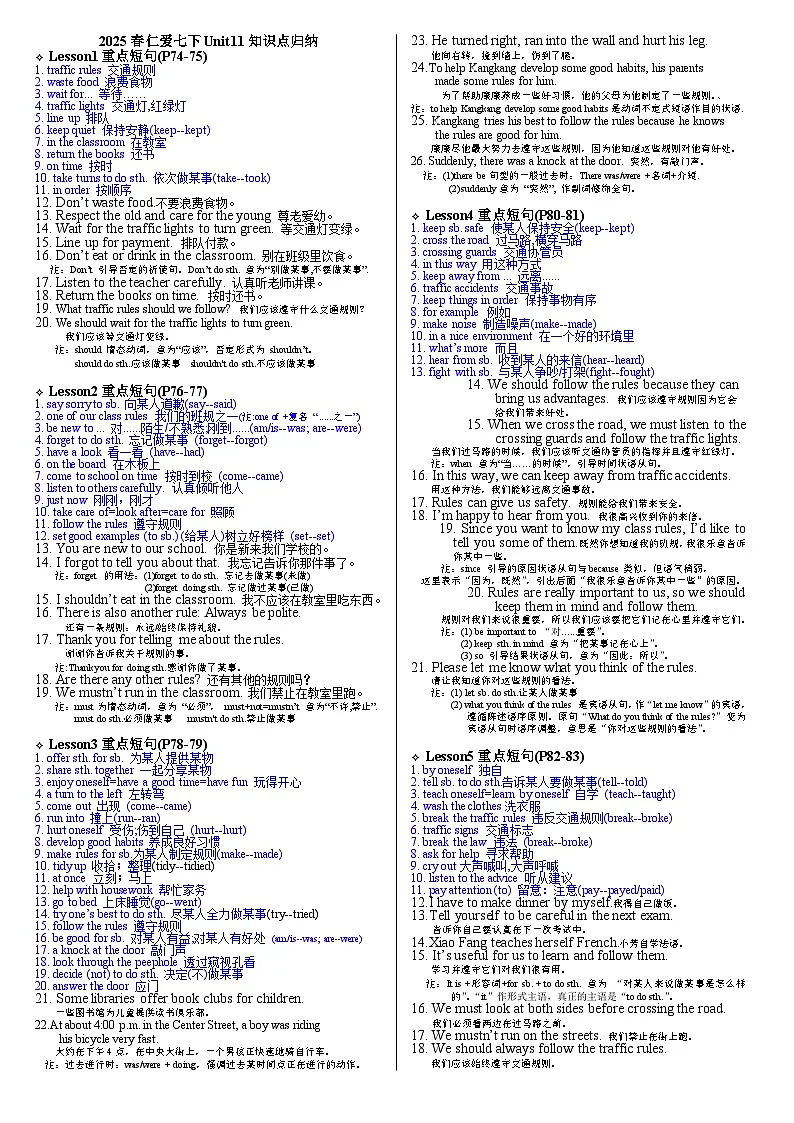
1. traffic rules 交通规则
2. waste fd 浪费食物
3. wait fr... 等待……
4. traffic lights 交通灯,红绿灯
5. line up 排队
6. keep quiet 保持安静(keep--kept)
7. in the classrm 在教室
8. return the bks 还书
9. n time 按时
10. take turns t d sth. 依次做某事(take--tk)
11. in rder 按顺序
12. Dn’t waste fd.不要浪费食物。
13. Respect the ld and care fr the yung 尊老爱幼。
14. Wait fr the traffic lights t turn green. 等交通灯变绿。
15. Line up fr payment. 排队付款。
16. Dn’t eat r drink in the classrm. 别在班级里饮食。
注:Dn’t 引导否定的祈使句。Dn’t d sth. 意为“别做某事,不要做某事”.
17. Listen t the teacher carefully. 认真听老师讲课。
18. Return the bks n time. 按时还书。
19. What traffic rules shuld we fllw? 我们应该遵守什么交通规则?
20. We shuld wait fr the traffic lights t turn green.
我们应该等交通灯变绿。
注:shuld 情态动词,意为“应该”,否定形式为 shuldn’t。
shuld d sth.应该做某事 shuldn't d sth.不应该做某事
Lessn2重点短句(P76-77)
1. say srry t sb. 向某人道歉(say--said)
2. ne f ur class rules 我们的班规之一(注:ne f +复名 “之一”)
3. be new t ... 对陌生/不熟悉;刚到(am/is--was; are--were)
4. frget t d sth. 忘记做某事 (frget--frgt)
5. have a lk 看一看 (have--had)
6. n the bard 在木板上
7. cme t schl n time 按时到校 (cme--came)
8. listen t thers carefully. 认真倾听他人
9. just nw 刚刚,刚才
10. take care f=lk after=care fr 照顾
11. fllw the rules 遵守规则
12. set gd examples (t sb.) (给某人)树立好榜样 (set--set)
13. Yu are new t ur schl. 你是新来我们学校的。
14. I frgt t tell yu abut that. 我忘记告诉你那件事了。
注:frget 的用法:(1)frget t d sth. 忘记去做某事(未做)
(2)frget ding sth. 忘记做过某事(已做)
15. I shuldn’t eat in the classrm. 我不应该在教室里吃东西。
16. There is als anther rule: Always be plite.
还有一条规则:永远/始终保持礼貌。
17. Thank yu fr telling me abut the rules.
谢谢你告诉我关于规则的事。
注:Thank yu fr ding sth.感谢你做了某事。
18. Are there any ther rules? 还有其他的规则吗?
19. We mustn’t run in the classrm. 我们禁止在教室里跑。
注:must为情态动词,意为 “必须”, must+nt=mustn’t 意为“不许,禁止”.
must d sth.必须做某事 mustn't d sth.禁止做某事
Lessn3重点短句(P78-79)
1. ffer sth. fr sb. 为某人提供某物
2. share sth. tgether 一起分享某物
3. enjy neself=have a gd time=have fun 玩得开心
4. a turn t the left 左转弯
5. cme ut 出现 (cme--came)
6. run int 撞上(run--ran)
7. hurt neself 受伤;伤到自己 (hurt--hurt)
8. develp gd habits 养成良好习惯
9. make rules fr sb.为某人制定规则(make--made)
10. tidy up 收拾;整理(tidy--tidied)
11. at nce 立刻;马上
12. help with husewrk 帮忙家务
13. g t bed 上床睡觉(g--went)
14. try ne’s best t d sth. 尽某人全力做某事(try--tried)
15. fllw the rules 遵守规则
16. be gd fr sb. 对某人有益;对某人有好处 (am/is--was; are--were)
17. a knck at the dr 敲门声
18. lk thrugh the peephle 透过窥视孔看
19. decide (nt) t d sth. 决定(不)做某事
20. answer the dr 应门
21. Sme libraries ffer bk clubs fr children.
一些图书馆为儿童提供读书俱乐部。
22.At abut 4:00 p.m. in the Center Street, a by was riding
his bicycle very fast.
大约在下午4点,在中央大街上,一个男孩正快速地骑自行车。
注:过去进行时:was/were + ding,强调过去某时间点正在进行的动作。
23. He turned right, ran int the wall and hurt his leg.
他向右转,撞到墙上,伤到了腿。
24.T help Kangkang develp sme gd habits, his parents
made sme rules fr him.
为了帮助康康养成一些好习惯,他的父母为他制定了一些规则。、
注:t help Kangkang develp sme gd habits是动词不定式短语作目的状语.
25. Kangkang tries his best t fllw the rules because he knws
the rules are gd fr him.
康康尽他最大努力去遵守这些规则,因为他知道这些规则对他有好处。
26. Suddenly, there was a knck at the dr. 突然,有敲门声。
注:(1)there be句型的一般过去时:There was/were +名词+介短.
(2)suddenly意为 “突然”, 作副词修饰全句。
Lessn4重点短句(P80-81)
1. keep sb. safe 使某人保持安全(keep--kept)
2. crss the rad 过马路,横穿马路
3. crssing guards 交通协管员
4. in this way 用这种方式
5. keep away frm ... 远离
6. traffic accidents 交通事故
7. keep things in rder 保持事物有序
8. fr example 例如
9. make nise 制造噪声(make--made)
10. in a nice envirnment 在一个好的环境里
11. what’s mre 而且
12. hear frm sb. 收到某人的来信(hear--heard)
13. fight with sb. 与某人争吵/打架(fight--fught)
14. We shuld fllw the rules because they can bring us advantages. 我们应该遵守规则因为它会给我们带来好处。
15. When we crss the rad, we must listen t the crssing guards and fllw the traffic lights.
当我们过马路的时候,我们应该听交通协管员的指挥并且遵守红绿灯。
注:when 意为“当……的时候”,引导时间状语从句。
16. In this way, we can keep away frm traffic accidents.
用这种方法,我们能够远离交通事故。
17. Rules can give us safety. 规则能给我们带来安全。
18. I’m happy t hear frm yu. 我很高兴收到你的来信。
19. Since yu want t knw my class rules, I’d like t tell yu sme f them.既然你想知道我的班规,我很乐意告诉你其中一些。
注:since 引导的原因状语从句与because类似,但语气稍弱,
这里表示“因为,既然”,引出后面“我很乐意告诉你其中一些”的原因。
20. Rules are really imprtant t us, s we shuld keep them in mind and fllw them.
规则对我们来说很重要,所以我们应该要把它们记在心里并遵守它们。
注:(1) be imprtant t “对重要”。
(2) keep sth. in mind 意为“把某事记在心上”。
(3) s 引导结果状语从句,意为“因此;所以”。
21. Please let me knw what yu think f the rules.
请让我知道你对这些规则的看法。
注:(1) let sb. d sth.让某人做某事
(2) what yu think f the rules 是宾语从句,作“let me knw”的宾语,遵循陈述语序原则。原句“What d yu think f the rules?”变为宾语从句时语序调整,意思是“你对这些规则的看法”。
Lessn5重点短句(P82-83)
1. by neself 独自
2. tell sb. t d sth.告诉某人要做某事(tell--tld)
3. teach neself=learn by neself 自学 (teach--taught)
4. wash the clthes洗衣服
5. break the traffic rules 违反交通规则(break--brke)
6. traffic signs 交通标志
7. break the law 违法 (break--brke)
8. ask fr help 寻求帮助
9. cry ut大声喊叫,大声呼喊
10. listen t the advice 听从建议
11. pay attentin (t) 留意:注意(pay--payed/paid)
12.I have t make dinner by myself.我得自己做饭。
13.Tell yurself t be careful in the next exam.
告诉你自己要认真在下一次考试中。
14.Xia Fang teaches herself French.小芳自学法语。
15. It’s useful fr us t learn and fllw them.
学习并遵守它们对我们很有用。
注:It is +形容词+fr sb. + t d sth. 意为 “对某人来说做某事是怎么样的”。“it”作形式主语,真正的主语是“t d sth.”。
16. We must lk at bth sides befre crssing the rad.
我们必须看两边在过马路之前。
17. We mustn’t run n the streets. 我们禁止在街上跑。
18. We shuld always fllw the traffic rules.
我们应该始终遵守交通规则。
19. Yu shuldn’t play n the rad.你不应该在路上玩耍。
【语法梳理】
(一)反身代词
1.定义:
反身代词意为“自己,本身,亲自”,与它所指代的名词或代词形成互指关系,
在人称、性、数上保持一致。
2.反身代词的构成
3.反身代词的用法
(1) 作宾语
He hurt himself when he was climbing the muntain. 他爬山的时候弄伤了自己。
The little girl can lk after herself. 这个小女孩能照顾自己。
(2) 作同位语
用来加强名词或代词的语气,作同位语一般放在被修饰词之后。
The bk itself is very interesting. 这本书本身很有趣。
(itself 强调 the bk. 说明这本书自身的特点。)
She herself desn’t like this mvie. 她自己不喜欢这部电影。
(herself 加强 she 的语气,表明是她本人不喜欢。)
3. 反身代词的常见搭配
(1) enjy neself 玩得开心 (2)teach neself 自学 (3) hurt neself 受伤
(4) by neself 独自 (5) help neself (t sth.) 随便吃点/喝点
(二)情态动词 must/mustn't 以及 shuld/shuldn't 的用法
情态动词 must/mustn’t
情态动词 must 意为“必须”,不能单独作谓语,必须与实义动词一起构成谓语,没有人称和数的变化。must 的否定形式为 mustn’t。
知识点一 基本用法
(1) 表示义务,可用于肯定句和疑问句中。
Yu must fllw the traffic rules. 你必须遵守交通规则。
Must I finish my hmewrk right nw? 我必须现在完成作业吗?
(2) mustn’t=must nt,表示不许,禁止。
Yu mustn’t swim in the river. 你不许在河里游泳。
(3) 表示推测,意为“一定”。
The bk must be Jerry’s. His name is n the cver.
这本书一定是杰瑞的,封面上写着他的名字。
(4) 表示劝告,必须做某事,表明事情的必要性与重要性。
Yu must drink mre water. 你必须多喝点水。
知识点二 基本句式
(1) 肯定句:主语+must+动词原形(+其他)。
Yu must d mre exercise. 你必须多锻炼。
(2) 否定句:主语+mustn’t+动词原形(+其他)。
Yu mustn’t smke here. 你不许在这里抽烟。
(3) 一般疑问句:Must+主语+动词原形(+其他)?
肯定回答:Yes,主语+must.
否定回答:N,主语+dn’t have t/needn’t.
(注意:回答含有 must 的疑问句时,要用 dn’t have t 或 needn’t 作为否定回答,不能用 mustn’t。)
→ Must we keep the windws pen all the time? 我们得一直让窗户开着吗?
→ N, yu dn’t have t/N, yu needn’t. 不,没有必要。
知识点三 与 have t 的比较
must 和 have t 都有“必须”的含义,但各自的侧重点不同。
1. must 强调说话者的主观看法,have t 强调客观的需要。
I must leave nw. 我现在得走了。(我想走)
I missed the bus and had t walk hme. 我没赶上公共汽车,只好步行回家。
(错过公共汽车等客观原因导致我不得不步行回家。)
2. must 没有人称、数和时态的变化,have t 则有。
I had t buy a car at that time. 那时我只好买了一辆车。
情态动词 shuld/shuldn’t
情态动词 shuld 不能单独作谓语,必须与实义动词一起构成谓语,没有人称和数的变化。shuld 的否定形式为 shuldn’t。
知识点一 基本用法
(1) 表示义务。We shuld save water. 我们应该节约用水。
(2) 表示提出或征询建议。
Yu shuld ask yur teacher fr help. 你应该向你的老师寻求帮助。
Yu shuldn’t speak ludly in the library. 你不应该在图书馆大声喧哗。
知识点二 基本句式
(1) 肯定句:主语+shuld+动词原形(+其他)。
Yu shuld get up early. 你应该早起。
(2) 否定句:主语+shuldn’t+动词原形(+其他)。
Yu shuldn’t spend t much time playing cmputer games.
你不应该花这么多时间玩电脑游戏。
(3) 一般疑问句:Shuld+主语+动词原形(+其他)?
肯定回答:Yes,主语+shuld.
否定回答:N,主语+shuldn’t.
(4) 特殊疑问句:特殊疑问词+shuld+主语+动词原形(+其他)?
What shuld we d t prtect the envirnment?
我们应该做些什么来保护环境呢?
Lessn6重点短句(P84)
1. the waste cans 垃圾桶
2. take care f 照顾(take--tk)
3. feed the birds 喂鸟(feed--fed)
4. a family picnic 一次家庭野餐
5. a trip with classmates 一次和同学们的旅行
6. a swimming pl 游泳池; 游泳馆
7. Befre yu start yur activities in the park, I’d like t talk abut the park rules again.
在你们开始在公园开展活动之前,我想再讲讲公园的规范。
注:befre 的用法:(1) 连词,意为“在……之前”引导时间状语从句。
(2) 介词,意为“(时间上)在……之前,早于”。
Put the waste int the waste cans. 把垃圾放进垃圾桶。
Take care f the children under 10 years ld.
照顾好 10 岁以下的儿童。
10.Dn’t swim in the lake.不要在湖里游泳。
11.Dn’t feed the birds.不要喂鸟。
Lessn7重点短句(P85-86)
1. hld a party=have a party 举办聚会(hld--held; have--had)
2. be in a big mess 一团糟(am/is--was; are--were)
3. get angry 生气 (get--gt)
4. decide t d sth. 决定做某事
5. make rules 制定规则(make--made)
6. frm nw n 从现在开始
7. clean up the kitchen 打扫厨房
8. make t much nise 制造太多噪音(make--made)
9. prmise t d sth. 承诺去做某事
10. break the rules 违反规则(break--brke)
11. try ne's best nt t d sth. 尽某人最大努力不做某事
12. The huse was in a big mess after the party.
在聚会之后,房子乱成一团。
13. Our parents gt really angry and decided t make sme new family rules.
我们的父母非常生气,决定制定一些新的家庭规则。
注:get angry意为“生气”,get 此处为系动词,后接形容词作表语,构成系表结构。
14. S nw, we mustn’t play in his study. 所以现在,我们不允许在他的书房玩。
15. The new rules say we can’t make t much nise.
新规则说我们不能制造太多噪音。
注:say 引导的宾语从句,结构为“主语+say+(that)+从句.”
16. We prmise t fllw the new rules and try ur best nt t break them.
我们承诺遵守新的规则,并尽我们最大的努力不去违反它们。
【语篇结构】
熟悉并掌握描述规则制定的原因及影响的说明文文体结构,掌握相应写作要点:
1. Title (标题): Family Rules fr a Huse Party
2. Beginning (开头): Reasns fr new rules(制定新规则的原因)
3. Bdy (主体): (1) Causes(原因) (2)Effects(影响)
4. End (结尾): Prmise(承诺)
【描述方式】
1. 介绍规则制定的起因
The huse was in a big mess after the party. Our parents gt really angry and decided t make sme new family rules.
2. 描述具体规则制定的前因后果
First, there were a lt f dirty dishes left. Frm nw n, we have t clean up the kitchen after every party. Secnd, a few f ur friends mved ur dad’s bks. S nw, we mustn’t play in his study...
3. 表达遵守规则的决心
We prmise t fllw the new rules and try ur best nt t break them.
【参考范文】Library Rules fr Schl Library
At the library, there are rules t make it a gd place t learn.
Firstly, we shuld talk quietly. It's imprtant because lud vices can bther thers studying. Secndly, yu shuld take gd care f every bk in the library and keep it clean. Lastly, we must return bks n time. In this way, ther students can read them t.
We felt these rules can keep the library clean and quiet.
Lessn8重点短句(P87-89)
1. gd behavirs 良好的行为
2. public signs 公共标识
3. n the subway在地铁上
4. get a fine 收到罚单(get--gt)
5. wear helmets 戴头盔(wear-wre)
6. in the frnt f …在的前面(内部)
at the back f … 在……的后面(内部)
remember t d sth. 记得要做某事
remember nt t d sth. 记得(不要)做某事
8. drive t fast 开车太快 (drive--drve)
9. be late fr schl 上学迟到(am/is--was; are--were)
10. keep … clean 保持……干净(keep--kept)
11. stay up t late 熬夜太晚
12. think f … as … 把……看作…… (think--thught)
13. table manners 餐桌礼仪
14. wait fr the elders 等待长辈
15. pint at 指着
16. Children under 18 must wear helmets while riding bicycles.
18岁以下的儿童骑自行车时必须戴头盔。
17. During the meeting, we mustn’t chat.开会期间,我们不允许聊天。
18. We Chinese think f fd as an imprtant part f ur lives. 我们中国人认为食物是我们生活的重要组成部分。
19. There is usually a “Best Seat” fr the mst imprtant persn and a right seat fr everyne.
通常会有一个“最佳座位”留给最重要的人,而每个人都有一个合适的座位。
20. Never pint at peple with chpsticks. 永远别用筷子指人。 人称
单数
构成方式
复数
第一人称
myself(我自己)
形容词性为主代词my+self
urselves(我们自己)
第二人称
yurself(你自己)
形容词性为主代词yur+self
yurselves(你们自己)
第三人称
herself(她自己)
人称代词宾格her+self
themselves(ta们自己)
himself(他自己)
人称代词宾格him+self
itself(它自己)
人称代词宾格it+self
这是一份英语仁爱科普版(2024)Unit 11 Rules Matter !优秀导学案,共3页。学案主要包含了语法梳理,语篇结构,描述方式,参考范文等内容,欢迎下载使用。
这是一份英语七年级下册(2024)Unit 12 Better Together精品学案,共3页。学案主要包含了语法梳理,语篇结构,描述方式,参考范文等内容,欢迎下载使用。
这是一份仁爱科普版(2024)七年级下册(2024)Unit 7 Being a Smart Shopper精品导学案,共3页。学案主要包含了语法梳理,语篇结构,描述方式,参考范文等内容,欢迎下载使用。
 新教材
新教材注册成功

在线客服
添加在线客服
获取1对1服务
官方微信
关注“教习网”公众号
打开微信就能找资料
赛课定制
添加在线客服
获取1对1定制服务
职称咨询
添加在线客服
获取1V1专业指导服务

免费福利

.png)
.png)
.png)
