免费领取教师福利

若您为此资料的原创作者,认为该资料内容侵犯了您的知识产权,请扫码添加我们的相关工作人员,我们尽可能的保护您的合法权益。


这是一份北京市海淀区2026届高三下学期一模英语试卷(Word版无答案),共28页。试卷主要包含了04,5 分,共 15 分), A等内容,欢迎下载使用。
高三英语
本试卷共 8 页,100 分。考试时长 90 分钟。
考生务必将答案答在答题卡上,在试卷上作答无效。
考试结束后,将本试卷和答题卡一并交回。
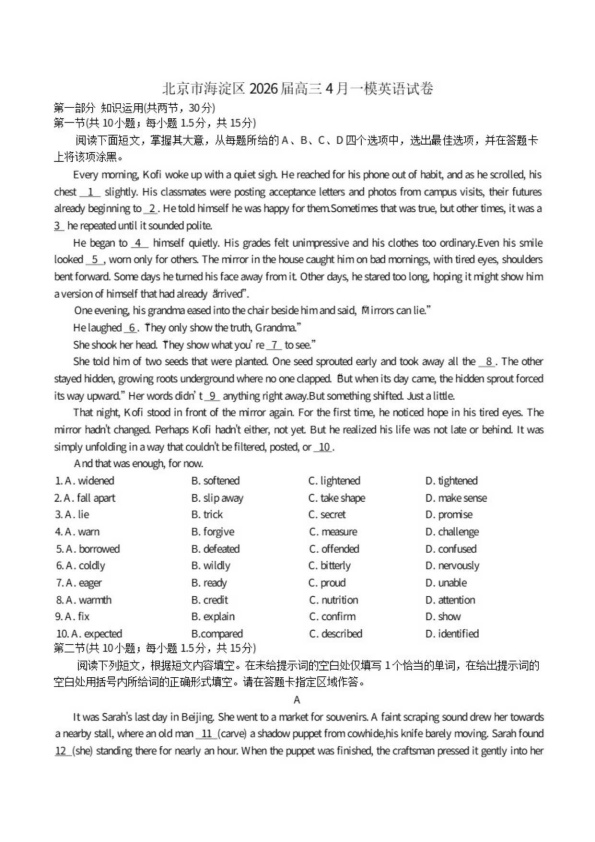
第一部分 知识运用(共两节,30 分)
第一节(共 10 小题;每小题 1.5 分,共 15 分)
阅读下面短文,掌握其大意,从每题所给的 A、B、C、D 四个选项中,选出最佳选项,并在
答题卡上将该项涂黑。
Every mrning, Kfi wke up with a quiet sigh. He reached fr his phne ut f habit, and as he scrlled, his
chest 1 slightly. His classmates were psting acceptance letters and phts frm campus visits, their
futures already beginning t 2 . He tld himself he was happy fr them. Smetimes that was true, but ther
times, it was a 3 he repeated until it sunded plite.
He began t 4 himself quietly. His grades felt unimpressive and his clthes t rdinary. Even his
smile lked 5 , wrn nly fr thers. The mirrr in the huse caught him n bad mrnings, with tired eyes,
shulders bent frward. Sme days he turned his face away frm it. Other days, he stared t lng, hping it might
shw him a versin f himself that had already “arrived”.
One evening, his grandma eased int the chair beside him and said, “Mirrrs can lie.”
He laughed 6 . “They nly shw the truth, Grandma.”
She shk her head. “They shw what yu’re 7 t see.”
She tld him f tw seeds that were planted. One seed spruted early and tk away all the 8 . The
ther stayed hidden, grwing rts undergrund where n ne clapped. “But when its day came, the hidden sprut
frced its way upward.” Her wrds didn’t 9 anything right away. But smething shifted. Just a little.
That night, Kfi std in frnt f the mirrr again. Fr the first time, he nticed hpe in his tired eyes. The
mirrr hadn’t changed. Perhaps Kfi hadn’t either, nt yet. But he realized his life was nt late r behind. It was
simply unflding in a way that culdn’t be filtered, psted, r 10 .
And that was enugh, fr nw.
1. A. widened B. sftened C. lightened D. tightened
2. A. fall apart B. slip away C. take shape D. make sense
3. A. lie B. trick C. secret D. prmise
4. A. warn B. frgive C. measure D. challenge
5. A. brrwed B. defeated C. ffended D. cnfused 6. A. cldly B. wildly C. bitterly D. nervusly
7. A. eager B. ready C. prud D. unable
8. A. warmth B. credit C. nutritin D. attentin
9. A. fix B. explain C. cnfirm D. shw
10. A. expected B. cmpared C. described D. identified
第二节(共 10 小题;每小题 1.5 分,共 15 分)
阅读下列短文,根据短文内容填空。在未给提示词的空白处仅填写 1 个恰当的单词,在给出
提示词的空白处用括号内所给词的正确形式填空。请在答题卡指定区域作答。
A
It was Sarah’s last day in Beijing. She went t a market fr suvenirs. A faint scraping sund drew her
twards a nearby stall, where an ld man 11 (carve) a shadw puppet frm cwhide, his knife barely
mving. Sarah fund 12 (she) standing there fr nearly an hur. When the puppet was finished, the
craftsman pressed it gently int her hands. Sarah smiled, paid, and walked back int the crwd. She had cme fr
suvenirs but left 13 a stry.
B
“Digital amnesia” refers t the situatin where we utsurce memry t devices instead f using ur wn
brains. Accrding t recent research, 14 (realise) infrmatin is digitally available weakens peple’s
ability t recall it. In studies n digital habits, participants 15 (find) t depend heavily n smartphnes lng
befre their persnal memry shws signs f decline. This habit initiates a cycle, cntinuusly weakening ur
natural cgnitive functins. The critical questin nw is whether this shift is altering ur capability 16
(prcess) infrmatin.
C
A skilled critical thinker with a clsed mind will likely have many true 17 (belief), but will be blind t
thers. Hwever, thse 18 dn’t screen incming ideas will end up believing things nt nly false, but
als 19 (danger). By thinking critically, yu reject ideas; by being pen-minded, yu accept them. These
tw mindsets seem t be in cnflict, but supprt each ther nicely, which is 20 yu shuld strive t
transfrm yurself int an pen-minded critical thinker if yu wish t strengthen yur mind.
第二部分 阅读理解(共两节,38 分)
第一节(共 14 小题;每小题 2 分,共 28 分)
阅读下列短文,从每题所给的 A、B、C、D 四个选项中,选出最佳选项,并在答题卡上将该
项涂黑。
A
Eager t run yur wn cmpany? Venture is yur perfect chice! It helps yu becme an excellent leader and
public speaker, build lifelng cnnectins with peers and technlgical prfessinals, and gain real-wrld learning
beynd academics.
What Yu’ll Learn & D
·Week 1: Break limiting mindsets, present ideas, frm teams by grup vte, and create a prf-f-cncept with
caches’ supprt.
·Week 2: Plish ideas via user engagement, build a Minimum Viable Prduct, and learn branding and visual
design t launch a landing page.
·Week 3: Enter the market, shwcase prducts, and master marketing, sales and ad creatin t gain custmers.
·Week 4: Craft stry-driven presentatins and practice delivering them t investrs cnfidently.
Dem Day
Present yur cmpany t a panel f investrs. Teams are judged n prduct-market fit, market size, grwth
and presentatin, with awards fr Mst Outstanding Cmpany and Best Entrepreneur (企业家).
Extracurriculars
Enjy tailred leisure activities and mental health cnversatins with a licensed therapist during the prgram.
Online On-site
Start date July 10, 2026 June 15, 2026
End date August 8, 2026 July 12, 2026
Schedule Classes 8 AM t 11 AM Full-time prgram
·Guidance frm accmplished start-up funders in all time ·Classes in a tp cllege campus
znes · All meals, including vegetarian
Features ·Teamwrk thrughut the day ptins
·Grup leisure activities ·Husing near campus
·Flexible schedule ·Grup leisure activities in the city
21. Venture is intended t help students ______.
A. release their academic ptential B. land a jb in the tech industry
C. develp business-building skills D. netwrk with public speakers
22. What will participants d during the prgram?
A. Craft stries n a landing page. B. Wrk in teams assigned by caches.
C. Attend weekly mental health talks. D. Display their prducts in the market.
23. Unlike the n-site prgram, the nline prgram ______.
A. requires full-time cmmitment B. prvides leisure activities
C. invites entrepreneurs wrldwide D. features individual learning
B
— 3 tablespns butter
— 2 eggs
— 2 medium carrts
— 1 small white nin
— 3 clves garlic
— 4 cups cked and chilled rice
I bet yu didn’t read thse numbers.
I’ll let yu in n a secret — I didn’t either.
The ingredients abve were cpied and pasted frm the first nline search result fr “fried rice recipe”. But,
withut any disrespect t the recipe’s wner, I can tell yu it’s wrng.
The nly true fried rice recipe is n recipe at all. There are n measurements, n exact instructins, n timer
fr hw lng smething shuld sizzle in the pan. There are nly smells and feelings and memries. I learned t
ck fried rice n the rickety stl cvered in stickers, surrunded by the scents f my Grandma’s aprn. We used
hwever much leftver rice we had and a cmbinatin f anything and everything sitting in the fridge. The kitchen
was always a little messy, but that was part f the fun.
Yet I’ve always been mre f a baker than a ck. I enjy recipes — I enjy the prcess f being exact and
finding details, adjusting and leveling and weighing. Frm a yung age, I fund cmfrt in the careful baking
recipes in Western ckbks.
But I understand the beauty f spntaneity (即兴) and rganic creatin. There’s smething special in realizing
that n tw recreatins f my grandma’s fried rice will ever be the same, and really, isn’t that what life is? Creatin,
withut recipe?
It’s funny. This may cntradict everything I’ve written thus far, but the mre I bake, the mre I realize perhaps
baking is spntaneus t. I dn’t always need t weigh my flur befrehand in rder t get perfect ckies. My
signature fd is cupcake, but I challenged myself t use a different recipe every time. Yu’d be surprised at hw
different cupcakes taste when yu add an extra egg, and yu’d be especially uncertain abut my baking skills if yu
tried my cupcakes that had way t much baking sda (trial and errr …).
I’m learning t lve ging with the flw. It’s nt mutually exclusive with lving precisin, and it’s such an
integral part f my culture; I’d be missing ut therwise. Cming t terms with and embracing the unknwn is
scary, but I assure yu: One day, I’ll master my wn fried rice.
24. What des the authr think f the fried rice recipe?
A. It prvides inaccurate details. B. It includes t many ingredients.
C. It misses the essence f cking. D. It cntradicts the basics f cuisine.
25. The authr enjys baking because f ______.
A. her hpe t pass recipes n B. her lve f precisin and detail
C. her interest in a different culture D. her desire t hnur family traditins
26. The authr’s cupcake experiments made her mre ______.
A. pen-minded B. rganized C. cnfident D. clear-headed
27. What can we learn frm this passage?
A. Fnd memries make a dish tasty.
B. Precisin and creativity are inseparable.
C. Creativity prspers where rules end.
D. Life desn’t always cme with a recipe.
C
Fr half a century, psychlgist Keith Hlyak has studied analgy — the capacity t see relatinal
similarities between superficially dissimilar things — as a crnerstne f human intelligence. His new bk, The
Human Edge, takes a fresh lk at analgy as a defining feature f human thught.
At its cre, analgy enables us t apply prir knwledge t nvel situatins. Unlike simple perceptual
similarity, analgy maps relatinal patterns acrss different dmains. The prverb abut tw dgs fighting ver a
bne while a third runs away, fr instance, illuminates a business scenari where cmpeting crpratins weaken
each ther, allwing a rival t take advantage. This capacity fr relatinal mapping underpins fluid intelligence —
the ability t reasn abut new prblems — and strngly predicts perfrmance n intelligence tests.
Analgy als drives creativity. Hlyak’s classic research n the “radiatin prblem” illustrates this:
participants struggled t destry a tumr (肿瘤) with rays withut harming healthy tissue. But thse first expsed t
a stry abut a general attacking a castle frm multiple sides readily devised the cnvergent (会聚的) ray slutin.
While we ften fail t retrieve useful analgies independently, expsure t structurally similar but superficially
different situatins can spark breakthrugh thinking.
This cgnitive capacity develps early and naturally. Children begin reasning analgically arund age three
and the capacity cntinues t develp until adulthd. Hlyak identifies this as a “Late System” — a uniquely
human, evlutinarily recent ability fr general relatinal reasning. It builds upn and cperates with lder,
specialized “Early Systems” we share with ther animals. While nnhuman species perfrm tasks that resemble
analgical reasning, these successes remain dmain-specific. Humans alne can map relatins acrss any cntent,
frm fairy tales t physics.
This special ability, hwever, grants neither wisdm nr mrality. Abstract thught has yielded bth medical
cures and weapns f mass destructin. As Hlyak ntes, if Earth becmes uninhabitable, it wn’t be the
chimpanzees’ fault.
The rise f AI presents a new frntier. Large language mdels (LLMs) nw slve analgy prblems at a
cllege-student level, and their cmputatinal pwer culd eventually prduce superhuman intelligence. Yet they
lack autnmy and, crucially, the ability t spntaneusly ntice a meaningful analgy. In art, this limitatin may
prve difficult t vercme. AI, lacking emtin, cnsciusness, and individuality, prduces wrk many find
sulless.
Human uniqueness stems frm the evlutin f cperative systems: a “Late System” that enables cmplex
relatinal reasning and the “Early Systems” that reflect ur vast bilgical heritage. Their integratin is the very
essence f the human edge.
28. What des the wrd “underpins” underlined in Paragraph 2 mst prbably mean?
A. Supprts. B. Evaluates. C. Replaces. D. Frames.
29. What can we learn frm the passage?
A. The “Late System” is develped in adulthd.
B. The “tw dgs” prverb encurages cmpetitins.
C. The cnvergent ray slutin arse frm an analgy.
D. LLMs can’t frm analgies due t lack f autnmy.
30. Which wuld be the best title fr the passage?
A. Develping Analgy: The Cre f Human Creativity
B. Decding Analgy: A Capacity Setting Humans Apart
C. Defining Analgy: The Frce Driving Human Evlutin
D. Defending Analgy: A Mechanism f Human Perceptin
D
Meritcracy (优绩主义) has becme a leading scial ideal. Pliticians cntinually return t the theme that the
rewards f life — mney, jbs, university admissin — shuld be distributed accrding t skill and effrt.
Cnceptually and mrally, meritcracy is presented as the ppsite f hereditary aristcracy, in which ne’s scial
psitin is determined by the lttery f birth.
Althugh widely held, the belief that merit rather than luck determines success r failure in the wrld is
demnstrably false. This is nt least because merit itself is, in large part, the result f luck. Talent and the capacity
fr determined effrt depend a great deal n ne’s genetic gifts and upbringing.
This is t say nthing f ther frtuitus circumstances that figure int every success stry. In his bk
Success and Luck, Rbert Frank recunts the cincidences behind the stellar rise f many successful entrepreneurs.
Luck intervenes by ffering peple merit, and again by furnishing circumstances where merit can translate int
success. This is nt t deny the industry and talent f successful peple. Hwever, it des demnstrate that the link
between merit and utcme is weak and indirect at best.
In additin t being false, research suggests that believing in meritcracy makes peple mre selfish, less
self-critical and even mre prne t acting in discriminatry ways. The “ultimatum game” is a cmmn
psychlgical experiment, where ne player is given a sum f mney and tld t prpse a divisin between him
and anther player, wh may accept r reject the ffer. If the ffer is rejected, neither gets anything. Usually a
relatively even split is ffered. In ne variatin, participants played a fake game f skill befre making ffers.
Players wh were led t believe they had “wn” claimed mre fr themselves than thse wh engaged in games f
chance. Similar studies suggest that just having the idea f skill in mind makes peple mre tlerant f unequal
utcmes.
By cntrast, research n gratitude indicates that remembering the rle f luck increases genersity. Simply
asking subjects t recall external cntributrs t their successes made them mre likely t give t charity than thse
remembering internal factrs.
Part f meritcracy’s mral appeal is its pwer t justify the existing scial rder. On tp f that, it als ffers
flattery. Where success is determined by merit, each win can be viewed as a reflectin f persnal wrth and
wrldly failures becme signs f persnal weaknesses.
Meritcracy ught t be abandned bth as a belief abut hw the wrld wrks and as a general scial ideal. It’
s false, and believing in it encurages selfishness, discriminatin and indifference t the struggles f the
unfrtunate.
31. What can we learn frm the first three paragraphs?
A. Pliticians argue life rewards are set at birth. B. Talent and determinatin we nthing t luck.
C. Industry enhances merit and directs t success.
D. Merit is largely decided by circumstantial factrs.
32. What des the authr imply by citing the “ultimatum game” experiment?
A. The results cnfirm meritcracy’s mral appeal.
B. Belief in merit may encurage selfishness and bias.
C. Ideas f skill can increase ur willingness t dnate.
D. Games f chance ensure even distributin f resurces.
33. The authr feels meritcracy’s mral appeal is ______.
A. errneus B. justified C. practical D. grundless
34. What is the purpse f this passage?
A. T criticise the mindset f chasing success.
B. T challenge a cmmnly held scial belief.
C. T cmpare different scial reward systems.
D. T evaluate the prs and cns f meritcracy.
第二节(共 5 小题;每小题 2 分,共 10 分)
根据短文内容,从短文后的七个选项中选出能填入空白处的最佳选项,并在答题卡上将该项涂
黑。选项中有两项为多余选项。
Hw many times d yu find yurself in a cnversatin with smene, waiting fr the ther persn t stp
talking s yu can say what yu want t say? 35 This cmmn experience shws a lack f active listening,
because yu are nly thinking abut hw yu want t respnd.
Cmmunicatin that leads t real human cnnectin invlves active listening and empathy. Active listening
includes eye cntact as well as verbal and nn-verbal acknwledgments that yu are listening. 36 Empathy
invlves reflectin, validatin and a genuine cncern fr hw thers are feeling. This cmbinatin f active
listening and empathy — empathetic listening — can imprve relatinships f all kinds.
37 Being brave enugh t share with anther persn is a vulnerable psitin t be in. Imagine sharing
smething sad with a friend: “I studied s hard fr the math exam, but I still failed it.” Cnsider these tw ptential
respnses and hw they wuld make yu feel.
“Oh well, I’m glad I’m nt the ne taking that exam. Want t hang ut?”
“That must be s hard. Thank yu fr sharing with me. I am here fr yu.”
The first respnse might leave ne feeling dismissed. Why d peple respnd like that? Perhaps the cmment
cmes frm a place f the listener being uncmfrtable with hearing smething that taps int their wn fears r
vulnerability. 38 The secnd respnse, hwever, might make ne feel heard, seen and supprted. It shws
the listener heard what the ther persn was saying, understanding and expressing cncern.
S hw d yu knw what t say r nt t say when smene shares smething difficult with yu? Smetimes,
the best thing t d is t sit and listen. Brene Brwn, a renwned researcher in this field, says it best: “Empathy is a
strange and pwerful thing. There is n script. There is n right way r wrng way t d it. 39 ”
A. Shifting the tpic might bring cmfrt t the speaker.
B. These include ndding, cnfirming, and clarifying questins.
C. Just be empathetic and yu’ll have thught-prvking cnversatins.
D. It’s simply listening, withhlding judgment, and emtinally cnnecting.
E. Everyne wants t feel understd fr speaking their thughts and feelings.
F. The listener may want t shut dwn the cnversatin and mve t a safer space.
G. Yu might even expect the ther persn t cmpletely tune int what yu are saying.
第三部分 书面表达(共两节,32 分)
第一节(共 4 小题;第 40、41 题各 2 分,第 42 题 3 分,第 43 题 5 分,共 12 分)
阅读下面短文,根据题目要求用英文回答问题。请在答题卡指定区域作答。
I have always been better at expressing myself thrugh writing than verbally r thrugh any ther medium,
and I’ve been cmmunicating thrugh the written wrds since I was a child. This practice became prfundly
meaningful t me after my stepfather Vince passed away.
Vince died in 2018, right befre New Year’s Eve. I had wanted t write him a letter fr years, lng befre his
shcking diagnsis, but I kept delaying it. I always thught there wuld be mre time. Sadly, I never finished that
letter. It is a regret I will carry with me always.
Yet, this persnal failure led me t think f the ther imprtant peple in my life — thse I culd still reach,
thse with whm I still had time. There were things I needed t say t them, wrds that mattered.
In 2019, I made a list f everyne I wanted t write t, and I started sending a few letters here and there.
Gratitude, regrets, aplgies — all f these were fund in my pages. Each envelpe marked anther crssing ff
f a name n my bucket list f recipients.
In 2020, I appraised my prgress and began thinking abut hw I might encurage ther peple t write letters
t. I perated a website that encurages peple t write letters t thers — three letters, t be exact.
There are n rules r restrictins regarding the cntents f participants’ letters r the frmat they take. The
letters can be typed r handwritten, in any length and language, n any style f paper, etc. My nly advice is that
the letters shuld be sent within ne year. I am hesitant t impse any directives at all, but I believe a deadline can
be helpful as it will remind peple we dn’t always have all the time we think we d.
My gal is t wrk n a letter t smene at least nce a mnth. We have nly a limited amunt f time n
this planet. There are imprtant things that we need t say.
40. What did the authr find imprtant after lsing her stepfather?
41. Why did the authr set up the website?
42. Please decide which part is false in the fllwing statement, then underline it and explain why.
➢ On the authr’s website, she suggests a deadline in rder t cllect as many letters as pssible.
43. If yu are t write a letter t smene, wh will yu write t? What will yu write abut? (In abut 40 wrds)
第二节(20 分)
假设你是红星中学高三学生李华。你们学校即将举办“未来已来”(The Future is Here)的科技节活动。
你打算邀请你的国际部好友 Jim 参加。请你给他写一封邮件,内容包括:
1.活动安排(时间、地点等);
2.活动内容。
注意:1.词数 100 左右;
2.开头和结尾已给出,不计入总词数。
Dear Jim,
____________________________________________________________________________________________
____________________________________________________________________________________________
____________________________________________________________________________________________
Yurs,
Li Hua
(请务必将作文写在答题卡指定区域内)
这是一份北京市海淀区2026届高三下学期一模英语试卷(Word版无答案),共28页。试卷主要包含了04,5 分,共 15 分), A等内容,欢迎下载使用。
这是一份北京市海淀区2026届高三下学期一模英语试卷(Word版附解析),共28页。试卷主要包含了04,5 分,共 15 分), A等内容,欢迎下载使用。
这是一份北京市海淀区2026届下学期高三下学期高考一模英语试题(含答案),共40页。
注册成功

在线客服
添加在线客服
获取1对1服务
官方微信
关注“教习网”公众号
打开微信就能找资料
赛课定制
添加在线客服
获取1对1定制服务
职称咨询
添加在线客服
获取1V1专业指导服务

免费福利


.png)
.png)