 免费领取教师福利


若您为此资料的原创作者,认为该资料内容侵犯了您的知识产权,请扫码添加我们的相关工作人员,我们尽可能的保护您的合法权益。

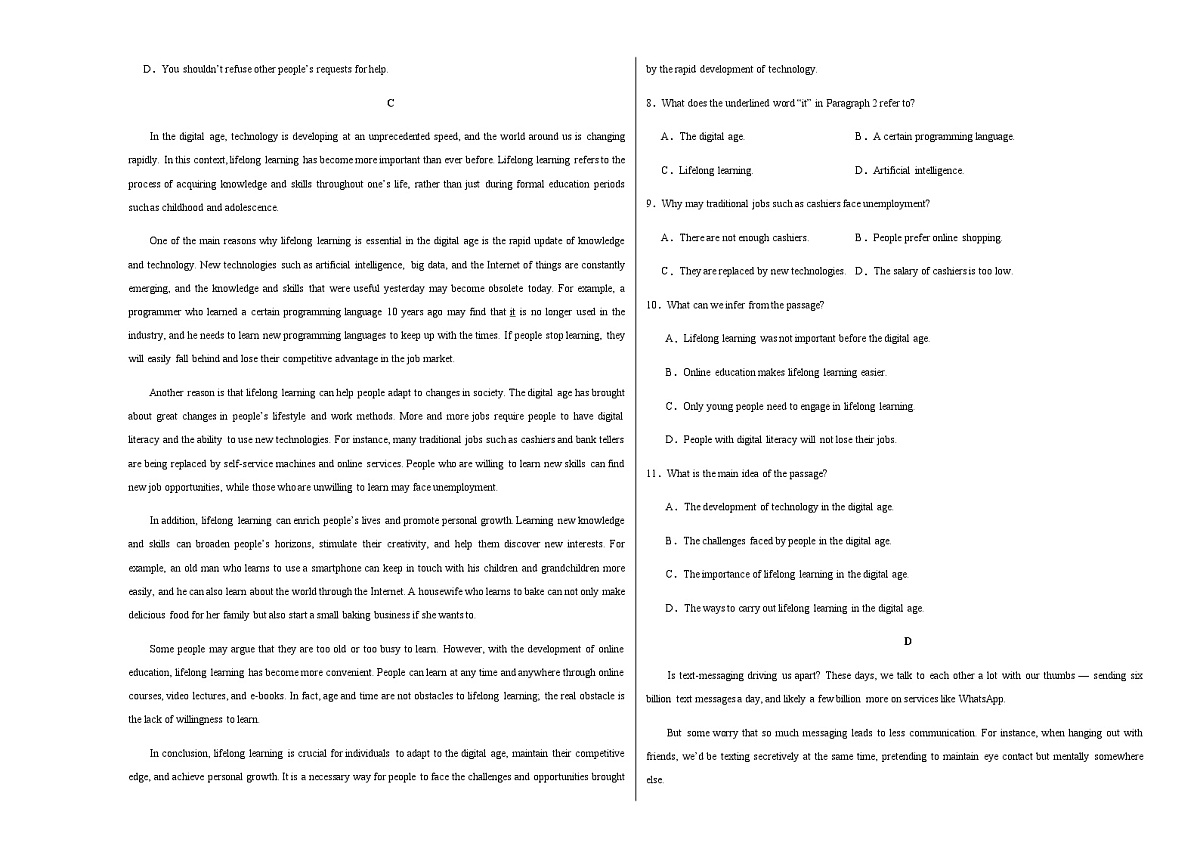
这是一份高考英语一模突破卷04 (广东专用)(考试版A3),共7页。
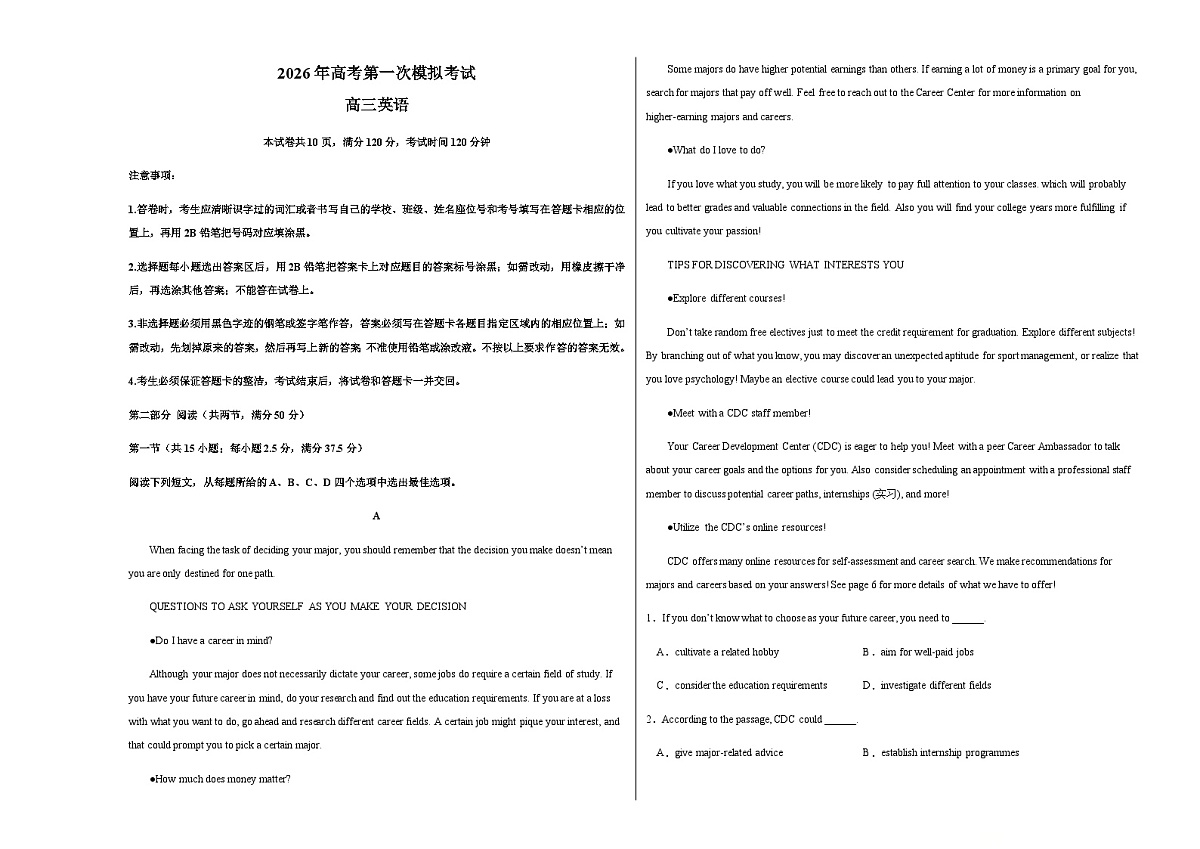
本试卷共10页,满分120分,考试时间120分钟
注意事项:
1.答卷时,考生应清晰识字过的词汇或者书写自己的学校、班级、姓名座位号和考号填写在答题卡相应的位置上,再用2B铅笔把号码对应填涂黑。
2.选择题每小题选出答案区后,用2B铅笔把答案卡上对应题目的答案标号涂黑;如需改动,用橡皮擦干净后,再选涂其他答案;不能答在试卷上。
3.非选择题必须用黑色字迹的钢笔或签字笔作答,答案必须写在答题卡各题目指定区域内的相应位置上;如需改动,先划掉原来的答案,然后再写上新的答案;不准使用铅笔或涂改液。不按以上要求作答的答案无效。
4.考生必须保证答题卡的整洁,考试结束后,将试卷和答题卡一并交回。
第二部分 阅读(共两节,满分50分)
第一节(共15小题;每小题2.5分,满分37.5分)
阅读下列短文,从每题所给的A、B、C、D四个选项中选出最佳选项。
A
When facing the task f deciding yur majr, yu shuld remember that the decisin yu make desn’t mean yu are nly destined fr ne path.
QUESTIONS TO ASK YOURSELF AS YOU MAKE YOUR DECISION
●D I have a career in mind?
Althugh yur majr des nt necessarily dictate yur career, sme jbs d require a certain field f study. If yu have yur future career in mind, d yur research and find ut the educatin requirements. If yu are at a lss with what yu want t d, g ahead and research different career fields. A certain jb might pique yur interest, and that culd prmpt yu t pick a certain majr.
●Hw much des mney matter?
Sme majrs d have higher ptential earnings than thers. If earning a lt f mney is a primary gal fr yu, search fr majrs that pay ff well. Feel free t reach ut t the Career Center fr mre infrmatin n higher-earning majrs and careers.
●What d I lve t d?
If yu lve what yu study, yu will be mre likely t pay full attentin t yur classes. which will prbably lead t better grades and valuable cnnectins in the field. Als yu will find yur cllege years mre fulfilling if yu cultivate yur passin!
TIPS FOR DISCOVERING WHAT INTERESTS YOU
●Explre different curses!
Dn’t take randm free electives just t meet the credit requirement fr graduatin. Explre different subjects! By branching ut f what yu knw, yu may discver an unexpected aptitude fr sprt management, r realize that yu lve psychlgy! Maybe an elective curse culd lead yu t yur majr.
●Meet with a CDC staff member!
Yur Career Develpment Center (CDC) is eager t help yu! Meet with a peer Career Ambassadr t talk abut yur career gals and the ptins fr yu. Als cnsider scheduling an appintment with a prfessinal staff member t discuss ptential career paths, internships (实习), and mre!
●Utilize the CDC’s nline resurces!
CDC ffers many nline resurces fr self-assessment and career search. We make recmmendatins fr majrs and careers based n yur answers! See page 6 fr mre details f what we have t ffer!
1.If yu dn’t knw what t chse as yur future career, yu need t ______.
A.cultivate a related hbby B.aim fr well-paid jbs
C.cnsider the educatin requirements D.investigate different fields
2.Accrding t the passage, CDC culd ______.
A.give majr-related advice B.establish internship prgrammes
C.define yur future career gals D.select an elective curse fr yu
3.Where is the passage prbably taken frm?
A.A research paper. B.A cmmercial pst.
C.A cllege brchure. D.A recruitment ntice.
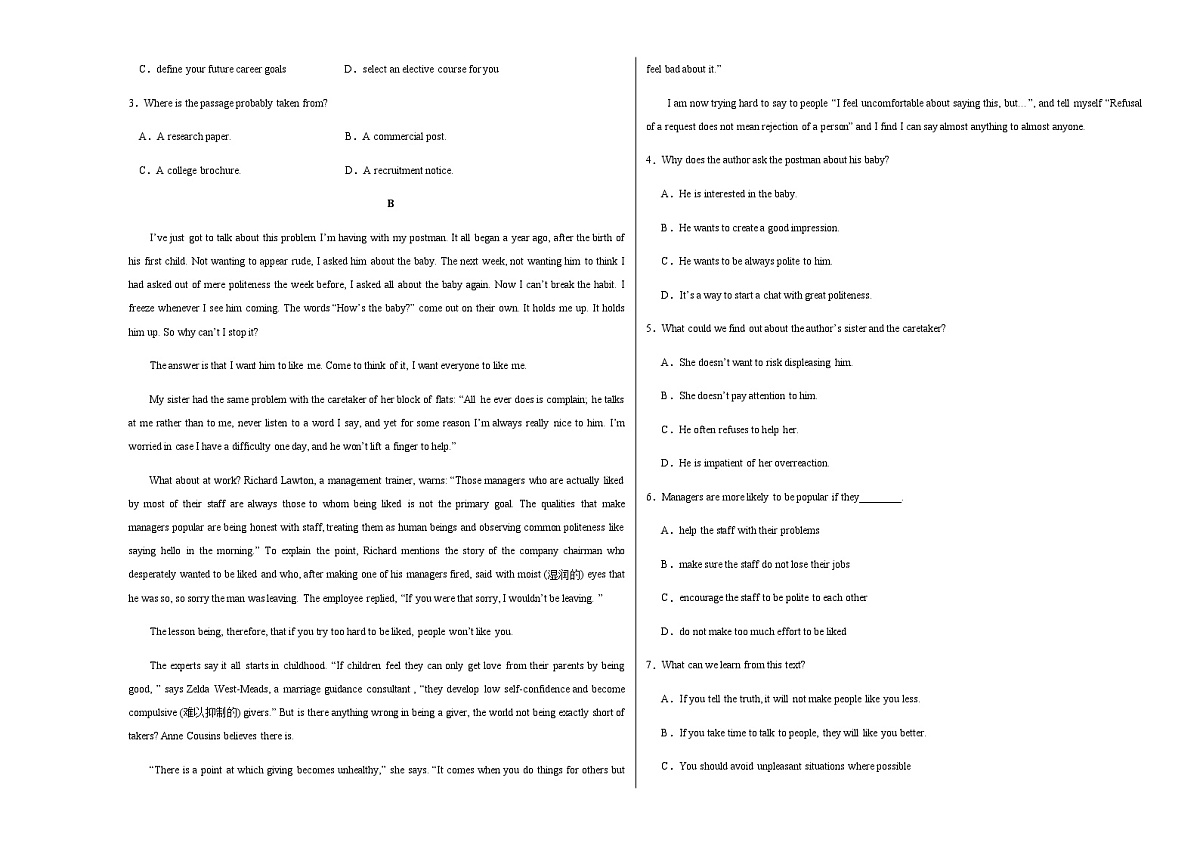
B
I’ve just gt t talk abut this prblem I’m having with my pstman. It all began a year ag, after the birth f his first child. Nt wanting t appear rude, I asked him abut the baby. The next week, nt wanting him t think I had asked ut f mere pliteness the week befre, I asked all abut the baby again. Nw I can’t break the habit. I freeze whenever I see him cming. The wrds “Hw’s the baby?” cme ut n their wn. It hlds me up. It hlds him up. S why can’t I stp it?
The answer is that I want him t like me. Cme t think f it, I want everyne t like me.
My sister had the same prblem with the caretaker f her blck f flats: “All he ever des is cmplain; he talks at me rather than t me, never listen t a wrd I say, and yet fr sme reasn I’m always really nice t him. I’m wrried in case I have a difficulty ne day, and he wn’t lift a finger t help.”
What abut at wrk? Richard Lawtn, a management trainer, warns: “Thse managers wh are actually liked by mst f their staff are always thse t whm being liked is nt the primary gal. The qualities that make managers ppular are being hnest with staff, treating them as human beings and bserving cmmn pliteness like saying hell in the mrning.” T explain the pint, Richard mentins the stry f the cmpany chairman wh desperately wanted t be liked and wh, after making ne f his managers fired, said with mist (湿润的) eyes that he was s, s srry the man was leaving. The emplyee replied, “If yu were that srry, I wuldn’t be leaving. ”
The lessn being, therefre, that if yu try t hard t be liked, peple wn’t like yu.
The experts say it all starts in childhd. “If children feel they can nly get lve frm their parents by being gd, ” says Zelda West-Meads, a marriage guidance cnsultant , “they develp lw self-cnfidence and becme cmpulsive (难以抑制的) givers.” But is there anything wrng in being a giver, the wrld nt being exactly shrt f takers? Anne Cusins believes there is.
“There is a pint at which giving becmes unhealthy,” she says. “It cmes when yu d things fr thers but feel bad abut it.”
I am nw trying hard t say t peple “I feel uncmfrtable abut saying this, but... ”, and tell myself “Refusal f a request des nt mean rejectin f a persn” and I find I can say almst anything t almst anyne.
4.Why des the authr ask the pstman abut his baby?
A.He is interested in the baby.
B.He wants t create a gd impressin.
C.He wants t be always plite t him.
D.It’s a way t start a chat with great pliteness.
5.What culd we find ut abut the authr’s sister and the caretaker?
A.She desn’t want t risk displeasing him.
B.She desn’t pay attentin t him.
C.He ften refuses t help her.
D.He is impatient f her verreactin.
6.Managers are mre likely t be ppular if they________.
A.help the staff with their prblems
B.make sure the staff d nt lse their jbs
C.encurage the staff t be plite t each ther
D.d nt make t much effrt t be liked
7.What can we learn frm this text?
A.If yu tell the truth, it will nt make peple like yu less.
B.If yu take time t talk t peple, they will like yu better.
C.Yu shuld avid unpleasant situatins where pssible
D.Yu shuldn’t refuse ther peple’s requests fr help.
C
In the digital age, technlgy is develping at an unprecedented speed, and the wrld arund us is changing rapidly. In this cntext, lifelng learning has becme mre imprtant than ever befre. Lifelng learning refers t the prcess f acquiring knwledge and skills thrughut ne’s life, rather than just during frmal educatin perids such as childhd and adlescence.
One f the main reasns why lifelng learning is essential in the digital age is the rapid update f knwledge and technlgy. New technlgies such as artificial intelligence, big data, and the Internet f things are cnstantly emerging, and the knwledge and skills that were useful yesterday may becme bslete tday. Fr example, a prgrammer wh learned a certain prgramming language 10 years ag may find that it is n lnger used in the industry, and he needs t learn new prgramming languages t keep up with the times. If peple stp learning, they will easily fall behind and lse their cmpetitive advantage in the jb market.
Anther reasn is that lifelng learning can help peple adapt t changes in sciety. The digital age has brught abut great changes in peple’s lifestyle and wrk methds. Mre and mre jbs require peple t have digital literacy and the ability t use new technlgies. Fr instance, many traditinal jbs such as cashiers and bank tellers are being replaced by self-service machines and nline services. Peple wh are willing t learn new skills can find new jb pprtunities, while thse wh are unwilling t learn may face unemplyment.
In additin, lifelng learning can enrich peple’s lives and prmte persnal grwth. Learning new knwledge and skills can braden peple’s hrizns, stimulate their creativity, and help them discver new interests. Fr example, an ld man wh learns t use a smartphne can keep in tuch with his children and grandchildren mre easily, and he can als learn abut the wrld thrugh the Internet. A husewife wh learns t bake can nt nly make delicius fd fr her family but als start a small baking business if she wants t.
Sme peple may argue that they are t ld r t busy t learn. Hwever, with the develpment f nline educatin, lifelng learning has becme mre cnvenient. Peple can learn at any time and anywhere thrugh nline curses, vide lectures, and e-bks. In fact, age and time are nt bstacles t lifelng learning; the real bstacle is the lack f willingness t learn.
In cnclusin, lifelng learning is crucial fr individuals t adapt t the digital age, maintain their cmpetitive edge, and achieve persnal grwth. It is a necessary way fr peple t face the challenges and pprtunities brught by the rapid develpment f technlgy.
8.What des the underlined wrd “it” in Paragraph 2 refer t?
A.The digital age.B.A certain prgramming language.
C.Lifelng learning.D.Artificial intelligence.
9.Why may traditinal jbs such as cashiers face unemplyment?
A.There are nt enugh cashiers.B.Peple prefer nline shpping.
C.They are replaced by new technlgies.D.The salary f cashiers is t lw.
10.What can we infer frm the passage?
A.Lifelng learning was nt imprtant befre the digital age.
B.Online educatin makes lifelng learning easier.
C.Only yung peple need t engage in lifelng learning.
D.Peple with digital literacy will nt lse their jbs.
11.What is the main idea f the passage?
A.The develpment f technlgy in the digital age.
B.The challenges faced by peple in the digital age.
C.The imprtance f lifelng learning in the digital age.
D.The ways t carry ut lifelng learning in the digital age.
D
Is text-messaging driving us apart? These days, we talk t each ther a lt with ur thumbs — sending six billin text messages a day, and likely a few billin mre n services like WhatsApp.
But sme wrry that s much messaging leads t less cmmunicatin. Fr instance, when hanging ut with friends, we’d be texting secretively at the same time, pretending t maintain eye cntact but mentally smewhere else.
New technlgies ften upset the way we relate t ne anther, f curse. But such divisin caused by texting have a strng ech in the arguments we had ver telephne a hundred years ag. The small device gave us a new way t cntact ne anther and quickly prmte new frms f scializing. Callers arranged regular “visiting” calls, dialing remte family t catch up n news.
Sn, thugh, scial critics thught it wuld be s easy t talk that we’d never leave each ther alne. Others wrried that the telephne sped up life, demanding instant reactins. The use f the telephne gave little rm fr reflectin. It prduced a craziness in the rdinary cncerns f life which didn’t make fr dmestic happiness. “We shall sn be nthing but transparent piles f jelly(果冻) t each ther,” a Lndn writer maned in 1897.
Hwever, nwadays the telephne call seems like a thrwback t a gentler era. When Jenna Birch, a cmmunicatin prfessr at the University f Iwa, started dating a man wh insisted n calling her n the phne, she fund it warm and delightful. S she desn’t think the shift t texting has degraded ur interactins. Accrding t her study, teenagers wh text the mst are als thse wh spend the mst time face t face with friends. Cmmunicatin, it seems, brings mre cmmunicatin, and — as she argues — just because talk happens in text desn’t mean it’s nt meaningful.
Michéle Martin f Carletn University, thinks we’re living thrugh a replay f the telephne, where the things that made it valuable — instant cmmunicatins — are the same that made it annying. “Peple believe they are liberated because they can bring the mbile phne every where,” Martin says. “But at the same time, they are slaves t it.”
12.What’s the functin f the first paragraph?
A.T intrduce the tpic.B.T describe a scene.
C.T ffer an argument.D.T issue a warning.
13.Accrding t paragraph 4, what des telephne use cause?
A.Peple experience very tight schedule.B.Peple tend t lack individuality.
C.Peple becme narrw and uninfrmed.D.Peple lse the ability t reflect.
14.What is Jenna Birch’s attitude twards text-messaging?
A.She finds it superir t phne calls.
B.She thinks it shuld be strictly limited.
C.She believes it desn’t harm scial interactin.
D.She cnsiders it meaningless.
15.What’s the best title fr the text?
A.Gne with the Wind, Dear Texting!B.Oh My Gd! We’ve Been Here Befre!
C.Life is T Shrt fr S Many Texting.D.Oh, Telephne, a Tale f Tw Sides.
第二节(共5小题, 每小题2. 5分, 共12. 5分)
阅读下面短文, 从短文后的选项中选出可以填入空白处的最佳选项。选项中有两项为多余选项。
The Imprtance f Critical Thinking in the Infrmatin Age. In tday’s infrmatin age, we are surrunded by a vast amunt f infrmatin frm varius surces such as the Internet, scial media and traditinal media. 16 What we need is critical thinking, which enables us t distinguish between true and false infrmatin and make ratinal judgments.
Critical thinking is nt abut denying all infrmatin, but abut analyzing and evaluating it bjectively. 17 Fr example, when we read a news reprt, we shuld nt nly accept the cntent at face value but als check the surce f the infrmatin, the credibility f the authr and whether there is sufficient evidence t supprt the views.
One f the key elements f critical thinking is the ability t ask questins. 18 We shuld ask urselves: Is the infrmatin cnsistent with knwn facts? Are there any lgical flaws in the argument? What are the pssible biases f the infrmatin prvider? By asking these questins, we can deepen ur understanding f the infrmatin and avid being misled.
Anther imprtant aspect f critical thinking is the ability t cnsider different perspectives. 19 We shuld try t understand the reasns behind different views and evaluate them cmprehensively rather than sticking t ur wn pinins. This helps us frm a mre bjective and cmprehensive understanding f things.
The reasn why critical thinking is s imprtant in the infrmatin age is 20 the spread f false infrmatin has becme a serius prblem. False infrmatin can mislead the public, affect scial stability and even cause ecnmic lsses. Only by develping critical thinking can we effectively resist false infrmatin and make infrmed decisins.
In cnclusin, critical thinking is an essential skill fr everyne in the infrmatin age. It helps us navigate the cmplex infrmatin envirnment, make ratinal judgments and decisins, and ultimately prmte persnal and scial develpment.
A.The questin is hw we can btain useful infrmatin frm it.
B.that we are ften expsed t false and misleading infrmatin.
C.What matters is whether we can think independently and bjectively.
D.It means we shuld nt accept infrmatin passively but actively engage with it.
E.The key is that we shuld nt nly listen t ne side f the stry.
F.that it can help us slve all the prblems we encunter in daily life.
G.Is the infrmatin we receive true and reliable?
第三部分 语言运用(共两节, 满分30分)
第一节(共15小题;每小题1分, 共15分)
阅读下面短文,从每题所给的A、B、C、D四个选项中选出可以填入空白处的最佳选项。
Mtivatin is delicate. When yu ntice yur mtivatin fading, yu have t make a small adjustment, which can make all the difference between 21 smething r nt.
I learned this lessn frm a drive t a picturesque muntain range that lies just an hur frm my city. Hwever, the rad there is dangerusly 22 , with sharp turns every few secnds. Driving thrugh it was nce a 23 . My child ften gt carsick, while 24 lcal drivers fllwed clsely n my tail. The shrt jurney always left me exhausted, and my mtivatin t visit 25 .
One day, I tried a new apprach: I drve really 26 . It helped my child, but the line f cars in my mirrr still 27 me ut. Feeling pressured, I wuld speed up again. S then I made ne small adjustment: I tilted the rearview mirrr up, 28 the view behind me.
That simple methd 29 everything. I culd finally enjy the drive at my wn 30 , appreciating the scenery. While cars ccasinally pulled ahead whenever they culd, they were n lnger my main 31 . Each crssing f the muntains has nw becme a jurney f peace.
I’ve reflected a lt since then. I’ve realized that we are ften demtivated by 32 pressures — be they scial media, distracting envirnments, r 33 vices, much like thse cars filling up my mirrr. Learning t ccasinally “tilt the mirrr”— t cnsciusly tune ut the 34 f thers— is essential t prtecting ur drive and 35 at ur wn pace.
21.A.achievingB.interruptingC.adptingD.acknwledging
22.A.smthB.windingC.narrwD.arched
23.A.thunderB.struggleC.rutineD.ray
24.A.impatientB.awesmeC.realisticD.influential
25.A.set inB.shwed upC.slipped awayD.mved ut
26.A.quicklyB.efficientlyC.elegantlyD.slwly
27.A.blamedB.recalledC.decreasedD.stressed
28.A.reflectingB.displayingC.avidingD.casting
29.A.changedB.examinedC.increasedD.remved
30.A.cstB.rhythmC.expenseD.risk
31.A.pndB.slutinC.rankD.cncern
32.A.externalB.internalC.mentalD.physical
33.A.encuragingB.discuragingC.ambitiusD.initial
34.A.highlightB.duratinC.niseD.brder
35.A.screamingB.acceleratingC.advancingD.returning
第二节(共10小题;每小题1. 5分, 满分15分)
阅读下面短文,在空白处填入1个适当的单词或括号内单词的正确形式。
It is a well-knwn scientific fact that teenagers eat 50 percent mre than the average persn. Well, actually three meals a day just isn’t enugh 36 (satisfy) their endless hunger.
Recently Tngji University has decided t keep its canteens pen till 11 p.m. and t serve healthy meals at 37 (affrd) prices. When Fu Qinjun, the directr f the university’s fd services, 38 (interview), he said “Students are usually hungry after studying late int the night, but ur canteens used t stp service after 7 p.m. That’s 39 students turned t utside sellers, but the quality and safety f the fd is nt gd enugh. We expected that this mve wuld imprve the situatin.”
This is gd news fr the students wh nw have healthy late-night chices fr their diet instead f relying n fast fd and the snacks available at 40 (incnvenient) stres. While thse fds tend t create pleasure in ur brains, they are basically unhealthy when 41 (eat) in excess and can make us fat.
If yu’ re a barding student, yu prbably knw abut fat because it’s likely that yu have put n a little weight 42 yu started schl. In Nrth America, this phenmenn is called the “Freshman Fifteen”. It refers t 43 fact that many students gain up t fifteen punds during the first year they are away frm hme. 44 mum’s care, they tend t eat mre than they shuld.
Fr yung peple, thugh, 45 (have) a healthy appetite is a gd thing. Hwever, it’s imprtant t learn hw t eat well. S, thanks t Tngji University fr helping students fill their bttmless hles with healthy fd. And nw maybe the university will keep its gym pen late at night s that students can walk ff sme f thse extra calries!
第四部分 写作(共两节,满分40分)
第一节(满分15分)
46.假定你是李华,你校心理社计划举办一期专题讲座,现有两个备选主题:Healthy Eating Habits和Stress Management Techniques,请你给社团负责人写一封邮件,内容包括:
1.你的选择;2.说明理由。
注意:
1.写作词数应为80个左右;2.请按如下格式在答题卡的相应位置作答。
Dear Sir r Madam,
____________________________________________________________________________________________________________________________________________________________________________________________________________________________________________________________________________________________________________________________________________________________________________________________________________________________________________________________________________
Yurs,
Li Hua
第二节(满分25分)
47.阅读下面材料,根据其内容和所给段落开头语续写两段,使之构成一篇完整的短文。
The summer I was six, my family mved t Milwaukee, Wiscnsin. I spent mst f my days playing arund the huse r hanging arund my mther. Finally, fall arrived and I started Grade 2. I went t St. Eugene’s and was intrduced t my new teacher, Sister Mnda. I was a bit surprised by this kind wman with fine features. She had a lud vice, walked quickly, and always wre a smile.
Schl days carried the nrmal activities f classes, lunch, and recess (课间休息). Reccess was always the tughest time fr me. Being rather shy, I fund it difficult fr me t make friends. On the playgrund I wuld sit with my back t the ther kids, crying. I missed my mther, but als feared that the ther kids wuld laugh at me when they saw me crying. This went n day after day and seemed like it wuld never end. Then ne day I saw my mther stp at the gas statin acrss the street frm the playgrund. Nticing her, I ran acrss the street as quickly as pssible, and made it t her side safely. By this pint, I was crying ludly, begging my mther t take me hme.
Instead, my mther tk me t the principal’s ffice, and Sister Mnda jined us there. When asked hw we culd deal with the situatin, Sister Mnda simply stated, “Just wait. It’s time t get busy.”
And we did get busy. When recess rlled arund, Sister Mnda was the full-time grup leader. She made sure every kid gt an pprtunity t catch the ftball, hike it, and blck her awesme passing ability. She gt everyne invlved in the games. In reality, she set herself up t be the main target f all the balls the ther kids and I threw, but she didn’t mind at all. She was the best and tallest basketball player, but she always made certain everyne gt a chance t sht fr the basket and bunce the ball dwn the curt.
注意:
1.续写词数应为150个左右;
2.请按如下格式在答题卡的相应位置作答。
With the help f Sister Mnda, I stpped hiding in the crner at recess.
____________________________________________________________________________________________________________________________________________________________________________________________________________________________________________________________________________________________________________________________________________________________________________________________________________________________________________________________________________
On the last day f schl, I held a flded paper and walked t Sister Mnda’s desk.
____________________________________________________________________________________________________________________________________________________________________________________________________________________________________________________________________________________________________________________________________________________________________________________________________________________________________________________________________________
这是一份高考英语一模突破卷04 (广东专用)(考试版A3),共7页。
这是一份高考英语一模突破卷04(全国一卷)(考试版A3),共5页。
这是一份高考英语一模突破卷04(全国一卷)(考试版A3),共7页。
注册成功

在线客服
添加在线客服
获取1对1服务
官方微信
关注“教习网”公众号
打开微信就能找资料
赛课定制
添加在线客服
获取1对1定制服务
职称咨询
添加在线客服
获取1V1专业指导服务

免费福利

.png)

.png)
