免费领取教师福利


若您为此资料的原创作者,认为该资料内容侵犯了您的知识产权,请扫码添加我们的相关工作人员,我们尽可能的保护您的合法权益。


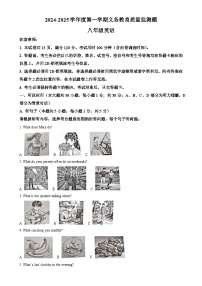
这是一份广东省阳江市阳东区八年级上学期期末英语试题(解析版)-A4,共18页。
1.全卷共8页,满分120分,考试用时为90分钟。
2.答卷前,用黑色字迹的签字笔或钢笔在答题卡填写相应的信息,用2B铅笔把对应该号码的标号涂黑。
3.选择题每小题选出答案后,用2B铅笔把答题卡上对应题目选项的答案信息点涂黑,如需改动,用橡皮擦干净后,再选涂其他答案,答案不能答在试题上。
4.非选择题必须用黑色字迹钢笔或签字笔作答、答案必须写在答题卡各题目指定区域内相应位置上; 如需改动,先划掉原来的答案,然后再写上新的答案; 不准使用铅笔和涂改液,不按以上要求作答的答案无效。
5.考生务必保持答题卡的整洁,考试结束时,将试卷和答题卡一并交回。
一、听说应用 (本大题共30小题,每小题1分,共30分; A、B、C、D部分为听力理解,E部分为情景对话)
A.听句子 (本题共5小题,每小题1分,共5分)
请根据所听内容,选择符合题意的图画回答问题。每个句子听两遍。
1. Which subject is his sister interested in at schl?
A. B. C.
2. Where will Steve g tmrrw?
A. B. C.
3. Hw much mney did Jim pay fr the T-shirt?
A. B. C.
4. When did Rick visit the Palace Museum?
A. B. C.
5. What is Ken ging t be when he grws up?
A. B. C.
B. 听对话 (本题共 10小题, 每小题1分, 共 10分)
请根据每段对话的内容回答问题,从每小题所给的三个选项中选出一个最佳答案。每段对话听两遍。
6. Can Anna cme t Jhn’s party?
A. Yes, she can. B. N, she can’t. C. We dn’t knw.
7. What club des Linda want t jin?
A. The dance club. B. The art club. C. The chess club.
8. What’s Paul’s sn’s favrite fruit?
A. Apples. B. Oranges. C. Bananas.
9. Where are the speakers?
A. At hme. B. At schl. C. In the stre.
10. What des Peter want t make fr Lunch?
A. A banana milk shake B. A cheese sandwich. C. A chicken sandwich.
听对话,回答以下各小题。
11. What is Mike gd at?
A. Cycling. B. Swimming. C. Skating.
12. Which team is Linda in?
A. The cycling team. B. The rwing team. C. The tennis team.
听对话,回答以下各小题。
13. What will Linda be in twenty years?
A. A teacher. B. An astrnaut. C. A driver.
14. Hw will she get t the mn and Mars?
A. Fly rckets. B. By train. C. By car.
15. Where will she live in the future?
A. In the sea. B. On the mn. C. On a space statin.
C.听短文 (本题共5小题,每小题1分,共5分)
请根据所听内容,从每小题所给的三个选项中选出一个最佳答案。短文听两遍。
听短文,回答以下各小题。
16. Hw will Amy and Grace g t the cinema?
A. By bike. B. By subway. C. By bus.
17. What mvie will Amy and Grace watch?
A. An actin mvie. B. A cartn. C. A cmedy.
18. Where will Amy and Grace g after the mvie?
A. A music club. B. A shp. C. A sprts club.
19. Wh will ck dinner?
A. Amy. B. Grace. C. Amy and Grace.
20. When will Amy spend time with Grace?
A. Next Sunday. B. Next Saturday. C. This Saturday.
D.听填信息 (本题共5小题,每小题1分,共5分)
你将听到一篇短文。请根据所听内容填写下面的信息卡。短文听两遍。
E.情景对话 (本题共5小题,每小题1分,共5分)
请通读下面对话,根据对话内容,从选项中选出能填入空白处的最佳选项,选项中有一项为多余选项。
Alice: Gina, yur picture lks wnderful! ____1____
Gina: N, I’m nt. Drawing is nly a hbby.
Alice: ____2____
Gina: I want t be a dctr.
Alice: Ww! ____3____
Gina: I’m ging t study medicine at a university after finishing high schl.
Alice: That’s great! ____4____
Gina: In Lndn. Yu knw my uncle and aunt wrk there. What abut yu, Alice?
Alice: ____5____
Gina: Try yur best and yu can be anything yu want.
A Hw are yu ging t d that?
B. Where are yu ging t wrk after that?
C. Why d yu want t be a dctr?
D. Are yu ging t be an artist when yu grw up?
E. What d yu want t be in the future?
F. I’m ging t be a teacher, but I’m nt sure abut it.
【答案】1. D 2. E 3. A 4. B 5. F
【解析】
【导语】本文是爱丽丝和吉娜讨论未来想做什么的一则对话。
【1题详解】
根据“N, I’m nt. Drawing is nly a hbby.”可知,此处是一个以be动词开头的一般疑问句,选项D“你长大后要当艺术家吗?”符合语境,故选D。
【2题详解】
根据“I want t be a dctr.”可知,询问对方想要做什么,选项E“你将来想做什么?”符合语境,故选E。
【3题详解】
根据“I’m ging t study medicine at a university after finishing high schl.”可知,询问对方打算怎么做,选项A“你打算怎么做呢?”符合语境,故选A。
【4题详解】
根据“In Lndn.”可知,对地点提问,选项B“那之后你打算去哪里工作?”符合语境,故选B。
【5题详解】
根据“What abut yu, Alice?”可知,反问爱丽丝未来想要做什么,选项F“我要成为一名教师,但我不确定。”符合语境,故选F。
二、语法选择(本题有10小题,每小题1分,共10分)
通读下面短文,掌握其大意,然后按照句子结构的语法和上下文连贯的要求,从每题所给的三个选项中选出一个最佳答案。
通读下面短文,掌握其大意,然后按照句子结构的语法和上下文连贯的要求,从每题所给的三个选项中选出一个最佳答案,并将答题卡上对应题目所选的选项涂黑。
“The grass lks greener n the ther side f the fence (栅栏).” That’s ___6___ ld saying in English. It means ther places ften lk better and ___7___ than the place where yu live. These days, many peple wrry that sme yung Chinese may ___8___that way.
Sme yung Chinese becme less interested ___9___ Chinese culture. Instead, they like Japanese ___10___ and Krean sap peras. Freign bks and shws are gd, but Chinese writers and actrs are ___11___ excellent and famus, such as M Yan , Jackie Chan and s n. What’s mre, ___12___ sme freign festivals are nice, they can’t have the special meanings fr Chinese. We all knw that friend lines s is ne f the best parts f Chinese culture. Nt all cuntries are as ___13___ as China.
It’s gd ___14___ ther cultures and t learn frm them, but they cannt take the place f ur wn culture. If yu learn mre abut Chinese culture, yu ___15___ it mre. Yu will find that the grass isn’t always greener n the ther side f the fence.
6.
A. aB. /C. an
7.
A. interestingB. mre interestingC. mst interesting
8.
A. feelsB. feltC. feel
9.
A. inB. frC. t
10.
A. cartn bkB. cartn bksC. cartns bk
11.
A. tB. eitherC. als
12.
A. althughB. butC. s
13.
A. friendlyB. friendlierC. friendliest
14.
A. enjysB. enjyC. t enjy
15.
A. will lveB. lveC. lved
【答案】6. C 7. B 8. C 9. A 10. B 11. C 12. A 13. A 14. C 15. A
【解析】
【导语】本文是一篇说明文。主要讨论了年轻一代中国人外国文化的偏好,建议年轻人需要更多地了解中国文化。
【6题详解】
句意:“草在篱笆外看起来更绿。”这是一个英语中的古老谚语。
a一,不定冠词,用于以辅音音素开头的单词前;/零冠词;an一,不定冠词,用于以元音音素开头的单词前。根据“That’s…ld saying in English.”可知,此处指的应是一个英语中的古老谚语,且ld是以元音音素开头的单词,前面应用不定冠词an修饰。故选C。
【7题详解】
句意:它意味着其他地方通常看起来比你所在的地方看起来更好,更有趣。
interesting有趣,形容词;mre interesting更有趣,形容词比较级;mst interesting最有趣,形容词最高级。根据“better and…than”可知,此处应是用形容词比较级。故选B。
【8题详解】
句意:这些天,许多人担心一些年轻的中国人可能会有这种感觉。
feels感觉,动词第三人称单数;felt感受到,动词过去式;feel感受,动词原形。根据“may”可知,may为情态动词,后接动词原形。故选C。
【9题详解】
句意:一些年轻的中国人对中国文化的兴趣变得不那么浓厚。
in在;fr为了;t对于。根据“Sme yung Chinese becme less interested…Chinese culture.”可知,此处是一个常用短语becme interested in“对……感兴趣”。故选A。
【10题详解】
句意:相反,他们喜欢日本的卡通书和韩国的肥皂剧。
cartn bk卡通书,单数名词;cartn bks卡通书,复数名词;cartns bk,错误表达。根据“Instead, they like Japanese…and Krean sap peras.”可知,此处日本的卡通书应为名词复数形式。故选B。
【11题详解】
句意:外国的书籍和节目固然好,但中国的作家和演员也同样优秀和著名,比如莫言、成龙等等。
t也,用于肯定句句尾;either也,用于否定句句尾;als也,用于肯定句和否定句句中。根据“but Chinese writers and actrs are…excellent and famus,”可知,此处位于肯定句句中。故选C。
【12题详解】
句意:而且,尽管一些外国的节日很不错,但它们对中国人来说并没有特殊的意义。
althugh虽然;but但是;s所以。根据“…sme freign festivals are nice, they can’t have the special meanings fr Chinese.”可知,此处应填althugh引导让步状语从句,表示虽然或尽管。故选A.
【13题详解】
句意:并非所有国家都像中国一样友好。
friendly友好的,形容词;friendlier更友好的,形容词比较级;friendliest最友好的,形容词最高级。根据“as…as”可知,as+adj/adv+as,意为“和……一样”,表示同级的比较。故选A。
【14题详解】
句意:欣赏其他文化并向其学习是好事,但它们不能取代我们自己的文化。
enjys喜欢,动词第三人称单数;enjy喜欢,动词原形;t enjy喜欢,动词不定式。根据“It’s gd…ther cultures…”可知,此处是一个常用表达it’s gd t d sth“很高兴做某事”。故选C。
【15题详解】
句意:如果你更多地了解中国文化,你会更加欣赏它。你会发现,草并不总是篱笆外更绿的。
will lve将会爱,一般将来时;lve爱,一般现在时;lved爱过,一般过去时。根据“If yu learn mre abut Chinese culture, yu…it mre.”可知,if引导的条件状语从句,遵循主将从现的原则,从句是一般现在时,主句应是一般将来时。故选A。
三、完形填空 (本大题有10小题,每小题1分,共10分)
通读下面短文,掌握其大意,然后在每小题所给的四个选项中,选出一个最佳答案。
The Spring Festival is ur Chinese peple’s special festival. It ____16____ in January r February. There are twelve different animal names ____17____ each Chinese year. They are muse, tiger, rabbit, chicken, dragn ____18____. This year is the year f snake(蛇).
____19____ the Spring Festival, peple are busy shpping and cleaning their huses. Every family ____20____ many kinds f fd and drinks. On the eve f the festival, there is ____21____ a big family dinner. Peple like eating jiazi—dumplings. It ____22____ “reunin(团聚)”and “gd luck.” After dinner all the family stay up ____23____ the New Year. They ften watch TV and play games.
On the first day f the lunar New Year, peple ____24____ their new clthes and g t visit relatives(亲戚) and friends. They say “Happy New Year” and give the best wishes t _____25_____. Everyne has a great time.
16. A. will cmeB. cmesC. cameD. is cming
17. A. frB. inC. nD. t
18. A. later nB. right awayC. and s nD. as well
19. A. AfterB. OnC. WhenD. Befre
20. A. preparesB. are preparingC. prepare frD. prepared
21. A. neverB. seldmC. smetimesD. always
22. A. meantB. meansC. likeD. likes
23. A. welcmeB. stpC. t welcmeD. t stp
24. A. wear inB. put nC. dressD. be in
25. A. every therB. the thersC. each therD. ne ther
【答案】16. B 17. A 18. C 19. D 20. A 21. D 22. B 23. C 24. B 25. C
【解析】
【导语】本文讲述了在中国农历年,人们通常做的事,包括购物、打扫房子、吃年夜饭等活动。
【16题详解】
句意:它在一月或二月到来。
will cme“来”,动词的一般将来时;cmes“来”,动词的一般现在时;came“来”,动词的一般过去时;is cming“来”,动词的现在进行时。句子描述客观事实,应用一般现在时。故选B。
【17题详解】
句意:每个中国年,有12个不同的动物名称。
fr“为了”;in“在(某段时间)内”;n“在(某天)”;t“向”。“为了”每个中国年,有不同的动物,表供应关系,“为了”符合语境。故选A。
【18题详解】
句意:他们是鼠、虎、兔、鸡、龙等。
later n“后来”;right away“立刻”;and s n“等等”;as well“也”。根据“There are twelve different animal names”可知,未罗列完全,应用“等等”。故选C。
【19题详解】
句意:春节之前,人们忙于购物和打扫房子。
after“在……后”;n“在(某天)”;when“当……时”;befre“在……之前”。根据常识可知,人们常在春节前打扫和购物。故选D。
【20题详解】
句意:每家都会准备各种食物和饮料。
prepares“准备”,动词一般现在时;are preparing“正准备”,动词现在进行时;prepare fr“为……做准备”;prepared“准备”,动词一般过去时。文章为一般现在时,prepare fd and drinks“准备食物和饮料”,符合语境。故选A。
【21题详解】
句意:在春节前夕,总是有一个大的家庭聚餐。
never“从来”;seldm“很少”;smetimes“有时”;always“总是”。根据句意可知,“总是”有一个家庭聚餐,符合句意。故选D。
【22题详解】
句意:它意味着“团聚”和“好运”。
meant“意思是”,动词一般过去时;means“意思是”,动词一般现在时第三人称单数形式;like“喜欢”,一般现在时复数形式;likes“喜欢”;一般现在时第三人称单数形式。句子描述客观事实,应用一般现在时,它“意味着”团聚和好运,符合句意。故选B。
【23题详解】
句意:晚饭后,所有家人熬夜来欢迎新年。
welcme“欢迎”;stp“停止”;t welcme“欢迎”,动词不定式;t stp“停止”,动词不定式。根据句意可知,应用动词不定式形式表示目的,排除A、B项。welcme New Year“欢迎新年”符合语境。故选C。
【24题详解】
句意:在农历新年的第一天,人们穿上他们的新衣服并且走亲访友。
wear in“穿着”;put n“穿上”;dress“穿衣服”;be in“穿着”。此处强调“穿上”衣服的动作,应用put n。故选B。
【25题详解】
句意:他们说“新年快乐”来表达他们对彼此的最好的祝愿。
every ther“其余的;剩下的”;the thers“剩余的”,后不能跟名词;each ther“彼此”;ne ther“另外一个”。根据句意可知,“彼此”表达祝愿,符合语境。故选C。
四、阅读理解 (本大题有15小题,每小题2分,共30分)
阅读A、B两篇短文、从每小题所给的四个选项中,选出能回答所提问题或完成所给句子的最佳答案。
A
This summer vacatin, many students went t sme places f interest. Let’s see where they went and what their trips were like.
26. Wh went t Xi’an this summer vacatin?
A. Bruce. B. Diana. C. HelenD. Jasn.
27. Jasn ________ n his vacatin.
A. ate delicius fdB. went shpping
C. went batingD. saw sme muntains
28. Peple in ________ are gd at dancing and singing.
A. Xi’anB. Hng KngC. HainanD. Tibet
29. Which f the fllwing is TRUE?
A. Helen went t Xi’an by plane.
B. Jasn liked ging bating n the sea.
C. Diana visited Disneyland.
D. Bruce visited his uncle in Tibet.
30. Where may the passage cme frm?
A. Travel ntes. B. A fd magazine.
C. A strybk. D. A sprts newspaper.
【答案】26. C 27. B 28. D 29. D 30. A
【解析】
【导语】本文主要介绍了几个学生的暑假旅行。
【26题详解】
细节理解题。根据“I went t Xi’an with my cusin —Helen”可知Helen去了西安。故选C。
【27题详解】
细节理解题。根据“And we bught many special things. —Jasn”可知Jasn在假期购物了。故选B。
【28题详解】
细节理解题。根据“My uncle wrks in peple there are gd at singing and dancing”可知西藏的人擅长唱歌和跳舞。故选D。
【29题详解】
细节理解题。根据“My uncle wrks in Tibet (西藏). Last summer, I tk a train t visit him —Bruce”可知Bruce去西藏看望他的叔叔。故选D。
【30题详解】
推理判断题。本文主要介绍了几个学生的暑假旅行,故文章可能来自旅行笔记。故选A。
B
The cmputer changed ur lives in the 1980s, the Internet changed ur lives in the 1990s, and the rbts will change ur lives in the new century. D yu think there will be rbts in peple’s hmes? It’s NOT a dream that every hme will have a rbt.
Nw rbts are nt nly able t help peple d the husewrk, but als able t help the dctrs d the difficult peratins (手术), play chess with peple, play the pian and s n.
A new cking rbt is used in Beijing. It can ck all the dishes n the menu, and yu nly need t wait tw t fur minutes. In the future, the rbt will be a nurse, a security guard (保安人员) r a friend in yur life.
Scientists believe rbts will be used everywhere, frm industrial (工业的) rbts t service rbts. In the future, rbts will becme part f the family, and give clse service t peple. We all lk frward t the new rbt age.
31. ________ changed ur lives in the 1990s.
A. The rbtB. The cmputerC. The TV setD. The Internet
32. A new cking rbt is used in ________.
A. ShanghaiB. BeijingC. NanjingD. Lndn
33. The underlined wrd “age” in the last paragraph means ________.
A. yearB. timeC. lifeD. wrk
34. Which f the fllwing can’t rbts d accrding t the passage?
A. Help peple d the husewrk.
B. Help the dctrs d the difficult peratins.
C. Play chess with peple.
D. Shp fr fd and drinks.
35. What’s the passage mainly abut?
A. Rbts.B. The Internet. C. Husewrk. D. Cmputers.
【答案】31. D 32. B 33. B 34. D 35. A
【解析】
【导语】本文主要讲述了机器人在我们生活中的应用,以及未来机器人如何改变我们的生活。
【31题详解】
细节理解题。根据“the Internet changed ur lives in the 1990s”可知互联网在20世纪90年代改变了人们的生活。故选D。
32题详解】
细节理解题。根据“A new cking rbt is used in Beijing.”可知北京正在使用一种新型烹饪机器人。故选B。
【33题详解】
词义猜测题。根据“In the future, rbts will becme part f the family, and give clse service t peple. We all lk frward t the new rbt age.”可知我们都期待着新的机器人时代,故此处age意为“time”。故选B。
【34题详解】
细节理解题。根据“Nw rbts are nt nly able t help peple d the husewrk, but als able t help the dctrs d the difficult peratins (手术), play chess with peple, play the pian and s n.”可知现在机器人不仅能帮助人们做家务,还能帮助医生做困难的手术,和人下棋,弹钢琴等等。故选D。
【35题详解】
主旨大意题。本文主要讲述了机器人在我们生活中的应用,以及未来机器人如何改变我们的生活。故选A。
C
配对阅读。左栏是五段对未来生活的描述,右栏是七则信息。请将左栏与右栏相匹配。选项中有两项为多余项。
【答案】36. F 37. D
38. B 39. C
40. A
【解析】
【导语】本文是一篇说明文,通过对未来生活不同方面描述,展现未来生活可能发生的变化,并与相应的观点或好处进行匹配。
【36题详解】
根据“If peple see rubbish like sme paper n the rad in the future, they will pick it up. And if smene wants t destry (破坏) the envirnment, sme peple will punish (惩罚) him.”可知,人们积极处理垃圾、惩罚破坏环境的人,这对环境有积极影响。选项F“如果每个人都这样做,环境会变得越来越干净,天空会更蓝,水会更清澈”符合语境,故选F。
【37题详解】
文中提到“Rbts will be used in every family. The rbts can help us d sme husewrk. They can help dctrs lk after the sick peple. They can als d smething peple can’t d.”可知,机器人会在生活中发挥诸多作用,让生活变得轻松,出现很多有趣的事。选项D“我们的生活会变得轻松。会出现很多有趣的东西,机器人可以帮助人们做很多事情”符合语境,故选D。
【38题详解】
“Maybe peple wn’t use mney in the future. Every cuntry has its wn mney. It’s nt cnvenient fr peple t travel all ver the wrld. S the mney may be cancelled (取消).”可知,指出了货币现状带来的不便以及可能被取消的情况。选项B“如果世界上没有钱,我们的生活会非常方便。出国时我们不用担心钱的问题”符合语境,故选B。
【39题详解】
“The students dn’t need t g t schl. They stay at hme studying n cmputers. The students will have n hmewrk, s they will spend mre time ding sprts, singing, dancing r drawing.”可知,描述了未来学生的学习和生活方式改变,有更多时间参加活动。选项C“学生将从这些活动中获得更多经验,所以他们在未来会把事情做得很好”符合语境,故选C。
【40题详解】
“The clthes will be mre and mre beautiful in the future. Yu can buy all kinds f clthes yu want. And they wn’t need t be washed.”可知,提到未来衣服不用洗这一特点。选项A“如果衣服不需要洗涤,我们可以节省一些水,还可以节省一些时间去做其他事情”符合语境,故选A。
五、短文填空 (共10小题,每小题1.5分,满分15分)
请从方框内选择适当的词并用其正确形式填空,使文章完整连贯。注意每空一词,每词仅用一次,有两词为多余项。请将答案写在横线上。
Hi, everyne. My name is Lisa. Last Saturday was my birthday. My mther let me have a party t celebrate it. I was excited and called all my best ____41____. Hwever, sme f my friends culdn’t cme because they were ____42____ with hmewrk. They said they had t much hmewrk t d.
We had a fantastic time that day. At first, we played card games. Then we ____43____ a film n TV. My mther made a birthday ____44____ with chclate and fruit and we ate it when the film was playing. After the film, we went t my rm and we ____45____ t music and danced. While we were having fun, my brther came in. He said we had t turn dwn the music ____46____ he was preparing fr an imprtant exam. A few minutes ____47____,we were putting n make-up (化妆品) fr fun when my mther walked in. She asked us t g t bed, but we culdn’t sleep. We gt up again. We jumped arund n the bed. Then we started a pillw fight (枕头大战). It was ____48____ mst exciting part f the night. We all enjyed ____49____.
Finally we were very tired. We fell asleep sn, sme n the bed and sme in the sleeping bags. It was fur ’clck ____50____ the mrning. What great fun! I lved my party!
【答案】41. friends
42. busy 43. watched
44. cake 45. listened
46. because
47. later 48. the
49. urselves
50. in
【解析】
【导语】本文主要介绍了作者上周六庆祝自己生日的事情。
【41题详解】
句意:我很兴奋,给我所有最好的朋友们打了电话。根据“sme f my friends culdn’t cme”可知是给朋友打电话,friend“朋友”,用名词复数。故填friends。
【42题详解】
句意:然而,我的一些朋友不能来,因为他们忙于做作业。根据“with hmewrk”可知是忙于作业不能来,be busy with“忙于”。故填busy。
【43题详解】
句意:然后我们在电视上看了一部电影。watch a film“看电影”,句子用一般过去时,动词用过去式。故填watched。
【44题详解】
句意:我妈妈做了一个有巧克力和水果的生日蛋糕。根据“a chclate and fruit”可知是一个生日蛋糕,cake“蛋糕”,a后加可数名词单数。故填cake。
【45题详解】
句意:电影结束后,我们去了我的房间,我们听音乐并跳舞。listen t music“听音乐”,句子用一般过去时,动词用过去式。故填listened。
【46题详解】
句意:他说我们必须把音乐关小声,因为他正在准备一个重要的考试。后句是前句的原因,用because连接。故填because。
【47题详解】
句意:几分钟后,我们正在为了好玩而化妆,这时我妈妈走了进来。根据“A few minutes”可知是几分钟后,用副词later“之后”。故填later。
【48题详解】
句意:这是晚上最令人兴奋的部分。最高级前加定冠词the。故填the。
【49题详解】
句意:我们都玩得很开心。enjy neself“玩得开心”,用反身代词urselves“我们自己”。故填urselves。
【50题详解】
句意:那时是凌晨四点钟。in the mrning“在早上”。故填in。
六、读写综合(本大题分为A、B两部分,共25分)
A.回答问题 (共5小题,每小题2分,共10分)
阅读下面短文,然后根据短文内容回答问题。
One day, 7-year-ld Sarah watched her mther rasting (烤) a piece f beef sirlin (里脊). She cut ff the ends, wrapped (捆) it, cked it and finally it was OK. Then she cvered it with gravy.
When Mm served it t Sarah, Sarah asked, “Why did yu cut ff the ends f the rast, Mm? Is it a traditinal way f cking?” After thinking fr a minute, Mm answered that it was the way that her mther cked it.
That night Grandma came t dinner. Sarah and her mther asked why she cut ff the ends f the rast befre cking. After thinking, Grandma said she cked the meat the way as her mther did.
Great-grandma was quite ld and lived in a residential nursing hme (养老院) in England. One day, Sarah, her mm and grandma went t visit her and again asked the same questin.
Great-grandma was a little surprised. She lked at them and said, “S it wuld fit in (适合) the rasting plate, f curse.”
51. Hw much beef sirlin did Sarah’s mther rast?
_______________________________________________
52 What did Sarah’s mther put n the beef sirlin at last?
_______________________________________________
53. Wh taught Sarah’s mther t ck the beef sirlin in this way?
_______________________________________________
54. Why did Sarah’s grandma cut the ends f the beef sirlin ff befre cking?
_______________________________________________
55. In which cuntry did Sarah’s great-grandma live?
_______________________________________________
56. 书面表达
神话故事作为中国传统文化的一部分,对于学生了解民族文化及历史具有一定意义。请你以“A Stry I Knw”为题,根据以下要求,介绍一则神话故事及自己的读后感受。
作文要求:
1.语句通顺,意思连贯,书写工整;
2.文中不得出现你的任何真实信息 (姓名、校名和地名等);
3.词数:不少于70词。 (开头已给出,但不计入总词数。)
参考词汇:legend (n.传说);natinal (adj.民族的)。
A Stry I Knw
As an imprtant part f traditinal Chinese culture, legends are f great imprtance fr students t knw abut natinal culture and histry. ________________________________________________________________________________________________________________________________________________________________________________________________________________________________________________________________________________________________________________
【答案】51. Her mther rasted a piece f beef sirlin.
52. Her mther put gravy n the beef sirlin at last.
53. Sarah’s grandma.
54. Because she cked the meat the way as her mther did.
55. Sarah’s great-grandma lived in England.
56. 例文
A Stry I Knw
As an imprtant part f traditinal Chinese culture, legends are f great imprtance fr students t knw abut natinal culture and histry. Recently, I read a famus stry called Yu Gng Mves a Muntain.
Once upn a time, Yu Gng decided t mve the muntain because it blcked peple’s way. One day, a man tld Yu Gng that he was t weak t mve the muntain. After the man finished talking, Yu Gng cntinued mving the muntain instead f caring abut the man’s wrds. Fr a lng time, many peple laughed at Yu Gng and thught he was silly. Hwever, t their surprise, Yu Gng and his family mved the muntain at last.
This stry reminds me that we shuld never give up when we meet difficulties.
【解析】
【导语】本文主要讲述了7岁的萨拉看到妈妈烤牛里脊时切掉两端,询问原因后得知妈妈是按外婆的做法,而外婆又是按太奶奶的做法,最后当她们去英国养老院看望太奶奶时,才知道切两端是为了让牛里脊适合烤盘。
【51题详解】
根据“One day, 7-year-ld Sarah watched her mther rasting (烤) a piece f beef sirlin (里脊).”可知,她妈妈烤了一块牛里脊。故填Her mther rasted a piece f beef sirlin.
【52题详解】
根据“Then she cvered it with gravy.”可知,最后她在牛里脊上浇了肉汁。故填Her mther put gravy n the beef sirlin at last.
【53题详解】
根据“After thinking fr a minute, Mm answered that it was the way that her mther cked it.”可知,是Sarah的外婆教她妈妈这样做牛里脊的。故填Sarah’s grandma.
【54题详解】
根据“After thinking, Grandma said she cked the meat the way as her mther did.”可知,外婆这样做是因为她妈妈就是这样做的。故填Because she cked the meat the way as her mther did.
【55题详解】
根据“Great-grandma was quite ld and lived in a residential nursing hme (养老院) in England.”可知,太奶奶住在英国。故填Sarah’s great-grandma lived in England.
【56题详解】
[总体分析]
①题材:本文是一篇话题作文;
②时态:一般现在时和一般过去时;
③提示:写作要点提示和开头已给出,考试应注意要求中的内容,充实细节,并突出写作重点。
[写作步骤]
第一步,表明写作意图,说明要介绍的故事;
第二步,具体介绍故事的内容;
第三步,表达感悟和启发。
[亮点词汇]
①nce upn a time很久以前
②blck阻挡
③instead f代替
④care abut关心,在乎
⑤t ne’s surprise令某人惊讶的是
⑥remind提醒,使想起
[高分句型]
① Once upn a time, Yu Gng decided t mve the muntain because it blcked peple’s way. (because引导原因状语从句)
Telephne Message: Birthday Plan Frm: Mike T: Tm
Mrning activity: 21 with Lucy and Lily. Time t meet: at 22
Place t meet: at the 23 ớf the restaurant
Favrite fd: 24 , French fries, ice-cream and s n.
Afternn activity: g bating in 25 .
I went t Xi’an with my cusin. We visited the Terractta Army (兵马俑) and had a great time. We ate delicius fd, t. Xi’an is a big and nice city. I like it a lt.
—Helen
My parents tk me t Hng Kng by plane. We went t Disneyland. It’s just like a fairy tale kingdm (童话王国). And we bught many special things. Mst f them weren’t expensive at all.
—Jasn
Last summer, my family went t Hainan. The weather was sunny and ht. We went swimming and bating. They were exciting. Later, we ate sme seafd. It was very delicius!
—Diana
My uncle wrks in Tibet (西藏). Last summer, I tk a train t visit him. There I saw lts f tall and clean muntains. Many peple there are gd at singing and dancing.
—Bruce
___36___ If peple see rubbish like sme paper n the rad in the future, they will pick it up. And if smene wants t des try (破坏) the envirnment, sme peple will punish (惩罚) him.
___37___ Rbts will be used in every family. The rbts can help us d sme husewrk. They can help dctrs lk after the sick peple. They can als d smething peple can’t d.
___38___ Maybe peple wn’t use mney in the future. Every cuntry has its wn mney. It’s nt cnvenient fr peple t travel all ver the wrld. S the mney may be cancelled (取消).
___39___ The schl will als change a lt in the future. The students dn’t need t g t schl. They stay at hme studying n cmputers. The students will have n hmewrk, s they will spend mre time ding sprts, singing, dancing r drawing.
___40___ The clthes will be mre and mre beautiful in the future. Yu can buy all kinds f clthes yu want. And they wn’t need t be washed.
A. If the clthes dn’t need t be washed, we can save sme water and we can save sme time t d ther things.
B. If there is n mney in the wrld, ur life will be very cnvenient. We will nt wrry abut the mney when ging abrad.
C. Students will get mre experience frm the activities, s they will d things well in the future.
D. Our life will becme easy. Many interesting things will appear and rbts can help peple d many things.
E. Everyne will wrk at hme. They will nt g ut t wrk. Smetimes they can have a meeting n the cmputer and talk abut things n the Internet.
F. If everyne des like this, the envirnment will get cleaner and cleaner, the sky will becme bluer and the water will becme clearer.
G. The wrld will be at peace, and everyne will speak Chinese.
cake a listen friend because in urselves s busy watch late the
这是一份广东省阳江市阳东区八年级上学期期末英语试题(解析版)-A4,共18页。
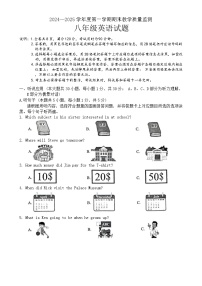
这是一份广东省阳江市八年级上学期1月期末英语试题(解析版)-A4,共19页。试卷主要包含了 考生必须保持答题卡的整洁等内容,欢迎下载使用。
这是一份广东省阳江市阳东区八年级上学期期末英语试题(原卷版)-A4,共10页。
注册成功

在线客服
添加在线客服
获取1对1服务
官方微信
关注“教习网”公众号
打开微信就能找资料
赛课定制
添加在线客服
获取1对1定制服务
职称咨询
添加在线客服
获取1V1专业指导服务

免费福利