免费领取教师福利



若您为此资料的原创作者,认为该资料内容侵犯了您的知识产权,请扫码添加我们的相关工作人员,我们尽可能的保护您的合法权益。

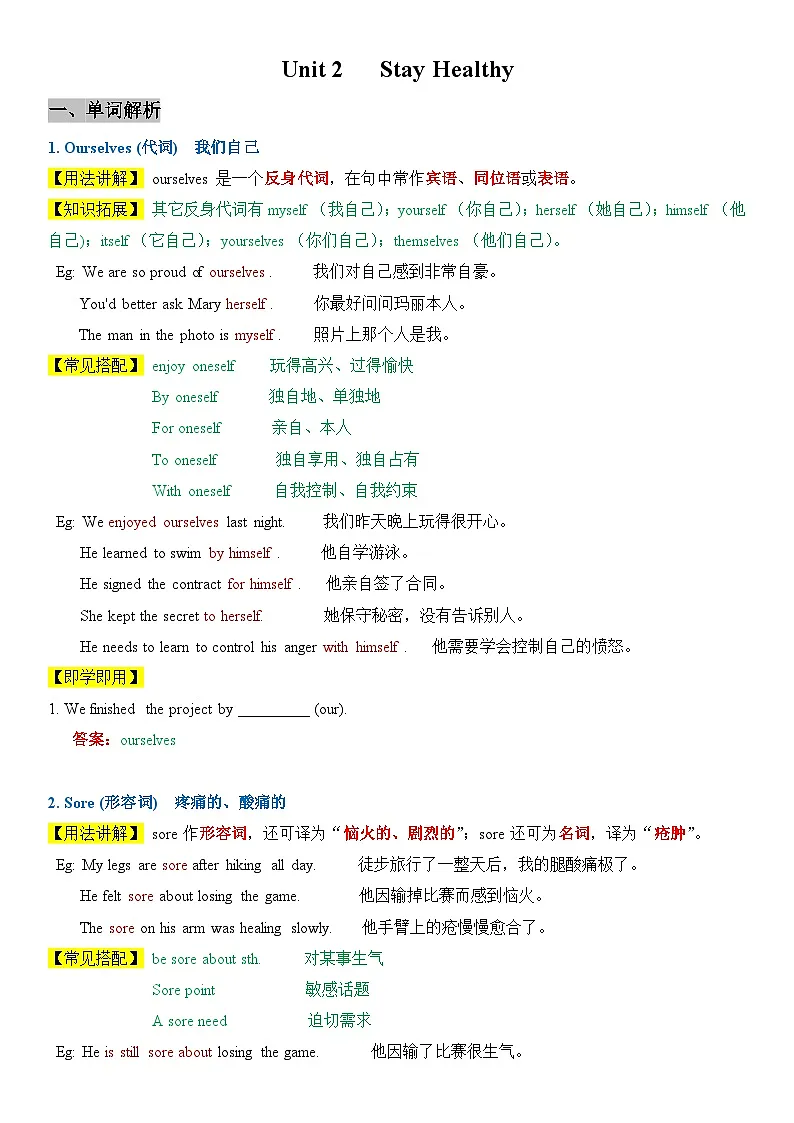
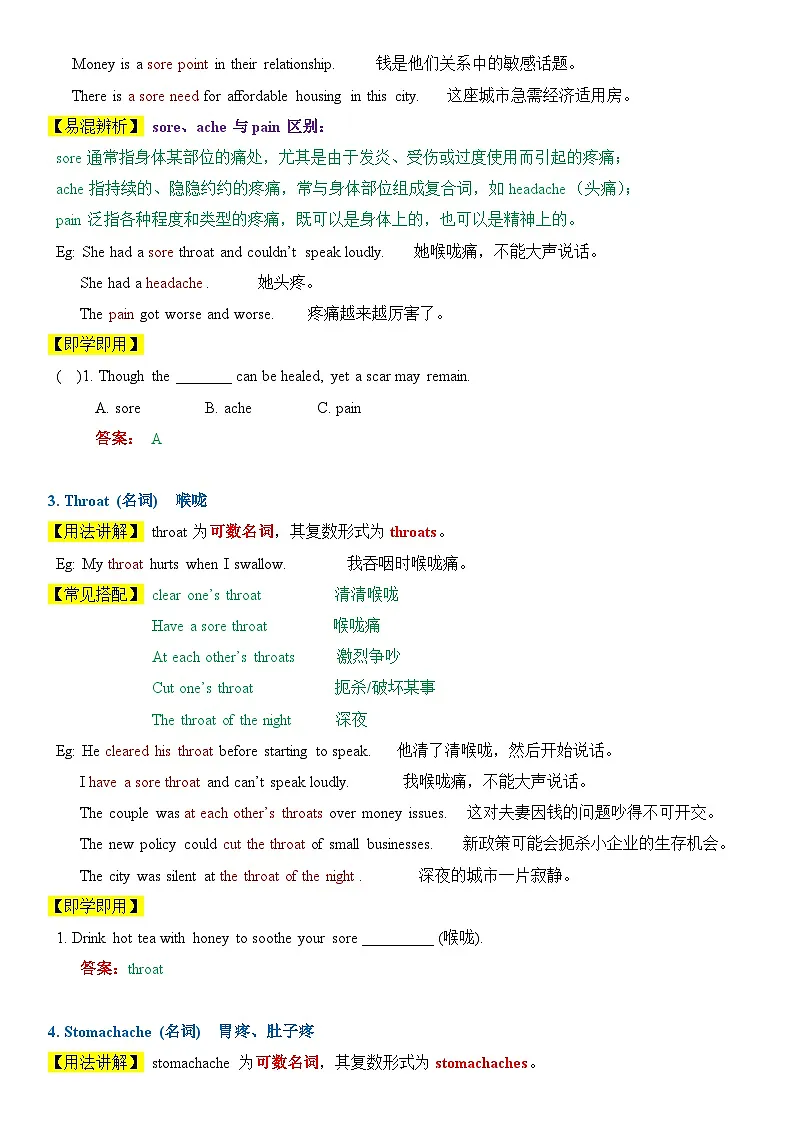
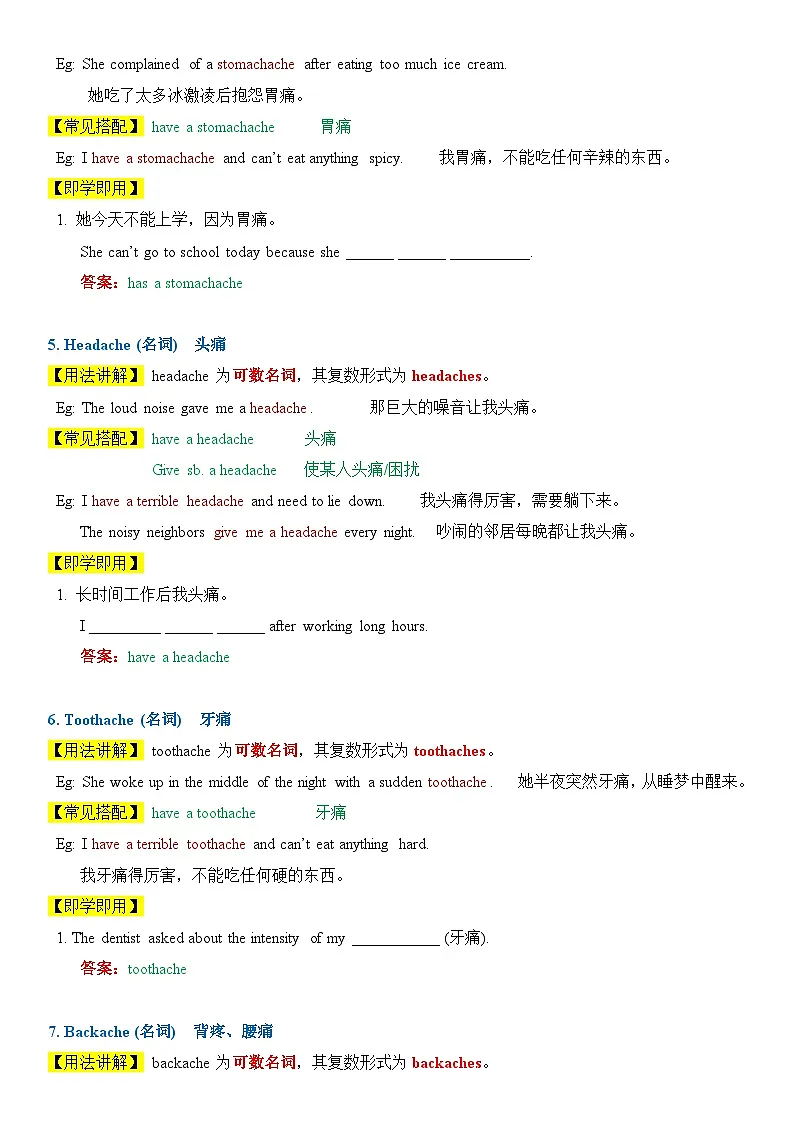
这是一份2026人教新版八年下册英语 Unit 2 Stay healthy! 讲义,文件包含2026人教新版八年下册英语Unit2Stayhealthy讲义教师版docx、2026人教新版八年下册英语Unit2Stayhealthy讲义学生版docx等2份学案配套教学资源,其中学案共111页, 欢迎下载使用。
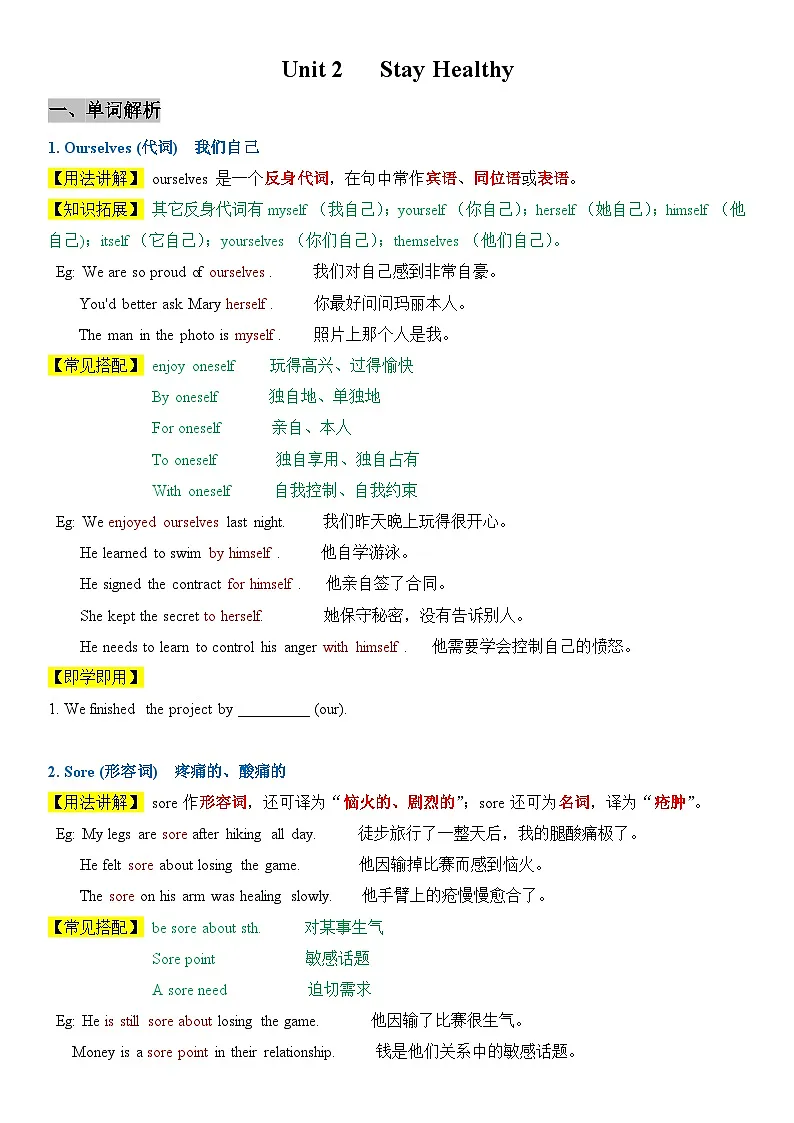
Ourselves (代词) 我们自己
【用法讲解】 urselves是一个反身代词,在句中常作宾语、同位语或表语。
【知识拓展】 其它反身代词有myself(我自己);yurself(你自己);herself(她自己);himself(他自己);itself(它自己);yurselves(你们自己);themselves(他们自己)。
Eg: We are s prud f urselves. 我们对自己感到非常自豪。
Yu'd better ask Mary herself. 你最好问问玛丽本人。
The man in the pht is myself. 照片上那个人是我。
【常见搭配】 enjy neself 玩得高兴、过得愉快
By neself 独自地、单独地
Fr neself 亲自、本人
T neself 独自享用、独自占有
With neself 自我控制、自我约束
Eg: We enjyed urselves last night. 我们昨天晚上玩得很开心。
He learned t swim by himself. 他自学游泳。
He signed the cntract fr himself. 他亲自签了合同。
She kept the secret t herself. 她保守秘密,没有告诉别人。
He needs t learn t cntrl his anger with himself. 他需要学会控制自己的愤怒。
【即学即用】
We finished the prject by _________ (ur).
Sre (形容词) 疼痛的、酸痛的
【用法讲解】 sre作形容词,还可译为“恼火的、剧烈的”;sre还可为名词,译为“疮肿”。
Eg: My legs are sre after hiking all day. 徒步旅行了一整天后,我的腿酸痛极了。
He felt sre abut lsing the game. 他因输掉比赛而感到恼火。
The sre n his arm was healing slwly. 他手臂上的疮慢慢愈合了。
【常见搭配】 be sre abut sth. 对某事生气
Sre pint 敏感话题
A sre need 迫切需求
Eg: He is still sre abut lsing the game. 他因输了比赛很生气。
Mney is a sre pint in their relatinship. 钱是他们关系中的敏感话题。
There is a sre need fr affrdable husing in this city. 这座城市急需经济适用房。
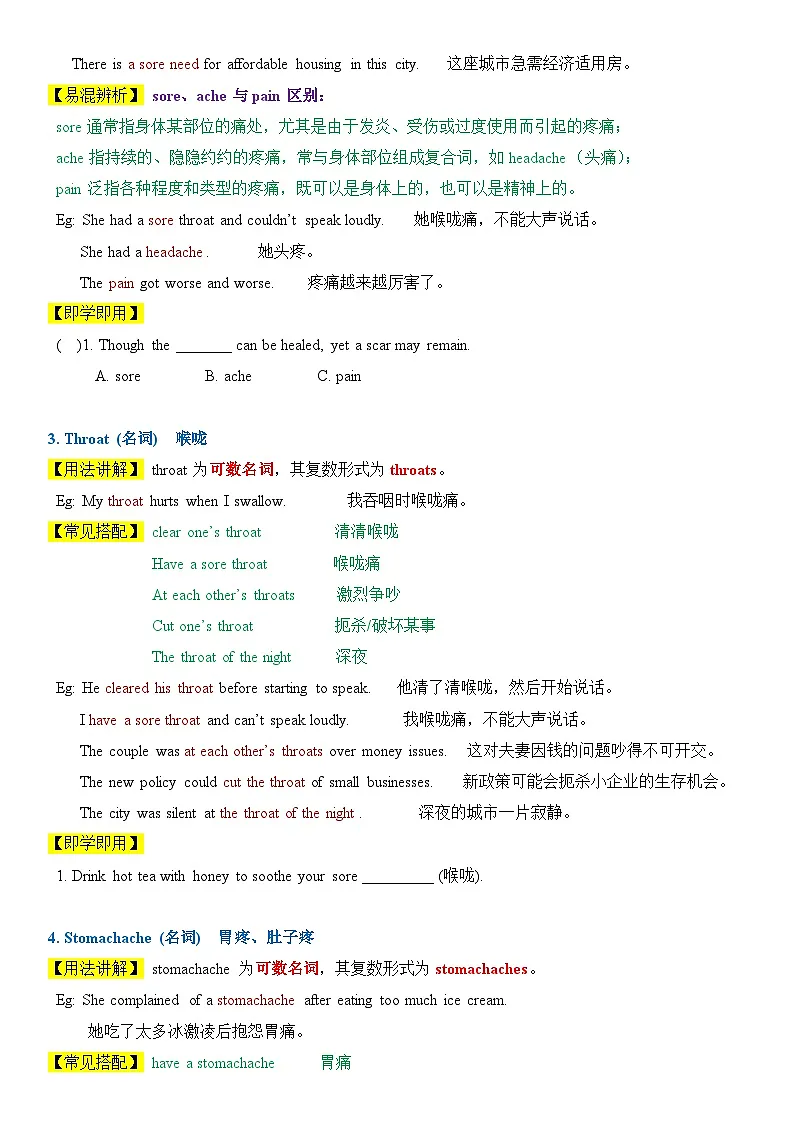
【易混辨析】 sre、ache与pain区别:
sre通常指身体某部位的痛处,尤其是由于发炎、受伤或过度使用而引起的疼痛;
ache指持续的、隐隐约约的疼痛,常与身体部位组成复合词,如headache(头痛);
pain泛指各种程度和类型的疼痛,既可以是身体上的,也可以是精神上的。
Eg: She had a sre thrat and culdn’t speak ludly. 她喉咙痛,不能大声说话。
She had a headache. 她头疼。
The pain gt wrse and wrse. 疼痛越来越厉害了。
【即学即用】
( )1. Thugh the _______ can be healed, yet a scar may remain.
sre B. ache C. pain
Thrat (名词) 喉咙
【用法讲解】 thrat为可数名词,其复数形式为thrats。
Eg: My thrat hurts when I swallw. 我吞咽时喉咙痛。
【常见搭配】 clear ne’s thrat 清清喉咙
Have a sre thrat 喉咙痛
At each ther’s thrats 激烈争吵
Cut ne’s thrat 扼杀/破坏某事
The thrat f the night 深夜
Eg: He cleared his thrat befre starting t speak. 他清了清喉咙,然后开始说话。
I have a sre thrat and can’t speak ludly. 我喉咙痛,不能大声说话。
The cuple was at each ther’s thrats ver mney issues. 这对夫妻因钱的问题吵得不可开交。
The new plicy culd cut the thrat f small businesses. 新政策可能会扼杀小企业的生存机会。
The city was silent at the thrat f the night. 深夜的城市一片寂静。
【即学即用】
Drink ht tea with hney t sthe yur sre _________ (喉咙).
Stmachache (名词) 胃疼、肚子疼
【用法讲解】 stmachache为可数名词,其复数形式为stmachaches。
Eg: She cmplained f a stmachache after eating t much ice cream.
她吃了太多冰激凌后抱怨胃痛。
【常见搭配】 have a stmachache 胃痛
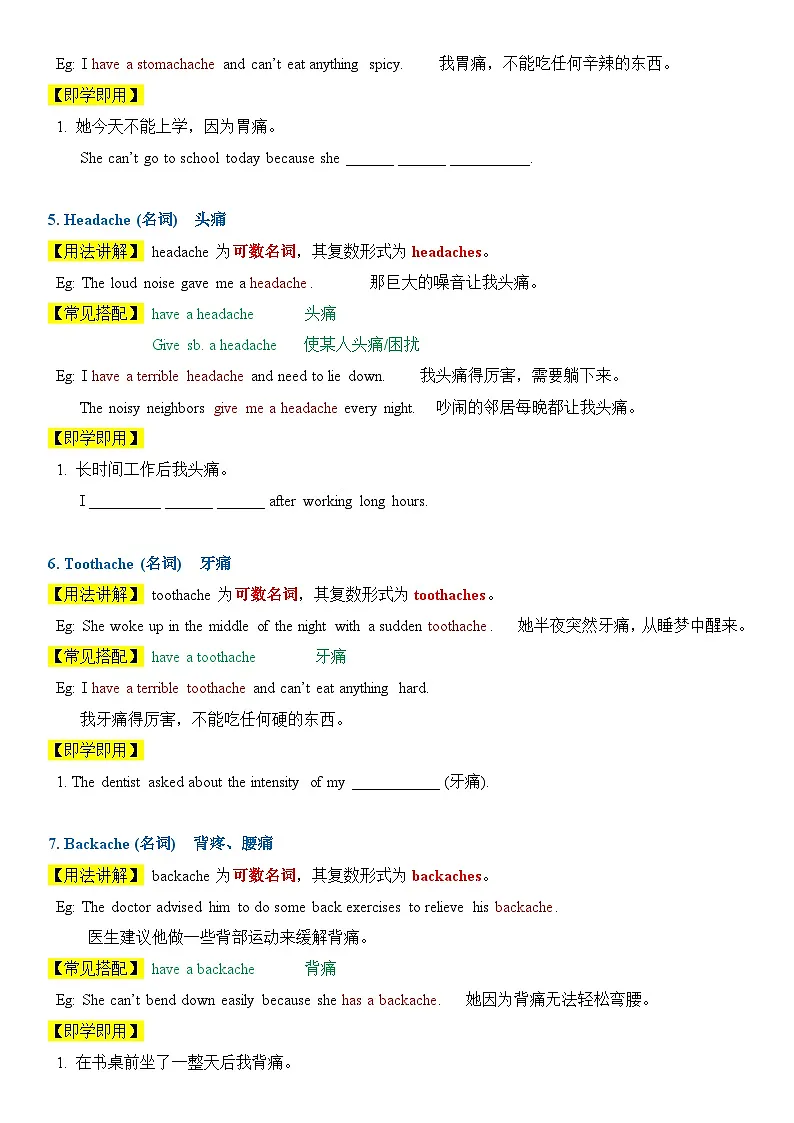
Eg: I have a stmachache and can’t eat anything spicy. 我胃痛,不能吃任何辛辣的东西。
【即学即用】
她今天不能上学,因为胃痛。
She can’t g t schl tday because she ______ ______ __________.
Headache (名词) 头痛
【用法讲解】 headache为可数名词,其复数形式为headaches。
Eg: The lud nise gave me a headache. 那巨大的噪音让我头痛。
【常见搭配】 have a headache 头痛
Give sb. a headache 使某人头痛/困扰
Eg: I have a terrible headache and need t lie dwn. 我头痛得厉害,需要躺下来。
The nisy neighbrs give me a headache every night. 吵闹的邻居每晚都让我头痛。
【即学即用】
长时间工作后我头痛。
I _________ ______ ______ after wrking lng hurs.
Tthache (名词) 牙痛
【用法讲解】 tthache为可数名词,其复数形式为tthaches。
Eg: She wke up in the middle f the night with a sudden tthache. 她半夜突然牙痛,从睡梦中醒来。
【常见搭配】 have a tthache 牙痛
Eg: I have a terrible tthache and can’t eat anything hard.
我牙痛得厉害,不能吃任何硬的东西。
【即学即用】
The dentist asked abut the intensity f my ___________ (牙痛).
Backache (名词) 背疼、腰痛
【用法讲解】 backache为可数名词,其复数形式为backaches。
Eg: The dctr advised him t d sme back exercises t relieve his backache.
医生建议他做一些背部运动来缓解背痛。
【常见搭配】 have a backache 背痛
Eg: She can’t bend dwn easily because she has a backache. 她因为背痛无法轻松弯腰。
【即学即用】
在书桌前坐了一整天后我背痛。
I _______ ______ _________ after sitting at the desk all day.
Press (动词) 压、按、挤、推
【用法讲解】 press作动词,还可译为“催促、榨取、熨烫”;press还可为名词,译为“报刊、出版社、压、按”。
Eg: Press the red buttn t start the machine. 按下红色按钮启动机器。
The prtesters pressed fr immediate refrm. 抗议者要求立即改革。
He pressed his shirt befre the interview. 面试前他熨了衬衫。
The press reprted the scandal extensively. 媒体广泛报道了丑闻。
This bk was published by Oxfrd University Press. 这本书由牛津大学出版社出版。
The army pressed frward despite heavy fire. 军队在猛烈火力下继续推进。
【常见搭配】 press sb. t d sth. 敦促某人做某事
Press fr ... 迫切要求..
Eg: The bss pressed him t finish the reprt. 老板催促他完成报告。
Activists are pressing fr envirnmental refrms. 活动人士呼吁环境改革。
【即学即用】
P________ the return key t enter the infrmatin.
Nsebleed (名词) 鼻出血
【用法讲解】 nsebleed为可数名词,其复数形式为nsebleeds。
Eg: The dctr examined his nse and fund the reasn fr his frequent nsebleeds.
医生检查了他的鼻子,找到了他频繁流鼻血的原因。、
【常见搭配】 get a nsebleed 开始流鼻血
Have a nsebleed 流鼻血
Eg: I gt a nsebleed when I was playing basketball and gt hit in the face.
我打篮球时脸部被撞到,流鼻血了。
The dry air in winter ften causes him t have nsebleeds. 冬天干燥的空气经常使他流鼻血。
【即学即用】
She tilted her head back t stp the ___________ (鼻血).
Dentist (名词) 牙科医生
【用法讲解】 dentist为可数名词,其复数形式为dentists。
Eg: Visitr yur dentist twice a year fr a check - up. 每年去牙医处做两次牙齿检查。
【常见搭配】 see a dentist 看牙医
G t the dentist 去牙医诊所
Eg: Yu shuld see a dentist if yu have a tthache. 如果你牙痛,应该去看牙医。
I’m ging t the dentist tmrrw. 我明天要去牙医诊所。
【即学即用】
If a tth feels very lse, yur d_________ may recmmend that it’s taken ut.
Fever (名词) 发烧
【用法讲解】 fever为可数名词,其复数形式为fevers。
Eg: His fever went dwn after taking the medicine. 他吃了药后,烧退了。
【常见搭配】 have a (high) fever 发(高)烧
Reduce a fever 退烧
In a fever f excitement 极度兴奋
Eg: D yu have a fever? Let me check yur temperature.
你发烧了吗? 让我给你量一下体温。
Cld cmpresses help reduce a fever. 冷敷有助于退烧。
The fans were in a fever f excitement when their favrite star appeared.
当他们最喜欢的明星出现时,粉丝们极度兴奋。
【即学即用】
她发高烧,需要休息。
She _______ _____ _____ ______ and needs rest.
Stmach (名词) 胃、腹部
【用法讲解】 stmach为可数名词,其复数形式为stmachs,还可译为“食欲”。
Eg: I have a pain in my stmach. 我胃痛。
His stmach rumbled because he was hungry. 他饿了,肚子咕咕叫。
After a lng walk, I wrked up an appetite and my stmach was grwling fr fd.
走了很长一段路后,我有了食欲,肚子饿得咕咕叫着要食物。
【常见搭配】 n an empty stmach 空腹
Turn ne’s stmach 使人恶心、令人倒胃口
Eg: Yu shuldn’t take this medicine n an empty stmach. 你不应该空腹吃这种药。
The smell f the rtten fd turned my stmach. 腐烂食物的气味让我恶心。
【即学即用】
Remember nt t drink milk n an empty s_________.
Avid (动词) 避免、防止
Eg: Gd leaders avid unnecessary cnflicts in teams. 优秀领导者避免团队中不必要的冲突。
She avids spicy fd because f her stmach. 她因胃病避开辛辣食物。
【常见搭配】 avid ding sth. 避免做某事
Eg: T stay healthy, avid smking and drinking. 为了保持健康,要避免吸烟和饮酒。
【派生词】 avidance为名词,译为“避免、躲避”;
avidable为形容词,译为“可避免的”。
Eg: His avidance f the tpic made everyne curius. 他回避这个话题让每个人都很好奇。
This accident was avidable if he had been mre careful. 如果他更小心,这个事故是可以避免的。
【即学即用】
We shuld avid _______ (waste) water.
Gas (名词) 气体、燃气
【用法讲解】 gas为可数名词,其复数形式为gasses;gas还可为动词,译为“放出气体、排气、吹牛、加汽油”。
Eg: Hydrgen and xygen are gases. 氢和氧是气体。
The vlcan is gassing cntinuusly. 火山在持续排气。
Yu shuld gas up the car befre the lng - distance trip. 在长途旅行前你应该给汽车加满油。
Dn’t gas away all the time. Get dwn t wrk. 别总是吹牛了。开始工作吧。
【常见搭配】 gas statin 加油站
Run ut f gas 汽油用完
Eg: We need t stp at the gas statin t get sme gas. 我们需要在加油站停下来加些汽油。
The car ran ut f gas n the way. 汽车在路上汽油用完了。
【即学即用】
Air is a mixture f __________ (gas).
Ache (名词/名词) 疼痛
【用法讲解】 ache为可数名词,其复数形式为aches。
Eg: My legs ached after a lng walk. 走了很长一段路后,我的腿疼。
I have a stmach ache. 我胃痛。
【常见搭配】 have a (terrible) ache in... ...疼得(厉害)
Eg: I have a terrible ache in my back. 我后背疼得厉害。
【即学即用】
The _________ (疼痛) in his muscles made it hard t mve.
X - ray (名词) X光照片、X射线
【用法讲解】 X-ray还可为动词,译为“用X光检查”;X-ray也可为形容词,译为“X光的”。
Eg: The X - ray technician perates the X - ray equipment. 这位X光技师操作X光设备。
They X - rayed the ancient vase t study its internal structure.
他们对这个古代花瓶进行了X光检查以研究其内部结构。
【常见搭配】 take an X - ray 给...做X光检查
Eg: The dctr will take an X - ray f yur leg. 医生将给你的腿做X光检查。
【即学即用】
I need t have an _________ (X光照片) fr my injured arm.
Careless (形容词) 不小心的、粗心的
【用法讲解】 careless在句中常作定语或表语。
Eg: His careless mistake cst him the jb. 他粗心的错误使他丢掉了这份工作。
Dn’t be s careless next time. 下次别这么粗心了。
【常见搭配】 be careless abut... 对...粗心
Be careless f ... 不关心、不顾及
Eg: He is careless abut his health. 他对自己的健康很粗心。
She is careless f ther peple’s feelings. 她不顾及别人的感受。
【派生词】 careful为形容词,译为“仔细的、认真的、小心的”;
carefully为副词,译为“认真地、仔细地”。
Eg: She is careful when crssing the street. 她过马路时很小心。
She listened carefully t the instructins. 她仔细听了指示。
【即学即用】
The accident was caused by ________ (care) driving.
Runny (形容词) 流鼻涕的、流眼泪的
【用法讲解】 runny作形容词常作定语或表语,也可表示“(物体)稀的、水分过多的”。
Eg: She has a runny nse frm the cld. 他因感冒而流鼻涕。
The sauce is t runny; add sme flur. 酱汁太稀了,加些面粉。
【常见搭配】 runny nse 流鼻涕
Runny eyes 流眼泪
Runny egg 溏心蛋
Eg: My runny nse wn’t stp. 我流鼻涕止不住。
The pllen makes my eyes runny. 花粉让我眼镜流泪。
I like runny eggs. 我喜欢溏心蛋。
【派生词】 run为动词,译为“跑”。
Eg: The dg is running after the cat. 那只狗正在追赶那只猫。
【即学即用】
She has a ________ (run) nse because f he pllen allergy.
Cugh (名词/动词) 咳嗽
【用法讲解】 cugh为可数名词,其复数形式为cughs。
Eg: He had a bad cugh. 他咳嗽得很厉害。
He cughed ludly in the classrm. 他在教室里大声咳嗽。
【常见搭配】 have a cugh 咳嗽
Cugh up 咳出、勉强说出
Eg: I have had a cugh fr a few days. 我已经咳嗽好几天了。
She finally cughed up the truth. 她终于说出了真相。
【即学即用】
他整夜咳嗽的很厉害。
He _______ ______ _______ ________ all night.
Bruised (形容词) 受了瘀伤的
【用法讲解】 bruised作形容词时,在句中常作定语或表语;bruised也可为bruise的过去式或过去分词形式。
Eg: He had a bruised knee frm the fall. 他摔倒后膝盖淤青了。
The team’s mrale was bruised after the defeat. 球队在失败后士气受挫。
His arm was bruised in the accident. 他的胳膊在事故中碰伤了。
【常见搭配】 be bruised 受伤、受挫
Bruised and battered 遍体鳞伤、伤痕累累
Eg: His eg was bruised by the rejectin. 他的自尊心因被拒绝而受挫。
The bxer came ut f the fight bruised and battered. 这位拳击手打完比赛后遍体鳞伤。
【派生词】 bruise为名词,译为“瘀伤”;bruise也可为动词,译为“受损”。
Eg: He had several bruises after the fight. 他打架后有多处瘀伤。
The fall bruised her shulder. 跌倒导致她肩膀瘀伤。
【即学即用】
She had a __________ (bruise) te frm drpping the heavy bx.
Suffer (动词) 受苦、遭受
【用法讲解】 suffer也可为名词,译为“痛苦、折磨”。
Eg: As lng as I am here, I wn’t the child suffer. 只要有我在,就不能让孩子受苦。
【常见搭配】 suffer frm ... 遭受某种痛苦
Suffer due t ... 因某种原因而遭受
Suffer in silence 默默承受、忍受
Eg: She suffered frm a bad cld last week. 上周她感冒了。
Many families are suffering due t lack f access t clean water.
许多家庭由于无法获得干净的水资源而受苦。
She suffered in silence rather than ask fr help.
她选择默默承受,而不是寻求帮助。
【即学即用】
很多人有失眠的困扰。
Many peple ________ ________ insmnia.
Take a seat 坐下
Eg: After a lng jurney, he was tired and just wanted t take a seat and rest.
长途旅行后,他很累,只想找个座位坐下休息。
【知识拓展】 seat作名词为可数名词,其复数形式为seats,译为“座位、所在地、席位”;seat还可为动词,译为“安排座位、容纳人数、安装”。
Eg: Please check yur barding pass fr yur assigned seat. 请查看登机牌上的指定座位。
Beijing is the seat f gvernment f China. 北京是中国政府所在地。
Jack will win a seat in an electin. 杰克将在选举中赢得一个席位。
The prtcl fficer seated diplmats accrding t their ranks. 礼宾官按外交官级别安排入座。
The amphitheater seats 1,200 with ptimal sightlines. 该圆形剧场最佳观演区设1200座。
Seat the valve carefully t prevent gas leakage. 仔细安装阀门底座以防气体泄漏。
【常见搭配】 take/ have a seat 坐下
Seat neself 自行坐下
Bk a seat 预定座位
Eg: Can I have a seat here? 我可以坐这里吗?
Please seat yurself. 请坐。
I bked a seat n the high - speed train t Beijing n the Internet.
我在网上预定了去北京的高铁座位。
【即学即用】
Last year its 1431 _________ (seat) were 94 percent ccupied all year lng.
主人迎接可客人并说:“请就坐。”
The hst greeted the guests and said, “ _______ ______ _______, please.”
Take ne’s temperature 给某人量体温
Eg: The nurse tk the patient’s temperature. 护士量了病人的体温。
【知识拓展】 temperature泛指“温度”时,为不可数名词;其他情况为可数名词,指不同温度时可用复数形式,其复数形式为temperatures。
Eg: The temperature utside is very high tday. 今天外面的温度非常高。
The temperature f the water is just right fr swimming. 水的温度正适合游泳。
【常见搭配】 take ne’s temperature 量某人的体温
High/ lw temperature 高温/低温
Rm temperature 室温
Have a temperature 发烧
Keep ne’s temperature 保持冷静
Raise the temperature 使气氛热烈起来
Eg: The nurse tk the patient’s temperature. 护士量了病人的体温。
We shuld avid ging ut in high temperature. 我们应该避免再高温时外出。
The wine shuld be served at rm temperature. 这种酒应该再室温下饮用。
She has a temperature and feels unwell. 她发烧了,感觉不舒服。
In a heated argument, try t keep yur temperature. 在激烈的争论中,尽量保持冷静。
The hst raised the temperature f the party with his jkes. 主持人用他的笑话让派对气氛热烈起来。
【派生词】 temperate为形容词,译为“温和的”;
temperamental为形容词,译为“情绪多变的”。
Eg: The temperate climate is suitable fr grwing many kinds f plants.
温和的气候适合种植很多种类的植物。
She is a temperamental persn. 她是个情绪多变的人。
【即学即用】
我需要给我女儿量一下体温,因为她觉得有点热。
I need t _______ _______ ________ __________ because she feels a little warm.
Test (名词/动词) 检查、测验
【用法讲解】 test为可数名词,其复数形式为tests;test还可为动词,译为“试验、检查、测试”等。
Eg: I have a math test tmrrw. 我明天有数学测试。
This is a test f ur friendship. 这是对我们友谊的考验。
The dctr tested his eyesight. 医生测试了他的视力。
【常见搭配】 final test 期末考试
Pass/ fail the test 通过/未通过考试
Bld test 验血
Test n ... 在...上进行测试
Test ut 试验成功
Stand the test f time 经受住时间的考验/经久不衰
Eg: I have t take a final test next week. 我下周要参加期末考试。
I am very happy because I pass the English test. 我非常开心因为我通过了英语考试。
A bld test will tell us wh I am? 验血能确定我是谁吗?
The new drug was tested n animals first. 这种新药首先在动物身上进行了试验。
The prttype tested ut better than expected. 原型机测试结果超预期。
Shakespeare’s wrks have std the test f time. 莎翁的作品经久不衰。
【易混辨析】 test、exam与quiz的区别
test通常指小型的、不定期的测验,用于检验特定知识或技能;
exam一般指正式的、大型的考试;
Quiz通常指一种简短的、频繁的评估。
Eg: The test results came back psitive. 测试结果呈阳性。
Failing ne exam is nt the end f the wrld. 一次考试不及格并非世界末日。
The slutin t last week’s quiz is n page 81. 上星期测验的答案在第81页。
【即学即用】
他们的友谊经受住了时间的考验。
Their friendship has ________ ______ _______ _____ ______.
Flu (名词) 流行性感冒
【用法讲解】 flu虽为可数名词,但通常以单数形式出现。
Eg: I caught the flu last week and had a high fever. 我上周得了流感,发高烧了。
【常见搭配】 catch/ get the flu 感染流感
Have the flu 患流感
Flu seasn 流感季
Eg: She caught the flu frm her cwrker. 她从同事那里感染了流感。
He has the flu and is running a fever. 他得了流感,正在发烧。
Flu seasn usually starts in autumn. 流感季通常从秋季开始。
【即学即用】
The dctr advised me t rest at hme because I had the _________ (流感).
Medicine (名词) 药、医学
【用法讲解】 medicine表示“药、药物”时为不可数名词;medicine表示“不同种类的药物”时为可数名词,其复数形式为medicines。
Eg: There are many medicines fr treating clds. 有许多治疗感冒的药物。
【常见搭配】 take sme medicine 吃药
Eg: He has t take sme medicine every day. 他不得不每天吃药。
【即学即用】
她已服用了许多药,但没有一种药能治好她的药。
She has ________ ______ ______ ______ _______ _______, but nn have cured her disease.
Mask (名词) 口罩
【用法讲解】 mask为可数名词,其复数形式为masks;mask还可为动词,译为“遮盖、伪装”。
Eg: Please a mask in public places. 公共场所请佩戴口罩。
She masked her fear with a smile. 她用微笑掩饰恐惧。
The spy masked his identity t avid detectin. 间谍伪装身份以避免被发现。
【常见搭配】 face mask 面罩、面膜
Under the mask f 以...为伪装、在...的幌子下
Mask sth. frm sb. 向某人隐瞒某事
Eg: She applied a face mask befre bed. 她睡前敷了面膜。
He cmmitted the crime under the mask f kindness. 他以善良伪装犯了罪。
She tried t mask her true feelings frm her parents. 她试图向父母隐瞒自己的真实感受。
【派生词】 masked为形容词,译为“戴面具的、隐藏的”;
masking为名词,译为“掩饰、遮蔽”。
Eg: The masked dancer perfrmed beautifully. 那位戴面具的舞者表演得很精彩。
The masking f th truth made the situatin mre cmplicated. 对真相的掩饰使情况更加复杂。
【即学即用】
The actr wre a glden ________ (面具) n stage.
Virus (名词) 病毒
【用法讲解】 virus为可数名词,其复数形式为virus,还可译为“有害影响、毒液”等。
Eg: Many diseases are caused by viruses. 许多疾病是由病毒引起的。
The virus f jealusy is latent in everyne. 嫉妒的毒液潜伏在每个人心中。
【常见搭配】 catch a virus 感染病毒
Spread a virus 传播病毒
Eg: He caught a virus and had t stay in bed fr a few days. 他感染了病毒,不得不卧床休息几天。
Msquites can spread viruses frm ne persn t anther. 蚊子可以在人与人之间传播病毒。
【派生词】 viral为形容词,译为“病毒的、病毒性的”。
Eg: The viral infectin spread quickly in the schl. 病毒感染在学校里迅速传播。
【即学即用】
Dctrs are fighting against the new _________ (病毒) bravely.
Stp... frm ding 防止...、阻止...
Eg: The fence stps the dgs frm running int the street. 栅栏阻止了狗跑到街上。
【知识拓展】 Stp为动词,译为“停止”,也可为名词,译为“停止、车站”。
Eg: She stpped the car. 她停下了车。
The bus stp is just arund the crner. 公交车站就在拐角处。
【常见搭配】 stp t d sth. 停下来去做另一件事
Stp ding sth. 停止正在作的事
Eg: I’m tired, let’s stp t have a rest. 我累了,让我们停下来休息一会。
I’m tired, let’s stp wrking. 我累了,让我们停止工作。
【即学即用】
我们应该采取措施防止污染变得更严重。
We shuld take measures t ________ the pllutin _________ getting wrse.
Hw can we stp them frm _______ (cut) dwn the trees?
Descriptin (名词) 描写、形容
【用法讲解】 descriptin为可数名词,其复数形式为descriptins,还可译为“类型、种类”。
Eg: The descriptin f the scene was very vivid. 对那个场景的描述非常生动。
This is a descriptin f a new type f car. 这是一种新型汽车的介绍。
【常见搭配】 give a descriptin f ... 对...进行描述
In descriptin 在描述中
Eg: Can yu give a descriptin f the persn yu saw at the scene?
你能描述一下你在现场看到的那个人吗?
The actual situatin is different frm what is said in descriptin. 实际情况与描述中的不同。
【派生词】 describe为动词,译为“描述、形容”;
Descriptive为形容词,译为“描述性的、叙述性的”。
Eg: He described the accident in detail. 他详细地描述了这起事故。
The descriptive essay was full f vivid details. 这篇描述性文章充满了生动的细节。
【即学即用】
The suspect matches the ___________ (describe) given by the witness.
Patient (名词) 病人;(形容词) 有耐心的
【用法讲解】 patient为可数名词,其复数形式为patients。
Eg: He is very patient persn, never getting angry easily. 他是个非常有耐心的人,从不轻易发脾气。
The patient is recvering well after the surgery. 手术后,病人恢复得很好。
【常见搭配】 be patient with sb./ sth. 对某人/某物有耐心
Eg: Please be patient with me, I’m trying t figure this ut. 请对我有点耐心,我正在想办法。
【派生词】 patience为名词,译为“耐心”。
Eg: I’ve lst all patience with his cnstant cmplaining. 我对他不断的抱怨已经失去了所有耐心。
【即学即用】
这名老师对学生很有耐心。
This teacher ______ ________ ________ students.
Injury (名词) 伤害、损伤
【用法讲解】 injury为可数名词,其复数形式为injuries。
Eg: He suffered a serius injury in the accident. 他在事故中受了重伤。
She was awarded cmpensatin fr injury t her feelings. 她因感情受到伤害而获得赔偿。
【常见搭配】 be an injury t ... 对...有害
Eg: Lack f exercise is an injury t yur physical fitness. 缺乏锻炼对你的身体素质有害。
【派生词】 injured为形容词,译为“受伤的、损害的”;
injurius为形容词,译为“有害的、造成伤害的”。
Eg: The injured were taken t the hspital immediately. 伤者被立即送往医院。
Smking is injurius t health. 吸烟有害健康。
【易混辨析】 injury与wund的区别:
Injury使用范围较广,可指身体各部位因意外事故、暴力等受到的伤害,即指外伤也指内伤;
wund通常指由刀、枪等锐器或暴力造成的开放性外伤,由明显伤口。
Eg: He gt an injury t his back while lifting heavy bjects. 他在搬重物时背部受伤了。
The sldier had a serius wund n his arm. 士兵的胳膊上有一处严重的伤口。
【即学即用】
He suffered an i________ t his back in the accident.
There were several ________ (injury/ wund) caused by the accident.
Illness (名词) 疾病
【用法讲解】 illness常为不可数名词,但在表示“具体的疾病类型”时为可数名词,其复数形式为illnesses。
Eg: She is recvering frm a serius illness. 她正在从重病中康复。
Chrnic illnesses like diabetes require lifelng management. 糖尿病等慢性病需终身管理。
【常见搭配】 suffer frm an illness 患(某种)疾病
Recver frm an illness 从疾病中康复
Eg: She has been suffering frm a chrnic illness fr years. 她多年来一直患有一种慢性疾病。
He is slwly recvering frm his illness. 他正在慢慢从疾病中康复。
【派生词】 ill为形容词,译为“生病的、不健康的”。
Eg: She lks ill. Yu shuld take her t the dctr. 她看起来生病了。你应该带她去看医生。
【易混辨析】 illness与disease区别:
illness侧重描述身体或心理上处于不健康的状态,不一定有明确的病因或病理特征;
Disease通常指具体的、有明确病理特征和病因的疾病,强调医学上的专业性和严重性。
Eg: He tk a leave f absence because f illness. 他因生病请假了。
Cancer is a serius disease that affects many peple wrldwide.
癌症是一种严重影响全球许多人的严重疾病。
【即学即用】
He has been suffering frm a serius _______ (ill) fr mnths.
Knife (名词) 刀
【用法讲解】 knife为可数名词,其复数形式为knives。
Eg: He used a knife t cut the bread. 他用刀切面包。
【常见搭配】 like a ht knife thrugh butter 轻而易举
Twist the knife 落井下石
At knife’s edge 危在旦夕
Eg: The new sftware slved the prblem like a ht knife thrugh butter.
新软件轻松解决了问题。
After her failure, her clleagues twisted the knife by criticizing her publicly.
她失败后,同事公开批评她,落井下石。
The negtiatin was at knife’s edge until bth sides cmprmised.
谈判僵持不下,直到双方妥协。
【即学即用】
The kitchen drawer was full f ___________ (knife) f all sizes.
Clear (形容词) 清晰的、清楚的;(动词) 清理
【用法讲解】 clear为动词,译为“澄清”,clear还可为形容词,译为“晴朗的”。
Eg: Please clear the snw frm the path. 请把小路上的雪清理掉。
She cleared up the misunderstanding. 她澄清了误解。
The instructins are very clear. 说明非常清晰。
The weather is clear tday. 今天天气晴朗。
【常见搭配】 clear ut 清理、丢掉
Clear up 天气放晴
In the clear 摆脱困境
Keep clear f... 主动避开危险或麻烦
Make clear 讲清楚、使明白
Eg: I need t clear ut my clset. 我需要清理我的衣柜。
The sky cleared up in the afternn. 下午填空放晴了。
He is in the clear nw. 他现在摆脱困境了。
Drivers shuld keep clear f the accident area. 司机应避开事故区域。
Yu need t make clear yur intentins befre yu start the prject.
在开始这个项目之前,你需要讲清楚你的意图。
【派生词】 clearly为副词,译为“清楚地”。
Eg: Speak mre clearly. 说得更清楚些。
【即学即用】
She spke ________ (clear) s everyne culd hear her.
我们正在把阁楼里的旧家具清理出去。
We are ________ _________ the ld furniture frm the attic.
Pain (名词) 疼痛、痛苦
【用法讲解】 pain泛指“疼痛”时为不可数名词;pain特指“身体部位的疼痛”或“pain”前有形容词修饰时为可数名词,pain也可引申为“劳苦、辛劳”;pain还可为动词,译为“使疼痛”。
Eg: He suffered great pain after the accident. 事故后他遭受了巨大痛苦。
He has a pain in his knee. 他膝盖疼。
Her wrds pained him deeply. 她得话使他深感痛苦。
【常见搭配】 N pains, n gains. 不劳无获。
Have a pain in 身体部位 身体某部位疼
In pain 处于痛苦中
Take pains t d sth. 尽力做某事
Spare n pains t d sth. 不遗余力做某事
Eg: He has a sharp pain in his stmach. 他肚子疼得厉害。
The injured man was lying in pain n the grund. 受伤的男子痛苦地躺在地上。
She tk pains t make the party a success. 她煞费苦心使聚会取得成功。
The teacher spared n pains t help the students imprve their grades.
老师不遗余力地帮助学生提高成绩。
【派生词】 painful为形容词,译为“疼痛的、痛苦的”。
Eg: The painful memry still haunts him. 那段痛苦的记忆仍然萦绕在他心头。
【易混辨析】 pain与ache区别:
Pain使用范围较广,可指身体各部位的剧烈疼痛,也可指精神上的疼痛;
ache通常指持续的、隐隐的疼痛,多用于身体部位。
Eg: I have a pain in my stmach. 我肚子疼。
I have a bad headache. 我头痛得厉害。
【即学即用】
She has a cnstant p________ in her knee.
What’s mre 更有甚者、更为重要的是
【用法讲解】 what’s mre译为“而且、此外”,通常房子句子的中间或开头,用于引入额外的信息或观点。
Eg: I need t finish this reprt by tmrrw. What’s mre, I have t prepare fr a meeting.
我需要在明天之前完成这份报告。此外,我还要准备一个会议。
【即学即用】
她数学很好。而且,她对科学充满热情。
She is gd at math. _______ ______, she has a passin fr science.
Brightness (名词) 亮度
【用法讲解】 brightness为不可数名词,还可译为“聪慧、活泼”。
Eg: The brightness f the sun blinded me. 太阳的亮度使我睁不开眼。
Her eyes shwed a special brightness. 她的眼睛透露出一种特别的聪慧。
【常见搭配】 adjust the brightness 调节亮度
Eg: He adjusted the brightness f the TV t a cmfrtable level.
他把电视的亮度调节到了一个舒适的水平。
【派生词】 bright为形容词,译为“明亮的、聪慧的”;
brighten为动词,译为“使变亮、使愉快”。
Eg: The bright mnlight gently illuminated the quiet garden. 明亮的月光温柔地照亮了宁静的花园。
The sun began t brighten the sky. 太阳开始使天空变亮。
【即学即用】
The _____________ (bright) f the lamp can be adjusted accrding t yur need.
Envirnment (名词) 环境
【用法讲解】 envirnment为可数名词,其复数形式为envirnments,还可译为“条件、环境”等。
Eg: We shuld prtect the natural envirnment. 我们应该保护自然环境。
A cmfrtable wrking envirnment is imprtant fr emplyees. 一个舒适的工作环境对员工很重要。
This sftware can run in different envirnments. 这个软件可以在不同的环境中运行。
【常见搭配】 wrk envirnment 工作环境
Living envirnment 生活环境
Eg: A gd wrk envirnment can imprve wrk efficiency. 良好的工作环境能提高工作效率。
We shuld pay attentin t imprving ur living envirnment. 我们应该注意改善我们的生活环境。
【派生词】 envirnmental为形容词,译为“环境的”;
Envirnmentalist为名词,译为“环保主义者”。
Eg: Making envirnmental prtectin is ne f China’s basic natinal plicies.
确保环境保护是中国的一项基本国策。
Many envirnmentalists are wrking hard t prtect the earth. 许多环保主义者正在努力保护地球。
【即学即用】
The pllutin is damaging the ___________ (环境).
Crss (动词) 穿越、横过、交叉
【用法讲解】 crss作动词还可译为“反对、违背”;crss还可为名词,译为“十字架、十字形记号”;crss还可为形容词,译为“生气的、恼怒的”。
Eg: The river is t wide t crss. 这条河太宽,跨不过去。
The tw lines crss at this pint. 这两条线在这个点相交。
Dn’t crss yur parents’ wishes. 不要违背你父母的意愿。
Make a crss n the map where yu are. 在地图上你所在的位置做个十字记号。
He was crss with me fr being late. 因为我迟到了,他对我很生气。
【常见搭配】 crss ne’s mind 突然想到
Crss ut 划掉、删除
Be crss with sb. 和某人生气
Eg: It never crssed my mind that he wuld lie t me. 我从未想到他会对我说谎。
Crss ut the wrng answers. 把错误的答案划掉。
He was crss with himself fr frgetting the keys. 他因忘记钥匙而自责。
【派生词】 acrss为介词,译为“穿过”;
crssing为名词,译为“十字路口、交叉点”。
Eg: Please be careful when yu walk acrss the street. 过马路时请当心。
Take care at the crssing. 在十字路口要小心。
【即学即用】
_______ the rad at the zebra _________ (crss).
Catch fire 着火
【用法讲解】 catch fire还可译为“突然引发热情/兴趣”。
Eg: The ld building caught fire last night. 那座老建筑昨晚着火了。
Her speech caught fire amng the audience. 她的演讲在听众中引发了热烈反响。
【知识拓展】 fire为名词,译为“火、火宅、炉灶”;fire还可为动词,译为“开火、解雇、激发”。
Eg: There is a big fire in the frest. 森林里有一场大火。
The fire destryed many huses. 火宅烧毁了许多房屋。
She cked dinner n the fire. 她在炉灶上做晚餐。
The sldiers fired at the enemy. 士兵们向敌人开火。
He was fired frm his jb. 他被解雇了。
The mvie fired his imaginatin. 这部电影激发了他的想象力。
【即学即用】
别让蜡烛无人看官,可能会着火。
Dn’t leave candles unattended -- they might _______ ______.
Themselves (代词) 他(或她、它)们自己
【用法讲解】 themselves字句中常作宾语或同位语。
Eg: The children dressed themselves quickly. 孩子们很快就自己穿好了衣服。
The scientists themselves verified the data. 科学家们亲自验证了数据。
【常见搭配】 by themselves 单独地、独立完成
Fr themselves 为自己、亲自
Eg: The children cleaned the rm by themselves. 孩子们自己打扫了房间。
They bught new clthes fr themselves. 他们为自己买了新衣服。
【派生词】 they为人称代词主格,译为“他们”;
them为人称代词宾格,译为“他们”。
Eg: They culdn’t give me any mre infrmatin. 他们不可能给我提供更多的信息。
I can prbably make the time t see them. 我大概能腾出时间去看望他们。
【即学即用】
They ften help each ther ut, and in ding s, they strengthen _________ (they).
Fry (动词) 油炸、油煎、油炒
【用法讲解】 fry还可译为“干透、烤焦”。
Eg: She likes t fry eggs fr breakfast. 她喜欢早餐煎鸡蛋。
The sun fried the grass. 太阳把草晒干了。
【派生词】 fried为形容词,译为“油炸的”;
Frying为名词,译为“油炸、煎炸”。
Eg: I dn’t like fried fd. 我不喜欢油炸食物。
The frying f the fish filled the kitchen with a delicius smell. 煎鱼让厨房充满了香味。
【即学即用】
We f_________ the chicken in live il.
Turn n 接通(电流、煤气、水等)
Eg: It’s dark in here -- turn n the light! 这里太暗了 -- 开灯!
【知识拓展】 turn在此处为动词,译为“转变”,还可译为“转动、改变方向”等。
Eg: Please turn the key in the lck. 请把钥匙插到锁里转动。
Turn left at the crner. 在拐角处左转。
【常见搭配】 turn... int ... 把...变成...
Turn ... ff 关闭(常指关掉自来水、电灯及家用电器等)
Turn... n 打开(常指开灯或打开家用电器等)
Turn dwn 把声音调低、拒绝
Turn up 把声音调高、出现
Turn ne’s head 转头
Eg: The magician turned the flwer int a bird. 这个魔术师把一朵花变成了一只鸟。
Yu must turn ff the light when yu g t bed. 你应当在你睡觉前关灯。
I want t watch TV, can I turn it n? 我想要看电视,我能开吗?
Dn’t frget t turn dwn the vlume when yu leave the rm. 当你离开房间时,别忘了调低音量。
He has turned dwn the letter. 他拒绝了信。
Dn't wrry, it will turn up. 别担心,它会出现的。
I can't hear the music clearly, please turn up the radi. 我听不清音乐,请把收音机声音调高。
【即学即用】
他转头看着他的妈妈。
He _______ ______ ______ arund t lk at his mther.
( )2. The music is t nisy, please ______.
turn it n B. turn in ff C. turn it up D. turn it dwn
Stve (名词) 厨房炊具、炉子
【用法讲解】 stve为可数名词,其复数形式为stves。
Eg: The sup is n the stve -- it’ll be ready in ten minutes.
汤在炉灶上煮着 -- 十分钟后就好了。
【常见搭配】 gas stve 燃气灶
Electric stve 电炉
Eg: We installed a new gas stve in the kitchen. 我们在厨房装了新燃气灶。
An electric stve is safer if yu have children at hme. 如果家里有孩子,用电炉更安全。
【即学即用】
She cks n the ________ (炉子) every mrning fr her family.
Happily (副词) 快乐地、高兴地
【用法讲解】 happily在句中常用来修饰动词、形容词或副词。
Eg: The children played happily in the park. 孩子们在公园里快乐地玩耍。
【派生词】 happy为形容词,译为“快乐的、幸福的”;
happiness为名词,译为“幸福、快乐”。
Eg: She has a happy family. 她有一个幸福的家庭。
Mney desn’t always bring happiness. 金钱并不总是带来快乐。
【常见搭配】be happy t d sth. 开心做某事
Be happy abut/at sth. 对...高兴、开心
Be happy with sth. 对...满意
Eg: He was happy t be cming hme. 他很高兴要回家了。
We are happy at/abut his letter. 收到他的信我们很开心。
She is happy with this idea. 她对这个主意很满意。
【即学即用】
The baby laughed ________ (happy) when seeing his mther.
N way 不可能、没门
Eg: -- Can yu lend me yur new car fr the weekend? 你周末能把你的新车借给我吗?
-- N way! I’m ging n a rad trip myself. 没门儿!我自己要去自驾游。
【即学即用】
他不可能在仅仅一天内完成这个庞大的项目。
There’s _______ _______ he can finish this huge prject in just ne day.
Burn (动词) 燃烧、着火
【用法讲解】 burn作动词,还可译为“烧伤、感到灼热、晒黑、激起、消耗”,其过去式为burned/burnt;其过去分词为burned/ burnt;burn还可为名词,译为“烧伤、痕迹、烙印”。
Eg: The fire burned the ld huse t the grund. 大火把这座旧房子烧毁了。
Be careful nt t burn yur hands n the ht stve. 小心别被热炉子烫伤手。
My eyes burn frm staring at the screen fr t lng. 我盯着屏幕太久了,眼睛感到灼热。
The sun burned my skin during the beach vacatin. 在海滩度假时,太阳把我的皮肤晒黑了。
His wrds burned with anger. 他的话充满了愤怒。
Exercise helps burn calries. 运动有助于消耗卡路里。
He suffered severe burns in the accident. 他在事故中受了严重烧伤。
There was a burn n the carpet frm the cigarette. 地毯上有一个香烟留下的烧痕。
【常见搭配】 burn dwn 烧毁、烧光
Burn ut 燃尽
Burn ff 通过运动消耗(能量、脂肪等)
Burn with 充满(某种情感)
Eg: The ld building burned dwn in the fire. 那座旧建筑在大火中被烧毁了。
The fire had burned ut by mrning. 到早上火已经燃尽了。
He likes t burn ff calries by running. 他喜欢通过跑步消耗卡路里。
He burned with jealusy when he saw her with anther man.
当他看到她和另一个男人在一起时,充满了嫉妒。
【派生词】 burning为形容词,译为“燃烧的、强烈的”;
burnable为形容词,译为“可燃的”;
burnt为形容词,译为“烧焦的、晒伤的”。
Eg: A burning candle illuminated the rm. 燃烧的蜡烛照亮了房间。
She felt a burning desire t help thers. 她有强烈的愿望去帮助别人。
Paper and wd are burnable materials. 纸和木头是可燃材料。
The tast was burnt t a crisp. 吐司烤得焦脆。
His arms were burnt after a day in the sun. 他在太阳下晒了一整天,胳膊晒伤了。
【即学即用】
Which material b________ mst cleanly?
The firefighters entered the _________ (burn) building.
On fire 着火、起火
【用法讲解】 n fire也可用来形容人或事物充满激情。
Eg: The huse is n fire! Call the fire department! 房子着火了!快叫消防队!
She’s n fire with enthusiasm fr her new prject. 她对新项目充满热情。
The singer was n fire during the cncert, captivating the audience.
歌手在演唱会上表现出色,吸引了观众。
His painting is n fire with vibrant clrs and bld strkes.
他的画作色彩鲜艳、笔触大胆,充满活力。
【即学即用】
汽车在高速公路上突然起火了。
The car suddenly caught ______ _______ n the highway.
Flame (名词) 火焰
【用法讲解】 flame为名词,还可译为“热情、激情”;flame还可为动词,译为“燃烧、高涨”。
Eg: The candle flame flickered in the gentle breeze. 蜡烛的火焰在微风中闪烁。
The team played with great flame and determinatin. 这支球队带着极大的热情和决心比赛。
The ld lgs flamed up brightly. 旧木柴剧烈地燃烧起来。
The argument flamed up between them. 他们之间的争论激烈起来。
【常见搭配】 in flame 着火、在燃烧
Flame ut (飞机引擎)熄火、(计划、事业等)失败
A flame f hpe/ lve 一簇希望/爱的火焰
Eg: The building was in flames when the firemen arrived. 消防员到达时,大楼正在燃烧。
The plane’s engine flamed ut during the flight. 飞机在飞行过程中引擎熄火了。
His business flamed ut after a series f mistakes. 在一系列错误之后,他的生意失败了。
His cmments nly fanned the flames f the argument. 他的评论只会加剧争论。
【派生词】 flammable为形容词,译为“易燃的”。
Eg: This material is highly flammable -- keep it away frm fire.
这种材料极易燃,请远离火源。
【即学即用】
The campfire’s ________ (火焰) died dwn as night fell.
Panic (名词) 恐慌、惊恐
【用法讲解】 panic常作不可数名词使用;panic还可为动词,译为“(使)恐慌”,其过去式为panicked,过去分词为panicked;panic还可为形容词,译为“恐慌的”。
Eg: The crwd was in a panic when the fire brke ut. 火宅发生时,人群陷入恐慌。
She panicked at the sight f the snake. 她一看到蛇就惊慌起来。
The panic expressin n her face revealed her fear. 她脸上惊恐的表情透露出她的恐惧。
【常见搭配】 n panic 冷静、别慌
Get int a panic 陷入恐慌状态
In (a) panic 恐慌的状态
Eg: N panic, we still have time. 别慌,我们还有时间。
She gt int a panic when she lst her keys. 她丢钥匙后惊慌失措。
The children fled in panic. 孩子们惊慌逃窜。
【派生词】 panicky为形容词,译为“易惊慌的”。
Eg: Her panicky behavir made it difficult fr thers t calm her dwn.
她紧张不安的行为使得其他人很难使她平静下来。
【即学即用】
Financial _________ (恐慌) swept thrugh the market after the crash.
Ont (介词) 向、朝
【用法讲解】 nt还可译为“转移到、对...了解”等意。
Eg: She stepped nt the stage with cnfidence. 她自信地走上舞台。
He transferred the data nt the new cmputer. 他把数据转移到新电脑上。
The plice are nt him. 警方已经盯上他了。
【常见搭配】 cme nt 进入市场、出现
Get nt 上车、进入(交通工具)
Eg: New prducts cme nt the market every mnth. 每月都有新产品上市。
We gt nt the bus and sat dwn. 我们上了公交车,坐到座位上。
【即学即用】
The cat jumped _________ the table.
Thrw (动词) 猛动身体、扔、抛
【用法讲解】 thrw其过去式为threw、过去分词为thrwn。
Eg: He threw the ball t me. 他把球扔给了我。
The pitcher threw a fastball. 投手投了一个快速球。
【常见搭配】 thrw at... 把某物投向...
Thrw away 扔掉、浪费
thrw up 呕吐、建造
Thrw in ... 额外加入、投入
Thrw sb. up t... 反复责备某人
Eg: The angry prtesters threw stnes at the plice. 愤怒的抗议者向警察投掷石块。
Dn’t thrw away yur talent n a jb that desn’t challenge yu.
不要把你的才能浪费在一份没有挑战性的工作上。
He threw up all night after eating the bad seafd. 他吃了坏海鲜后整晚都在呕吐。
She threw in a few extra ingredients t make the cake mre flavrful.
她加了一些额外的配料,让蛋糕更加美味。
His parents are always thrwing his mistakes up t him. 他的父母总是责备他的错误。
【即学即用】
把好的食物扔掉是浪费。
It is a waste t ________ _________ gd fd.
Rll (动词) (使)翻滚、滚动
【用法讲解】 rll作动词,还可译为“摇晃、卷起、行驶、掷骰子、摇晃”;rll还可为名词,译为“卷、面包卷、打滚、隆隆声”等。
Eg: The ball rlled dwn the hill. 球从山上滚了下来。
The car rlled slwly alng the rad. 汽车在路上缓慢行驶。
She rlled her eyes in disbelief. 她不相信地翻了翻白眼。
He rlled the dice and waited fr the result. 他掷了骰子,等待结果。
I had a rll fr breakfast. 我早餐吃了一个面包卷。
The rll f thunder was deafening. 雷声滚滚,震耳欲聋。
Please check the rll t see wh is absent. 请点名查看谁缺席。
【常见搭配】 rll ut 展开/推出
Rll up 卷起/聚集
Rll in 大量涌入
Rll int 滚入/合并
Rll back 使退却/消减
Eg: The cmpany rlled ut a new sftware update. 公司发布了新软件更新。
She rlled up her sleeves and started wrking. 她卷起袖子开始工作。
Dnatins rlled in after the charity event. 慈善活动捐款源源不断。
The tw departments will rll int a single team. 两个部门将合并为一个团队。
The gvernment plans t rll back taxes n fuel. 政府计划消减燃油税。
【派生词】 rller为名词,译为“滚筒”。
Eg: Her skirt was in rllers. 她的裙子用卷发筒卷着。
【即学即用】
R________ the paper tightly.
Quick (形容词) 快的、迅速的;(副词) 迅速地、快速地
Eg: The quick brwn fx jumps ver the lazy dg. 那只敏捷的棕色狐狸跳过了那只懒狗。
He ran quick t catch the bus. 他快速跑去赶公交车。
【常见搭配】 quick fix 临时解决方案
Quick thinking 快速反应能力
Quick temper 急脾气
Eg: This is nly a quick fix; we need a permanent slutin.
这只是临时解决方案,我们需要长期办法。
His quick thinking saved the day. 他的快速反应扭转了局面。
He has a quick temper and gets angry easily. 他脾气急,容易生气。
【派生词】 quickly为副词,译为“快速地”。
Eg: The car mved quickly alng the highway. 汽车在高速公路了上快速行驶。
【易混辨析】 quick与fast区别:
Quick侧重反应敏捷、动作迅速,常用来形容人或动作的敏捷性,也可形容时间短暂;
fast主要强调速度高、运动快,常用来形容物体运动的速度。
Eg: She made a quick decisin. 她很快做了决定。
The car ran fast n the street. 汽车在街上快速行驶。
【即学即用】
We need a ________ (quickly) slutin t this prblem.
Be abut t 即将、正要(做某事)
Eg: The plane is abut t take ff. Please fasten yur seat belt.
飞机即将起飞,请系好安全带。
【常见搭配】 be abut t d sth. When... 正要做某事,这时...
Eg: He was abut t g t bed when there was a knck at the dr.
他正要上床睡觉,这时有人敲门。
【即学即用】
我正要离开,这时电话响了。
I ______ _______ _______ leave when the phne rang.
Stp shrt 突然停住
Eg: He stpped shrt when he saw a snake in frnt f him. 他看到前面有一条蛇,突然停了下来。
【常见搭配】 stp shrt f (ding) sth. 未到达...就停下来、险些做出某事
Eg: She stpped shrt f falling ff the cliff. 她险些从悬崖上掉下去。
【即学即用】
汽车突然停下,以免撞到那只狗。
The car ________ _______ t avid hitting the dg.
Aid (名词/动词) 帮助、援助
【用法讲解】 aid在表示抽象概念“帮助”时为不可数名词,表示具体事物“辅助工具”时为可数名词,其复数形式为aids。
Eg: The gvernment prvided financial aid t the fld victims. 政府向洪水灾民提供了经济援助。
The sftware aids in data analysis. 该软件有助于数据分析。
【常见搭配】 First aid 急救
With the aid f... 借助...的帮助
In aid f 为了帮助...
Aid sb. in ding sth. 帮助某人做某事
Aid t d sth. 帮助去做某事
Eg: There are many emergencies which need prmpt first aid treatment.
有很多紧急情况需要进行迅速的急救处理。
With the aid f a dictinary, he translated the article. 借助字典,他翻译了这篇文章。
They rganized a cncert in aid f the pr children. 他们组织了一场音乐会,以帮助贫困儿童。
The teacher aided the students in understanding the cncept. 老师帮助学生理解这个概念。
The grant aided us t cmplete the prject. 这笔拨款帮助我们完成了项目。
【即学即用】
对大三学生,我们也教生活技能,比如说急救。
Fr junirs, we als teach life skills such as _______ ______.
Safety (名词) 安全、安全处所
【用法讲解】 safety常为不可数名词。
Eg: Safety rules were disregarded. 安全规则被忽视了。
The cmpany priritizes emplyee safety. 公司优先考虑员工安全。
【常见搭配】 safety belt/seat belt 安全带
In safety 处于安全状态
Fr safety 为了安全起见
With safety 安全地
Fd safety 食品安全
Eg: Always wear yur safety belt while driving. 当开车的时候请一直佩戴安全带。
The hikers are nw in safety. 徒步者现已安全。
She lcked the dr fr safety. 她为了安全锁了门。
They crssed the rad with safety. 他们安全地过了马路。
Recent scandals have raised cncerns abut fd safety. 近来关于食品安全的丑闻不断上升。
【形容词】 safe为形容词,译为“安全的”;
safely为副词,译为“安全地”。
Eg: This medicine is safe fr children. 这种药对儿童安全。
The plane landed safely at last. 飞机最后安全着陆。
【即学即用】
We need t discuss the __________ (safe) f this plan.
Extinguisher (名词) 灭火器
【用法讲解】 extinguisher为可数名词,其复数形式为extinguishers。
Eg: Every hme shuld have a fire extinguisher in case f emergency.
每个家庭都应该配备灭火器,以防紧急情况。
【派生词】 extinguish为动词,译为“熄灭”;
extinguishable为形容词,译为“可熄灭的”。
Eg: The firefighters wrked hard t extinguish the big fire in the frest.
消防员们努力扑灭森林里的大火。
The fire was extinguishable with water. 此火灾可用水扑灭。
【即学即用】
D yu knw hw t use a fire __________ (灭火器)?
Eat ut 上馆子吃饭、在外用餐
Eg: We eat ut every Friday. 我们每周五外出吃饭。
We ate ut at a new Italian restaurant. 我们在一家新开的意大利餐厅吃了饭。
I ate ut with my friends yesterday. 我昨天和朋友们出去吃了饭。
【易混辨析】 eat ut与take ut区别:
Eat ut常指外出去餐馆内用餐;
Take ut常指打包带走食物。
【即学即用】
会议期间我们出去吃,节省时间。
We _______ ________ during the cnference t save time.
Tnight (副词) 在今晚;(名词) 今夜、今晚
【用法讲解】 tnight为副词时,常作时间状语;作名词时可作主语、宾语等。
Eg: We are ging t the mvies tnight. 我们今晚要去看电影。
Tnight will be cld. 今晚会很冷。
Let’s meet tnight. 我们今晚见吧。
【即学即用】
The weather frecast says it will rain t_________.
Sadly (副词) 伤心地、令人遗憾
【用法讲解】 sadly在句中常位于句首,用来修饰整个句子,也可位于动词前后修饰动词。
Eg: Sadly, she missed the flight. 遗憾的是,她错过了航班。
She smiled sadly at the news. 她听到这个消息 后悲伤地笑了。
【常见搭配】 sadly t say 遗憾地说
Sadly fr sb. 对某人来说不幸的是
Eg: Sadly t say, the prject has failed. 遗憾地说,项目失败了。
Sadly fr him, he didn’t get the jb. 对他来说不幸的是,他没得到这份工作。
【派生词】 sad为形容词,译为“悲伤的”。
Eg: She is a sad persn. 她是个悲伤的人。
【即学即用】
They hugged ______ (sad) at the airprt.
Smke (名词) 烟;(动词) 吸烟、冒烟
【用法讲解】 smke为不可数名词。
Eg: There is a lt f smke cming frm the chimney. 从烟囱里冒出很多烟。
He smkes a pack f cigarettes a day. 他一天抽一包香烟。
【常见搭配】 n smke withut fire 无风不起浪
A puff f smke 一缕烟
Smke alarm 烟雾报警器
Eg: There are rumrs abut him, and n smke withut fire.
有关于他的谣言,无风不起浪嘛。
The train disappeared in a puff f smke. 火车消失在一缕烟中。
The smke alarm went ff when she burned the tast. 她烤焦面包中烟雾报警器响了。
【派生词】 smky为形容词,译为“烟雾弥漫的、烟熏味的”;
smker为名词,译为“吸烟者”。
Eg: The smky flavr f the barbecue was delicius. 烧烤的烟熏味很美味。
Many public places have banned smkers. 许多公共场所禁止吸烟者进入。
【即学即用】
The s________ frm the fire was visible frm miles away.
Unfrtunately (副词) 不幸地、可惜地
【用法讲解】 unfrtunately在句中常位于句首,用来修饰整个句子,也可位于动词前后修饰动词。
Eg: Unfrtunately, the flight was delayed. 不幸的是,航班延误了。
The package arrived, unfrtunately damaged. 包裹送到了,但不幸的是损坏了。
【常见搭配】 end unfrtunately 以不幸收场
Eg: Their vacatin ended unfrtunately with a lst passprt.
他们的假期以丢失护照的不幸结局告终。
【派生词】 unfrtunate为形容词,译为“不幸的”;
frtunately为副词,译为“幸运地”。
Eg: It’s an unfrtunate situatin. 这是个不幸的情况。
Frtunately, I had backup cpies f the files. 幸运的是,我有文件的备份。
【即学即用】
__________ (frtunate), the rescue effrts were hampered by bad weather.
Luckily (副词) 幸运地
【用法讲解】luckily可位于句首修饰整个句子。
Eg: Luckily, I fund my lst keys just in time. 幸好我及时找到了丢失的钥匙。
【派生词】 luck为名词,译为“幸运”;
Lucky为形容词,译为“幸运的”。
Eg: Gd luck t yu. 祝你好运。
Yu are s lucky. 你真幸运。
【常见搭配】 gd luck 好运
Lucky day 幸运日
Lucky dg 幸运儿
Eg: It’s really a lucky day fr me. 今天对我来说真是幸运的一天。
Yu are lucky dg. 你事幸运儿。
【即学即用】
__________ (Luck), she passed the exam.
Badly (副词) 严重地
【用法讲解】 badly在句中常用来修饰动词或形容词。
Eg: She sang badly in the cmpetitin. 她在比赛中唱得很糟糕。
I’m badly hurt. 我受伤很重要。
【派生词】 bad为形容词,译为“坏的、糟糕的、严重的”。
Eg: This i s a bad idea. 这是个坏主意。
I feel bad abut missing the meeting. 我为错过会议而感到糟糕。
【即学即用】
I hurt my ankle ________ (bad) while playing ftball.
Harm (名词/动词) 伤害、损害
【用法讲解】harm为名词,译为“伤害”;harm也可为动词,译为“对..有害”。
Eg: Hard wrk never did anyne any harm. 努力工作对任何人都绝无害处。
Pllutin can harm marine life. 污染会危及海洋生物。
【常见搭配】 d harm t sb. 对某人有害
Eg: He did harm t me intentinally. 他故意对我造成伤害。
【派生词】 harmful为形容词,译为“有害的”。
Eg: Harmful chemicals were released int the air. 有害化学物质被释放到空气中。
【常见搭配】 be harmful t d sth. 对...有害
It is harmful t d sth. 做某事是有害的
Eg: Smking is harmful t yur health. 吸烟对你的健康有害。
It is harmful t drink t much alchl. 喝太多的酒有害。
【即学即用】
躺在床上看书对你的眼睛是有害的。
Reading bed will _______ _______ _______ yur eyes.
Tears help t prtect the eye frm ptentially ________ (harm) freign bdies.
Pill (名词) 药丸、药片
【用法讲解】 pill为可数名词,其复数形式为pills。
Eg: Yu shuld take this pill three times a day after meals. 你应该饭后一天吃三次这种药。
【常见搭配】 take a pill 吃药
A bttle f pills 一瓶药
Eg: I need t take a pill fr my cld. 我需要吃一片治感冒的药。
She bught a bttle f pills at the pharmacy. 她在药店买了一瓶药。
【易混辨析】 tablet、capsule与pill区别:
Tablet特指通过压制形成的扁平方形药片;
capsule指胶囊(外壳为明胶、内含粉末或液体);
pill通用性强,强调药物形态(圆形/椭圆形固体)。
Eg: a paracetaml tablet 扑热息痛片剂
A vitamin capsule 维生素胶囊
An aspirin pill 阿司匹林药丸
【即学即用】
The dctr prescribed sme p________ fr my cugh.
Painful (形容词) 疼痛的、令人痛苦的
【用法讲解】 painful在句中常作定语或表语。
Eg: She felt a painful sting when the bee bit her. 蜜蜂蛰她时,她感到一阵剧痛。
My tth feels painful. 我的牙很痛。
【常见搭配】 painful (t d sth.) 做某事很痛苦(强调动作的困难或不适)
Painful fr + 人称 强调对特定对象的负面影响
Be in pain 处于痛苦之中(身体或情感上)
Eg: It’s painful t watch him struggle. 看着他挣扎很痛苦。
The delay was painful fr the team. 延误对团队造成了困扰。
She was in great pain after the accident. 事故发生后,她痛苦不堪。
【派生词】 painfully为副词,译为“痛苦地、非常”;
pain为名词,译为“疼痛”;pain也可为动词,译为“使疼痛”。
Eg: He lked at me painfully. 他痛苦地看着我。
The prblem is painfully bvius. 这个问题非常明显。
The pain in his leg made it difficult fr him t walk. 他腿上的疼痛使他走路很困难。
His rude wrds pained his friends. 他粗鲁的话让朋友们很烦恼。
【常见搭配】 in pain 处于痛苦之中
Take pains t d sth. 煞费苦心地做某事
Spare n pains t d sth. 不遗余力地做某事
Eg: The injured man was lying in pain n the grund. 受伤的男子痛苦地躺在地上。
She tk pains t make sure everyne was cmfrtable at the party.
她煞费苦心地确保派对上的每个人都感到舒适。
The teacher spared n pains t help the students imprve their grades.
老师不遗余力地帮助学生提高成绩。
【即学即用】
Lsing the game taught us a ___________ (pain) lessn.
Lie (动词) 平躺、平放
【用法讲解】 lie作动词译为“平躺”等时,其过去式为lay,过去分词为lain;lie作动词,译为“说谎”时过去式为lied,过去分词为lied;lie还可作名词,译为“谎言”。
Eg: The cat is lying n the flr. 猫躺在地板上。
He lied abut his grades. 他撒谎了关于他的成绩。
He tld a lie t cver up his mistake. 他撒谎来掩盖他的错误。
【常见搭配】 tell a lie 说谎
Lie t sb. 对某人说话
Lie dwn 躺下
Lie in bed 躺在床上
The lie f the land 形势、局势
Eg: Yu shuldn’t tell a lie. 你不应该说谎。
Dn’t lie t me! 别对我说谎!
Let me lie dwn fr a rest. 让我躺下休息一会儿。
He was lying in bed, sund asleep. 他正躺在床上,睡得很香。
Befre making a decisin, we need t knw the lie f the land. 在做决定之前,我们需要了解局势。
【即学即用】
我累了。我需要躺一会儿休息一下。
I’m tired. I need t ________ _______ fr a while.
( )2. He _______ a layer f hay in the field.
Hit (动词) 碰撞、击、打;(名词) 打、击、击中
【用法讲解】 hit为动词,还可译为“突然想起、完成”等;hit作名词,还可译为“成功的事物”。
Eg: The car hit the tree. 车子撞到了树上。
The idea hit me when I wke up this mrning. 今天早晨醒来时我突然想到了一个主意。
The twn was hit by a severe fld. 这个小镇遭受了严重的洪水。
The temperature hit 30 degrees Celsius tday. 今天的温度达到了30摄氏度。
The mvie was ne f the biggest hits f the year. 这部电影是当年最卖座的作品之一。
【常见搭配】 hit sb. n/ in the + 身体部位 击中某人的某个身体部位
Hit sth. with sth. 用某物击打某物
Hit it ff 相处融洽
Eg: The thief hit the plice fficer n the shulders. 这个窃贼打中了警察的肩膀。
He hit the ball with a bat. 他用球棒打了那个球。
We hit it ff right away. 我们一见面就很投缘。
【易混辨析】 beat与hit区别:
Beat强调有节奏地、连续地击打,常与鼓、心脏等搭配,也可表示在比赛中打败对手;
hit侧重于一次性的、有力的击打,对象可以是各种事物。
Eg: The drummer beats the drum regularly. 鼓手有节奏地敲鼓。
He hit the ball hard. 他用力击球。
【即学即用】
He ________(hit) the nail with the hammer.
Shck (名词) 震惊、令人震惊的事;(动词) 使震惊、使惊愕
【用法讲解】 shck作名词时为可数名词,其复数形式为shcks。
Eg: It was a shck t discver the truth. 发现真相令人震惊。
The scandal shcked the cmmunity. 丑闻震惊了整个社区。
【常见搭配】 in shck 处于震惊状态、休克
Shck trps 突击部队
Be shcked at/ by sth. 因某事感到震惊
Cultural shck 文化冲击
Eg: After hearing the bad news, she was in shck fr a lng time.
听到这个坏消息后,她长期处于震惊状态。
The shck trps were sent t the frnt line t launch a surprise attack.
突击部队被派往前线发动突袭。
I was shcked at hw much weight he had lst. 我对他瘦了这么多感到震惊。
Many travelers experience cultural shck when visiting freign cuntries.
许多游客在国外会经历文化冲击。
【派生词】 shcking为形容词,译为“令人震惊的”(修饰物);
Shcked为形容词,译为“感到震惊的”(修饰人)。
Eg: The results revealed a shcking truth. 结果揭示了一个骇人的真相。
The shcked crwd gathered arund the accident site. 震惊的人群聚集在事故现场。
【即学即用】
She reacted with _______ (震惊) t the sudden prpsal.
I was _________ (shck) at the sight f the accident.
Bleed (动词) 流血、出血
【用法讲解】 bleed作动词,还可译为“渗出、榨取”,其过去式为bled,其过去分词为bled。
Eg: He bled prfusely frm the wund. 他伤口大量出血。
The ink bled thrugh the paper. 墨水渗到了纸的背面。
The crrupt fficial bled the cmpany dry. 那个贪官把公司的钱财榨干了。
【常见搭配】 bleed ff 放掉(液体、气体等)、逐渐减弱
Bleed thrugh 渗色、显现出来
Bleed int 逐渐影响
Eg: Bleed ff the excess air frm the tire. 放掉轮胎里多余的空气。
The enthusiasm fr the prject began t bleed ff. 对这个项目的热情开始逐渐减弱。
His past mistakes are bleeding thrugh in his current behavir.
他过去的错误在他现在的行为中显现出来了。
Her persnal life bled int her wrk. 她的个人生活逐渐影响了工作。
【派生词】 bleeding为形容词,译为“流血的”;
bld为名词,译为“血液”。
Eg: Lk at the bleeding cut n her arm. 看她手臂上流血的伤口。
Bld tests are essential fr diagnsing diseases. 血液检查对诊断疾病至关重要。
【即学即用】
The sldier _________ (bld) heavily n the battlefield.
Check (动词) 检查、查明;(名词) 检查、调查
【用法讲解】 check作名词时,还可译为“支票”,其复数形式为checks。
Eg: Please check yur answers befre submitting the exam. 请在提交试卷前核对答案。
Yu always have t g thrugh security checks at the airprt. 你总是要在机场通过安全检查。
I wrte a check fr the purchase f a new car. 我开了一张支票用于购买新车。
【常见搭配】 check in 报到、登记
Check ut 结账离开、检验
Check ver 仔细检查
Eg: We need t check in by 6 pm. 我们需要在下午6点前办理入住手续。
They checked ut this mrning. 他们今天早上办理了退房手续。
The dctr checked ver the patient’s cnditin. 医生仔细检查了病人的病情。
【即学即用】
C________ yur answers befre handing in the paper.
Tight (形容词) 疼痛的、憋气的、紧的、牢固的
【用法讲解】 tight作形容词,还可译为“严格的、拮据的”;tight还可为副词,译为“紧紧地”。
Eg: The lid is t tight. I can’t pen it. 这个盖子太紧了,我打不开。
The cmpany has a tight security system. 这家公司有严格的安全系统。
Our schedule is pretty tight tday. 我们今天的日程安排相当紧张。
The tw teams have a tight relatinship. 这两支队伍关系很密切。
He held the baby tight in his arms. 他把婴儿紧紧地抱在怀里。
【用法讲解】 be tight with sb. 与某人关系亲密
Eg: I’m tight with my best friend frm cllege. 我和大学最好的朋友关系很亲密。
【派生词】 tightly为副词,译为“紧紧地”。
Eg: She clsed the dr tightly behind her. 她紧紧地关上了身后的门。
【即学即用】
These jeans feel _______ (紧的) arund the waist.
Peanut (名词) 花生
【用法讲解】 peanut为可数名词,其复数形式为peanuts,也可表示“微不足道的人/物”。
Eg: Peanuts are rich in prtein. 花生富含蛋白质。
Dn’t be a peanut in the team. Try t shw yur abilities.
不要在团队里做个微不足道的人。试着展示你的能力。
【常见搭配】 peanuts (as) payment 微薄的薪水
Eg: He wrks hard but gets nly peanuts as payment. 他工作很努力,但报酬却极少。
【即学即用】
The little by is eating _________ (花生) happily.
Nervusly (副词) 紧张不安地
【用法讲解】 nervusly在句中常用来修饰动词。
Eg: He nervusly glanced arund the rm. 他紧张地环顾房间。
【派生词】 nervus为形容词,译为“紧张的、焦急的”。
Eg: I always feel nervus befre an exam. 考试前我总是感到紧张。 (作表语)
He is a nervus persn and gets wrried easily. 他是个容易紧张的人,很容易担心。(作定语)
【常见搭配】 be nervus abut ... 对...感到紧张
Make sb. nervus 使某人紧张
Eg: She is nervus abut flying. 她对坐飞机感到紧张。
The lud nise made me nervus. 那巨大的噪音让我紧张。
【即学即用】
The students __________ (nervus) flipped thrugh their ntes befre the final exam.
他对工作面试感到紧张。
He was ________ _______ the jb interview.
Allergic (形容词) 过敏的
【用法讲解】 allergic在句中常作定语或表语,还可译为“对...极讨厌的”。
Eg: Sme children are allergic t certain antibitics. 一些孩子对某些抗生素过敏。
He's allergic t cnflict and always tries t avid arguments. 他极度反感冲突,总是尽量避免争吵。
【常见搭配】 be allergic t sth. 对...过敏、对...极讨厌
Have an allergic reactin 产生过敏反应
Eg: I’m allergic t peanuts, s I always check fd labels carefully.
我对花生过敏,因此总是仔细检查食品标签。
She had an allergic reactin after eating the nuts. 她吃了坚果后产生了过敏反应。
【派生词】 allergy为名词,译为“过敏”;
allergens为名词,译为“过敏原”。
Eg: He has a fd allergy. 他有食物过敏症。
Dust mites are cmmn allergens. 尘螨是常见过敏原。
【即学即用】
病人对青霉素过敏,医生开了替代药物。
The patient ______ _________ ______ penicillin and was given an alternative drug.
Frm nw n 从现在起
Eg: Frm nw n, I will try my best t exercise every day t keep healthy.
从现在起,我会尽我最大的努力每天锻炼来保持健康。
【即学即用】
从现在起,我会课前预习、课后复习功课。
______ ______ ______, I will preview the lessns befre class and review them after class.
课文解析
Sectin A What shuld we d when we dn’t feel well ?
Stay healthy 保持健康
【用法讲解】 healthy为形容词,译为“健康的”,在句中常作定语或表语。
Eg: She is very healthy. 她很健康。
An apple is a kind f healthy fruit. 苹果是一种健康的水果。
【常见搭配】 keep healthy = keep fit = stay healthy 保持健康。
Eg: T keep healthy, she des exercise every day. 为了保持健康,她每天锻炼。
【派生词】 health为名词,译为“健康”。
unhealthy为形容词,译为“不健康的”
【常见搭配】 in gd health 身体健康
In bad health 身体不健康
Eg: She is in gd health. = She is healthy. 她身体很健康。
【即学即用】
定期锻炼可以帮助你保持健康。
Regular exercise can help yu ________ ________.
What’s wrng, David? 你怎么了,大卫?
【用法讲解】 句式“What’s wrng with ”译为“...怎么了?/...出了什么事?”;其同义句为“What’s the matter with...”。
Eg: What’s wrng with yur bike? It’s making a strange nise.
你的自行车怎么了?它发出奇怪的声音。
【即学即用】
妈妈,电视怎么了?没有画面了。
Mum, _______ _______ ______ the TV? It has n picture.
I have a stmachache. 我胃疼。
【用法讲解】 表示身体疼痛的方式:“have + 身体部位 + ache” = “have a sre + 身体部位” = “have a pain in/ n ...” = “There is smething wrng with...”
Eg: I have a tthache. 我牙疼。
I have a sre arm. 我胳膊疼。
I have a pain in my leg. 我腿疼。
There is smething wrng with my hand. 我手疼。
【即学即用】
我的奶奶后背疼。
My grandma ______ _______ ________.
I culdn’t help myself? 我控制不住自己。
【用法讲解】 “culdn’t help (ding) sth.”译为“忍不住(做)某事”,常与过去时连用,其原形为“can’t help (ding) sth.”。
Eg: When I heard the sand news, I culdn’t help feeling sad.
当我听到这个悲伤的消息时,我忍不住感到难过。
【即学即用】
当我在商店里看到这条漂亮的裙子时,忍不住买了下来。
I _______ ______ _______ that beautiful dress when I saw it in the stre.
I’m srry t hear that. 听到这很抱歉。
【用法讲解】 hear在此处为动词,译为“听见、听说”,其过去式为heard。
Eg: I can hear the music in the backgrund. 我能听到背景音乐。
【常见搭配】 hear sb. d sth. 听见某人做某事(全过程)
Hear sb. ding sth. 听见某人正在做某事(部分)
Hear f sth. 听说...
Hear frm sb. 收到某人来信
Eg: We ften hear him sing in the park. 我们经常听见他在公园里唱歌。
I heard her singing a sng when I passed the rm. 当我路过房间时,我听见她在唱歌。
I have heard abut his success in business. 我听说他在生意上成功了。
I haven’t heard frm my parents fr a lng time. 我很久没有收到父母的来信了。
【即学即用】
I heard smene ________ (call) my name.
Did yu bite smething hard? 你咬硬的东西了吗?
【用法讲解】 bite作动词,还可译为“击败、吸引注意力、感到刺激、伤害”等,其过去式为bit。
Eg: The dg bit the bne in half. 狗把骨头咬成了两半。
Our team really bit int their ppnents during the secnd half f the game.
在下半场比赛中,我们队击败了对手。
The bk really bites int yur imaginatin. 这本书真的很能激发你的想象力。
The wind really bit int my face as I walked hme. 我回家时,风真的吹的我脸上生疼。
His wrds really bit int her self - esteem. 他的话真的伤害了她的自尊心。
【常见搭配】 bite back 忍住不说、抑制住(眼泪、愤怒等)
Bite dwn 用力咬住(某物)
Bite sb. n/ in the 身体部位 咬某人的某个部位
Eg: She had t bite back her tears when she heard the bad news.
听到这个坏消息时,她不得不忍住泪水。
He bit dwn hard n the apple. 他用力咬了一口苹果。
The dg bit him in the leg. 狗咬了他的腿。
【即学即用】
The dg ________ (bite) the pstman yesterday.
I guess I didn’t drink enugh water. 我猜我没有喝足够多的水。
【用法讲解】 enugh在此处为副词,译为“充分地”,通常放在形容词或副词之后;enugh也可作形容词,译为“足够的”,放在名词前作定语。
Eg: He is tall enugh t play basketball. 他足够高可以打篮球。
We have enugh time t finish the wrk. 我们有足够的时间来完成这项工作。
【常见搭配】 be + 形容词 + enugh + fr sb. + t d sth. 对某人来说做某事...
Eg: The bk is easy enugh fr yu t read. 这本书对你来说很容易读。
【即学即用】
( )1. Mike is nly 15 years ld. He is nt ______ t get a driver’s license.
ld enugh B. enugh ld C. yung enugh D. enugh yung
I fell ff my bike! 我从自行车上摔倒了。
【用法讲解】 fall作动词时,译为“进入(某状态)、落下、掉落”,其过去式为fell,过去分词为fallen;fall还可以作名词,为美式英语中的“秋天”,autumn为英式英语中的“秋天”。
Eg: The leaves begin t fall when autumn cmes. 树叶在秋天开始落下。
It's very slippery. Yu’ll fall. 地面很滑,你会跌倒的。
N ne knws why the huse prices have fallen. 没人直到为什么房价下跌了。
【用法讲解】 fall dwn 跌倒、落下
Fall ill 生病
Fall asleep 入睡、睡着
Fall rain 秋雨
Eg: She accidentally fell dwn the stairs. 她不小心从楼梯上摔下来了。
He fell ill after eating the cntaminated fd. 他吃了被污染的食物后生病了。
He fell asleep while reading the bk. 他在读书时睡着了。
The fall rain made the streets wet and slippery. 秋雨让街道变得潮湿光滑。
【即学即用】
我真的很担心我的学习落后了。
I’m really wrried that I’m ________ ________ in my studies.
D yu think I brke my nse? 你觉得我鼻子碎了吗?
【用法讲解】 break为动词,译为“破碎、违反、打断”,其过去式为brke,过去分词为brken;break还可为名词,译为“休息”,相当于rest;。
Eg: The dish fell t the flr and brken. 碟子掉到地上摔碎了。
She brke her prmise t me. 她违背了对我的诺言。
We usually break fr lunch at 12:30. 我们通常12点半休息吃午饭。
I thught a 15 min break frm his wrk wuld d him gd.
我想他停下工作休息15分钟对他会有好处。
【常见搭配】 have a break 休息
break dwn 出故障、分解
Break in 强行进入、打断
Break ut 爆发
Break up 结束关系、解散
Eg: I must have a break. 我必须休息一下。
The machine has brken dwn. 机器出故障了。
Smene is trying t break in. 有人试图强行进入。
A fire brke ut in the building. 大楼里发生了火宅。
They decided t break up. 他们决定分手。
【即学即用】
学校里孩子们有课间休息。
The children ______ ______ _______ between classes at schl.
( )2. When the war _______, thusands fled the city.
brke up B. brke dwn C. brke in D. brke ut
Yu culd get sme rest fr nw. 你现在应该休息。
【用法讲解】 Rest在此处为名词,译为“休息”,还可译为“剩余”;rest也可作动词,译为“休息”。
【常见搭配】 take/ have a rest 休息
the rest f + 名词 剩下的 (作主语时谓语动词取决于后面的名词)
Eg: Yu lk tired. Why dn’t yu take a rest? 你看上去很累。为什么不休息一下呢?
The rest f the team is waiting fr us. 队伍中的其他人正在等我们。
The rest f the eggs are yurs. 剩下的鸡蛋是你的。
I’m tired, and I want t rest. 我累了,我想休息。
【即学即用】
( )1. The rest f the students ______ in the classrm.
be B. am C. is D. are
你已经工作两天了,最好休息一下。
Yu have already wrked fr tw days, yu’d better _____ ______ _______.
When I tried t get ut f bed, I almst fell and hurt myself. 我起床的时候,差点摔倒伤了自己。
【用法讲解】 Try为动词,译为“尝试、试图”;try也可为名词,译为“尝试、努力”。
【常见搭配】 try t d sth. 努力做某事
Try ding sth. 尝试做某事
Try ... n 试穿...
Try ut 试验、试用
Try ne’s best t d sth. 尽全力做某事
Have a try 试一试
Eg: He tried t finish the wrk befre the deadline. 他在截止日期前尽力完成工作。
I want t try swimming. 我想尝试游泳。
Can I try n these shes? 我可以试穿这些鞋子吗?
They are trying ut a new sftware prgram. 他们正在使用一款新的软件程序。
I will try my best t meet the deadline. 我会尽全力在截至日期前完成。
Why nt have a try and see if yu can d it? 为什么不试一试看看你能否做到呢?
【即学即用】
Everyne must try his best __________ (finish) the task n time.
If yu take gd care f yurself, yu’ll get better sn. 如果你照顾好自己,你很快会好。
【用法讲解】 take care还可译为“照顾、当心、关注”。
Eg: Take care n yur way hme. 你在回家的路上要保重。
My grandmther takes care f the garden all by herself. 我的祖母独自照料花园。
Take care! There’s a brken glass n the flr. 小心!地板上有个碎玻璃。
Parents shuld take care f their children’s emtinal needs. 父母应该关注孩子的情感需求。
【用法讲解】 care可作动词,译为“关心、愿意”;care也可为名词,译为“关心、照顾、忧虑”。
【常见搭配】 care fr ... 喜欢、关心或照顾
Care abut ... 关心、挂念
Take care f... 照顾 = lk after
Eg: She cares fr her plants like they’re her children. 她像照顾孩子一样照顾她的植物。
We shuld care abut the envirnment. 我们应该关心环境。
Can yu take care f my cat while I’m away? 我离开的时候你能照顾一下我的猫吗?
【派生词】 careful为形容词,译为“小心的、仔细的、认真的”;
careless为形容词,译为“粗心的”
【常见搭配】 be careful with ... 小心...
Be careful in ding sth. 做某事时要小心
Be careful t d sth. 小心做某事
Eg: Please be careful with yur things. 请小心保管你的东西。
Be careful in crssing the street. 过马路时要小心。
He is careful t read every sentence. 他小心翼翼地读每一个句子。
She is s careless that she didn’t pass the exam. 她如此粗心以至于没有通过考试。
【即学即用】
( )1. He desn’t care ______ the result f the exam. He just wants t have a gd time.
with B. fr C. abut D. at
2. Be _______ (care) when yu crss the rad. There are many cars.
3. 保重,祝你旅途愉快。
________ _______ and have a gd trip.
Yu shuld als talk t yur friends instead f sending them message.
你也应该和你的朋友聊天而不是给他们发信息。
【用法讲解】 message为可数名词,其复数形式为messages,译为“消息、通知”;message还可为动词,译为“通知、报信”等。
Eg: I received several messages this mrning. 我今天早上收到了几条消息。
He messages me t tell the news. 他给我发消息来告诉我这个消息。
What is the message f the bk? 这本书的中心思想是什么?
【常见搭配】 shrt message 短信
Receive a message 收短信
Send a message 传递信息
Leave a message 留言
Eg: I’ll send yu a shrt message later. 我稍后会给你发一条短信。
Their success sends a message that hard wrk pays ff. 他们成功传递了努力工作会有回报的信息。
Wuld yu like t leave a message fr her? 你想给他留个言吗?
【易混辨析】 Message、infrmatin与news的区别:
Infrmatin (不可数名词) “信息;消息”常指通过观察、学习、调查或交谈所获得的消息、情报及资料等。在表示信息数量时,可以用“数词 + 量词 + f + 不可数名词”的结构,也可用sme/much/a little等修饰。
Message (可数名词)“消息;电报”;常指口头、书面、无线电等多种渠道传送的信息等。
News (不可数名词) “新闻”;常指通过电视、报纸、广播等新闻媒体向大众发布的各种最新消息。
Eg: Yu can search fr the infrmatin n the Internet. 你可以在网上搜寻信息。
I can leave a message fr yu. 我可以为你捎个口信。
I have gt gd news fr yu. 我有好消息告诉你。
【即学即用】
( )1. We can use mbile phnes t send _______.
message B. messages C. infrmatin D. news
Sectin B Hw shuld we stay safe?
Then he turned n the stve and left the il t heat while he prepared the chicken.
然后它打开炉子加热油然后去准备鸡肉
【用法讲解】 leave为动词,译为“使处于某种状态”,其后常接形容词、副词、介词短语、动词ing形式或过去分词作宾语补足语;leave也可译为“留下、遗落、离开”等,其过去式为left。
Eg: Leave the dr pen. 让门开着吧。
Tm, dn’t leave water running. 汤姆,不要让水一直流。
His parents died, nly leaving him a huse. 他的父母去世了,只留给他一栋房子。
She left her hmewrk at hme. 她把家落在家里了。
She will leave Beijing tmrrw. 她明天离开北京。
【易混辨析】 leave与frget区别:
Leave侧重于“把某物遗留在某地”,强调是在动作发生之后,物体被留在原本不该留的地方。
frget侧重于“记不起、忘记”,强调的是大脑中的记忆缺失。
Eg: I left my bk n the bus. 我把书落在公交车上了。
I frgt my wallet. 我忘记带钱包了。
【即学即用】
( )1. -- I’m srry I ______ my exercise bk at hme.
-- Dn’t frget ______ it t schl tmrrw, please.
frgt; t take B. left; t bring C. frgt; t bring D. left; t take
They bth rushed back int the kitchen. 他们都冲回到厨房。
【用法讲解】 bth作主语时,谓语动词用复数形式。
bth作主语时,常与名词或代词连用;
Eg: Bth Tm and Jerry are cartn characters. 汤姆和杰瑞都是卡通人物。
Bth作宾语时,常放在动词之后;
Eg:I like bth pizza and pasta. 我喜欢披萨和意大利面。
bth作定语时,可放在名词前,修饰复数名词,表示“两个都”;
Eg: I have a friend wh is bth a dctr and a lawyer. 我有一个既是医生又是律师的朋友。
Bth作同位语时,放在be动词或行为动词之前。
Eg: They are bth frm Australia. 他们两人都是澳大利亚人。
【常见搭配】 bth A and B 两者都
Bth f ... ...两个
Eg: She can speak bth English and French. 她即会说英语也会说法语。
Bth f them are nt right. 两者都不是正确的。
【易混辨析】 bth, either和neither
相同点:均用于两个人或物
不同点:
bth指“两者都”常与and连用。作主语时,谓语动词用复数。
either指“两者中的任意一个”,通常与r连用。作主语时,谓语动词通常用临近原则。
neither指“两者中没有一个(全否定)”通常与nr连用。做主语时,谓语动词通常用临近原则。
Eg: Bth Lily and Lucy are frm America. 丽丽和露西都来自美国。
Either tea r cffee is OK. 或者茶或者咖啡都可以。
Neither tea nr cffee is OK. 茶和咖啡都不可以。
( )1. Liu Xiang and Ya Ming are wrld - famus sprts stars. ______ f them are the pride f China.
Bth B. Neither C. All D. Nne
He put ut the fire by rlling n the grund. 他通过在地上打滚灭火。
【用法讲解】 put ut还可译为“扑灭、出版发行内容、造成他人困扰”等。
Eg: The firemen quickly put ut the fire. 消防员迅速扑灭了火灾。
He put ut his hand t shake mine. 他伸出他的手来和我握手。
The cmpany put ut a new bk last mnth. 上个月这家公司出版了一本新书。
I’m srry t put yu ut, but culd yu help me with this bx?
很抱歉打扰你,但你能帮我搬这个箱子吗?
【put常见搭配】 put dwn 放下
Put n 穿上
Put ff 推迟
Put up 张贴、搭建
Put away 放好
Eg: After tw rings, I put dwn the phne. 响了两声后,我放下了电话。
He put n his cat and went t wrk. 他穿上外套去上班。
We decided t put ff the meeting because f the weather. 由于天气原因,我们决定推迟会议。
He put up sme psts n the wall. 他把一些海报贴在墙上。
Please put away yur tys after playing. 玩完之后请把玩具收好。
【即学即用】
( )1. It tk tw hurs t _________ the fire.
put up B. put ut C. put ff D. put away
Thanks t the first aid and safety classes he tk at schl.
多亏他在学校上的急救安全课。
【用法讲解】 thanks t译为“多亏、由于”,后常接名词、代词或动名词。
Eg: Thanks t yur help, I finished the prject n time. 多亏了你的帮助,我按时完成了项目。
【知识拓展】 thanks fr ... 为...而感谢
Eg: Thanks fr yur help. 谢谢你的帮助。
【易混辨析】 thanks t与because f区别
Thanks t通常带有一种积极的、感谢的意味;
Because f更中性,有时可能带有负面的意味。
Eg: Thanks t yur advice, I avided a big mistake. 对亏你的建议,我避免了打错。
Because f the bad weather, we had t cancel ur plans. 由于天气不好,我们不得不取消计划。
【即学即用】
多亏了她的努力工作,她得到晋升。
_______ _______ her hard wrk, she gt the prmtin.
James fllwed Allen int the living rm. 詹姆斯跟着艾伦走进客厅。
【用法讲解】 fllw作动词,也可译为“跟随、理解、听懂”。
Eg: She fllwed him ut f the rm. 她跟着他离开了房间。
Please fllw the instructins carefully. 请仔细遵循指示。
I’m nt fllwing yu. Culd yu explain that again? 我不懂你的意思。你能再解释一遍吗?
【常见搭配】 fllw up 跟进
Fllw thrugh 坚持到底
Fllw the rules 遵守规则
Eg: He needs t fllw up n that prject. 他需要跟进那个项目。
She decided t fllw thrugh with her plan. 她决定坚持到底实行她的计划。
We must fllw the schl rules. 我们必须遵守学校规则。
【派生词】 fllwer为名词,译为“跟随者”;
fllwing为形容词,译为“下列的、接下来的”。
Eg: His fllwer is very lyal. 他的追随者非常忠诚。
The fllwing cmrades will stay. 下列同志请留下。
【即学即用】
The dg f_________ its wner everywhere.
Julie invited Mark and Lucy t her huse fr lunch. 朱丽叶邀请马克和露西去她家吃午饭。
【用法讲解】 invite为动词,译为“邀请”。
【常见搭配】 invite sb. t 地点 邀请某人去某地
Invite sb. t d sth. 邀请某人做某事
Eg: He invited me t her hme. 他邀请我去她家。
They invited her t g fr a walk. 他们邀请她一起去散步。
【派生词】 invitatin为名词,译为“邀请”。
Eg: I gt an invitatin frm my best friend t her birthday party. 我收到我最好朋友生日派对的邀请。
【即学即用】
I have an pen ________ (invite) t visit my friend in America.
She invited me _________ (have) dinner this evening.
They rdered pizza, salad, and juice. 他们点了披萨、沙拉和果汁。
【用法讲解】rder作名词,可译为“订单、顺序”;rder作动词,也可译为“命令、订购”等。
Eg: The bks are arranged in alphabetical rder. 这些书按字母顺序排列。
I placed an rder fr a new cmputer. 我订购了一台新电脑。
The dctr rdered the patient t rest. 医生命令病人休息。
I rdered 500 pairs f shes frm the factry. 我向这家工厂订购了500双鞋。
【常见搭配】 Out f rder 故障或不正常
In rder t d sth. (=s that) 为了做某事
Eg: The printer is ut f rder. 这台打印机坏了。
I study hard in rder t get a gd jb. = I study hard s that I can get a gd jb.
我努力学习是为了找到好工作。
【即学即用】
为了提高英语,我已经开始了英语课程。
I have started an English curse ______ _______ ______ imprve my English.
What causes this health prblem? 什么导致了健康问题?
【用法讲解】 cause为动词,译为“使发生、造成、导致”;cause作名词时为可数名词,其复数形式为causes,还可译为“原告、事业、原因、理由”。
Eg: The cause f the accident is still unknwn. 事故的原因仍然不明。
The plaintiff is the cause in a civil lawsuit. 在民事诉讼中,原告是诉因方。
She devted her life t the cause f educatin. 她把自己的一生奉献给了教育事业。
Smking can cause many health prblems. 吸烟会导致许多健康问题。
The war caused great suffering t the peple. 战争给人们带来了巨大的痛苦。
【常见搭配】 rt cause 根本原因
Main cause 主要原因
Cause sb. sth. 给某人带来某种影响
Cause sb. t d sth. 使某人做某事
In the cause f ... 为了...的目的
Eg: Identifying the rt cause is crucial fr slving the prblem. 找出根本原因对解决问题至关重要。
Pllutin is a majr cause f climate change. 污染是气候变化的主要原因。
The news caused her great jy. 这个消息让她非常高兴。
His speech caused the audience t applaud. 他的演讲使观众鼓掌。
They fught in the cause f freedm. 他们为了自由的目的而战。
【即学即用】
The c________ f the fire was a faulty electrical wire.
语法解析
情态动词shuld和culd
二者均为情态动词,后面接动词原形,没有人称和数的变化,它们的否定形式为shuldn’t和culdn’t.
提出建议
shuld译为“应该”,用于表示义务或提出建议/要求;culd译为“能够”,也可用来提出建议。
Eg: -- What culd I d t imprve my English? 我怎样才能够提高我的英语水平?
-- Well, yu shuld try t speak mre. 你应该尽可能多说。
征求意见
Shuld也可用于征求意见,此时一般用于第一人称疑问句中;culd用于请求或请求允许,带有一些试探性,因而显得更加委婉。
Eg: Shuld I pen the windw? 我可以开窗户吗?
Culd I brrw sme mney frm yu? 我可以向你借些钱吗?
推测情况
shuld用来表示有较大可能性实现的猜测,译为“可能、总该...吧”;culd表示推测时,译为“可能的、但又未必可能”。
Eg: They shuld be here by nw. 他们现在可能到了。
One day I culd becme a millinaire, but the chances are very small.
有一天我也学会成为百万富翁,但这种可能性很小。
反身代词
基本含义为:通过反身代词指代主语,使施动者把动作在形式上反射到施动者自己。因此,反身代词与它所指代的名词或代词形成互指关系,在人称、数上保持一致。
Eg: He saw himself in the mirrr. 他在镜中里看见了他自己。 (himself 和he为同一人)
He saw him in the mirrr. 他在镜子里看见了他。 (him指另一个人)
形式
用法及位置
作宾语时可位于动词、介词之后
Eg: Tm enjyed himself at the dancing party. 汤姆在舞会上玩得很开心。
(himself位于动词enjy之后)
He can take care f himself. 他可以照顾他自己。
(himself位于介词f之后)
作表语时可位于系动词之后
Eg: Mary hasn’t quite been herself recently. 玛丽最近不在状态。
(herself位于系动词Be之后)
作同位语时可位于名词或代词之后或句末
Eg: Yu had better ask the driver himself. 你最好问一下司机本人。
(himself位于句末作driver的同位语)
相关短语
动词之后
Enjy neself 玩得高兴
Help neself (t) 自用(食物等)
Dress neself 自己穿衣服
Teach neself 自学
Lse neself 沉溺于
Devte neself (t) 献身于
介词之后
By neself 单独地;亲自
Fr neself 为自己
Of neself 自动
T neself 独有
Lk after neself 照顾自己
Smile t neself 暗笑
写作
本单元写作主题为“保持健康”,写一篇医生和患者之间的对话
常用句型
What happened just nw? 刚才发生什么了?
D yu knw what yu are allergic t? 你知道你对什么过敏吗?
When did yu start t feel sick? 你什么时候感觉不舒服?
Hw much salad did yu eat? 你吃了多少沙拉?
What happened after yu ate the salad? 你吃了沙拉后发生什么了?
Yu shuld check the ingredients f anything yu eat r drink.
你应该检查一下你吃的和喝的东西的原材料。
写作思路
What happen? 发生了什么?
What did yu eat? 你吃了什么?
Hw did yu feel? 你感觉怎么样?
What advice did the dctr give? 医生给了什么建议?
What shuld yu d? 你该做什么?
范文
Mark: Thank yu, Dr. Cper. I feel much better nw.
Dr. Cper: That’s gd. What happened just nw?
Mark: Well, I ate smething at my friend’s place, and then I started t feel strange.
Dr. Cper: D yu knw what yu were allergic t?
Mark: Yes, I am allergic t peanuts.
Dr. Cper: When did yu start t feel sick?
Mark: Abut an hur ag.
Dr. Cper: Hw much salad did yu eat?
Mark: I had a small bwl.
Dr. Cper: What happened after yu ate the salad?
Mark: My skin was itchy, my face felt warm, and my thrat felt tight.
Dr. Cper: Yu shuld check the ingredients f anything yu eat r drink. Let’s start with a skin prick test. If necessary, we might als cnsider a bld test.
Mark: OK, I’m willing t try anything t get relief frm these symptms.
(Half an hur passed)
Dr. Cper: Yur symptms aren’t serius. Yu culd take these medicine fr a few days.
Mark: Thank yu very much.
Dr. Cper: Yu’re welcme. If yu dn’t feel better, yu shuld cme again.
Mark: OK. Bye.
单数
复数
第一人称
Myself 我自己
Ourselves 我们自己
第二人称
yurself你自己
Yurselves 你们自己
第三人称
Himself 他自己
Themselves
他/她/它们自己
Herself 她自己
Itself 它自己
这是一份2026人教新版八年下册英语 Unit 2 Stay healthy! 讲义,文件包含2026人教新版八年下册英语Unit2Stayhealthy讲义教师版docx、2026人教新版八年下册英语Unit2Stayhealthy讲义学生版docx等2份学案配套教学资源,其中学案共111页, 欢迎下载使用。
这是一份初中英语人教版(2024)八年级下册(2024)Unit 2 Stay HealthySection B学案设计,共19页。学案主要包含了单元词汇,单元重点等内容,欢迎下载使用。
这是一份人教版(2024)八年级下册(2024)Section A导学案,共13页。学案主要包含了单词默写,词组默写,完形填空,语法填空,阅读理解等内容,欢迎下载使用。
注册成功

在线客服
添加在线客服
获取1对1服务
官方微信
关注“教习网”公众号
打开微信就能找资料
赛课定制
添加在线客服
获取1对1定制服务
职称咨询
添加在线客服
获取1V1专业指导服务

免费福利

.png)