免费领取教师福利
若您为此资料的原创作者,认为该资料内容侵犯了您的知识产权,请扫码添加我们的相关工作人员,我们尽可能的保护您的合法权益。

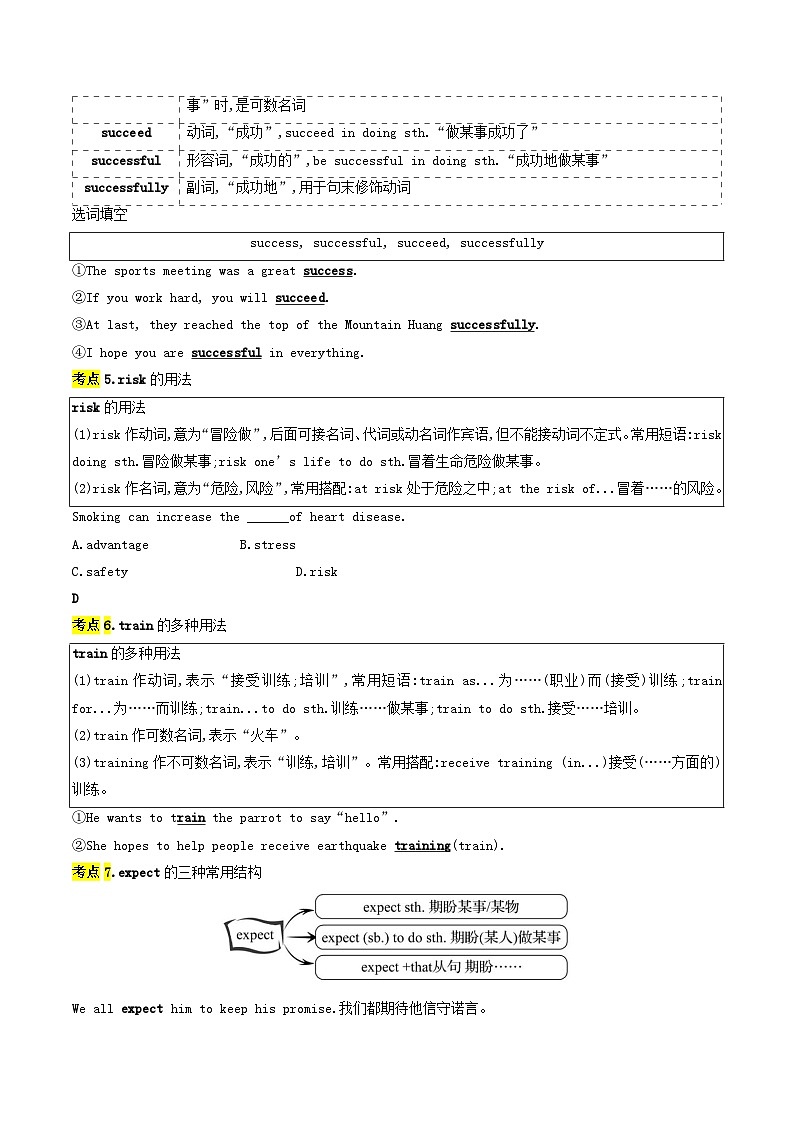
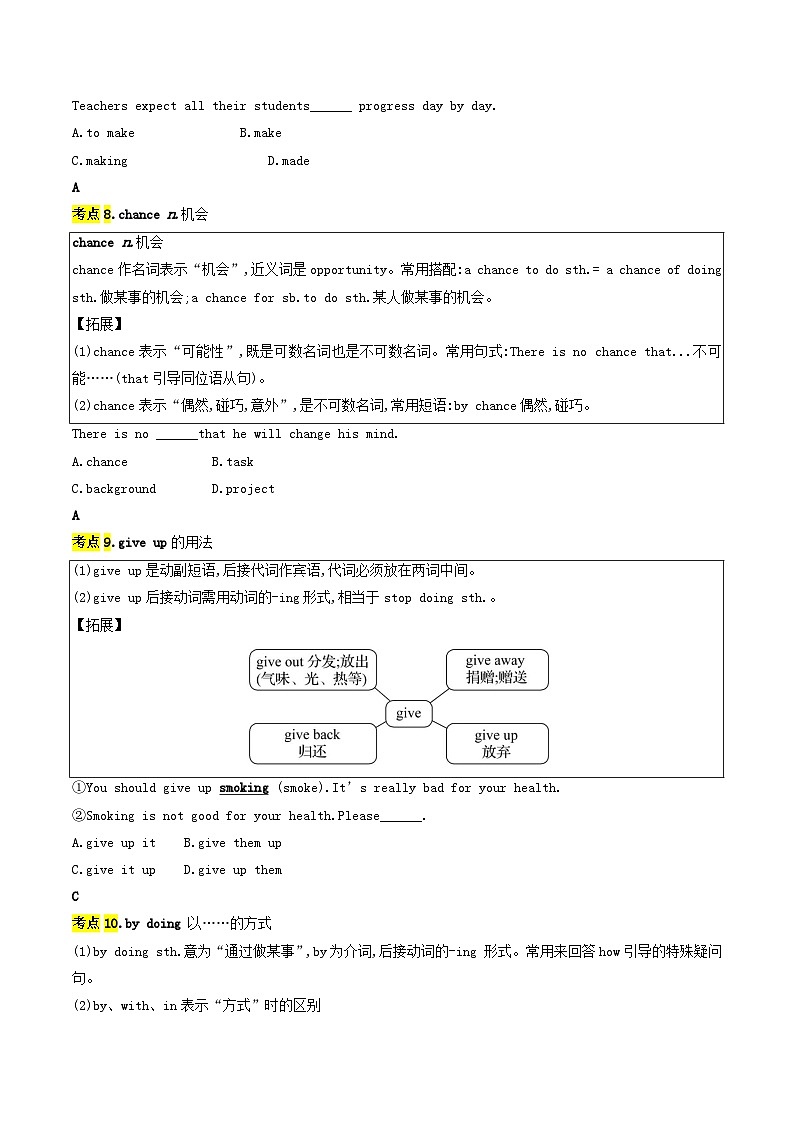
这是一份译林版2025年八年级英语下学期期末总复习(知识梳理)考点清单03Unit5-8常考点和易错点(学生版+解析),文件包含译林版2025年八年级英语下学期期末总复习知识梳理考点清单03Unit5-8常考点和易错点教师版docx、译林版2025年八年级英语下学期期末总复习知识梳理考点清单03Unit5-8常考点和易错点学生版docx等2份学案配套教学资源,其中学案共27页, 欢迎下载使用。
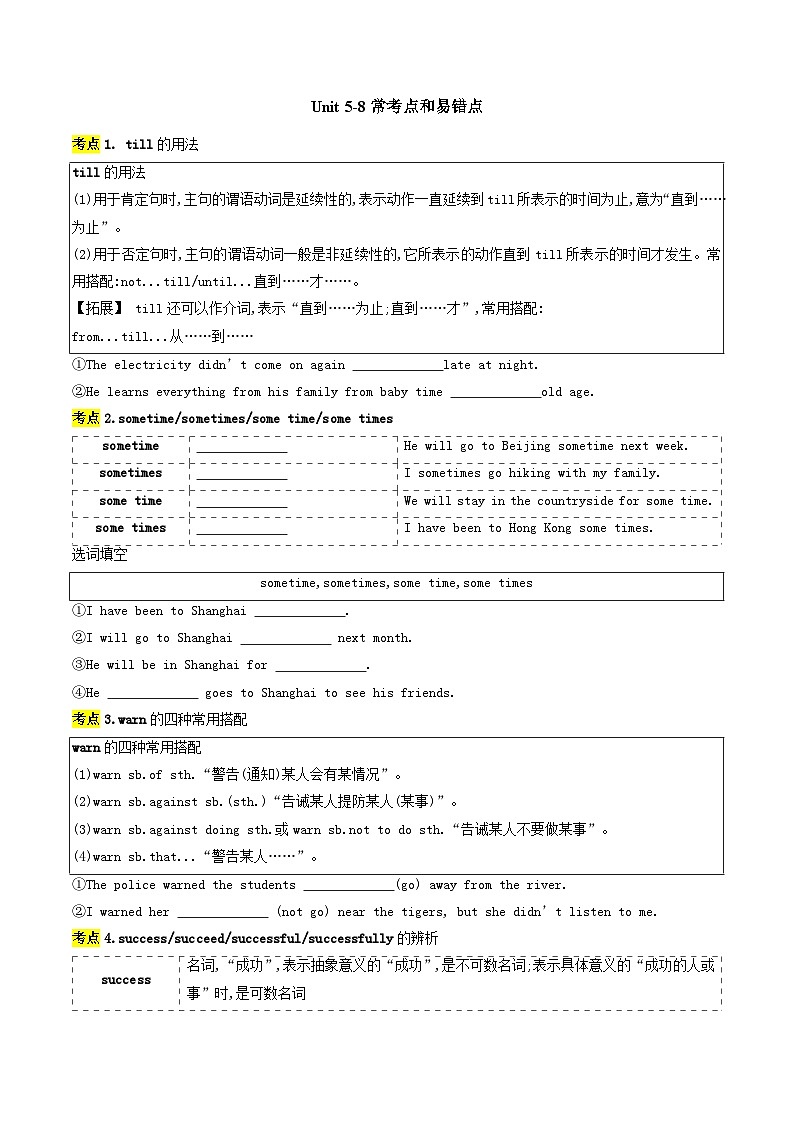
till的用法
(1)用于肯定句时,主句的谓语动词是延续性的,表示动作一直延续到till所表示的时间为止,意为“直到……为止”。
(2)用于否定句时,主句的谓语动词一般是非延续性的,它所表示的动作直到till所表示的时间才发生。常用搭配直到……才……。
【拓展】 till还可以作介词,表示“直到……为止;直到……才”,常用搭配:
从……到……
①The electricity didn’t cme n again late at night.
②He learns everything frm his family frm baby time ld age.
考点2.smetime/smetimes/sme time/sme times
选词填空
smetime,smetimes,sme time,sme times
①I have been t Shanghai .
②I will g t Shanghai next mnth.
③He will be in Shanghai fr .
④He ges t Shanghai t see his friends.
考点3.warn的四种常用搭配
warn的四种常用搭配
(1)warn sb.f sth.“警告(通知)某人会有某情况”。
(2)warn sb.against sb.(sth.)“告诫某人提防某人(某事)”。
(3)warn sb.against ding sth.或warn sb.nt t d sth.“告诫某人不要做某事”。
(4)warn “警告某人……”。
①The plice warned the students (g) away frm the river.
②I warned her (nt g) near the tigers, but she didn’t listen t me.
考点4.success/succeed/successful/successfully的辨析
选词填空
success, successful, succeed, successfully
①The sprts meeting was a great .
②If yu wrk hard, yu will .
③At last, they reached the tp f the Muntain Huang .
④I hpe yu are in everything.
考点5.risk的用法
risk的用法
(1)risk作动词,意为“冒险做”,后面可接名词、代词或动名词作宾语,但不能接动词不定式。常用短语:risk ding sth.冒险做某事;risk ne’s life t d sth.冒着生命危险做某事。
(2)risk作名词,意为“危险,风险”,常用搭配:at risk处于危险之中;at the risk f...冒着……的风险。
Smking can increase the ______f heart disease.
A.advantage B.stress
C.safetyD.risk
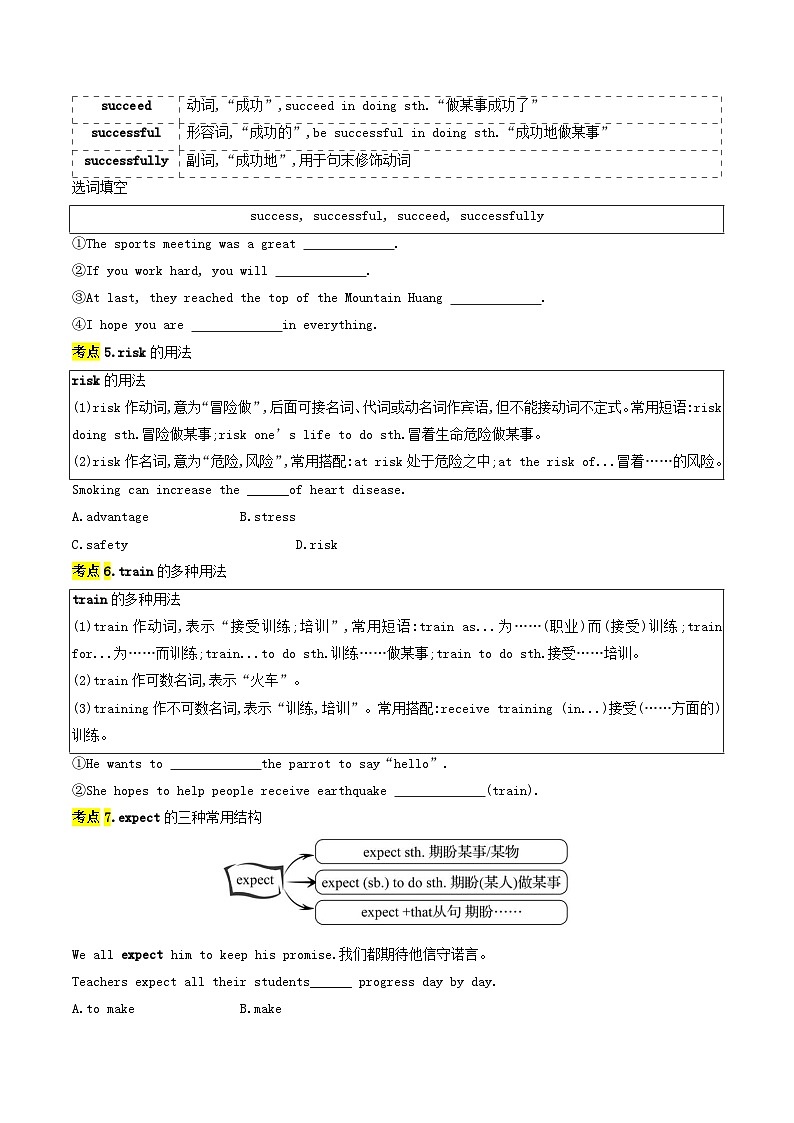
考点6.train的多种用法
train的多种用法
(1)train作动词,表示“接受训练;培训”,常用短语:train as...为……(职业)而(接受)训练;train fr...为……而训练; d sth.训练……做某事;train t d sth.接受……培训。
(2)train作可数名词,表示“火车”。
(3)training作不可数名词,表示“训练,培训”。常用搭配:receive training (in...)接受(……方面的)训练。
①He wants t the parrt t say“hell”.
②She hpes t help peple receive earthquake (train).
考点7.expect的三种常用结构
We all expect him t keep his prmise.我们都期待他信守诺言。
Teachers expect all their students______ prgress day by day.
A.t make B.make
C.makingD.made
考点8.chance n.机会
chance n.机会
chance作名词表示“机会”,近义词是pprtunity。常用搭配:a chance t d sth.= a chance f ding sth.做某事的机会;a chance fr sb.t d sth.某人做某事的机会。
【拓展】
(1)chance表示“可能性”,既是可数名词也是不可数名词。常用句式:There is n chance that...不可能……(that引导同位语从句)。
(2)chance表示“偶然,碰巧,意外”,是不可数名词,常用短语:by chance偶然,碰巧。
There is n ______that he will change his mind.
A.chanceB.task
C.backgrundD.prject
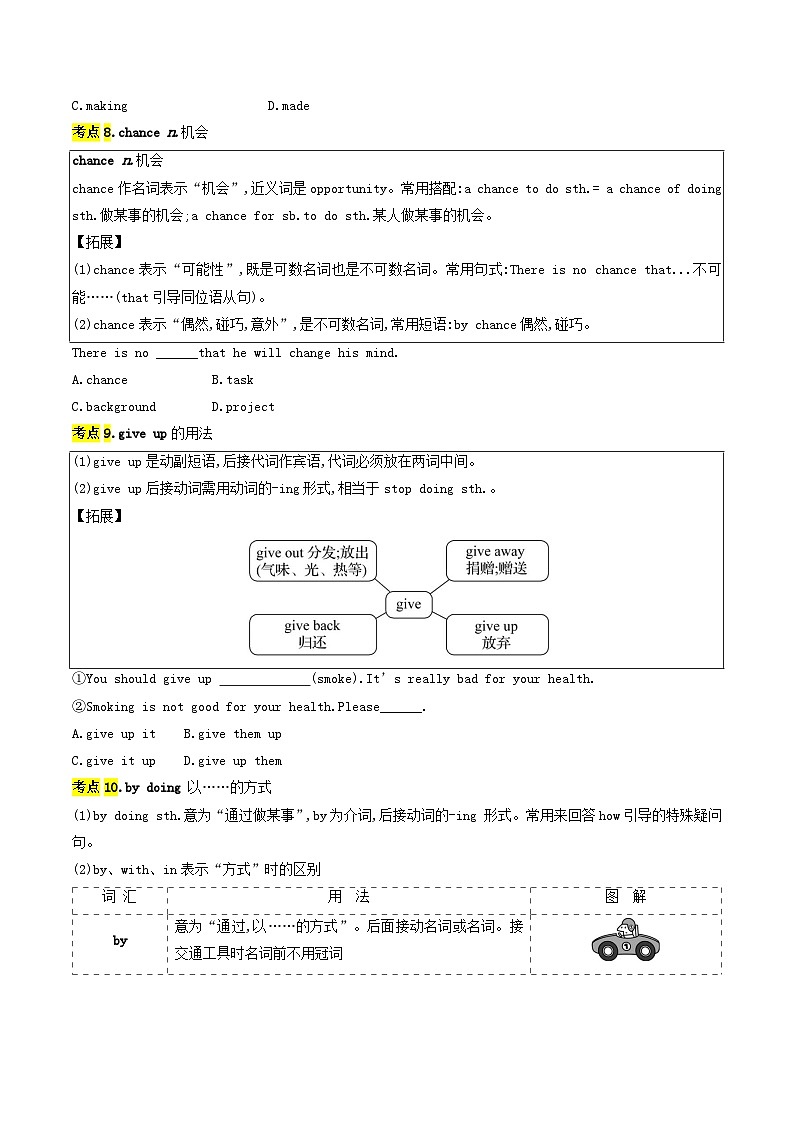
考点9.give up的用法
(1)give up是动副短语,后接代词作宾语,代词必须放在两词中间。
(2)give up后接动词需用动词的-ing形式,相当于stp ding sth.。
【拓展】
①Yu shuld give up (smke).It’s really bad fr yur health.
②Smking is nt gd fr yur health.Please______.
A.give up itB.give them up
C.give it upD.give up them
考点10.by ding 以……的方式
(1)by ding sth.意为“通过做某事”,by为介词,后接动词的-ing 形式。常用来回答hw引导的特殊疑问句。
(2)by、with、in表示“方式”时的区别
①Nwadays,many yung peple keep in tuch with their relatives and friends ______WeChat.
A.in B.by C.fr D.as
②Yu can imprve yur English ______reading mre.
A.inB.withC.byD.fr
③—Culd yu tell me hw I will pay fr the fruit?
—By (pay)ver the Internet.
考点11.prud adj. 自豪的,骄傲的
prud adj. 自豪的,骄傲的
(1)prud 形容词,意为“骄傲的”,常构成短语be prud f,意为“为……感到骄傲/自豪”。
(2)pride是prud的名词形式,意为“骄傲;自豪”,常构成短语take pride in,意为“以……而骄傲/自豪”。
①All the Chinese peple are (pride) f ur wn cuntry.
②Mr Wu is prud (have) such a gd car.
考点12.include/including的用法辨析
include/including的用法辨析
(1)include作及物动词,意为“包括,包含”,后面直接跟名词、代词或v.-ing形式,可列举事物。
(2)including作介词,意为“包括”,一般放在逗号后面,后跟名词、代词或v.-ing形式。
①Five peple died in the accident, (include)a child.
②Persnality (include) yur thughts.
考点13.What’s the matter? 怎么了?
What’s the matter? 怎么了?
(1)What’s the matter?常用来询问身体不适、疾病等健康方面的问题。
(2)询问“某人怎么了?”常用句型
【拓展】matter还可作动词,意为“有关系;要紧”。
①—What’s ______matter, Nancy?
—I have ______sre thrat.
A.the;the B.the;aC.a;aD.a;the
②Pay n attentin t thse wh laugh at yu.What ______mst is hw yu see yurself.
A.drinksB.mattersC.caresD.changes
考点14.in+一段时间 在……之后/内
in+一段时间 在……之后/内
(1)“in+一段时间”表示一段时间以后,常用于将来时。
(2)对“in+一段时间”提问,用hw sn “多久”。
—Hw sn will he cme back?
——他多久之后回来?
—In ten days.——十天后。
(3)“after+一段时间”,意为“在……以后”,相当于“一段时间+later”。这两个短语常用于一般过去时,对其提问用when。
These children left the village after three days.这些孩子三天后就离开了这个村子。
①My friend will cme back ______a week.
A.in B.fr C.since D.as
②—______ will yu finish the wrk?
—In a week.
A.Hw lngB.Hw ften
C.Hw snD.Hw far
考点15.serius adj.认真的,严肃的
serius adj.认真的,严肃的
serius在句中常作表语或定语,其比较级为mre serius,最高级为mst serius。常用短语:be serius abut sb./sth.对某人/某事是认真的;be serius abut ding sth.对做某事认真。
【拓展】serius的其他用法
serius作形容词还表示“严重的,不好的”。
When I was 12 years ld, I gt a serius disease.12岁那年,我得了一场严重的疾病。
I’m ______.I’m nt making a stry.It really happened!
A.meaningful B.simple
C.seriusD.wise
考点16.turn ff 关
turn ff 关上(开关)
turn n 打开turn ff关闭
pen 打开clse关闭
turn up 调高turn dwn调低
用 turn n,turn dwn 和turn up填空
①I can hardly hear what it is saying n TV.Culd yu please it ?
②Amy, I want t watch TV.Wuld yu like t it fr me?
③The baby is sleeping. the TV, please.
考点17.separate的常用短语
separate的常用短语
把……分成……
be separated int...被分成……
把……和……分开,
把……和……分离
be separated frm 与……分开
①We shuld rubbish different grups.
我们应该把垃圾分成不同的类别。
②This patient shuld the thers.这个病人应该隔离。
考点18.allw vt. 允许
allw vt. 允许
(1)allw作及物动词,常用于allw sb.(nt) t d sth.结构,意为“(不)允许某人做某事”。
(2)allw后不接人称代词或名词而直接接动词时,动词必须用-ing形式,即allw ding sth.,意为“允许做某事”。
(3)be allwed t d sth.意为“被允许做某事”。
My mther allws me ______ut with my friends n Sundays.
A.hang B.hanging
C.t hangD.hung
考点19.fine的多种用法
(1)fine作动词,表示“罚款”。常用短语:fine sb.(+金额) 处罚某人(多少钱);be fined (+金额)fr (ding) sth.因为(做)某事被处罚(多少钱)。
(2)fine作形容词,表示“美好的;好看的;健康的;晴朗的”。
Lily is fine and sends yu best wishes.莉莉身体很好,向你表达了最美好的祝愿。
(3)fine作名词,表示“罚金,罚款”。
She has paid ver 200 yuan in fines.她已经付了200多元的罚款。
①On any (fine) night, yu can see the star.
②He was (fine) by the pliceman fr speeding.
考点20.run ut与run ut f
We have ______all the water and fd.And the mney is ______.
A.run ut f;running ut
B.run ut;running ut f
C.run ut f;running ut f
D.run ut;running ut
考点21used t (用于过去持续或经常发生的事)曾经
used t意为“过去曾经;过去常常”,后接动词的原形,其疑问句和否定句需要借助助动词did。
【拓展】
My grandfather used t______ TV at hme after dinner,but nw he is used t______ut fr a walk.
A.watch;g B.watch;ging
C.watching;g D.watching;ging
考点22.
since与fr的区别
①—Why are yu in such a hurry?
—Because the class ______fr 10 minutes.
A.has been nB.has begun
C.is nD.begins
②—______ has yur grandparents lived in that city?
—Since 2018.
A.Hw lngB.Hw sn
C.Hw far D.Hw ften
考点23.realize的用法
(1)及物动词,意识到。其后可接名词、代词或从句作宾语。
He didn’t realize that he was wrng.他没有意识到他错了。
(2)realize还表示“实现”。常用短语:realize ne’s dream实现某人的梦想。
realize和cme true都可以表示“实现”,但在用法上还有不同。
用所给词的适当形式填空。
①She didn’t realize the (imprtant) f health until she gt ill.
②He studies hard (realize) his dream.
考点24.辨析 already与yet的用法
用 already或 yet填空
①—Have they taken dwn the ld pictures ?
—N, nt .
②Mst f us have finished ur cmpsitins .
③He said he hadn’t visited the exhibitin .
④I’d lve t g there with yu, but I haven’t finished ur task .
考点25.cnditin与situatin的辨析
The plants grw best in cl,damp (cnditin).
考点26.such as与fr example的不同
Sme freigners like t give themselves funny Chinese names.______, a friend f mine calls himself “Ha Lihai”.
A.Fr exampleB.Such as
C.S farD.First f all
考点27.at the end f/by the end f/in the end
If we cntinue killing elephants fr their ivry, we humans will lse them______.
A.at the same timeB.all in all
C.in the endD.by the end f
考点28.have been t 去过
have been t 去过
(1)have/has been t意为“曾经去过某地”,现在已经不在那里了,后可接次数,如nce,twice,three times等,表示“去过某地几次了”,也可和just,never,ever等连用。
He has been t Beijing three times.
他去过北京三次了。
(2)have/has been in表示“在某地待了多长时间”,常与表示一段时间的状语连用。
The Greens have been in Hng Kng fr tw weeks.格林一家在香港待了两周了。
(3)have/has gne t意为“到某地去了”,说话时该人不在现场,一般不用第一人称、第二人称作句子的主语。
Jim isn’t in.He has gne t the library.吉姆不在。他去图书馆了。
【提醒】 这三个句型后接地点副词时,句型中的介词都应去掉。
例如:It’s a beautiful place.I have been there.它是个美丽的地方,我曾经去过那儿。
用have/has been t,have/has gne t或have/has been in 填空
①—Where is he?
—He Lndn.
② She left Beijing last year.She the city fr ne year.
③—Hw many times the children France?
—Many times.
④—Hw lng the man the village?
—Since 1999.
⑤Guilin is a gd place.I there twice.
考点29.except/besides/beside/but的辨析
用except/besides/beside填空
①I like this skirt. , it’s really cheap.
②Everyne else in my class was there me, and I didn’t knw why.
③There is a park my schl.
④All f us helped t clean up the ld peple’s hme Eric.He had a bad cld.
考点30.mind v. 介意
(1)mind作动词,意为“介意,反对”,常表示委婉、客气的请求。常用于以下句型及短语中:
①Wuld/D yu mind ding sth.? 表示客气的请求;
②Wuld/D yu mind nt ding sth.? 表示委婉建议或请求;
③Never mind.不要紧。
(2)对Wuld/D yu mind ding sth.? 的回答:
①如果同意对方做此事,则常用“N,nt at all.” “Certainly nt.”“Of curse nt.”或“G ahead.”;
②如果不希望对方这么做,则应该说“Yu’d better nt.”或“I’m srry,but...”。
【提醒】 mind作名词,意为“头脑;想法”等。常见短语有: make up ne’s mind“下定决心”;change ne’s mind“改变主意”。
—Wuld yu mind ______the windw?
—______.It is t ht.
A.t pen;Of curse nt B.pening;Certainly
C.pening;G aheadD.t pen;Sure
考点31.until cnj. 直到……为止
(1)until=till,后接具体时刻/时间单词或短语(yesterday/next weekend)或从句,主句中动词为延续性动词。
(2)直到……才,主句中动词为非延续性动词。
【提醒】
当until引导时间状语从句时,从句中常用一般现在时代替一般将来时;用一般过去时代替过去将来时。
①I didn’t knw the news Tm tld me tw minutes ag.
②They try again and again they succeed.
考点32.辨析(1)either/neither的辨析
(2)either/als/t/as well的辨析
①Jhn is gd at ding sprts.He ______climbs muntains ______plays sccer every Sunday mrning.
A.neither;nr B.either;r
C.nt nly;but alsD.bth;and
②—It’s said that Tina will g t Canada by herself.
—Yes.______f her parents will g with her.
A.BthB.Neither
C.EitherD.All
③______ Jane______ her brther is ging t the mvies this weekend.One f them has t stay at hme t lk after their sick mther.
A.Neither; nrB.Either;r
C.Bth; andD.Nt nly;but als
考点33.n time/in time
—Excuse me, will the flight arrive sn?
—Yes.It will be landing right ______.
A.at timesB.in time
C.n timeD.fr time
考点34.“疑问词+动词不定式”的用法
“特殊疑问词+不定式”由两部分构成:疑问词和动词不定式(wh-+t d)。疑问词部分包括疑问代词wh,whm,what,which和whse以及疑问副词when,where和hw。它主要具有以下几种功能:
(1)作主语:Where t lk fr him is a prblem.问题是到哪里去找他。
(2)作宾语:
①作动词的宾语:I can’t decide when t start.
我不能决定何时动身。
②作介词的宾语:I am thinking abut hw t deal with the prblem.
我正在考虑怎样处理这个问题。
(3)作宾语补足语:Please tell me what t d first.请告诉我第一步应该做什么。
(4)作表语:The main prblem is hw t wrk in this cmpany.
主要的问题是如何在这家公司工作。
①—Excuse me.Culd yu please tell me ______my car?
—Sure.Park it right here.I’ll help yu.
A.hw t stpB.where t park
C.when t parkD.which t park
②—Which dress d yu like best, Madam?
—Srry, I can’t decide ______nw.
A.t buy which neB.buy which ne
C.which ne t buyD.which t buy ne
考点35.advice n. 建议;忠告;劝告
(1)advice意为“建议;忠告;劝告”,是不可数名词,一条建议应表达为“a piece f advice”。
advice常用的搭配:
①give sb.advice (n sth.)(就某事)给某人提出建议
②take ne’s advice 接受某人的建议
(2)advise是advice的动词形式,意为“劝告;建议”。
advise sb.(nt) t d sth.意为“建议某人(不)做某事”。
①Can yu give me______ n hw t surf the Internet?
A.sme pieces f advicesB.sme piece f advices
C.sme pieces f adviceD.sme piece f advice
②She advised me (nt waste) time playing games.
smetime
He will g t Beijing smetime next week.
smetimes
I smetimes g hiking with my family.
sme time
We will stay in the cuntryside fr sme time.
sme times
I have been t Hng Kng sme times.
success
名词,“成功”,表示抽象意义的“成功”,是不可数名词;表示具体意义的“成功的人或事”时,是可数名词
succeed
动词,“成功”,succeed in ding sth.“做某事成功了”
successful
形容词,“成功的”,be successful in ding sth.“成功地做某事”
successfully
副词,“成功地”,用于句末修饰动词
词 汇
用 法
图 解
by
意为“通过,以……的方式”。后面接动名词或名词。接交通工具时名词前不用冠词
with
意为“用,拿着,与……一起”。后面可接表示工具或人物或身体部位的名词
in
意为“用”。多接表示语言或颜色的名词
run ut
用完,
耗尽
不及物动词短语,主语常为时间、食品、金钱等无生命的名词,主动形式表示被动意义
run ut f
及物动词短语,主语一般是人,f后跟某物,表示“某人用完了某物”,相当于use up
since
作介词,意为“自……以来”,后接表示时间点的词或词组
作连词,引导时间状语从句;通常情况下,从句用一般过去时,主句用现在完成时或现在完成进行时
fr
fr后接时间段,表示时间的持续,句中的谓语动词要用延续性动词
since短语和fr短语有时可以互换,如:since tw days ag=fr tw days,对fr短语和since短语提问用hw lng
realize
表示“实现”是及物动词,后面要接宾语,也可用于被动语态
Her dream has been realized.=She realized her dream.
她的梦想实现了。
cme
true
是不及物动词短语,后面不可接宾语,也不能用于被动语态
Her dream has cme true.=She has made her dream cme true.她的梦想实现了。
already
意为“已经”,一般用于肯定句;用于疑问句时表示“惊喜;意外”
yet
意为“已经;还”,一般用于否定句或疑问句句末
cnditin
一般强调产生影响的条件或环境,着重于条件或境况
Cnditin in pr areas is hrrible.
贫困地区的条件十分糟糕。
situatin
指明确具体的环境情况或处境,着重于形势或局面
The verall situatin is wrsening.整体形势在日益恶化。
such as
用来“罗列”同类人或物中的几个例子,可置于被列举的事物与前面的名词之间,但其后不能用逗号
fr example
强调“举例”说明,而且一般只举同类人或物中的一个,作为插入语,且用逗号隔开,可置于句首、句中或句末
at the end f
“在……末尾,在……的尽头”,后接时间或地点。反义词组为at the beginning f
by the end f
“到……为止”,常用于一般将来时或过去完成时
in the end
“最后”,多用于一般过去时,相当于finally或at last,此时不能和f连用
except
except 作介词,意为“除了……以外”,其后接名词、代词、介词短语、副词、从句等,表示把某人或某物从某一范围内排除出去,即不包含在内。例如:The windw is never pened except in summer.除夏天外,这扇窗户从不打开。
except fr(用于所言不包括的人或事物前)除……之外。例如:I had nthing n except fr my scks.
除了短袜,我什么都没穿。
besides
作介词,意为“除……之外(还有)”。例如:Mary knws Japanese besides French.除法语外,玛丽还懂日语。
作副词,意为“而且,再说”。例如:I dn’t like this pair f shes.Besides,it’s t expensive.
我不喜欢这双鞋子,而且它也太贵了。
beside
作介词,意为“在……旁边”。例如:There is a museum beside his huse.在他的房子旁边有一个博物馆。
but
作介词,通常用于n,n ne,nbdy,nthing,any,anyne,anything,
every,everyne,everything,all,nne等词语后。例如:Nbdy knew her name but me.除我之外,没人知道她的名字。
either
①代词,作主语,视作单数形式;作限定词,后跟单数名词
②“ ”
neither
①代词,作主语,视作单数形式;作限定词,后跟单数名词
②“ ”
either
意为“也”,用于否定句中,通常放于句末
als
意为“也”,用于肯定句中,通常放于句中be动词、助动词或情态动词的后面,行为动词的前面
t/as well
意为“也”,用于肯定句中,通常放于句末
n time
“准时,按时”,指与某规定时间相符,相当于at the right time
in time
“及时”,指在某时间范围之内,正赶上时候或恰在需要的时候
注册成功

在线客服
添加在线客服
获取1对1服务
官方微信
关注“教习网”公众号
打开微信就能找资料
赛课定制
添加在线客服
获取1对1定制服务
职称咨询
添加在线客服
获取1V1专业指导服务

免费福利