免费领取教师福利



若您为此资料的原创作者,认为该资料内容侵犯了您的知识产权,请扫码添加我们的相关工作人员,我们尽可能的保护您的合法权益。

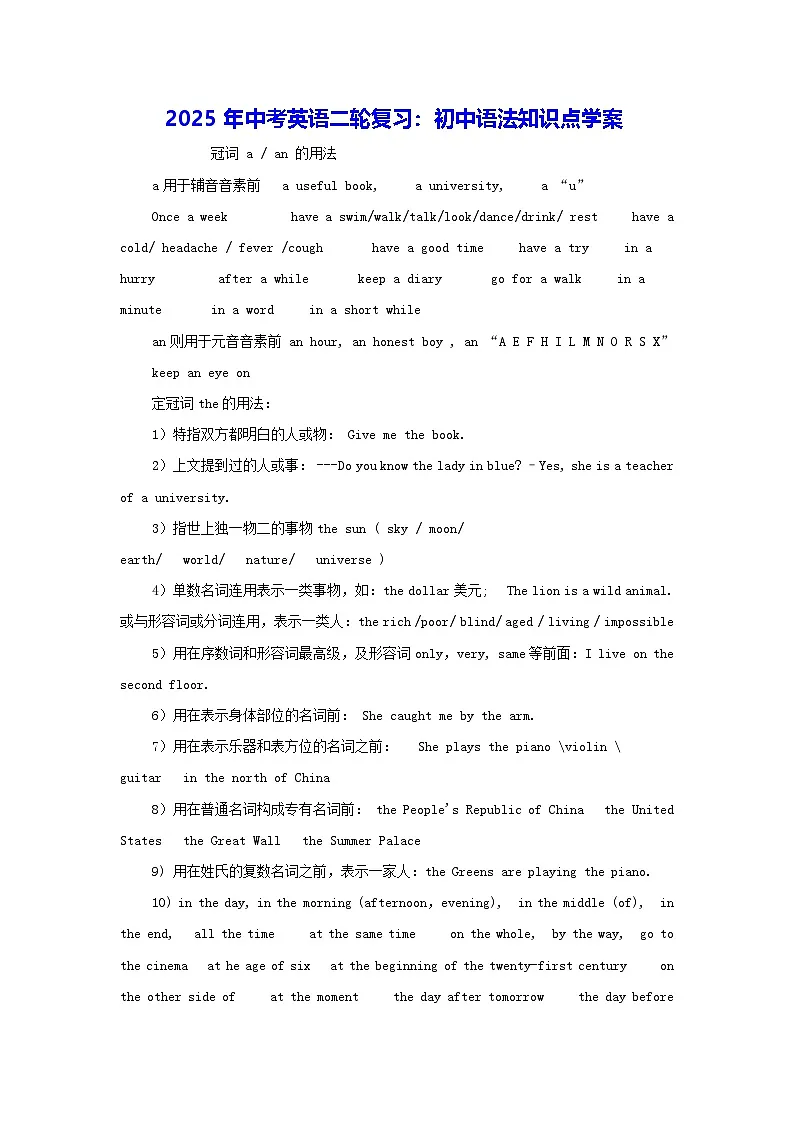
这是一份2025年中考英语二轮复习:初中语法知识点学案,共21页。学案主要包含了二物主,三为宾,动词变为形容词,名词变为形容词,形容词变为名词,否定的,其它等内容,欢迎下载使用。
a用于辅音音素前 a useful bk, a university, a “u”
Once a week have a swim/walk/talk/lk/dance/drink/ rest have a cld/ headache / fever /cugh have a gd time have a try in a hurry after a while keep a diary g fr a walk in a minute in a wrd in a shrt while
an则用于元音音素前 an hur, an hnest by , an “A E F H I L M N O R S X”
keep an eye n
定冠词the的用法:
1)特指双方都明白的人或物: Give me the bk.
2)上文提到过的人或事: ---D yu knw the lady in blue? –Yes, she is a teacher f a university.
3)指世上独一物二的事物the sun ( sky / mn/ earth/ wrld/ nature/ universe )
4)单数名词连用表示一类事物,如:the dllar 美元; The lin is a wild animal.或与形容词或分词连用,表示一类人:the rich /pr/ blind/ aged / living / impssible
5)用在序数词和形容词最高级,及形容词nly,very, same等前面:I live n the secnd flr.
6)用在表示身体部位的名词前: She caught me by the arm.
7)用在表示乐器和表方位的名词之前: She plays the pian \vilin \ guitar in the nrth f China
8)用在普通名词构成专有名词前: the Peple's Republic f China the United States the Great Wall the Summer Palace
9) 用在姓氏的复数名词之前,表示一家人:the Greens are playing the pian.
10) in the day, in the mrning (afternn,evening), in the middle (f), in the end, all the time at the same time n the whle, by the way, g t the cinema at he age f six at the beginning f the twenty-first century n the ther side f at the mment the day after tmrrw the day befre yesterday, the next mrning, in the sky (water,field,cuntry) in the dark, in the rain,
不用定冠词的情况
1) 国名,人名前通常不用定冠词:China , Eurpe 欧洲 Lei Feng 雷锋
2)物质名词和抽象名词表示一般概念时,通常不加冠词;当表示特定的意思时,需要加定冠词Failure is the mther f success. 失败乃成功之母。
3)在季节、月份、节日、 假日、日期、星期等表示时间的名词之前,不加冠词; Children’s Day Mther’s Day Father’s Day
4)在称呼或表示官衔,职位的名词前不加冠词; He is captain f the team.
5)在三餐、四季,球类运动、学科、娱乐运动的名称前,不加冠词 如:have breakfast /supper / lunch,play basketball / ftball / vlleyball / chess , in spring/summer/ autumn/ winter
6)当by 与火车等交通工具连用,表示一种方式时,中间无冠词;by bus/ train/ taxi/ bus/ ship
7)Day and night face t face side by side step by step watch TV at schl / wrk / hme at first/ last in danger in truble n ft n duty n watch in bed n time in time g t schl g t wrk by taxi / bike at nn at night n TV at twn
部分词组有无冠词的区别
in hspital 生病住院 in the hspital 在医院里
in frnt f 在---的前面in the frnt f 在----内部的前面
g t schl 上学g t the schl 到学校去
a number f = a lt f 许多,谓语动词用复数。
The number f ----的数目,----的总数, 谓语动词用单数(第三人称单数)
名词:专有名词和普通名词(个体名词、集体名词、物质名词、抽象名词)
可数名词的单数变复数①一般情况加s ②以s, x sh ch,等结尾的词加-es bus-buses watch-watches ③以 结尾的名词,无生命的加s,如: pht---phts pian---pians 有生命的es,如:ptat--ptates tmat--tmates 均可,如:zer---zers / zeres ④以f或fe 结尾的名词,去f, fe 加ves,如:half---halves knife---knives leaf---leaves wlf---wlves wife---wives life---lives thief---thieves (加s,如:belief---beliefs rf---rfs safe---safes gulf---gulfs;)⑤以辅音字母+y结尾的词,变y 为i,再加es baby---babies ⑥不规则:a. 单复数形式一样。Sheep, deer, Chinese, Japanese. Peple, plice, scissrs, trusers b. 其他的。ft—feet tth---teeth child—children muse---mice man---men wman---wmen businessman ---businessmen
German---Germans wmen dctrs
集体名词: Peple, plice,(一般表示一个整体,谓用复数) class, family, glasses
不可数名词:
常见的不可数名词有:infrmatin, news, rm (空间), wrk, wrk, weather, advice, bread , fd, milk, tea, ice, glasses, meat
① A little, a bit f, sme, much, a lt f, quite a lt f 常修饰不可数名词.
② 不可数名词作主语,谓语动词用单数。
③ 如果用and连接两个不可数名词作主语时,谓语动词用复数。Time and mney are-
④ A cup\ glass \bttle \bx \ kil \ grup \ crwd \ class \ pair f
Tw and a half kils f = tw kils and a half f
名词所有格 在英语中有些名词可以加"'s"来表示所有关系,带这种词尾的名词形式称为该名词的所有格,如:a teacher's bk。名词所有格的规则如下:
1) 单数名词词尾加"'s",复数名词词尾没有s,也要加" 's ",如the by's bag,men's rm Children’s Day Mther’s Day Father’s Day
2) 若名词已有复数词尾-s ,只加" ' ",如:Teachers’ Day ladies’ rm twenty minutes’ walk
3) 凡不能加"'s"的名词,都可以用"名词+f +名词"的结构来表示所有关系,如:the title f the sng 歌的名字; A picture f family; a map f China
4) 在表示店铺或教堂的名字或某人的家时,名词所有格的后面常常不出现它所修饰的名词,如:the barber's 理发店。
5) 如果两个名词并列,并且分别有's,则表示"分别有";只有一个's,则表示'共有'。 Jhn's and Mary's rm(两间) Jhn and Mary's rm(一间)
6) 复合名词或短语,'s 加在最后一个词的词尾。 如:a mnth r tw's absence
7)双重所有格 a friend f mine / hers / his / theirs a friend f Mary’s mther’s
代词
1、人称代词、物主代词和反身代词
I—me—my—mine—myself yu —yu—yur—yurself (yurselves)
he—him—his—his—himself she—her—her—hers—herself
it—it—its—its—itself we—us—ur—urs—urselves
they—them—their—theirs—themselves
人称顺序yu, he, she, I ; we, yu, they
主格作主语;宾格作宾语,动词和介词之后通常作宾格;形容词性物主代词不能单独使用,通常放在名词之前;名词性物主代词=形容词性物主代词+名词,“f+名词性物主代词”表示所属关系。A friend f mine我的一位朋友; teacher f hers 她的老师
代词it 的用法:
①指代前面提到过的事物。 ②表天气。 ③表距离。
④指婴儿和不明身份的人。 ---Jhn, smene in yur class phned yu this mrning. ---Oh, wh was it?
⑤用作形式主语。
It’s kind / gd / nice /clever /plite / flish f sb. t d sth.
It’s imprtant / necessary / pssible / easy / difficult fr sb t d sth,
It’s time t get up.
It’s time fr lunch.
It’s ne’s turn t d
It seems that
It takes sb. sme time t d sth.
⑥用作形式宾语。Find / think / feel + it +adj +t d sth
It ne 的区别
It 特指上文提到的同一对象,同一事物。
ne同类而不同一。
that常用于比较结构中,代替前面提到的名词,以避免重复。
反身代词
构成规则:一、二物主,三为宾。
运用:hurt/ teach/ wash / buy/ enjy neself
by / Help neself (ne selves) t --- / Lk after neself / Say t neself / Cme t neself
2、不定代词 little, a little, few, a few=several(sme), sme, any much, t much, much t, mre then =ver, less than= nearly
little, 几乎没有,表示否定意思,用以修饰不可数名词。
A little ①一点点,表示肯定,用以修饰不可数名词。Only a little 仅一点点.②也可修饰形容词和副词。③一点点,放在动词、动词宾语后。
few几乎没有,表示否定意思,用以修饰可数名词。
a few=several 几个, 一些,表示肯定意思,用以修饰可数名词。
sme 一些,修饰可数名词,后跟复数形式名词或nes, 也可修饰不可数名词。在表示请求、委婉语气的疑问句和表示希望得到对方的肯定回答的问句中,常用sme. Culd yu give me sme apples?
any 一些,任何一些。 一般用于疑问句中或否定句中和IF 引导的条件句中。
much 许多。修饰不可数名词,放在不可数名词前,可用a lt f 替换。
t much 太多的,用法相当于much ,放在不可数名词前。Heath is very imprtant t us. We shuld eat mre vegetables and fruit instead f t much rich fd.
much t 太,用法相当于t, 放在形容词和副词前。Keep quiet! It’s much t nisy here.
mre than 超过,多于。=ver
mre r less 或多或少,差不多。=abut
at least 至少
a lt 许多,修饰动词。Thanks a lt.
a lt f = lts f 许多的,可修饰可数名词和不可数名词。
a number f 许多的,= many 只用于修饰复数形式名词,放在可数名词复数前。
every 用于三个或三个以上,着眼于整体。后可跟数词。词组有every ten minuets
each 用于两个或两个以上,着眼于个体。词组有each f
either 两个中任何一个
either ----r
bth 两个都
bth ---- and ---
bth f ---
neither 两个中一个也没有 e.g. ---D yu like talking with yur friends n the telephne r mbile phne? ---Neither, I enjy using QQ.
neither --- nr ---
any 三个以上中任何一个
all三个以上中全部
nne 三个以上中一个也没有。 Nne f ---中没有一个,表示三个或以上数目的人或物中没有一个,表否定,作主语时,谓语动词一般用单数。
thers 表示“泛指”除自己外,别的人。Sme ----, thers -----
the ther 表示两个中的另一个。One ----, the ther ----
the thers 表示特指的另一些。
anther 后跟单数名词。表示泛指另一个人。后跟带数词的复数名词,表示“再,还要”的意思。
ther 别的,另外的,一般后跟复数名词或nes , 在ther 前可加sme, many 或数词,表示“几个,一些别的”
Such a tall building such an exciting ftball match
s many peple
each ther相互,彼此,指两个或两个物时 。ne anther 相互,彼此,指三者或三者以上的彼此。ne anther’s 相互的,彼此的。
数词
表示数目多少或顺序多少的词叫数词,数词分为基数词和序数词。表示数目多少的数词叫基数词;表示顺序的数词叫序数词。
一、基数词和序数词
1)基数词写法和读法: ①百位与十位,用 and, 十位与个位,写时用“—”②先确定分节号,从右至左,每隔三位数是一个分节号。③第一个分节号是千位 thusand 4第二个分节号是千位 millin ⑤第三个分号节是十亿位 billin. 1, 234 ,567, 892 ne billin tw hundred and thirty-fur millin five hundred and sixty-seven thusand eight hundred and ninety-tw
2)分数表示法 构成:分子基,分母序,分子大于1时,分母在序数词后加S: 1/2 a half 1/3 ne-third; 2/3 tw thirds 3/4 three quarters = three furths 2- 3/4 tw and three furths
3)表示"年代",用 in +the +数词复数; in the 1980s (20世纪80年代)
4)表某人几岁时: in +物主代词+数词的复数形式 in ne’s twenties
5)He lives in Rm 88. One plus tw is three. Three times five is fifteen.
6)hundred , thusand , millin 等词前有具体的数字时,不能加S 如 three hundreds 这种说法是错误的
7)hundreds f thusands f millins f
8)a 21-year-ld girl three days and a half = three and a half days ne and a half hurs = ne hur and a half we’ll have tw weeks’ hliday (tw-week hliday)
9)(基数词变序数词的口诀)
一、二、 三特别记,th从四以上记;怎么加很容易,八减t,九减e; f来把ve替,见y变ie; 若是遇到几十几,变换个位就可以。
One-first tw-secnd three- third five- fifth eight-eighth nine- ninth twelve – twelfth thirteen- thirteenth fifteen- fifteenth eighteen- eighteenth twenty- twentieth twenty-ne---twenty-first thirty-thirtieth frty-frtieth fifty –fiftieth sixty- sixtieth seventy- seventieth eighty-eightieth ninety-ninetieth
序数词的缩写形式: first---1st secnd---2nd thirty-first---31st
形容和副词
①修饰smething, anything, everything, anybdy等不定代词的形容词,形容词要放在不定代词之后。I have Smething imprtant t tell yu.
②enugh修饰形容词、副词时,enugh要放在形容词和副词之后。Far enugh
③interesting, exciting, bring, amazing, surprising, mving 主语为物。Interested, excited, amazed, surprised, frightened, tired, pleased 主语为人。
④Much, far, a lt, a little, even等后要用形容词或副词的比较级。 I fell even wrse nw.
5.连系动词be, 感官动词(lk, smell, taste, sund, feel )三个变(get, becme, turn,) keep 后跟形容词.
⑥既可作形容词又可作副词的词有:
hard 作形容词=difficult , 作副词,放在wrk, rain等后,表努力地做。
well作形容词身体好; 作副词,做得好。
lng作形容词,表事物的长度,作副词,放在last, talk等后,表动作持续。
Fast 作作形容,放在系动词后,作副词放在rain, make sth.等词后,表“做得快”。
High作形容词“山,海浪的高。作副词, 放在fly, jump 等后表飞得高,跳得高。
⑦五、形容词变为副词 ①+ly useful, wide, strng ②改y为i,再加ly healthy , heavy, happy, lucky, nisy, ③gd ——well terrible---terribly prbable---prbably
⑧多数以ly 结尾的词是副词。 但friendly, lnely, lvely, likely, daily, lively 是形容词。
⑨China is larger than any ther cunty in Asia. (同一范围内) China is larger than any cunty in Afirca. (不同范围内)
⑩hw many 对可数名词数量的提问。Hw many peple are there in yur family?
Hw much 对不可数名词数量的提问和提问价格。
Hw lng 多久,多长时间。回答常用:fr + 段时间 since +点时间。
Hw sn 多快,多久以后。回答常用:in +段时间
Hw ften 多长时间一次,提问频率。回答常用:nce (twice) a week, three times a day, ften
Hw far 多远,对距离提问。回答常用:fifteen minutes’ walk , 10 meters away
形容词和副词的比较级和最高级:
原级: as +原级 + as ; nt as / s +原级 + as =反义词+than English is as interesting as Chinese. Mr. Zhang isn’t as ld as Mr. Li. = Mr. Zhang is yunger than Mr. Li.
比较级的标志词 ①than, Lily’s bag is bigger than hers.
②much, far, a little, even , next time
③which / wh ---- A, B ? Which is mre beautiful, Tm, Jim?
④the +比较级----,the+比较级---- The mre we get tgether, the happier we’ll be.
⑤比较级+and+比较级 (多音节词和部分双音节词用mre and mre +原级) 越来越---- harder and harder , ur hmetwn is becming mre and mre beautiful.
最高级标志词:①the + 最高级 + f / in Shanghai is the biggest city in China.
②One f the + 最高级 + 名词复数 Zhu Jiekun is ne f the mst ppular singers.
③Which / wh ----+ 最高级, A, B r C? Wh city is the mst beautiful, Beijing, Shanghai r Kunming?
④序数词+最高级,表“第几最----” Chang jiang is the first lngest river in China. the secnd largest ppulatin
形容词和副词比较级和最高级的构成规则 (略)
不规则: gd / well --- better--- best bad / badly/ ill ---wrse--wrst many / much -- mre ----mst little ---less---least far --- farther(较远)--- farthest far---further(进一步) ----furthest
tired ---mre tired ---the mst tired (right, tired, glad. pleased. real )
动词的时态
祈使句 祈使句用以表达命令,要求,请求,劝告等。
1) 祈使句否定在句首加Dn't: Dn't mve. Dn't be late.
2) Let’s ------shall we ? let us \ him ----- will yu / wn't yu?
感叹句
Hw+形容词或副词+主语+谓语+其它 Hw lvely the baby is!
What a / an + 形容词+可数名词单数+主语+谓语+其它 What a clever by he is!
What + 形容词+可数名词复数+主语+谓语+其它 What wnderful ideas (we have)!
What + 形容词+不可数名词+主语+谓语+其它 What cld weather it is!
反意疑问句
1) 陈述部分用 n, nthing, nbdy, never, few, seldm, hardly, rarely, little, t---t等否定含义的词时,疑问部分用肯定含义。Sme plants never blwn (开花), d they ?
2) 陈述部分有have t +v. (had t + v.),疑问部分常用dn't +主语(didn't +主语)。
We have t get there at eight tmrrw, dn't we?
3) 陈述部分的谓语是used t 时,疑问部分用didn't +主语或 usedn't +主语。
He used t take pictures there, didn't he? / usedn't he?
4) 陈述部分有had better + v. 疑问句部分用hadn't yu?
Yu'd better read it by yurself, hadn't yu?
5) 陈述部分由neither… nr, either… r 连接的并列主语时,疑问部分根据其实际逻辑意义而定。 Neither yu nr I am engineer, are we?
6) 陈述部分主语是指示代词或不定代词everything, that, nthing, this, 疑问部分主语用it。
Everything is ready, isn't it?
7) 陈述部分为主语从句或并列复合句,疑问部分有三种情况:
a. 并列复合句疑问部分,谓语动词根据邻近从句的谓语而定。
Mr. Smith had been t Beijing fr several times, he shuld have been in China nw, shuldn't he?
b. 带有定语从句,宾语从句的主从复合句,疑问部分谓语根据主句的谓语而定:
He is nt the man wh gave us a talk, is he? He said he wanted t visit Japan, didn't he?
c. 上述部分主句谓语是think, believe, expect, suppse, imagine等引导的定语从句,疑问部分与宾语从句相对应构成反意疑问句。
I dn't think he is bright, is he? We believe she can d it better, can't she?
8) 陈述部分主语是不定代词everybdy, anyne, smebdy, nbdy, n ne等,疑问部分常用复数they,有时也用单数he。
Everyne knws the answer, dn't they? (des he?)
Nbdy knws abut it, d they? (des he?)
9) 省去主语的祈使句的反意疑问句,疑问部分用will yu。
Dn't d that again, will yu? G with me, will yu / wn't yu ?
注意: Let's 开头的祈使句,后用shall we? Let's g and listen t the music, shall we?
Let us 开头的祈使句,后用will yu? Let us wait fr yu in the reading-rm, will yu ?
10) 陈述部分是"there be"结构的,疑问部分用there省略主语代词。
There is smething wrng with yur watch, isn't there? There will nt be any truble, will there?
11) 否定前缀不能视为否定词,其反意疑问句仍用否定形式。
It is impssible, isn't it? He is nt unkind t his classmates, is he?
并列句
and 和,并且, wrk hard, and yu can pass the exam.
but 但是 he is rich but he is nt happy.
Or 否则,要不然,或者(在否定句中表和) Hurry up, r yu’ll be late.
s 因此,所以 Kate was ill s she didn’t g t schl.
Fr 因为 I have t stay up late, fr I have a lt f wrk t d.
状语从句
当状语从句的引导词为If, when, befre, after, until, as sn as 等,主句和从句有下列情况:
英语句子中如果一看到 Thught----but----; because----s---这种结构,就是错误.
倒装句
s+助动词\BE动词\情态动词+另一主语,表示后者与前者一致。
s+上句主语+助动词\BE动词\情态动词,真的,确实如此。
Tm watched TV last night, s did Ann.
Tm didn’t watch TV last night. Neither did Ann.
---Yu’ve left the light n. ---S I have. I’ll g and turn it ff.
宾语从句
?从句用陈述句语序。
?主句与从句的关系。
A.主现从不限;
B.主过从过;
C.真金不怕火炼。The earth mves arund the sun.
③常见的宾语从句。
She says that ----
I hpe / think / feel / wnder---- I wnder if he will jin us in the discussin tnight.
Culd yu tell / shw me--- Culd yu please tell me where the teacher’s ffice is?
D yu knw---- D yu knw where Mr. Li lives?
Please tell me ---
She asked me ---
I dn’t knw ---- I dn’t knw whether Tm will g r nt.
定语从句
that和which在指物的情况下一般都可以互换, 但在下列情况下, 一般用that而不用which。
(1) 先行词为all, everything, nthing, smething, anything, little, much 等不定代词时。
I am sure she has smething (that) yu can brrw.
(2)先行词被all, every, n, sme, any, little, much等修饰时。I’ve read all the bks that are nt mine.
(3)先行词被序数词或最高级修饰时。This is the first bk (that) he has read.
(4)先行词被the nly, the very, the same, the last修饰时。
This is the very bk that belngs t him.
一般用that而不用wh
(1) 先行词是wh或wh引导的主句。
Wh is the girl (that) drve the car? Wh (that) brke the windw will be punished.
(2) 主句以There be 引导时 。 There are 200 peple (that) didn’t
that和which在指物的情况下一般都可以互换, 但在下列情况下, 一般用which而不用that。
(1)关系代词在限制性定语从句中紧跟介词作宾语(介词提前)。 Thse are many trees under (which) they can have a rest.
(2) 在非限制性定语从句中。 Ftball , (which) is a very ppular game, is played all ver the wrld.
后跟ing 的词有
Finish ding Befre 2008 Beijing we will finish building the Olympic Park.
enjy ding 喜欢做某事 I enjy reading English ludly.
mind ding 介意(反对)做某事 wuld yu mind pening the windw?
practice ding sth. 练习做某事 we shuld practice speaking English as ften as pssible.
be busy ding sth. 忙于做某事
be wrth ding sth. 值得做某事
feel like ding sth =want t d sth. 想要做某事
spend --- (in) ding sth 花费时间做某事
stp / prevent / keep ----frm ding 阻止某人做某事
have truble \prblem / a hard time ding sth. 做某事很困难
Have fun ding sth. =have a gd time ding sth. 做某事很快乐
g n ding sth 接着做原来做着的事
g shpping / swimming/ skating /surfing---
d sme running / washing/ cking ---
介词(fr, with, withut, abut ---)
后跟动词原形:
why dn't yu
why nt
yu'd better (nt)
wuld yu please (nt)
make\ let \ have\ [注意: 在被动语态中, t 要加上]
后跟ing 和TO 的区别
develping cuntry 发展中国家 develped cuntry 发达国家
stp t d sth.停下手中的事而去做另外的事(事情有两件)
Stp ding sth. 停止正在做的事情(事情只有一件)
Remember t d sth.记住要去做某事(事情没有做)
Remember ding sth. 记得曾经做过某事(事情已经做)
Frget t d sth. 忘记去做某事(事情没做)
Frget ding sth. 忘记曾经做过的事情 (事情已经做)
Try t d sth. 努力去做某事
Try ding sth. 试着去做某事
G n t d sth. 做完一件事,接着改做另外一件事
G n ding sth. 继续不停地做某事
See / hear sb ding / d
情态动词
Can ①能,可能,表示能力,猜测。过过式culd
②可能,也许。主要用在疑问句、否定句中,表示怀疑、估计,不用肯定句中。
③对culd 的委婉语气回答一般不直接用yes和n,要用 certainly, f curse. Ok. Sure.
④ wuld yu please nt d---- ?
⑤wuld yu like t play ftball with me tnight? Yes, I’d lve t. Srry, I am busy. Yes, I’d lve t. But ----
⑥wuld yu like sme bananas? Yes, please. N. thanks.
⑦在表示请求、委婉语气的疑问句和表示希望得到对方的肯定回答的问句中,常用sme. Culd yu give me sme apples?
May
①可以,表许可。may I ----? 回答:Yes, yu may. Yes, f curse. N, yu may nt. N, yu’d better nt.
②也许,可能。表猜测,但把握性不是很大。
③maybe= perhaps是副词,放在句首或句末。May be和Maybe不同。
Must
①Must I ----? 否定回答用N, yu needn’t. N, yu dn’t have t.
②必须。应该。mustn’t 禁止,绝对不能。
③must 表主观。Have t 表客观。 Dn’t have t = needn’t
④must 一定。用于表推测。表示有很大的把握时用,只用于肯定句、不用疑问句。 否定句中can’t 有不可能之意。
Need
①dn’t have t d sth. = needn’t d sth.
②肯定回答Yes, ----must. 否定回答N, ---needn’t.
不定式
不定式常跟在以下及物动词后面作宾语:want, like, wish, hpe, try, ask, start, begin, frget, remember, learn, chse, agree, tell, decide, need
E.g. Want t d sth. Ask sb. (nt )t d sth. Tell sb. t d sth. Decide t d sth. Wuld like t d sth. Set ut t d sth. Warn sb t d sth. Help sb. (t) d sth.
动词不定式还可用在某些表示感情的形容词之后:glad, happy, pleased, srry, sad, afraid
不定式作宾语的有:smething t drink \ eat; have sth t d ; the way t d sth.
不定式作宾语: 特殊疑问词(what, where )----+不定式 where t g
主谓一致
1.邻近和靠近原则 由there be, either … r, neither…nr, nt nly…but (als)连接两个并列的主语,谓语动词遵守就近原则。
2. Either f , neither f, each f 作主语,谓语动词用单数。
3. Each, every, many a, n 修饰并列单句时,谓语动词用单数。
4.在百分数、分数等后,如跟可数名词,谓语动词用复数。如跟不可数名词,谓语动词用单数。
5.表示时间、重量、长度、价值等名词作为主语,谓语动词用单数。
6.动词不定式或动名词作主语,谓语动词用单数。
7.算术题中主语是数词,谓语动词用单数。
8. The number f +名词复数, 谓语动词用单数。A number f +名词复数, 谓语动词用复数。
9.One and a half +名词复数, 谓语动词用单数。
单词的词性变化
单词的词性变化
动词变为名词
二、动词变为形容词
三、名词变为形容词
四、形容词变为名词
五、形容词变为副词
六.形容词和副词同形。
七、否定的
八、其它。
crss——acrss pass——past science ——scientist library——librarian friend ——friendship
smething 某事,某物,用于肯定句。
注意:⑴由复合不定代词作主语时,谓语动词用第三人称单数。Everyne is here.
⑵修饰不定代词的形容词后置。I have smething imprtant t tell yu.
⑶在反意疑问句中,表示人的复合代词在陈述句中作主语时,附加问句中的主语用he或they,表物的用it 。
anything 任何事物,某事物,用于否定句、疑问句。
everything 每件事,一切事物,用于各种句型。
nthing没什么,没有任何东西。=nt ----any thing
smebdy 某人,有人=smene
anybdy 任何人(用于否定句、疑问句,条件从句中)
nbdy没有人
时态名称
结构
标志词
被动语态
难点与要点
一般现在时
?am \is \ are
?there be 结构
?行为动词
smetimes, ften, usually, always,
every day, nce a week
am / is / are +dne
注意第三人称单数情况
现在进行时
am/ is / are +Ving
nw, lk, listen, right nw, at the mment,
it's +几点
am/ is/ are +being +dne
动词ING 形式的构成
一般过去时
?was/ were +表语结构
?Ved
yesterday, last, ag一家; just nw, in the ld days, a mment ag,
lng ag, ih the 1990s
was / were +dne
注意动词的过去式的构成
一般将来时
?will/ shall +V原形
?be ging t +V原形
tmrrw, next year, this year, at the end f this term, frm nw n,
in the future,
in a few days' time
will / shall + be +dne
be ging t +be +dne
注意动词过去分词的构成 (与过去式的区别)
P255
过去进行时
was / were +Ving
at +具体时间, at this time., when+一般过去时从句
was / were +being +dne
与一般过去时的区别
现在完成时
have / has +dne
already, yet, just, never, ever,
fr, since,
s far
注意瞬间动词在现在完成时中的运用
过去将来时
?wuld / shuld +V原形
?was / were ging t +V原形
宾语从句中,从句动作在主句动作之后发生.
Wuld/ shuld +be +dne
be ging t +be +dne
过去完成时
had +dne
by+过去某一时点;
befre + 过去某一时间点; by the time +从句; 从句动作在主句动作前发生
Had +been + dne
情态动词
情态动词+be +dne
注: 不规则动词过去式和过去分词详见初三课本的255页。
主句
从句
①一般将来时(主将从现)
一般现在时
I will g t the park if it desn’t rain tmrrw.
②祈使句
一般现在时
③含有情态动词的句子
一般现在时
④一般过去时
一般过去时
①+er(r)
cleaner,
seller
player
surfer
singer
wner
jumper
speaker
traveler
teacher
wrker
painter,
farmer
diver
driver,
writer
waiter (waitress)
Runner
winner
rbber
②+r
Visitr
inventr cnductr
inspectr(检查员)
Actr (actress )
③+ing
crss——crssing
wash——washing
meet——meeting
park——parking
pack——packing(包装)
surf——surfing
mean——meaning
hiking
breathing
Beginning
Shpping
④describe---descriptin
invent ---inventin
discuss--discussin
disappear ---disappearance
enter---entrance
knw---knwledge
live---life
die---death
please---pleasure
sit ---seat
fly ---flight
rb ---rbbery
develp ---develpment
decide——decisin
Clse ---clsed
excited ——excited
frustrate ——frustrated (挫败的)
interest——interested
surprise ——surprised
die——dead
frighten ——frightened
fry ——fried
wrry ——wrried
break ——brken
enjy ——enjyable
lse ——lst
amaze ——amazing
miss ——missing
fllw ——fllwing (下列的)
excite——exciting
interest——interesting
mve ——mving
sleep ——asleep
wake——awake
wnder——wnderful
thank——thankful
frget ——frgetful
care——careful
clr——clrful
help——helpful
Pain ——painful
use——useful
success——successful
heath——healthy
luck——lucky
nise——nisy
clud——cludy
rain ——rainy
mist——misty
shwer——shwery
snw——snwy
wind——windy
fg——fggy
sun ——sunny
suth——suthern
nrth——nrthern
wl——wlen
cnfidence ——cnfident
danger——dangerus
persn ——persnal
pst ——pstal
friend——friendly
America ——American
Australia ——Australian
Canada ——Canadian
Italy ——Italian
china ——Chinese
Japan —— Japanese
Britain ——British
England ——English
France ——French
Germany ——German
gd——gdness
busy——business
different ——difference
freign ——freigner
difficult ——difficulty
safe ——safety
true——truth
prud ----Pride
dry ——drught
imprtant ---imprtance
cnfident ——cnfidence (信心)
①+ly useful, wide, strng
②改y为,再加ly
healthy , heavy, happy, lucky, nisy,
gd ——well terrible---terribly prbable---prbably
early
enugh
fast
far
first
hard
high
late
much
right
straight
unlucky
unknwn
unlike
unhappy
unusual
unfriendly
discver
disappear
impssible
careless
hmeless
这是一份2025年中考英语二轮复习:初中语法知识点学案,共21页。学案主要包含了二物主,三为宾,动词变为形容词,名词变为形容词,形容词变为名词,否定的,其它等内容,欢迎下载使用。
这是一份2025年中考英语三轮冲刺:语法选择题高频考点详解 学案,共12页。学案主要包含了时态与语态,从句引导词,非谓语动词,主谓一致,其他高频考点,2025新增难点,避坑口诀,真题示例等内容,欢迎下载使用。
这是一份2025-2026学年中考英语复习语法名词学案,共10页。学案主要包含了名词的分类,名词的数,名词所有格,名词在句中的作用,中考常见易混词辨析等内容,欢迎下载使用。
注册成功

在线客服
添加在线客服
获取1对1服务
官方微信
关注“教习网”公众号
打开微信就能找资料
赛课定制
添加在线客服
获取1对1定制服务
职称咨询
添加在线客服
获取1V1专业指导服务

免费福利

.png)