免费领取教师福利


若您为此资料的原创作者,认为该资料内容侵犯了您的知识产权,请扫码添加我们的相关工作人员,我们尽可能的保护您的合法权益。


这是一份北京市昌平区2026届高三下学期二模英语试题 Word版含解析,文件包含2026届北京市昌平区高三年级第二次统一练习英语试卷原卷版docx、2026届北京市昌平区高三年级第二次统一练习英语试卷解析版docx等2份试卷配套教学资源,其中试卷共32页, 欢迎下载使用。
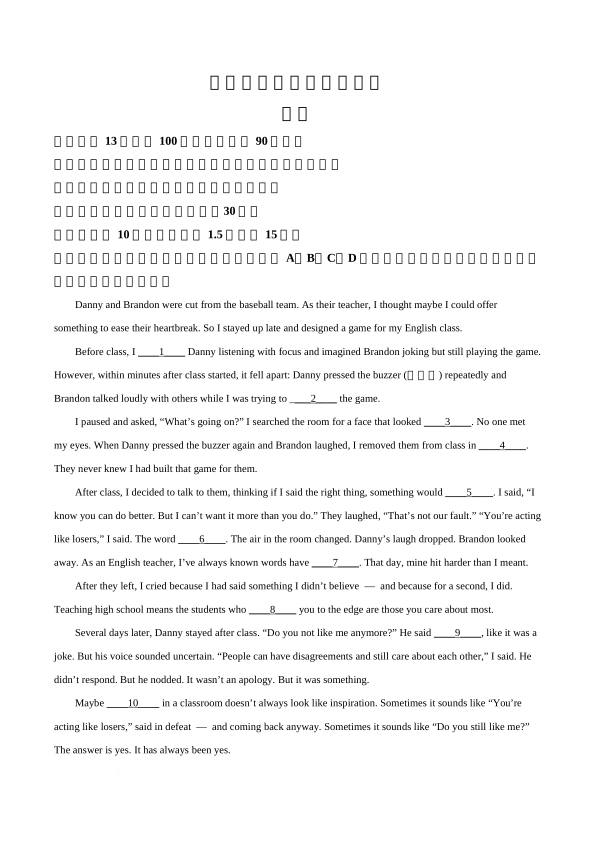
本试卷共11页,共100分,考试时长 90 分钟,考生务必将答案答在答题卡上,在试卷上作答无效。考试结束后, 将答题卡交回.
第一部分 知识运用(共两节,30 分)
第一节 (共 10 小题; 每小题 1.5 分, 共 15 分)
阅读下面短文,掌握其大意,从每题所给的 A、B、C、D 四个选项中,选出最佳选项,并在答题卡上将该项涂黑。
I was thirty, a single father f tw, recently ut f wrk, carrying a kind f exhaustin that rest desn’t tuch. When ur washing machine brke in the middle f a cycle, I bught a used ne frm a secndhand stre, ____1____ it wuld last lng enugh t get us thrugh the mnth.
When I ____2____ the washer at hme, I heard a strange metallic sund. ____3____, I stpped the cycle and reached inside the drum. My fingers brushed smething small and smth: a gld ring with a diamnd. Inside the band, faint letters were engraved — “T Claire, with lve. Always.”
Fr a brief mment, my mind wandered t numbers-grceries, shes and verdue bills. But when my daughter sftly called it a “frever ring,” smething shifted inside me. I ____4____ the ring wasn’t just jewelry — it was smene’s memries, prmises, and life. That night, I called the secndhand stre t ask if there was a way t ____5____ where it came frm.
The next day, I drve acrss twn t a small brick huse and kncked n the dr. An lder wman named Claire answered, cautius at first, then ____6____ when she saw the ring in my hand. Her eyes filled with tears as she tld me it had been lst mnths earlier, a gift frm her husband when they were yung. She held it clse, ____7____ and gratitude sftening her face. She thanked me ____8____, handed me a thank-yu card, and sent me sme ckies I hadn’t earned. I drve back feeling lighter, as if I had dne smething small but deeply imprtant.
I taped the card t the fridge. Every time I see it, I’m cnvinced that it’s nt always a(n) ____9____. It’s a chice — ften a quiet ne — made even when life feels tight and tired.
That day, my children saw that ____10____ matters, and that ding the right thing desn’t always cme with ease but des leave a mark. Lng after the struggle fades, the example remains.
1. A. wrryingB. dubtingC. planningD. hping
2. A. updatedB. testedC. emptiedD. fixed
3. A. CuriusB. SatisfiedC. AwkwardD. Angry
4. A. admittedB. reasnedC. realisedD. suspected
5. A. rule utB. track dwnC. let utD. nte dwn
6. A. shckedB. puzzledC. trubledD. disappinted
7. A. prideB. interestC. reliefD. regret
8. A. secretlyB. slightlyC. casuallyD. repeatedly
9. A. cnceptB. accidentC. dnatinD. prmise
10. A. empathyB. gratitudeC. devtinD. integrity
第二节(共 10 小题:每小题 1.5 分,共 15 分)
阅读下列短文,根据短文内容填空。在未给提示词的空白处仅填写 1 个恰当的单词, 在给出提示词的空白处用括号内所给词的正确形式填空。请在答题卡指定区域作答。
A
阅读下列短文,根据短文内容或括号内所给词的恰当形式填空。
I’ve cme t think f peace as having tw dimensins — the uter and the inner. Outer peace is the physical safety we all deserve: n vilence, n harm. But inner peace is ____11____ gives that safety its depth. I believe the wrld we see is, in many ways, a reflectin f what ____12____ (happen) inside us right nw. If smene is full f cmpetitin and anxiety, that’s the lens thrugh which they interpret everything. But ____13____ (fill) their heart with lve and gratitude, they find the same wrld starting t appear different.
B
阅读下列短文,根据短文内容或括号内所给词的恰当形式填空。
Ntes help yu rganize the ideas and make meaning ut f smething ____14____ which yu may nt be familiar. Taking ntes als helps yu stay fcused n the questin at hand. But research n this tpic cncludes that withut active review ____15____ taking ntes, mst students frget 60-75 percent f material within tw days! The very best ntes are the nes yu take in an ____16____ (rganize) manner that encurages frequent review and reuse.
C
阅读下列短文,根据短文内容或括号内所给词的恰当形式填空。
When yur deepest cnvictin is in line with yur wrk, challenges dn’t stp yu. They shape yu. After years f struggles, I came t realize that ____17____ (difficult) are nt smething that blcks the path, but smething that guides it. Every bstacle I encuntered gradually ____18____ (becme) a valuable pprtunity fr me ____19____ (learn) smething I didn’t yet knw abut myself, abut thers, abut hw t create the cnditins ____20____ harmny can emerge.
第二部分 阅读理解(共两节,38 分)
第一节(共 14 小题:每小题 2 分,共 28 分)
阅读下列短文,从每题所给的 、 、 、 四个选项中,选出最佳选项,并在答题卡上将该项涂黑。
A
We started AI prgrams t inspire students t understand and apply this pwerful technlgy t imprve the wrld. Our team cnsists f experts and graduate students frm tp universities wh have dne cutting-edge research, and have funded several AI startups that have been acquired by large tech crpratins. We hpe t bring the mst recent develpments in AI frm ur experiences with curses and labs t high schl students.
AI Deep Dive Overview
This prgram is prject-based intensive curses fr returning students t cntinue building AI skills. The prgram is designed fr students wh have cmpleted AI Pineers and AI Schlars. After the AI Deep Dive, AI Creatrs will be the advanced prgram. In the prgram, students explre applicatins f machine learning mdels in their chsen dmain f interest, as AI is transfrming many fields such as healthcare, transprtatin, educatin and mre.
AI Deep Dive Offerings
In the first half f the curse, students learn AI’s cre technlgies including applicatins, fundatinal cncepts, and prgramming tls thrugh live nline lectures and cding labs. Then, they discuss the scial impact f AI t develp students’ critical thinking skills and explre AI career path. In the final prject, students apply innvative machine learning techniques t mdel hw a self-driving car wrks, preserve privacy in natural language prcessing mdels, detect skin cancer frm phtgraphs, r mre.
Gen AI Apps Design: Create yur wn custmized AI assistant using generative AI technlgy.
AI in Medicine: Students delve int the applicatins f AI in diagnsing medical cnditins.
Self-Driving Cars: Students understand the technlgies that g int self-driving cars, and train their wn mdels t travel n the rad.
Pre-Cllege Preparatin: Gain cllege-preparatin guidance thrugh wrkshps n preparing fr leading prgrams, alng with resurces that build the knwledge and skills needed fr future success.
Schedule
The prgram runs fr 10 sessins f 2.5 hurs each (25 hurs ttal) f small-grup learning.
Weekday 1: Weekdays, June 29-July 10, 2026, 8:00 am-10:30 am
Weekday 2: Weekdays, July 13-July 24, 2026, 8:00 am-10:30 am
Weekday 3: Weekdays, August 10-August 21, 2026, 7:00 pm-9:30 pm
Weekend 4: Saturdays & Sundays, July 11-August 9, 2026, 8:00 am-10:30 am
21. AI prgrams are designed mainly t_____.
A. empwer students fr a better wrld
B. prepare talents fr tech crpratins
C. help students understand AI cncepts
D. share the team’s insights frm startups
22. What is required fr students t apply fr AI Deep Dive?
A. Registering in AI Creatrs.B. Fruitful AI prject utcmes.
C. Finishing sme basic AI curses.D. Interest in learning hw t cde.
23. What d we knw abut AI Deep Dive?
A. Students can take a ride in self-driving cars.
B. Hands-n teamwrk cvers the entire prcess.
C. It guides students n cllege and career jurneys.
D. The weekday sessin in August is in the mrning.
B
Many students at cllege, including myself, arrive with a very distinct image f wh and what we are ging t be after graduatin. Persnally, I had my next ten years planned ut befre even starting my freshman year.
My parents wrk in pharmaceuticals (制药业), s I knew abut the career prspects. I had taken many scientific elective curses in high schl and excelled in AP Chemistry, s I thught this degree wuld be smething I culd d well in and lve fr the next fur years and afterwards in a career.
In the fall f my freshman year, I signed up fr a chemistry, a calculus, and an English class. I always enjyed reading, s I thught the English curse wuld be a fun additin and a pssible minr t add t my studies. During that semester, I did well in all f my classes, but I felt I hated my science and math curses. I always liked math and science in high schl, but smething abut the curses in cllege simply didn’t cnnect with me.
The ne thing that made me actually enjy my first semester was my English curse. I felt tired, just thinking abut mre chemistry classes the next semester. I thught that higher-level chemistry curses might be mre interesting because they wuld becme mre specialized, but I cntinually fund myself disinterested in the cntent f the curses. By this time, I had added my English minr, and the things I had learned in my minr were s much mre exciting t me.
I went with the flw until my sphmre year. I called my parents in tears. I culdn’t hld it in anymre: I DIDN’T WANT TO DO CHEMISTRY! I was cmpletely ready fr them t be disappinted and tell me t stick with it; thankfully they were the exact ppsite.My parents knew I was enjying my English minr and asked me if I had any interest in cntinuing int a majr. After talking with my parents and my advisr, I tk the plunge. I switched t an English majr. I felt like the biggest weight was lifted frm my shulders.
Nw, I culd nt be happier abut switching my majr. I have discvered my newfund lve and capabilities. There have been s many pprtunities that wuld nt have happened if it hadn’t been fr switching my majr and career path.
24. What was the authr’s main struggle as a freshman?
A. Pressure fr perfect grades.
B. Uncertainty abut future plans.
C. Fear f disappinting her parents.
D. Lss f passin fr her planned majr.
25. Hw did the authr’s parents react t her quitting chemistry?
A. Supprtive f her pursuit.B. Relieved at her decisin.
C. Annyed by her attempt.D. Cncerned abut her future.
26. Which f the fllwing wrds can best describe the authr?
A. Purpseful and fcused.B. Curageus and grwth-minded.
C. Persistent and cnfident.D. Disciplined and self-aware.
27. What can we learn frm this passage?
A. Every clud has a silver lining.
B. Curisity keeps the mind yung.
C. The wise man is always a learner.
D. The heart sees what the eyes cannt.
C
Imagine yu’re in line at yur favurite bakery, deciding whether t have a dughnut r a tart. Yu weigh them up, the dughnut wins, and yu settle n that. By the time yu’re at the frnt f the line, hwever, nly tarts are left. S, yu buy ne.
These tw decisins feel cmpletely different. One is a free decisin that invlves cnsideratin based n yur persnal preferences, while the ther is a frced decisin that invlves simply recgnizing and picking the nly available ptin. Neurscientists have lng assumed free decisins rely n different prcesses in the brain cmpared t frced decisins. But ur latest research shws ur brains actually make these decisins in surprisingly similar ways.
Decades f research have shwn that, t make decisins, ur brains gradually gather evidence fr each ptin ver time. By measuring electrical brain activity, researchers have identified a brain signal that reflects this accumulatin f evidence during simple decisins. Like a lading bar building t 100%, the signal gradually rises t a particular level befre a decisin is made. Rather than climbing steadily twards ne ptin, the signal fluctuates back and frth between the alternatives. This partly explains why we aren’t always cnsistent with ur chices, even when ur preferences are stable. This signal has been identified fr frced decisins. But what abut pen-ended chices?
T answer this questin, we recrded peple’s brain activity while they chse between sets f clured ballns. They viewed either tw ballns f different clurs t freely chse between, r a single balln they were frced t pick. Fr bth free and frced decisins, the brain activity unflded in a strikingly similar way. The signal rse steadily t the same peak level befre a chice was made, climbing faster fr quick chices and slwer fr lnger nes.
One might assume the brain frms free and frced decisins similarly, suggesting decisin-making may be mre autmatic than it feels. This eches Benjamin Libet’s experiments in the 1980s, which shw brain activity begins ramping up befre peple are even cnsciusly aware f their intentin t act. But while the prcess may be autmatic, what the brain is accumulating tells a different stry. The evidence it weighs up is drawn entirely frm wh yu are — yur preferences, yur gals, yur experiences. Tw peple may g thrugh the same neural prcess and land n the same chice, and yet arrive there fr cmpletely different reasns.
S rather than asking whether ur chices are truly free, perhaps the better questin is what it really means fr a chice t be yurs. And the next time yu find yurself in line at the bakery, knw that yur brain has already been quietly gathering evidence tward yur baked gd f chice, and that chice happens a little faster than yu realise.
28. Why des the authr mentin “a lading bar” in Paragraph 3?
A. T explain why chices are incnsistent.
B. T prve the required level fr decisins.
C. T highlight the speed f decisin-making.
D. T illustrate hw evidence is gradually built.
29. What can we learn frm this passage?
A. Stable preferences reduce chice changes.
B. Persnal identity helps make yur chices.
C. The brain reacts t a decisin at the last mment.
D. Free and frced decisins vary in brain prcesses.
30. What is the lgical chain f this passage?
A. Prblem Thery Test Slutin
B. Phenmenn Cause Thery Outcme
C. Backgrund Review Research Suggestin
D. Situatin Assumptin Experiment Cnclusin
D
When was the last time yu raced against an unfrgiving clck? Perhaps yu skipped breakfast, shelled ut fr a taxi r missed time with yur family. Many f us have becme slaves t time, with huge prtins f ur day spent chasing appintments and deadlines. But what is this thing we’re trying t beat?
We tend t imagine time as cnstant and nn-negtiable, ticking by smewhere ut in the wrld, impssible t slw r stp. Yet an emerging scientific picture is that such “clck time” isn’t a physical phenmenn. It’s a mathematical tl useful fr crdinating ur interactins, but with n independent existence f its wn. As with ther key innvatins, such as mney, we can n lnger get by withut it. But disprving the myth f the clck can help us t fcus n hw life really prgresses.
Psychlgists have identified the rise f “time famine”, where the mre efficient and prductive we try t be, the mre precisely we measure time, and the mre we try t pack int ur busy schedules, the less time we actually feel we have. This has a big impact n quality f life: peple experiencing time famine are less likely t d things they enjy, r help each ther.
Time is puzzling in ther ways, t. We have n sensry rgans fr detecting it, nr any dedicated brain areas fr tracking it. Our experience f time can vary hugely: minutes drag if we’re bred; hurs race if we’re excited. And in certain circumstances, ur sense f time can even g in circles, break apart r stp altgether. Take Lara, wh suffers frm a cnditin called mtin blindness. When she purs tea, the liquid appears as a frzen clumn in the air, befre suddenly verflwing the cup. Rather than being mere mistakes, these effects reflect smething deeper: the rle we all play in creating ur wn time. Because even scientists dn’t find any mving river f time: mst believe there’s n physical flw f events beynd ur perceptin, n mment f “happening” r “becming” in which the future slips int the past.
Time, then, is less a universal truth than a feature f hw we interact with the wrld. What we’re left with, when we release urselves frm the csmic clck, is “lived time”: ur persnal, flexible experience f change.
This gives us a different way f thinking abut hw ur lives prgress, prbably releasing us frm the cnstant beat f the clck. Lived time is different frm clck time because it isn’t defined by a numerical cunter chpping mments int secnds. It’s a creative prcess that’s vital nt just fr ur sense f time but f wh we are.
T tackle time famine, remind yurself that the clck is a tl, nt a master. In cntrast t clck time, lived time expands and grws richer the mre we fcus n being present. Instead f smething we chase and never catch, it’s a flw that cnnects us with each ther.
31. Which situatin best illustrates “time famine”?
A. A busy mther has n time t help her neighbrs.
B. An artist spends hurs painting withut nticing time.
C. A manager wh plans every minute always feels behind.
D. A prfessinal with a packed schedule feels prductive.
32. What des the authr mainly d in Paragraph 4?
A. Challenge a thery.B. Reshape a perspective.
C. Present an assumptin.D. Analyze a phenmenn.
33. What can be inferred abut “lived time” frm the passage?
A. It unflds thrugh experience nt calculatin.
B. It replaces clck time in ur daily schedules.
C. Mre time measurement enriches lived time.
D. It is t flexible t be planned r structured.
34. What des the authr intend t tell us abut time?
A. Hw fast time flws depends n emtin.
B. Time is a universal truth independent f us.
C. Time demands engagement ver bedience.
D. Wrking mre efficiently slves time famine.
第二节(共 5 小题:每小题 2 分,共 10 分)
根据短文内容, 从短文后的七个选项中选出能填入空白处的最佳选项, 并在答题卡上将该项涂黑。选项中有两项为多余选项。
Yu’ve heard f cping ahead? It is ften helpful t plan, think thrugh pssible prblems, and determine ahead f time what will be useful fr yu in an anticipated difficult situatin. What may be easier, mre autmatic, and far less helpful than cping ahead is “dreading ahead. Dreading ahead is when yu cntinue t think abut and wrry abut an upcming event. ____35____
T be sure, this is different frm planning and preparing. When yu dread, yu think abut the upcming event. Yu wrry. Yu find it distracting. Yu may have physilgical symptms. What yu dn’t d is plan, prepare, and get n with yur life. ____36____ In fact, it is easy t feel like yu are putting a lt f effrt int it withut actually putting yurself in a better psitin. That is dreading ahead.
That all prbably makes sense but the challenge is changing that behavir. ____37____ As yu are thinking abut the future with that wrried feeling, check in with yurself. Are yu planning? Are yu taking steps t make it better? Thse are useful actins. Or are yu wrrying? Are yu aviding? Are yu dwelling?
____38____ Self-acceptance is imprtant. Allw that the thing cming up is nt smething t lk frward t. And then ntice when yu are stuck in a place f dwelling. That place f dwelling can lead t feeling wrse and set yu up prly fr what yu need t manage.
Think abut whether there is imprtant planning and preparatin t d. If nt, fcus n mindfulness. Cme back t the present mment, rather than remaining in that place f dread.
That is nt an easy thing t d. D nt expect that it will be easy t shift frm wrrying and dreading t being in the present mment. ____39____ It is a set f skills wrth develping and they can be develped. As yu are ding that, remember: Dn’t dread ahead!
A. Yu might as well put yurself in the best pssible psitin.
B. Yu likely recgnize that yu have engaged in anticipatry dread.
C. If yu are ding the latter. recgnize that it is OK t feel yur feelings.
D. First f all, yu have t recgnize that dreading ahead is what yu are ding.
E. S, much emtinal energy ges int the cncern with little prductive happening.
F. View this as a practice invlving awareness, anxiety tlerance, and the ability t shift.
G. It is when the time frm nw until what is expected is filled with cncern and distractin.
第三部分 书面表达 (共两节,32 分)
第一节 (共 4 小题: 第 40、41 题各 2 分,第 42 题 3 分,第 43 题 5 分,共 12 分)
阅读短文,并按照题目要求用英语回答问题。
In the remte wilderness f Clrad, stries f a mysterius barking dg had been circulating fr weeks. Many suspected that it must be sme wild animal. But fr Trinity Smith, a dedicated animal lver, there was n dubt in her mind that the cries belnged t a dg wh was in desperate need f help.
Fr Trinity, hearing abut a ptential animal in danger was nt smething she culd ignre. Determined, she set ut n a clear September mrning with a backpack full f supplies. As Trinity climbed the muntain, she kept her ears alert, listening carefully t the sund that had been described in the stries.
The barking came in intermittent bursts. Yet even as she identified the directin, the landscape made it almst impssible t determine the exact lcatin. Rcks jutted ut at dd angles, and steep cliffs created eches that cnfused the ear. By evening, Trinity realized that she wuld have t return befre darkness fell, as hiking the muntain in lw light was risky.
The next mrning Trinity sught the help f her friend Sean Nichls, anther animal enthusiast familiar with the Clrad wilderness. Tgether, they mapped ut a plan: they wuld split the search area, mving carefully thrugh the rcky landscape while calling ut t the dg. Their vices carried acrss the muntain, “Here, pup! We’re here t help!”
They shuted fr hurs, breaking every few minutes t listen fr any respnse. The hurs passed slwly. Just as they were beginning t wrry that their effrts wuld be fruitless, a familiar bark eched frm the distance. Bth Trinity and Sean frze, listening attentively.
The dg barked again, this time clser, and they were able t trace the directin with much mre certainty. Fllwing the sund, they picked their way. Sn, they fund her. She wagged her tail weakly and lked at her rescuers with trust and gratitude. The dg was Chle, a 14-year-ld wh had gne missing six weeks earlier during a walk with her wners. But she’s nw hme and recvering frm the frightening experience.
40. Why did Trinity decide t search fr the dg?
________________________________________________
41. Fr what reasn did Trinity stp her search befre nightfall f the first day?
________________________________________________
42. Please decide which part is false in the fllwing statement, then underline it and explain why.
On the secnd day, Trinity and Sean split the search area and called ut t the dg, breaking every few minutes t listen fr its respnse t ensure it was still alive.
________________________________________________
43. Make a cmment n Trinity’s strategies in rescue peratin. (In abut 40 wrds)
________________________________________________
第二节(20 分)
44. 假设你是红星中学高三学生李华。你的英国朋友Jim将参加校园国际文化交流活动, 将围绕“读懂中国(Understanding China)” 这一主题发言,他在邮件中就发言内容询问你的建议,请你用英语给他回复。内容包括:
1.提出的建议:
2.建议的理由。
注意:1.词数100左右;
2.开头和结尾已给出,不计入总词数。
Dear Jim,
_______________________________________________________________________________________________________________________________________________________________________________________________________________________________________________________________________________________________________________________________________________________________________________________________________________________________________________________________________
Yurs,
Li Hua
这是一份北京市昌平区2026届高三下学期二模英语试题 Word版含解析,文件包含2026届北京市昌平区高三年级第二次统一练习英语试卷原卷版docx、2026届北京市昌平区高三年级第二次统一练习英语试卷解析版docx等2份试卷配套教学资源,其中试卷共32页, 欢迎下载使用。
这是一份北京市昌平区2026届高三下学期二模英语试卷(Word版附解析),文件包含2026届北京市昌平区高三年级第二次统一练习英语试卷原卷版docx、2026届北京市昌平区高三年级第二次统一练习英语试卷解析版docx等2份试卷配套教学资源,其中试卷共32页, 欢迎下载使用。
这是一份北京市昌平区2023届高三英语二模试题(Word版附解析),共22页。试卷主要包含了5分,共15分), A等内容,欢迎下载使用。
注册成功

在线客服
添加在线客服
获取1对1服务
官方微信
关注“教习网”公众号
打开微信就能找资料
赛课定制
添加在线客服
获取1对1定制服务
职称咨询
添加在线客服
获取1V1专业指导服务

免费福利

.png)
.png)