 免费领取教师福利

若您为此资料的原创作者,认为该资料内容侵犯了您的知识产权,请扫码添加我们的相关工作人员,我们尽可能的保护您的合法权益。


这是一份人教版(2024)七年级上册(2024)Unit 2 Keep Tidy Section B教案,共14页。
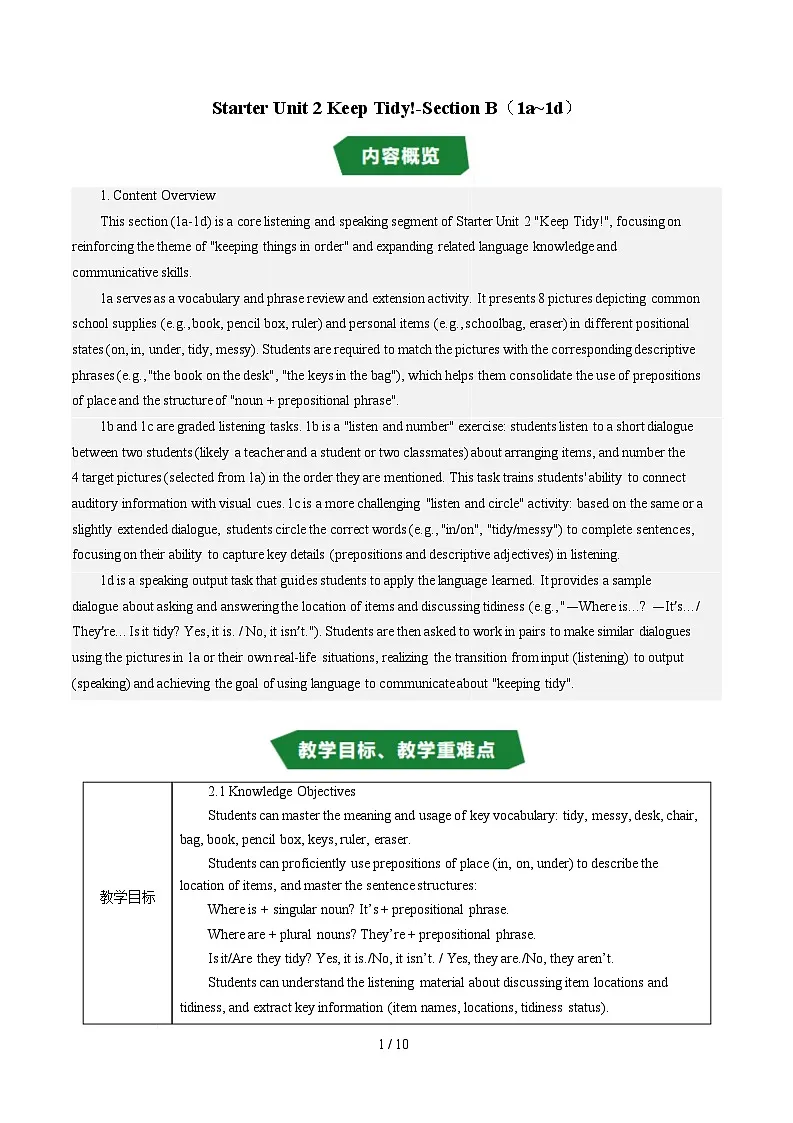
This sectin (1a-1d) is a cre listening and speaking segment f Starter Unit 2 "Keep Tidy!", fcusing n
reinfrcing the theme f "keeping things in rder" and expanding related language knwledge and
cmmunicative skills.
1a serves as a vcabulary and phrase review and extensin activity. It presents 8 pictures depicting cmmn
schl supplies (e.g., bk, pencil bx, ruler) and persnal items (e.g., schlbag, eraser) in different psitinal
states (n, in, under, tidy, messy). Students are required t match the pictures with the crrespnding descriptive
phrases (e.g., "the bk n the desk", "the keys in the bag"), which helps them cnslidate the use f prepsitins
f place and the structure f "nun + prepsitinal phrase".
1b and 1c are graded listening tasks. 1b is a "listen and number" exercise: students listen t a shrt dialgue
between tw students (likely a teacher and a student r tw classmates) abut arranging items, and number the
4 target pictures (selected frm 1a) in the rder they are mentined. This task trains students' ability t cnnect
auditry infrmatin with visual cues. 1c is a mre challenging "listen and circle" activity: based n the same r a
slightly extended dialgue, students circle the crrect wrds (e.g., "in/n", "tidy/messy") t cmplete sentences,
fcusing n their ability t capture key details (prepsitins and descriptive adjectives) in listening.
1d is a speaking utput task that guides students t apply the language learned. It prvides a sample
dialgue abut asking and answering the lcatin f items and discussing tidiness (e.g., "—Where —It’s... /
They’re... Is it tidy? Yes, it is. / N, it isn’t."). Students are then asked t wrk in pairs t make similar dialgues
using the pictures in 1a r their wn real-life situatins, realizing the transitin frm input (listening) t utput
(speaking) and achieving the gal f using language t cmmunicate abut "keeping tidy".
2.1 Knwledge Objectives
Students can master the meaning and usage f key vcabulary: tidy, messy, desk, chair,
bag, bk, pencil bx, keys, ruler, eraser.
Students can prficiently use prepsitins f place (in, n, under) t describe the
Where are + plural nuns? They’re + prepsitinal phrase.
Is it/Are they tidy? Yes, it is./N, it isn’t. / Yes, they are./N, they aren’t.
Students can understand the listening material abut discussing item lcatins and
tidiness, and extract key infrmatin (item names, lcatins, tidiness status).
1 / 10
教学目标
lcatin f items, and master the sentence structures:
Where is + singular nun? It’s + prepsitinal phrase.
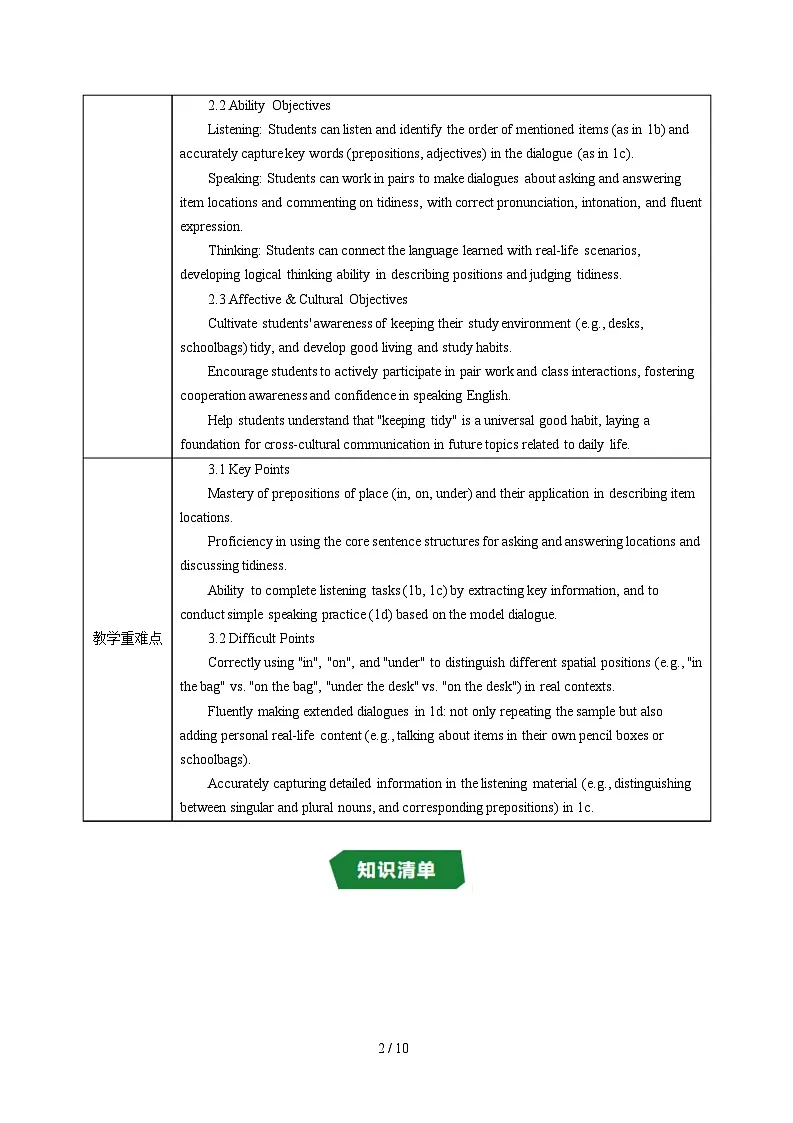
2.2 Ability Objectives
Listening: Students can listen and identify the rder f mentined items (as in 1b) and
accurately capture key wrds (prepsitins, adjectives) in the dialgue (as in 1c).
Speaking: Students can wrk in pairs t make dialgues abut asking and answering
item lcatins and cmmenting n tidiness, with crrect prnunciatin, intnatin, and fluent
expressin.
Thinking: Students can cnnect the language learned with real-life scenaris,
develping lgical thinking ability in describing psitins and judging tidiness.
2.3 Affective & Cultural Objectives
Cultivate students' awareness f keeping their study envirnment (e.g., desks,
schlbags) tidy, and develp gd living and study habits.
Encurage students t actively participate in pair wrk and class interactins, fstering
cperatin awareness and cnfidence in speaking English.
Help students understand that "keeping tidy" is a universal gd habit, laying a
fundatin fr crss-cultural cmmunicatin in future tpics related t daily life.
3.1 Key Pints
Mastery f prepsitins f place (in, n, under) and their applicatin in describing item
lcatins.
Prficiency in using the cre sentence structures fr asking and answering lcatins and
discussing tidiness.
Ability t cmplete listening tasks (1b, 1c) by extracting key infrmatin, and t
cnduct simple speaking practice (1d) based n the mdel dialgue.
教学重难点 3.2 Difficult Pints
Crrectly using "in", "n", and "under" t distinguish different spatial psitins (e.g., "in
the bag" vs. "n the bag", "under the desk" vs. "n the desk") in real cntexts.
Fluently making extended dialgues in 1d: nt nly repeating the sample but als
adding persnal real-life cntent (e.g., talking abut items in their wn pencil bxes r
schlbags).
Accurately capturing detailed infrmatin in the listening material (e.g., distinguishing
between singular and plural nuns, and crrespnding prepsitins) in 1c.
2 / 10
教学过程
5.1 Warm-up & Lead-in (5 minutes)
Teaching Activities
Greeting & Review (2 minutes)
The teacher greets students in English: "Gd mrning, class! Hw are yu tday?" After students respnd,
the teacher reviews the previus lessn’s cntent: "Last class, we talked abut ‘keeping tidy’. Wh can tell me:
what des ‘tidy’ mean?" Invite 1-2 students t answer (e.g., "Things are in rder."), and then ask: "What’s the
ppsite f ‘tidy’?" Guide students t say "messy" (if they can’t, the teacher directly teaches the wrd and
explains it with simple gestures r pictures).
Game: "Guess Where It Is" (3 minutes)
The teacher prepares a real schlbag and sme small items (bk, pencil, eraser). Put ne item in/n/under
the schlbag (e.g., put the bk in the bag), and say: "Lk! I have a bk. Where is it? Yu can guess: Is it in the
bag? On the bag? Or under the bag?" Invite students t take turns guessing. After the crrect answer is given, the
teacher repeats the sentence: "Yes! It’s in the bag." Then change the item’s psitin (e.g., put the eraser n the
bag) and repeat the game. During the game, the teacher emphasizes the prepsitins "in", "n", "under" and the
sentence structure "It’s + prepsitinal phrase" t activate students’ prir knwledge and lay the fundatin fr
the new lessn.
Purpse
Thrugh greeting and review, students quickly enter the English learning state and recall the theme f
"keeping tidy" and basic vcabulary.
The interactive game cnnects language with real bjects, making abstract prepsitins cncrete, stimulating
students’ interest, and naturally leading t the new lessn cntent.
5.2 Presentatin: 1a Activity (8 minutes)
Teaching Activities
Intrduce 1a Pictures & Phrases (4 minutes)
The teacher prjects the 8 pictures f 1a n the screen, and guides students t bserve: "Lk at these
pictures. They shw many things in ur classrm. What can yu see in Picture 1?" (e.g., "A bk and a desk.")
Then the teacher pints t the bk n the desk and says: "The bk is n the desk. S the phrase is ‘the bk n
3 / 10
the desk’." Write the phrase n the blackbard, and lead students t read it 2-3 times (pay attentin t crrect
prnunciatin f "n" and stress in the phrase).
Use the same methd t intrduce 3-4 mre key phrases (e.g., "the keys in the bag", "the pencil bx n the
chair", "the ruler under the desk"), and explain the meaning f each phrase by pinting t the pictures. Fr the
phrases invlving "tidy" and "messy" (e.g., "the tidy desk", "the messy bag"), the teacher uses bdy language (e.g.,
making a "neat" gesture fr tidy, a "disrdered" gesture fr messy) t help students understand.
Match Pictures with Phrases (4 minutes)
The teacher distributes small wrksheets (with 1a pictures and phrases) t students, and says: "Nw, let’s d
a matching exercise. Match each picture with the right phrase. Yu have 3 minutes t finish it by yurself."
After students cmplete the exercise, the teacher checks the answers with the whle class. Call 8 students t
take turns saying the picture number and the crrespnding phrase (e.g., "Picture 2: the eraser in the pencil bx").
Fr incrrect answers, the teacher guides ther students t crrect them, and repeats the crrect phrase t
strengthen memry.
Purpse
By analyzing pictures and explaining phrases, students systematically review and expand vcabulary related
t items and psitins, and understand the structure f "nun + prepsitinal phrase".
The independent matching exercise helps students cnslidate the cnnectin between visual infrmatin
and language expressins, laying a slid fundatin fr subsequent listening tasks.
5.3 Listening Practice: 1b & 1c Activities (12 minutes)
Teaching Activities
Pre-listening Preparatin (3 minutes)
Fr 1b: The teacher pints t the 4 blank pictures in 1b n the screen and says: "We will listen t a dialgue.
In the dialgue, tw students are talking abut sme items. Yur task is t number these 4 pictures in the rder
yu hear them. First, let’s lk at these 4 pictures: what’s in each picture?" Guide students t name the items and
psitins (e.g., "Picture A: the bk n the desk") t help them predict the listening cntent.
Fr 1c: The teacher prjects the 1c sentences n the screen (e.g., "1. The bk is ___ the desk. (in / n)"),
and asks students t read the sentences alud. Then the teacher says: "Listen carefully, and circle the right wrd
t cmplete each sentence."
Listening fr 1b (3 minutes)
Play the audi fr 1b the first time: "Listen carefully, and try t remember the rder f the pictures."
Play the audi the secnd time: "This time, write the numbers (1-4) next t the pictures." The teacher walks
arund the classrm t bserve students’ prgress, and prvides timely reminders (e.g., "Listen t the first item:
it’s a bk...").
Check the answers: Invite a student t shw their numbered pictures n the screen, and play the audi again
t cnfirm. Fr students wh made mistakes, the teacher helps them find the crrespnding part in the audi and
explains.
4 / 10
Listening fr 1c (4 minutes)
Play the audi fr 1c the first time: "Listen and understand the dialgue first. Dn’t circle the wrds yet."
Play the audi the secnd time: "Nw, circle the crrect wrds. If yu miss smething, dn’t wrry—we’ll
listen again."
Play the audi the third time: "Check yur answers, and crrect them if needed."
Check the answers in pairs first: "Discuss yur answers with yur deskmate. If yu have different answers,
listen t the audi part again tgether." Then the teacher checks the answers with the whle class, and asks
students t read the cmpleted sentences alud t reinfrce the crrect usage f prepsitins and adjectives.
Pst-listening: Retell the Dialgue (2 minutes)
The teacher guides students t retell the main cntent f the dialgue based n 1b and 1c: "Wh can tell us
what the dialgue is abut? Fr example: The bk is n the desk. It’s tidy..." Invite 2-3 students t retell, and the
teacher supplements and crrects errrs in expressin.
Purpse
Pre-listening preparatin helps students predict listening cntent, reduce listening anxiety, and imprve
listening efficiency.
Graded listening (first numbering, then filling in blanks) cnfrms t students’ cgnitive rules, allwing them
t gradually master listening skills f capturing rder and details.
Pst-listening retelling helps students internalize the listening cntent, transfrming auditry input int
language utput, and laying a fundatin fr subsequent speaking practice.
5.4 Speaking Practice: 1d Activity (15 minutes)
Teaching Activities
Intrduce the Sample Dialgue (4 minutes)
The teacher prjects the 1d sample dialgue n the screen:
A: Where is the bk?
B: It’s n the desk.
A: Is it tidy?
B: Yes, it is.
The teacher reads the dialgue with a student first (teacher as A, student as B), paying attentin t natural
intnatin (e.g., rising tne fr questins). Then the teacher divides the class int tw grups, and the tw grups
read the dialgue alternately.
The teacher explains the dialgue structure: "In this dialgue, A asks abut the lcatin f the bk, B
answers, then A asks abut tidiness, and B answers. We can use this structure t talk abut ther items." Then the
teacher replaces "the bk" with "the keys" and "n the desk" with "in the bag", and invites anther pair f
students t practice the new dialgue:
A: Where are the keys?
B: They’re in the bag.
5 / 10
A: Are they tidy?
B: Yes, they are.
Emphasize the difference between singular and plural (is/are, It’s/They’re) and ask students t practice the
new dialgue in pairs.
Pair Wrk: Make New Dialgues (7 minutes)
The teacher gives instructins: "Nw, wrk with yur deskmate. Chse a picture frm 1a, r talk abut
items in yur wn pencil bx/schlbag. Make a dialgue like the sample. Yu can add mre sentences, such as
‘Where is yur ruler? It’s in my pencil bx. Is yur pencil bx tidy? Yes, it is. Because all my pens are in it.’"
The teacher prvides 3 minutes fr students t prepare, and walks arund the classrm t ffer help (e.g.,
reminding students f crrect sentence structures, helping them find apprpriate vcabulary).
After preparatin, the teacher invites 4-5 pairs f students t present their dialgues in frnt f the class.
After each presentatin, the teacher gives psitive feedback (e.g., "Great! Yu used ‘They’re’ crrectly.") and
crrects minr errrs (e.g., prnunciatin, grammar) gently.
Grup Cmpetitin: "Tidy Team" (4 minutes)
Divide the class int 4 grups. The teacher says: "Each grup will send ne student t the frnt. I will shw a
picture f a messy desk, and the student needs t make a dialgue with me abut tidying it up (e.g., Teacher:
‘Where is the pencil? Student: ‘It’s under the bk. Teacher: ‘Let’s put it in the pencil bx. Is it tidy nw? Student:
‘Yes, it is.’). The grup that makes the mst fluent and crrect dialgue gets a ‘tidy star’."
Cnduct 2 runds f the cmpetitin. After the cmpetitin, the teacher summarizes the results and praises
all grups fr their active participatin.
Purpse
The sample dialgue prvides a clear language mdel, helping students master the basic speaking structure
quickly.
Pair wrk allws students t practice in a relaxed envirnment, and adding real-life cntent prmtes the
applicatin f language.
The grup cmpetitin increases the fun f learning, stimulates students’ enthusiasm, and strengthens their
awareness f keeping tidy.
5.5 Summary & Hmewrk (5 minutes)
Teaching Activities
Class Summary (2 minutes)
The teacher leads students t review the key cntent f the class with a mind map (prjected n the screen):
Vcabulary: tidy, messy, desk, bag, etc.
Prepsitins: in, n, under
Sentence Structures: Where It’s/They’re... Is it/Are they tidy?
The teacher asks: "What did we learn tday? Wh can share ne thing yu will d t keep tidy?" Invite 2-3
students t share (e.g., "I will put my bks in my schlbag after class."), and affirm their ideas.
6 / 10
Hmewrk Assignment (3 minutes)
Assign 3 types f hmewrk, cnsidering students’ different levels:
Basic Hmewrk: Draw a picture f yur tidy desk, and write 3 sentences abut it (e.g., "My bk is n the
desk. My pencil bx is in the desk. My desk is tidy.").
2. Intermediate Hmewrk: Recrd a 1-minute dialgue with yur family member abut the lcatin f
items at hme (e.g., asking where the cups are, and cmmenting n whether the table is tidy).
3. Advanced Hmewrk: Write a shrt paragraph (5-6 sentences) abut hw yu keep yur schlbag tidy
every day (e.g., "Every mrning, I put my bks in my schlbag. I put my keys in the small pcket. My pencil bx
is n the tp... S my schlbag is always tidy.").
The teacher reminds students: "Check yur sentences fr crrect prepsitins and verb frms (is/are) befre
submitting. We will share sme excellent wrks in the next class."
教学反思
Teaching reflectin is a crucial step t imprve teaching quality. It helps teachers summarize experience,
find prblems, and ptimize subsequent teaching design. This reflectin is based n the actual implementatin
f the 45-minute teaching prcess f Sectin B (1a-1d), fcusing n teaching effect, advantages, existing
prblems, and imprvement strategies.
6.1 Overall Teaching Effect
The verall teaching effect f this lessn meets the preset teaching bjectives. Mst students (abut 85%)
can master the key vcabulary (tidy, messy, desk, etc.) and prepsitins f place (in, n, under), and can use the
cre sentence structures (e.g., "Where is the bk? It’s n the desk. Is it tidy? Yes, it is.") t cmplete simple
listening and speaking tasks. In the 1b listening activity, ver 90% f students crrectly numbered the pictures;
in the 1d pair wrk, 70% f pairs culd fluently make dialgues based n the sample, and sme even added
real-life cntent (e.g., talking abut their wn water bttles). In terms f affective gals, the "Guess Where It Is"
game and "Tidy Team" cmpetitin effectively stimulated students’ interest—mst students actively raised their
hands t participate, and after class, sme students mentined that they wuld "arrange their desks neatly
tmrrw", which shws that the awareness f keeping tidy was initially cultivated.
6.2 Advantages f the Teaching Design
Lgical Teaching Prcess, Cnfrming t Students’ Cgnitive Rules
The teaching prcess fllws the sequence f "Warm-up & Lead-in → Presentatin (1a) → Listening
Practice (1b-1c) → Speaking Practice (1d) → Summary & Hmewrk", which is in line with the "input →
internalizatin → utput" language learning law. Fr example, the warm-up game activates students’ prir
knwledge f prepsitins; the 1a presentatin lays a vcabulary fundatin fr listening; the graded listening
tasks (1b fr rder, 1c fr details) help students gradually imprve listening skills; and the 1d speaking practice
realizes the transfrmatin frm knwledge t ability. This step-by-step design reduces students’ learning
pressure and makes it easier fr them t accept new knwledge.
Rich Interactive Activities, Enhancing Student Engagement
This lessn designs multiple interactive activities t avid ne-way "teacher talking, students listening"
7 / 10
teaching. The "Guess Where It Is" game uses real bjects (schlbag, bk) t make abstract prepsitins
cncrete, and every student has the pprtunity t guess; the "Tidy Team" cmpetitin in the speaking part
increases the sense f participatin and cmpetitin, making students mre active in practicing dialgues. In
additin, pair wrk in 1d and 1c (checking answers in pairs) encurages students t cmmunicate with each
ther, fstering cperatin awareness and reducing the anxiety f speaking in frnt f the whle class.
Differentiated Hmewrk, Meeting Diverse Learning Needs
The hmewrk is divided int basic, intermediate, and advanced levels, which takes int accunt the
differences in students’ English prficiency. Basic hmewrk (drawing and writing sentences) helps students
cnslidate basic knwledge; intermediate hmewrk (recrding a dialgue) fcuses n imprving speaking and
listening skills; advanced hmewrk (writing a paragraph) challenges students t use language cmprehensively.
This design ensures that lw-level students can "finish", medium-level students can "master", and high-level
students can "imprve", aviding the prblem f "ne-size-fits-all" hmewrk.
Clse Cnnectin with Real Life, Highlighting the Theme f "Keeping Tidy"
Thrughut the lessn, the teaching cntent is clsely linked t students’ daily life (desks, schlbags,
pencil bxes), making language learning n lnger abstract. Fr example, in the warm-up game, the teacher uses
a real schlbag t shw item psitins; in the 1d speaking practice, students are encuraged t talk abut their
wn items; in the summary, students share hw t keep tidy in life. This cnnectin nt nly helps students
understand and apply language but als effectively integrates the affective gal f "cultivating gd habits" int
language teaching, achieving the unity f language learning and mral educatin.
6.3 Existing Prblems and Causes
Listening Practice: Sme Students Fail t Capture Detailed Infrmatin
In the 1c listening activity, abut 20% f students culd nt crrectly circle the prepsitins (e.g.,
cnfusing "in" and "n") r adjectives (e.g., mixing up "tidy" and "messy"). The main reasns are:
Audi Speed and Prnunciatin: The audi f the textbk is recrded by native speakers, and the speed is
slightly fast fr sme students wh have weak listening fundatins; in additin, the cntractin f "It’s" and
"They’re" in the dialgue (e.g., /ɪts/ instead f /ɪt ɪz/) makes it difficult fr students t distinguish.
Lack f Pre-listening Predictin Guidance: Althugh the teacher guided students t read the 1c sentences
befre listening, they did nt further help students predict pssible answers (e.g., analyzing that "bk" is
usually "n the desk" instead f "in the desk" in real life). This makes students passively listen instead f
actively predicting, reducing the accuracy f capturing details.
Speaking Practice: Individual Students Lack Participatin
In the 1d pair wrk and "Tidy Team" cmpetitin, 10-15% f students (mstly students with weak English
prficiency) did nt actively participate. Sme nly repeated their deskmates’ wrds, and sme even remained
silent. The causes are:
Language Anxiety: These students are wrried abut making mistakes in prnunciatin r grammar when
speaking in frnt f thers, s they are reluctant t participate.
Insufficient Individual Guidance: During the pair wrk, the teacher walked arund t help students, but due
t the large number f students (abut 40 in a class), it was impssible t prvide targeted guidance t every
8 / 10
student. Sme students wh encuntered difficulties (e.g., nt knwing hw t express "the ruler under the
chair") culd nt get timely help, s they gave up participating.
Time Allcatin: Speaking Practice is Slightly Hasty
The preset time fr the 1d speaking practice is 15 minutes, but in the actual teaching prcess, due t the
extended time spent n checking answers in 1c (riginally 4 minutes, actually 6 minutes), the speaking practice
was cmpressed t 13 minutes. As a result, the "Tidy Team" cmpetitin nly cnducted 1 rund instead f 2,
and sme pairs wh wanted t present their dialgues did nt get the pprtunity. This affects the full
develpment f the speaking activity and the cmprehensive applicatin f students’ language skills.
6.4 Imprvement Strategies fr Future Teaching
Optimize Listening Teaching t Imprve Students’ Listening Ability
Adjust Audi Speed and Prvide Transcripts: Fr students with weak listening fundatins, play the audi
at 0.8x speed fr the first time, and then play it at nrmal speed; after listening, prvide a simplified transcript f
the dialgue (marking key wrds such as prepsitins and adjectives) t help students check and understand.
Strengthen Pre-listening Predictin: Befre listening t 1c, guide students t predict pssible answers based
n life experience and language rules. Fr example, ask: "Where d we usually put ur bks? On the desk r in
the desk?" "If things are in rder, is it tidy r messy?" This helps students frm a "mental framewrk" fr
listening and imprve the accuracy f capturing details.
Pay Attentin t Individual Differences and Reduce Students’ Language Anxiety
Adpt Hierarchical Gruping in Speaking Activities: When dividing pairs fr 1d, grup students with
strng English prficiency and weak prficiency tgether (i.e., "mentr-student pairs"). The strng students can
help the weak nes crrect errrs and prvide language supprt, reducing the latter’s anxiety.
Increase Individual Guidance Time: In future teaching, reduce the time spent n cllective answer checking
(e.g., check answers in pairs first, then the teacher nly explains difficult questins), and use the saved time t
prvide targeted guidance t students wh encunter difficulties. Fr example, fr students wh cannt express
"the ruler under the chair", the teacher can write the sentence n a small piece f paper and guide them t read it
alud, helping them master the expressin.
Refine Time Management t Ensure the Cmpletin f Teaching Activities
Frmulate a Detailed Time Schedule and Set Reminders: Befre the class, make a detailed time schedule
(e.g., 1a presentatin: 2 minutes fr intrducing pictures, 2 minutes fr explaining phrases, 4 minutes fr
matching exercises) and write it n the blackbard r prject it n the screen. Assign a student as the
"timekeeper" t remind the teacher when the time is up, ensuring that each activity is cmpleted within the
preset time.
Prepare Flexible Backup Activities: Fr activities that may take extra time (e.g., 1c answer checking),
prepare a backup plan. Fr example, if the time is tight, nly check 2-3 key questins instead f all questins, t
ensure that the subsequent speaking practice has sufficient time.
Enrich Teaching Aids t Enhance the Visualizatin f Teaching Cntent
Use Multimedia and Real Objects t Assist Teaching: In additin t prjecting pictures, use vides t shw
the prcess f "tidying a desk" (e.g., putting bks n the desk, putting pencils in the pencil bx) t help
9 / 10
students understand the meaning f "tidy" and "messy" mre intuitively; prepare mre real bjects (e.g., ruler,
keys, chair) t let students practice describing psitins by tuching and placing the bjects, making language
learning mre vivid.
In cnclusin, this lessn has achieved certain teaching effects, but there are still sme prblems t be
slved. In future teaching, I will cntinue t summarize experience, ptimize teaching design, pay attentin t
the individual needs f students, and strive t imprve the quality f English teaching, helping every student
make prgress in language learning and habit cultivatin.
10 / 10
这是一份人教版(2024)七年级上册(2024)Unit 2 Keep Tidy Section B教案,共14页。
这是一份初中人教版(2024)Unit 2 Keep Tidy Section B教案及反思,共11页。教案主要包含了教学目标,教学重难点,教学方法,教学过程,教学反思等内容,欢迎下载使用。
这是一份人教版(2024)七年级上册(2024)Unit 2 Keep Tidy Section B教案设计,共8页。教案主要包含了教学目标,教学重难点,教学方法,教学过程,教学资源,教学反思等内容,欢迎下载使用。
注册成功

在线客服
添加在线客服
获取1对1服务
官方微信
关注“教习网”公众号
打开微信就能找资料
赛课定制
添加在线客服
获取1对1定制服务
职称咨询
添加在线客服
获取1V1专业指导服务

免费福利


.png)
.png)
.png)
