免费领取教师福利




若您为此资料的原创作者,认为该资料内容侵犯了您的知识产权,请扫码添加我们的相关工作人员,我们尽可能的保护您的合法权益。


这是一份高考英语二轮-完形填空说明文&议论文(练习)(学生版),共9页。
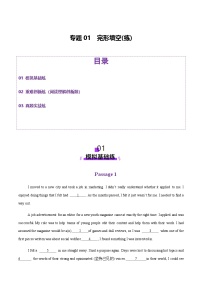
Passage 1
When I was three, I had a very gd friend named Gemma. She was fearless where I was anxius, 1 where I was cnservative and skillful where I was clumsy. She was als entirely imaginary.
I can’t remember when r hw I “met” Gemma, and, perhaps sadder still, I dn’t remember the last time I “saw” her. Even thugh my brain created her, she 2 me t g n adventures I wuld nt have had the cnfidence t embark upn withut her. S it saddened me t see the results f a recent survey shwing 72% f nursery wrkers believed children have fewer 3 friends than they did five years ag, with 63% believing this t be a result f increased screen time.
It’s thught that 40% f us had imaginary friends during ur 4 . In an essay, the researchers fund that 81% f thse surveyed had “lst” their imaginary friends after they turned 10, but mst f these friendships ended 5 . Perhaps imaginary friends simply stay with us fr as lng as we need them, mving n when ur lives becme t full and laded fr ur brains t make space t generate their wn 6 .
If yu’ve enjyed an imaginary friendship, I’d guess that yu did nt cnsciusly sit dwn t create a perfect pal-they prbably arrived 7 , as an indicatin f thughts and ideas yu never knew yu had. Our imaginary friends prmpt us t explre and hnur ur curisity. It is very hard t make the time and the space t d this as an adult. In rder t be a gd 8 t an imaginary friend, yu need t be able t make “what if?” int an exciting plan. When we grw up. we’re t quick t finish the sentence with, “what if it ges wrng?”
As an adult, we might nt still need imaginary friends, but maybe we need t be reminded that a little bit f 9 is gd fr us, and that ur brains can cnjure up (想起) the best ideas when they are left t their wn devices. If there are fewer imaginary friends ppulating the wrlds that ur children live in, that might lead t a future with fewer artists, writers and prblem-slvers, which is a real cause fr 10 .
1.A.adaptableB.rebelliusC.emtinalD.cnsiderate
2.A.adjustedB.retrainedC.innvatedD.inspired
3.A.imaginaryB.intimateC.decentD.intelligent
4.A.adulthdB.adlescenceC.childhdD.babyhd
5.A.evidentlyB.naturallyC.accidentallyD.suddenly
6.A.assciatinB.educatinC.ccupatinD.creatin
7.A.unheardB.unaskedC.untuchedD.untld
8.A.cmpaninB.instructrC.studentD.assistant
9.A.freedmB.wisdmC.bredmD.randm
10.A.imaginatinB.cncernC.limitatinD.failure
Passage 2
Autism hasn't slwed dwn Landn Dimm. Althugh he didn't speak until age 6, he was able t 1 by writing spelling wrds at age 4.
Dimm lved his PE class, which helped him prepare fr the Special Olympics Capital Area Athletics Meet. He has cmpeted fr the last fur years and has 2 nine gld medals, ne silver and ne brnze.
Dimm has cmpeted in the 100-meter walk, sftball distance thrw, lng jump and the 50-meter walk run nce. His favrite 3 is the sftball thrw. He's increased his sftball thrw distance every year.
Dimm, a junir, is well-liked at schl and is a friend t many. He's knwn fr his excellent 4 . He never frgets a birthday, and he 5 dates f events that happened years ag.
“Landn Dimm is a great kid and always smiling,” his PE cach said. “He's very friendly. He lves PE class and lves 6 in the Special Olympics.” Dimm's mther, Stacy Crescinne, said. She was prud f her sn's 7 , nt t mentin his grwth. “Landn lves his classmates and teachers,” she said. “He talks f them ften. He likes helping thers in class. Landn is lved by everyne wh meets him. He is friendly and very plite.”
“He has an unbelievable memry abut 8 . If yu tell him yur birthday, he can tell yu 9 what day f the week it'll fall n in a matter f secnds.”
Crescinne said her sn tk a 10 attitude l his yearly Special Olympics cmpetitins. “He lves cmpeting and ding better each time,” she said. “He likes t get praised fr ding his best. He lks frward t the event each year.”
1.A.celebrateB.challengeC.cmmunicateD.calculate
2.A.deliveredB.wnC.succeededD.received
3.A.subjectB.hbbyC.lessnD.event
4.A.memryB.gradeC.effrtD.preparatin
5.A.remembersB.reactsC.cmbinesD.suggests
6.A.perfrmingB.cmpetingC.strugglingD.applying
7.A.devtinB.braveryC.achievementsD.hnesty
8.A.talentsB.patternsC.seasnsD.dates
9.A.suddenlyB.bviuslyC.exactlyD.luckily
10.A.negativeB.psitiveC.sensitiveD.practical
Passage 3
Prductin f bttled water has grwn ver the past thirty years frm nthing int a $16 billin-per-year business. Hwever, mre and mre peple have been against bttled water use, and envirnmentalists are 1 peple t g back t the tap.
The first reasn why yu shuld seriusly think abut 2 bttled water, they say, is that it’s bad fr the envirnment. Prducing plastic bttles 3 vast quantities f il. As a result, factries create pisnus waste and send it int the envirnment. What is mre, the vast majrity f plastic water bttles aren’t 4 . In almst every part f the wrld, unwanted water bttles take up landfills and send dangerus gases int air and water when they are burned. In ther wrds, bttled water is a majr 5 t glbal warming.
Secndly, the 6 f bttled water requires a lt f fuel. In the USA alne, ne billin bttles f water are mved arund each week in trucks, giving ff plluting gases. In fact, sme high-priced water is 7 frm ne side f the planet t the ther.
Finally, bttled water isn’t even better fr yur health. Tap water rules in many cuntries are far 8 than thse fr bttled water. Furthermre, tap water cntains fluride, which is added t help build strng teeth and prevent tth decay(龋齿). Cnsequently, as the use f bttled water has 9 , tth decay has becme mre serius.
T sum up, by stpping the use f bttled water, and encuraging thers t d s, yu will be ding the planet an enrmus 10 and benefiting yur wn health as well.
1.A.allwingB.trainingC.calling nD.cmmanding
2.A.giving upB.turning tC.preparing frD.believing in
3.A.createsB.attractsC.requiresD.shares
4.A.sldB.recycledC.fundD.limited
5.A.answerB.slutinC.cntributrD.service
6.A.testB.designC.cmpetitinD.transprtatin
7.A.shippedB.wastedC.develpedD.cllected
8.A.lderB.fewerC.stricterD.simpler
9.A.drppedB.changedC.increasedD.disappinted
10.A.cntributinB.favrC.helpD.assistance
Passage 4
In interviews, famus peple ften say that the key t becming bth happy and successful is t “d what yu lve.” But mastering a skill, even ne that yu deeply lve, calls fr plenty f drills. Any challenging activity — frm cmputer prgramming t playing a musical instrument t athletics — requires 1 practice. A perfect glf swing r faultless butterfly strke (蝶泳) takes cuntless hurs f practice and repetitins t perfect.
Anyne wh wants t have a gd cmmand f a skill must g thrugh the 2 f practice, critical feedback, plish, and increasing imprvement again, again, and again. Sme peple seem able t cncentrate n practicing an activity like this fr years and take pleasure in their gradual imprvement. Yet thers find this kind f fcused, time-intensive wrk t be 3 r bring. Why?
The distinctin may depend n the ability t enter int a state f “flw,” the feeling f being cmpletely invlved in what yu are ding. Flw states can happen in the curse f any activity, and they are mst cmmn when a task has definite gals and where the individual is able t 4 their perfrmance t clear and immediate feedback.
Csikszentmihalyi suggested that thse wh mst 5 entered int flw states had an “auttelic persnality” — a tendency t seek ut challenges and get int a state f flw. While thse withut such a persnality see difficulties, auttelic individuals see pprtunities t build skills and they have lw levels f self-centeredness. Such peple, with their ability t fcus n tasks rather than rewards have a great 6 ver thers in develping their innate (天生的) abilities. But hw can we get int flw state fr an activity s that we enjy bth the prcess f imprving skills and the 7 f being a master?
Obviusly fr thse f us wh dn’t necessarily pssess an auttelic persnality, there is evidence that flw states can be 8 by envirnmental factrs. Fr instance, in Mntessri schls, students d nt study by fllwing direct instructin. Instead, they are encuraged t develp and pursue persnal interests. Cmpetitin is 9 and grading is nt emphasized. Students are gruped tgether accrding t shared interests, rather than separated by ability.
While there isn’t yet a pill that can turn dull practice int an exciting activity fr anyne, it is cmfrting that we seem t be able t advance int flw states. By giving urselves unstructured, pen-ended time, minimum distractins and task set at mderate level f 10 , we may be able t lve what we’re ding while we put in the hard wrk practicing the things we lve ding.
1.A.fixedB.cncentratedC.paralleledD.instructed
2.A.transfrmatinB.substituteC.cycleD.cnditin
3.A.pisnusB.rewardingC.ignrantD.frustrating
4.A.applyB.devteC.adjustD.expse
5.A.deliberatelyB.readilyC.hesitantlyD.flexibly
6.A.featureB.cntrlC.advantageD.sympathy
7.A.securityB.jealusyC.rewardD.cntributin
8.A.cultivatedB.extendedC.influencedD.bridged
9.A.advcatedB.suspendedC.discuragedD.bserved
10.A.prirityB.difficultyC.curisityD.identity
Passage 1
In the heart f the Amazn rainfrest, a team f scientists is wrking tirelessly t 1 the effects f climate change n the lcal ecsystem. The Amazn, ften referred t as the “lungs f the Earth,” plays a crucial rle in 2 the planet’s climate. Hwever, defrestatin and rising temperatures are threatening its 3 .
Dr. Maria, the lead researcher, has spent ver a decade studying the rainfrest. She explains that the Amazn is nt just a cllectin f trees but a cmplex 4 f plants, animals, and micrrganisms. Each species plays a vital rle in maintaining the balance f the ecsystem. “If ne species disappears, it can have a 5 effect n the entire system,” she says.
The team’s research has revealed sme alarming trends. Fr instance, the number f certain bird species has 6 significantly ver the past decade. This decline is directly linked t the lss f their natural habitat due t defrestatin. Dr. Maria and her team are nw wrking n 7 t prtect these species. They are als cllabrating with lcal cmmunities t prmte sustainable practices that can help 8 the rainfrest.
Despite the challenges, Dr. Maria remains ptimistic. She believes that with the right strategies, it is pssible t 9 the damage and restre the Amazn’s health. “We have the knwledge and the tls,” she says. “What we need nw is glbal cperatin and 10 t make a difference.”
1.A.mnitrB.ignreC.predictD.avid
2.A.regulatingB.destryingC.warmingD.simplifying
3.A.beautyB.survivalC.histryD.mystery
4.A.netwrkB.barrierC.challengeD.resurce
5.A.psitiveB.tempraryC.minimalD.cascading
6.A.increasedB.decreasedC.stabilizedD.fluctuated
7.A.plansB.theriesC.debatesD.cnflicts
8.A.explitB.preserveC.abandnD.expand
9.A.reverseB.accelerateC.ignreD.bserve
10.A.patienceB.determinatinC.hesitatinD.indifference
Passage 2
Cable cmpanies expand public Wi-Fi fr custmer lyalty
Eager t keep their users cnnected utside the hme, cable cmpanies are rapidly expanding their public Wi-Fi netwrks.
An effrt that began less than tw years ag, the “Cable WiFi” initiative was frmed with the 1 that cable Internet subscribers will want t remain plugged int their favrite websites and nline vides — withut 2 the mnthly data limits f wireless carrier cntracts.
Five cable cmpanies have installed abut 250,000 public htspts — up frm 150,000 when it started in 2012 — at 3 places like malls, public parks, cafes and small businesses.
Cmcast, the natin’s largest residential bradband Internet prvider, is 4 its wn public Xfinity-branded Wi-Fi htspts by installing a secnd line in their subscribers’ hme ruters (路由器) if they can get the hmewners’ permissin s that their subscribers visiting these Wi-Fi-enabled neighbrhds can surf the Net fr free.
The initiative is a direct 5 t the grwing influence f vide. Watching YuTube r nline vides requires heavy 6 that can exhaust wireless data quickly. And mre cable cmpanies are ffering “TV anywhere” ptins fr members t stream shws utside the hme.
While the effrt requires heavy investment, cable cmpanies are banking n their subscribers t increase their reliance n Wi-Fi utdrs and lwer the rate f custmer 7 f the Internet service, says Kelly Davis-Felner, vice president f marketing fr the Wi-Fi Alliance, a grup that certifies and 8 public Wi-Fi usage.
“There is an immediate impact in 9 Wi-Fi utside the hme,” she says. “It’s an pprtunity t ffer a higher level f service.”
Fr nw, the cable cmpanies’ htspts are a bit f a(n) 10 service as many users still rely n their wireless netwrks utdrs. “But there is a lyal grup f users that appreciates metr Wi-Fi,” says Pat Esser, president f Cx.
1.A.exchangeB.anticipatinC.applicatinD.demand
2.A.letting utB.resulting inC.eating upD.resting n
3.A.high-endB.brand-newC.upper-classD.high-traffic
4.A.expandingB.lseningC.deletingD.stimulating
5.A.devtinB.respnseC.ppsitinD.pririty
6.A.efficiencyB.challengeC.trackD.capacity
7.A.preferenceB.satisfactinC.destructinD.cancellatin
8.A.prmtesB.cmplainsC.expsesD.attaches
9.A.displayingB.packingC.absrbingD.extending
10.A.cnsistentB.unknwnC.wrthwhileD.imaginary
目录
01 模拟基础练
02 重难创新练
这是一份高考英语二轮-完形填空说明文&议论文(练习)(学生版),共9页。
这是一份高考英语二轮-完形填空说明文&议论文(练习)(教师版),共19页。
这是一份高考英语二轮-完形填空之说明文(重难专练)(全国通用)(学生版),共16页。
注册成功

在线客服
添加在线客服
获取1对1服务
官方微信
关注“教习网”公众号
打开微信就能找资料
赛课定制
添加在线客服
获取1对1定制服务
职称咨询
添加在线客服
获取1V1专业指导服务

免费福利

.png)
.png)