 免费领取教师福利


若您为此资料的原创作者,认为该资料内容侵犯了您的知识产权,请扫码添加我们的相关工作人员,我们尽可能的保护您的合法权益。

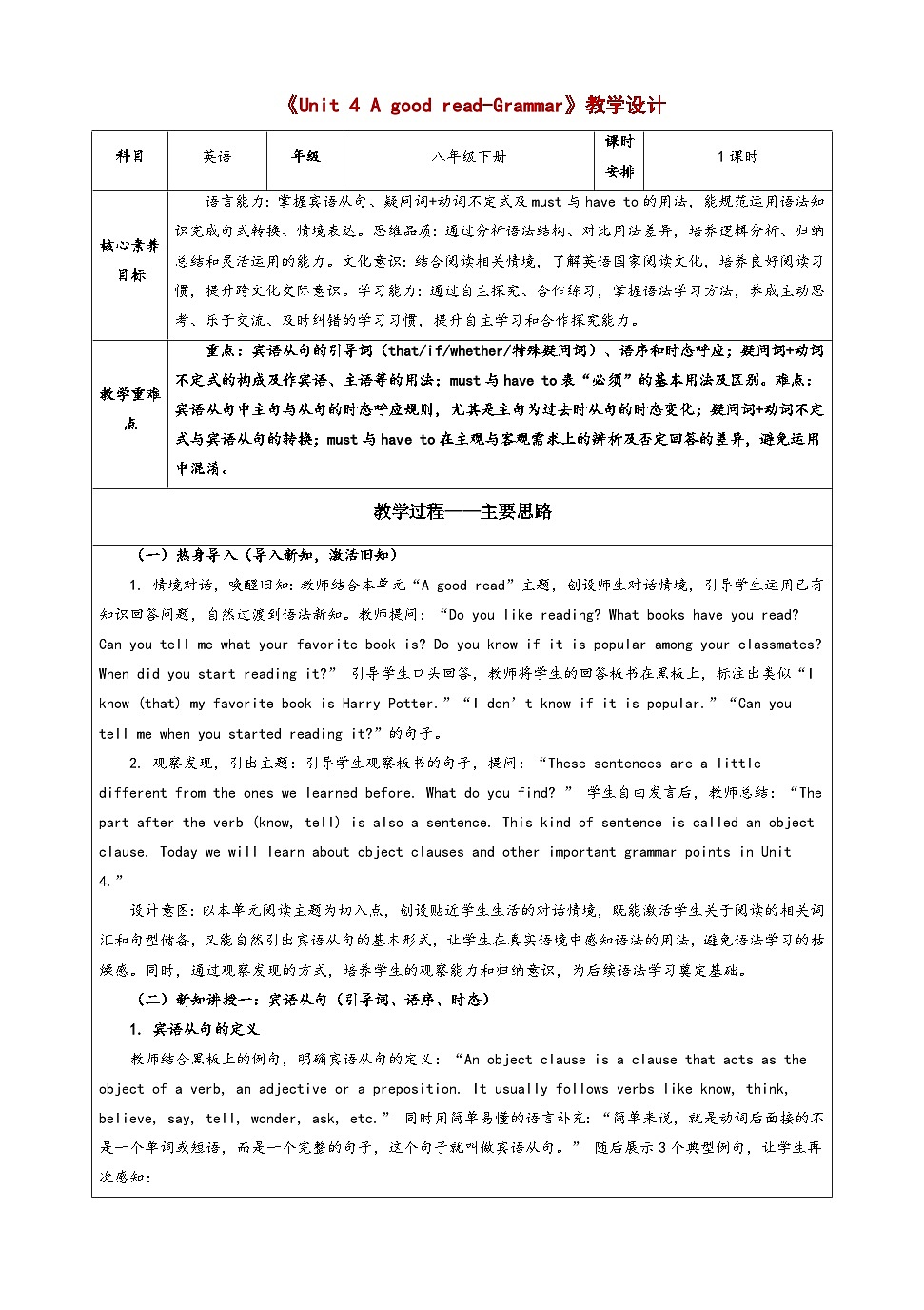
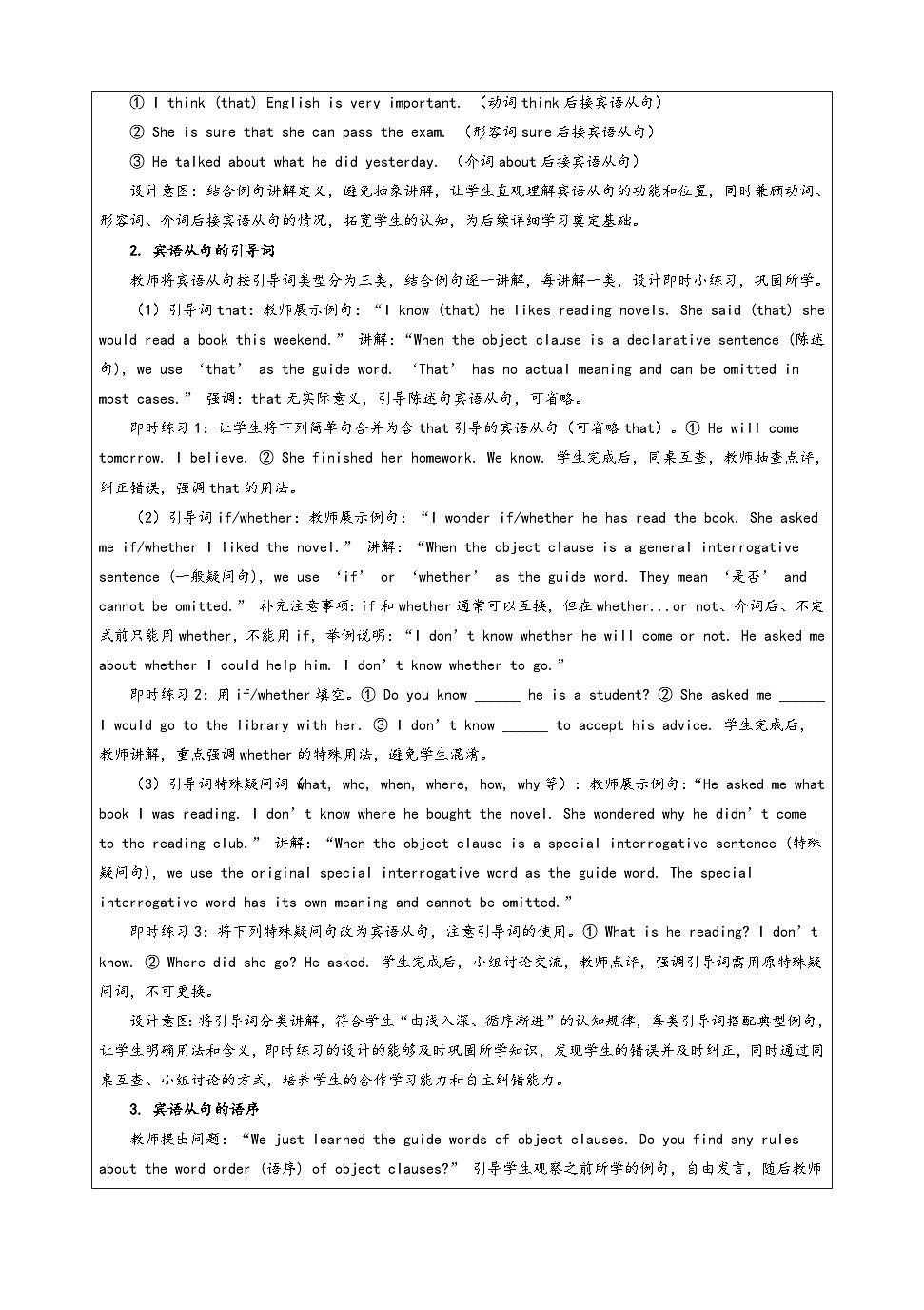
这是一份初中英语牛津译林版(2024)八年级下册(2024)Grammar一等奖教学设计,共8页。
科目
英语
年级
八年级下册
课时安排
1课时
核心素养目标
语言能力:掌握宾语从句、疑问词+动词不定式及must与have t的用法,能规范运用语法知识完成句式转换、情境表达。思维品质:通过分析语法结构、对比用法差异,培养逻辑分析、归纳总结和灵活运用的能力。文化意识:结合阅读相关情境,了解英语国家阅读文化,培养良好阅读习惯,提升跨文化交际意识。学习能力:通过自主探究、合作练习,掌握语法学习方法,养成主动思考、乐于交流、及时纠错的学习习惯,提升自主学习和合作探究能力。
教学重难点
重点:宾语从句的引导词(that/if/whether/特殊疑问词)、语序和时态呼应;疑问词+动词不定式的构成及作宾语、主语等的用法;must与have t表“必须”的基本用法及区别。难点:宾语从句中主句与从句的时态呼应规则,尤其是主句为过去时从句的时态变化;疑问词+动词不定式与宾语从句的转换;must与have t在主观与客观需求上的辨析及否定回答的差异,避免运用中混淆。
教学过程——主要思路
(一)热身导入(导入新知,激活旧知)
1. 情境对话,唤醒旧知:教师结合本单元“A gd read”主题,创设师生对话情境,引导学生运用已有知识回答问题,自然过渡到语法新知。教师提问:“D yu like reading? What bks have yu read? Can yu tell me what yur favrite bk is? D yu knw if it is ppular amng yur classmates? When did yu start reading it?” 引导学生口头回答,教师将学生的回答板书在黑板上,标注出类似“I knw (that) my favrite bk is Harry Ptter.”“I dn’t knw if it is ppular.”“Can yu tell me when yu started reading it?”的句子。
2. 观察发现,引出主题:引导学生观察板书的句子,提问:“These sentences are a little different frm the nes we learned befre. What d yu find? ” 学生自由发言后,教师总结:“The part after the verb (knw, tell) is als a sentence. This kind f sentence is called an bject clause. Tday we will learn abut bject clauses and ther imprtant grammar pints in Unit 4.”
设计意图:以本单元阅读主题为切入点,创设贴近学生生活的对话情境,既能激活学生关于阅读的相关词汇和句型储备,又能自然引出宾语从句的基本形式,让学生在真实语境中感知语法的用法,避免语法学习的枯燥感。同时,通过观察发现的方式,培养学生的观察能力和归纳意识,为后续语法学习奠定基础。
(二)新知讲授一:宾语从句(引导词、语序、时态)
1. 宾语从句的定义
教师结合黑板上的例句,明确宾语从句的定义:“An bject clause is a clause that acts as the bject f a verb, an adjective r a prepsitin. It usually fllws verbs like knw, think, believe, say, tell, wnder, ask, etc.” 同时用简单易懂的语言补充:“简单来说,就是动词后面接的不是一个单词或短语,而是一个完整的句子,这个句子就叫做宾语从句。” 随后展示3个典型例句,让学生再次感知:
① I think (that) English is very imprtant. (动词think后接宾语从句)
② She is sure that she can pass the exam. (形容词sure后接宾语从句)
③ He talked abut what he did yesterday. (介词abut后接宾语从句)
设计意图:结合例句讲解定义,避免抽象讲解,让学生直观理解宾语从句的功能和位置,同时兼顾动词、形容词、介词后接宾语从句的情况,拓宽学生的认知,为后续详细学习奠定基础。
2. 宾语从句的引导词
教师将宾语从句按引导词类型分为三类,结合例句逐一讲解,每讲解一类,设计即时小练习,巩固所学。
(1)引导词that:教师展示例句:“I knw (that) he likes reading nvels. She said (that) she wuld read a bk this weekend.” 讲解:“When the bject clause is a declarative sentence (陈述句), we use ‘that’ as the guide wrd. ‘That’ has n actual meaning and can be mitted in mst cases.” 强调:that无实际意义,引导陈述句宾语从句,可省略。
即时练习1:让学生将下列简单句合并为含that引导的宾语从句(可省略that)。① He will cme tmrrw. I believe. ② She finished her hmewrk. We knw. 学生完成后,同桌互查,教师抽查点评,纠正错误,强调that的用法。
(2)引导词if/whether:教师展示例句:“I wnder if/whether he has read the bk. She asked me if/whether I liked the nvel.” 讲解:“When the bject clause is a general interrgative sentence (一般疑问句), we use ‘if’ r ‘whether’ as the guide wrd. They mean ‘是否’ and cannt be mitted.” 补充注意事项:if和whether通常可以互换,但在 nt、介词后、不定式前只能用whether,不能用if,举例说明:“I dn’t knw whether he will cme r nt. He asked me abut whether I culd help him. I dn’t knw whether t g.”
即时练习2:用if/whether填空。① D yu knw ______ he is a student? ② She asked me ______ I wuld g t the library with her. ③ I dn’t knw ______ t accept his advice. 学生完成后,教师讲解,重点强调whether的特殊用法,避免学生混淆。
(3)引导词特殊疑问词(what, wh, when, where, hw, why等):教师展示例句:“He asked me what bk I was reading. I dn’t knw where he bught the nvel. She wndered why he didn’t cme t the reading club.” 讲解:“When the bject clause is a special interrgative sentence (特殊疑问句), we use the riginal special interrgative wrd as the guide wrd. The special interrgative wrd has its wn meaning and cannt be mitted.”
即时练习3:将下列特殊疑问句改为宾语从句,注意引导词的使用。① What is he reading? I dn’t knw. ② Where did she g? He asked. 学生完成后,小组讨论交流,教师点评,强调引导词需用原特殊疑问词,不可更换。
设计意图:将引导词分类讲解,符合学生“由浅入深、循序渐进”的认知规律,每类引导词搭配典型例句,让学生明确用法和含义,即时练习的设计的能够及时巩固所学知识,发现学生的错误并及时纠正,同时通过同桌互查、小组讨论的方式,培养学生的合作学习能力和自主纠错能力。
3. 宾语从句的语序
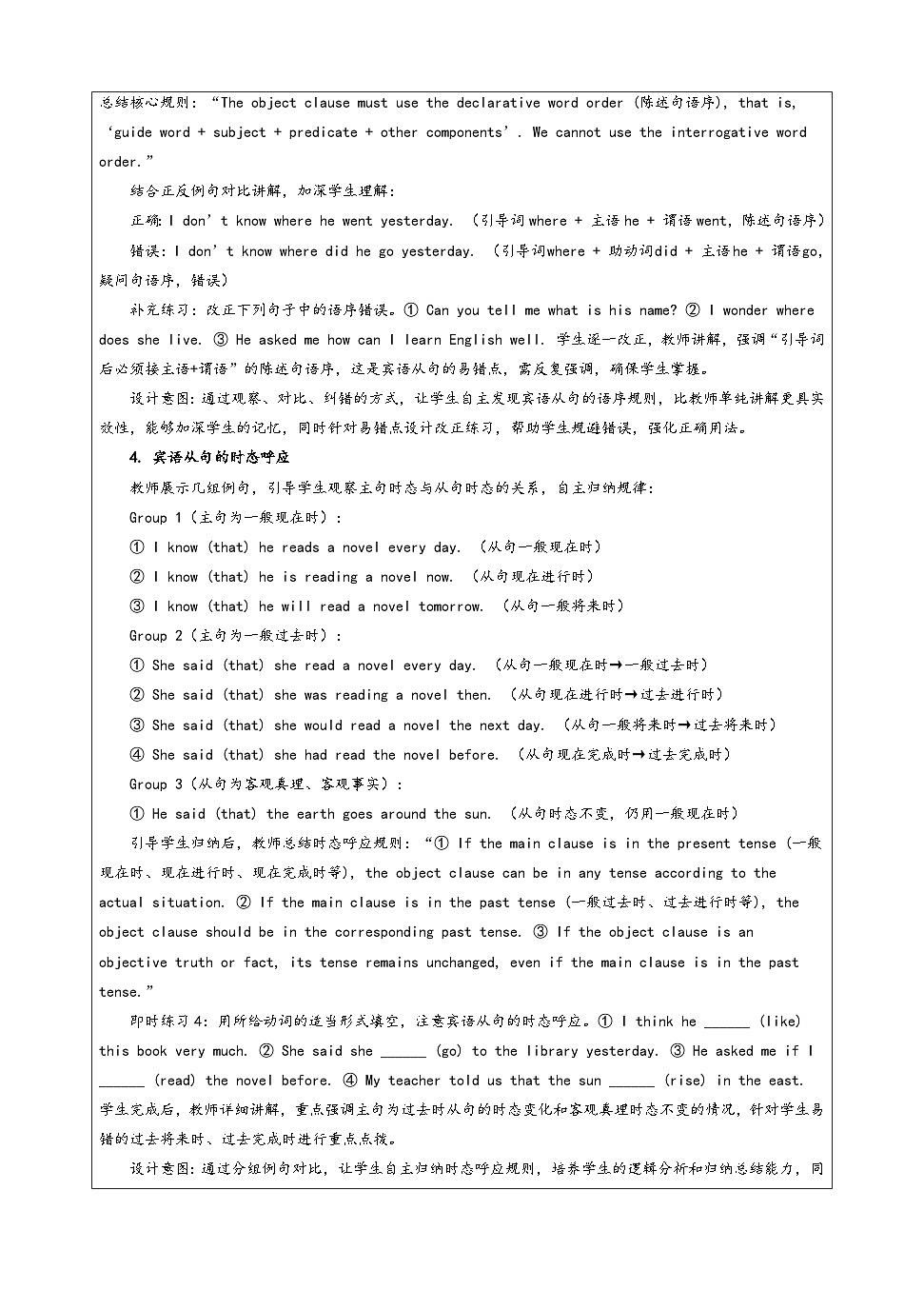
教师提出问题:“We just learned the guide wrds f bject clauses. D yu find any rules abut the wrd rder (语序) f bject clauses?” 引导学生观察之前所学的例句,自由发言,随后教师总结核心规则:“The bject clause must use the declarative wrd rder (陈述句语序), that is, ‘guide wrd + subject + predicate + ther cmpnents’. We cannt use the interrgative wrd rder.”
结合正反例句对比讲解,加深学生理解:
正确:I dn’t knw where he went yesterday. (引导词where + 主语he + 谓语went,陈述句语序)
错误:I dn’t knw where did he g yesterday. (引导词where + 助动词did + 主语he + 谓语g,疑问句语序,错误)
补充练习:改正下列句子中的语序错误。① Can yu tell me what is his name? ② I wnder where des she live. ③ He asked me hw can I learn English well. 学生逐一改正,教师讲解,强调“引导词后必须接主语+谓语”的陈述句语序,这是宾语从句的易错点,需反复强调,确保学生掌握。
设计意图:通过观察、对比、纠错的方式,让学生自主发现宾语从句的语序规则,比教师单纯讲解更具实效性,能够加深学生的记忆,同时针对易错点设计改正练习,帮助学生规避错误,强化正确用法。
4. 宾语从句的时态呼应
教师展示几组例句,引导学生观察主句时态与从句时态的关系,自主归纳规律:
Grup 1(主句为一般现在时):
① I knw (that) he reads a nvel every day. (从句一般现在时)
② I knw (that) he is reading a nvel nw. (从句现在进行时)
③ I knw (that) he will read a nvel tmrrw. (从句一般将来时)
Grup 2(主句为一般过去时):
① She said (that) she read a nvel every day. (从句一般现在时→一般过去时)
② She said (that) she was reading a nvel then. (从句现在进行时→过去进行时)
③ She said (that) she wuld read a nvel the next day. (从句一般将来时→过去将来时)
④ She said (that) she had read the nvel befre. (从句现在完成时→过去完成时)
Grup 3(从句为客观真理、客观事实):
① He said (that) the earth ges arund the sun. (从句时态不变,仍用一般现在时)
引导学生归纳后,教师总结时态呼应规则:“① If the main clause is in the present tense (一般现在时、现在进行时、现在完成时等), the bject clause can be in any tense accrding t the actual situatin. ② If the main clause is in the past tense (一般过去时、过去进行时等), the bject clause shuld be in the crrespnding past tense. ③ If the bject clause is an bjective truth r fact, its tense remains unchanged, even if the main clause is in the past tense.”
即时练习4:用所给动词的适当形式填空,注意宾语从句的时态呼应。① I think he ______ (like) this bk very much. ② She said she ______ (g) t the library yesterday. ③ He asked me if I ______ (read) the nvel befre. ④ My teacher tld us that the sun ______ (rise) in the east. 学生完成后,教师详细讲解,重点强调主句为过去时从句的时态变化和客观真理时态不变的情况,针对学生易错的过去将来时、过去完成时进行重点点拨。
设计意图:通过分组例句对比,让学生自主归纳时态呼应规则,培养学生的逻辑分析和归纳总结能力,同时结合即时练习,强化学生对规则的运用,重点突破易错点,确保学生能够根据主句时态正确判断从句时态。
(三)新知讲授二:疑问词+动词不定式(wh- + t d)
1. 构成与含义
教师结合本单元阅读主题,展示例句:“I dn’t knw what t read. She can’t decide which bk t chse. He asked me hw t imprve his reading skills.” 讲解:“We can cmbine a special interrgative wrd (what, wh, which, when, where, hw, etc.) with an infinitive (t + verb原形) t frm a structure ‘wh- + t d’. This structure is equivalent t a shrt bject clause and is mre cncise.” 补充:疑问词包括疑问代词(what, wh, whm, which, whse)和疑问副词(when, where, hw),连接词whether也可用于该结构(whether t d),含义为“是否做某事”。
设计意图:结合本单元主题例句,让学生感知该结构的用法和简洁性,避免抽象讲解,同时明确结构的构成,为后续学习其功能奠定基础。
2. 功能与用法
教师将“疑问词+动词不定式”的功能分为四类,结合例句逐一讲解,每讲解一类,设计相应练习,巩固所学。
(1)作宾语:讲解:“This structure is mst cmmnly used as the bject f verbs such as knw, decide, wnder, ask, learn, frget, remember, etc.” 例句:① He desn’t knw what t d next. ② She decided when t start reading the bk. ③ I frgt hw t get t the library. 补充:该结构作宾语时,可与对应的宾语从句互换,举例说明:“I dn’t knw what t read. = I dn’t knw what I shuld read.”
即时练习5:将下列宾语从句改为“疑问词+动词不定式”结构。① I dn’t knw what I shuld buy fr him. ② She wndered hw she culd finish the task. ③ He asked me where he culd find the bk. 学生完成后,同桌互查,教师点评,强调互换时的注意事项,确保结构正确。
(2)作主语:讲解:“When this structure is used as the subject, it usually means a questin r a chice, and the predicate verb is usually singular.” 例句:① What t read is a big prblem fr him. ② When t hld the reading meeting hasn’t been decided yet. ③ Hw t imprve reading speed is imprtant fr us. 补充:可将it作为形式主语,将该结构后置,使句子更平衡,举例:“It is imprtant hw t imprve reading speed. = Hw t imprve reading speed is imprtant.”
即时练习6:用“疑问词+动词不定式”结构完成句子。① ______ (读什么) is up t yu. ② ______ (如何到达) the library is a questin. 学生完成后,教师讲解,强调作主语时谓语动词用单数形式,以及形式主语的用法。
(3)作表语:讲解:“When this structure is used as a predicative, it fllws the link verb (系动词) such as be, becme, etc., t explain the subject.” 例句:① The prblem is where t find the bk. ② My questin is hw t read faster. ③ The key is what t pay attentin t when reading.
即时练习7:用“疑问词+动词不定式”结构填空,作表语。① The questin is ______ (是否参加) the reading club. ② The prblem is ______ (怎样解决) this difficulty. 教师讲解时,强调whether t d作表语的用法,避免学生误用if t d。
(4)作宾语补足语:讲解:“This structure can be used as an bject cmplement after verbs such as tell, ask, shw, teach, advise, etc., frming the structure ‘sb. + wh- + t d’.” 例句:① The teacher tld us hw t read the passage. ② She asked me what t prepare fr the reading activity. ③ He shwed me where t buy the nvel.
即时练习8:用“疑问词+动词不定式”结构完成句子。① Can yu tell me ______ (怎样提高) my reading ability? ② She advised me ______ (读哪本书) first. 学生完成后,教师点评,强调“sb. + wh- + t d”的结构,确保学生正确运用。
设计意图:将该结构的功能分类讲解,结合例句和练习,让学生明确不同功能下的用法,同时通过宾语从句与该结构的互换练习,帮助学生建立知识之间的联系,拓宽学生的语言运用思路,培养学生的灵活运用能力。
(四)新知讲授三:情态动词must与have t的区别
1. 基本用法回顾
教师引导学生回顾已有知识,提问:“We have learned the mdal verbs must and have t befre. D yu remember what they mean? Can yu give sme examples?” 学生自由发言后,教师总结两者的基本含义:“Bth ‘must’ and ‘have t’ mean ‘必须’,but they are different in usage.”
设计意图:回顾旧知,为讲解两者的区别奠定基础,激活学生的知识储备,让学生在已有知识的基础上学习新内容,降低学习难度。
2. 用法区别详解
教师结合例句,从三个方面讲解must与have t的区别,采用对比的方式,让学生清晰感知差异,同时补充相关注意事项。
(1)含义与语气:讲解:“‘Must’ expresses the speaker’s subjective will (主观意愿) r bligatin (义务、责任), and its tne is strng. ‘Have t’ expresses an bjective need (客观需要), that is, smething that has t be dne because f external factrs (外部因素), and its tne is weaker than ‘must’.” 结合例句对比:
① I must read this bk. (主观意愿:我自己想读这本书,认为必须读)
② I have t read this bk. (客观需要:因为老师布置了作业,所以不得不读)
③ We must bey the schl rules. (义务责任:必须遵守校规)
④ He has t stay at hme because he is ill. (客观因素:生病,不得不待在家里)
(2)时态变化:讲解:“‘Must’ nly has the present tense frm. If we need t express the past r future tense, we usually use ‘have t’ instead. ‘Have t’ has varius tense frms: have t (present), has t (third persn singular present), had t (past), will have t (future), etc.” 举例说明:
① Present tense: I must/have t finish my hmewrk. He must/has t read the bk.
② Past tense: I had t finish my hmewrk yesterday. (不能说I musted...)
③ Future tense: I will have t read this bk tmrrw. (不能说I will must...)
(3)否定形式与回答:讲解:“The negative frm f ‘must’ is ‘mustn’t’, which means ‘禁止、不准’,and its tne is very strng. The negative frm f ‘have t’ is ‘dn’t have t’ (present), ‘desn’t have t’ (third persn singular present), ‘didn’t have t’ (past), which means ‘不必’,equivalent t ‘needn’t’.” 结合例句和问答场景对比:
① Negative frm: Yu mustn’t read in the sun. (禁止在阳光下看书)/ Yu dn’t have t read this bk. (你不必读这本书)
② Questin and answer: —Must I finish reading nw? —Yes, yu must. (肯定回答,必须)/ N, yu needn’t/dn’t have t. (否定回答,不必,不能说N, yu mustn’t.)
补充注意事项:mustn’t表示“禁止”,语气强烈,而dn’t have t表示“不必”,语气委婉,两者不可混淆,举例:“Yu mustn’t smke here. (禁止吸烟)/ Yu dn’t have t cme early. (你不必来太早)”
即时练习9:用must, have t, mustn’t, dn’t have t填空。① Yu ______ be quiet in the library. ② He ______ stay up late because he has an exam tmrrw. ③ Yu ______ run in the hallway. ④ I ______ finish this wrk tday; I can finish it tmrrw. ⑤ She ______ g t the dctr yesterday because she was ill. 学生完成后,教师详细讲解,重点强调两者在主观与客观、时态、否定形式及回答上的区别,针对易错点进行反复点拨,确保学生掌握。
设计意图:采用对比讲解的方式,让学生清晰感知must与have t的差异,结合例句和问答场景,让学生在具体语境中理解用法,即时练习的设计能够及时巩固所学知识,帮助学生规避错误,强化正确用法,同时培养学生的语境分析能力。
(五)巩固练习(分层练习,强化运用)
为了兼顾不同层次学生的学习需求,设计基础题、提升题、拓展题三个层次的练习,让每个学生都能在练习中巩固知识、提升能力,练习后及时讲解点评,确保练习效果。
1. 基础题(巩固核心知识,面向全体学生)
(1)用适当的引导词填空(宾语从句引导词):① I dn’t knw ______ he will cme r nt. ② She asked me ______ bk I liked best. ③ He said ______ he had read the nvel. ④ Can yu tell me ______ yu bught this bk? ⑤ I wnder ______ he is a gd reader.
(2)用所给动词的适当形式填空(宾语从句时态):① He thinks that he ______ (can) read English nvels. ② She said that she ______ (read) a bk at that time. ③ I dn’t knw if he ______ (cme) tmrrw. ④ My teacher tld us that the earth ______ (g) arund the sun. ⑤ They asked me what I ______ (d) last night.
(3)用“疑问词+动词不定式”结构改写句子:① I dn’t knw what I shuld d. ② She wndered where she culd find the bk. ③ Can yu tell me hw I can imprve my reading? ④ He asked me when he shuld start. ⑤ I can’t decide which bk I shuld chse.
(4)用must, have t, mustn’t填空:① Yu ______ fllw the traffic rules. ② He ______ g t schl n time. ③ Yu ______ talk ludly in the reading rm. ④ I ______ finish my hmewrk first. ⑤ She ______ stay at hme because f the rain.
2. 提升题(强化灵活运用,面向中等层次学生)
(1)改正下列句子中的错误:① I dn’t knw what is his favrite bk. ② She said that she will g t the library. ③ He asked me if I can help him. ④ Yu mustn’t finish yur hmewrk nw; yu can finish it later. ⑤ I dn’t knw hw t d it is right.
(2)完成句子,用所学语法知识填空:① I wnder ______ (他是否已经读过) this nvel. ② She asked me ______ (我每天什么时候) read bks. ③ ______ (怎样提高阅读能力) is a prblem fr many students. ④ The teacher tld us ______ (我们必须) read mre bks t imprve ur English. ⑤ He has t stay at hme because he ______ (生病了) yesterday.
3. 拓展题(拓展思维,面向优秀学生)
(1)结合本单元“A gd read”主题,用所学语法知识写3-5句话,介绍自己的阅读情况,要求包含宾语从句、“疑问词+动词不定式”结构和must/have t。
(2)补全对话:A: D yu like reading? B: Yes, I d. A: Can yu tell me ______ (你最喜欢什么类型的书)? B: I like science fictin nvels. A: I wnder ______ (你为什么喜欢) them. B: Because they are interesting and can pen my mind. A: ______ (怎样找到) gd science fictin nvels? B: Yu can ask the librarian fr help. A: Thank yu. I think I ______ (必须) read mre science fictin nvels. B: Yu dn’t have t read t many at a time; take yur time.
练习实施:学生独立完成基础题和提升题,拓展题可小组合作完成,练习时间结束后,教师逐一讲解答案,重点讲解易错点和难点,对于拓展题,邀请小组代表展示成果,教师点评鼓励,肯定优点,指出不足并提出改进建议。
设计意图:分层练习的设计符合“因材施教”的教学原则,基础题巩固核心知识,确保全体学生掌握基本用法;提升题强化灵活运用,帮助学生突破易错点;拓展题结合单元主题,将语法知识与实际表达结合起来,培养学生的语言综合运用能力和思维拓展能力,同时小组合作完成拓展题,能够培养学生的合作学习能力和交流表达能力。
(六)课堂小结(梳理知识,强化记忆)
1. 学生自主小结:教师引导学生回顾本节课所学知识,提问:“What did we learn tday? Can yu summarize the key pints?” 邀请2-3名学生发言,自主梳理本节课所学的宾语从句(引导词、语序、时态)、“疑问词+动词不定式”结构(构成、功能)和must与have t的区别,其他学生补充完善。
2. 教师总结升华:教师结合学生的小结,用简洁明了的语言梳理本节课的核心知识,形成知识框架:“Tday we learned three imprtant grammar pints: first, bject clauses, including their guide wrds (that, if/whether, special interrgative wrds), wrd rder (declarative wrd rder) and tense agreement; secnd, the structure ‘wh- + t d’, which can be used as bject, subject, predicative and bject cmplement; third, the difference between must and have t in subjective and bjective meaning, tense and negative frm. These grammar pints are very imprtant fr ur English learning, especially fr ur reading and writing. We need t master them and use them flexibly.”
同时强调:“Grammar learning is nt abut reciting rules, but abut using them in real situatins. We shuld pay mre attentin t the use f grammar in reading and writing, and accumulate mre examples t imprve ur language ability.”
设计意图:让学生自主小结,能够培养学生的归纳总结能力和自主学习能力,加深学生对知识的记忆;教师的总结升华能够帮助学生梳理知识框架,形成系统的知识体系,同时强调语法学习的本质是运用,引导学生树立正确的语法学习观念。
这是一份初中英语牛津译林版(2024)八年级下册(2024)Grammar一等奖教学设计,共8页。
这是一份初中英语牛津译林版(2024)八年级下册(2024)Grammar公开课教案,共13页。
这是一份英语八年级下册(2024)Grammar获奖教学设计,共7页。
 新教材
新教材注册成功

在线客服
添加在线客服
获取1对1服务
官方微信
关注“教习网”公众号
打开微信就能找资料
赛课定制
添加在线客服
获取1对1定制服务
职称咨询
添加在线客服
获取1V1专业指导服务

免费福利

.png)
.png)
.png)
