 免费领取教师福利


若您为此资料的原创作者,认为该资料内容侵犯了您的知识产权,请扫码添加我们的相关工作人员,我们尽可能的保护您的合法权益。

这是一份人教版七年级下册英语寒假预习第四单元(含答案及解析),共7页。学案主要包含了核心知识点,练习题,答案及解析等内容,欢迎下载使用。
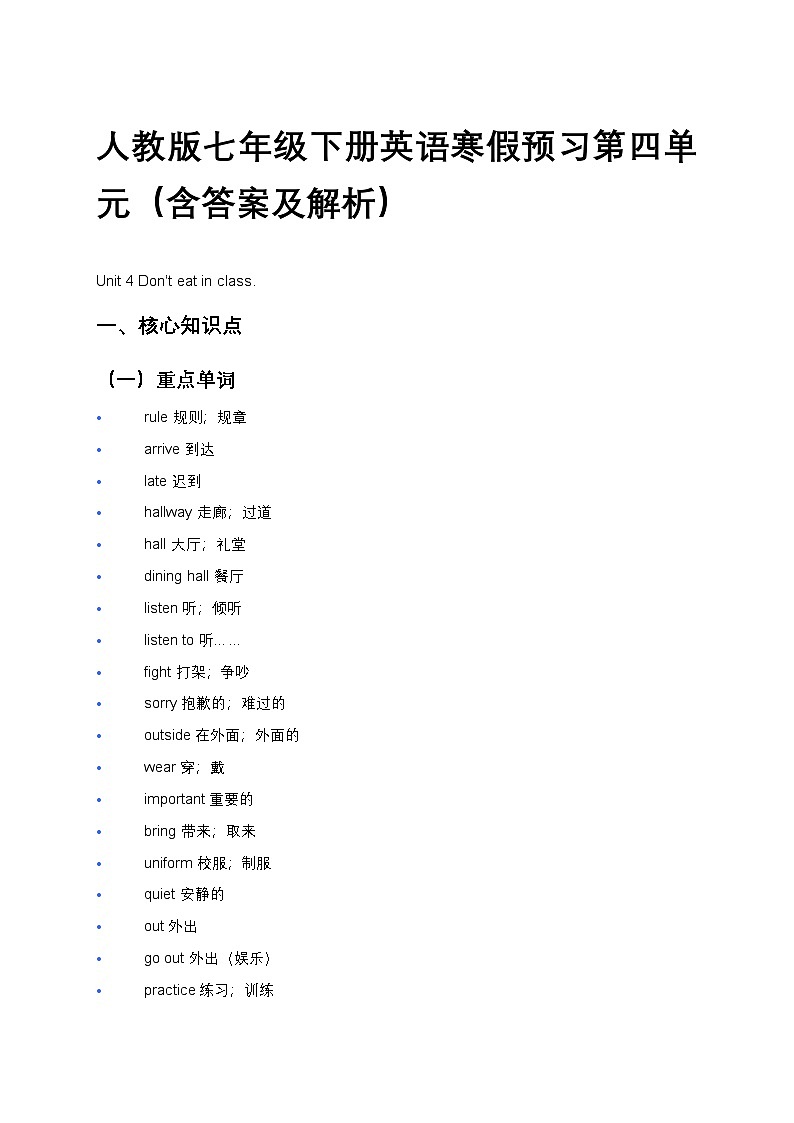
一、核心知识点
(一)重点单词
rule 规则;规章
arrive 到达
late 迟到
hallway 走廊;过道
hall 大厅;礼堂
dining hall 餐厅
listen 听;倾听
listen t 听……
fight 打架;争吵
srry 抱歉的;难过的
utside 在外面;外面的
wear 穿;戴
imprtant 重要的
bring 带来;取来
unifrm 校服;制服
quiet 安静的
ut 外出
g ut 外出(娱乐)
practice 练习;训练
dish 碟;盘
d the dishes 洗餐具
befre 在……以前;以前
dirty 脏的
kitchen 厨房
mre 更多的
nisy 吵闹的
relax 放松;休息
read 读;阅读
terrible 可怕的;糟糕的
feel 感受;觉得
strict 严格的;严厉的
be strict with sb. 对某人要求严格
remember 记住;记起
fllw 遵循;跟随
fllw the rules 遵守规则
luck 运气
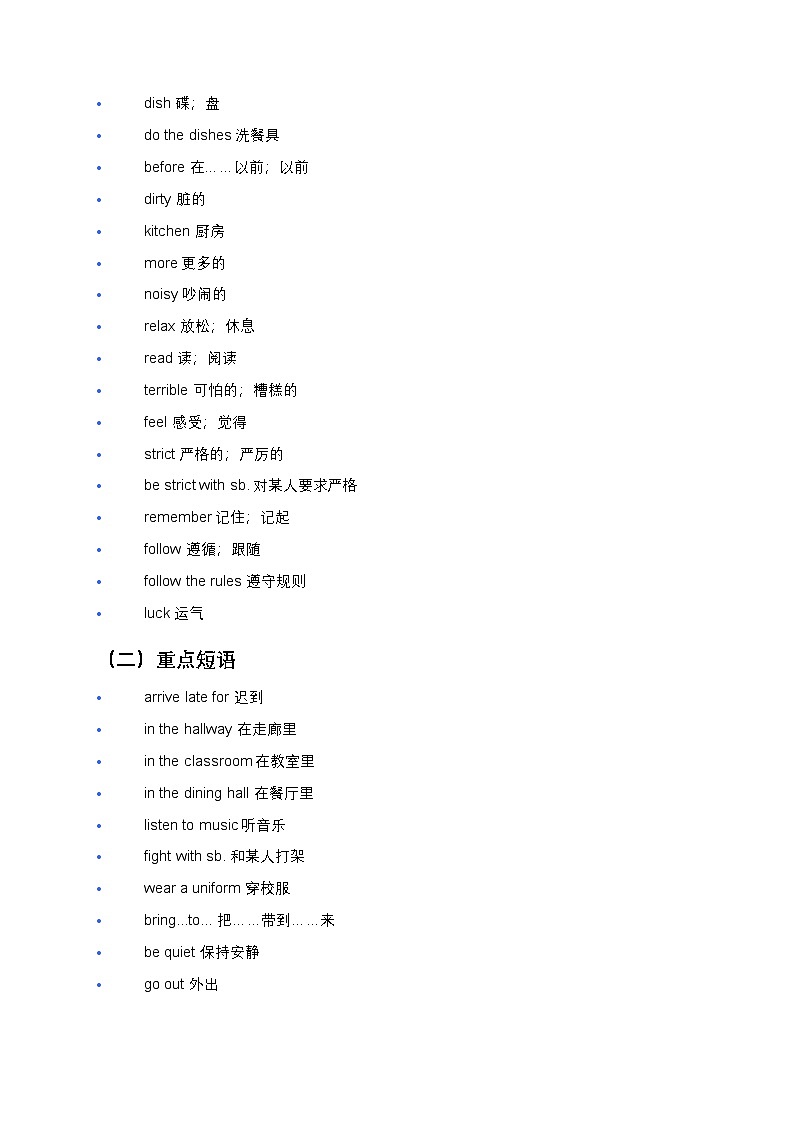
(二)重点短语
arrive late fr 迟到
in the hallway 在走廊里
in the classrm 在教室里
in the dining hall 在餐厅里
listen t music 听音乐
fight with sb. 和某人打架
wear a unifrm 穿校服
把……带到……来
be quiet 保持安静
g ut 外出
practice ding sth. 练习做某事
d the dishes 洗餐具
befre dinner 晚饭前
keep clean 保持干净
in the kitchen 在厨房里
be nisy 吵闹
relax at hme 在家放松
read a bk 读书
be strict with sb. 对某人要求严格
fllw the rules 遵守规则
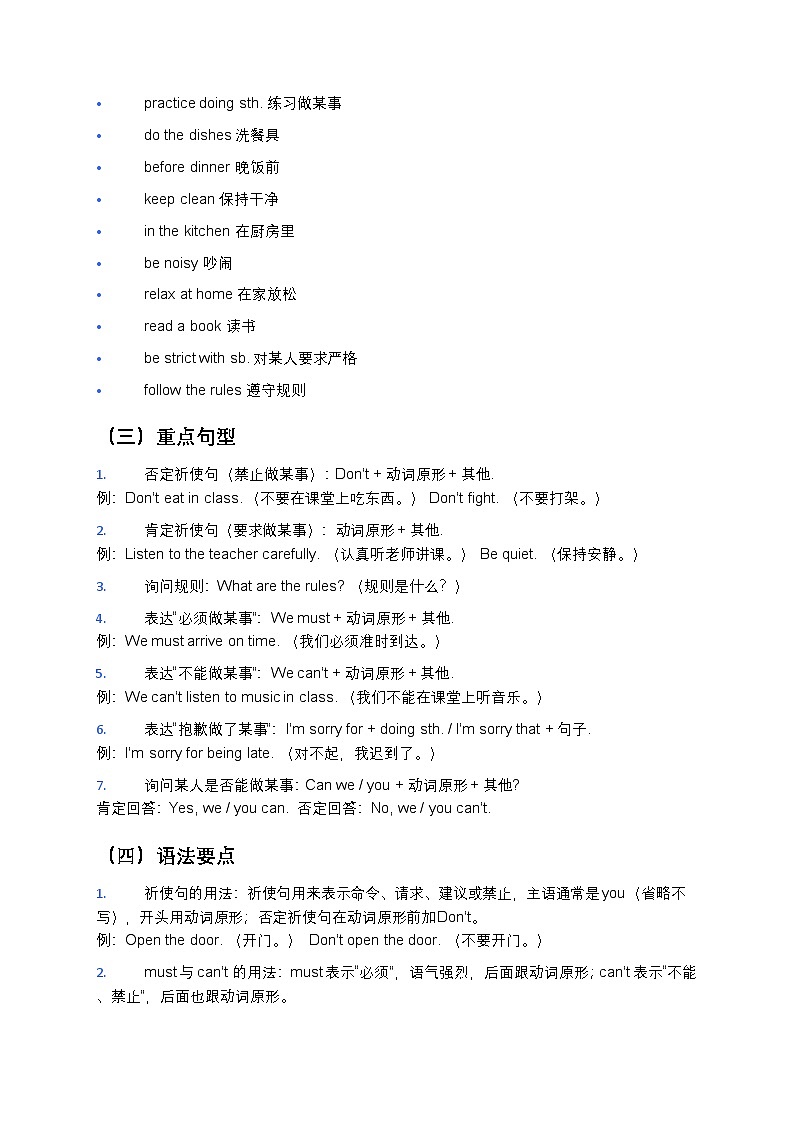
(三)重点句型
否定祈使句(禁止做某事):Dn’t + 动词原形 + 其他.
例:Dn’t eat in class. (不要在课堂上吃东西。) Dn’t fight. (不要打架。)
肯定祈使句(要求做某事):动词原形 + 其他.
例:Listen t the teacher carefully. (认真听老师讲课。) Be quiet. (保持安静。)
询问规则:What are the rules? (规则是什么?)
表达“必须做某事”:We must + 动词原形 + 其他.
例:We must arrive n time. (我们必须准时到达。)
表达“不能做某事”:We can’t + 动词原形 + 其他.
例:We can’t listen t music in class. (我们不能在课堂上听音乐。)
表达“抱歉做了某事”:I’m srry fr + ding sth. / I’m srry that + 句子.
例:I’m srry fr being late. (对不起,我迟到了。)
询问某人是否能做某事:Can we / yu + 动词原形 + 其他?
肯定回答:Yes, we / yu can. 否定回答:N, we / yu can’t.
(四)语法要点
祈使句的用法:祈使句用来表示命令、请求、建议或禁止,主语通常是yu(省略不写),开头用动词原形;否定祈使句在动词原形前加Dn’t。
例:Open the dr. (开门。) Dn’t pen the dr. (不要开门。)
must与can’t的用法:must表示“必须”,语气强烈,后面跟动词原形;can’t表示“不能、禁止”,后面也跟动词原形。
例:Yu must wear a unifrm. (你必须穿校服。) Yu can’t g ut at night. (你晚上不能外出。)
wear与put n的区别:wear表示“穿着、戴着”,强调穿着的状态;put n表示“穿上、戴上”,强调穿的动作。
例:She wears a red dress tday. (她今天穿了一条红色连衣裙。) Put n yur cat. (穿上你的外套。)
practice的用法:practice后面跟动词-ing形式,即practice ding sth.,意为“练习做某事”。
例:He practices speaking English every day. (他每天练习说英语。)
二、练习题
(一)单项选择(每小题1分,共10分)
从A、B、C、D四个选项中,选出可以填入空白处的最佳选项。
( )1. — ______ eat in class. — Srry, I wn’t. A. Dn’t B. D C. Can D. Can’t
( )2. We must ______ n time fr class. A. arrive B. arrives C. arriving D. t arrive
( )3. Dn’t ______ music in the hallway. A. listen B. listen t C. listens D. listens t
( )4. — Can we wear hats in class? — N, we ______. A. can B. can’t C. d D. dn’t
( )5. She ______ a unifrm t schl every day. A. wear B. wears C. wearing D. t wear
( )6. Dn’t fight ______ yur classmates. A. with B. t C. at D. in
( )7. We ______ be quiet in the library. A. can B. can’t C. must D. mustn’t
( )8. He practices ______ English every mrning. A. speak B. speaks C. speaking D. t speak
( )9. — What are the rules? — We ______ eat in the dining hall. A. can B. can’t C. mustn’t D. dn’t
( )10. I’m srry fr ______ late fr schl. A. be B. being C. is D. are
(二)词汇运用(每小题1分,共10分)
A. 根据句意及首字母提示完成单词
11. We must fllw the schl r______.
12. Dn’t a______ late fr class. It’s imprtant.
13. We can’t listen t m______ in the classrm.
14. She has t w______ a unifrm at schl.
15. Please be q______ in the library. Others are reading.
B. 用所给单词的适当形式填空
16. Dn’t ______ (fight) with yur brther.
17. We must ______ (arrive) n time.
18. He ______ (wear) a blue jacket every day.
19. She practices ______ (dance) after schl.
20. Can yu ______ (bring) yur bk t schl tmrrw?
(三)句型转换(每小题2分,共10分)
21. Eat in class.(改为否定祈使句) ______ ______ in class.
22. We can listen t music in the hallway.(改为否定句) We ______ ______ t music in the hallway.
23. She wears a unifrm t schl.(改为一般疑问句) ______ she ______ a unifrm t schl?
24. We must arrive n time.(改为一般疑问句) ______ we ______ n time?
25. They can g ut at night.(作否定回答) N, ______ ______.
三、答案及解析
(一)单项选择(每小题1分,共10分)
答案:1.A 2.A 3.B 4.B 5.B 6.A 7.C 8.C 9.A 10.B
解析:
1. 由答语Srry, I wn’t. 可知,此处是否定祈使句,禁止在课堂上吃东西,开头加Dn’t,选A。
2. 情态动词must后面跟动词原形,arrive意为“到达”,选A。
3. 否定祈使句Dn’t后面跟动词原形,listen t music意为“听音乐”,固定搭配,选B。
4. Can引导的一般疑问句,否定回答用N, 主语+can’t. ,选B。
5. 主语She是第三人称单数,一般现在时中,谓语动词用第三人称单数形式wears,wear a unifrm意为“穿校服”,选B。
6. fight with sb. 意为“和某人打架”,固定搭配,句意:不要和你的同学打架,选A。
7. 结合语境,在图书馆我们必须保持安静,must意为“必须”,选C。
8. practice ding sth. 意为“练习做某事”,后面跟动词-ing形式,选C。
9. 结合规则,我们可以在餐厅吃东西,can意为“可以”,选A。
10. be srry fr ding sth. 意为“抱歉做了某事”,fr后面跟动词-ing形式,being是be的-ing形式,选B。
(二)词汇运用(每小题1分,共10分)
A. 根据句意及首字母提示完成单词
答案:11.rules 12.arrive 13.music 14.wear 15.quiet
解析:
11. fllw the rules意为“遵守规则”,句意:我们必须遵守学校规则。
12. arrive late fr意为“迟到”,否定祈使句Dn’t后面跟动词原形,句意:不要上课迟到,这很重要。
13. listen t music意为“听音乐”,句意:我们不能在教室里听音乐。
14. wear a unifrm意为“穿校服”,have t后面跟动词原形,句意:她在学校必须穿校服。
15. be quiet意为“保持安静”,句意:请在图书馆保持安静,其他人在看书。
B. 用所给单词的适当形式填空
答案:16.fight 17.arrive 18.wears 19.dancing 20.bring
解析:
16. 否定祈使句Dn’t后面跟动词原形,fight用原形。
17. 情态动词must后面跟动词原形,arrive用原形。
18. 主语He是第三人称单数,一般现在时中,谓语动词用第三人称单数形式wears。
19. practice ding sth. 意为“练习做某事”,dance的-ing形式是dancing。
20. 情态动词can后面跟动词原形,bring用原形。
(三)句型转换(每小题2分,共10分)
答案:
21. Dn’t eat 解析:肯定祈使句改为否定祈使句,在动词原形前加Dn’t,eat用原形。
22. can’t listen 解析:含情态动词can的句子,改为否定句时,在can后面加nt,缩写为can’t,后面的动词listen用原形。
23. Des; wear 解析:原句是一般现在时,主语She是第三人称单数,改为一般疑问句时,加助动词Des,后面的动词wear用原形。
24. Must; arrive 解析:含情态动词must的句子,改为一般疑问句时,将must提前,后面的动词arrive用原形。
25. they can’t 解析:Can they引导的一般疑问句,否定回答用N, they can’t. ,主语用they,情态动词用can’t。
这是一份人教版七年级下册英语寒假预习第四单元(含答案及解析),共7页。学案主要包含了核心知识点,练习题,答案及解析等内容,欢迎下载使用。
这是一份人教版七年级下册英语寒假预习第七单元(含答案及解析),共7页。学案主要包含了核心知识点,练习题,答案及解析等内容,欢迎下载使用。
这是一份人教版七年级下册英语寒假预习第一单元(含答案及解析),共5页。学案主要包含了核心知识点,练习题,答案及解析等内容,欢迎下载使用。
注册成功

在线客服
添加在线客服
获取1对1服务
官方微信
关注“教习网”公众号
打开微信就能找资料
赛课定制
添加在线客服
获取1对1定制服务
职称咨询
添加在线客服
获取1V1专业指导服务

免费福利

.png)
.png)
.png)
