 免费领取教师福利
若您为此资料的原创作者,认为该资料内容侵犯了您的知识产权,请扫码添加我们的相关工作人员,我们尽可能的保护您的合法权益。

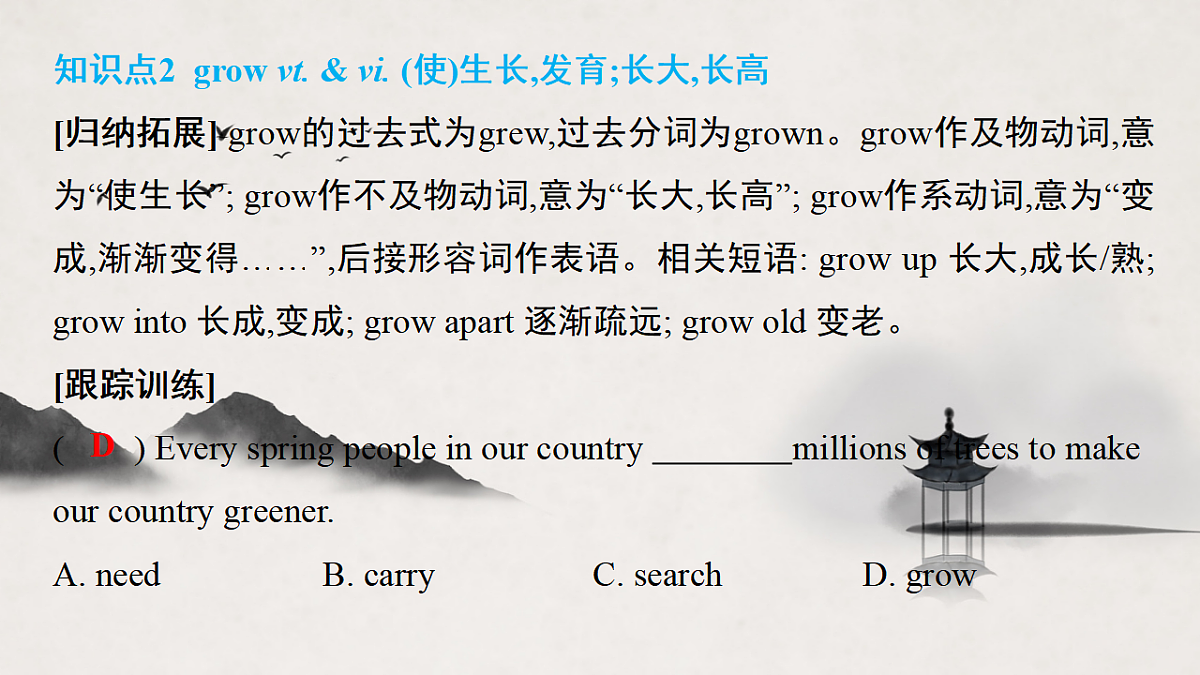
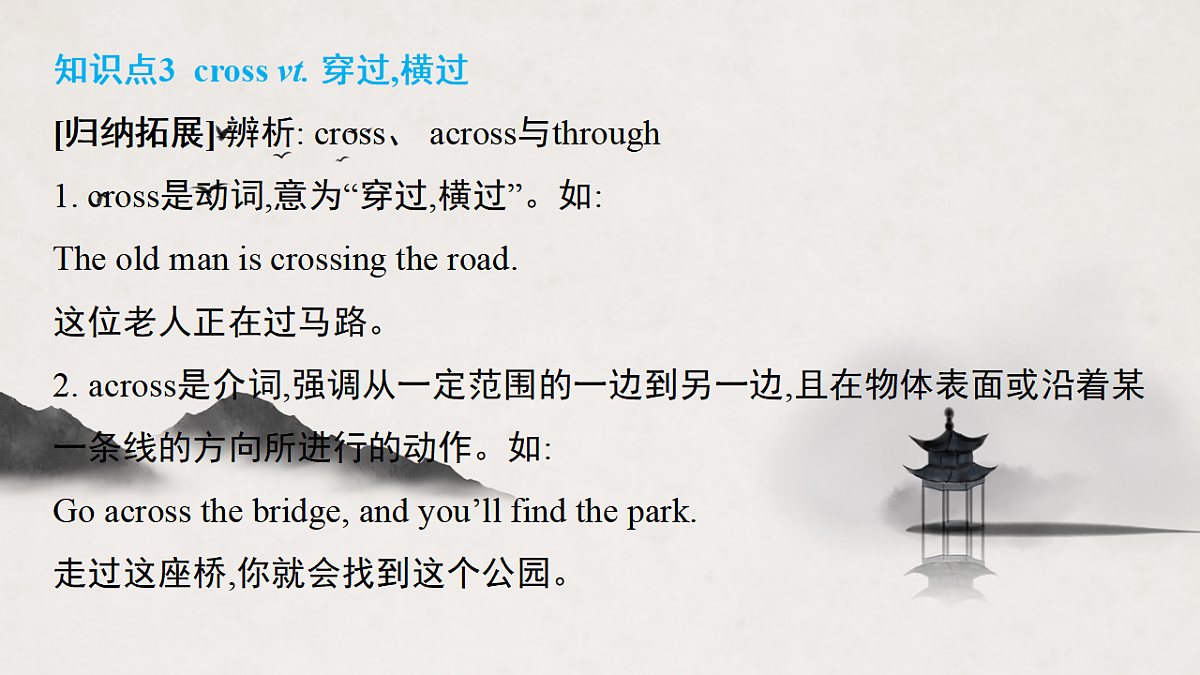
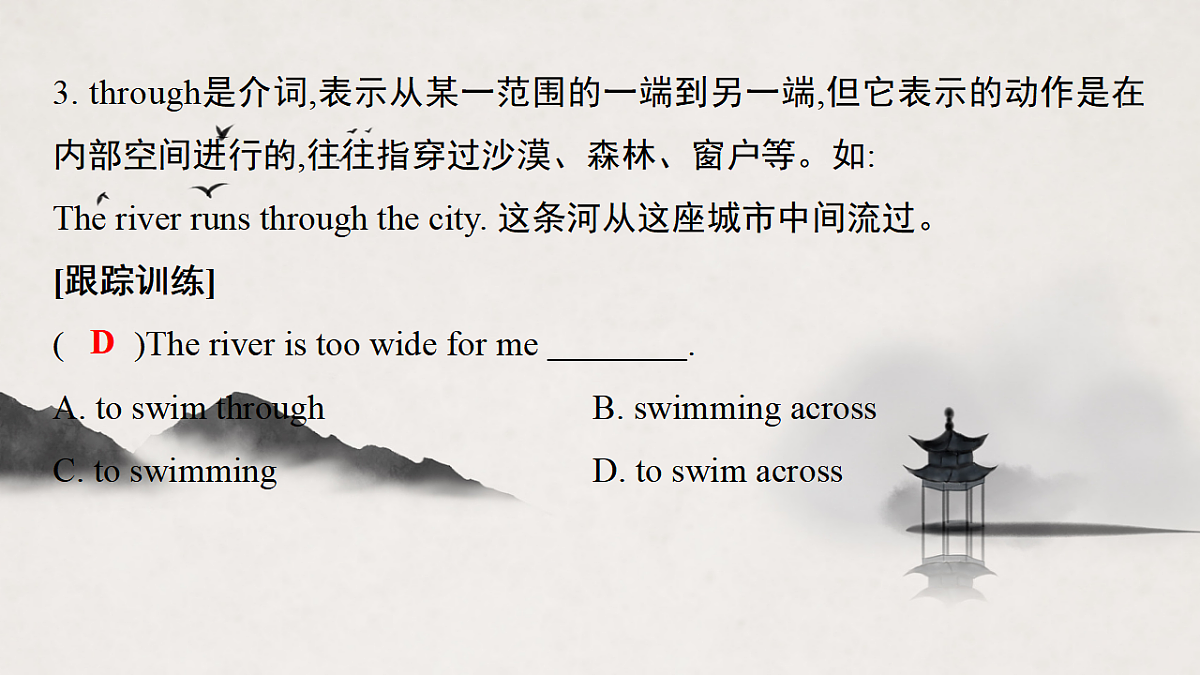
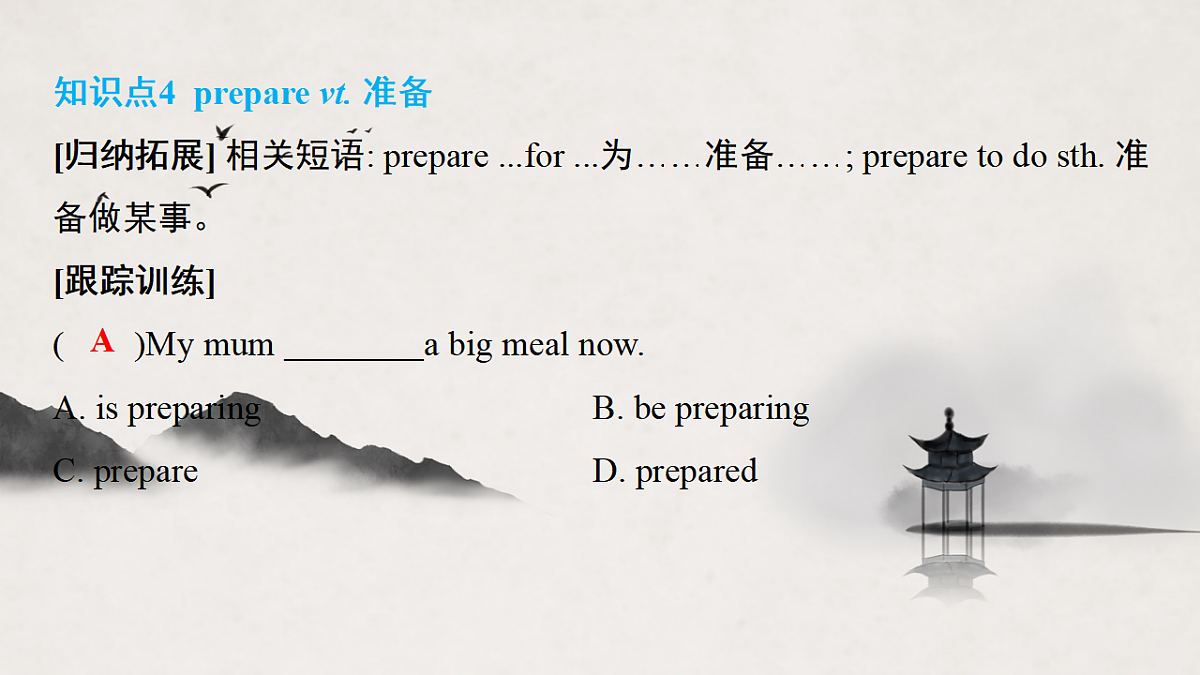
中考一轮复习七年级下册Units 3-41. 掌握并能熟练应用描述地点、公共交通、设施、人等方面的词汇和句式,并能够正确应用相关词汇和句式指明路线。2. 掌握名词所有格、形容词性物主代词和名词性物主代词的用法。辨别使用定冠词和不定冠词。3. 学会使用方位介词(behind、 inside、 outside、 above、 below、 over、 under等)和方位介词短语(in front of、 in the middle of等)。重点词汇知识点1 miss vt. 错过,失去[归纳拓展] miss的用法:1. 错过,失去。如: miss the beginning of the film错过这部影片的开头。2. 想念,思念。如: miss him想念他。3. 首字母大写的Miss意为“小姐”,用在姓前,专指未婚女性。如: Miss Li 李小姐。[跟踪训练]商店就在你的右边。别错过它。The shop is just on your right. . Don’t miss it知识点2 grow vt. & vi. (使)生长,发育;长大,长高[归纳拓展] grow的过去式为grew,过去分词为grown。grow作及物动词,意为“使生长”; grow作不及物动词,意为“长大,长高”; grow作系动词,意为“变成,渐渐变得……”,后接形容词作表语。相关短语: grow up 长大,成长/熟; grow into 长成,变成; grow apart 逐渐疏远; grow old 变老。[跟踪训练]( ) Every spring people in our country millions of trees to make our country greener. A. needB. carryC. searchD. growD知识点3 cross vt. 穿过,横过[归纳拓展] 辨析: cross、 across与through1. cross是动词,意为“穿过,横过”。如:The old man is crossing the road.这位老人正在过马路。2. across是介词,强调从一定范围的一边到另一边,且在物体表面或沿着某一条线的方向所进行的动作。如:Go across the bridge, and you’ll find the park. 走过这座桥,你就会找到这个公园。3. through是介词,表示从某一范围的一端到另一端,但它表示的动作是在内部空间进行的,往往指穿过沙漠、森林、窗户等。如:The river runs through the city. 这条河从这座城市中间流过。[跟踪训练]( )The river is too wide for me . A. to swim throughB. swimming acrossC. to swimmingD. to swim acrossD知识点4 prepare vt. 准备[归纳拓展] 相关短语: prepare ...for ...为……准备……; prepare to do sth. 准备做某事。[跟踪训练]( )My mum a big meal now. A. is preparingB. be preparingC. prepareD. preparedA重点句型知识点5 We are looking forward to meeting you soon. 我们盼望不久就能见到你们。[归纳拓展] look forward to意为“期盼,盼望”,其中to是介词,后接名词、代词。接动词时,要用动名词形式。[跟踪训练]( )Jane is my new penfriend. I often look forward to her emails. A. receiveB. receivesC. receivingD. receivedC知识点6 How far is it from the hotel? 它离旅馆有多远?[归纳拓展] 辨析: how long、 how often、 how soon与how far1. how long主要有以下两种意思:(1) 表示多长时间,主要用来对一段时间(如: three days、four weeks等)提问。(2) 表示某物有多长。2. how often 指每隔多久,主要用来对频率提问。3. how soon 指再过多久,主要用来对表示将来的一段时间(如: in an hour等)提问。4. how far指距离多远。[跟踪训练]( )— is your school from your home? — It is 4 kilometres from my home.A. How muchB. How oftenC. How farD. How longC知识点7 Some families raise cows, and others grow wheat. 一些家庭养牛,另一些家庭种植小麦。[归纳拓展] 辨析:“Some ..., and others ...”“Some ..., and the others ...”与“One ..., and the other ...”[跟踪训练]( )Some people are good at , and like singing. A. danced; othersB. dancing; othersC. danced; the othersD. dancing; the otherB知识点8 Sunshine Zoo is north of Sunshine Middle School. 阳光动物园在阳光中学的北面。[归纳拓展] 1. 方位词:2. 表示方位:(1) “A is in the ...of B.”表示A在B内部的某方位。如:Jiangsu is in the east of China. 江苏在中国的东部。(2) “A is on the ...of B.”表示A与B接壤。如:Russia is on the north of China. 俄罗斯在中国的北部。(3) “A is to the ...of B.”表示A与B不接壤。如:Japan is to the east of China. 日本在中国的东边。[跟踪训练]1. Guangzhou is the south of China. 2. Hangzhou is the south of Taizhou. 3. China is the south of Russia. intoon语法专题知识点9 名词所有格[归纳拓展]1. 概念:名词所有格表示人或物的所有关系,一般用’s表示,意为“……的”。2. 用法:(1) 一般单数名词的所有格直接在词尾加’s。如: the woman’s son、 the boy’s dad等。(2) 以s或es结尾的复数名词的所有格只要在词尾加’。如: the buses’ seats、 the twins’ parents等。(3) 不以s或es结尾的不规则变化的复数名词的所有格在词尾加’s。如: Children’s Day, the People’s Republic of China等。(4) 如果某事物为两个人共有,则在第二个名词后加’s表示所有关系。如: Su Hai and Su Yang’s parents等。(5) 如果事物为两个人分别拥有,则在两个名词后分别加’s表示所有关系。如: Judy’s and Sam’s bikes等。3. 其他所有格: of所有格。没有生命的事物一般用of所有格表示所属关系。如: the colour of the bike、 the size of the coat等。4. 双重所有格常用’s与of所有格的混合形式。如: some books of my father’s等。[跟踪训练]( )— Who’s the woman under the tree?— She’s aunt. A. Kelly and Joe’sB. Kelly’s and JoeC. Kelly’s and Joe’sD. Kelly and JoeA知识点10 物主代词[归纳拓展] 物主代词是表示所有关系的代词,分为形容词性物主代词和名词性物主代词。形容词性物主代词相当于形容词,用在句中时,后面一定要有名词,不可单独使用。名词性物主代词相当于名词,用在句中是为了避免重复提过的名词,可单独使用,后面不能再跟名词。注意: it没有名词性物主代词形式。[跟踪训练]( )(2023·连云港)Your school library looks as modern as . Can you show me around? A. weB. usC. ourD. oursD知识点11 冠词[归纳拓展] 冠词可分为不定冠词a、 an和定冠词 the。冠词本身无独立意义,用来帮助说明名词所指的人或物是泛指还是特指。1. 不定冠词 a和an 的用法:(1) 表示某人、某物的某一类。如:My brother is a doctor. 我哥哥/弟弟是医生。Do you like a dog or a cat? 你喜欢狗还是猫?(2) 表示某一事物中的任何一个。如:A cat can catch mice. 猫能抓老鼠。(3) 表示某人某物,但不具体说明何人何物。如:A patient died yesterday.昨天一名病人去世了。(4) 表示数量“1”。如:There is a big desk in the front of the classroom. 教室前有一张大桌子。(5) 帮助构成一些固定短语。如:have a rest 休息一下a lot of 许多make a fire 生火2. 定冠词 the 的用法:(1) 指上文提到过的人或物。如:I have a bike. The bike is old.我有一辆自行车。这辆自行车是旧的。(2) 世界上独一无二的事物。如:the Sun 太阳 the Moon 月亮(3) 用在序数词、表示方位的名词、形容词最高级前。如:the second one 第二个in the north 在北边(4) 用在乐器名称前。如:play the guitar 弹吉他(5) 在复数姓氏前用the表示某某一家人,常看成复数。如:The Kings(= the King family) 金一家3. 不用冠词的情况:(1) 在星期、月份、季节、年份、学科等词前。如:in summer 在夏天in September 在九月in 2004 在2004年(2) 一些专有名词、不可数名词、称呼和头衔前。如:China 中国 Grade Two 二年级Mr Smith 史密斯先生(3) 颜色、语言、国家前。如:a girl in red 穿红色衣服的女孩in America 在美国(4) 在一些习惯用语中。如:have supper 吃晚饭play football 踢足球by bus 乘公交车[跟踪训练]( )(2023·扬州)Yangzhou is city full of history, culture and mouth-watering food. A. the; aB. a; aC. the; theD. a; /D知识点12 方位介词[归纳拓展] 我们常用方位介词表示物体的位置,常用的方位介词如下:1. at在……处,指在某一点,常用于较小的地点。2. in在……处,相对于at,常用于较大的地点。3. on在……上,在某一平面上。4. above在……上方,表示“高于某物”。5. below在……下方,表示“低于某物”。6. over在……上方,在垂直正上方,不接触表面。7. under在……下方,在垂直正下方,不接触表面。8. behind在……后面,在某物的后面。9. next to在……旁边,相当于beside。10. between在……中间,两者之间, among表示“三者(或以上)之间”。[跟踪训练]( )1. (2023·无锡)A new bridge was built the Yellow River last year. A. aroundB. acrossC. againstD. along( )2. (2023·益阳)— Where’s Jenny? I can’t see her.— Maybe she is hiding the door. A. underB. betweenC. behindBC一、 词汇。A. 根据句意及首字母或汉语提示写出单词,完成句子。1. Many people like to send to each other at Christmas.(明信片) 2. Mum is waiting for me on the street .(角落) 3. (2023·南通)After four years of college education, more and more young men return to Nantong to help with the development.(当地的) 4. In autumn, quite a few turn yellow and fall off the trees.(树叶) 5. (2023·宿迁)Mr Chen is humorous and he often tells funny jokes to make us l . postcardscornerlocalleavesaughB. 根据句意用所给单词的适当形式填空。1. Peter looks forward to on with his new friends.(get) 2. The tips are useful to us.(follow) 3. I spent one time making the video.(night) 4. — Whose book is it, Ken?— It’s .(I) 5. — Let’s go swimming in the river.— We’d better not. It’s .(danger) gettingfollowingnight’sminedangerous二、 单项选择。( )1. (2023·南通)As a student in modern China, everybody should work hard to live meaningful life. A. aB. anC. theD. /( )2. (2023·淮安市洪泽区模拟)I forgot to bring my English book yesterday. Luckily, Jack shared with me. A. himB. heC. hisD. he’sAC( )3. All children are the day when they can go back to school. A. looking upB. taking care ofC. taking outD. looking forward to( )4. The restaurant is very popular because the waiters there are customers. A. thirsty forB. strict withC. hard onD. friendly toDD( )5. Open the window and have some air in. Too much smoke is in the room. A. thinB. hotC. dirtyD. fresh( )6. Anna is taller than me. She sits me in the classroom. A. betweenB. fromC. behindD. amongDC
注册成功

在线客服
添加在线客服
获取1对1服务
官方微信
关注“教习网”公众号
打开微信就能找资料
赛课定制
添加在线客服
获取1对1定制服务
职称咨询
添加在线客服
获取1V1专业指导服务

免费福利


.png)
.png)
.png)
