免费领取教师福利


若您为此资料的原创作者,认为该资料内容侵犯了您的知识产权,请扫码添加我们的相关工作人员,我们尽可能的保护您的合法权益。

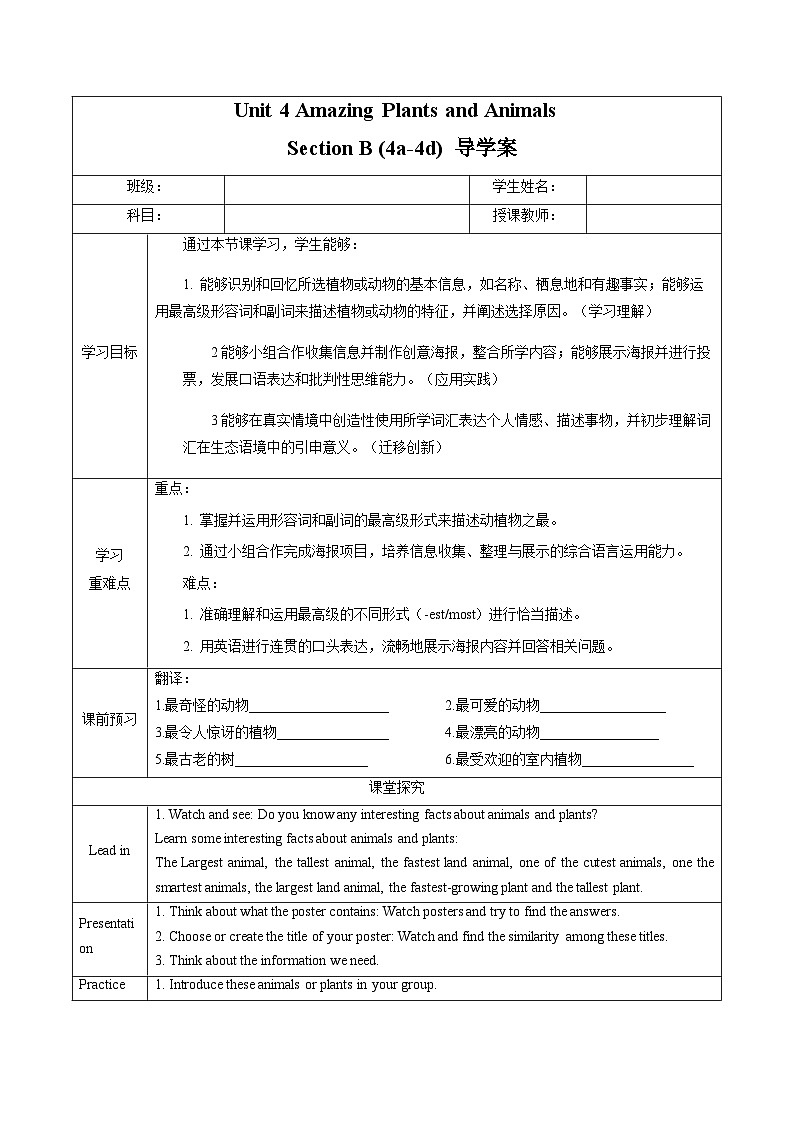
这是一份英语八年级上册(2024)Unit 4 Amazing Plants and Animals Section B Project优秀同步训练题,文件包含Unit4课时7SectionB4a-4d分层作业原卷版docx、Unit4课时7SectionB4a-4d分层作业解析版docx、Unit4课时7SectionBProject4a-4d导学案docx等3份试卷配套教学资源,其中试卷共20页, 欢迎下载使用。
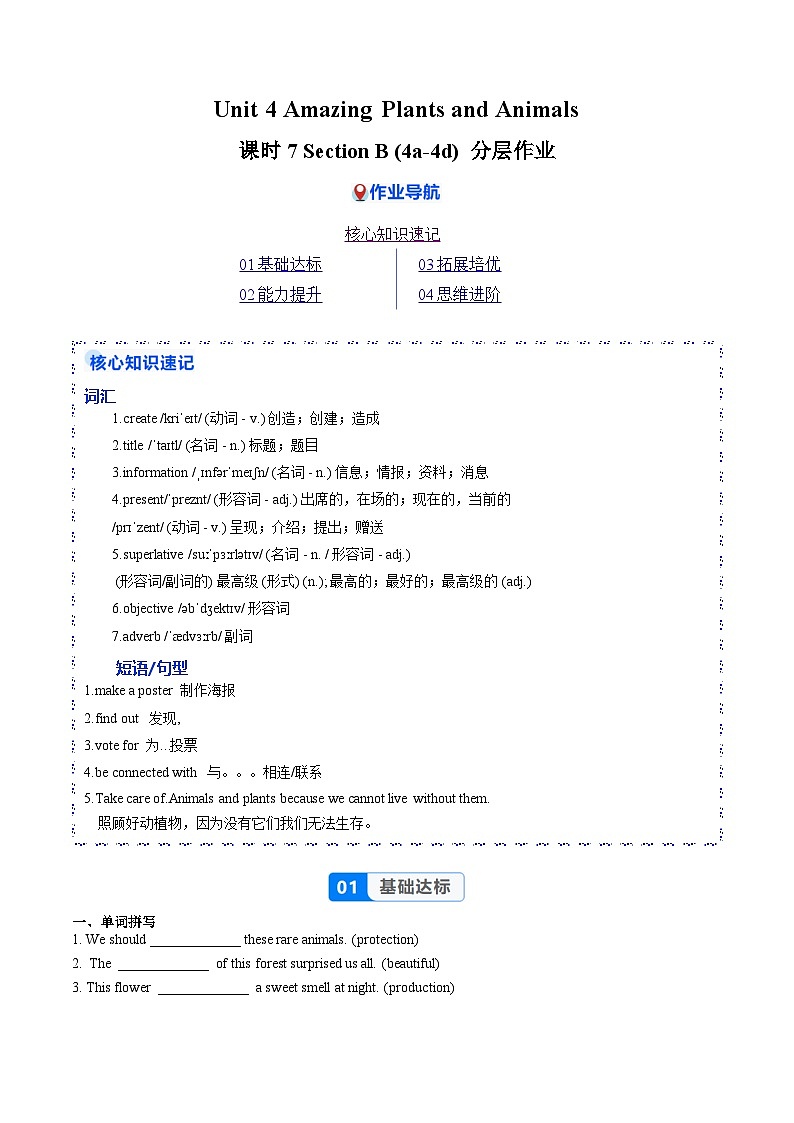
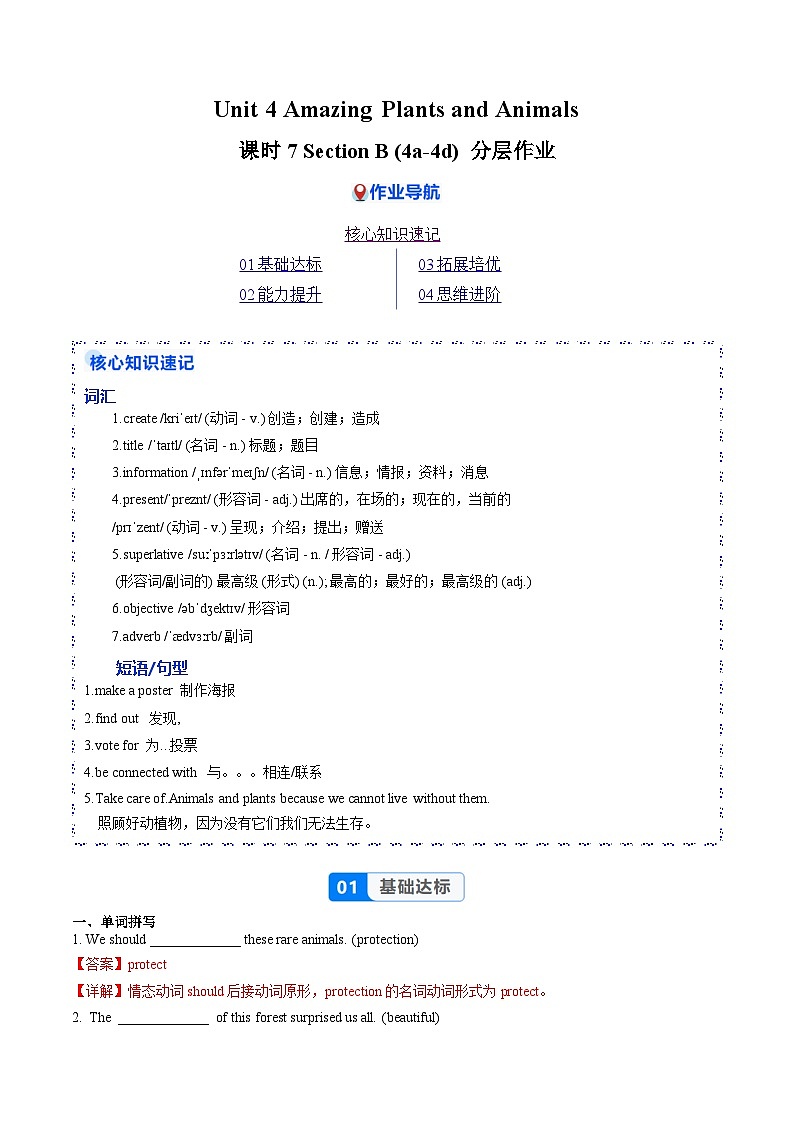
词汇
1.create /kriˈeɪt/ (动词 - v.) 创造;创建;造成
2.title /ˈtaɪtl/ (名词 - n.) 标题;题目
3.infrmatin /ˌɪnfərˈmeɪʃn/ (名词 - n.) 信息;情报;资料;消息
4.present/ˈpreznt/ (形容词 - adj.) 出席的,在场的;现在的,当前的
/prɪˈzent/ (动词 - v.) 呈现;介绍;提出;赠送
5.superlative /suːˈpɜːrlətɪv/ (名词 - n. / 形容词 - adj.)
(形容词/副词的) 最高级 (形式) (n.); 最高的;最好的;最高级的 (adj.)
6.bjective /əbˈdʒektɪv/ 形容词
7.adverb /ˈædvɜːrb/ 副词
短语/句型
1.make a pster 制作海报
2.find ut 发现,
3.vte fr 为...投票
4.be cnnected with 与。。。相连/联系
5.Take care f.Animals and plants because we cannt live withut them.
照顾好动植物,因为没有它们我们无法生存。
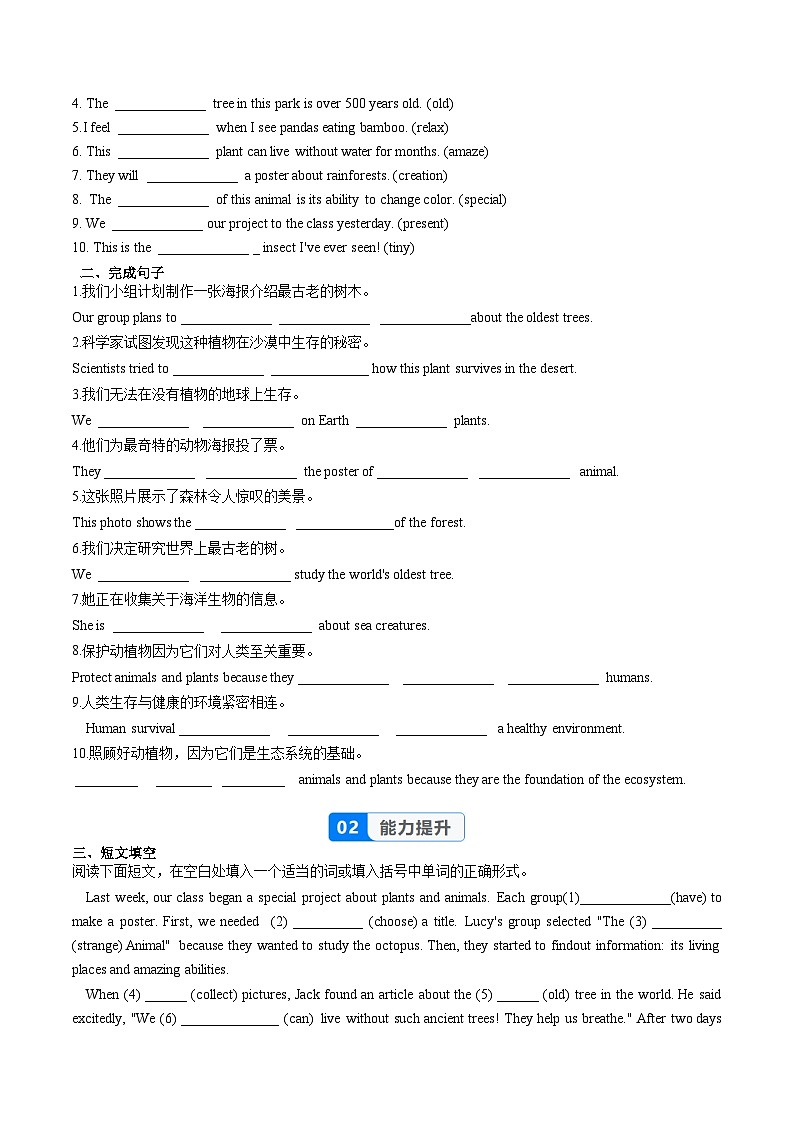
一、单词拼写
1. We shuld _____________ these rare animals. (prtectin)
【答案】prtect
【详解】情态动词shuld后接动词原形,prtectin的名词动词形式为prtect。
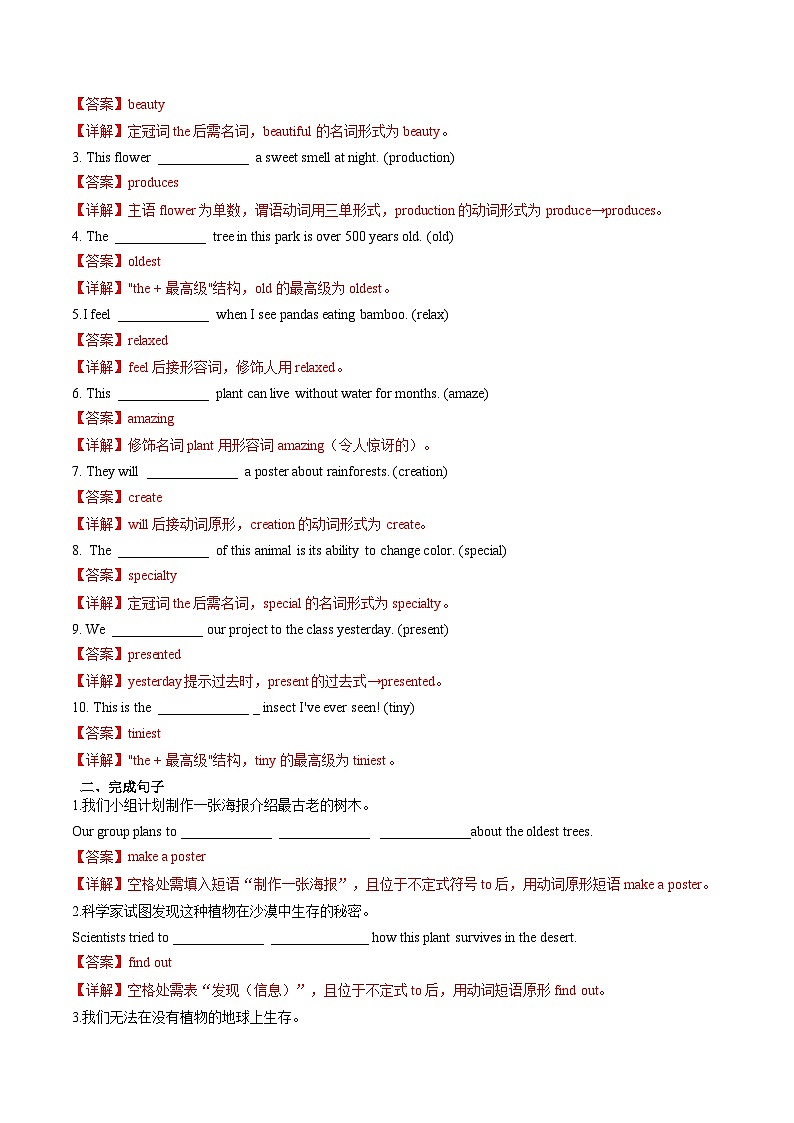
2. The _____________ f this frest surprised us all. (beautiful)
【答案】beauty
【详解】定冠词the后需名词,beautiful的名词形式为beauty。
3. This flwer _____________ a sweet smell at night. (prductin)
【答案】prduces
【详解】主语flwer为单数,谓语动词用三单形式,prductin的动词形式为prduce→prduces。
4. The _____________ tree in this park is ver 500 years ld. (ld)
【答案】ldest
【详解】"the + 最高级"结构,ld的最高级为ldest。
5.I feel _____________ when I see pandas eating bamb. (relax)
【答案】relaxed
【详解】feel后接形容词,修饰人用relaxed。
6. This _____________ plant can live withut water fr mnths. (amaze)
【答案】amazing
【详解】修饰名词plant用形容词amazing(令人惊讶的)。
7. They will _____________ a pster abut rainfrests. (creatin)
【答案】create
【详解】will后接动词原形,creatin的动词形式为create。
8. The _____________ f this animal is its ability t change clr. (special)
【答案】specialty
【详解】定冠词the后需名词,special的名词形式为specialty。
9. We _____________ ur prject t the class yesterday. (present)
【答案】presented
【详解】yesterday提示过去时,present的过去式→presented。
10. This is the _____________ _ insect I've ever seen! (tiny)
【答案】tiniest
【详解】"the + 最高级"结构,tiny的最高级为tiniest。
二、完成句子
1.我们小组计划制作一张海报介绍最古老的树木。
Our grup plans t _____________ _____________ _____________abut the ldest trees.
【答案】make a pster
【详解】空格处需填入短语“制作一张海报”,且位于不定式符号t后,用动词原形短语 make a pster。
2.科学家试图发现这种植物在沙漠中生存的秘密。
Scientists tried t _____________ ______________ hw this plant survives in the desert.
【答案】find ut
【详解】空格处需表“发现(信息)”,且位于不定式t后,用动词短语原形 find ut。
3.我们无法在没有植物的地球上生存。
We _____________ _____________ n Earth _____________ plants.
【答案】cannt live withut
【详解】"无法生存" = cannt live(情态动词否定 + 动词原形):"没有" = withut(介词)
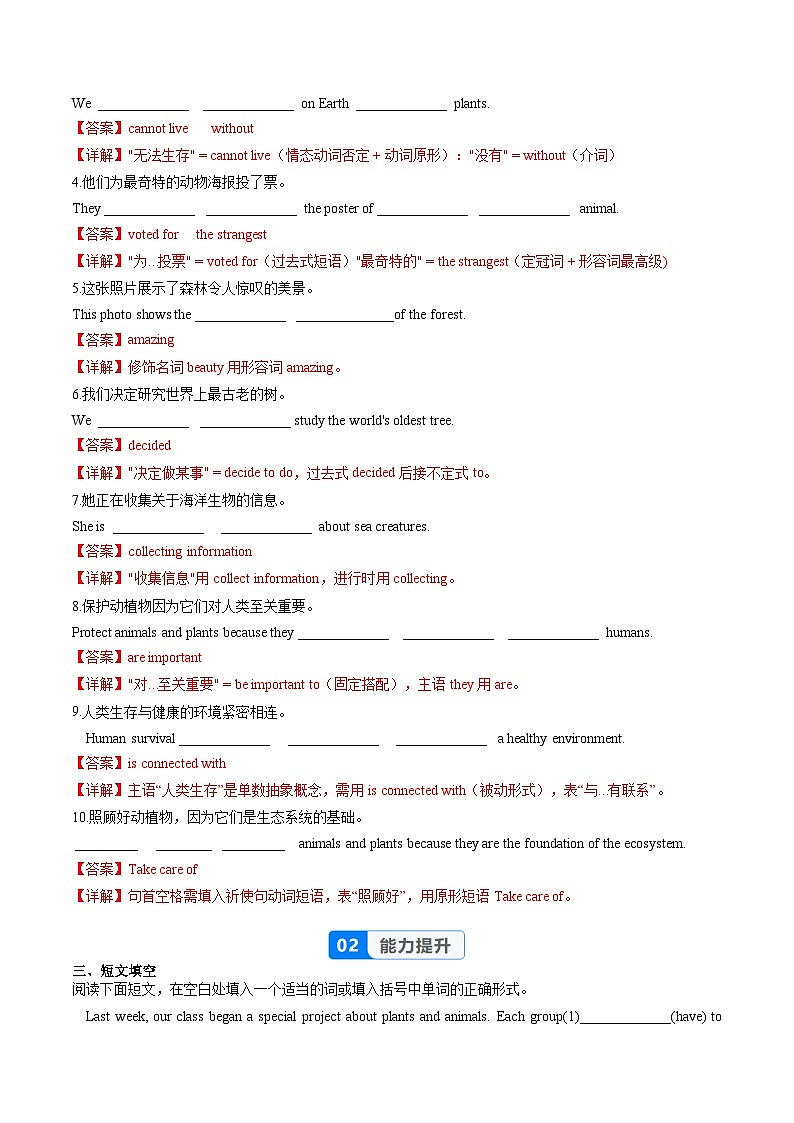
4.他们为最奇特的动物海报投了票。
They _____________ _____________ the pster f _____________ _____________ animal.
【答案】vted fr the strangest
【详解】"为...投票" = vted fr(过去式短语)"最奇特的" = the strangest(定冠词 + 形容词最高级)
5.这张照片展示了森林令人惊叹的美景。
This pht shws the _____________ ______________f the frest.
【答案】amazing
【详解】修饰名词beauty用形容词amazing。
6.我们决定研究世界上最古老的树。
We _____________ _____________ study the wrld's ldest tree.
【答案】decided
【详解】"决定做某事" = decide t d,过去式 decided 后接不定式 t。
7.她正在收集关于海洋生物的信息。
She is _____________ _____________ abut sea creatures.
【答案】cllecting infrmatin
【详解】"收集信息"用cllect infrmatin,进行时用cllecting。
8.保护动植物因为它们对人类至关重要。
Prtect animals and plants because they _____________ _____________ _____________ humans.
【答案】are imprtant
【详解】"对...至关重要" = be imprtant t(固定搭配),主语 they 用 are。
9.人类生存与健康的环境紧密相连。
Human survival _____________ _____________ _____________ a healthy envirnment.
【答案】is cnnected with
【详解】主语“人类生存”是单数抽象概念,需用 is cnnected with(被动形式),表“与...有联系”。
10.照顾好动植物,因为它们是生态系统的基础。
_________ ________ _________ animals and plants because they are the fundatin f the ecsystem.
【答案】Take care f
【详解】句首空格需填入祈使句动词短语,表“照顾好”,用原形短语 Take care f。
三、短文填空
阅读下面短文,在空白处填入一个适当的词或填入括号中单词的正确形式。
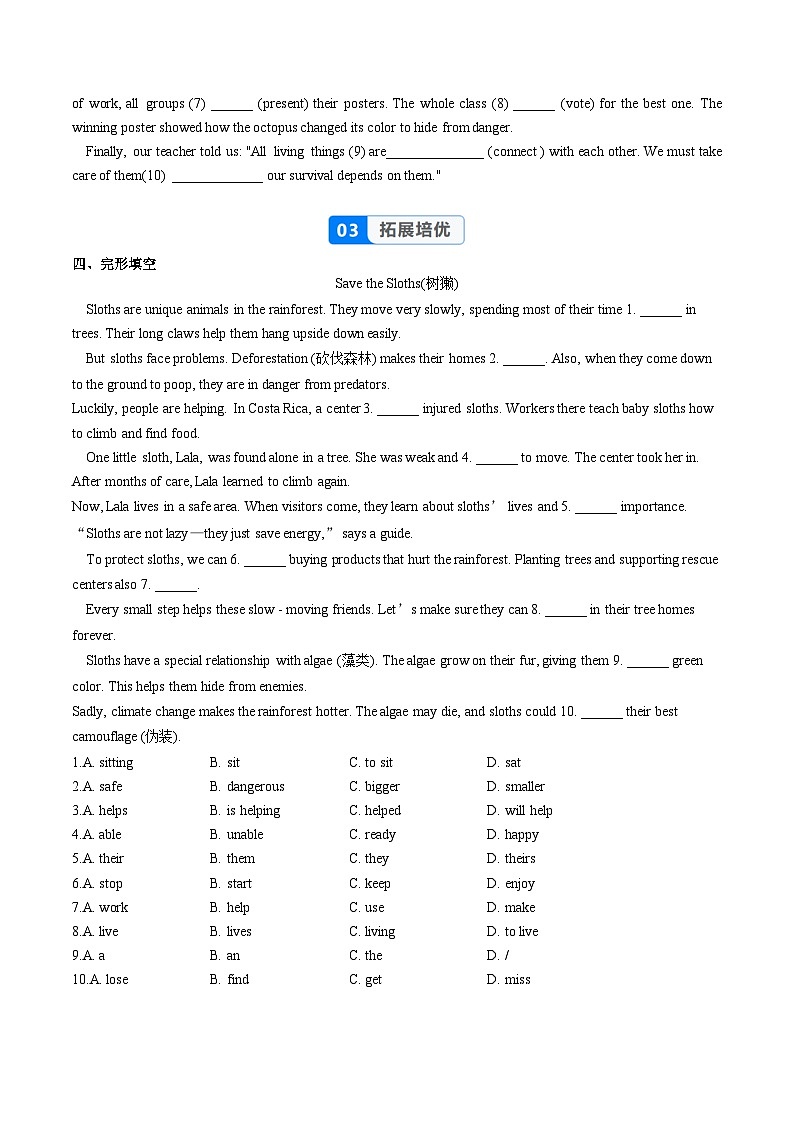
Last week, ur class began a special prject abut plants and animals. Each grup(1)_____________(have) t make a pster. First, we needed (2) __________ (chse) a title. Lucy's grup selected "The (3) __________ (strange) Animal" because they wanted t study the ctpus. Then, they started t findut infrmatin: its living places and amazing abilities.
When (4) ______ (cllect) pictures, Jack fund an article abut the (5) ______ (ld) tree in the wrld. He said excitedly, "We (6) ______________ (can) live withut such ancient trees! They help us breathe." After tw days f wrk, all grups (7) ______ (present) their psters. The whle class (8) ______ (vte) fr the best ne. The winning pster shwed hw the ctpus changed its clr t hide frm danger.
Finally, ur teacher tld us: "All living things (9) are______________ (cnnect ) with each ther. We must take care f them(10) _____________ ur survival depends n them."
【答案】1.had 2.t chse 3.strangest 4.cllecting 5.ldest
6.cannt(或 can't) 7.presented 8.vted 9.cnnected 10.because
【导语】本文为说明性记叙文,描述班级完成"奇妙自然"海报项目的全过程。
1.句意:每个小组必须制作一张海报。描述过去义务,情态动词 had t(必须)固定搭配,后接动词原形 make 不受空格影响。故填 had。
2.句意:我们首先需要选择一个标题。"需要做某事"需用 need t d 结构,不定式表目的。括号词 chse 需转为 t chse 作 needed 的宾语。故填 t chse。
3.句意:露西小组选择了"最奇特动物"研究章鱼。定冠词 the 与标题结构 "The ______ Animal" 提示填最高级,strange 为多音节词,最高级为 the strangest。故填 strangest。
4. 句意:当收集图片时,杰克发现了一篇文章。:When 后接现在分词作时间状语,逻辑主语 Jack 与 cllect 为主动关系。括号词 cllect 需加 -ing。故填 cllecting。
5.句意:关于世界上最古老的树。the + 形容词最高级 + 名词 结构,ld 的最高级为 ldest(课文原词复现)。故填 ldest。
6.句意:没有这些古树,我们无法生存!withut 提示否定语境,情态动词 can 的否定式 cannt/can't 表能力缺失,与单元金句 "cannt live withut them" 一致。故填 cannt(或 can't)。
73.句意:所有小组展示了他们的海报。After tw days 表明过去动作,present 需用过去式 presented。
故填 presented。
8. 句意:全班投票选出最佳海报。并列谓语(与前句 presented 时态一致),vte fr(为...投票)的过去式。
故填 vted。
9. 句意:所有生物彼此相互关联。
are 提示被动语态,cnnect with(与...连接)的被动式 are cnnected with,括号词 cnnect 需变过去分词。
故填 cnnected。
10.句意:我们必须照顾它们,因为我们的生存依赖它们。
:后句 ur survival depends n them 是前句的原因,需因果连词 because 引导状语从句。
故填 because。
四、完形填空
Save the Slths(树獭)
Slths are unique animals in the rainfrest. They mve very slwly, spending mst f their time 1. ______ in trees. Their lng claws help them hang upside dwn easily.
But slths face prblems. Defrestatin (砍伐森林) makes their hmes 2. ______. Als, when they cme dwn t the grund t pp, they are in danger frm predatrs.
Luckily, peple are helping. In Csta Rica, a center 3. ______ injured slths. Wrkers there teach baby slths hw t climb and find fd.
One little slth, Lala, was fund alne in a tree. She was weak and 4. ______ t mve. The center tk her in. After mnths f care, Lala learned t climb again.
Nw, Lala lives in a safe area. When visitrs cme, they learn abut slths’ lives and 5. ______ imprtance. “Slths are nt lazy—they just save energy,” says a guide.
T prtect slths, we can 6. ______ buying prducts that hurt the rainfrest. Planting trees and supprting rescue centers als 7. ______.
Every small step helps these slw - mving friends. Let’s make sure they can 8. ______ in their tree hmes frever.
Slths have a special relatinship with algae (藻类). The algae grw n their fur, giving them 9. ______ green clr. This helps them hide frm enemies.
Sadly, climate change makes the rainfrest htter. The algae may die, and slths culd 10. ______ their best camuflage (伪装).
1.A. sitting B. sit C. t sit D. sat
2.A. safe B. dangerus C. bigger D. smaller
3.A. helps B. is helping C. helped D. will help
4.A. able B. unable C. ready D. happy
5.A. their B. them C. they D. theirs
6.A. stp B. start C. keep D. enjy
7.A. wrk B. help C. use D. make
8.A. live B. lives C. living D. t live
9.A. a B. an C. the D. /
10.A. lse B. find C. get D. miss
【答案】1.A 2. D 3. B 4. B 5. A 6. A 7. B 8. A 9. A 10. A
【导语】本文介绍树懒的生活习性、因森林砍伐和气候变化面临的生存威胁,以及人类通过救助中心、环保行动保护树懒的故事,呼吁守护树懒的栖息家园 。
1.句意:它们移动非常缓慢,大部分时间都坐在树上。
“spend time ding sth.” 是固定搭配,意为 “花费时间做某事”,此处需用动名词形式;B 项 “sit” 是动词原形,C 项 “t sit” 是不定式,D 项 “sat” 是过去式,均不符合搭配。故选 A。
2.句意:森林砍伐让它们的家园变小。
前文 “Defrestatin”(砍伐森林)会导致树懒栖息地面积缩减,“smaller”(更小的)符合逻辑;A 项 “safe”(安全的)与砍伐带来的危害矛盾,B 项 “dangerus”(危险的)侧重环境安全性,非面积变化,C 项 “bigger”(更大的)与事实相反。故选 D。
3.句意:在哥斯达黎加,一个中心正在救助受伤的树懒。
结合语境,救助行动是当下持续进行的,用现在进行时 “is helping”;A 项 “helps” 是一般现在时(表常态,与 “当下救助” 不符),C 项 “helped” 是过去式(表过去动作),D 项 “will help” 是将来时(表未来动作),均不符合 “正在救助” 的语境。故选 B。
4.句意:她很虚弱,无法移动。
前文 “weak”(虚弱)暗示树懒行动受限,“unable”(不能的)符合逻辑;A 项 “able”(能的)与 “weak” 矛盾,C 项 “ready”(准备好的)、D 项 “happy”(开心的)均与 “虚弱” 的状态无关。故选 B。
5.句意:当游客来访时,他们了解树懒的生活和它们的重要性。
此处修饰名词 “imprtance”,需用形容词性物主代词 “their”;B 项 “them” 是宾格,C 项 “they” 是主格,D 项 “theirs” 是名词性物主代词,均无法修饰名词。故选 A。
6.句意:为了保护树懒,我们可以停止购买破坏雨林的产品。
结合环保逻辑,“stp ding sth.”(停止做某事)符合 “抵制有害产品” 的动作;B 项 “start”(开始)与保护意图相反,C 项 “keep”(保持)、D 项 “enjy”(享受)均不符合 “减少伤害” 的逻辑。故选 A。
7.句意:种树和支持救助中心也有帮助。
前文列举保护行动,“help”(有帮助)直接说明行动的积极作用;A 项 “wrk”(起作用)侧重动作本身有效,非 “对树懒的帮助”,C 项 “use”(使用)、D 项 “make”(制作)均偏离 “保护效果” 的核心。故选 B。
8.句意:让我们确保它们能永远在树上的家园里生活。
“can” 是情态动词,后接动词原形,“live” 符合语法;B 项 “lives” 是第三人称单数形式,C 项 “living” 是动名词,D 项 “t live” 是不定式,均不符合情态动词的用法。故选 A。
9.句意:藻类在它们的皮毛上生长,赋予它们一种绿色。
“a green clr” 表示 “一种绿色”,表泛指,且 “green” 以辅音音素开头,用不定冠词 “a”;B 项 “an” 用于元音音素开头的单词前,C 项 “the” 表特指,D 项不填不符合 “一种颜色” 的表达。故选 A。
10.句意:藻类可能死亡,树懒可能失去它们最好的伪装。
前文 “algae may die”(藻类死亡)会导致树懒失去伪装,“lse”(失去)符合因果逻辑;B 项 “find”(找到)、C 项 “get”(得到)与 “藻类死亡” 的结果矛盾,D 项 “miss”(错过)侧重 “未抓住机会”,非 “失去事物”。故选 A。
五、阅读还原
请阅读下面短文,根据语篇内容,从下面所给的选项中选出能填入空白处的最佳选项,使短文意思通顺。
Create Yur Animal/Plant Pster
Making a pster abut an amazing plant r animal is a fun prject. Here’s hw yu can d it well.
______ First, pick a title. It culd be “The Cutest Animal” r “The Mst Amazing Plant”—smething that makes peple curius!
Next, cllect pictures. Find clear phts that shw the plant/animal’s lks and habitat. 2. ______ Fr example, if yu chse a panda, find images f its black - and - white fur and the bamb frests it lives in.
Then, research infrmatin. Answer questins: Where des it live? Why is it special? 3. ______ Interesting facts make yur pster stand ut—like hw a blue whale’s heart is as big as a car!
______ Arrange yur pictures and wrds neatly. Use clrs that match yur tpic (green fr plants, blue fr cean animals). Leave space s it desn’t lk messy.
Finally, present it! Share yur pster in class. 5. ______ Vting fr the best ne lets everyne enjy different ideas abut nature.
A. Plan the layut.
B. Start with a great title.
C. Dn’t frget t add fun facts!
D. Pictures help peple “see” yur tpic.
E. Making psters cnnects us with nature.
【答案】1.B 2. D 3. C 4. A 5. E
【导语】本文围绕 “制作动植物海报” 项目,分步讲解选标题、收集图片、挖掘趣味信息、规划布局、课堂展示的流程,阐释海报创作的方法与意义 。
1.句意:从一个精彩的标题开始。
后文 “First, pick a title” 直接围绕 “选标题” 展开,B 项明确第一步核心是确定吸睛标题,与后文逻辑直接呼应;其余选项聚焦布局、趣味事实、图片作用、海报意义,均未涉及 “标题选择” 的起始动作。故选 B。
2.句意:图片帮助人们 “看见” 你的主题。
前文围绕 “cllect pictures” 展开,空后通过 “熊猫图片展示皮毛和栖息地” 的例子,解释图片功能,D 项阐释图片呈现主题的作用,完美衔接 “收集图片→举例” 的逻辑;其余选项未围绕 “图片” 核心话题,主题偏离。故选 D。
3.句意:别忘记添加趣味事实!
前文讲 “research infrmatin”,空后以 “蓝鲸心脏如汽车” 的趣味事实为例,说明其对海报的增色作用,C 项提示融入趣味信息,契合 “让海报突出” 的目的;其余选项未涉及 “信息中的趣味点”,逻辑关联不足。故选 C。
4.句意:规划布局。
后文 “Arrange yur pictures and wrds neatly” 描述 “图片和文字排版” 动作,A 项概括该步骤为 “规划布局”,直接引领排版细节的阐述;其余选项未涉及 “排版” 核心动作,主题偏离。故选 A。
5.句意:制作海报让我们与自然相连。
前文讲 “present it(课堂展示)”,空后通过 “投票欣赏自然理念” 升华项目意义,E 项点明海报在 “连接人与自然” 层面的价值,呼应结尾升华逻辑;其余选项聚焦步骤,未触及 “意义” 维度,层次不符。故选 E。
六、阅读理解
A
The Magic f Mnarch Butterflies
Mnarch butterflies are famus fr their lng jurney. Every year, millins f them fly frm Canada and the US t Mexic—ver 4,000 kilmeters! But why d they travel s far?
Part 1: The Great Migratin
Mnarchs can’t live in cld winters. S they fly t warm Mexic, where they rest in huge grups n tree branches. These grups lk like range cluds! The trip takes abut tw mnths, and nt all butterflies survive.
Part 2: A Dangerus Jurney
Tday, mnarchs face truble. Their favrite fd, milkweed plants, are disappearing. Farmers use chemicals that kill milkweed. Als, climate change makes the weather unpredictable. Strms can hurt the flying butterflies.
Part 3: Hw t Help
Peple are taking actin. Many plant milkweed in their gardens t feed mnarchs. Schls als teach students abut the butterflies’ jurney. In Mexic, wrkers prtect the frests where mnarchs rest.
Part 4: A Small Creature, Big Meaning
Mnarchs are mre than beautiful insects. Their migratin shws the cnnectin between cuntries. Saving them means saving a amazing natural stry.
1.Why d mnarch butterflies fly t Mexic?
A. T find mre fd. B. T avid cld winters.
C. T lay their eggs. D. T meet ther butterflies.
2.What is NOT a prblem fr mnarchs?
A. Milkweed is dying. B. Strms hurt them.
C. Their wings get t weak. D. Climate change affects them.
3.Hw d peple help mnarchs?
A. By building huses fr them. B. By planting milkweed.
C. By mving them t warm places.D. By feeding them sugar water.
4.What can we learn frm the passage?
A. Mnarchs nly live in Nrth America.
B. Their migratin is a symbl f internatinal cnnectin.
C. All mnarchs can finish the lng jurney.
D. Mexic is the nly place they live.
5.The best title fr the passage is ______.
A. The Lng Flight f Mnarch ButterfliesB. Why Mnarchs Lve Milkweed
C. Hw t Prtect ButterfliesD. The Mst Beautiful Insect
【答案】1.B 2. C 3. B 4. B 5. A
【导语】本文介绍黑脉金斑蝶(帝王蝶)的长途迁徙习性、面临的生存威胁(食物减少、气候变化),以及人类通过种植乳草、保护栖息地等方式的保护行动,揭示其迁徙背后的生态意义与国际关联 。
1.句意:帝王蝶为什么飞往墨西哥?
文章 “Part 1” 提到 “Mnarchs can’t live in cld winters. S they fly t warm Mexic”,即躲避寒冬;A 项 “找更多食物”、C 项 “产卵”、D 项 “见其他蝴蝶” 均非迁徙主因,原文未提及。故选 B。
2.句意:哪一项不是帝王蝶面临的问题?
“Part 2” 阐述威胁:“milkweed plants are disappearing”(乳草消失)、“climate change makes the weather unpredictable”(气候变化)、“Strms can hurt the flying butterflies”(风暴伤害);C 项 “翅膀变弱” 文中未提,其余选项均为原文明确的危机。故选 C。
3.句意:人们如何帮助帝王蝶?
“Part 3” 指出 “Many plant milkweed in their gardens t feed mnarchs”,即种植乳草供其食用;A 项 “建造房屋”、C 项 “移到温暖处”(迁徙是蝴蝶自主行为,非人类搬运)、D 项 “喂糖水” 文中未提,均不符合。故选 B。
4.句意:从文章中我们能学到什么?
“Part 4” 说 “Their migratin shws the cnnectin between cuntries”,即迁徙象征国际间的生态关联;A 项 “只生活在北美” 错误(迁徙至墨西哥,跨区域),C 项 “所有蝴蝶都能完成迁徙”(原文 “nt all survive”,表述绝对),D 项 “只生活在墨西哥” 错误(也在加拿大、美国繁殖),均排除。故选 B。
5.句意:文章最佳标题是______。
全文围绕 “帝王蝶的长途迁徙” 展开,从迁徙原因、危机到保护,A 项 “帝王蝶的漫长飞行” 涵盖核心;B 项仅聚焦 “乳草”,片面;C 项 “保护蝴蝶” 范围过大(文章专属帝王蝶);D 项 “最美昆虫” 文中未提比较,均不贴切。故选 A。
B
七、任务型阅读
请阅读下面这篇文章,根据所提供的信息,回答5个问题。要求所写答案语法正确、语义完整。
The Shy Mimsa
Mimsa pudica, r the "sensitive plant", is knwn fr its special ability. When tuched, its leaves fld up quickly, as if it’s shy. This clever trick helps it avid being eaten by animals—mst pests lse interest when the leaves clse!
Mimsa grws in warm places like frests and grasslands. It lves sunlight and well-watered sil. But tday, this plant is in danger. Peple ften pick it fr fun, and cnstructin (建筑施工) destrys its hme. In sme areas, mimsa has becme rare.
Scientists say mimsa is mre than a "shy" plant. Its flding leaves can teach us abut plant mvement—hw plants react t the wrld arund them. Prtecting mimsa means saving a small but imprtant part f nature’s diversity (多样性).
题目设置
1.Why d mimsa leaves fld up when tuched? (N mre than 10 wrds)
__________________________________________________________________________
2.Where des mimsa like t grw? (N mre than 15 wrds)
__________________________________________________________________________
3.What are the tw dangers t mimsa? (N mre than 15 wrds)
__________________________________________________________________________
4.What can we learn frm mimsa’s flding leaves? (N mre than 10 wrds)
__________________________________________________________________________
5.What can yu d t prtect mimsa? (N mre than 20 wrds)
__________________________________________________________________________
【答案】
1.T avid being eaten by animals.
2.In warm places like frests and grasslands with sunlight and well-watered sil.
3.Peple pick it fr fun and cnstructin destrys its hme.
4.Hw plants react t the wrld.
5.(Example) I can tell thers nt t pick mimsa and prtect its grwing areas.(答案言之有理即可).
【导语】本文介绍含羞草的 “害羞” 特性(叶片受触碰闭合)、生长环境,以及面临的人为采摘、栖息地破坏等威胁,阐述保护含羞草对维护生物多样性的意义。
句意:含羞草的叶子被触碰时为什么会闭合?
解析:文章首段明确提到 “This clever trick helps it avid being eaten by animals”,即闭合叶片是为了避免被动物吃掉。需控制在 10 词以内,故答案为:T avid being eaten by animals.
句意:含羞草喜欢生长在哪里?
解析:第二段指出 “Mimsa grws in warm places like frests and grasslands. It lves sunlight and well-watered sil”,需整合 “温暖环境、森林、草原、阳光、湿润土壤” 等信息,控制在 15 词以内,故答案为:In warm places like frests and grasslands with sunlight and well-watered sil.
句意:含羞草面临的两个威胁是什么?
解析:第二段提到 “Peple ften pick it fr fun, and cnstructin destrys its hme”,直接列举两个威胁,控制在 15 词以内,故答案为:Peple pick it fr fun and cnstructin destrys its hme.
句意:我们能从含羞草闭合的叶片中学到什么?
解析:第三段说明 “Its flding leaves can teach us abut plant mvement—hw plants react t the wrld arund them”,核心是 “植物如何对周围世界做出反应”,控制在 10 词以内,故答案为:Hw plants react t the wrld.
句意:你能做些什么来保护含羞草?
解析:这是开放题,需结合 “保护植物” 的实际行动,如 “告诉他人不要采摘”“保护生长区域” 等,合理即可。示例答案:I can tell thers nt t pick mimsa and prtect its grwing areas.
\l "核心知识速记" 核心知识速记
\l "基础达标" 01基础达标
\l "拓展培优" 03拓展培优
\l "能力提升" 02能力提升
\l "思维进阶" 04思维进阶
这是一份英语八年级上册(2024)Unit 4 Amazing Plants and Animals Section B Project优秀同步训练题,文件包含Unit4课时7SectionB4a-4d分层作业原卷版docx、Unit4课时7SectionB4a-4d分层作业解析版docx、Unit4课时7SectionBProject4a-4d导学案docx等3份试卷配套教学资源,其中试卷共20页, 欢迎下载使用。
这是一份人教版(2024)八年级上册(2024)Unit 4 Amazing Plants and Animals Section B 3a-3c复习练习题,文件包含Unit4课时6SectionB3a-3c分层作业原卷版docx、Unit4课时6SectionB3a-3c分层作业解析版docx、Unit4课时6SectionB3a-3c导学案docx等3份试卷配套教学资源,其中试卷共19页, 欢迎下载使用。
这是一份人教版(2024)1a-1f精品课堂检测,文件包含Unit4课时4SectionB1a-1f分层作业原卷版docx、Unit4课时4SectionB1a-1f分层作业解析版docx、Unit4课时4SectionB1a-1f导学案docx等3份试卷配套教学资源,其中试卷共22页, 欢迎下载使用。
 新教材
新教材
注册成功

在线客服
添加在线客服
获取1对1服务
官方微信
关注“教习网”公众号
打开微信就能找资料
赛课定制
添加在线客服
获取1对1定制服务
职称咨询
添加在线客服
获取1V1专业指导服务

免费福利

.png)