免费领取教师福利
若您为此资料的原创作者,认为该资料内容侵犯了您的知识产权,请扫码添加我们的相关工作人员,我们尽可能的保护您的合法权益。

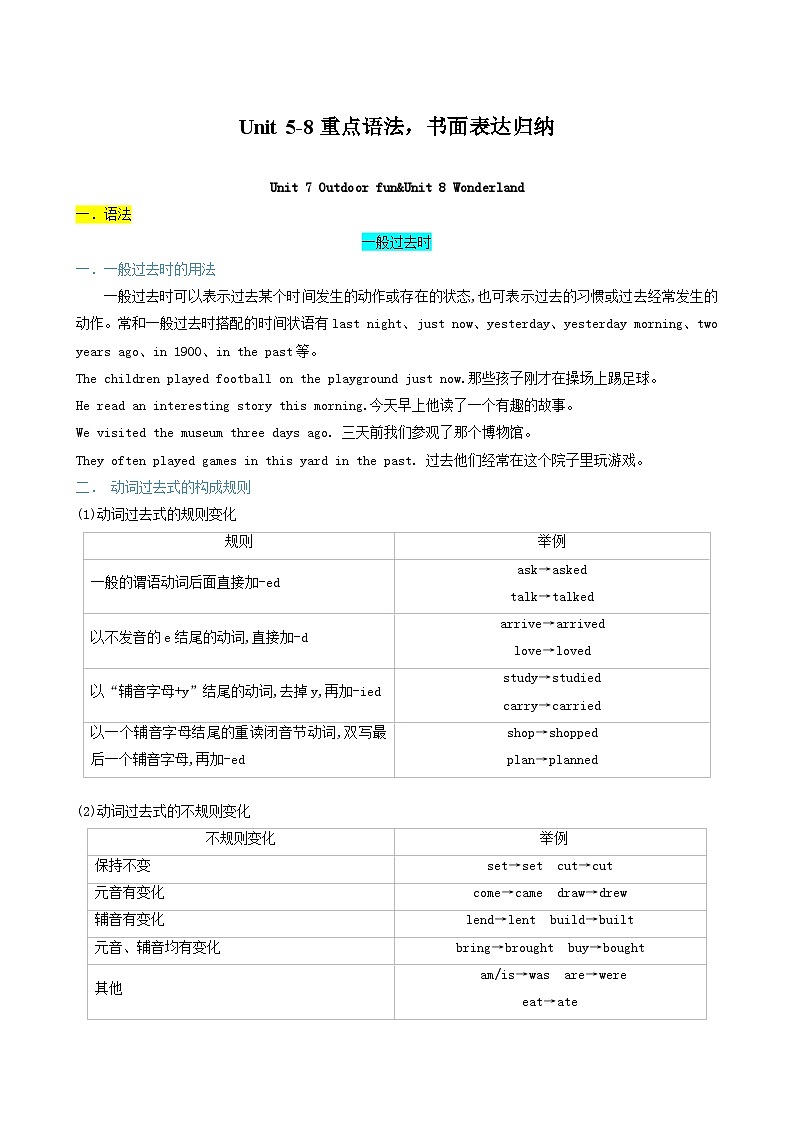
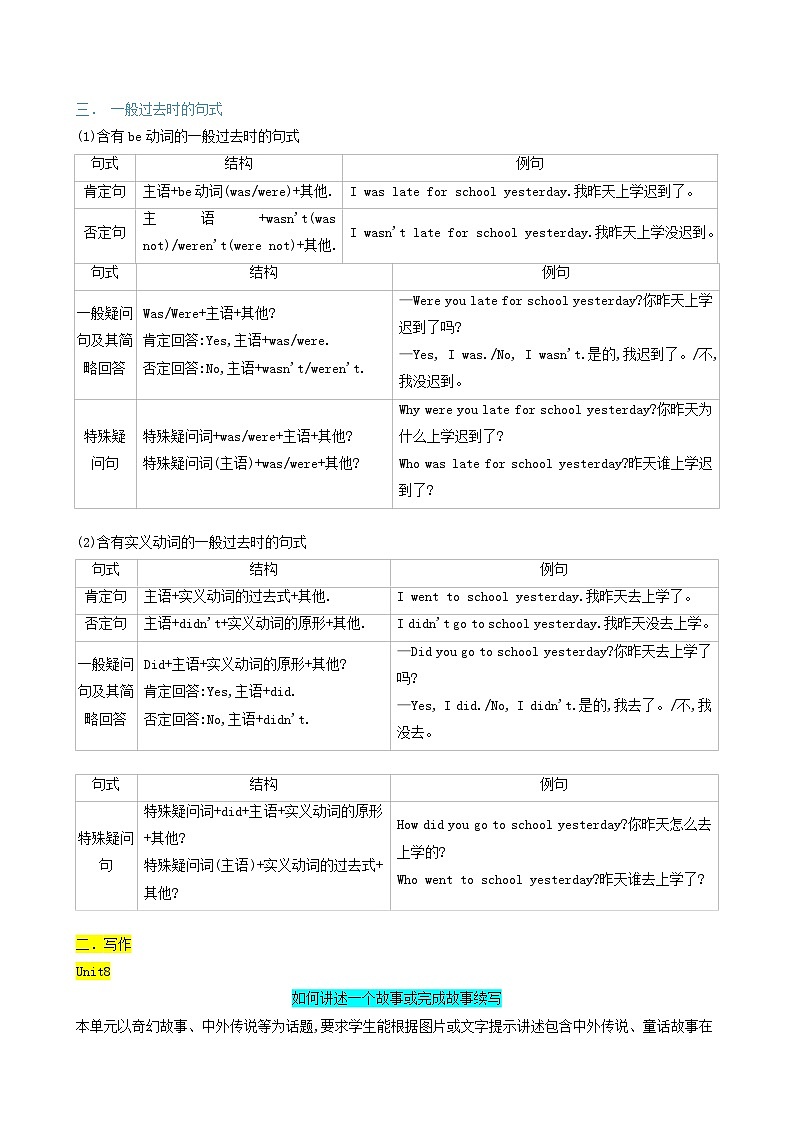
这是一份译林版2025年七年级英语下学期期末总复习(知识梳理)考点清单02Unit5-8重点语法,书面表达归纳(学生版+解析),文件包含译林版2025年七年级英语下学期期末总复习知识梳理考点清单02Unit5-8重点语法书面表达归纳教师版docx、译林版2025年七年级英语下学期期末总复习知识梳理考点清单02Unit5-8重点语法书面表达归纳学生版docx等2份学案配套教学资源,其中学案共24页, 欢迎下载使用。
Unit 7 Outdr fun&Unit 8 Wnderland
一.语法
一般过去时
一.一般过去时的用法
一般过去时可以表示过去某个时间发生的动作或存在的状态,也可表示过去的习惯或过去经常发生的动作。常和一般过去时搭配的时间状语有last night、just nw、yesterday、yesterday mrning、tw years ag、in 1900、in the past等。
The children played ftball n the playgrund just nw.那些孩子刚才在操场上踢足球。
He read an interesting stry this mrning.今天早上他读了一个有趣的故事。
We visited the museum three days ag. 三天前我们参观了那个博物馆。
They ften played games in this yard in the past. 过去他们经常在这个院子里玩游戏。
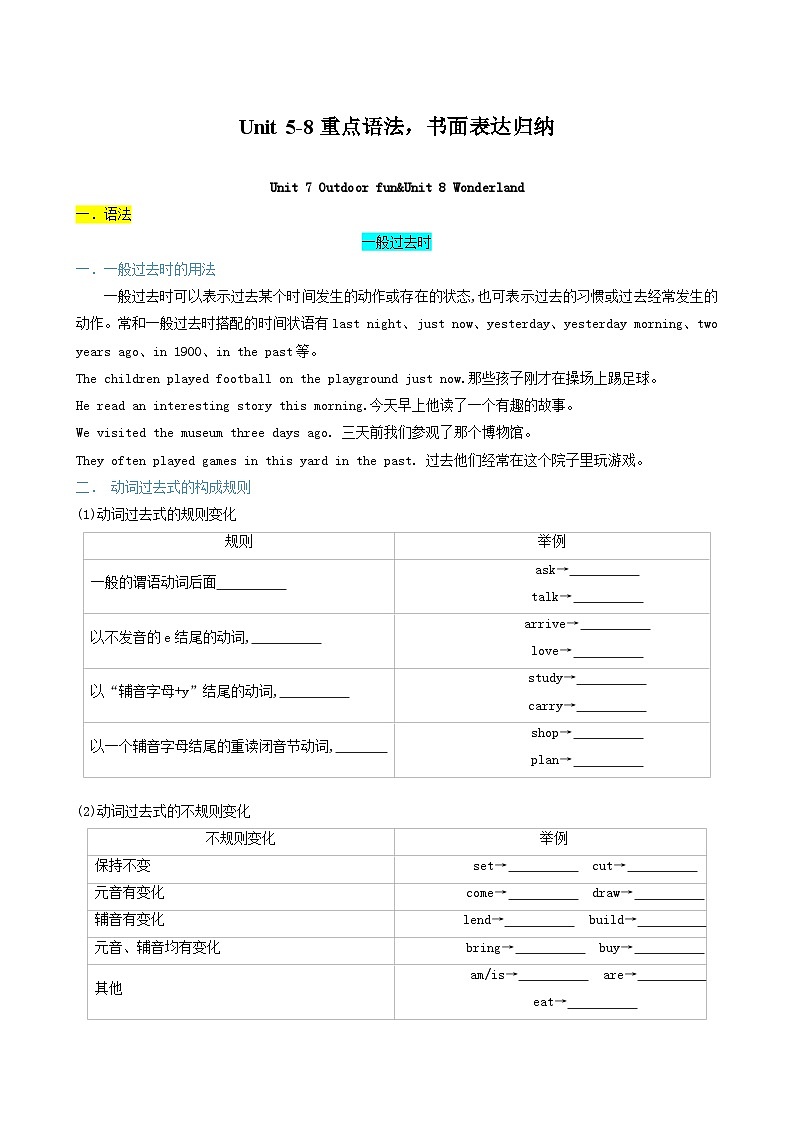
二. 动词过去式的构成规则
(1)动词过去式的规则变化
(2)动词过去式的不规则变化
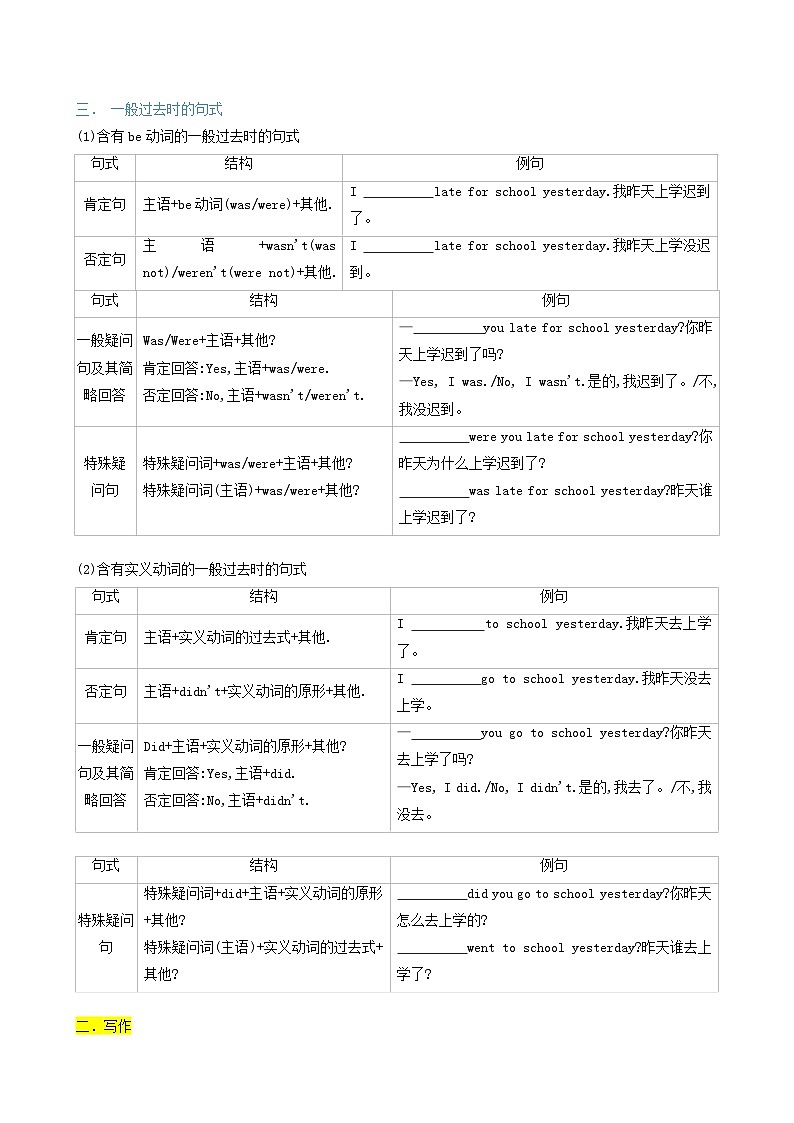
三. 一般过去时的句式
(1)含有be动词的一般过去时的句式
(2)含有实义动词的一般过去时的句式
写作
Unit8
如何讲述一个故事或完成故事续写
本单元以奇幻故事、中外传说等为话题,要求学生能根据图片或文字提示讲述包含中外传说、童话故事在内
的中外经典文学、文化作品。写作时,通常按照故事发生的起因、经过和结果的顺序进行叙述。时态以一般过去时为主,在直接引用别人的原话时,可根据实际情况选用不同的时态。写故事时围绕
when、where、wh、what、hw等要素,分别进行背景、人物、故事梗概的介绍。此外,还可在最后讲述故事的寓意或受到的启发。
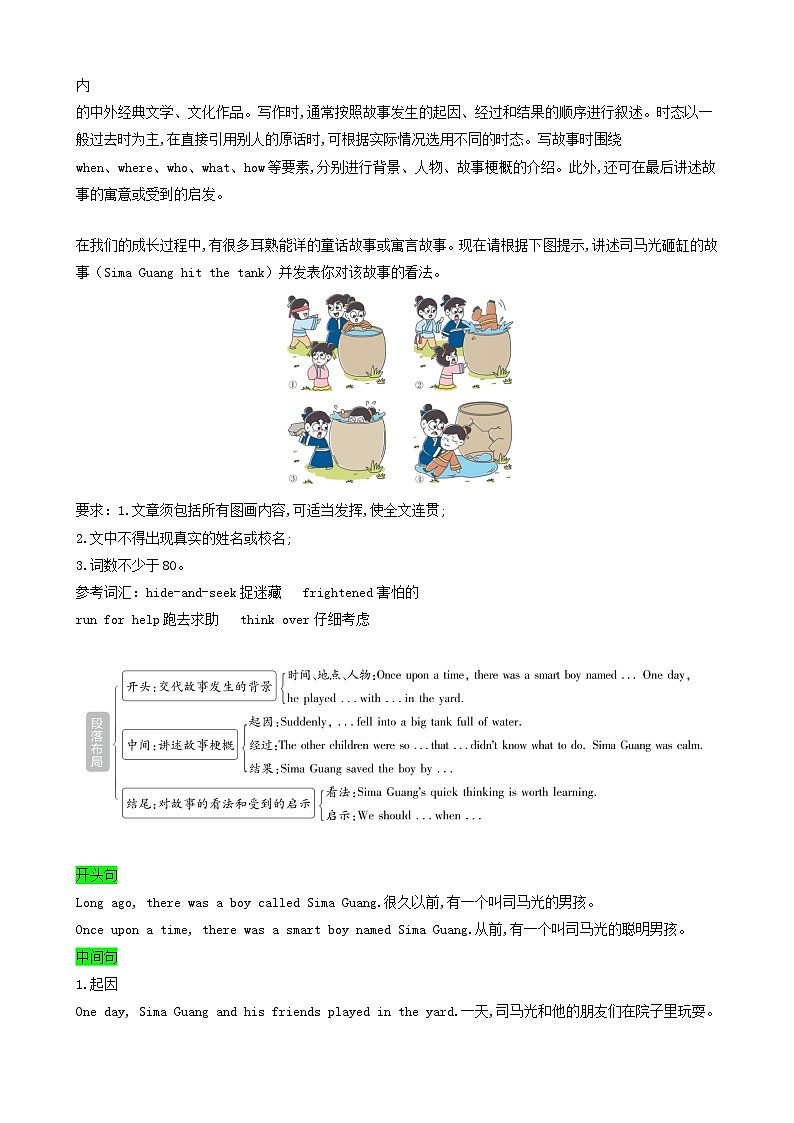
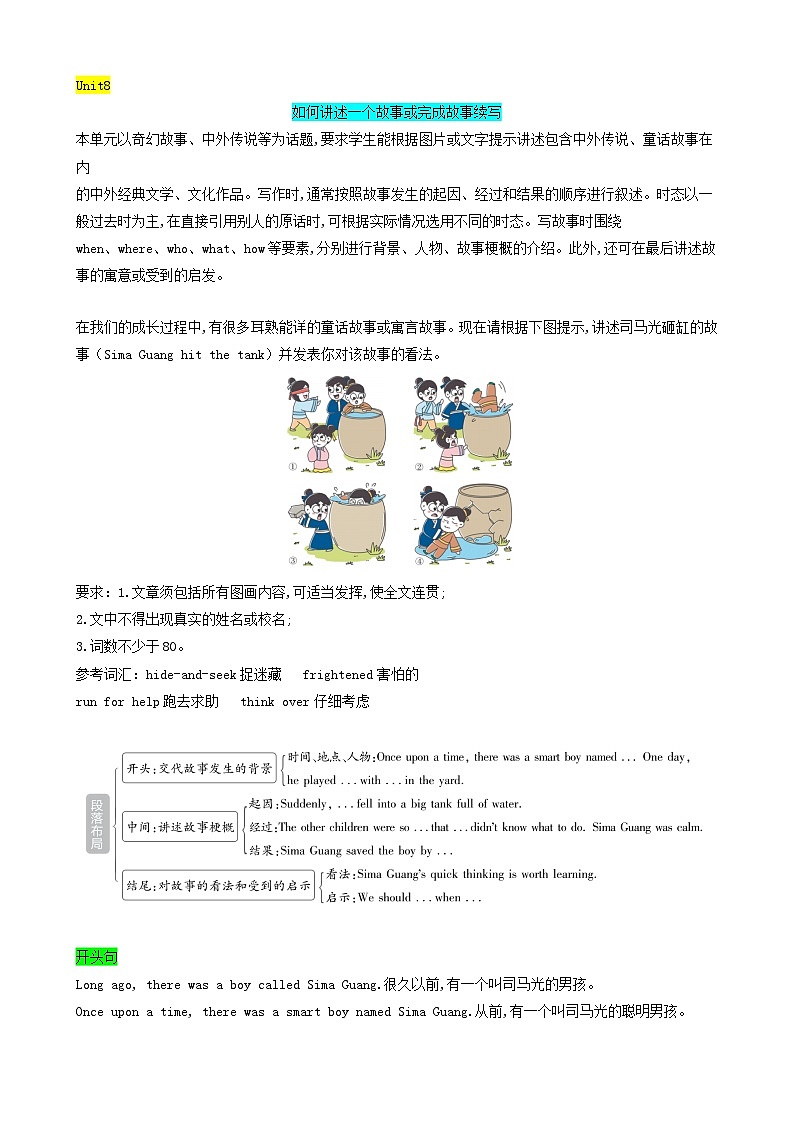
在我们的成长过程中,有很多耳熟能详的童话故事或寓言故事。现在请根据下图提示,讲述司马光砸缸的故事(Sima Guang hit the tank)并发表你对该故事的看法。
要求:1.文章须包括所有图画内容,可适当发挥,使全文连贯;
2.文中不得出现真实的姓名或校名;
3.词数不少于80。
参考词汇:hide-and-seek捉迷藏 frightened害怕的
run fr help跑去求助 think ver仔细考虑
开头句
Lng ag, there was a by called Sima Guang.很久以前,有一个叫司马光的男孩。
Once upn a time, there was a smart by named Sima Guang.从前,有一个叫司马光的聪明男孩。
中间句
1.起因
One day, Sima Guang and his friends played in the yard.一天,司马光和他的朋友们在院子里玩耍。
Suddenly, ne f his friends fell int a big tank full f water.突然,他的一个朋友掉进了一个装满水的缸里。
2.经过
The ther children were very scared. But Sima Guang was calm.其他孩子非常害怕。但是司马光很冷静。
Sme children were s frightened that they started t cry.一些孩子很害怕,开始哭了起来。
Sme children ran fr help.一些孩子跑去寻求帮助。
Sima Guang was calm and he thught it ver.司马光很冷静,他仔细考虑。
Sima Guang quickly had an idea.司马光很快想出了一个主意。
3.结果
He picked up a big stne and hit/threw at the tank.他捡起一块大石头并砸向/扔向水缸。
The tank brke and the water ran ut.水缸破了,水流了出来。
Sima Guang saved the by’s life.司马光救了那个男孩的命。
结尾句
Sima Guang’s quick thinking is wrth learning.司马光思维敏捷,值得学习。
We shuld learn frm Sima Guang: Be calm and brave when in truble.我们应该向司马光学习:遇到麻烦时要沉着、勇敢。
Sima Guang hit the tank
Once upn a time, there was a smart by named Sima Guang.
One day, he and his friends played in the yard. Suddenly, a by fell int a big tank full f water. A
child shuted, “Oh dear, ur friend falls int the tank! ”The ther children were t frightened t d anything. But Sima Guang was very calm. He quickly said, “Dn’t wrry. We have t think f a way t save him!” The ther children asked, “Then what shall we d?” Sima Guang answered, “I have an idea. We can save him by breaking the tank!” He picked up a big stne and threw it at the tank. Bang! The tank brke and the water ran ut. Sima Guang saved the by’s life.
Sima Guang’s quick thinking is wrth learning. The stry teaches us a gd lessn fr life: be calm and
brave when in truble.
Unit7
如何写与户外活动相关的文章
本单元的话题是“户外活动”,要求学生能描述户外活动的经历及感受等相关内容。与此相关的写作通常有:①讲述一次难忘的户外活动经历;②介绍自己最喜欢的户外活动;③介绍户外活动前的准备工作及安全提示。在具体讲述户外活动经历时,时态以一般过去时为主,人称以第一人称为主。通常包含以下要点:①点明户外活动的时间、地点和参与者;②具体描述活动过程,如遇到的问题以及如何克服这些问题等;③表达活动的意义及感受。
开头句
Last summer, my classmates and I went n an unfrgettable schl trip t the nearby muntains.去年暑假,我和同学们去附近的山区进行了一次难忘的学校旅行。
It was an amazing experience!那是一次令人惊奇的经历!
中间句
1.与具体活动有关
We spent the day explring the hills, taking in fresh air and admiring all kinds f flwers and plants.我们花了一天时间游览山丘,呼吸新鲜空气,欣赏各种花草。
We tk sme great phts.我们拍了一些很棒的照片。
We had a picnic by a river, and we shared stries and laughter.我们在河边野餐,分享故事和欢笑。
2.与活动感受有关
We were very tired when we finally reached the tp f the hill, but it was wrth it.终于到达山顶时,我们都非常疲惫,但这一切都很值得。
结尾句
This activity was amazing because it gave us a chance t take a break frm busy life and be clse t nature.这次活动很棒,因为它让我们有机会从繁忙的生活中脱离出来,亲近大自然。
I can’t wait t d it again!我迫不及待地想再来一次!
An amazing utdr activity
Last summer, my classmates and I went n an unfrgettable schl trip t the nearby muntains.
We spent the day explring the hills, taking in fresh air and admiring all kinds f flwers and plants.
At nn, we had a small picnic by a river, and we shared stries and laughter. We were very tired when we finally reached the tp f the hill, but it was wrth
it. The view frm the tp was fantastic!
This activity was amazing because it gave us a chance t take a break frm busy life and be clse t
nature.It was als a great chance t create gd memries with ur classmates. I can’t wait t d it again!
Unit 6 Beautiful landscapes
一.语法
复合不定代词
复合不定代词是由sme-, any-, every-, n-分别与ne, bdy, thing组合而成的。这些复合不定代词具有名词的性质,在句中可作主语、宾语或表语,但不能作定语。
一.复合不定代词的构成
二.复合不定代词的用法
一般情况下,由sme-构成的复合不定代词用于肯定句中;由any-构成的复合不定代词用于否定句或疑问句中;由n-构成的复合不定代词表示否定意义。
The car hit a tree r smething.汽车撞上了树或别的什么东西。
Is there anybdy in the fitting rm?有人在试衣间吗?
I have nthing t say.我没有什么说的。
注意(1)在表示请求、邀请、提建议等带有委婉语气的疑问句,或希望得到对方肯定答复的疑问句中,用smething,smene,smebdy等复合不定代词。
Wuld yu like smething t eat? 你想要点吃的东西吗?
(2)当anything表示“任何事(物),任何东西”,anyne,anybdy表示“无论谁,任何人”等意义时,它们也可以用于肯定句中。
Anybdy knws the answer.任何人都知道答案。
(3)复合不定代词在句中作主语时,谓语动词一般用单数形式。
There is smething wrng with my eyes. 我的眼睛出了点毛病。
Anything is OK. 什么都行。
(4)形容词或动词不定式(短语)修饰复合不定代词时,应放在复合不定代词之后。
He fund smething strange but interesting. 他发现了一些奇怪却有趣的事情。
D yu have anything t eat? 你有吃的东西吗?
感叹句
一.What引导的感叹句
what引导的感叹句的中心词是名词。其句式结构为:
What an interesting mvie(it is)!(它是)一部多么有趣的电影呀!
What beautiful butterflies(they are)! (它们是)多么美丽的蝴蝶呀!
What delicius fd!多么美味的食物呀!
二.Hw引导的感叹句
hw引导的感叹句的中心词是形容词或副词。其句式结构为:
Hw interesting the mvie is!这部电影多有趣呀!
Hw imprtant a skill it is!它是多么重要的一项技能啊!
Hw time flies!时光飞逝!
二.写作
如何写介绍某一景观/景点的文章
本单元围绕beautiful landscapes(美丽的风景)这一话题而展开,介绍了一些特别的景观。介绍景观时,我们可以从以下几个方面着笔:①景观的名称、位置等基本情况;②景观的地形、地貌、气候以及特色;③景观周边设施和活动;④分享自己对景观的个人感受等。写作时,人称通常要用第三人称,时态通常要用一般现在时。要将提示内容介绍清楚,还要注意主体部分与开头、结尾的衔接要自然、流畅。
开头句
I will intrduce Fujian Tulu t yu.我将向你介绍福建土楼。
Let me tell yu smething abut Fujian Tulu.我来给你讲讲福建土楼吧。
中间句
1.有关位置
Tulu mainly lies in...土楼主要位于……
They stand at the ft f/n the tp f... 它们在……的脚下/顶部。
2.有关历史
Tulu has a lng histry 土楼有……年的悠久历史。
Peple began t build Tulu in the Sng Dynasty.人们在宋朝时期开始建造土楼。
3.有关建筑材料
They are cvered with...它们被……覆盖。
Tulu is made f... 土楼由……制成。
4.有关建筑风格
Tulu is in different shapes, such as runds and squares.土楼有不同的形状,例如圆形和方形。
5.有关功能
Peple built Tulu t prtect them frm bad weather and wild animals.人们建造土楼是为了保护自己免受恶劣天气和野兽的侵害。
Peple living in Tulu feel warm in winter and cl in summer.住在土楼里的人们感到冬暖夏凉。
结尾句
It every year.它每年吸引……游客。
I believe yu will lve it as much as I d.我相信你会和我一样喜欢它。
Dear Anna,
Hw are yu ding these days? I hear that yu are interested in Fujian Tulu. Tday I wuld like t intrduce them t yu.
Fujian Tulu is the wrld cultural heritage. These buildings mainly lie in Zhangzhu, Lngyan and Quanzhu in Fujian Prvince. ②Peple began t build Tulu in the Sng Dynasty and in the Ming Dynasty Tulu develped better. Tulu is famus fr its building styles. They are mstly made f wd, sil, bamb and stne. Besides, they are in different shapes such as runds and squares. In ld days, peple built Tulu t prtect them frm bad weather and wild animals. What’s mre, peple living in Tulu always feel warm in winter and cl in summer. They are s cmfrtable that peple like t live in these buildings.
Fujian Tulu attracts hundreds f thusands f turists every year. I hpe yu can cme here t have a
visit ne day.
Yurs,
Lin Ta
Unit 5 Animal friends
一.写作
形容词
英语中用来描述人或事物的性质、状态或特征的词叫形容词。
一.形容词的基本用法
二.形容词作定语的位置
(1)置于被修饰的名词之前
形容词一般位于被修饰的名词之前作定语。
That's a wnderful film. 那是一部精彩的影片。
(2)置于被修饰词之后
①表语形容词(alne、asleep、alive等)作定语时,常放在被修饰词之后。
He is the mst famus scientist alive in the wrld tday. 他是当今在世的最著名的科学家。
②形容词修饰smething、anything、nbdy、everybdy等复合不定代词时应后置。
I have smething imprtant t tell yu.我有重要的事情要告诉你们。
情态动词can/culd/may的用法
情态动词表示说话人对某一动作或状态的态度或主观设想,表示命令、可能、请求、义务、能力、需要等。情态动词不能单独作谓语,后接动词原形一起构成谓语。
二.写作
本单元围绕“动物朋友”这一话题展开,谈论了我们身边的动物朋友,以及如何更好地照顾它们。与此相关的
写作通常有:①介绍自己的宠物;②介绍某一种动物;③说明某一动物的现状并呼吁保护动物。在具体介绍自己的宠物朋友时,通常包含以下要点:
①宠物的外貌和习性;②宠物的特殊之处;③你和宠物之间的关系和情感等。写作时常以第三人称和一般现在时为主。
开头句
My favurite pet is ... 我最喜欢的宠物是……
I lve my ... very much. 我非常喜欢我的……
My pet is a ... named ... 我的宠物是一个叫……的……
中间句
1.与外貌有关
He has a shrt tail, fur shrt legs, a small head and a hard shell.它有一条短尾巴、四条短腿、一个小脑袋和一个硬壳。
2.与习性有关
He likes sleeping in ... all the time.它喜欢一直睡在……里。
He lves t eat desn’t like eating ... 它喜欢吃……但是不喜欢吃……
3.与特性有关
He is always very friendly/quiet/nisy.它总是很友好/安静/吵闹。
He makes me feel happy every day.它使我每天都感到开心。
It’s easy t lk after him.它很容易照顾。
It’s much fun t play with him.和它玩很有趣。
结尾句
Pets are nt nly ur friends, but als ur family members.宠物不仅是我们的朋友,还是我们的家庭成员。
I like my pet very much. I will lk after him till the end.我很喜欢我的宠物。我会照顾它直到最后。
My Pet Trtise
I have a pet trtise named Lucky. He is very lvely. I like it very much.
He has a shrt tail, fur shrt legs, a small head and a hard shell. He enjys eating meat and vegetables, s I ften feed him sme fish and prk. He likes sleeping in the sand.When I tuch him, he will put his head,
his fur legs and his tail int his shell. It’s s interesting.He is very clever and makes me feel happy every day.I think it’s easy t lk after him.
I like my pet very much and I will lk after him till the end.
规则
举例
一般的谓语动词后面直接加-ed
ask→asked
talk→talked
以不发音的e结尾的动词,直接加-d
arrive→arrived
lve→lved
以“辅音字母+y”结尾的动词,去掉y,再加-ied
study→studied
carry→carried
以一个辅音字母结尾的重读闭音节动词,双写最后一个辅音字母,再加-ed
shp→shpped
plan→planned
不规则变化
举例
保持不变
set→set cut→cut
元音有变化
cme→came draw→drew
辅音有变化
lend→lent build→built
元音、辅音均有变化
bring→brught buy→bught
其他
am/is→was are→were
eat→ate
句式
结构
例句
肯定句
主语+be动词(was/were)+其他.
I was late fr schl yesterday.我昨天上学迟到了。
否定句
主语+wasn't(was nt)/weren't(were nt)+其他.
I wasn't late fr schl yesterday.我昨天上学没迟到。
句式
结构
例句
一般疑问
句及其简
略回答
Was/Were+主语+其他?
肯定回答:Yes,主语+was/were.
否定回答:N,主语+wasn't/weren't.
—Were yu late fr schl yesterday?你昨天上学迟到了吗?
—Yes, I was./N, I wasn't.是的,我迟到了。/不,我没迟到。
特殊疑
问句
特殊疑问词+was/were+主语+其他?
特殊疑问词(主语)+was/were+其他?
Why were yu late fr schl yesterday?你昨天为什么上学迟到了?
Wh was late fr schl yesterday?昨天谁上学迟到了?
句式
结构
例句
肯定句
主语+实义动词的过去式+其他.
I went t schl yesterday.我昨天去上学了。
否定句
主语+didn't+实义动词的原形+其他.
I didn't g t schl yesterday.我昨天没去上学。
一般疑问
句及其简
略回答
Did+主语+实义动词的原形+其他?
肯定回答:Yes,主语+did.
否定回答:N,主语+didn't.
—Did yu g t schl yesterday?你昨天去上学了吗?
—Yes, I did./N, I didn't.是的,我去了。/不,我没去。
句式
结构
例句
特殊疑问句
特殊疑问词+did+主语+实义动词的原形+其他?
特殊疑问词(主语)+实义动词的过去式+其他?
Hw did yu g t schl yesterday?你昨天怎么去上学的?
Wh went t schl yesterday?昨天谁去上学了?
-ne
-bdy
-thing
sme-
smene
smebdy
smething
any-
anyne
anybdy
anything
every-
everyne
everybdy
everything
n-
n ne
nbdy
nthing
用法
例句
作定语,放在所修饰的名词之前。
This is a new bike.这是一辆新自行车。
作表语,放在系动词be、lk、turn、get、becme等之后。
His mther lks very yung.他的妈妈看上去很年轻。
在句中作状语,常用来说明主语的情况,通常表示原因、条件或方式。
The children came back, hungry and tired.孩子们回来了,又饿又累。
在句中作宾语补足语。
Wh left the dr pen? 是谁把门开着的?
情态动词
用法
例句
can
表示一个人现在所具备的能力,意为“能够,会”。
He can speak a little English nw.他现在会说一点儿英语。
用来表示请求或许可,一般常用于口语中,但它不如may正式,也不如culd语气委婉,意为“可以,能”。
—Can I use yur bike? 我能用你的自行车吗?
—Of curse. 当然可以。
表示推测,意为“可能”时,往往用于否定句或疑问句中。用于肯定句中时表示理论上的可能性;用于否定句中时,cannt (can't)表示“不可能”。
My father can be at hme nw.我父亲现在可能在家里。
He can't be there. 他不可能在那里。
culd
表示一个人过去所具备的能力,意为“能够,会”。
He culd read and write at the age f fur.他四岁时就会读书写字了。
用于一般疑问句中,表示请求或允许,语气委婉,此时若回答表示允许别人做某事应用can。
—Culd I smke here? 我可以在这儿吸烟吗?
—Yes,yu can./Srry, I'm afraid yu can't.是的,你可以。/对不起,恐怕你不可以。
表示推测,意为“可能”时,可用于肯定句、否定句或疑问句中。
Yu culd be right, but I dn't think yu are.你可能是对的,但我认为你是错的。
may
表示一种可能性,意为“可能,也许”,其过去式是might。
The stry may nt be true.这个故事也许不是真的。
用来征求同意或表示许可,意为“可以”,比较正式。对含may的一般疑问句作答时,肯定回答常用“Yes,主语+can.”或“Yes,please./Of curse.”;否定回答常用“N,主语+can nt.”或“I'm afraid nt.”。
—May I use yur mbile phne?
我可以用你的手机吗?
—Of curse.当然可以。

注册成功

在线客服
添加在线客服
获取1对1服务
官方微信
关注“教习网”公众号
打开微信就能找资料
赛课定制
添加在线客服
获取1对1定制服务
职称咨询
添加在线客服
获取1V1专业指导服务

免费福利