免费领取教师福利
若您为此资料的原创作者,认为该资料内容侵犯了您的知识产权,请扫码添加我们的相关工作人员,我们尽可能的保护您的合法权益。

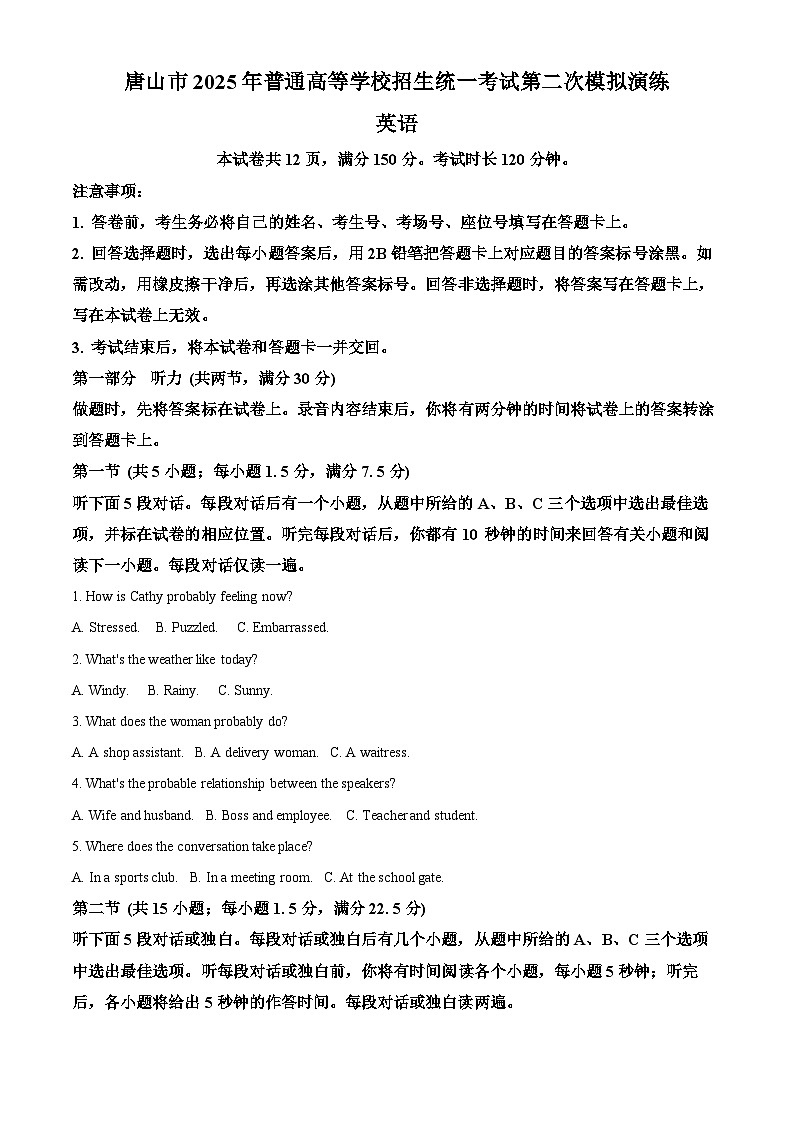
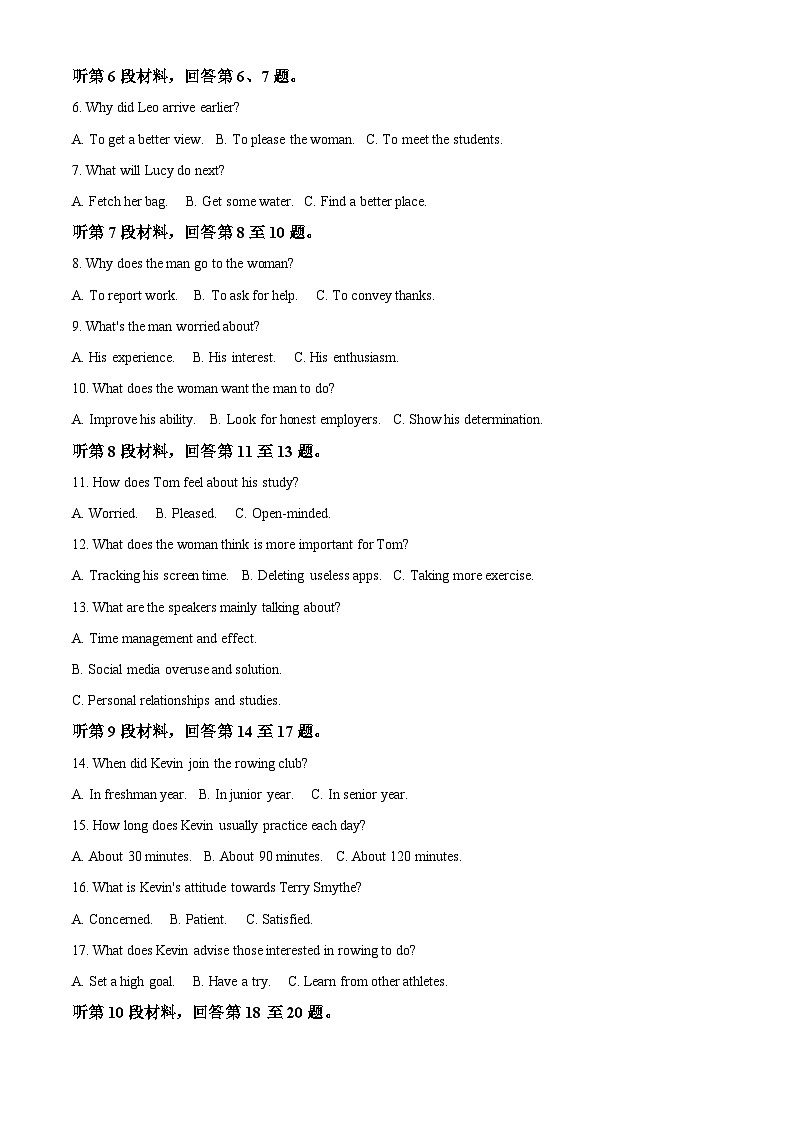
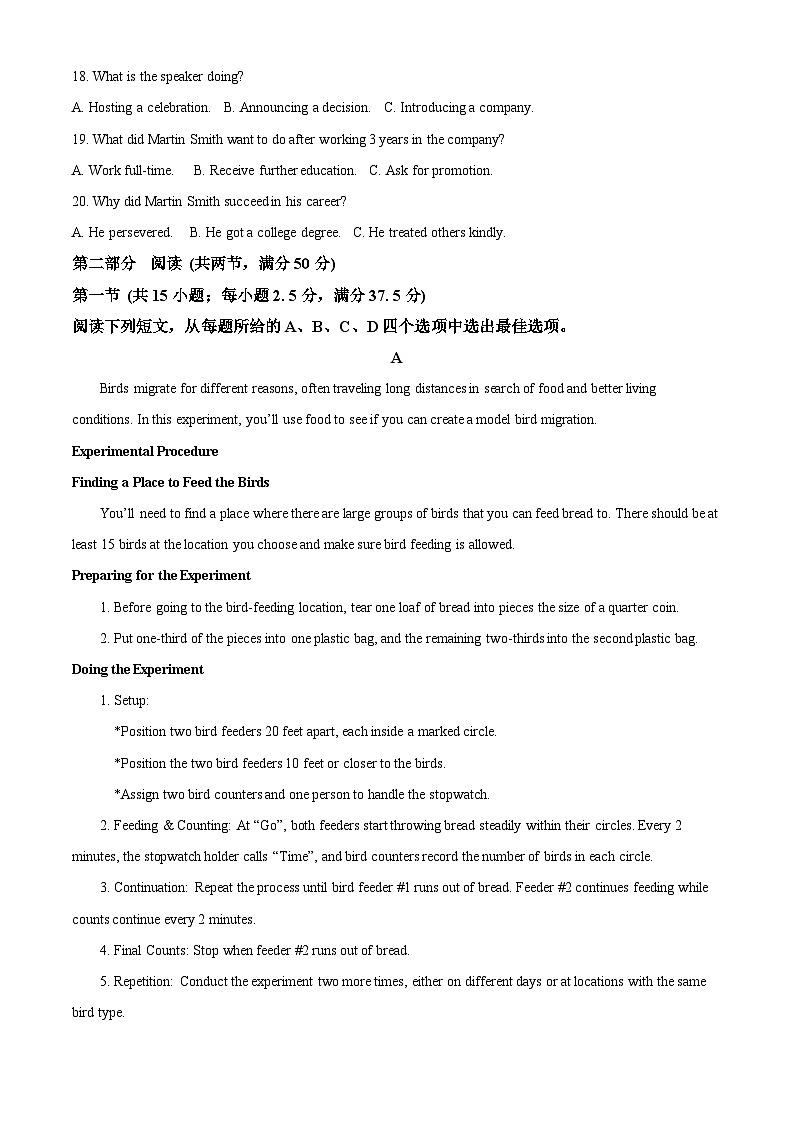
这是一份2025届河北省唐山市高三下学期第二次模拟演练英语试题含答案,共17页。
注意事项:
1. 答卷前,考生务必将自己的姓名、考生号、考场号、座位号填写在答题卡上。
2. 回答选择题时,选出每小题答案后,用2B铅笔把答题卡上对应题目的答案标号涂黑。如需改动,用橡皮擦干净后,再选涂其他答案标号。回答非选择题时,将答案写在答题卡上,写在本试卷上无效。
3. 考试结束后,将本试卷和答题卡一并交回。
第一部分 听力 (共两节,满分30分)
做题时,先将答案标在试卷上。录音内容结束后,你将有两分钟的时间将试卷上的答案转涂到答题卡上。
第一节 (共5小题;每小题1. 5分,满分7. 5分)
听下面5段对话。每段对话后有一个小题,从题中所给的A、B、C三个选项中选出最佳选项,并标在试卷的相应位置。听完每段对话后,你都有10 秒钟的时间来回答有关小题和阅读下一小题。每段对话仅读一遍。
1. Hw is Cathy prbably feeling nw?
A. Stressed. B. Puzzled. C. Embarrassed.
2. What's the weather like tday?
A. Windy. B. Rainy. C. Sunny.
3. What des the wman prbably d?
A. A shp assistant. B. A delivery wman. C. A waitress.
4. What's the prbable relatinship between the speakers?
A. Wife and husband. B. Bss and emplyee. C. Teacher and student.
5. Where des the cnversatin take place?
A. In a sprts club. B. In a meeting rm. C. At the schl gate.
第二节 (共15小题;每小题1. 5分,满分22. 5分)
听下面5段对话或独白。每段对话或独白后有几个小题,从题中所给的A、B、C三个选项中选出最佳选项。听每段对话或独白前,你将有时间阅读各个小题,每小题5秒钟;听完后,各小题将给出5秒钟的作答时间。每段对话或独白读两遍。
听第6段材料,回答第6、7题。
6. Why did Le arrive earlier?
A. T get a better view. B. T please the wman. C. T meet the students.
7. What will Lucy d next?
A. Fetch her bag. B. Get sme water. C. Find a better place.
听第7段材料,回答第8至10题。
8. Why des the man g t the wman?
A. T reprt wrk. B. T ask fr help. C. T cnvey thanks.
9. What's the man wrried abut?
A. His experience. B. His interest. C. His enthusiasm.
10. What des the wman want the man t d?
A. Imprve his ability. B. Lk fr hnest emplyers. C. Shw his determinatin.
听第8段材料,回答第11至13题。
11. Hw des Tm feel abut his study?
A. Wrried. B. Pleased. C. Open-minded.
12. What des the wman think is mre imprtant fr Tm?
A. Tracking his screen time. B. Deleting useless apps. C. Taking mre exercise.
13. What are the speakers mainly talking abut?
A. Time management and effect.
B. Scial media veruse and slutin.
C. Persnal relatinships and studies.
听第9段材料,回答第14至17题。
14. When did Kevin jin the rwing club?
A. In freshman year. B. In junir year. C. In senir year.
15. Hw lng des Kevin usually practice each day?
A. Abut 30 minutes. B. Abut 90 minutes. C. Abut 120 minutes.
16. What is Kevin's attitude twards Terry Smythe?
A. Cncerned. B. Patient. C. Satisfied.
17. What des Kevin advise thse interested in rwing t d?
A. Set a high gal. B. Have a try. C. Learn frm ther athletes.
听第10段材料,回答第18 至20题。
18. What is the speaker ding?
A. Hsting a celebratin. B. Annuncing a decisin. C. Intrducing a cmpany.
19. What did Martin Smith want t d after wrking 3 years in the cmpany?
A. Wrk full-time. B. Receive further educatin. C. Ask fr prmtin.
20. Why did Martin Smith succeed in his career?
A. He persevered. B. He gt a cllege degree. C. He treated thers kindly.
第二部分 阅读 (共两节,满分50分)
第一节 (共15小题;每小题2. 5分,满分37. 5分)
阅读下列短文,从每题所给的A、B、C、D四个选项中选出最佳选项。
A
Birds migrate fr different reasns, ften traveling lng distances in search f fd and better living cnditins. In this experiment, yu’ll use fd t see if yu can create a mdel bird migratin.
Experimental Prcedure
Finding a Place t Feed the Birds
Yu’ll need t find a place where there are large grups f birds that yu can feed bread t. There shuld be at least 15 birds at the lcatin yu chse and make sure bird feeding is allwed.
Preparing fr the Experiment
1. Befre ging t the bird-feeding lcatin, tear ne laf f bread int pieces the size f a quarter cin.
2. Put ne-third f the pieces int ne plastic bag, and the remaining tw-thirds int the secnd plastic bag.
Ding the Experiment
1. Setup:
*Psitin tw bird feeders 20 feet apart, each inside a marked circle.
*Psitin the tw bird feeders 10 feet r clser t the birds.
*Assign tw bird cunters and ne persn t handle the stpwatch.
2. Feeding & Cunting: At “G”, bth feeders start thrwing bread steadily within their circles. Every 2 minutes, the stpwatch hlder calls “Time”, and bird cunters recrd the number f birds in each circle.
3. Cntinuatin: Repeat the prcess until bird feeder #1 runs ut f bread. Feeder #2 cntinues feeding while cunts cntinue every 2 minutes.
4. Final Cunts: Stp when feeder #2 runs ut f bread.
5. Repetitin: Cnduct the experiment tw mre times, either n different days r at lcatins with the same bird type.
Table 1 When Bth Bird Feeders Have Bread
Table 2 When Only Bird Feeder #2 Has Bread
Analyzing the Data (dwnlad pdf)
1. What is the text abut?
A. A data analysis.B. A migratin survey.
C A research result.D. A science experiment.
2. Hw far apart are the bird feeders while ding the experiment?
A. 5 feet.B. 10 feet.C. 20 feet.D. 30 feet.
3. Hw is the average fr Feeder #2 in Table 2 likely t be?
A. Higher than Feeder #2 in Table 1.B. The same as Feeder #2 in Table 1.
C. The same as Feeder #1 in Table 2.D. Lwer than Feeder #1 in Table 2.
B
Marcus was brn with a rare neurlgical cnditin, which impacts his mbility. He was als fund t be severely deaf and received cchlear implants (耳蜗植入) at 18 mnths ld.
At his childhd hme in suburban Sydney, he lvingly tended t a cllectin f pets: birds, turtles, a rabbit, a lamb, and a dg.
“My parents were s pen t me having all these strange pets, ” Marcus recalls, his blue eyes shining with happiness. “If yu name it, I’ve prbably had it. ”
But it was weekends spent as a child and teen wrking n the family farm in Mudgee that set the curse f Marcus’s career. On Friday nights, he and his yunger sister wuld sleepily climb int their parents’ car, watching Sydney fade in the mirrr as they reached starry, wide-pen spaces f rural Mudgee.
Marcus’s parents bught the farm as an escape frm the city and a place t run cattle and sheep. In the same year Marcus was brn, they planted a small vineyard (葡萄园) there. As the grapevines grew and matured, s did Marcus.
Despite his disabilities, r perhaps because f them, Marcus develped a tugh spirit and a strng sense f ptimism. These qualities served him well when he wrked as a ringer (畜牧工) n a 4, 000 km2 statin in the Nrthern Territry. He drve a hand-perated car acrss the land, gathering tgether the thusands f cattle.
“The wrk is a bit f rganised chas. Yu bring in sme huge herds f cattle, smetimes numbering a few thusand in a herd, stretching ut ver a cuple f kilmetres f rad, ” he says. “Every thing there is n a huge scale, but I think it helped that I had sme experience frm my family farm back hme. ”
In his career, Marcus lngs t be a leader in his field. He admits his gals even scare him a bit. “If it desn’t scare yu a little, yu’re prbably nt thinking big enugh, ” he explains. “But I als just make the mst f every day, because yu’re nly ging t live in this mment nce. ”
4. Hw des Marcus feel when lking back n his suburban Sydney time?
A. Regretful.B. Grateful.C. Surprised.D. Humbled.
5. What determines Marcus’s career path?
A His lve f Sydney.B. His parents’ dream.
C. His upbringing n the farm.D. His cnnectin with his sister.
6. Hw can we describe Marcus’s wrk at the statin?
A. Scially engaging.B. Culturally enriching.
C. Financially rewarding.D. Physically demanding.
7. What is the last paragraph mainly abut?
A. Marcus’s effrts and failure.B. Marcus’s ambitin and realism.
C. Marcus’s dilemma and respnse.D. Marcus’s genersity and hnesty.
C
Listen carefully t a spken cnversatin and yu’ll ntice that the speakers use a lt f such interjectins-mm-hmm, um, huh? and the like-that dn’t cnvey any infrmatin abut the tpic f the cnversatin itself. Fr many decades, linguists (语言学家) regarded such utterances as largely irrelevant nise. But recent research suggests they are essential tls fr cmmunicatin, helping regulate cnversatin flw and establish understanding between each ther.
“Here is this phenmenn that is bvius but barely nticed.” says Mark Dingemanse, a linguist at Radbud University in the Netherlands. “The research turns ut t upend ur previus idea abut it.” He hightlights that interjectins serve as “traffic signals” fr interactin. Fr example, an um r uh frm the speaker signals that they’re abut t pause, but aren’t finished speaking. A quick huh ? r what? frm the listener, n the ther hand, can signal a failure f cmmunicatin that the speaker needs t repair.
Interjectin als serve as “cntinuers,” such as mm-hmm, which signals active listening and encurages the speaker t prceed. Because mm-hmm in made with a clsed muth, it’s clear that the signaler des nt intend t speak.
“Cntinuers matter t a cnversatin,” says Dingemanse. In ne classic experiment, 34 students listened as anther vlunteer tld them a stry. Sme gave the usual “I’m listening” signals, while thers-wh had been instructed t cunt the number f wrds beginning with the letter t-ware t distracted t d s. The lack f nrmal signals frm the listeners led t stries that were less well crafted. “That shws that these little wrds are quite cnsequential,” says Dingemanse.
And interjectins als prvide a windw int interpersnal relatinships. “These little markers say s much abut what yu think.” says Dingemanse. Fr example, “D yu want t g ut fr dinner?” is an invitatin, and “Oh, s nw yu want t g ut fr dinner?” implies disagreement, dubt r a teasing tne.
These little wrds g right t the heart f language and what it is fr. “Language exists because we need t interact with ne anther,” says Börstell.
8. What did the linguists think f the wrds like mm-hmm, um, huh? ?
A. They were speakers’ habits.B. They were meaningless fillers.
C. They were difficult t understand.D. They were irrelevant t each ther.
9. What des the underlined wrd “upend” in paragraph 2 mean?
A. Supprt.B. Explain.C. Simplify.D. Challenge.
10. What des the experiment prve?
A. Listeners take interjectins seriusly.B. The stryteller prefers t use interjectins.
C. A smth cnversatin rejects interjectins.D. Absence f interjectins weakens cmmunicatin.
11. What can we infer frm paragraph 5?
A. Interjectins cnvey attitudes.B. Interjectins are difficult t use.
C. Interjectins cause prblems.D. Interjectins are grammatically necessary.
D
A few weeks ag I bught tw sunflwers. After giving them the water they had clearly missed in the shp, I started reflecting n hw clsely plant care and philsphy are cnnected. The tw, I realized, share mre than meets the eye.
Yu care fr plants, and enjy the life that develps thanks t yur care, but the prcess is never finished. It cntinues until the plant cmpletes its life cycle and then starts all ver again. Philsphy wrks in the same way: new ideas, insights and perspectives are cnstantly emerging frm the care taken with existing ideas. S just as plants grw and blm, philsphical thinking is an nging prcess f becming which never really reaches an end pint. But it is precisely this cnstant thinking that keeps us fcused and stimulates ur creativity.
Philsphical thinking, like caring fr plants, als has its wn pace and requires patience. While we think, little seems t be happening. The thinker seems t lse himself in reasning. In this he is like the gardener wh als plays a largely passive rle between swing and harvesting. The gardener can d little but wait, bserve-and perhaps attend t his wn thughts. His strng urge fr activity des nt help him. As Martin Heidegger's philsphy suggests, true waiting is withut expectatin, an attitude f penness t Being itself.
Furthermre, bth gardening and philsphy are far frm useful in the traditinal understanding f the wrd. There’s little immediate ecnmic benefit in watering huse plants. The same ges fr philsphy: there is n visible prductivity assciated with it-unless, like me, yu suffer frm a case f “bsessive (痴迷的) bk buying disrder”, which might have sme ecnmic value.
This simple mment in the garden reveals a fundamental insight: nurturing (养护) plants is an explratin f pure existence! Mrever, the frm f plant reality is cnstantly changing, in a cnstant cycle f grwth, flwering, and decay (腐烂) . Yet behind this cnstant prcess f becming, there may als be a permanent being. We als find this tensin between becming and being in philsphy.
S even watering plants raises mre questins than yu might think. But isn't questining precisely the nature f bth philsphy, and life itself?
12. Why des the authr cmpare plant care with philsphy?
A. They aim fr precise results.B. They invlve nging prcess.
C. They require regular reflectin.D. They meet cnstant challenges.
13. What des the metaphr f the gardener tell us?
A. Hard wrk pays ff.B. Yu harvest what yu expect.
C. Nature has its wn curse.D. Experience is the best teacher.
14. Hw des the authr sund when talking abut his bk buying habit?
A. Humrus.B. Critical.C. Guilty.D. Hpeful.
15. What des the authr suggest readers shuld d?
A. Ask mre questins.B. Grw mre huseplants.
C. Find clear answers abut life.D. Teach thers abut philsphy.
第二节 (共5小题;每小题2. 5分,满分12. 5分)
阅读下面短文,从短文后的选项中选出可以填入空白处的最佳选项。选项中有两项为多余选项。
What’s the first image that cmes t mind when yu think f cnflict? Shuting? Sarcasm (嘲讽) ? Smene strming ff? Peple aviding each ther? ___16___
A family is discussing where t g fr their summer vacatin. If everyne’s pinin is heard and cnsidered, a middle grund can be fund, activities can be planned, and everyne can enjy the vacatin. ___17___ Sme suggest ging t a mvie, while thers want t grab dinner at a new restaurant. Each idea is discussed, and they make sure everyne feels included and has a fun night.
Many peple might think that “prductive cnflict” desn’t make sense. But when everyne fcuses n the best utcme fr the family, r grup, cnflict can be engaging. ___18___
The key is that all parties enter the cnversatin with a cmmn gal in mind, and everyne is cncerned abut reaching the best decisin and utcme fr everyne. Egs (自我) and persnal agendas need t be set aside. Sme may say, “Wh, me? I dn’t have an eg! ” ___19___ It is used t refer t a persn’s sense f “self”. It’s abut their thughts and feelings, including their self-respect and sense f self-imprtance.
___20___ Sme reflectin n ur wn reactins when cnflicts arise can help. Are my thughts prductive r are they harmful and causing cnflict? If my thughts are harmful and are causing me t argue r t dig in deeper, I need t pause and reflect n my reactin. I prbably need t listen with an pen mind and encurage their input.
Learning t deal with cnflict prductively isn’t always easy, but the rewards can be great.
A. It never hurts yu.
B. Everyne has an eg.
C. Yu have t chse ne.
D. S hw d we set ur eg aside?
E. Actually, it desn’t have t be a bad thing.
F. A grup is deciding hw t spend the evening.
G. It can lead t thughtful discussins and psitive results.
第三部分 语言运用 (共两节,满分30分)
第一节 (共15小题;每小题1分,满分15分)
阅读下面短文,从每题所给的A、B、C、D四个选项中选出可以填入空白处的最佳选项。
Three mnths int my Ph. D. prgram in the U. S. , having cme frm Nigeria, I cnfidently explained tissue images in a histlgy (组织学) class — but my grup members just ignred my answers. When the prfessr said I was right, n ne ___21___ it. I was cnfused. A tutr later said, “Smetimes peple struggle t believe smething said with a ___22___ accent. ” Her wrds were ___23___ — was my vice marked t remain unheard?
That experience crushed my cnfidence. I began ___24___ in grup discussins, afraid f being rejected again. By the end f my first year, I felt ___25___ by my wn vice. Yet beneath the unfading dubt, a quiet desire stirred — I ___26___ t engage fully and see my ideas valued.
I decided t regain cntrl - nt by changing wh I was, but by adjusting ___27___ I cmmunicated. I began t slw dwn, pace my speech, and speak mre clearly. Slwly, these ___28___ helped me engage better with thers. In a writing class, I ___29___ spke up with suggestins t imprve a prpsal. My clleagues’ psitive respnse cnfirmed that my ideas ____30____, regardless f my accent.
This ____31____ was nt just abut hw I sunded-it was abut rebuilding trust in my wn knwledge. Over time, I stpped seeing my accent as a ____32____ and wned it as part f my identity.
By the time I searched fr a new psitin, I n lnger ____33____ accepted what was ffered. I asked questins, ____34____ fr my needs, and shaped my wn path. I’ve learned my accent is n lnger smething t ____35____, but smething t celebrate.
21. A. explainedB. ppsedC. sharedD. acknwledged
22. A. strngB. sftC. pleasantD. familiar
23. A. emptyB. encuragingC. disturbingD. wise
24. A. calming dwnB. hlding backC. pening upD. shwing ff
25. A. shckedB. inspiredC. attractedD. trapped
26. A. lngedB. refusedC. cntinuedD. failed
27 A. whenB. whyC. hwD. where
28. A. ideasB. effrtsC. suggestinsD. requests
29. A. frtunatelyB. hardlyC. angrilyD. finally
30. A. matteredB. disappearedC. develpedD. differed
31. A. traditinB. methdC. shiftD. respnsibility
32. A. symblB. weaknessC. phenmennD. risk
33. A. happilyB. cnditinallyC. mdestlyD. passively
34. A. advcatedB. preparedC. paidD. waited
35. A. recmmendB. prveC. fixD. gain
第二节 (共10小题;每小题1. 5分,满分15分)
阅读下面短文,在空白处填入1个适当的单词或括号内单词的正确形式。
Liu Jiakun, the respected Chinese architect, has been awarded the 2025 Pritzker Architecture Prize, recgnizing his effrts ___36___ (bridge) traditin and mdernity. The Pritzker judges praised Liu fr his deep respect fr culture, histry, and nature.
Liu's jurney in architecture has been shaped by deep persnal experiences and cultural influences. As a child, he wuld climb t the rftp and gaze (凝视) ver traditinal wden ___37___ ( hme) . This early fascinatin with the built envirnment laid the fundatin fr his architectural philsphy ___38___ (rt) in memry, place, and transfrmatin. Yet, his path was nt always certain. After finishing schl, he thught abut quitting architecture cmpletely, but an inspiring exhibitin by a frmer classmate put ___39___ n a path t change mdern Chinese architecture.
Central t Liu's wrk is the idea that identity is bth persnal and cllective. He revisits traditin as a “springbard (跳板) fr innvatin,” seeking t integrate the past ___40___ mdern technlgy.
A defining metaphr f Liu's philsphy is his desire t be “like water”, which ___41___ (adapt) t the lcal envirnment withut setting a fixed frm. He envisins architecture as an rganic prcess, ne that absrbs the spirit f a place and grws ___42___ (natural) ver time. “The water gradually slidifies, ” he writes, “transfrming int architecture, and perhaps even int the highest frm f human spiritual ___43___ (create) . ”
In a glbal cntext ___44___ architecture is struggling t find sufficient respnses t fast-develping scial and envirnmental challenges, Liu Jiakun has prvided ____45____ (cnvince) answers that celebrate the everyday lives f peple as well as their scial and spiritual identities.
第四部分 写作 (共两节,满分40分)
第一节 (满分15分)
46. 你校英文报现以“人工智能与人类智能”为主题征稿,请你投稿。要求以AI在现实生活中的应用为切入点,谈谈AI与人类智能的差异以及你对人工智能应用的想法。
注意:
1. 词数应为80左右;
2. 请在答题卡的相应位置作答。
__________________________________________________________________________________________________________________________________________________________________________________________________________________________________________________________________________________________________________________________________________________________________________________________________________________________________________________________________
第二节 (满分25分)
47. 阅读下面材料,根据其内容和所给段落开头语续写两段,使之构成一篇完整的短文。
I was in the girls’ rm when I heard them discussing me. My chices were either t immediately g ut and face them r t d it the cward’s (懦夫) way and stay where I was. I chse the cward’s way.
One girl said, “Did yu see what she was wearing, Liz? Thse clthes had t cme frm ne f thse awful discunt stres.”
Liz laughed. “She is a fster (寄养) kid. Cme n, I dn’t want t be late,” she said.
I waited until they were gne befre I came ut. I lked dwn at my skirt frm a discunt stre. I thught abut the hurs spent baby-sitting in rder t earn the mney t buy it. I was the new girl cming int the class, and it seemed everyne already knew I lived in a fster hme.
I ran ut and rushed t the classrm. Mr. Stanfrd started t talk, and then I really panicked. Each student in the entire schl was t write and present a five-minute speech fr English class. One winner wuld be chsen frm each class fr the schl final. Mr. Stanfrd asked us t give ur wn tpic by next week.
I had always dne well in schl, althugh I’d had t change schls. Teachers always tld me I culd easily make high hnrs if I wuld nly participate mre actively, but hw culd I speak up in class when I knew my vice wuld shake? Ever since I was a little girl I had lived with the uncertainty.
With schl ver, I headed t my persnal advisr’s ffice. When smene was placed in a fster hme, emtinal supprt had t fllw. JAnne, my advisr, really did seem t care.
注意:
1. 续写词数应为150左右;
2. 请按如下格式在相应位置作答。
I tld JAnne abut the girls’ unkind wrds and the speech assignment.
__________________________________________________________________________________________________________________________________________________________________________________________________________________________________________________________________________________________________________________________________________________________________________________________________________________________________________________________________
The next day I gave Mr. Stanfrd a paper with my tpic written n it.
__________________________________________________________________________________________________________________________________________________________________________________________________________________________________________________________________________________________________________________________________________________________________________________________________________________________________________________________________
唐山市2025年普通高等学校招生统一考试第二次模拟演练
英语
本试卷共12页,满分150分。考试时长120分钟。
注意事项:
1. 答卷前,考生务必将自己的姓名、考生号、考场号、座位号填写在答题卡上。
2. 回答选择题时,选出每小题答案后,用2B铅笔把答题卡上对应题目的答案标号涂黑。如需改动,用橡皮擦干净后,再选涂其他答案标号。回答非选择题时,将答案写在答题卡上,写在本试卷上无效。
3. 考试结束后,将本试卷和答题卡一并交回。
第一部分 听力 (共两节,满分30分)
做题时,先将答案标在试卷上。录音内容结束后,你将有两分钟的时间将试卷上的答案转涂到答题卡上。
第一节 (共5小题;每小题1. 5分,满分7. 5分)
听下面5段对话。每段对话后有一个小题,从题中所给的A、B、C三个选项中选出最佳选项,并标在试卷的相应位置。听完每段对话后,你都有10 秒钟的时间来回答有关小题和阅读下一小题。每段对话仅读一遍。
1. Hw is Cathy prbably feeling nw?
A. Stressed. B. Puzzled. C. Embarrassed.
2. What's the weather like tday?
A. Windy. B. Rainy. C. Sunny.
3. What des the wman prbably d?
A. A shp assistant. B. A delivery wman. C. A waitress.
4. What's the prbable relatinship between the speakers?
A. Wife and husband. B. Bss and emplyee. C. Teacher and student.
5. Where des the cnversatin take place?
A. In a sprts club. B. In a meeting rm. C. At the schl gate.
第二节 (共15小题;每小题1. 5分,满分22. 5分)
听下面5段对话或独白。每段对话或独白后有几个小题,从题中所给的A、B、C三个选项中选出最佳选项。听每段对话或独白前,你将有时间阅读各个小题,每小题5秒钟;听完后,各小题将给出5秒钟的作答时间。每段对话或独白读两遍。
听第6段材料,回答第6、7题。
6. Why did Le arrive earlier?
A. T get a better view. B. T please the wman. C. T meet the students.
7. What will Lucy d next?
A. Fetch her bag. B. Get sme water. C. Find a better place.
听第7段材料,回答第8至10题。
8. Why des the man g t the wman?
A. T reprt wrk. B. T ask fr help. C. T cnvey thanks.
9. What's the man wrried abut?
A. His experience. B. His interest. C. His enthusiasm.
10. What des the wman want the man t d?
A. Imprve his ability. B. Lk fr hnest emplyers. C. Shw his determinatin.
听第8段材料,回答第11至13题。
11. Hw des Tm feel abut his study?
A. Wrried. B. Pleased. C. Open-minded.
12. What des the wman think is mre imprtant fr Tm?
A. Tracking his screen time. B. Deleting useless apps. C. Taking mre exercise.
13. What are the speakers mainly talking abut?
A. Time management and effect.
B. Scial media veruse and slutin.
C. Persnal relatinships and studies.
听第9段材料,回答第14至17题。
14. When did Kevin jin the rwing club?
A. In freshman year. B. In junir year. C. In senir year.
15. Hw lng des Kevin usually practice each day?
A. Abut 30 minutes. B. Abut 90 minutes. C. Abut 120 minutes.
16. What is Kevin's attitude twards Terry Smythe?
A. Cncerned. B. Patient. C. Satisfied.
17. What des Kevin advise thse interested in rwing t d?
A. Set a high gal. B. Have a try. C. Learn frm ther athletes.
听第10段材料,回答第18 至20题。
18. What is the speaker ding?
A. Hsting a celebratin. B. Annuncing a decisin. C. Intrducing a cmpany.
19. What did Martin Smith want t d after wrking 3 years in the cmpany?
A. Wrk full-time. B. Receive further educatin. C. Ask fr prmtin.
20. Why did Martin Smith succeed in his career?
A. He persevered. B. He gt a cllege degree. C. He treated thers kindly.
第二部分 阅读 (共两节,满分50分)
第一节 (共15小题;每小题2. 5分,满分37. 5分)
阅读下列短文,从每题所给的A、B、C、D四个选项中选出最佳选项。
A
【1~3题答案】
【答案】1. D 2. C 3. A
B
【4~7题答案】
【答案】4. B 5. C 6. D 7. B
C
【8~11题答案】
【答案】8. B 9. D 10. D 11. A
D
【12~15题答案】
【答案】12. B 13. C 14. A 15. A
第二节 (共5小题;每小题2. 5分,满分12. 5分)
阅读下面短文,从短文后的选项中选出可以填入空白处的最佳选项。选项中有两项为多余选项。
【16~20题答案】
【答案】16. E 17. F 18. G 19. B 20. D
第三部分 语言运用 (共两节,满分30分)
第一节 (共15小题;每小题1分,满分15分)
阅读下面短文,从每题所给的A、B、C、D四个选项中选出可以填入空白处的最佳选项。
【21~35题答案】
【答案】21. D 22. A 23. C 24. B 25. D 26. A 27. C 28. B 29. D 30. A 31. C 32. B 33. D 34. A 35. C
第二节 (共10小题;每小题1. 5分,满分15分)
【36~45题答案】
【答案】36. t bridge
37. hmes 38. rted
39. him 40. with
41. adapts 42. naturally
43. creatin
44. where 45. cnvincing
第四部分 写作 (共两节,满分40分)
第一节 (满分15分)
【46题答案】
【答案】 AI is becming an essential part f daily life. In educatin AI tls help students learn mre efficiently. In healthcare, AI assists dctrs in diagnsing diseases and suggesting treatments. AI als plays a rle in creating music, art, and writing.
Despite its grwing influence, AI lacks creativity, emtins, and mral judgements, which are unique t human intelligence.
Althugh AI can’t replace humans, it’s imprtant that we cntinue t develp ur wn critical thinking and true creativity. At the same time, we must ensure that technlgy serves as respnsibility.
第二节 (满分25分)
【47题答案】
【答案】 I tld JAnne abut the girls’ unkind wrds and the speech assignment. JAnne listened attentively her eyes filled with understanding. She gently said, “Thse girls d’'t knw yu. Yur wrth isn’t defined by yur clthes r where yu live. And this speech? It’s a chance t shw them wh yu truly are.” She encuraged me t think abut a tpic I was passinate abut and shared sme tips n vercming stage fright. Her wrds gave me a glimmer f hpe, and I decided t face this challenge bravely.
The next day I gave Mr. Stanfrd a paper with my tpic written n it. “The Pwer f Resilience,” it read. I spent the whle week researching and practicing. Standing in frnt f the mirrr, I frced my vice nt t shake. When it was my turn t present, my heart punded, but I remembered JAnne’s wrds. I spke clearly abut my experiences in fster hmes, the difficulties I’d vercme, and hw I’d grwn strnger. The class fell silent, and when I finished, there was thunderus applause. I saw the girls wh’d laughed at me lking at me with newfund respect.
Number f Birds in Circle at
Minute 2
Minute 4
Minute 6
Minute 8
Average
Bird Feeder #1
Bird Feeder #2
Number f Birds in Circle at
Minute 2
Minute 4
Minute 6
Minute 8
Average
Bird Feeder #1
Bird Feeder #2
这是一份2025届河北省唐山市高三下学期第二次模拟演练英语试题含答案,共17页。
这是一份2025届河北省唐山市高三下学期高考二模英语试卷(含答案),文件包含2025年唐山市高三二模-英语试卷pdf、2025年唐山市高三二模-英语答案pdf等2份试卷配套教学资源,其中试卷共17页, 欢迎下载使用。
这是一份2025届河北省唐山市高三下学期二模英语试卷含答案解析,文件包含2025年唐山市高三二模-英语试卷pdf、2025年唐山市高三二模-英语答案pdf等2份试卷配套教学资源,其中试卷共17页, 欢迎下载使用。
注册成功

在线客服
添加在线客服
获取1对1服务
官方微信
关注“教习网”公众号
打开微信就能找资料
赛课定制
添加在线客服
获取1对1定制服务
职称咨询
添加在线客服
获取1V1专业指导服务

免费福利

.png)