免费领取教师福利
若您为此资料的原创作者,认为该资料内容侵犯了您的知识产权,请扫码添加我们的相关工作人员,我们尽可能的保护您的合法权益。

这是一份2025年中考人教版英语一轮复习:七八九年级重点短语和句型 讲义,共76页。学案主要包含了重点短语,重点句型等内容,欢迎下载使用。
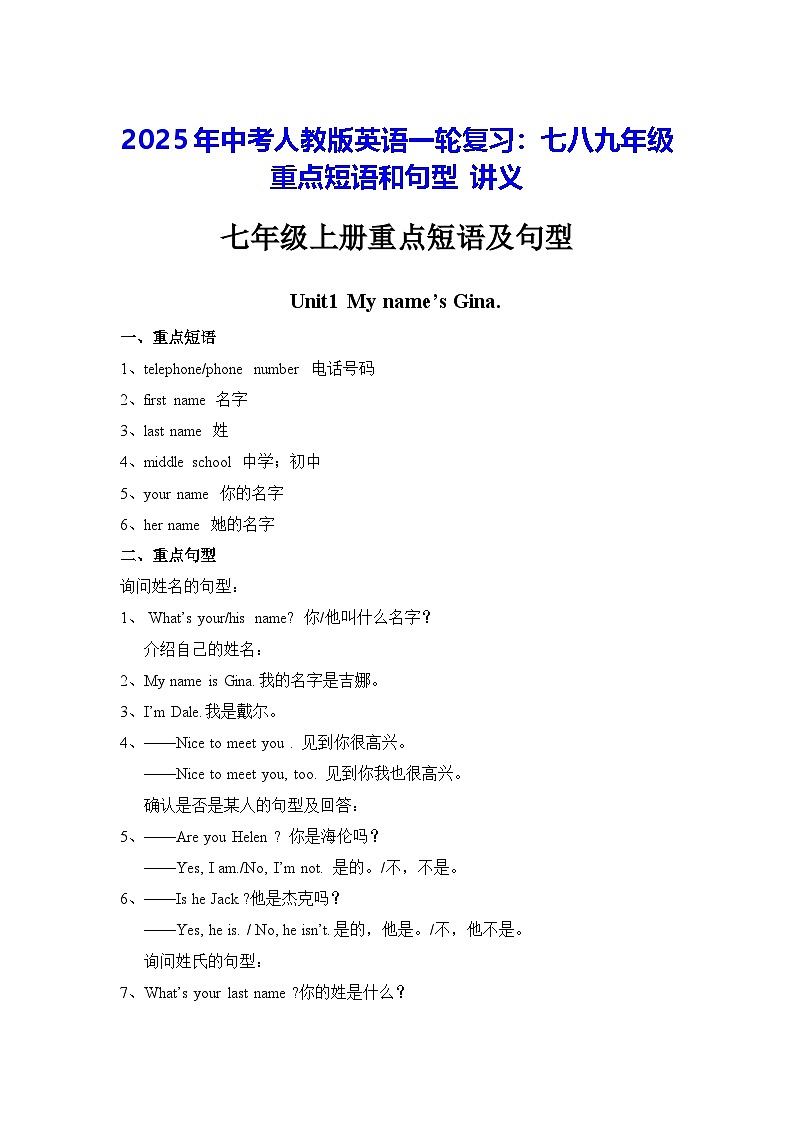
Unit1 My name’s Gina.
一、重点短语
1、telephne/phne number 电话号码
2、first name 名字
3、last name 姓
4、middle schl 中学;初中
5、yur name 你的名字
6、her name 她的名字
二、重点句型
询问姓名的句型:
What’s yur/his name? 你/他叫什么名字?
介绍自己的姓名:
2、My name is Gina.我的名字是吉娜。
3、I’m Dale.我是戴尔。
4、——Nice t meet yu . 见到你很高兴。
——Nice t meet yu, t. 见到你我也很高兴。
确认是否是某人的句型及回答:
5、——Are yu Helen ? 你是海伦吗?
——Yes, I am./N, I’m nt. 是的。/不,不是。
6、——Is he Jack ?他是杰克吗?
——Yes, he is. / N, he isn’t.是的,他是。/不,他不是。
询问姓氏的句型:
7、What’s yur last name ?你的姓是什么?
询问号码的句型及回答:
8、What’s yur telephne number ? 你的电话号码是多少?
It’s 359-4576. 它是359-4576。
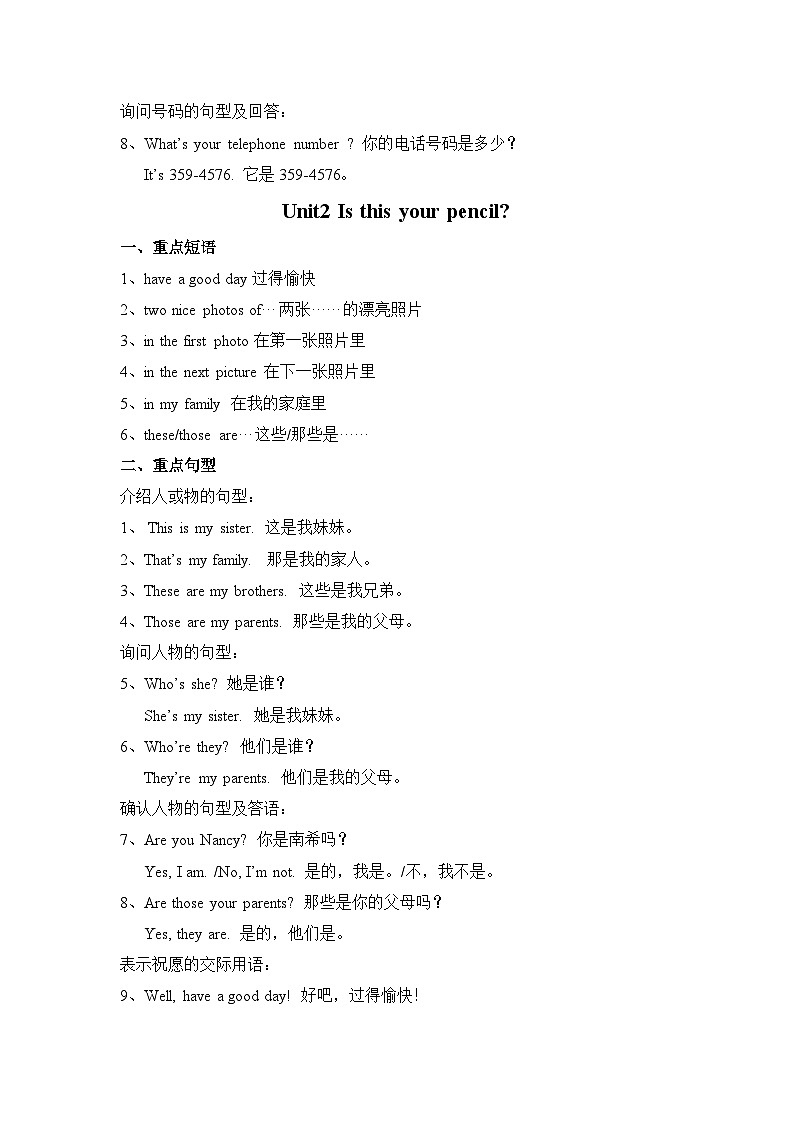
Unit2 Is this yur pencil?
一、重点短语
1、have a gd day过得愉快
2、tw nice phts f···两张······的漂亮照片
3、in the first pht在第一张照片里
4、in the next picture在下一张照片里
5、in my family在我的家庭里
6、these/thse are···这些/那些是······
二、重点句型
介绍人或物的句型:
This is my sister. 这是我妹妹。
2、That’s my family. 那是我的家人。
3、These are my brthers. 这些是我兄弟。
4、Thse are my parents. 那些是我的父母。
询问人物的句型:
5、Wh’s she? 她是谁?
She’s my sister. 她是我妹妹。
6、Wh’re they? 他们是谁?
They’re my parents. 他们是我的父母。
确认人物的句型及答语:
7、Are yu Nancy? 你是南希吗?
Yes, I am. /N, I’m nt. 是的,我是。/不,我不是。
8、Are thse yur parents? 那些是你的父母吗?
Yes, they are. 是的,他们是。
表示祝愿的交际用语:
9、Well, have a gd day! 好吧,过得愉快!
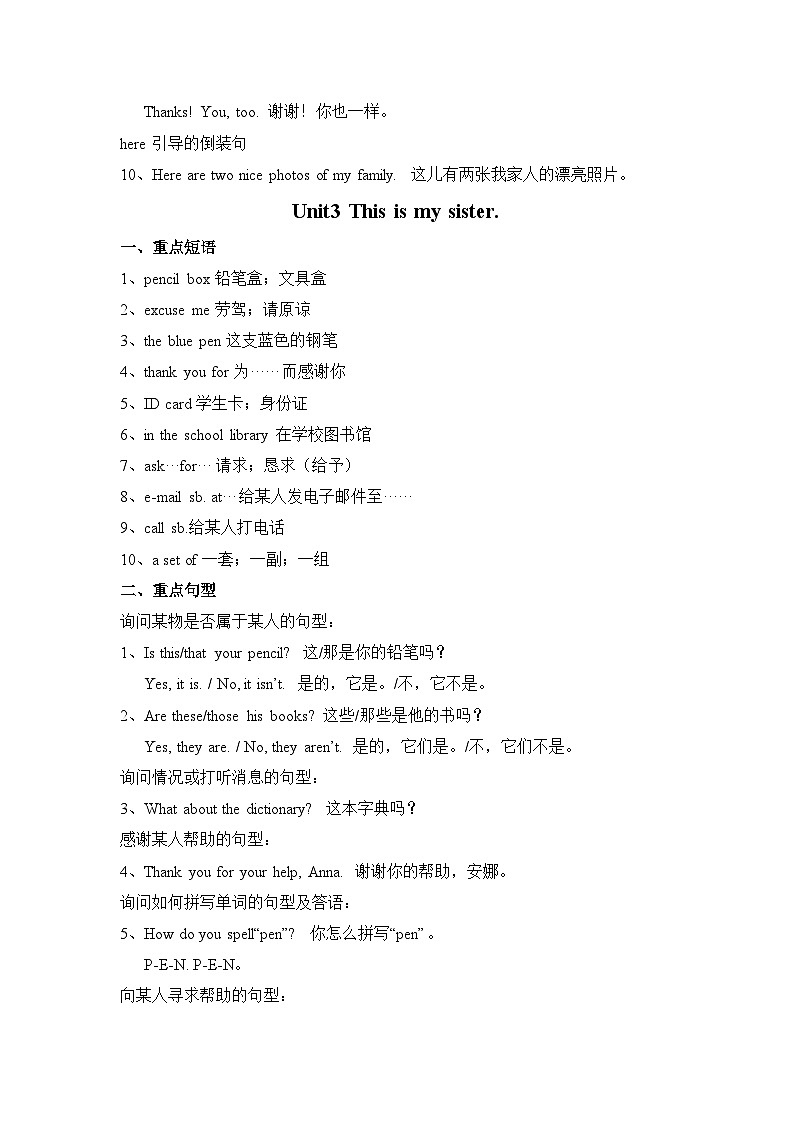
Thanks! Yu, t. 谢谢!你也一样。
here引导的倒装句
10、Here are tw nice phts f my family. 这儿有两张我家人的漂亮照片。
Unit3 This is my sister.
一、重点短语
1、pencil bx铅笔盒;文具盒
2、excuse me劳驾;请原谅
3、the blue pen这支蓝色的钢笔
4、thank yu fr为······而感谢你
5、ID card学生卡;身份证
6、in the schl library在学校图书馆
7、ask···fr···请求;恳求(给予)
8、e-mail sb. at···给某人发电子邮件至······
9、call sb.给某人打电话
10、a set f一套;一副;一组
二、重点句型
询问某物是否属于某人的句型:
1、Is this/that yur pencil? 这/那是你的铅笔吗?
Yes, it is. / N, it isn’t. 是的,它是。/不,它不是。
2、Are these/thse his bks? 这些/那些是他的书吗?
Yes, they are. / N, they aren’t. 是的,它们是。/不,它们不是。
询问情况或打听消息的句型:
3、What abut the dictinary? 这本字典吗?
感谢某人帮助的句型:
4、Thank yu fr yur help, Anna. 谢谢你的帮助,安娜。
询问如何拼写单词的句型及答语:
5、Hw d yu spell“pen”? 你怎么拼写“pen”。
P-E-N. P-E-N。
向某人寻求帮助的句型:
6、Ask the teacher fr help. 向老师寻求帮助。
寻物启事与失物招领启事的常用语:
7、Please call me at***-****. 请拨打电话t***-****找我。
8、Please e-mail me at maryg#gfimail.c m.
请给我发电子邮件到maryg#gfimail.c m。
Unit4 Where is my schlbag?
一、重点短语
n the sfa 在沙发上
in ne’s schlbag 在某人的书包里
under ne’s bed 在某人的床下面
n the table 在桌子上
5、cme n 快点儿
6、tape player 磁带播放机
7、mdel plane 飞机模型
8、be tidy 整洁的
9、in the bkcase 在书柜里
10、be everywhere 到处都是
二、重点句型
询问某物在哪里的句型:
Where’s my pencil bx? 我的铅笔盒在哪里?
Where are my bks? 我的书在哪里?
介绍物品位置的句型:
It’s under yur bed. 它在你的床下面。
My keys are in my schlbag. 我的钥匙在我的书包里。
Gina’s bks are everywhere——n her bed, n the sfa and under the chair.
吉娜的书到处都是——在她的床上、沙发上和椅子下面。
Cme n, Jack! 快点儿,杰克!
鼓励、催促对方的句型:
I think it’s in yur grandparents’ rm. 我认为他在你祖父母的房间里。
Unit5 D yu have a sccer ball?
一、重点短语
1、sccer ball (英式)足球
2、a ping—png bat 一个乒乓球拍
3、be later (fr) 迟到
4、in my bag 在我的包里
5、baseball bat 棒球棒
6、n the chair 在椅子上
7、play basketball 打篮球
8、play cmputer games 玩电脑游戏
9、watch TV 看电视
10、n TV 在电视上
11、be easy fr 对…容易
12、after class 下课后
二、重点句型
询问“某人有……吗 ?”的句型及回答:
1、D yu have a ping-png ball ? 你有乒乓球吗?
Yes, I d. / N, I dn’t. 是的,我有。/不,我没有。
2、Des she have a tennis ball ? 她有网球吗?
Yes, she des. / N, she desn’t. 是的,她有。/不,她没有。
对别人的建议表示赞同或者有兴趣的句型:
3、That sunds gd . 听起来不错。
表示某人对某事的观点与看法的句型:
4、I think he has a ping-png ball, t. 我认为他也有一个乒乓球。
提出建议的句型:
5、Let’s play basketball. 让我们打篮球吧。
表达某事容易的句型:
6、It’s easy fr me. 它对我来说很容易。
Unit6 D yu like bananas?
一、重点短语
1、birthday dinner生日晚餐
2、next week下周
3、think abut思考;考虑
4、hw/what abut怎么样
5、sprts star体育明星
6、eat well吃得好
7、ask ···abut···询问······关于······
8、eating habits饮食习惯
9、fr breakfast作为早餐
10、ne last questin最后一个问题
11、after dinner晚饭后
二、重点句型
询问某人是否喜欢某人某物的句型及回答:
1、D yu like salad? 你喜欢沙拉吗?
Yes, I d. 是的,我喜欢。
2、D yu like vegetables? 你喜欢蔬菜吗?
N, I dn’t like vegetables. 不,我不喜欢蔬菜。
表示喜欢某物的句型:
3、He likes ice-cream. 他喜欢冰激凌。
表示不喜欢某物的句型:
4、We dn’t like hamburgers. 我们不喜欢汉堡包。
5、He desn’t like vegetables. 他不喜欢蔬菜。
询问早饭、午饭、晚饭喜欢吃什么的句型:
6、What d yu like fr breakfast? 你早餐喜欢吃什么?
询问情况或征求意见、看法的句型及回答:
7、Hw abut hamburgers, vegetable salad, and sme fruit?
汉堡包、蔬菜沙拉和水果怎么样?
Sunds gd.听起来不错。
Unit7 Hw much are these scks?
一、重点短语
1、hw much多少钱
2、seven dllars7美元
3、what clr什么颜色
4、yellw scks黄色的短袜
5、clthes stre服装店
6、at very gd prices以很好的价格
7、fr bys对于男孩子来说
8、in purple穿着紫色的衣服
9、a pair f一双
二、重点句型
售货员常对顾客打招呼的用语和答语:
1、Can I help yu? 我能帮你吗?/What can I d fr yu? 我能为你做什么?
Yes, please. I need a sweater fr schl.
是的,我需要一件上学穿的毛衣。
询问价格的句型和短语:
2、Hw much is the hat? 这顶帽子多少钱?
It’s five dllars. 5美元。
3、Hw much are these scks? 这双袜子多少钱?
They’re tw dllars. 两美元。
表示买下某物的句型:
4、I’ll take it. 我买了。
表示“给你”的句型:
5、Here yu are. 给你。
描述店中物品的句型:
Fr girls, we have skirts in purple fr nly $20.
我们有女孩穿的紫色裙子,仅售20美元。
Unit8 When is yur birthday?
一、重点短语
1、happy birthday生日快乐
2、hw ld多大
3、in August在8月
4、see yu再见
5、birthday party生日聚会
6、English test英语测试
7、basketball game篮球比赛
8、have a schl trip有一个学校旅行
9、art festival艺术节
10、have an English party举办一次英语聚会
11、have a bk sale图书展销
12、have a gd time过得愉快
二、重点句型
询问某人生日的句型及答语:
1、When is yur birthday? 你的生日是什么时候?
It’s n January 5th. 我的生日是一月五号。
2、When is Alice’s birthday? 爱丽丝的生日是什么时候?
Her birthday is n September 5th. 她的生日是九月五号
3、Is his birthday in July? 他的生日在七月吗?
Yes, it is. 是的。
询问年龄的句型及答语:
4、Hw ld are yu? 你多大了?
I’m thirteen. 我13岁。
表达祝愿的句型:
5、Have a gd time! 祝你们过得愉快!
Thank yu! 谢谢你!
6、Happy birthday! 生日快乐!
Thank yu, Bill! 谢谢你,比尔!
Unit9 My favrite subject is science.
一、重点短语
1、favrite subject 最喜欢的学科
2、P.E. teacher体育老师
3、play games玩游戏
4、the next day第二天
5、fr sure无疑;肯定
6、n Friday在星期五
7、have math上数学课
8、frm···t···从······到······
9、have an art lessn上一节美术课
10、after that在那以后
11、fr tw hurs两小时
二、重点句型
询问对方最喜欢的学科句型及答语:
1、What’s yur favrite subject? 你最喜欢的学科是什么?
My favrite subject is science. 我最喜欢的学科是科学。
询问喜欢某物的原因及答语:
2、Why d yu like science? 你为什么喜欢科学?
Because it’s interesting. 因为它有趣。
询问做某事的时间的句型及答语:
3、When is yur gegraphy class? 你什么时候上地理课?
It’s n Mnday and Friday. 在星期一和星期五。
询问某人是谁的句型及短语:
4、Wh is yur music teacher? 谁是你的音乐老师?
My music teacher is Mrs. Xie. 我的音乐老师是谢老师。
表示完全赞同别人观点的句型:
5、That’s fr sure. 确实如此。
七年级下册重点短语及句型
Unit1Can yu play the guitar?
一、重点短语
1、play chess下国际象棋
2、speak English说英语
3、English club英语社团
4、be gd at擅长于······
5、talk t跟······说
6、tell stries 讲故事
7、play the drums敲鼓
8、play the pian 弹钢琴
9、play the vilin 拉小提琴
10、be gd with善于应付······的;对······有办法
11、make friends 结交朋友
12、help (sb.)with sth. 在某方面帮助(某人)
13、n the weekends 在周末
14、play games 玩游戏
二、重点句型
含情态动词can的一般疑问句及答语:
1、---Can yu swim? 你会游泳吗?
---Yes, I can. / N, I can’t. 是的,我会。/不,我不会。
特殊疑问句
2、What club d yu want t jin? 你们想参加什么社团?
韩情态动词can的肯定句:
3、I can speak English and I can als play sccer。我会说英语,我也会踢足球。
祈使句
4、Please talk t Mr. Zhang after schl. 放学后请和张老师谈。
含有固定结构的句型:
5、Yu’re very gd at telling stries. 你很擅长讲故事。
6、Are yu gd with ld peple? 你善于与老年人相处吗?
Unit2 What time d yu g t schl?
一、重点短语
1、what time什么时候
2、get up起床;站起
3、get t schl去上学
4、take a shwer洗淋浴
5、eat breakfast吃早饭
6、g t wrk去上班
7、be late fr迟到
8、get dressed穿上衣服
9、d ne’s hmewrk做作业
10、g hme回家
11、g t bed去睡觉
12、get hme 到家
13、be gd fr对······有益处
14、lts f大量;许多
15、either···r···要么······要么
16、take a walk散步;走一走
17、n weekends在周末
二、重点句型
询问何时做某事的特殊疑问句及答语:
1、What time d yu usually get up? 你通常几点起床?
I usually get up at six thirty. 我通常六点半起床。
2、What time d they get dressed? 他们几点穿衣服?
They always get dressed at seven twenty. 他们一直七点二十穿衣服。
3、What time des Rick eat breakfast? 里克几点吃早饭?
He eats breakfast at 7:00.七点。
4、When des Sctt g t wrk? 斯科特什么时候去上班?
He usually ges t wrk at 11. 他一直十一点去上班。
5、When d yur friends exercise? 你的朋友们在什么时候锻炼?
They usually exercise n weekends. 他们通常在周末锻炼。
复合句
When I get hme, I always d my hmewrk first.
当我回到家时,我总是先做作业。
7、She knws it’s nt gd fr her. 她知道这对她不好。
含有固定结构的句型:
8、···S I’m never late fr wrk. ······所以我上班从不迟到。
9、···I either watch TV r play cmputer games.
······我要么看电视,要么玩电脑游戏。
倒装句:
10、Here are yur clthes. 这是你的衣服。
Unit3 Hw d yu get t schl?
一、重点短语
1、get t schl到校
2、take the train坐火车
3、take the bus坐公共汽车
4、take the subway乘地铁
5、ride a bike骑自行车
6、every day每天
7、hw far 多远
8、frm···t···从······到······
9、hw lng多长时间
10、by bike骑自行车
11、bus stp公交汽车站
12、train statin火车站
13、think f 认为;想起
14、crss the river过河
15、between···and···在······和······之间
16、play with和······玩
17、be like像
18、cme true实现;成为现实
二、重点句型
Hw引导的特殊疑问句
Hw d yu get t schl? 你怎么去学校?
I ride my bike. 我骑自行车。
Hw des she get t schl?她怎么去学校?
She usually takes the bus. 她通常乘公共汽车。
疑问词组引导的疑问句:
Hw lng des it take t get t schl? 到学校要花费多长时间?
It takes abut 15 minutes. 大约花费15分钟。
Hw far is it frm yur hme t schl? 从你家到学校有多远?
It’s nly abut tw kilmeters. 大约只有两千米。
一般现在时的一般疑问句及其问答:
Des Jane walk t schl? 简步行去学校吗?
N, she desn’t. She ges by bike. 不,她不是。她骑自行车去。
D they take the bus t schl? 他们乘公共汽车去学校吗?
N, they dn’t. They walk. 不,他们不是。他们步行。
祈使句:
Have a gd day at schl. 祝你上学愉快。
固定句型:
8、Fr many students, it is easy t get t schl. 对许多学生来说,去上学很容易。
9、There is a very big river between their schl and the village.
在他们学校和村庄之间有一条很大的河。
10、Thanks fr yur last e-mail. 谢谢你上一封电子邮件。
Unit4 Dn’t eat in class.
一、重点短语
1、in class在课上
2、arrive late fr class上课迟到
3、n time 准时
4、in the hallways 在走廊里
5、dining hall餐厅
6、listen t 听
7、have t 必须;不得不
8、schl unifrm 校服
9、be quiet 安静
10、g ut 外出
11、practice the guitar 练习弹吉他
12、d the dishes 清洗餐具
13、t many 太多
14、make ne’s bed 铺床
15、be strict with sb. 对某人要求严格
16、fllw the rules 遵守规则
17、make rules 制定规则
18、keep my hair shrt 留短发
二、重点句型
否定祈使句
Dn’t run in the hallways. 不准在走廊里跑。
Srry, Mr. Brwn. 对不起,布朗先生。
2、Dn’t arrive late fr class. 不准上课迟到。
3、Dn’t fight. 不准打架。
4、Dn’t leave the dirty dishes in the kitchen. 别把脏碗筷丢在厨房里。
表示必须做某事的肯定句
5、We must be n time. 我们必须准时。
6、And we always have t wear the schl unifrm. 而且我们总是得穿校服。
询问规定的一般疑问句
Can we eat in the classrm? 我们能在教室里吃东西吗?
N, we can’t, but we can eat in the dining hall. 不,我们不能,但是我们能在餐厅里吃。
Des he have t wear a unifrm at schl? 他在学校必须穿校服吗?
Yes, he des. / N, he desn’t. 是的,他必须穿。/不,他不必穿。
询问规定的特殊疑问句
What are the rules? 规则是什么?
We must be n time fr class. 我们必须准时上课。
10、What d yu have t d? 你们必须做什么?
We have t be quiet in the library. 我们在图书馆里必须保持安静。
Unit5 Why d yu like pandas?
一、重点短语
1、kind f 稍微,有点儿
2、Suth Africa 南非
3、be frm 来自
4、all day 一整天
5、ne f···(······)之一
6、a symbl f ······的象征
7、get lst 迷路
8、be in danger 处于危险之中
9、cut dwn 砍倒
10、lse ne’s hme 失去某人的家园
11、be made f 由······制成的
二、重点句型
询问原因的问句及答句
Why d yu want t see them? 你为什么想看它们?
Because they’re interesting. 因为它们很有趣。
Why dn’t yu like tigers? 你为什么不喜欢老虎?
Because they’re really scary. 因为它们真的很吓人。
询问动物情况的句型:
Where are lins frm? 狮子来自哪里?
They’re frm Suth Africa. 它们来自南非。
表示建议的句型:
Let’s see the pandas first. 让我们先看熊猫吧。
含固定结构的句型:
5、The elephant is ne f Thailand’s symbls. 大象是泰国的象征之一。
6、But elephants are in great danger. 但是大象正处于极大的危险当中。
否定疑问句
7、Isn’t she beautiful? 难道她不漂亮吗?
Unit6 I’m watching TV.
一、重点短语
1、read a newspaper 看报纸
2、talk n the phne 打电话
3、watch TV 看电视
4、use the cmputer 用电脑
5、make sup 做汤
6、eat ut 出去吃饭
7、after dinner 晚饭后
8、g t the mvies 去看电影
9、live with 和······一起住
10、watch the race 观看比赛
11、talk t 和······交谈
12、wish t d sth. 希望做某事
13、miss ne’s family 想家
二、重点句型
现在进行时的特殊疑问句
What are yu ding?你正在做什么?
I’m watching TV. 我正在看电视。
What’s she ding? 她正在做什么?
She’s washing her clthes. 她正在洗她的衣服。
现在进行时的一般疑问句及答语:
Is he reading a newspaper? 他在看报纸吗?
N, he isn’t. He’s playing basketball. 不,他没看。他正在打篮球。
Are they using the cmputer? 他们正在用电脑吗?
N, they aren’t. They are exercising. 不,他们没用。他们正在锻炼。
打电话用语:
5、Hell? This is Jenny. 喂?我是珍妮。
Hi,Jenny. It’s Laura here. 喂,珍妮。我是劳拉。
Unit7 It’s raining!
一、重点短语
1、take a message 捎个口信;传话
2、play cmputer games 玩电脑游戏
3、sund like 听起来像
4、have a gd time/have fun 玩的开心
5、tell sb. t d sth. 告诉某人做某事
6、call (sb.)back (给某人)回电话
7、right nw 此刻,马上
8、n a vacatin 度假
9、take a pht f···拍一张······的照片
10、speak t sb. 和某人讲话
11、ask sb. t d sth. 让某人做某事
二、重点句型
询问天气状况的句型和答语:
Hw’s the weather? 天气怎么样?
It’s cludy. / It’s sunny. / It’s raining. 多云。/晴朗。/正在下雨。
现在进行时的特殊疑问句:
2、What are yu ding? 你在做什么?
3、What are they ding? 他们在做什么?
4、What’s he ding? 他正在做什么?
询问事情进展状况的句型及答语:
Hw is it ging? 最近怎么样?
Great! 好极了!
含固定结构的句型:
6、I’m s happy t see them again. 我很高兴再次见到他们。
7、I’m having a great time visiting my aunt in Canada.
我正在加拿大看望我姑姑,玩的很愉快。
Unit8 Is there a pst ffice near here?
一、重点短语
1、pst ffice 邮局
2、pay phne 付费电话
3、acrss frm 在······对面
4、in frnt f 在······前面
5、near here 在这儿附近
6、next t 在······旁边
7、between···and···在······和······中间
8、far frm 离······远
9、turn right 向右转
10、turn left 向左转
11、g alng 沿着······走
12、at the first crssing 在第一个十字路口
13、spend···n··· 花费······在······上
14、watch sb. ding sth. 看着某人在做某事
15、lk like 看起来像
16、walk alng 沿着······走
17、n the right 在右边
18、enjy ding sth. 喜欢做某事
二、重点句型
There be句型:
1、Is there a hspital near here? 这附近有医院吗?
2、Is there a bank near here? 这附近有银行吗?
Yes,there is. 是的,有。
问路的句型:
3、Where is the park? 公园在哪里?
4、Is there a restaurant n Nrth Street? 北街上有餐馆吗?
5、Hw d yu get there frm yur hme? 你从家怎样到那里?
指路的句型
6、The restaurant is in frnt f the pst ffice. 餐馆在邮局前面。
7、Just g dwn Nrth Rad and turn left. 沿着北街走,然后向左拐。
8、Turn right at the first crssing··· 在第一个十字路口向右转······
9、···the restaurant is n yur left··· ······餐馆就在你的左边······
表示“喜欢做某事”的句型:
10、I lve t watch the mnkeys climbing arund. 我喜欢看猴子们爬来爬去。
11、···I enjy reading there. ······我喜欢在那里读书。
12、We als like t sit and talk. 我们也喜欢坐下来聊天。
Unit9 What des he lk like?
一、重点短语
1、a little 一点儿,少量
2、shrt hair 短发
3、(be) f medium height 中等身高
4、lng straight hair 长长的直发
5、wear glasses 戴眼镜
6、in the end 最后
7、a rund face 一张圆脸
8、draw a picture 画一幅画
9、the same way 相同的方式
10、first f all 首先
二、重点句型
询问外貌的句型及答语
What des she lk like? 她长什么样?
She has lng straight hair. 她留着长长的头发。
What des he lk like? 他长什么样?
He’s really tall. 他很高。
选择疑问句及答语:
Is he tall r shrt? 他个子高还是矮?
He isn’t tall r shrt. He is f medium height. 他不高也不矮。他中等身高。
D they have straight r curly hair? 他们留着直发还是卷发?
They have curly hair. 他们留着卷发。
现在进行时表示将来:
5、Are yu ging t the mvie tnight? 你今天晚上去看电影吗?
Unit10 I’d like sme ndles.
一、重点短语
1、wuld like (表示意愿)愿意;喜欢
2、ne (large)bwl f··· 一(大)碗······
3、take ne’s rder 点菜
4、blw ut 吹灭
5、cut up 切碎
6、the number f··· ······的数目
7、make a wish 许愿
8、cme true 实现;成真
9、get ppular 变得流行
10、arund the wrld 世界各地
11、bring gd luck t··· 给······带来好运
12、be shrt f 缺乏,缺少
二、重点句型
询问“某人想要什么”的句型和答语:
What wuld yu like? 你想要什么?
I’m nt sure yet. 我还没向好。
What kind f ndles wuld yu like? 你想要什么种类的面条?
I’d like beef ndles, please. 我想要牛肉面。
What size wuld yu like? 你想要多大碗的?
I’d like a large bwl, please. 我想要大碗的。
Wuld yu like a large bwl? 你想要大碗的吗?
Yes, please. 是的。
询问“是否有某种食品”的句型及答语
Is there any meat in the tmat and egg sup? 西红柿鸡蛋汤里有肉吗?
N, there isn’t any. / N, there’s n meat. 不,没有。/不,没有肉。
请求点菜的句型
May I take yur rder? 可以点菜了吗?
Unit11 Hw was yur schl trip?
一、重点短语
1、milk a cw 给奶牛挤奶
2、ride a hrse 骑马
3、feed chickens 喂鸡
4、quite a lt (f···) 许多
5、take sme phts 拍些照片
6、shw sb. arund··· 带领某人参观······
7、learn abut··· 学习/了解······的知识
8、feed···with/n··· 用······喂······
9、s much 如此多的
10、fire statin 消防站
11、be interested in 对······感兴趣
12、alng the way 沿途
13、lvely gifts 可爱的礼物
14、all in all 总的来说
15、nt···at all 一点儿也不;完全不
16、a lt f 很多
二、重点句型
一般过去时的肯定句
1、It was s much fun. 那很有意思。
Carl picked sme strawberries and tk them hme.
卡罗尔摘了一些草莓并把它们带回了家。
3、Did yu g t the z? 你去动物园了吗?
N, I didn’t. I went t a farm. 不,我没有。我去农场了。
4、Did yu see any cws? 你看见奶牛了吗?
Yes, I did. I saw quite a lt. 是的,我看见了。我看见了很多。
Were the strawberries gd? 草莓好吃吗?
Yes, they were. /N, they weren’t. 是的,它们很好吃。/ 不,它们不好吃。
询问“假期怎么样”的句型及问答
Hw was yur schl trip? 你的学校旅行怎么样?
It was great! 非常棒!
含“特殊疑问句+动词不定式”结构的句型
7、Then the guide taught us hw t make a mdel rbt.然后导游教我们如何制作机器人模型。
Unit12 What did yu d last weekend?
一、重点短语
1、stay up late 深夜不睡,熬夜到很晚
2、shut at 冲······大声叫嚷
3、last weekend 上周末
4、as a guide 作为一个导游
5、tell abut 告诉有关······(的事)
6、living habits 生活习惯
7、run away 跑开
8、a secnd language 第二种语言
9、high schl 中学
10、put up 搭起;举起
11、get a surprise 吃惊
12、shut t 对······大声喊叫
13、wake···up 把······弄醒
14、fly a kite 放风筝
15、lk ut f 向······外看
16、tw weeks ag 两周前
17、make a fire 生火
18、each ther 互相;彼此
19、s···that···如此······以至于······
20、up and dwn 上上下下;起伏
二、重点句型
一般过去时的特殊疑问句
What did yu d last weekend? 你(们)上周末做什么了?
I did my hmewrk. / We went bating. 我做作业了。/我们去划船了。
2、Wh visited her grandma? 谁看望了她的奶奶?
Becky did. 贝姬。
Where did she g last weekend? 她上周末去哪里了?
She went t a farm. 她去农场了。
Wh did she g with? 她和谁一起去的?
She went with her classmates. 她和她的同学们一起去的。
感叹句
Hw interesting! 真有意思!
含s···that···结构的句子
But I was s tired that I went t sleep early.
但是我太累了,以至于早早就睡着了。
I was s scared that I culdn’t mve. 我太害怕了以至于动不了。
八年级上册重点短语及句型
Unit1 Where did yu g n vacatin?
一、重点短语
1、g n vacatin去度假
2、stay at hme待在家里
3、g t the muntains去山区
4、study fr tests为考试学习
5、g ut出去;外出
6、take phts拍照;照相
7、quite a few相当多;不少
8、taste gd尝起来好吃
9、have a gd time玩得开心/愉快
10、g shpping去购物
11、f curse当然
12、keep a diary记日记
13、arrive at/in到达
14、feel like给······的感觉;感受到
15、in the past在过去
16、walk arund四处走走
17、take the train乘火车
18、t many太多
19、because f因为
20、ne bwl f···一碗······
21、the next day第二天
22、find ut找出;查明
23、keep ding sth.继续/一直做某事
24、g n继续
25、up and dwn上上下下
26、cme up升起
二、重点句型
1、buy sth. fr sb. 为某人买某物
如:I bught smething fr my father. 我给我的爸爸买了一些东西。
2、nthing···but 除了······没有什么······
如:The nly prblem was that there was nthing much t d in the evening but read.
唯一的问题是晚上除了看书没有什么太多事情可做。
3、decide t d sth. 决定做某事
如:It was sunny and ht, s we decided t g t the beach near ur htel.
天气晴朗而且炎热,因此我们决定去我们旅馆附近的海滩。
4、s···that··· 如此······以至于······
如:My legs were s tired that I wanted t stp. 我的腿太累了以至于我想停下来。
5、“What a+可数名词单数(+主语+谓语)!”结构的感叹句
如:What a difference a day makes! 一天的差异是多么大啊!
6、tell sb. t d sth. 告诉某人做某事
如:My classmates tld me t keep ging, s I went n.
我的同学们告诉我坚持下去,因此我继续前进。
Unit2 Hw ften d yu exercise?
一、重点短语
1、n weekends在周末
2、hardly ever几乎从不
3、g shpping去购物
4、hw ften多久一次
5、twice a week一周两次
6、g t the mvies去看电影
7、three times a week一周三次
8、use the internet使用因特网
9、swing dance摇摆舞
10、stay up熬夜
11、at least至少;不少于;起码
12、g t bed上床睡觉
13、play sprts进行体育运动
14、junk fd垃圾食品
15、be gd fr对······有好处
16、nce a week一周一次
17、nt···at all根本不······
18、g nline上网
19、the answer t the questin问题的答案
20、such as例如;像······一样
21、mre than多于
22、less than少于
二、重点句型
1、hw ften询问频度
如:Hw ften d yu watch TV? 你多久看一次电视?
Twice a week. 一周两次。
2、“Here+谓语动词+名词。”结构的倒装句
如:Here are the results. 这是调查结果。
3、ask sb. abut sth. 询问某人关于某事的情况
如:Last mnth we asked ur students abut their free time activities.
上个月我们询问了我们的学生们关于他们业余活动的情况。
4、spend time with sb. 和某人一起度过时光。
如:Exercise such as playing sprts is fun, and yu can spend time with yur friends and family as yu play tgether.
比如进行体育运动之类的锻炼是有趣的,而且当你们在一起运动时,你可以和你的朋友们、家人们一起度过时光。
5、“It+is+adj.+t d sth. ” 做某事是······的。
如:It is gd t relax by using the internet r watching game shws.
通过使用因特网或看游戏类节目来放松时好的(方式)。
6、the best way t d sth.做某事的最好方式/方法
如:···but we think the best way t relax is thrugh exercise.
······但是我们认为放松的最好方式是通过训练。
Unit3 I’m mre utging than my sister.
一、重点短语
1、as···as···和······一样······
2、the singing cmpetitin歌咏比赛
3、have fun玩得开心
4、be talented in music在音乐方面有才能
5、the same as和······相同;与······一致
6、care abut关心;在意
7、make friends交朋友
8、as lng as只要
9、be different frm与······不同;与······有差异
10、bring ut使显现;使表现出
11、get better grades取得更好的成绩
12、reach fr ne’s hand伸手帮某人一把
13、tuch ne’s heart感动某人
14、in fact确切地说;事实上;实际上
15、be similar t与······相像的/类似的
16、be gd with···与······相处得好
二、重点句型
1、比较级句型
如:Tina is mre utging than Tara. 蒂娜比塔拉更外向。
I think Lisa sang better than Nelly. 我认为莉萨比内莉唱得好。
Wh is smarter, yur mther r yur father? 谁更聪明,你妈妈还是你爸爸?
2、最高级句型
如:But the mst imprtant thing is t learn smething new and have fun.
但是最重要的事情是学到一些新的东西并玩得开心。
3、as···as···和······一样······
如:Are yu as friendly as yur sister? 你和你的姐姐一样友好吗?
4、as lng as只要
如:But I think friends are like bks-yu dn’t need a lt f them as lng as they’re gd.
但是我认为朋友就像书-不在多而贵在好。
5、反义疑问句
如:That’s Tara, isn’t it? 那是塔拉,不是吗?
6、“It is+adj.+fr sb. +t d sth.” 对某人来说做某事是······的。
如:I’m shy s it’s nt easy fr me t make friends.
我害羞,因此对于我来说交朋友是不容易的。
7、make sb. d sth. 让某人做某事
如:She makes me laugh.
Unit4 What’s the best mvie theater?
一、重点短语
1、clse t靠近
2、s far到目前为止;迄今为止
3、n prblem不客气
4、thanks fr···因······而感谢
5、nt···at all一点儿也不······
6、hw far多远
7、have···in cmmn有相同特征;(想法、兴趣等方面)相同
8、all kinds f各种类型的;各种各样的
9、be up t是······的职责;由······决定
10、play a rle发挥作用;有影响
11、make up编造(故事、谎言等)
12、fr example例如
13、take···seriusly认真对待······
14、cme true实现;变成现实
二、重点句型
1、询问看法、评价的句型及答语
如:Hw d yu like it s far? 到目前为止,你认为它怎么样?
It’s fantastic.好极了。
What d yu think f 970AM? 你认为970AM怎么样?
I think 970AM is pretty bad. It has the wrst music.
我认为970AM非常差。它的音乐最差。
2、mre and mre···越来越······
如:Talent shws are getting mre and mre ppular.
才艺表演类的节目正变得越来越受欢迎。
3、最高级句型
如:But wh can play the pian the best r sing the mst beautifully?
但是谁弹钢琴谈得最棒或谁唱歌唱得最动听呢?
4、play a rle in ding sth. 在做某事方面发挥作用
如:When peple watch the shw, they usually play a rle in deciding the winner.
当人们观看节目时,他们通常充当着评判获胜者的角色。
5、交际用语
如:That’s up t yu t decide. 那由你来做决定。
Unit5 D yu want t watch a game shw?
一、重点短语
1、think f认为
2、talk shw访谈节目
3、sap pera肥皂剧
4、game shw游戏节目
5、learn frm从······中获得;向······学习
6、find ut查明;弄清
7、g n发生
8、arund the wrld世界各地
9、have a discussin讨论
10、ne day有一天
11、watch a mvie看电影
12、actin mvie动作影片
13、cme ut发行;发表;出版
14、ne f··· ······之一
15、such as例如
16、be ready t d sth.准备好做某事
17、try ne’s best尽某人最大的努力
18、a pair f一双;一对
19、a symbl f··· ······的象征
20、dress up装扮;乔装打扮
21、take sb.’s place代替;替换
22、d a gd jb干得好
二、重点句型
1、询问看法、评价的句型及回答
如:What d yu think f talk shws? 你认为访谈节目怎么样?
I dn’t mind them. / I can’t stand them! / I lve watching them!
我不介意它们。/我不能忍受它们!/我爱看它们!
2、plan t d sth.计划做某事
如:What d yu plan t watch tnight? 今晚你打算看什么?
I plan t watch Days f Our Past. 我打算看《我们过去的日子》。
3、hpe t d sth. 希望做某事
如:I hpe t be a TV reprter ne day. 我希望有一天成为一名电视台记者。
4、be ready t d sth. 准备好做某事;愿意做某事
如:Hwever, he was always ready t try his best.
然而,他总是准备好尽他最大的努力。
5、expect t d sth. 期待做某事
如:What can yu expect t learn frm sitcms?
你期待能从情景喜剧中学到什么?
6、take ne’s place 代替某人
如:She dresses up like a by and takes her father’s place t fight in the army.
她侨装打扮成男孩的样子,代替她的父亲从军打仗。
Unit6 I’m ging t study cmputer science.
一、重点短语
1、grw up 长大;成熟;成长
2、cmputer prgrammer 计算机程序设计员
3、keep n ding sth .继续做某事
4、try ne’s best 尽某人最大的努力
5、be sure abut 确信;对···有把握
6、make sure 确保,查明
7、take acting lessns 上表演课
8、send sth. t···把某物发送/邮寄给······
9、make reslutins 做决定
10、make the sccer team 组建足球队
11、be able t d sth .能够做某事
12、make prmises 许诺,承诺
13、at the beginning f···在···的开始
14、write dwn 写下,记录下
15、have t d with 关于;与···有关系
16、take up (尤其指为消遣)学着做,开始做
17、hardly ever 几乎从不
18、t···t···太······而不能······
二、重点句型
1、When引导的时间状语从句
如:What d yu want t be when yu grw up?长大后你想当什么?
2、be ging t d sth. 打算做某事
如:Hw are yu ging t d that? 你打算怎么做呢?
I’m ging t study math really hard. 我打算非常努力地学习数学。
When are yu ging t start? 你打算什么时候开始呢?
I’m ging t start when I finish high schl and cllege.
我打算当我上完高中和大学后开始。
3、keep n ding sth . 继续做某事
如:Well, I’m ging t keep n writing stries, f curse.
嗯,我当然是打算继续写故事。
4、be able t d sth . 能够做某事
如:Were yu able t keep them? 你能坚持它们吗?
5、t…t… 太······而不能······
如:Smetimes the reslutins may be t difficult t keep.
有时候可能这些决定太难让人无法坚持。
Unit7 Will peple have rbts?
一、重点短语
1、n cmputers 在电脑上
2、live t…years ld 活到······岁
3、in danger 处于危险中
4、n the earth 在地球上
5、play a part 参与;发挥作用
6、in the future 在将来,未来
7、space statin 太空站
8、help with sth .帮助做某事
9、ver and ver again 多次;反复地
10、try t d sth .尽力做某事
11、wake up 醒来
12、hundreds f 许多;大量
13、fall dwn 突然倒下;跌倒;坍塌
14、lk fr 寻找;寻求
15、lk like 看起来像
16、at sme pint 在某一时刻
二、重点句型
1、“will+动词原形”将要做某事
如:D yu think there will be rbts in peple’s hmes?
你认为人们家里将会有机器人吗?
如:Peple will live t be 200 years ld. 人们将会活到200岁。
Will peple use mney in 100 years?100年后人们还会使用钱吗?
N, they wn’t. Everything will be free.
不,他们将不会(使用了)。所有的东西都将是免费的。
2、交际用语
如:Sunds cl. 听起来很酷。
Me, t. 我也是。
Yes, I hpe s. 是的,我希望如此。
3、play a part in ding sth . 参与做某事。
如:Everyne shuld play a part in saving the earth. 每个人都应当参与拯救地球。
4、There be sb./sth. ding sth. 有某人/某物正在做某事
如:Tday there are already rbts wrking in factries.
现在已经有机器人在工厂工作了。
5、sme…thers…一些······另一些······
如:Sme will lk like humans, and thers might lk like animals.
一些将看起来像人,一些可能看起来像动物。
Unit8 Hw d yu make a banana milk shake?
一、重点短语
1、milk shake 奶昔
2、turn n 接通(电流、煤气、水等);打开
3、cut up 切碎
4、pur… int…把······倒进······里
5、put…in/ int…把······放进······里
6、ne mre thing 还有一件事
7、frget t d sth.忘记去做某事
8、hw many 多少
9、hw munch 多少钱;多少
10、ne cup f 一杯
11、a piece f 一片/段/块······
12、at this time 在这个时候;此时
13、fill…with…用······装满······
14、fr a lng time 很长一段时间
15、way t d sth.做某事的方法
16、cver…with…用······覆盖······
17、serve sth. t sb.用某物招待某人
18、ne by ne 一个接一个(地)
二、重点句型
1、hw many/much 多少
如:Hw many bananas d we need? 我们需要多少香蕉?
Hw much ygurt d we need? 我们需要多少酸奶?
2、“疑问词+动词不定式”结构
如:D yu knw hw t plant a tree? 你知道怎样种树吗?
3、动词不定式作目的状语
如:T make this special fd, d yu need t have rice ndles, chicken sup, chicken, lettuce and eggs.
要制作这种特殊的食物,你需要有米线、鸡汤、鸡肉、生菜和鸡蛋。
4、“make +sb./sth.+形容词” 使某人/某物······
如:Then , make the chicken sup very ht ,ver 100 ℃.
然后,把鸡汤烧到很热,超过100摄氏度。
5、It’s time (fr sb .)t d sth. 是(某人)做某事的时候了。
如:Nw, it’s time t enjy the rice ndles! 现在,是享受(美味)米线的时候!
Unit9 Can yu cme t my party?
一、重点短语
1、prepare fr为······做准备
2、n Saturday afternn在星期六下午
3、g t the dctr去看医生
4、have the flu患流感
5、g t the mvies去看电影
6、t much 太多
7、anther time其它时间;别的时间
8、g bike riding去骑自行车
9、hang ut闲逛;常去某处
10、the day befre yesterday前天
11、the day after tmrrw后天
12、lk after照顾;照料
13、accept an invitatin接受邀请
14、turn dwn拒绝
15、see sb. d sth.看见某人做某事
16、take a trip去旅行
17、at the end f···在······的结尾
18、help ut(帮助······)分担工作、解决难题
19、lk frward t期望;期待
20、hear frm收到某人信、电话
21、invite sb. t d sth.邀请某人做某事
22、g t a cncert去听音乐会
二、重点句型
1、can yu···?你能······吗?
如:Can yu cme t my party Saturday afternn?
星期六下午你能来参加我的聚会吗?
Sure, I’d lve t. / Srry, I can’t. I have t prepare fr an exam.
当然,我很愿意。/对不起,我不能。我不得不为考试做准备。
2、nt···until···直到······才······
如:Oh, but Sam isn’t leaving until next Wednesday.
哦,但是萨姆直到下个星期三才会离开。
3、交际用语
如:Catch yu n Mnday! 周一见!
I’m afraid nt. 我恐怕不能。
4、What’s tday? 今天是什么日子?
It’s Mnday the 14th. 今天是14号,星期一。
5、be sad/glad t d sth. 做某事很悲伤/高兴
如:I’m sad t see her g, and this party is the best way t say “Thank yu and gdbye.”
看到她要走我很难过,这个聚会是说“谢谢和再见”的最好方式。
Hwever, I’d still be glad t help ut with any f the party preparatins, like planning the games.
然而,我扔乐意帮忙做聚会的任何准备工作,像策划游戏。
6、s that引导的目的状语从句
如:Bring Ms.Steen t the party withut telling her s that she can be surprised.
在不告知斯迪恩老师的前提下,把她带到聚会上,以便她能感到惊喜。
7、wuld like t d sth. 愿意做某事
如:I wuld like t invite yu t the pening f ur new library at N.9 High Schl.
我想邀请你来(参加)我们第九中学新图书馆的落成仪式。
Unit10 If yu g t the party, yu’ll have a great time!
一、重点短语
1、g t the party去参加聚会
2、have a great time玩得很开心
3、take the bus乘公共汽车
4、half the class一半的学生
5、ask sb.t d sth.要求/请求某人做某事
6、tell sb. t d sth.告诉某人做某事
7、make friends交朋友
8、arund the wrld全世界
9、g t cllege去上大学
10、make mney赚钱;挣钱
11、keep···t neself保守秘密
12、have prblems with在······有困难
13、be afraid t d sth.不敢做某事
14、keep ding sth.继续/一直做某事
15、make mistakes犯错误
16、remember t d sth.记得做某事
17、advise sb. abut/n sth.关于某事给某人忠告/建议
18、run away frm回避;躲避
19、in half分成两半
20、by ding sth.通过做某事
二、重点句型
1、条件状语从句
如:If yu g t the party, yu’ll have a great time.
如果你去参加聚会,你将玩得很开心。
Unless we talk t smene, we’ll certainly feel wrse.
如果我们不和别人交谈,我们肯定会感觉很糟糕。
2、t···t···太······而不能······
如:If we ask peple t bring fd, they’ll just bring ptat chips and chclate because they’ll be t lazy t ck.
如果我们要求人们带食物来,他们将只会带薯条和巧克力,因为他们太懒了将不会去做饭。
3、动名词作主语
如:But I think talking t smene helps a lt. 但是我认为和别人交谈很有帮助。
4、It’s best t d sth. 最好做某事
如:It’s best nt t run away frm ur prblems. 最好不要回避我们的问题。
5、be halfway t ding sth.
如:S yu’re halfway t slving a prblem just by talking t smene abut it!
因此,只要你跟人聊聊这个问题,你就已经解决了问题的一半。
6、the same···as···和······一样······
如:He feels the same way as Laura. 他和劳拉感觉一样。
八年级下册重点短语及句型
Unit1 What’s the matter?
一、重点短语
1、have a stmachache 胃痛
2、have a cld 感冒
3、lie dwn 躺下
4、take ne’s temperature 量体温
5、have a fever 发烧
6、g t a dctr 看医生
7、get ff 下车
8、t ne’s surprise 使······惊讶的,出乎······意料
9、agree t d sth. 同意做某事
10、get int truble 陷入麻烦或烦恼
11、fall dwn 摔倒
12、right away 立刻;马上
13、be used t 习惯于······,适应于······
14、take risks 冒险
15、cut ff 切除
16、get ut f 离开;从······出来
17、be in cntrl f 掌管;管理
18、keep n(ding sth.) 继续或坚持(做某事)
19、give up 放弃
20、run ut (f) 用尽;耗尽
二、重点句型
医生询问病情的常用语
1、What’s wrng /the matter/truble with yu? 你怎么了?
2、Hw are yu feeling nw? 你现在怎么样?
3、Are yu feeling better tday? 你今天感觉好些了吗?
4、Have yu gt a headache/a cugh? 你头痛/咳嗽吗?
5、When did it start? 什么时候开始的?
6、Did yu sleep well? 你睡得好吗?
7、D yu feel tired? 你觉得累吗?
病人诉说病情的常用语
8、I dn’t feel very well./I’m nt feeling well. 我感到不舒服。
9、I have a headache/a sre thrat. 我头痛/嗓子痛。
10、I have a backache/a pain in my back. 我背痛。
11、There is smething wrng with my leg. 我的腿有点问题。
12、I feel terrible. 我感到难受。
13、I dream t much. 我的梦非常多。
14、I dn’t feel like eating anything. 我什么都不想吃。
15、I can’t fall/be asleep in the evening. 晚上我睡不着。
Unit2 I’ll help t clean up the city parks
一、重点短语
1、clean up 打扫干净
2、cheer up 使变得高兴,振奋起来
3、give ut 分发,散发
4、make a plan 制定计划
5、cme up with 想出
6、help ut 帮助
7、used t 过去······,曾经
8、care fr 关心
9、at the age f 在······岁的时候
10、try ut 参加······选拔;试用
11、cme true 实现
12、at the same time 同时
13、fr example 例如,比方说
14、run ut f 用完
15、take after (外貌或行为)像
16、fix up 修理
17、be similar t 和······相似的
18、give away 赠送,捐赠
19、set up 建起;设立
20、make a difference 影响,有作用
21、be excited abut 对······感到感激
二、重点句型
表达自己想要提供帮助的意愿
1、I’d like t wrk utside. 我想在外边工作。
2、I’d like t help hmeless peple. 我想帮助无家可归的人。
就如何提供帮助提出建议
3、Yu culd give ut fd at the fd bank. 你可以在食品站分发食物。
4、Yu culd visit them in the hspital. 你可以去医院看望他们。
Unit3 Culd yu please clean yur rm?
一、重点短语
1、d the dishes 洗餐具,洗碗碟
2、take ut the rubbish 倒垃圾
3、fld clthes 叠衣服
4、sweep the flr 扫地
5、all the time 频繁,反复
6、in surprise 惊讶地
7、as sn as 一······就;尽快
8、a waste f 浪费
9、in rder t 目的是;为了
10、prvide sth. fr sb. 为某人提供某物
11、depend n 依赖;依靠
12、take care f 照顾,处理
13、as a result 结果是
14、fall ill 生病
二、重点句型
请求别人帮忙做某事及应答
Culd yu please take ut the rubbish/clean the rm/sweep the flr···?
你可以把垃圾倒掉/打扫房间/扫地······吗?
Sure/Certainly/Of curse/OK/N prblem/With pleasure.
当然/当然/当然/好的/没问题/乐意效劳。
Srry, I can’t. But··· 对不起,我不能,但是······
请求别人允许你做某事及应答
Culd I please d···? 我可以做······吗?
Yes, yu can. /Sure. 是的,你可以。/当然了。
Unit4 Why dn’t yu talk t yur parents?
一、重点短语
1、allw sb. t d sth. 允许某人做某事
2、wrk ut 成功的发展;解决
3、n the phne 在电话中
4、lk thrugh 快速查看;浏览
5、get n with 和睦相处;关系良好
6、refuse t d sth. 拒绝做某事
7、big deal 重要的事
8、give pinin abut sth. 给出关于某事的观点
9、cut ut 删除;删去
10、cmpare···with 比较;对比
11、agree with sb. 同意某人的话
12、in ne’s pinin 依······看
二、重点句型
给某人提出建议
1、Why dn’t yu···?/Why nt···? 为什么不······呢?
2、Hw/What abut···?······怎么样?
3、Yu shuld··· 你应该······
向别人征求意见
What shuld I d? 我该怎么办呢?
对对方的建议表示认可
5、Gd idea! 好主意!
6、That’s a gd idea. 那是个好主意。
7、I agree with yu. 我同意你的观点。
8、That sunds a gd idea. 那听起来是个好主意。
不同意对方的建议
9、I’m afraid nt. 我恐怕不行。
10、I dn’t think s. 我不这么认为。
11、Srry, I can’t. 抱歉,我不能······
12、I‘d lve t, but··· 我很愿意,但是······
Unit5 What were yu ding when the rainstrm came?
一、重点短语
1、at the time f 在······时候
2、g ff (闹钟)发出声响
3、pick up 接电话
4、at first 首先;起初
5、fall asleep 进入梦乡,睡着
6、wake up 醒来
7、break sth. apart 打散
8、take phts 拍照
9、turn n 打开
10、die dwn 逐渐变弱;逐渐消失
11、the side f ······边上
12、walk by 走过;路过
13、in silence 沉默;无声
14、take dwn 拆掉;拆毁
15、be surprised t d sth. 做某事很吃惊
16、have truble ding sth. 做某事有困难
二、重点句型
询问某事发生时某人正在干什么
What were yu ding when the rainstrm came? 暴风雨来的时候你在做什么?
询问过去某一时刻或某一段时间正在进行的动作
What were yu ding at eight last night? 昨天晚上八点钟你在干什么?
表示某事发生时某人在干什么
3、When yu called, I was having a shwer. 当你在打电话的时候,我正在洗澡。
4、While yu were sleeping, I called Jenny and she helped me.
当你睡觉的时候,我给珍妮打了电话,她帮了我。
Unit6 An ld man tried t mve the muntains.
一、重点短语
1、a little bit 有点儿;稍微
2、wrk n 忙于;从事
3、as sn as 一······就······
4、take sth. away 把某物带走
5、think abut 考虑
6、nce upn a time 从前
7、instead f 代替;反而
8、break pen 摔破;打开
9、give birth t 生孩子;产仔
10、turn···int···变成
11、get married 结婚
12、fall in lve 爱上;喜欢上
13、be brn 出生
二、重点句型
表达自己观点的举行
1、I think··· 我认为······
2、Well, I still dn’t agree with yu. 嗯,我仍热不同意你的观点。
讲故事的常用语
3、Once upn a time,there was··· · 从前,有······
4、My favrite stry is ··· 我最喜欢的故事是······
询问故事相关信息的用语
Hw was the stry begin?故事是怎么开始的?
What happened next? 接下来发生了什么?
Unit7 What’s the highest muntain in the wrld?
一、重点短语
1、feel free (可以)随便(做某事)
2、any ther 任何其他的
3、as far as I knw 就我所知
4、take in 吸入;吞入
5、in the face f 面对(问题、困难等)
6、the Pacific Ocean 太平洋
7、the frce f··· (······)的力量
8、even thugh(even if) 即使;虽然
9、at birth 出生时
10、up t 到达(某程度、数量等);至多有
11、walk int 走路时撞着
12、fall ver 绊倒
13、r s 大约
14、prepare···fr···为······准备······
15、be awake 醒来
16、run ver 跑过去
17、die frm 死于
18、cut dwn 砍伐;砍倒
19、fewer and fewer 越来越少
二、重点句型
询问世界上最······的······
1、What is the highest muntain in the wrld?世界上最高的山是什么山?
2、What is the deepest lake in the wrld?世界上最深的湖是什么湖?
谈论我们应该做什么的句型
3、We shuld prtect whales frm··· 我们应该保护鲸不受······
4、I think peple shuld ··· 我认为人们应该······
Unit8 Have yu read Treasure Island yet?
一、重点短语
1、full f 满是······的;(有)大量的
2、hurry up 赶快,急忙
3、bring back 带回
4、have been t 到过某地
5、ne···the ther··· 一个······另一个······
6、can’t wait t d sth. 迫不及待做某事
7、science fictin 科幻小说
8、cuntry music 乡村音乐
9、ever since 自从
10、ne anther 互相
11、fight ver 为······争吵
12、belng t 属于
13、d sme research n 在······方面做了一些研究
二、重点句型
询问某人是否已经做过某事及答语
Have yu···yet? 你已经······了吗?
Yes, I have. 是的。/N, I haven’t. 不,还没有。
询问某人是否已经决定做某事
Have yu decided···yet? 你已经决定······了吗?
表示自己已经做过某事
3、I have already···我已经······
询问某物的内容
What is it abut? 那是关于什么的?
It’s abut ··· 它是关于······的。
询问某人对某事/物的看法
What is it like? 它怎么样?
It’s fantastic. 太棒了。
5、What d yu think f ···?=Hw d yu like···?你认为······怎么样?
Unit9 Have yu ever been t a museum?
一、重点短语
1、amusement park 游乐场
2、tea art 茶艺
3、tea set 茶具
4、a cuple f 两个;一对
5、put up 搭起
6、culdn’t believe my eyes 无法相信我的眼睛
7、hear f 听说
8、encurage sb. t d sth. 鼓励某人做某事
9、thusands f 成千上万的;数以千计的
10、n the ne hand···n the ther hand··· 一方面······另一方面······
11、all year rund 整年
12、three quarters 四分之三
13、be clse t 靠近······
14、chse t d sth. 选择做某事
15、have prblem ding sth. 做某事有困难
二、重点句型
询问某人是否到过某地及答语
Have yu ever been t···? 你曾去过······吗?
Yes, I have. / N, I haven’t. 是的,我曾去过。/不,我没去过。
表达某人从没去过某地
He / She has never been t··· 他/她从未去过······
表达某人想要去某地
3、I’d like t g t··· 我想要去······
Unit10 I’ve had this bike fr three years.
一、重点短语
1、yard sale 庭院拍卖会
2、bring back 使······回忆
3、nt···anymre 不再
4、a cuple f 几个;一些
5、bard game 棋类游戏
6、check ut 察看;观察
7、grw up 成长
8、clear ut 清理;丢掉
9、decide t d sth. 决定做某事
10、n lnger 不再;不复
11、part with 放弃;交出(尤其指不舍得的东西)
12、as fr 至于
13、t be hnest 说实在的
14、nce r twice 一两次
15、search fr 寻找
16、accrding t 依据;依照
17、clse t 接近
18、in ne’s pinin 依某人看
二、重点句型
询问某人拥有某物多长时间的用语及答语
Hw lng have yu had···? 你拥有······多长时间了?
I’ve had it/them fr··· 我拥有它/它们······
询问某人为什么喜欢某物的句型
Why d yu like it s much?你为什么如此喜欢它?
Why is it special? 它为什么是特别的?
表示赞许对方观点的句型
Perfect! / Great! 好极了!/ 太好了!
九年级全册重点短语及句型
Unit1 Hw can we becme gd learners?
一、重点短语
1、ask sb . fr sth. 向某人要某物
2、making wrd cards 制作单词卡片
3、wrk with a grup和一个小组合作
4、listening t tapes 听(录音)磁带
5、watch vides 看录像
6、have cnversatins with 和······交谈
7、speaking skills 口语技能
8、spken English 英语口语
9、t…t…太······而不能······
10、a little nervus有点儿紧张
11、give a reprt 做一个报告
12、wrd by wrd 逐字地
13、at first 起初
14、s…that…如此······以至于······
15、be afraid t d sth .害怕做某事
16、because f 因为
17、fall in lve with 爱上······
18、bdy language 肢体语言
19、as well 也
20、the secret t language learning 语言学习的秘密
21、a piece f cake小菜一碟
22、serve sb. right某人活该
23、lk up (在词典、参考书、通过电脑)查阅
24、s that 以便,为了
25、repeat ut lud大声跟读
26、write e-mails t给······写电子邮件
27、take ntes记笔记
28、d grammar exercises做语法练习
29、reading speed阅读速度
30、make mistakes in sth.在某方面犯错误
31、be brn with天生具有
32、depend n 视······而定;取决于······
33、have …in cmmn有······共同之处
34、be interested in 对······感兴趣
35、pay attentin t注意;关注
36、cnnect…with…把·····连接或联系起来
37、get bred感到无聊
38、try t d sth.尽力做某事
39、even if即使;纵然
40、be stressed ut焦虑不安的
二、重点句型
1、by ding sth 通过做某事
如:by wrking with friends. 通过和朋友们合作
2、t…t
如:It’s t hard t understand spken English. 英语口太难了,理解不了。
3、s…that…如此······以至于······
如:The teacher spke s quickly that I did nt understand her mst f the time.
老师讲的如此快,以至于大部分时间我不知道他在讲什么。
4、s that(以便,为了)引导的目的状语从句
如:I want t learn new wrds and mre grammar s that I can have a better understanding f English mvies.
我想学习新单词和更多的语法,以便我能更好地理解英文电影。
5、even if(即使;纵然)引导的让步状语从句
如:Even if yu learn smething well, yu will frget it unless yu use it.
即使某个东西你学得很好,如果你不使用它,你也会忘记它。
6、“the+比较级,the+比较级” 越······,就越······
如:The mre yu read, the faster yu’ll be.你读得越多,你(阅读的速度)就越快。
7、whether …r nt 是否
如:But whether r nt yu can d this well depends n yur learning habits.
但是你能否做好这一点取决于你的学习习惯。
8、find it+adj. +t d sth.发现做某事
如:Why did Wei Fen find it difficult t learn English?
为什么魏芬发现学习英语困难?
9、“It+be +adj. +t d sth.” 做某事是······的。
如:It is nt enugh t just study hard. 仅仅努力学习是不够的。
Unit2 I think that mncakes are delicius!
一、重点短语
1、The Water Festival泼水节
2、The Dragn Bat Festival端午节
3、The Chinese Spring Festival中国春节
4、The Lantern Festival元宵节
5、next year明年
6、eat ut外出就餐
7、put n增加(体重);发胖
8、in tw weeks两周后
9、sund like听起来像
10、be similar t与······相似
11、thrw water at each ther互相泼水
12、wash away冲走;冲掉
13、in the shape f···呈······的形状
14、carry peple’s wishes寄托着人们的祝愿
15、traditinal flk stries传统的民间故事
16、sht dwn射下;击落
17、live frever长生不老
18、fly up t the mn飞到月亮上去
19、lay ut摆开;布置
20、as a result结果
21、Mther’s Day母亲节
22、Father’s Day父亲节
23、take ut带······出去
24、dress up装扮;乔装打扮
25、think f想起;考虑
26、care abut关心;在意;担忧
27、make mney挣钱
28、warn sb.(nt)t d sth.警告/告诫某人(不要)做某事
29、used t be曾经是
30、end up最终成为;最后处于
31、remind sb. f sth.使某人想起某事
32、wake up醒来;唤醒
33、find ut发现;查明
34、decide t d sth.决定做某事
35、prmise t d sth. 承诺做某事
36、in need需要帮助;处于困境中
37、the beginning f·········的开始
38、nt nly···but als···不仅······而且······
39、between···and···在······和······之间
40、spread··· arund分散
二、重点句型
1、that引导的宾语从句
如:Bill thinks that the races were nt that interesting t watch.
比尔认为观看比赛没有那么有趣。
I knw that the Water Festival is really fun.
我知道泼水节真的很有趣。
I believe that April is the httest mnth in Thailand.
我认为四月是泰国最热的月份。
2、whether/if引导的宾语从句
如:I wnder if they’ll have the races again next year.
我想知道明年他们是否会再次举行比赛。
I wnder whether June is a gd time t visit Hng Kng.
我想知道六月是否是参观香港的好时候。
3、What+a/an+adj.+单数可数名词!
如:What a great day!
4、What+不可数名词+主语+谓语!
如:What fun the Water Festival is! 泼水节多么有趣啊!
5、Hw+adj./adv.+主语+谓语!
如:Hw pretty the dragn bats were! 龙舟多么漂亮啊!
6、It+is+名词(性短语)+t d sth. 做某事是······的
如:It is als a gd idea t help parents t d smething instead.
帮助父母做一些事情反而也是一个好主意。
Unit3 Culd yu please tell me where the restrms are?
一、重点短语
1、excuse me打扰一下;对不起
2、get sme mney取一些钱
3、get sme magazines买一些杂志
4、have dinner吃晚餐
5、a pair f一双;一对;一副
6、get t到达
7、turn left/right向左/右转
8、between···and···在······和······之间
9、g past走过
10、be excited t d sth.对做某事感到兴奋
11、n ne’s way t···在某人去······的路上
12、pass by路过;经过
13、start ding sth.开始做某事
14、cme n 来吧;快点儿;加油
15、a little earlier早一点儿
16、pardn me抱歉;对不起;请再说一遍
17、the shpping center购物中心
18、depend n依赖;取决于
19、such as比如;例如
20、lead int引入;导入
21、in different situatins在不同的情况下
22、parking pt停车场;停车区
23、the way t···去······的路上
24、lk frward t盼望;期待
25、n the crner f···在······拐角处
26、in a rush匆忙;急忙
27、n time按时;准时
二、重点句型
1、特殊疑问句引导的宾语从句
如:Excuse me, culd yu please tell me hw t get t the bkstre?
打扰一下,请你告诉我如何到书店好吗?
Excuse me, culd yu tell us when the band starts playing this evening?
打扰一下,你能告诉我们今晚乐队几点开始演奏吗?
I wnder where we shuld g next. 我想知道接下来我们应该去哪里。
2、It is +adj.+t d sth. 做某事是······的
如:···,it is imprtant t knw hw t ask fr help plitely.
······,知道如何有礼貌地寻求帮助是重要的。
3、spend···(in)ding sth. 花费······做某事
如:Smetimes we even need t spend time learning int a request.
有时,我们甚至需要花费时间来导入一个请求。
4、thank sb. fr ding sth. 因做某事感谢某人
如:Yu need t thank the persn fr helping yu. 你应该去感谢那个帮助你的人。
Unit4 I used t be afraid f the dark.
一、重点短语
1、used t d sth.过去常常做某事
2、be afraid f害怕
3、be interested in对······感兴趣
4、frm time t tine时常;有时
5、turn red变红
6、take up ding sth.开始从事做某事
7、deal with应对;处理
8、dare t d敢于做
9、in frnt f在······的前面
10、nt… anymre不再······
11、be able t能够
12、all the time一直
13、tns f attentin很多关注
14、wrry abut担心
15、be careful abut对······小心;谨慎
16、hang ut闲逛
17、be prepared t d sth.准备好做某事;愿意做某事
18、give up放弃
19、think abut考虑
20、fight n继续奋斗
21、a number f…许多······;大量······
22、be alne独自
23、give a speech做一个演讲
24、in public公开地;当众
25、be nervus abut担心
26、d well in在······方面做得好
27、take care f照顾;照看
28、feel lnely感到孤独
29、be absent frm缺席
30、make a/the decisin做决定
31、barding schl寄宿学校
32、in persn亲身;亲自
33、even thugh纵然;即使
34、take pride in为······感到自豪
35、be pride f…为······骄傲/感到自豪
36、pay attentin t注意
37、in the last few years在过去的几年里
二、重点句型
1、used t用于肯定句
如:I used t be shrt. 我过去很矮。
I used t see him reading in the library every day.
我过去常常看见他每天在图书馆读书。
2、used t用于否定句
如:I didn’t use t be ppular in schl. 我过去在学校不受欢迎。
3、used t用于一般疑问句
如:—Did he use t wear glasses? 他过去戴眼镜吗?
—Yes, he did. / N, he didn’t. 是的,他戴眼镜。/不,他不戴眼镜。
4、“It’s been+一段时间+since+从句”自从······以来已经有多长时间了。
如:It’s been three years since we last saw ur primary schl classmates.
自从我们上次见到我们的小学同学已经有三年了。
5、adj.+enugh t d sth.足够······做某事
如:She was never brave enugh t ask questins. 他从来不够勇敢去问问题。
6、“such a/an + adj + 单数可数名词” 如此······的一个······
如:This party is such a great idea! 这次聚会是如此棒的一个主意!
7、advised sb . t d sth. 建议某人做某事
如:She advised them t talk with their sn in persn.
他建议他们亲自和他们的儿子谈谈。
8、see sb. ding sth. 看见某人正在做某事
如:I used t see him reading in the library every day.
我过去常常看见他每天在图书馆读书。
Unit5 What are the shirts made f?
一、重点短语
1、be made f有······制成
2、be made in在······制造
3、be made frm由······制成
4、be famus fr以······而著名
5、fr example例如
6、be knwn fr以······闻名;为人知晓
7、as far as I knw据我所知
8、n the sides f muntains在山坡上
9、by hand用手;手工
10、all ver the wrld全世界
11、be gd fr对······有好处
12、n matter不论;无论
13、bth···and·········和······(两者)都
14、even thugh纵然;即使
15、in fact事实上;实际上
16、be gd at擅长
17、be allwed t d sth.被允许做某事
18、traffic accidents 交通事故
19、find ut发现;查明;找出
20、different kinds f各种各样的
21、such as例如
22、turn int变成
23、accrding t 根据;按照
24、be used by被······使用
25、send ut放出(光、热、信号、声音等)
26、in truble处于困境中
27、be cvered with被······覆盖
28、rise int上升到······中
29、a symbl f······的象征
30、paper cutting剪纸
31、during the Spring Festival在春节期间
32、put···n···把······贴在······上
33、gd luck好运
34、at a high heat以高温
35、be used fr被用于
二、重点句型
1、“be+及物动词过去分词”结构的被动语态
如:Where is tea prduced in China? 中国哪里产茶?
It’s prduced in many different areas. 它在很多不同的地区被生产。
2、It seems+that(从句) 好像······
如:It seems that many peple all ver the wrld drink Chinese tea.
似乎世界上许多人都喝中国茶。
3、n matter(无论)引导的让步状语从句
如:N matter what yu may buy, yu might think thse prducts were made in thse cuntries.
无论你会买什么,你或许会认为那些产品是在那些国家制造的。
4、buy sb. sth.=buy sth. fr sb. 为某人买某物
如:I wanted t buy a ty car fr my cusin, but even thugh mst f the tys were American brands, they were made in China.
我想给我的堂弟买一个玩具汽车,即使大部分玩具都是美国的牌子,但它们都是在中国制造的。
5、“find it+adj.+that(从句)”发现······是······的
如:He fund it interesting that s many prducts in the lcal shps were made in China.
他发现了一个有趣的现象,当地商店里的很多产品都是在中国制造的。
6、avid ding sth. 避免做某事
如:He realized that Americans can hardly avid buying prducts made in China.
他意识到,美国人几乎无法避免购买中国制造的产品。
7、“It takes(tk)+一段时间+t d sth.” 做某事花费多长时间
如:It takes several weeks t cmplete everything. 完成一切要花费几个星期。
Unit6 When was it invented?
一、重点短语
1、the style f··· ······的样式
2、be used fr被用来······
3、think f想起;考虑
4、with pleasure乐意效劳
5、have a pint有道理
6、think abut思考;考虑
7、at that time在那时
8、by accident偶然;意外地
9、fall int落入,陷入
10、ne f··· ······之一
11、nt···until···直到······才······
12、less than少于;不足
13、take place发生;出现
14、in the 19th century在19世纪
15、the ppularity f··· ······的普及
16、withut dubt毫无疑问
17、at a lw price以低价
18、translate···int···把······翻译成······
19、all f a sudden突然;猛然
20、by mistake错误地;无意中
21、in the end最后
22、mre than多于
23、divide···int···把······分成······
24、n the same team在同一队
25、at the same time同时
26、dream f梦想
27、the number f··· ······的数量
28、mre and mre越来越多
29、lk up t钦佩;仰慕
30、achieve ne’s dream实现某人的梦想
31、take ntes记笔记
32、lead t导致;引起
二、重点句型
1、一般过去时的被动语态
如:When was the telephne invented? 电话是什么时候被发明的?
I think it was invented in 1876. 我认为它是在1876年被发明的。
What is it/are they used fr? 它/它们是用来做什么的?
It is/They are used fr changing the style f the shes.
它/它们是用来改变鞋的样式的。
Wh was it invented by? 它是由谁发明的?
It was invented by Wang. 它是由王发明的。
2、It is believed that··· 人们认为······
如:It is believed that tea was brught t Krea and Japan during the 6th and 7th century.
人们认为在6世纪和7世纪期间,茶被带到了韩国和日本。
3、nt···until··· 直到······才······
如:In England, tea didn’t appear until arund 1660.
在英国,直到1660年左右茶才出现。
4、stp sb. frm ding sth. 阻止某人做某事
如:At the same time, they need t stp the cmpeting team frm getting the ball int their wn basket.
同时,他们需要阻止竞争队把球投到自己的篮里。
5、nt nly···but als··· 不但······而且······
如:Basketball has nt nly becme a ppular sprt t play, but it has als becme a ppular sprt t watch.
篮球不仅成为一项受欢迎的体育运动,而且也成为一项(可以)观赏的受欢迎的运动。
6、encurage sb. t d sth. 鼓励某人做某事
如:These stars encurage yung peple t wrk hard t achieve their dreams.
这些明星鼓励年轻人努力学习来实现他们的梦想。
Unit7 Teenagers shuld be allwed t chse their wn clthes.
一、重点短语
1、g t the shpping center去购物中心
2、be wrried abut担心······
3、have part-time jbs做兼职工作
4、get sth. dne使某事被做
5、cut ne’s hair理发
6、stp ding sth.停止做某事
7、need t d sth.需要做某事
8、be excited abut对······感到兴奋
9、take phts照相;拍照
10、by ne’s side在某人身边
11、make sure确保;务必;设法保证
12、give sb . a hug给某人一个拥抱
13、lift up举起
14、talk back回嘴;顶嘴
15、regret ding sth后悔做了某事
16、listen t sb听某人的话
17、encurage sb.t d sth鼓励某人做某事
18、keep…away frm使······远离
19、take care f照顾
20、wrry abut担心······
21、be strict with sb.对某人要求严格
22、make ne’s wn decisin自己做决定
23、get in the way f挡······的路;妨碍
24、grw up 长大
25、achieve ne’s dream实现某人的理想
26、end up最终成为
27、be serius abut…对······认真
28、care abut关心;在意
29、make a chice做出一个选择
30、spend time n sth. 把时间花在······上
二、重点句型
1、否定前移
如:I dn’t think sixteen-year-lds shuld be allwed t drive.
我认为是六岁的孩子不应该允许被开车。
2、含有情态动词的被动语态句型
如:Teenagers shuld be allwed t get their wn clthes.
青少年应该被允许选择他们自己的衣服。
Students shuld nt be allwed t have part-time jbs.
学生们不应该允许被做兼职工作。
D yu think we may be allwed t take phts if we dn’t use a flash?
如果我们不用闪光灯,你认为我们可能被允许拍照吗?
I shuld nt be tld what t d! 我不应该被(别人)告诉做什么!
3、get sth . dne使某事被做
如:Sixteen-year-lds shuld be allwed t get their ears pierced.
16岁的孩子应该被允许穿耳洞。
4、when 引导的时间状语从句
如:When I was a tiny baby crying all night, my mm sang t me and stayed by my side.
当我还是一整夜哭闹的小宝宝时,我的妈妈给我唱歌,冰袋在我身边。
When I was tw running thrugh the field, she made sure I was safe and kept me frm danger.
两岁那年,当我跑过田间的时候,她确保我是安全的,并使我远离危险。
5、regret ding sth .
如:I regret talking back, nt listening t mm.
我后悔(自己)顶嘴,没有听妈妈的话。
6、have nthing against ding sth. 不烦对做某事
如:We have nthing against running! 我们不反对赛跑!
7、倒装句
如:Only then will I have a chance t achieve my dream.
只有到那时,我才有机会实现我的梦想。
Unit8 It must belng t Carla.
一、重点短语
1、belng t属于
2、at the picnic在野餐
3、attend a cncert参加一场音乐会
4、the rest f其余的;其他的
5、must have dne sth.一定做过某事
6、pick up捡起;拾起
7、each ther互相
8、used t d sth.过去常常做某事
9、at first起初
10、see sb./sth. ding sth.看到某人/某物正在做某事
11、run away逃走;逃跑
12、in the labratry在实验室里
13、have fun ding sth做某事开心
14、take a shwer洗淋浴
15、feel sleepy感到困倦的
16、catch a bus赶公共汽车
17、run after追赶
18、express a difference表达一个差异
19、at the same time同时
20、nt nly…but als…不但······而且······
21、mre than多余;超出
22、cmmunicate with sb.和某人交流
23、arrive in到达
24、pint in指出
25、a kind f一种
26、keep healthy保持健康
27、mve up上升
28、celebrate a victry庆祝一次胜利
29、n the phne在电话里
30、right nw现在
二、重点句型
1、表推测的句型
如:—Whse vlleyball is this? 这是谁的排球?
—It must be Carla’s. She lves vlleyball. 它一定是卡拉的。她喜欢排球。
I attended a cncert yesterday s it might still be in the music hall.
昨天我参加了一场音乐会,所以它可能还在音乐厅里。
He culd be running fr exercise. 他可能是为了锻炼而跑步。
2、if引导的宾语从句
如:I’ll call them nw t check if anybdy has it.
我现在将打电话给他们来核实是不是有人捡到了它。
3、have fun ding sth. 做某事开心
如The nise-maker is having t much fun creating fear in the neighbrhd.
噪音制造者非常乐于在街区里制造恐惧。
4、whenever引导让步状语从句
如:Whenever I try t read this bk, I feel sleepy.
每次我尽力读这本书的时候,我就感到困倦。
5、hear sb./ sth. ding sth. 听见某人/某物正在做某事
如;I hear water running in the bathrm. 我听见浴室里水在流。
6、d yu think 做插入语
如:Why d yu think the man is running? 你认为这个那人为什么在跑?
7、where引导的定语从句
如:Fr many years, histrians believed Stnehenge was a temple where ancient leaders tried t cmmunicate with the gds.
多年以来,历史学家们认为巨石阵是古代的首领试图与神灵沟通的一座寺庙。
8、“keep sb ./ sth.+adj.” 使某人或某物······
如:They think the stnes can prevent illness and keep peple healthy.
他们认为石头能防止疾病并能使人保持健康。
Unit9 I like music that I can dance t.
一、重点短语
1、sing alng with跟着唱
2、t much太多
3、in that case既然那样;假使那样的话
4、stick t坚持;固守
5、depend n依靠;取决于
6、cheer up使高兴;使振奋
7、try ne’s best t d sth.尽某人最大的努力做某事
8、plenty f大量;充足
9、t···t···太······而不能······
10、shut up 关闭;停止运转
11、in time及时
12、nce in a while偶尔地
13、be afraid f害怕
14、nt···anymre不再······
15、lk up查阅;查检
16、be knwn fr因······而著名
17、make mney赚钱
18、get married结婚
19、cntinue t d sth.继续做某事
20、during ne’s lifetime在某人的一生中
21、by the end f到······时为止
22、in ttal总共;合计
23、make sb. d sth.让某人做某事
24、tuch the heart触碰心灵
25、fr this reasn因为这个原因
二、重点句型
1、What···d/des sb. like? 某人喜欢······?
如:What kind f music d yu like? 你喜欢哪种音乐?
What kind f musicians des Carmen like? 卡门喜欢哪种音乐家?
2、定语从句
如:I lve music that I can sing alng with. 我喜欢我能跟着唱的音乐。
She likes musicians wh play different kinds f music.
他喜欢演奏不同音乐的音乐家。
I prefer mvies that/which give me smething t think abut.
我更喜欢能给我某种启示的电影。
When I’m dwn r tired, I prefer mvies that can cheer me up.
当我沮丧或沮丧的时候,我更喜欢(看)那些使我高兴起来的电影。
The price which was played n the erhu especially mved me.
那首用二胡演奏的乐曲尤其使我感动。
3、动名词作主语
如:Laughing fr tw hurs is a gd way t relax!
笑两个小时是一个放松的好方法。
4、“ne f+形容词最高级+可数名词复数”最······的·······之一
如:It was ne f the mst mving pieces f music that I’ve ever heard.
但它是我听过的最令人感动的乐曲之一。
5、被动语态
如:The music was written by Abing, a flk musician wh was brn in the city f Wuxi in 1893.
这首乐曲是由一位民间音乐家阿炳写的,他于1893年出生在无锡市。
6、It is a pity that··· 遗憾的是······
如:It is a pity that nly six pieces f music in ttal were recrded fr the future wrld t hear, but his ppularity cntinues t this day.
遗憾的是,总共只有六首乐曲被录了下来得以传世,但时至今日,他依旧很受欢迎。
7、nt nly···but als···
如:Its sad beauty nt nly paints a picture f Abing’s wn life but als makes peple recall their deepest wunds frm their wn sad r painful experiences.
它的凄美不但描绘了一副阿炳自己的生活图画,而且让人们从他们自己的悲伤或痛苦的经历中回忆起他们最深的伤痛。
Unit10 Yu’re suppsed t shake hands.
一、重点短语
1、be suppsed t d sth应该做某事
2、shake hands握手
3、as sn as一······就······
4、hld ut伸出;拿出
5、find ut发现;找出;查明
6、a bit稍微;有点儿
7、drp by顺便造访;临时拜访
8、as…as ne can尽可能······;尽量······
9、n time准时;按时
10、after all毕竟
11、get mad生气;气愤
12、make an effrt t d sth.努力做某事
13、clean ff把······擦掉
14、take ff脱下(衣服);(飞机等)起飞
15、stick int插入;伸入
16、pint at指
17、have a great time玩得开心;过得愉快
18、g ut f ne’s way特别努力地
19、make sb. feel at hme使某人感到并至如归
20、help sb.(t) d sth帮助某人做某事
21、because f因为,由于
22、be different frm与······不同
23、cut up切开;切碎
24、find it + adj . t d sth.发现做某事是······的
25、get used t习惯于
26、lk frward t盼望,期待
27、shw up 出席;露面
二、重点句型
1、be suppsed t的不同句式
如:What are yu suppsed t d when yu meet smene fr the first time?
当你第一次见到某人时,你应该做什么?
Yu’re suppsed t shake hands. 你应该握手。
2、When were yu suppsed t arrive ? 你应该什么时候到?
I was suppsed t arrive at 7:00. 我应该7:00到。
3、Am I suppsed t wear jeans ? 我应该穿牛仔裤吗?
N, yu’re expected t wear a suit and tie? 不,你应该穿西装戴领带。
It 作形式主语的句型
4、When we see each ther , it’s plite fr bys t shake hands and fr girls t kiss each ther n the side f the face.
当我们见到彼此的时候,对于男孩来说互相握手对于女孩来说亲吻彼此的脸颊,都是礼貌的。
It 作形式宾语的句型
5、I have t say that I find it difficult t remember everything , but I’m gradually getting used t it.
我不得不说,我发现记住所有的这些事情很难,但是我正在逐渐地习惯。
6、In Switzerland ,it’s very imprtant t be n time. 在瑞士,准时是非常重要的。
含“特殊疑问句+动词不定式”结构的句型
S she actually learned hw t make Chinese fd!
因此实际上她学习如何做中国食物。
含固定短语的句型越
They g ut f their way t make me at hme.
他们竭力使我感到像在自己家里一样。
9、I always leave the huse early t avid heavy traffic because I think it’s implite t keep thers waiting .
我总是早早的就离开家以避免交通堵塞,因为我认为让别人等待是不礼貌的。
10、We ften just walk arund the twn center , seeing as many f ur friends as we can!
我们经常只是在镇中心闲逛,尽可能多地见我们的朋友!
Unit11 Sad mvies make me cry.
一、重点短语
1、wuld rather宁愿
2、drive sb. crazy /mad使人发疯/发狂
3、s…that…如此······以至于·····
4、the mre…the mre…越·····越·····;愈·····愈·····
5、have…in cmmn有·····共同之处
6、be friends with sb.成为某人的朋友
7、leave ut忽略;不提及;不包括
8、be pale as chalk苍白
9、prime minister首相;大臣
10、call in召来;叫来
11、neither…nr…既不······也不······
12、in three days’ time在三天之内
13、t start with起初;开始时
14、clean up打扫
15、search fr搜寻;寻找
16、even thrugh尽管
17、let…dwn使失望
18、kick sb. ff开出某人
19、hear sb. ding sth.听到某人正在做某事
20、be hard n sb.对交流某人苛刻;对某人要求严厉
21、cmmunicate with与······交流
22、rather than而不是
23、pull tgether齐心协力;通力合作
24、t ne’s surprise令某人惊讶是
25、give up放弃
二、重点句型
含有make常用结构的句型
1、Sad mvies make me cry. 悲伤的电影让我哭。
2、That music makes me sleepy. 那种音乐让我感到昏昏欲睡。
3、Mney and fame dn’t always make peple happy. 名利并不是总会使人们开心。
固定句型
4、I’d rather g t Blue Ocean because I like t listen t quiet music while I’m eating.
我宁愿去蓝色海洋(饭店),因为我喜欢在吃饭的时候听轻柔的音乐。
5、A lng time ag, in rich and beautiful cuntry, there lived an unhappy king.
美丽的国家,住着一位不快乐的国王。
6、Neither medicine nr rest can help him. 无论是药物还是休息都不能帮到他。
7、But whatever it was, dn’t be t hard n yurself.
但不管发生了什么,不要对自己要求太苛刻。
8、T this surprise and relief , his teammates all ndded in agreement.
让他感到惊奇和宽慰的是,他的队友们都一致点头表示疑问。
比较级句型
9、The mre I gt t knw Julie , the mre I’ve realized that we have a lt in cmmn.
我越来越了解朱莉,我就越意识到我们之间有很多共同之处。
S…that…句型
10、The mvie was s sad that it made Tina and Amy cry.
这部电影如此悲伤,以至于它让蒂娜艾米哭了。
Unit12 Life is full f the unexpected.
一、重点短语
1、be full f…充满······
2、by the time…在······以前
3、“leave sth.+介词短语”把某物遗忘在······
4、g ff(闹钟)发出响声
5、keep ding sth.一直做某事;继续做某事
6、put n穿上;戴上
7、give…a lift捎······一程
8、at least至少
9、arrive at/in到达
10、be abut t d sth.即将做某事
11、decided t d sth.决定做某事
12、in line with(与······)成一排
13、in disbelief怀疑地;疑惑地
14、hear abut听到;听说
15、turn int变成
16、finish ding sth.完成做某事
17、frget t d sth.忘记去做某事
18、by the end f在(某时间点)以前
19、stay up熬夜
20、invite sb. t sp.邀请某人去某地
21、sell ut卖光
22、lst weight减肥
23、end up最终成为;最后处于
24、get married结婚
25、run away逃走;逃跑
二、重点句型
含有过去完成时的句型
1、When I gt t schl, I realized that I had left my backpack at hme.
当我到达学校的时候,我意识到我把我的书包放在家里了。
By the time I gt back t schl, the bell had rung.
当我回到学校时,(上课)铃声已经响了。
3、Befre I gt t the bus stp, the bus had already left.
在我到达公共汽车站之前,公共汽车已经离开了、
By the end f the day, mre than 10,000 peple had phned the TV statin t find ut hw t get this water.
到那天结束之前,一万多人给电视台打电话,询问如何得到这种水。
That 引导的宾语从句
5、One April Fl’s Day, a reprter in England annunced that there wuld be n mre spaghetti…
有一年的愚人节,英国的一名记者宣布不会再有意大利面了。,
动词不定式做目的状语
6、Many peple ran t their lcal supermarkets t buy as much spaghetti as they culd.
很多人涌向他们当地的超市尽可能地买意大利面。
7、One f the wrld’s mst famus tricks , hwever , happened in Octber rather than in April.
然而,世界上最著名的恶作剧之一发生在十月而不是四月。
其它句型
8、I was abut t g up when I decided t get a cffee first.
我正要上楼,这时我决定先去买杯咖啡。
9、As I was waiting in line with ther ffice wrkers , I heard a lud sund .
当我正和其他办公室职员在一起排队等候时,我听到了一声巨响。
Unit13 We’re trying t save the earth!
一、重点短语
1、used t d sth.过去常常做某事
2、play a part in参与;起作用;扮演角色
3、t much太多
4、be able t能够
5、cut dwn削减;砍到
6、instead f代替;而不是
7、be gd fr有益于;对······有好处
8、make a difference (t…)(对······)产生影响或作用
9、lead t引起;
10、cut ff切断;中断
11、be harmful t 对······有害
12、in fact 事实上;实际上
13、the number f··· ······的数目,······数量
14、in danger处于危险中
15、t···t···太······而不能······
16、take part in 参加
17、help···ut 帮助······解决困难
18、affrd t d sth.负担得起做某事
19、nt···any lnger/anymre不再
20、take actin采取行动
21、turn ff关掉
22、pay fr 付费;付出代价
23、thrw away扔掉;抛弃
24、put sth. t gd use好好利用某物
25、build/make···ut f用······建造/制作······
26、pull···dwn拆下;摧毁
27、upside dwn上下颠倒;倒转
28、be made f由······制成
29、a few一些;几个
30、set up建立
31、be knwn fr因······而著名
32、bring back恢复;使想起;归还
33、begin with···以······开始
二、重点句型
现在进行时的句型:
1、Peple are thrwing litter int the river. 人们正在把垃圾丢到河里。
2、We’re trying t save the earth. 我们正在接力拯救地球。
含有used t的句型:
3、The river used t be s clean. 这条河曾经很干净。
含被动语态的句型:
4、The air is badly plluted. 空气被严重污染了。
5、The windws and drs cme frm ld buildings arund her twn that were pulled dwn.
她所在的城镇周围被推倒的旧建筑物。
6、The mre ppular wrks can even be seen in art shps arund the city.
更受欢迎的作品甚至可以在城市周围的艺术品商店中看到。
现在完成时的句型:
7、N scientific studies have shwn that shark fins are gd fr health.
没有科学研究证明鱼翅对健康有益。
8、Have yu ever thught abut hw these things can actually be put t gd use?
你曾经想过这些东西实际上能如何被好好利用吗?
含情态动词的句型:
9、We shuld help save the sharks. 我们应该帮忙拯救鲨鱼。
Unit14 I remember meeting all f yu in Grade 7.
一、重点短语
1、remember ding sth.记得做过某事
2、help sb. with sth.在某事上帮助某人
3、in a rw连续几次地
4、advise sb. t d sth.建议某人做某事
5、take a break休息一下
6、be patient with对······有耐心
7、wrk ut解决;算出
8、n matter hw无论怎样
9、lk back at回首(往事);回忆;回顾
10、prepare fr为······做准备
11、make a mess弄得一团糟(一塌糊涂)
12、have fun玩的愉快
13、keep ne’s cl沉住气;保持冷静
14、have prblems with sb.在某方面有困难
15、senir high (schl)高中
16、g by(时间)逝去;过去
17、believe in信任;信赖
18、first f all首先
19、be thirsty fr渴望;渴求
20、be thankful t sb.对某人心存感激
21、ahead f在······前面
22、alng with连同;除······以外还
23、be respnsible fr对······有责任;负责任
24、set ut出发;启程
25、separate frm分开;隔开
二、重点句型
含固定结构的句型
1、I remember meeting all f yu in Grade 7. 我记得在7年级遇见你们所有人。
2、Sme was advised t take a break frm running by a teacher.
有人被一个老师建议跑完步休息一下。
3、First f all, I’d like t cngratulate all the students wh are here tday.
首先,我想祝贺所有今天到场的学生们。
含有宾语从句的复合句
4、I knw that Ms. Lee was always patient with yu in math class.
我知道李老师在数学课上总是很耐心。
5、I think that I’ll have t study much harder fr exams.
我认为我为了考试将不得不更加努力地学习。
6、I can’t believe hw fast the time went by! 我无法相信时间过得这么快!
7、I remember yu wn a prize fr science. 我记得你在科学上获得过奖。
8、Please cnsider what they’ve dne fr yu and what they mean t yu.
请想想他们为你们做了什么以及他们对你来说意味着什么。
含有状语从句的复合句
9、She helped yu t wrk ut the answers yurself n matter hw difficult they were.
不论题目有多难,她都会帮助你自己算出答案。
10、He always tk the time t explain things t me clearly whenever I culdn’t understand anything.
不论何时我遇到任何不理解的问题,他总会花时间将问题给我讲清楚。
11、Althugh yu’ve all wrked very hard ver the last three years, nne f yu did it alne.
虽然在过去的三年中你们学习都很努力,但你们没有一个人是孤军奋战的。
反义疑问句
And we’ve been gd friends ever since, haven’t we, Frank?
从那时候开始,我们就成了好朋友,难道我们不是吗,弗兰克?
这是一份2025年中考人教版英语一轮复习:七八九年级重点短语和句型 讲义,共76页。学案主要包含了重点短语,重点句型等内容,欢迎下载使用。
这是一份2025年中考英语总复习:人教版7~9年级6册所有单元语法知识点复习(短语句型语法)学案,共218页。学案主要包含了知识点总结,语法讲解等内容,欢迎下载使用。
这是一份2026年人教版中考英语总复习:九年级全一册各单元语法知识点复习(短语句型语法),共59页。学案主要包含了短语,词组,句型等内容,欢迎下载使用。
注册成功

在线客服
添加在线客服
获取1对1服务
官方微信
关注“教习网”公众号
打开微信就能找资料
赛课定制
添加在线客服
获取1对1定制服务
职称咨询
添加在线客服
获取1V1专业指导服务

免费福利

.png)