 免费领取教师福利


若您为此资料的原创作者,认为该资料内容侵犯了您的知识产权,请扫码添加我们的相关工作人员,我们尽可能的保护您的合法权益。

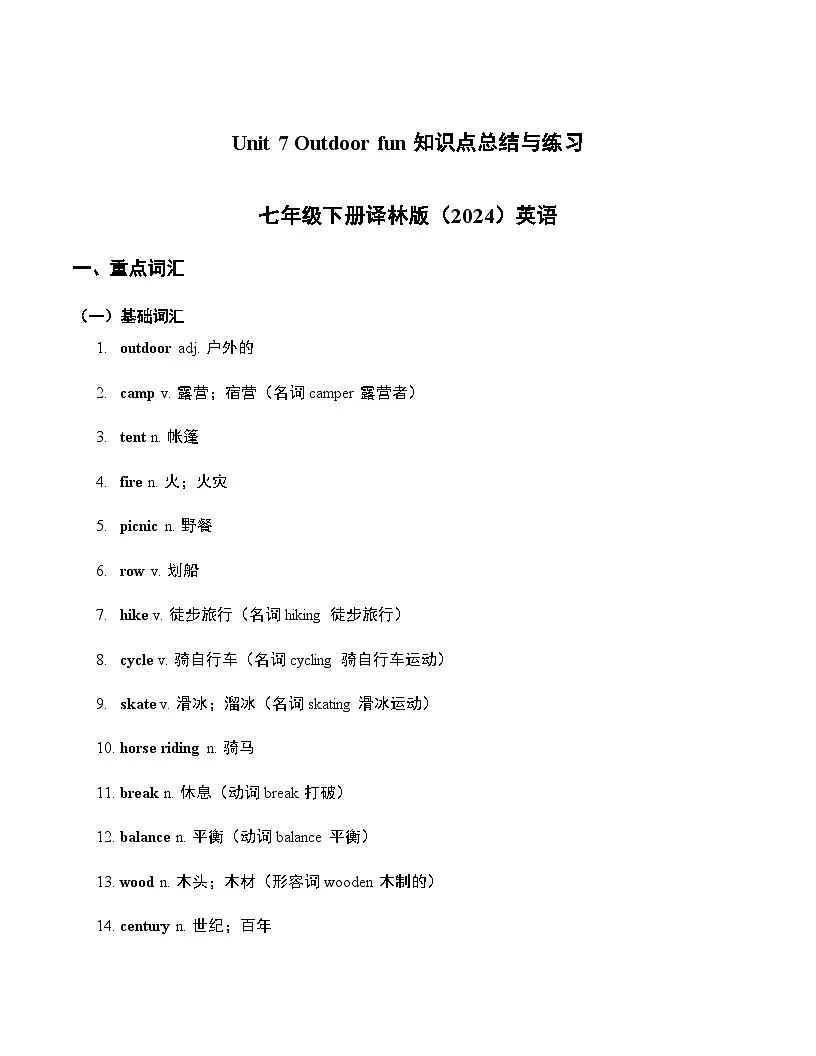
这是一份初中英语牛津译林版(2024)七年级下册(2024)Unit 7 Outdoor fun优秀课后测评,共11页。试卷主要包含了重点词汇,短语归纳,词义辨析,重点句型,语法聚焦等内容,欢迎下载使用。
一、重点词汇
(一)基础词汇
utdr adj. 户外的
camp v. 露营;宿营(名词 camper 露营者)
tent n. 帐篷
fire n. 火;火灾
picnic n. 野餐
rw v. 划船
hike v. 徒步旅行(名词 hiking 徒步旅行)
cycle v. 骑自行车(名词 cycling 骑自行车运动)
skate v. 滑冰;溜冰(名词 skating 滑冰运动)
hrse riding n. 骑马
break n. 休息(动词 break 打破)
balance n. 平衡(动词 balance 平衡)
wd n. 木头;木材(形容词 wden 木制的)
century n. 世纪;百年
prvince n. 省
mbile phne n. 手机
remember v. 记得;记住
dangerus adj. 危险的(名词 danger 危险)
excited adj. 激动的(形容词 exciting 令人兴奋的)
prepare v. 准备(名词 preparatin 准备)
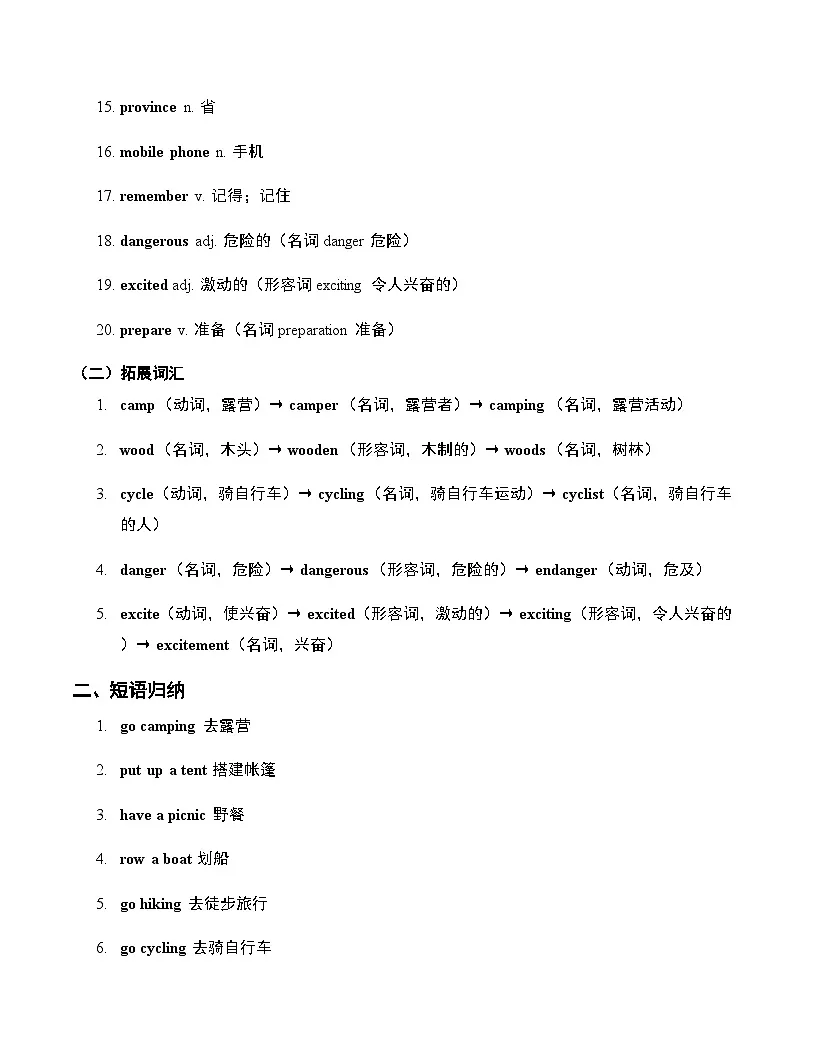
(二)拓展词汇
camp(动词,露营)→ camper(名词,露营者)→ camping(名词,露营活动)
wd(名词,木头)→ wden(形容词,木制的)→ wds(名词,树林)
cycle(动词,骑自行车)→ cycling(名词,骑自行车运动)→ cyclist(名词,骑自行车的人)
danger(名词,危险)→ dangerus(形容词,危险的)→ endanger(动词,危及)
excite(动词,使兴奋)→ excited(形容词,激动的)→ exciting(形容词,令人兴奋的)→ excitement(名词,兴奋)
二、短语归纳
g camping 去露营
put up a tent 搭建帐篷
have a picnic 野餐
rw a bat 划船
g hiking 去徒步旅行
g cycling 去骑自行车
g skating 去滑冰
g hrse riding 去骑马
take a break 休息一下
be clse t nature 亲近自然
wrk n balance 练习平衡能力
in the 13th century 在13世纪
make a fire 生火
be careful with 小心;注意
keep away frm 远离
in the cuntryside 在乡村
mbile phne 手机
frm then n 从那时起
be ready fr 为……做好准备
have fun ding sth. 做某事很开心
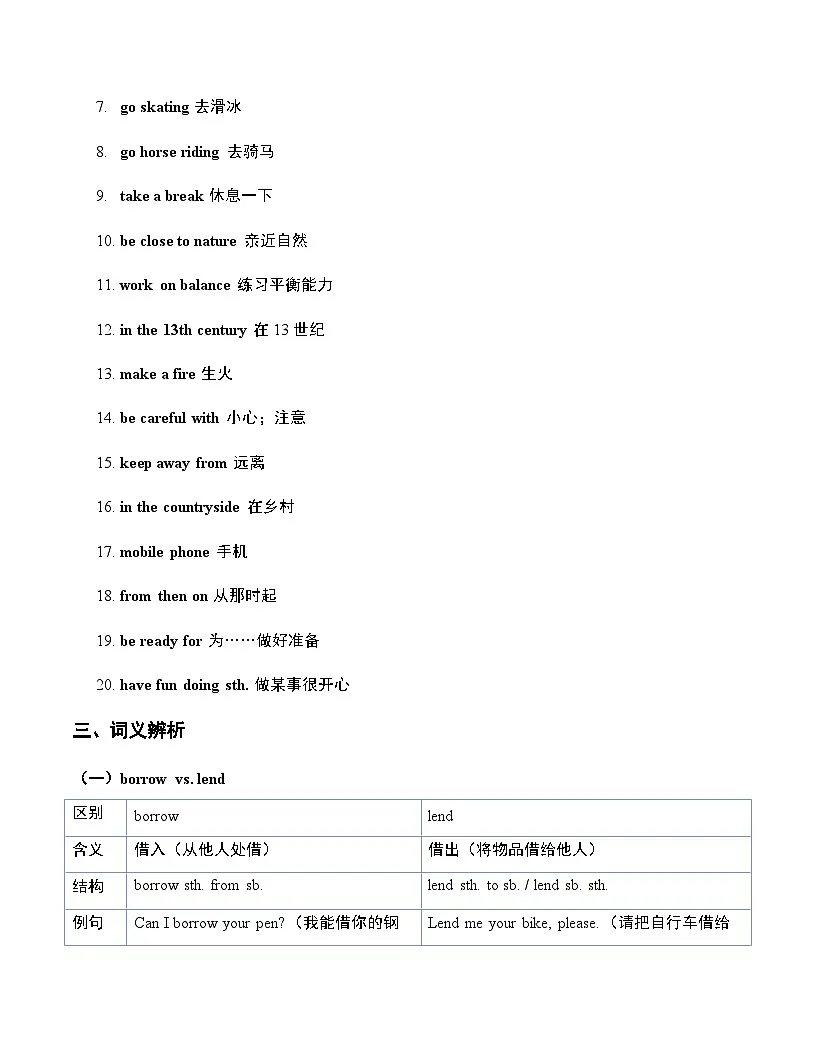
三、词义辨析
(一)brrw vs. lend
(二)take vs. bring
(三)dangerus vs. in danger
dangerus:危险的(描述事物的性质)。
例:Fire is dangerus.(火是危险的。)
in danger:处于危险中(强调状态)。
例:The animals are in danger.(动物们处于危险中。)
四、重点句型
—What utdr activity d yu like best?
你最喜欢什么户外活动?
—I enjy hiking because it makes me feel clse t nature.
我喜欢徒步旅行,因为它让我亲近自然。
We’re ging t put up ur tent near the lake this weekend.
我们打算这个周末在湖边搭帐篷。
It’s dangerus t play with fire. Yu shuld be careful.
玩火很危险,你应该小心。
Remember t bring yur mbile phne in case f emergencies.
记得带上手机以防万一。
She is excited abut the camping trip and can’t wait t g.
她对露营旅行很兴奋,迫不及待地想去。
In the 13th century, peple used wd t make kites.
在13世纪,人们用木头制作风筝。
五、语法聚焦
(一)一般将来时(be ging t)
结构:主语 + be (am/is/are) ging t + 动词原形
用法:表示计划、打算或有迹象表明即将发生的动作。
例:They are ging t have a picnic tmrrw.(他们明天打算野餐。)
否定句:He isn’t ging t jin the hiking club.(他不打算加入徒步俱乐部。)
疑问句:Are yu ging t bring a map?(你打算带地图吗?)
(二)现在进行时表将来
结构:主语 + be (am/is/are) + 现在分词
用法:表示已经计划或安排好的未来动作,常用于转移动词(如 g, cme, leave, start 等)。
例:We’re leaving fr the campsite this afternn.(我们今天下午出发去露营地。)
The meeting is starting in ten minutes.(会议十分钟后开始。)
(三)情态动词shuld的用法
表示建议或义务:“应该”。
例:Yu shuld drink plenty f water when hiking.(徒步时你应该多喝水。)
表示推测:“可能;应该”。
例:The weather shuld be fine tmrrw.(明天天气应该不错。)
否定形式:shuldn’t(不应该)。
例:Yu shuldn’t play near the fire.(你不应该在火边玩耍。)
练习题
(一)词汇填空(根据首字母或汉语提示写单词)
We need t p______ the tent befre it gets dark.
C______ is a ppular utdr activity in summer.
Dn’t t______ the bk away. I need it.
It’s d______ t swim in the river alne.
Remember t bring yur m______ phne in case f emergencies.
(二)用所给词的适当形式填空
The children are ______ (excite) abut the schl trip.
She ______ (g) hiking with her friends next weekend.
We ______ (nt skate) n the lake because it’s t cld.
______ (camp) is a great way t enjy nature.
Yu shuld ______ (be) careful with fire.
(三)单项选择
—What’s yur plan fr the weekend?
—I ______ camping with my family.
A. g B. went C. am ging D. have gne
—Can I ______ yur bike?
—Sure, but yu must return it tmrrw.
A. brrw B. lend C. keep D. buy
—Why d yu like hiking?
—Because it makes me feel ______ nature.
A. clse t B. far frm C. interested in D. wrried abut
—It’s ht tday. Let’s g swimming.
—______!
A. Gd luck B. Gd idea C. Gd jb D. Gdbye
—What shuld we d befre camping?
—We shuld ______ a tent and sme fd.
A. put up B. put n C. put ut D. put ff
(四)句型转换
They are ging t have a picnic this Sunday.(改为否定句)
They ______ ______ t have a picnic this Sunday.
I brrw a bk frm the library every week.(对划线部分提问)
______ ______ yu brrw a bk every week?
She is ging t visit her grandparents next mnth.(对划线部分提问)
______ ______ she ging t visit next mnth?
The lake is beautiful.(改为感叹句)
______ ______ the lake is!
Yu shuld be careful with fire.(改为同义句)
Yu ______ ______ careful with fire.
(五)阅读理解
Camping is a ppular utdr activity. It allws peple t enjy nature and spend time with family and friends. When camping, yu need t prepare a tent, sleeping bags, and fd. Yu can camp in a frest, by a lake, r in a muntain area.
Camping can be fun, but it’s imprtant t be safe. Always tell smene where yu are ging and when yu will return. Keep fd in sealed bags t avid attracting animals. And never leave a fire unattended.
Sme peple enjy hiking while camping. Hiking allws yu t explre nature and get exercise. Yu can als g fishing, swimming, r cycling during yur camping trip.
What is camping?
A. A ppular indr activity. B. A way t enjy nature.
C. A type f sprt. D. A way t ck fd.
What shuld yu d t avid attracting animals?
A. Keep fd in sealed bags. B. Leave a fire unattended.
C. G hiking alne. D. Camp in a frest.
What activities can yu d while camping?
A. Hiking and swimming. B. Fishing and cycling.
C. Bth A and B. D. Neither A nr B.
What is the main idea f the passage?
A. Hw t camp safely. B. The benefits f camping.
C. Ppular utdr activities. D. Bth A and B.
(六)书面表达
假设你是李华,你的英国朋友Tm想了解中国的户外活动。请你写一封邮件,内容包括:
介绍一种你喜欢的户外活动(如露营、徒步等);
描述活动的准备工作和过程;
邀请他来中国体验。
提示重点短语:
g camping
put up a tent
have fun
要求:60-80词,格式正确,语言通顺。
答案及解析
(一)词汇填空
【答案】put up
【解析】“搭建帐篷”,填put up。
【答案】Camping
【解析】“露营是夏季流行的户外活动”,填Camping。
【答案】take
【解析】“不要把书带走”,填take。
【答案】dangerus
【解析】“独自在河里游泳危险”,填dangerus。
【答案】mbile
【解析】“记得带手机”,填mbile。
(二)用所给词的适当形式填空
【答案】excited
【解析】“对学校旅行感到兴奋”,修饰人用excited,填excited。
【答案】is ging
【解析】next weekend提示用一般将来时,填is ging。
【答案】aren’t skating
【解析】现在进行时表将来,否定句用aren’t skating,填aren’t skating。
【答案】Camping
【解析】动名词作主语,填Camping。
【答案】be
【解析】shuld后接动词原形,填be。
(三)单项选择
【答案】C
【解析】“计划去露营”用be ging t结构,主语I用am ging,故选C。
【答案】A
【解析】“借入自行车”用brrw,故选A。
【答案】A
【解析】“亲近自然”用clse t,故选A。
【答案】B
【解析】“好主意”用Gd idea,故选B。
【答案】A
【解析】“搭建帐篷”用put up,故选A。
(四)句型转换
【答案】aren’t ging
【解析】否定句在are后加nt,缩写为aren’t,填aren’t ging。
【答案】Where d
【解析】对“从图书馆”提问用Where,助动词用d,填Where d。
【答案】Wh is
【解析】对“祖父母”提问用Wh,填Wh is。
【答案】Hw beautiful
【解析】感叹句结构Hw + 形容词 + 主语 + 谓语,填Hw beautiful。
【答案】shuldn’t be
【解析】“不应该不小心”即shuldn’t be careful,填shuldn’t be。
(五)阅读理解
【答案】B
【解析】第一段“Camping is a ppular utdr activity. It allws peple t enjy nature”,故选B。
【答案】A
【解析】第二段“Keep fd in sealed bags t avid attracting animals”,故选A。
【答案】C
【解析】第三段“hiking, fishing, swimming, r cycling”,故选C。
【答案】D
【解析】文章既讲露营的好处,也讲安全注意事项,故选D。
(六)书面表达(略)
(提示:开头介绍喜欢露营,描述准备帐篷、食物,搭建帐篷的过程,最后邀请Tm来体验。)区别
brrw
lend
含义
借入(从他人处借)
借出(将物品借给他人)
结构
brrw sth. frm sb.
lend sth. t sb. / lend sb. sth.
例句
Can I brrw yur pen?(我能借你的钢笔吗?)
Lend me yur bike, please.(请把自行车借给我。)
区别
take
bring
方向
带走(从说话者处到别处)
带来(从别处到说话者处)
例句
Take the umbrella with yu.(带上伞。)
Bring yur ntebk t class.(把笔记本带到课堂。)
这是一份初中英语牛津译林版(2024)七年级下册(2024)Unit 7 Outdoor fun优秀课后测评,共11页。试卷主要包含了重点词汇,短语归纳,词义辨析,重点句型,语法聚焦等内容,欢迎下载使用。
这是一份初中英语牛津译林版(2024)七年级下册(2024)Unit 7 Outdoor fun优秀同步训练题,共12页。试卷主要包含了单词翻译,词性转换,重点短语,重点句型等内容,欢迎下载使用。
这是一份初中英语Unit 7 Outdoor fun精品复习练习题,共9页。
 新教材
新教材
注册成功

在线客服
添加在线客服
获取1对1服务
官方微信
关注“教习网”公众号
打开微信就能找资料
赛课定制
添加在线客服
获取1对1定制服务
职称咨询
添加在线客服
获取1V1专业指导服务

免费福利

.png)
.png)
.png)
