免费领取教师福利
若您为此资料的原创作者,认为该资料内容侵犯了您的知识产权,请扫码添加我们的相关工作人员,我们尽可能的保护您的合法权益。

这是一份外研版(2024)八年级上册(2024)Understanding ideas巩固练习,共9页。
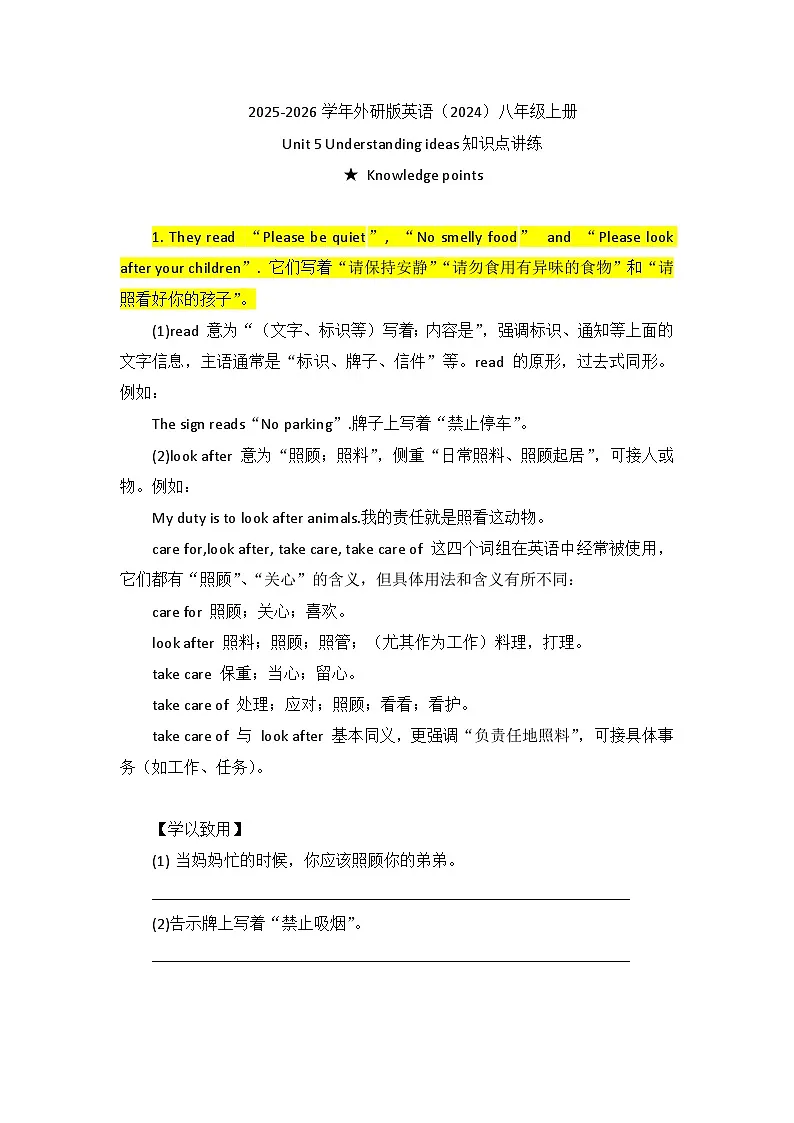
1. They read “Please be quiet”, “N smelly fd” and “Please lk after yur children”. 它们写着“请保持安静”“请勿食用有异味的食物”和“请照看好你的孩子”。
(1)read 意为“(文字、标识等)写着;内容是”,强调标识、通知等上面的文字信息,主语通常是“标识、牌子、信件”等。read 的原形,过去式同形。例如:
The sign reads“N parking”.牌子上写着“禁止停车”。
(2)lk after 意为“照顾;照料”,侧重“日常照料、照顾起居”,可接人或物。例如:
My duty is t lk after animals.我的责任就是照看这动物。
care fr,lk after, take care, take care f 这四个词组在英语中经常被使用,它们都有“照顾”、“关心”的含义,但具体用法和含义有所不同:
care fr 照顾;关心;喜欢。
lk after 照料;照顾;照管;(尤其作为工作)料理,打理。
take care 保重;当心;留心。
take care f 处理;应对;照顾;看看;看护。
take care f 与 lk after 基本同义,更强调“负责任地照料”,可接具体事务(如工作、任务)。
【学以致用】
当妈妈忙的时候,你应该照顾你的弟弟。
____________________________________________________________
(2)告示牌上写着“禁止吸烟”。
____________________________________________________________
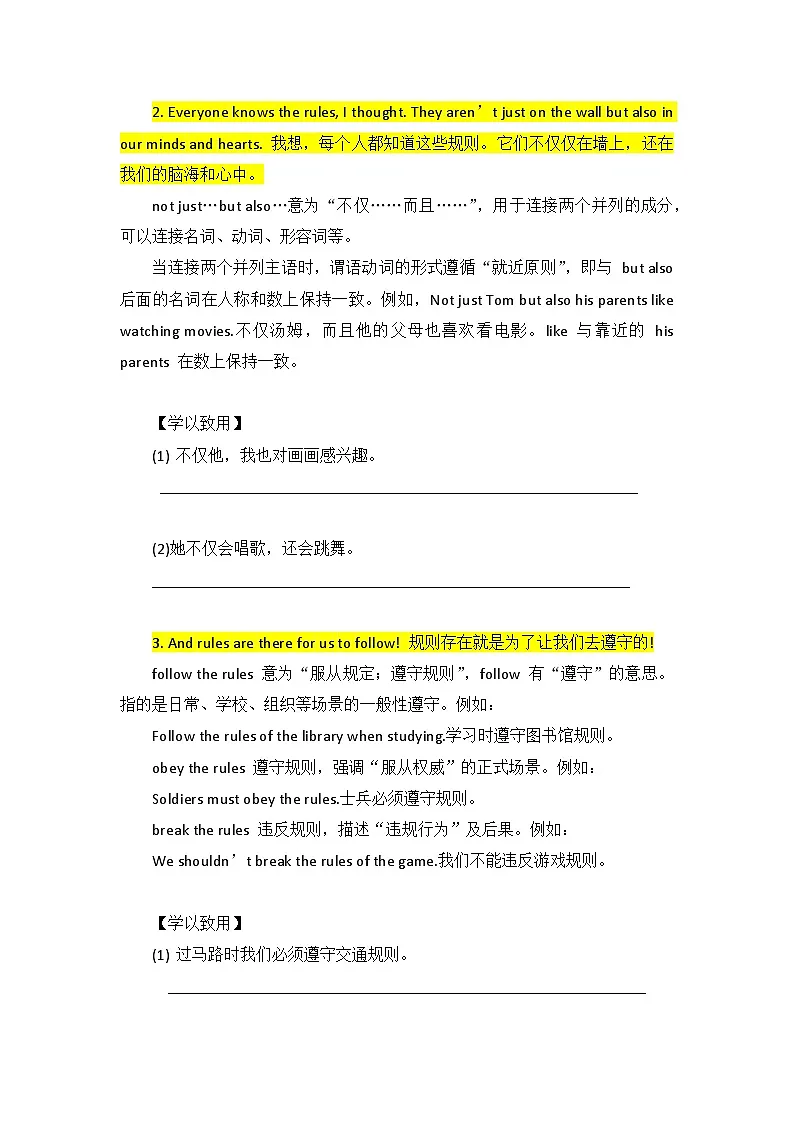
2. Everyne knws the rules, I thught. They aren’t just n the wall but als in ur minds and hearts. 我想,每个人都知道这些规则。它们不仅仅在墙上,还在我们的脑海和心中。
nt just…but als…意为“不仅……而且……”,用于连接两个并列的成分,可以连接名词、动词、形容词等。
当连接两个并列主语时,谓语动词的形式遵循“就近原则”,即与 but als 后面的名词在人称和数上保持一致。例如,Nt just Tm but als his parents like watching mvies.不仅汤姆,而且他的父母也喜欢看电影。like 与靠近的 his parents 在数上保持一致。
【学以致用】
不仅他,我也对画画感兴趣。
____________________________________________________________
(2)她不仅会唱歌,还会跳舞。
____________________________________________________________
3. And rules are there fr us t fllw! 规则存在就是为了让我们去遵守的!
fllw the rules 意为“服从规定;遵守规则”,fllw 有“遵守”的意思。指的是日常、学校、组织等场景的一般性遵守。例如:
Fllw the rules f the library when studying.学习时遵守图书馆规则。
bey the rules 遵守规则,强调“服从权威”的正式场景。例如:
Sldiers must bey the rules.士兵必须遵守规则。
break the rules 违反规则,描述“违规行为”及后果。例如:
We shuldn’t break the rules f the game.我们不能违反游戏规则。
【学以致用】
过马路时我们必须遵守交通规则。
____________________________________________________________
(2)遵守学校规章制度很重要。
____________________________________________________________
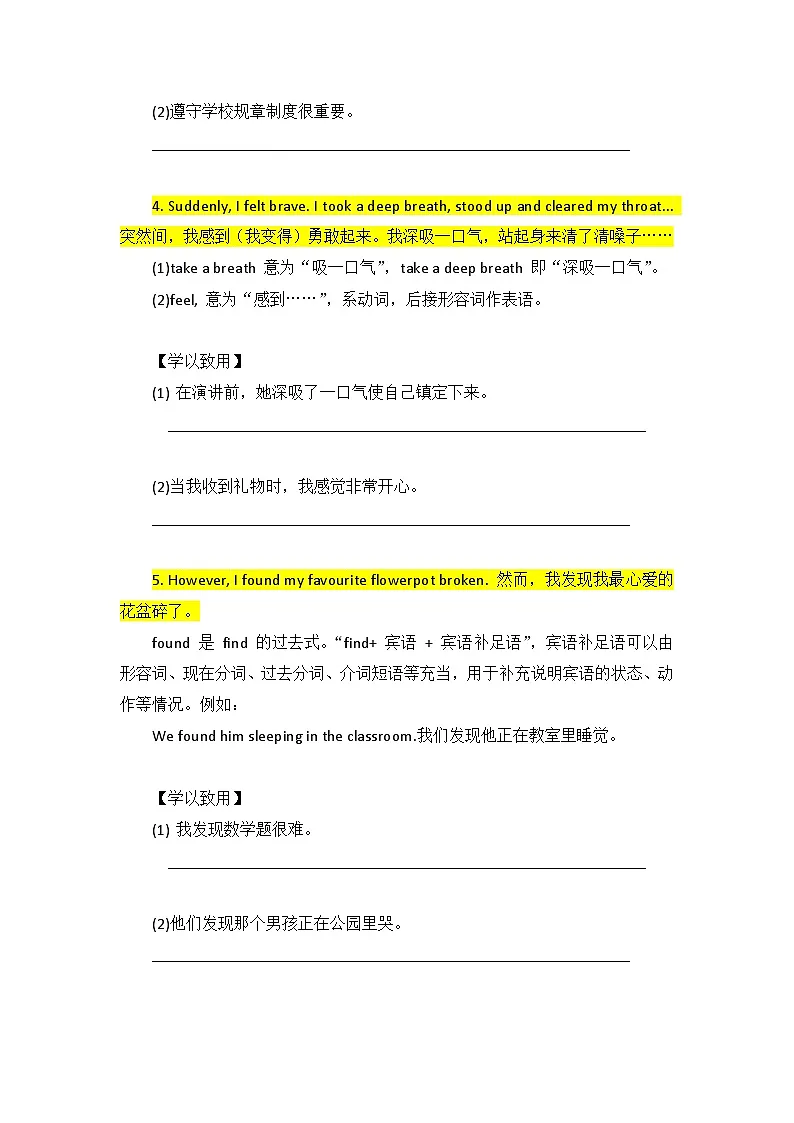
4. Suddenly, I felt brave. I tk a deep breath, std up and cleared my thrat... 突然间,我感到(我变得)勇敢起来。我深吸一口气,站起身来清了清嗓子……
(1)take a breath 意为“吸一口气”,take a deep breath 即“深吸一口气”。
(2)feel, 意为“感到……”,系动词,后接形容词作表语。
【学以致用】
在演讲前,她深吸了一口气使自己镇定下来。
____________________________________________________________
(2)当我收到礼物时,我感觉非常开心。
____________________________________________________________
5. Hwever, I fund my favurite flwerpt brken. 然而,我发现我最心爱的花盆碎了。
fund 是 find 的过去式。“find+ 宾语 + 宾语补足语”,宾语补足语可以由形容词、现在分词、过去分词、介词短语等充当,用于补充说明宾语的状态、动作等情况。例如:
We fund him sleeping in the classrm.我们发现他正在教室里睡觉。
【学以致用】
我发现数学题很难。
____________________________________________________________
(2)他们发现那个男孩正在公园里哭。
____________________________________________________________
Grammar
动词不定式作目的状语
动词不定式作目的状语知识点讲解参考教材131-132页内容。
一、基本形式:动词不定式的基本形式是t+动词原形,否定形式是在动词不定式前面直接加nt。在句中作目的状语时,用来表示谓语动词动作发生的目的。例如:
I get up early t catch the first bus.我早起是为了赶上第一班公交车。
在这个句子中,t catch the first bus就是动词不定式作目的状语,说明了get up early的目的。
二、位置
(1)动词不定式作目的状语时,通常位于句末。例如:
He studies hard t pass the exam.他努力学习是为了通过考试。
(2)为了强调目的,也可以将其置于句首,此时通常用逗号与句子其他部分隔开。例如:
T imprve my English,I read English bks every day. 为了提高我的英语水平,我每天都读英语书。
三、与其他结构的转换
(1)与in rder t/s as t的转换:in rder t和s as t都有"为了"的意思,后接动词原形,可与动词不定式作目的状语互换。但s as t一般不用于句首。例如:
I gt up early in rder t/s as t catch the early bus.= I gt up early t catch the early bus. 我早起是为了赶上早班车。
(2)与in rder that/s that的转换:in rder that和s that引导目的状语从句,其后接完整的句子,与动词不定式作目的状语可以相互转换。例如:
He studies hard in rder t pass the exam.= He studies hard in rder that he can pass the exam. 他努力学习是为了能通过考试。
四、注意事项
当动词不定式的逻辑主语与句子的主语不一致时,需要使用动词不定式的复合结构"fr+逻辑主语+动词不定式"。例如:
The teacher gives us sme advice n hw t learn English well fr us t imprve ur English.老师给我们一些关于如何学好英语的建议,以便我们提高英语水平。
【学以致用】
一、句型转换。
将以下两个句子合并为一个句子,使用t/in rder t/s as t。
1. I study every night. I want t pass the exam.
2. She turned ff her phne. She didn't want t be disturbed.
3. They brught umbrellas. They wanted t stay dry in the rain.
4. He wears glasses. He needs t read clearly.
5. We planted trees. We wanted t make the park greener.
二、用所给动词的适当形式填空。
1. They g t the gym ______ (exercise) every week.
2. I stay up late ______ (finish) my hmewrk.
3. She takes a bus ______ (g) t schl.
4. We plant trees ______ (make) the envirnment better.
5. He reads bks every day ______ (get) mre knwledge.
6. They study hard ______ (pass) the exam.
7. I get up early ______ (catch) the early bus.
8. She ges t the hspital ______ (see) her sick friend.
9. We clean the classrm ______ (make) it tidy.
10. He runs every mrning ______ (keep) healthy.
课后跟踪练
一、根据句意和首字母提示写出单词。
1. Dn't make s much n ______. The baby is sleeping.
2. Yu can put the fd in a p ______ t keep it fresh.
3. We are ging t have a p ______ in the park this Sunday.
4. There is a sign n the wall.It says "N fd".
5. Dn't k ______ the seat in frnt f yu. It's implite.
6. Please take a s ______ and wait fr a mment.
7. The p ______ n the bus are talking and laughing.
8. I didn't see a ______ in the dark rm.
9. Everyne shuld take r ______ fr their wn actins.
10. We shuld r ______ ur teachers and classmates.
二、用所给词的适当形式填空。
After a busy day at wrk,I gt n the train t g hme. I went t a quiet area in rder 1. ______ (read). I sat dwn and tk ut my bk.
Suddenly,a girl ppsite me started 2. ______ (play) lud music n her phne. What a 3. ______ (shck) I almst jumped up in 4. ______ (surprised).
A minute later,the man next t me tk ut several 5. ______ (packet) f fd. It was like he was n a picnic. Peple have t eat, f curse, but the fd was s 6. ______ (smell). It was like sitting next t a muntain f blue cheese.
I cvered my ears t 7.______ (effective) blck the nise cming frm Rck Girl. I cvered my nse as well t reduce the smell frm Mr Smelly Fd.
Then a by behind me started 8. ______ (kick) my seat. My 9. ______ (angry) grew. My face turned 10. ______ (red) than befre! I asked him t stp. Hwever, his mther replied, “Cme n, he’s just a kid.”
I turned arund t see the ther passengers’ faces. They als seemed 11. ______ (happy), but n ne did anything. Will they think me a fl if I d smething? I lked at the 12. ______ (sign) n the wall. They read “Please be quiet”, “N smelly fd” and “Please lk after yur children”. Everyne knws the rules, I thught. They aren’t just n the wall but als in ur minds and hearts. And rules are there fr us 13. ______ (fllw)!
Suddenly, I felt 14. ______ (brave) enugh. I tk a deep breath, std up and 15. ______ (clear) my thrat.
Understanding ideas答案
Knwledge pints
1. (1) When yur mther is busy, yu shuld lk after yur little brther.
(2) The ntice reads "N smking".
2. (1) Nt just he, but als I am interested in drawing.
(2) She can nt just sing but als dance.
3. (1) We must fllw the traffic rules when crssing the rad.
(2) It's imprtant t fllw the schl rules.
4. (1) Befre the speech, she tk a deep breath t calm herself dwn.
(2) I feel very happy when I receive the gift.
5. (1) I find maths prblems very difficult.
(2) They fund that by crying in the park.
Grammar
一、1. I study every night t/in rder t/s as t pass the exam.
2. She turned ff her phne s as nt t be disturbed./She turned ff her phne in rder nt t be disturbed.
3. They brught umbrellas t/in rder t/s as t stay dry in the rain.
4. He wears glasses t/in rder t/s as t read clearly.
5. We planted trees t/in rder t/s as t make the park greener.
二、1. t exercise 2. t finish 3. t g 4. t make 5. t get 6. t pass
7. t catch 8. t see 9. t make
10. t keep
课后跟踪练
1. nise 2. packet 3. picnic
4. smelly 5. kick 6. seat
7. passengers 8. anything
9. respnsibility 10. respect
1. t read 2. playing 3. shck
4. surprise 5. packets 6. smelly
7. effectively 8. kicking 9. anger
10. redder 11. unhappy 12. signs
13. t fllw 14. brave 15. cleared
注册成功

在线客服
添加在线客服
获取1对1服务
官方微信
关注“教习网”公众号
打开微信就能找资料
赛课定制
添加在线客服
获取1对1定制服务
职称咨询
添加在线客服
获取1V1专业指导服务

免费福利

.png)