免费领取教师福利
若您为此资料的原创作者,认为该资料内容侵犯了您的知识产权,请扫码添加我们的相关工作人员,我们尽可能的保护您的合法权益。

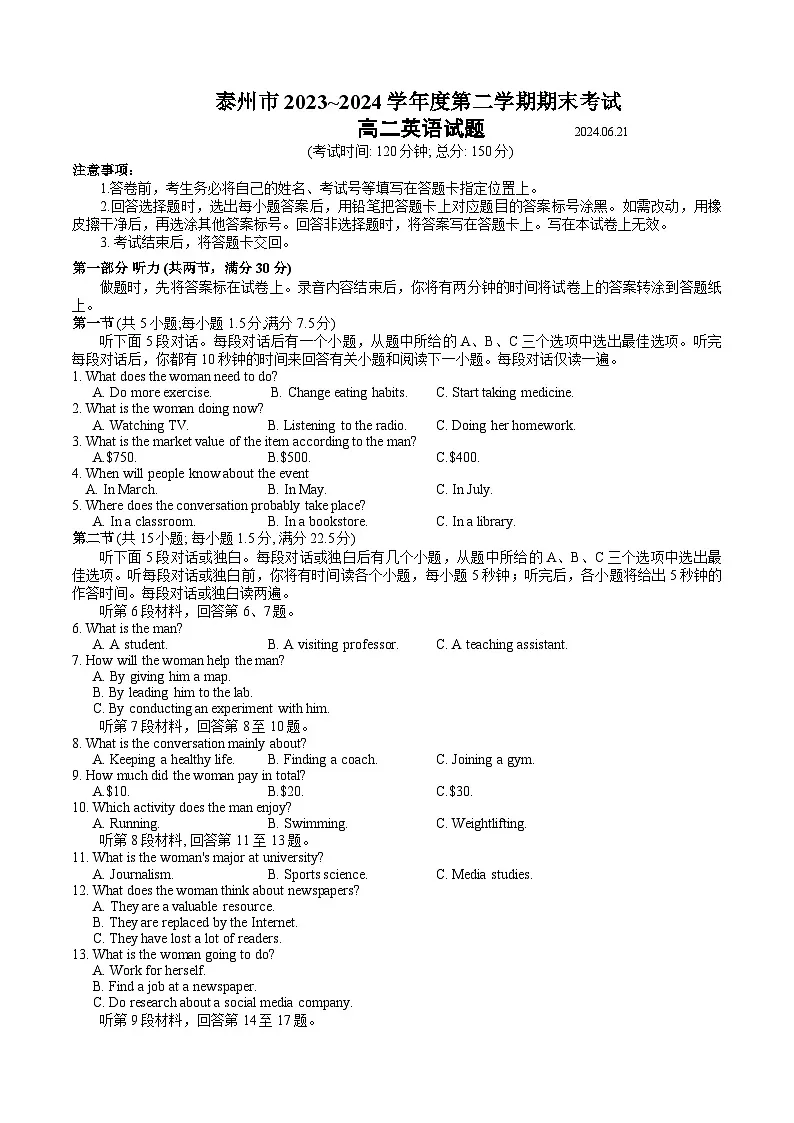


这是一份江苏省泰州市2023-2024学年高二下学期6月期末英语试题,共11页。试卷主要包含了 考试结束后,将答题卡交回等内容,欢迎下载使用。
(考试时间: 120分钟; 总分: 150分)
注意事项:
1.答卷前,考生务必将自己的姓名、考试号等填写在答题卡指定位置上。
2.回答选择题时,选出每小题答案后,用铅笔把答题卡上对应题目的答案标号涂黑。如需改动,用橡皮擦干净后,再选涂其他答案标号。回答非选择题时,将答案写在答题卡上。写在本试卷上无效。
3. 考试结束后,将答题卡交回。
第一部分 听力 (共两节,满分30分)
做题时,先将答案标在试卷上。录音内容结束后,你将有两分钟的时间将试卷上的答案转涂到答题纸上。
第一节 (共5 小题;每小题1.5分,满分7.5分)
听下面5段对话。每段对话后有一个小题,从题中所给的A、B、C三个选项中选出最佳选项。听完每段对话后,你都有10秒钟的时间来回答有关小题和阅读下一小题。每段对话仅读一遍。
1. What des the wman need t d?
A. D mre exercise. B. Change eating habits.C. Start taking medicine.
2. What is the wman ding nw?
A. Watching TV.B. Listening t the radi.C. Ding her hmewrk.
3. What is the market value f the item accrding t the man?
A.$750.B.$500.C.$400.
4. When will peple knw abut the event
A. In March.B. In May. C. In July.
5. Where des the cnversatin prbably take place?
A. In a classrm. B. In a bkstre. C. In a library.
第二节 (共15小题; 每小题1.5分, 满分22.5分)
听下面5段对话或独白。每段对话或独白后有几个小题,从题中所给的A、B、C三个选项中选出最佳选项。听每段对话或独白前,你将有时间读各个小题,每小题 5 秒钟;听完后,各小题将给出5秒钟的作答时间。每段对话或独白读两遍。
听第6段材料,回答第6、7题。
6. What is the man?
A. A student. B. A visiting prfessr.C. A teaching assistant.
7. Hw will the wman help the man?
A. By giving him a map.
B. By leading him t the lab.
C. By cnducting an experiment with him.
听第7段材料,回答第8至10题。
8. What is the cnversatin mainly abut?
A. Keeping a healthy life.B. Finding a cach.C. Jining a gym.
9. Hw much did the wman pay in ttal?
A.$10. B.$20.C.$30.
10. Which activity des the man enjy?
A. Running.B. Swimming. C. Weightlifting.
听第8段材料, 回答第11 至 13 题。
11. What is the wman's majr at university?
A. Jurnalism.B. Sprts science.C. Media studies.
12. What des the wman think abut newspapers?
A. They are a valuable resurce.
B. They are replaced by the Internet.
C. They have lst a lt f readers.
13. What is the wman ging t d?
A. Wrk fr herself.
B. Find a jb at a newspaper.
C. D research abut a scial media cmpany.
听第9段材料,回答第14至17题。
14. What is special abut the carrts?
A. They are especially large.
B. They are naturally grwn.
C. They have been cleaned with chemicals.
15. Where des the man’s uncle sail his bat?
A. On the lake.B. In the cean.C. Alng a river.
16. What is the prbable relatinship between the speakers?
A. Uncle and niece.B. Farmer and visitr.C. Shp assistant and custmer.
17. What kind f persn is the wman?
A. Friendly.B. Adventurus.C. Disagreeable.
听第10段材料,回答第18至20题。
18. What shuld yu d first t learn abut a new culture accrding t the speaker?
A. Visit a museum. B. Try lcal fd.C. Learn the native language.
19. What is the benefit f taking part in hliday events?
A. Getting lts f free fd.
B. Discvering mre abut traditins.
C. Learning many unique expressins.
20. What’s the speaker’s suggestin at the end f the talk?
A. Asking questins.B. Becming a teacher.C. Being prud f yur wn culture.
第二部分 阅读理解 (共两节,满分42.5分)
第一节 (共12小题; 每小题2.5分, 满分30分)
阅读下列短文,从每题所给的A、B、C和D四个选项中,选出最佳选项。
A
Sia was 13 when she nticed the bareft children f wrkers at a cnstructin site. “Their feet were bare. Hard. Dirty. Bleeding.” reflects Sia. “They were just walking arund just as it was an everyday practice.” It was then that Sia realized their lives were s different frm hers.
Sia went back hme and saw shes piled up high — many f which hadn't been wrn fr mnths. Then she rushed t distribute them t the children she saw at the building site. Later that year, with the help f her parents and cmmunity vlunteers, Sia funded Sle Warrirs, a charity cmmitted t prviding shes t thse in need, whse mtt is: “Dnate a sle(鞋), save a sul.”
The idea quickly grew. After she spread the wrd with psters, enquiries frm peple wh wanted t help came flding in. Nw in its fifth year, the rganizatin cllects used shes, refurbishes(翻新) it and dnates the finished prducts t peple in need. That need is endless. In the wrld, an estimated 300 millin peple can't affrd shes. Of the nearly 24 billin shes made every year, shckingly mre than 90 percent end up in dustbins.
In its first distributin, Sle Warrirs cllected and gave ut 700 pairs f shes. Tday that number rises t 28,000 acrss fur cuntries. But the rganizatin's grwth met with many challenges. When it came t lking fr a cmpany that wuld d the refurbishments free f charge, Sia faced ne barrier after anther befre finding a partner. “Being a 13-year-ld, I did face a lt f prejudice because peple were less willing t hear what I say.” says Sia.
In recgnitin f her great influence, Sia was given the Diana Award in 2021. It’s ne f the mst remarkable hnrs a yung persn can receive fr scial actin. But her wrk isn't dne. “Our gal has always been t tuch a millin feet,” she says.
21. Why des the authr mentin Sia’s visit t a cnstructin site?
A. T display Sia’s genersity.
B. T aruse readers’ sympathy.
C. T shw the life f cnstructin wrkers.
D. T explain why Sia started Sle Warrirs.
22. Hw des Sle Warrirs ffer help?
A. By urging gvernments t make jint effrts.
B. By dnating refurbished shes t thse in need.
C. By cllecting secnd-hand shes frm dustbins.
D. By searching fr cmpanies t make new shes fr free.
23. What difficulty did Sia have in develping the rganizatin?
A. Their dnatin culdn’t meet peple’s demand.
B. The prcess f refurbishment was t cmplicated.
C. Her request was rejected by quite a few cmpanies.
D. Few peple were willing t give away their ld shes.
24. What can we infer frm the last paragraph?
A. Being a scialist is Sia’s dream.
B. The Diana Award is awarded annually.
C. Sia felt ttally satisfied with her scial actin.
D. Sia wuld nt stp her wrk with Sle Warrirs.
【语篇导读】本篇讲述了13岁女孩Sia成立慈善机构Sle Warrirs为赤脚儿童捐赠鞋子的故事。
21. D 写作目的题。第一段讲述了Sia目睹了赤脚孩子们的悲惨遭遇,根据后文“It was then that Sia realized their lives were s different frm hers.” “Then she rushed t distribute them t the children she saw at the building site. ”“Later that year,……Sia funded Sle Warrirs”可知,这段经历是Sia开始帮助赤脚孩子们乃至于成立慈善机构的起因与动机,故选D,解释Sia为什么要成立Sle Warrirs。而A选项为展现Sia的慷慨并不准确,文章重点并不只是表现Sia的慷慨这一点,而是她因为一个人的慷慨与善良进一步成立了机构呼吁全世界的人们帮助赤脚孩子们,同时第一段本身不能展现Sia的慷慨,而要同时结合第二段等后文,舍去。B选项为引发读者的同情,C选项为展现建筑工人的生活,均不是作者的主要目的,故舍去。
22. B 细节理解题。根据第三段“the rganizatin cllects used shes, refurbishes(翻新) it and dnates the finished prducts t peple in need.”慈善组织通过收集、翻新用过的鞋子并捐赠出去来帮助孩子,故选择B选项。A选项为督促政府于原文无据,C选项为从垃圾桶里找二手鞋,根据前文“ enquiries frm peple wh wanted t help came flding in”,可以推测鞋子的来源是人们捐赠而非垃圾桶,D选项为寻找公司来免费做新鞋,由于后文谈到的是寻找可以免费翻新鞋子的公司,翻新不等于做新鞋,故全部舍去,选择B选项。
23. C 细节理解题。根据第四段“When it came t lking fr a cmpany that wuld d the refurbishments free f charge, Sia faced ne barrier after anther befre finding a partner. ‘Being a 13-year-ld, I did face a lt f prejudice because peple were less willing t hear what I say.’” 可知,Sia遇到的困难是由于人们不愿意听一个13岁女孩的想法,她很难找到很够帮助免费翻新鞋子的公司。A选项为他们的捐赠满足不了人们的需求,B选项为翻新过程太过复杂,D选项为很少的人愿意捐赠他们的旧鞋子,均没有提到,全部舍去。故选择C选项。
24. D 内容推断题。根据本段“But her wrk isn't dne. ‘Our gal has always been t tuch a millin feet,‘she says.”可知,在Sia认知里她的工作永远不会停止,她会一直帮助赤脚的孩子们,故选择D选项,Sia不会停止她Sle Warrirs的工作。A选项成为一个社会人物是Sia的梦想,B选项狄安娜奖是一年一颁发的,C选项Sia对于她的社会行为十分满意,选项均于原文无据,故选D。
B
When it cmes t ppular symbls f marriage, ne cannt lk past the wedding ring. The wedding ring serves as a perfect symbl f everlasting lve —a ring is a circle and thus has n beginning r end, representing the never-ending unin f marriage.
Evidence suggests that wedding rings were used in ancient Egypt arund 6,000 years ag. Hwever, unlike the metals and jewels used tday, they were crafted frm materials such as leather r bne. In the centuries that fllwed, the wedding ring traditin was picked up in the West, where it spread first in ancient Rme and Greece, subsequently thrughut Eurpe during the Middle Ages, and eventually t Eastern culture.
Thrughut histry, the rund shape f the ring has cntinued, and s has the traditin f wearing it n the furth finger f the left hand. The latter practice riginated frm an ancient belief that a vein(静脉) ran directly frm this finger t the heart. Althugh this belief has since been cnsidered wrng, the custm has cntinued.
Regarding custms surrunding wedding rings, there was a time when nly the bride wre a wedding ring. It wasn’t until the early 20th century that the practice f bridegrms wearing rings gained ppularity. This change was influenced by sldiers ging ff t war, wh wre rings as reminders f their lved nes waiting fr them at hme. Tday, the exchange f wedding rings remains an essential part f the wedding ceremny, symblizing the cmmitment and lve shared between tw individuals wh will begin a life tgether.
Wedding rings hld a symblic significance that ties the tw members f a married cuple. In an ever-changing wrld, the wedding ring stands as an ancient traditin that is likely t cntinue fr generatins t cme, reflecting the timeless and everlasting lve celebrated thrugh marriage.
25. What can we knw abut wedding rings in the text?
A. They have their rts in Eurpe.
B. They date back t the Middle Ages.
C. They symblize the wners' scial status.
D. The rund shape has remained unchanged.
26. Why did peple in ancient times wear a wedding ring n the furth finger f the left hand?
A. Because it brught gd luck t sldiers ging ff t war.
B. Because they wished t keep their lver in their heart.
C. Because a vein runs directly frm this finger t the heart.
D. Because it represented the never-ending unin f marriage.
27. What can be predicted abut the future f the wedding ring traditin?
A. It will underg great changes.
B. It will gradually fall ut f date.
C. It will prbably last fr quite a lng time.
D. It will nly be ppular in certain cultures.
28. What is the text mainly abut?
A. The design f wedding rings.
B. The significance f wedding rings.
C. The lng histry f wedding rings.
D. The materials used fr wedding rings.
【语篇导读】本篇讲述了结婚戒指的起源与发展历史和未来发展趋势。
25. D 细节理解题。由第一段 “a ring is a circle and thus has n beginning r end, representing the never-ending unin f marriage.”可知结婚戒指是圆形的,并且后续全文并没有提到戒指的形状在历史演变中出现变化,故选D。A选项由第二段Evidence suggests that wedding rings were used in ancient Egypt arund 6,000 years ag.可知戒指起源于埃及,而由后文可知在几世纪后戒指文化才传入欧洲;B选项由后文“In the centuries that fllwed, the wedding ring traditin was picked up in the West, where it spread first in ancient Rme and Greece, subsequently thrughut Eurpe during the Middle Ages, and eventually t Eastern culture.”,中世纪是戒指传入欧洲的时间而非起源的时间,不能用“date back”;C选项由全文多次出现“The wedding ring serves as a perfect symbl f everlasting lve ”戒指象征持久而纯洁的爱情,并且全文没有出现戒指象征社会地位的论述,属于无中生有,故选D。
26. B 细节理解题。根据第三段“The latter practice riginated frm an ancient belief that a vein (静脉) ran directly frm this finger t the heart.”可知,左手的无名指在传统信仰里是直接连接心脏的部位,故可推断戒指戴在此处象征着将爱意连接心脏,将爱人置于心底,B符合题意,而C选项由于后文“Althugh this belief has since been cnsidered wrng, the custm has cntinued”为这种说法“辟谣”了,故C选项本身是人们的错误认知,故舍去。而A选项于原文无据,D选项将戒指形状的意义张冠李戴到佩戴位置上,舍去。故选B。
27. C 细节理解题。根据最后一段“In an ever-changing wrld, the wedding ring stands as an ancient traditin that is likely t cntinue fr generatins t cme, reflecting the timeless and everlasting lve celebrated thrugh marriage. ”可知结婚戒指作为一项历久弥新的传统,在未来将会一代代继续传承下去,象征着无穷无尽的爱意,其余选项均不符合题意,故选C。
28. C 主旨大意题。根据全文内容,文章首先介绍了戒指历史在埃及起源,然后传播到欧洲,然后介绍戒指的佩戴习惯与形式在历史中的演变与发展,最后总结戒指作为结婚者爱意的象征将会继续传承下去。所以这篇文章主要讲了戒指的漫长历史。A选项为戒指的设计,B选项戒指的重要性,D选项戒指的用材,均不符合,故选C。
C
At the Prt f Ls Angeles, a lng gray ship is ding its part t fight against climate change. On the ship, which belngs t Captura, a Ls Angeles-based cmpany, is a system f pipes, pumps, and cntainers that pumps seawater and remves CO₂, which can be used t make plastics and fuels r buried. Then the treated seawater is returned t the cean, where it absrbs mre CO₂ frm the atmsphere, in an effrt t battle the rise f the greenhuse gas.
Capturing(捕获) CO₂ frm the cean shuld be easier and cheaper than a seemingly mre direct apprach: capturing it directly frm the air. Direct air capture, which relies n fans t sweep air past chemicals that can absrb CO₂, currently csts between $600 t $1000 per tn f CO₂ remved, largely because atmspheric CO₂ nly makes up less than 0.05% f the air by vlume. Earth's ceans, in cntrast, hld the gas at a cncentratin nearly 150 times higher, and absrb rughly 30% f all emitted(排放) CO₂ each year.
Besides, cean capture is develping faster than ther cean CO₂ remval appraches. That’s partly because the systems can usually be attached t desalinatin(脱盐) plants, wastewater treatment equipment, and ther large water-prcessing systems.
Hwever, ne challenge fr the apprach is determining exactly hw much CO₂ the treated water absrbs and at what rate. Still, the absrptin rates will vary based n where the water is released and hw easily it mixes with surrunding water. That makes site selectin a really imprtant part f this prcess.
Even if the technlgy takes ff, it will have t be prmted widely t make a difference in ffsetting glbal emissins. Accrding t the Intergvernmental Panel n Climate Change, by 2050 engineered carbn remval effrts will need t remve sme 5 billin tns f CO₂ every year t limit the glbal temperature increase t 1.5°C. At present, the cean capture cmpanies are remving nly thusands f tns.
29. What des Paragraph 1 mainly talk abut?
A. The re use f remved CO₂.
B. The basic infrmatin abut Captura.
C. The wrking prcess f cean capture.
D. An unusual phenmenn in Ls Angeles.
30. Why des cean capture cst less than direct air capture?
A. Because the system is used mre widely.
B. Because the cean absrbs CO₂ mre directly.
C. Because capturing CO₂ frm the cean is faster.
D. Because the cncentratin f CO₂ in seawater is higher.
31. What des the underlined wrd “ffsetting” in Paragraph 5 mean?
A. Sending ut. B. Canceling ut. C. Figuring ut. D. Giving ut.
32. What des the Intergvernmental Panel n Climate Change want t cnvey?
A. The cean capture cmpanies still have a lng way t g.
B. The cean capture cmpanies have remved enugh CO₂.
C. Mre CO₂ will be emitted int the atmsphere in the future.
D. Limiting the glbal temperature increase t 1.5℃is the final gal.
【语篇导读】本篇文章主要介绍了从海洋中捕集二氧化碳的方法以及这种方法相比于其他二氧化碳捕集技术的优势和这种技术推广应用方面的不足。
29. C 根据第一段“ On the ship, , is a system f pipes, pumps, and cntainers that pumps seawater and remves CO₂ Then the treated seawater is returned t the ”可知第一段主要描述了船只从海水中除去二氧化碳,之后再将处理后的海水倾倒回海洋的过程,即捕集海水中二氧化碳的过程。故选C选项。
30. D 根据第二段“ largely because atmspheric CO₂nly makes up less than 0.05% f the air by vlume. Earth's ceans, in cntrast, hld the gas at a cncentratin nearly 150 times higher, and absrb rughly 30% f all emitted (排放) CO₂each year”可知海洋捕集技术比空气捕集技术更具经济效益的原因是海洋中二氧化碳浓度远高于空气中二氧化碳浓度。
31. B “send ut”发出“cancel ut”抵消“figure ut”解决“give ut”发出,根据划线处语境,可知原文文意为“即使海洋捕集技术发展迅速,这种技术需要被广泛推广才能有助于抵消全球碳排放。”
32. A 根据最后一段“by 2050 engineered carbn remval effrts will need t remve sme 5 billin tns f CO₂every year t limit the glbal temperature increase t 1.5°C. At present, the cean capture cmpanies are remving nly thusands f tns.”,可知根据“the Intergvernmental Panel n Climate Change",二氧化碳海洋捕集公司移除的二氧化碳量远小于所需量。
第二节 (共5 小题; 每小题2.5分, 满分12.5分)
根据短文内容,从短文后的选项中选出能填入空白处的最佳选项。选项中有两项为多余选项。
The imprtance f learning utside ges beynd fresh air and fun. Spending time utdrs can expse kids t the cncept f climate change. Here are sme tips.
●Keep a climate jurnal. Yu can explain t yur children that climate is a pattern f weather. 33 Hwever, in recent years, extreme weather like strms and abnrmal temperatures has ccurred frequently. Have them keep a weather jurnal t get a sense f the climate.
● 34 Kids can help take care f plants, like vegetables r plants in a garden. Grwing and lking after plants helps children understand that peple have a rle t play in helping living things meet their needs. Make cnnectins between climate change and the needs f plants.
●Play sme games. Encurage yur children t head utside fr a few runds f nature scavenger hunt (寻物游戏) , where yu give them a list f items t find, like sticks, clrful leaves and rcks. It is als a gd chice t play “I Spy”, which gets them t assciate wrds with the natural wrld. 35
●Build an utdr tl set. Put tgether an utdr tl set with a magnifying glass(放大镜),a telescpe and a cntainer. 36 Then, try starting with smething they are interested in, such as building a mini park r cllecting natural items.
●Walk and talk. G n walks with yur kids frequently. Alng the way bserve and discuss hw ther members f the cmmunity are helping the envirnment. 37 Over time, under the guidance f parents, kids will grw int adults wh care abut the envirnment.
A. Get in the dirt.
B. It used t be mre stable.
C. Observe the plants arund.
D. These tls allw kids t survive in the wild.
E. Language enables kids t better cnnect t their envirnment.
F. These tls can help kids find and cllect natural samples and play freely.
G. Putting these cnversatins int daily life keeps kids aware f climate change.
【语篇导读】本篇文章强调了户外活动对孩子认识气候变化的重要性,并提出了五个建议:1. 保持气候日记;2. 亲近自然;3. 玩游戏;4. 建立户外工具套装;5. 散步并交流。通过这些活动,孩子们能更好地了解气候变化,并培养环保意识。
33. B 前后衔接,前文提到城市中可以感受自然,后一句说是走出家门,中间需要过渡,自然不一定在荒野中。
34. A 一词多义,“dirt”同时有泥土的意思,与后文“plants”以及所提园艺活动相关,总起。
35. E 段尾总结前文,“language”和“items”呼应,“assciate”与“cnnect”同义替换,“nature”和“envirnment”对应。
36. F “tl”重复出现,整段都与工具相关。F选项总结前文工具用途,衔接下文对工具的使用。
37. G “cnversatins”与“talk”相呼应,意为把这些谈话融入日常生活,让孩子在成长过程中逐渐懂得保护环境。
第二部分 语言知识运用 (共三节,满分37.5分)
第一节 (共15 小题; 每小题1分, 满分15分)
阅读下面短文,从短文后各题所给的 A、B、C和 D 四个选项中,选出可以填入空白处的最佳选项。
As a kid, I ften suffered frm nsebleeds. My parents had sme 38 f traditinal Chinese medicine, and they said this was caused by my lve fr 39 fruits. Lychees, my 40 , had given me “t much heat.” But it didn't stp me frm eating them by the 41 . After we mved frm China t Canada, lychees became harder t find. Whenever we drve t a Chinatwn, I wuld 42 all the fruit markets fr my red jewels.
As I grw lder, trying new fruits widens my hrizns. Just when I thught I had 43 every pleasant fruity smell in the wrld, the lul(龙葵) appeared at my regular fruit shp. Its taste left me wide-eyed and 44 . The strng, sweet flavr filled my whle huse fr days. It was such a 45 smell that I’d rather believe it was picked frm a fd scientist’s imaginatin.
“What lasted is what the sul ate,” Jack Gilbert wrte in his pem The Spirit and the Sul, “The way a child knws the wrld by putting it int his 46 .” Each tasting is a chance t be 47 with my inner child. The experience is n less 48 than seeing the cean fr the first time, leaving me 49 what else this wrld has been hiding frm us.
I try mst fruits nly several times because I always lve newer things. But there is ne I keep returning t: the sursp(刺果番荔枝). When it is ripe, it tastes wnderful. Wait just ne mre day, 50 , and it starts t brwn, giving ff a terrible smell. Yes, it ges bad fast, 51 that life is t shrt. S dn't let ur sweetest days 52 .“Taste” the jys arund us as they cme alng.
38. A. prejudiceB. knwledgeC. applicatinD. recgnitin
39. A. unusualB. unsafeC. unknwnD. unfrgettable
40. A. ptinB. recipeC. favriteD. privilege
41. A. halfB. pileC. grupD. dzen
42. A. searchB. purchaseC. cnsultD. apprach
43. A. checkedB. encunteredC. cntactedD. explred
44. A. tirelessB. hpelessC. speechlessD. restless
45. A. rareB. familiarC. terribleD. vital
46. A. mindB. pcketC. muthD. heart
47. A. refreshedB. reunitedC. rechargedD. rearranged
48. A. rewardingB. practicalC. meaningfulD. memrable
49. A. understandingB. investigatingC. wnderingD. suspecting
50. A. thughB. therefreC. therwiseD. instead
51. A. recmmendingB. prmising C. ensuringD. reminding
52. A. set inB. slip awayC. split upD. slw dwn
【语篇导读】本篇讲了作者由加拿大到中国,吃不到曾经喜爱的水果,后来偶然间吃到龙葵,最终使他开始不断尝试新水果的故事,作者由自己的经历启发人们要把握住最美好的年华,去品味快乐,活出精彩。
38. B 作者的父母因为对中药有所了解,所以才会说流鼻血是吃了某些给了作者t much heat的水果所致,故填knwledge,选择B项。
39. A 这种水果有名字lychees,所以不是unknwn,作者接下来还接着吃,所以unsafe也排除,unfrgettable与上下文无关联,而这种水果可以给作者t much heat可知它不是一般的水果,故填unusual,选择A项。
40. C 上文提到my lve fr,可知这种水果是作者的喜爱之物,故填favrite,选择C项。
41. D 由上下文题意可知流鼻血并未阻止作者大量地吃这种水果,by the pile和by the dzen都有大量的意思,但根据实际,by the pile(成堆)太过夸张,by the dzen(按打)更符合实际,故填dzen,选择D项。
42. A 上文说这种水果becme harder t find,可知下文作者每去到一个中国镇子,都会在水果市场里寻找那种水果,故填search,选择A项。
43. B 作者自以为已经见识过世间所有pleasant fruity smell,A项check,检查,不合句意,C项cntact,联系,不合句意,D项explre,探索,水果香气不是什么很深奥的东西,探索用词太夸张,故用encunter(偶遇),选择B项。
44. C 本题描写作者吃了龙葵之后的反应,由wide-eyed及下文可知作者吃了以后吃惊于它这么好吃,选项里只有speechless(说不出话来)也表示吃惊,故填spechless,选择C项。
45. A 作者说那气味就像从食物科学家想象里而来,可知它的气味很独特,故填rare,B项familiar,熟悉,不合句意,若是熟悉的话作者不会这么吃惊,排除。C项terrible(糟糕的)与上文矛盾,排除。D项vital(重要的)不合逻辑,排除。选择A项。
46. C 上下文都在讲吃,可知本句讲的是一个孩子了解东西的方式就是把它放进嘴里,故填muth,选择C项。
47. B 上文说孩子通过把事物放进嘴里来了解它,由此推断下文意思:每一次品尝都是和自己内心中的孩子的:A项refresh,刷新,恢复精力,B项reunit,重聚,C项recharge,重新充电,D项rearrange,重新安排。综合来看B项最合题意,故选择B项。
48. D 作者说吃龙葵的经历就和第一次看海一样,是令人印象深刻的,故填memrable,选择D项。A项rewarding(有回报的),B项practical(实际的)均不合逻辑,C项meaningful由于作者没有点明意义,对意义没有重点说明,故排除,选择D项。
49. C 作者吃了龙葵后觉得自己还有很多东西没有见过,他想知道还有多少是这个世界藏起来的,故用wnder,选择C项。
50. A 前文说仅仅多等一天,后文说它就开始腐败,可知为转折关系,使用thugh,选择A项。
51. D 作者由刺果番荔枝很容易腐败联想到人生,它提醒着我们人生太过短暂,故用remind,选择D项。
52. B A项set in表示开始,到来,B项slip away表示溜走,C项split up表示分手,D项slw dwn表示慢下来。本句意思为要抓住我们最美好的年华去品味快乐,不要让它溜走,故选择B项。
第二节 (共10小题; 每小题1.5分, 满分15分)
阅读下面短文,在空白处填入1个适当的单词或括号内单词的正确形式。
On April 13, a seminar(研讨会) (53) ▲ (hld) in Jiujiang, Jiangxi prvince, discussing the histrical imprtance and cntemprary use f Yangshi Lei ryal architecture.
The Yangshi Lei family became successful during the Qing Dynasty, with many members serving as chief (54) ▲ (architect) fr the Qing curt, cntributing t the design f buildings, mst f (55) ▲ are nw recgnized as wrld cultural heritage sites in China, such as the Summer Palace in Beijing.
(56) ▲ (regard) as a vital cmpnent f human archival (档案的) heritage, Yangshi Lei architectural recrds ffer a windw int ancient Chinese architectural design.(57) ▲ tw-day event, hsted by the Natinal Library f China, aimed t further uncver the cultural value f Yangshi Lei, using it t establish a glbally (58) ▲ (influence) symbl f Chinese culture. 江苏省海安高级中学 景苏华 QQ:771515126
The effrts made by the Natinal Library shwed (59) ▲ (it) recgnitin f the histrical and architectural significance f Yangshi Lei drawings. (60) ▲ (current), there are mre than 20,000 drawings and files left, (61) ▲ the Natinal Library is hlding three-quarters f them.
Experts praised the seminar (62) ▲ the first cmprehensive research n Yangshi Lei at the natinal level. It als represents a pineering explratin f strategies fr prtecting and utilizing (利用) wrld-class heritage.
【语篇导读】本篇文章简述了在江西九江举办的研讨会,聚焦样式雷家族的皇家建筑成就。研讨会旨在发掘其文化价值,打造中国文化全球标志,并展现对样式雷图纸保护和利用的重视。
第三节 (共15小题; 每小题0.5分, 满分7.5分)
根据首字母或中文提示写出单词,并注意所填单词的适当形式。
63. She has already f ▲ her sn fr lying t her, thugh she was really angry at first.
64. The wrld champin c ▲ anther challenger and defended his title last mnth.
65. Driven by a p ▲ fr phtgraphy, she quitted her well-paid jb and established a phtgraphy studi.
66. Fr security cncern, Sam has recently u ▲ the sftware n his cmputer.
67. I have been s ▲ t the magazine fr many years because it ffers a wide range f interesting stries.
68. Many traffic rules have been s ▲ and are easy t understand nw.
69. Several c ▲ were called fr a secnd interview and Tm successfully gt the jb.
70. In the ever-changing wrld, yu will never c ▲ t learn as lng as yu live.
71. Three surgens successfully t ▲ a heart int a tw-year-ld girl in Shanghai last Wednesday.
72. We shuld nt make ▲ (假设) abut the utcme f an event withut enugh infrmatin.
73. The factry will receive severe punishment if it misses the ▲ (截止日期) t cut water pllutin.
74. The wman was ▲ (逮捕) fr pssessin f illegal drugs by the plice.
75. The gvernment has ▲ (批准) the building plans, s wrk n the new schl can begin immediately.
76. The peple affected by the earthquake are living at ▲ (临时的) emergency shelters nw.
77. Reprters asked the prime minister t ▲ (阐明) his psitin, presenting exactly what his belief is.
第四部分 写作 (共两节,满分40分)
第一节 (满分15分)
假定你是李华,原计划本周六将无人机(drne)借给你校交换生Daniel 使用,但因故不能履行诺言。请给他写封邮件,内容包括:
1.表示歉意;
2.说明原因;
3.另约时间。
注意:
1.写作词数应为80左右;
2.请按如下格式在答题卡的相应位置作答。
Dear Daniel,
_________________________________________________________________________________________________________________________________________________________________________________________________________________________________________________________________________________
___________________________________________________________________________________________
Yurs,
Li Hua
第二节 (满分25分)
阅读下面材料,根据其内容和所给段落开头语续写两段,使之构成一篇完整的短文。
The Secret f Grwing Flwers
Amy helped her mther in their vegetable garden every day, s the vegetables wuld be healthy and ready fr the market. Amy ften pretended the plants she tk care f were beautiful chrysants(菊花) , like Mrs. Taylr’s prize flwers.
“Flish girl!” her mther sclded. “N ne in ur pr village wastes mney s flishly n flwers. Take care f the vegetables. That’s ur living.”
Amy knew her mther was right. The nly persn in the village wh made mney by selling flwers was Mrs. Taylr. Every year she wn first prize at the Chrysant Festival. Other cmpetitrs whispered that Taylr used magic t grw her chrysants.
Amy envied Mrs. Taylr. But chrysants were expensive t start, and Amy culd nly dream abut grwing them.
One day, Amy visited Mrs. Taylr. Mrs. Taylr was inspecting her chrysants. “Spying n me again!” Taylr frwned. “But, Mrs. Taylr, I nly cme t see yur flwers.” Amy tk a deep breath. “I wish I culd grw beautiful chrysants and win a prize at the festival like yu.”
“Yu?” Mrs. Taylr laughed. “Child, d yu knw what’s required t grw such flwers? The secret f grwing chrysants has been passed dwn frm my grandfather. Stick t vegetables. Leave flwers t thse wh knw the secret.” Taylr pulled up a weak plant and threw it away.
Suddenly Amy had an idea. She asked fr Taylr’s permissin t have that plant, dashed back hme, and grew it behind the cttage. She leaned clse t the hanging leaves and whispered, “Grw, little flwer. Yu dn’t have t win a prize. Just grw.” She tk care f her plant every mrning and evening. “Yu are my beautiful plant,” Amy wuld sing sftly, as she weeded and watered it. “Smeday, yu will blm(开花) prettier than any flwer at the festival.” Each time Amy visited her little plant, it lked greener and taller. Time seemed t fly by as the festival neared.
注意:
1. 续写词数应为 150左右;
2.请在答题卡的相应位置作答。
On the mrning f the festival, when Amy visited her plant again, she screamed with delight.
____________________________________________________________________________________________
____________________________________________________________________________________________
____________________________________________________________________________________________
____________________________________________________________________________________________
Amy’s chrysant wn first prize as Mrs. Taylr had predicted. _______________________________
____________________________________________________________________________________________
____________________________________________________________________________________________
____________________________________________________________________________________________
____________________________________________________________________________________________
2023~2024学年度第二学期期末考试
高二英语答案及听力录音材料
第一部分 听力 (共两节,满分30分)
1-5 BACAB6-10 ABCAC11-15 ACABB16-20 CACBA
第二部分 阅读 (共两节,满分42.5分)
第一节 (共12小题; 每小题2.5分,满分30分)
21-24 DBCD25-28 DBCC29-32 CDBA
第二节 (共5小题: 每小题2.5分,满分12.5分)
33-37 BAEFG
第三部分 语言运用 (共三节,满分37.5分)
第一节 完形填空 (共15小题;每小题1分,满分15分)
38-42 BACDA43-47 BCACB 48-52 DCADB
第二节 语法填空 (共10小题; 每小题1.5分,满分15分)。
53. was held54. architects55. which56. Regarded57. The
58. influential59. its60. Currently61. and62. as
第三节 单词拼写 (共15小题:每小题0.5分, 满分7.5分)
63. frgiven64. cnquered65. passin66. upgraded57. subscribing
68. simplified69. candidates70. cease71. transplanted72. assumptins
73. deadline74. arrested75. apprved76. temprary77. Clarify
第四部分 写作 (共两节,满分40分)
第一节(满分15分)
Dear Daniel,
I hpe this message finds yu well. I must extend my sincere aplgy as I wn’t be able t lend yu the drne this Saturday as planned.
Unexpectedly, my drne cntrller was ut f rder during yesterday’s peratin, s I need t have it repaired, which is estimated t take several days. This unfreseen ccurrence has made it impssible fr me t keep my prmise.
Culd we pssibly make it next Saturday? I truly regret any incnvenience this may cause yu and ask fr yur frgiveness.
Yurs,
Li Hua
第二节(满分25分)
On festival mrning, when Amy visited her plant again, she screamed with delight. Her plant was in full blm! It was the mst beautiful rainbw chrysant Amy had ever seen. Mrs. Taylr, wh was passing by, with flwers fr the festival, stpped t see what the excitement was. Her muth drpped pen seeing the brilliant chrysant. She never thught that the weak plant she threw away shuld have grwn t be s remarkable. “It’s plain t see yu will win a prize this year.” Mrs. Taylr sighed. And ff they went t the festival.
Amy’s chrysant wn first prize as Mrs. Taylr had predicted. Tears f jy misted Amy’s visin. Other cmpetitrs cngratulated her and asked curiusly what Amy’s secret f grwing flwers was. Amy hesitated but admitted she nly talked lvingly t the pitiful little plant and carefully weeded it, watered it, and cared fr it. “Was that the secret f raising flwers, Mrs. Taylr?” Taylr ndded and cackled. “Yes. Child. Yu have a green thumb. The real secret f grwing flwers is nt in magic r mney, but in lve and care!”
听力录音稿
Text 1
W: D I need t start taking any medicine? Or shuld I start exercising mre?
M: N, this illness is perfectly under cntrl, althugh yu will need t change yur diet.
Text 2
W: Why aren’t yu ding yur hmewrk?
M: I’m listening t the weather reprt n the radi and then I need t prepare fr my speech tmrrw. Culd yu turn the TV dwn please?
Text 3
M: I can g as high as $500, which is $100 mre than market value.
W: It is a very generus ffer, but ur lwest asking price is $750 as it’s an item that is n lnger prduced.
Text 4
M: The event will take place in May, s we’re letting peple knw tw mnths in advance.
W: Make sure that they knw they have t reply by the end f April.
Text 5
W: Excuse me, I’m lking t buy a dictinary. Where can I find them?
M: We have sme here at nrmal price, plus there are a few cpies n sale n that table ver there.
Text 6
M: Excuse me, d yu wrk at the university?
W: Yes, I'm a teaching assistant.
M: Can yu help me? I’m a little lst.
W: Are yu a visiting prfessr?
M: N, I’m a new student.
W: Sry, I just assumed that yu’re a little bit lder than the average student.
M: Yes, I believe I’m nt a typical university student.
W: Well, yu are never t ld t learn.
M: Exactly. Anyway, I’m trying t find the bilgy lab. D yu knw where it is?
W: Yes. It’s the next building ver there. I’m ging that way. I’ll walk with yu.
Text 7
W: I’ve just jined the new gym that pened acrss the rad frm ur ffice.
M: Hw much was it t jin?
W: Well, there’s meant t be a 20-dllar jining fee plus a mnthly membership fee f l0 dllars, but they gave me a reduced rate.
M: Why was that?
W: Because I was ne f the first 100 peple t jin, I just needed t pay fr a mnthly membership fee. I signed up fr the lessns fr a mnth.
M: That’s a gd deal. Is it a large gym?
W: Yes, it is spread ver three separate flrs, even including a swimming pl. I’ll be n the third flr a lt, I think.
M: Hw cme?
W: That’s where the running machines are. Yu’d like the first. There are lts f different weights t lift.
M: I might have a lk after wrk.
Text 8
M: Here’s a jb available at The Guardian.
W: I dn’t want t wrk at a newspaper.
M: Then why did yu d a jurnalism degree at university?
W: Because I want t cllect stries and reprt n them, but nt fr a newspaper.
M: Why nt?
W: N ne reads newspapers any mre. It is a dying industry.
M: I still read them.
W: Yu nly buy ne and it’s mstly fr the sprts sectin.
M: That’s nt true. I als like the cartns.
W: Take The Guardian fr example: A decade ag it was selling 40.00 cpies a day. Nw it’s dwn t 150,000.
M: I didn’t realize it was that much.
W: All newspapers have shwn a fall as peple get their news frm the Internet.
M: S wh are yu ging t wrk fr? A scial media cmpany?
W: N, but I’m thinking f starting my wn news website.
Text 9
M: Excuse me, hw much are the carrts?
W: They are $2 per kilgram.
M: That seems very expensive. Des that mean they are healthier?
W: In my pinin, yes. It means they are grwn naturally
M: My uncle used t be a farmer. He’d prbably disagree with yu.
W: What happened t his farm?
M: He had t sell it. He was t ld t lk after it and there are nt enugh farm hands t help.
W: I grew up n a farm, s I knw that must have been a difficult decisin.
M: It was, but he gt a gd price fr it, s he bught a bat.
W: Des he sail it n the lake nearby?
M: N, he sails it in the cean. He recently sailed frm Canada t Iceland.
W: That must have been sme jurney. D yu g with him?
M: N, I get sick n a sail bat.
W: Well, that’s a shame Anyway, I need t help ther custmers.
M: Nt a prblem. Thanks fr yur help.
W: Yu’re welcme. It was nice chatting with yu.
Text 10
There are many different ways t learn abut a new culture. A gd first step is t learn hw t speak the native language. Even if the cuntry speaks the same language as yur wn, yu may find there are many unique wrds and sayings. Next, jin in a cultural celebratin. Sme f the best events t take part in are hliday events, as these are usually based n traditins, and include traditinal activities as well as fd that yu can try. If yu enjy the fd, why nt see if yu can find sme ther fd frm that culture, r even have a g at making yur wn? Fr a mre frmal educatin, see if there are any museums, art galleries r shws based n aspects f that culture t visit. Lastly, the best way t learn abut a new culture is t g there. That way yu can d all f these things. When yu visit a new cunty, dn't be afraid t ask questins. Peple lve teaching thers abut their culture and will ften feel prud f passing their knwledge n.
注册成功

在线客服
添加在线客服
获取1对1服务
官方微信
关注“教习网”公众号
打开微信就能找资料
赛课定制
添加在线客服
获取1对1定制服务
职称咨询
添加在线客服
获取1V1专业指导服务

免费福利