 免费领取教师福利
若您为此资料的原创作者,认为该资料内容侵犯了您的知识产权,请扫码添加我们的相关工作人员,我们尽可能的保护您的合法权益。

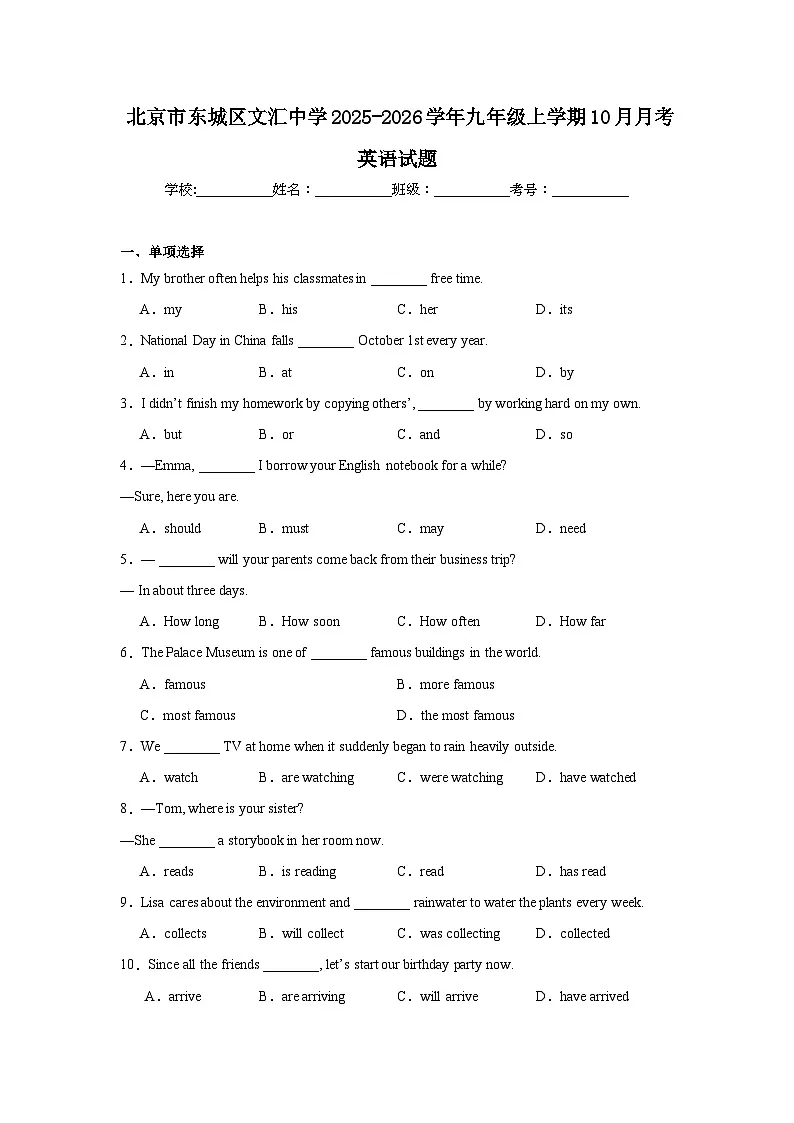
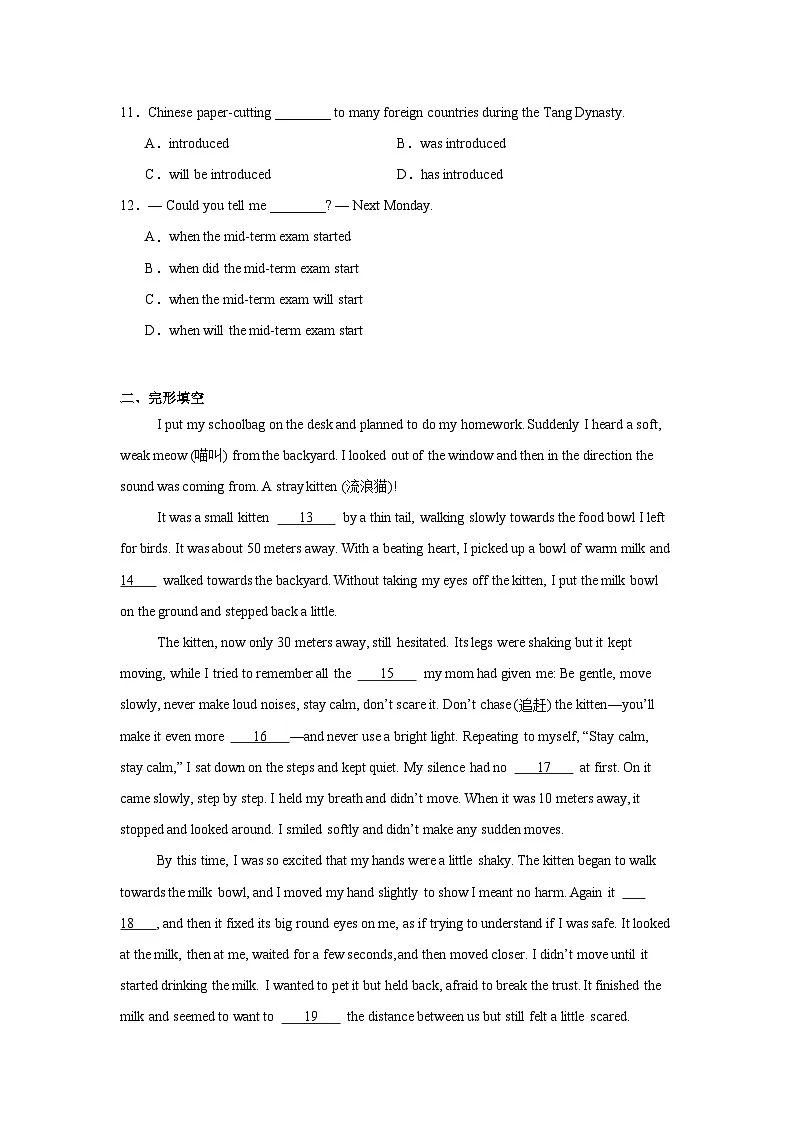
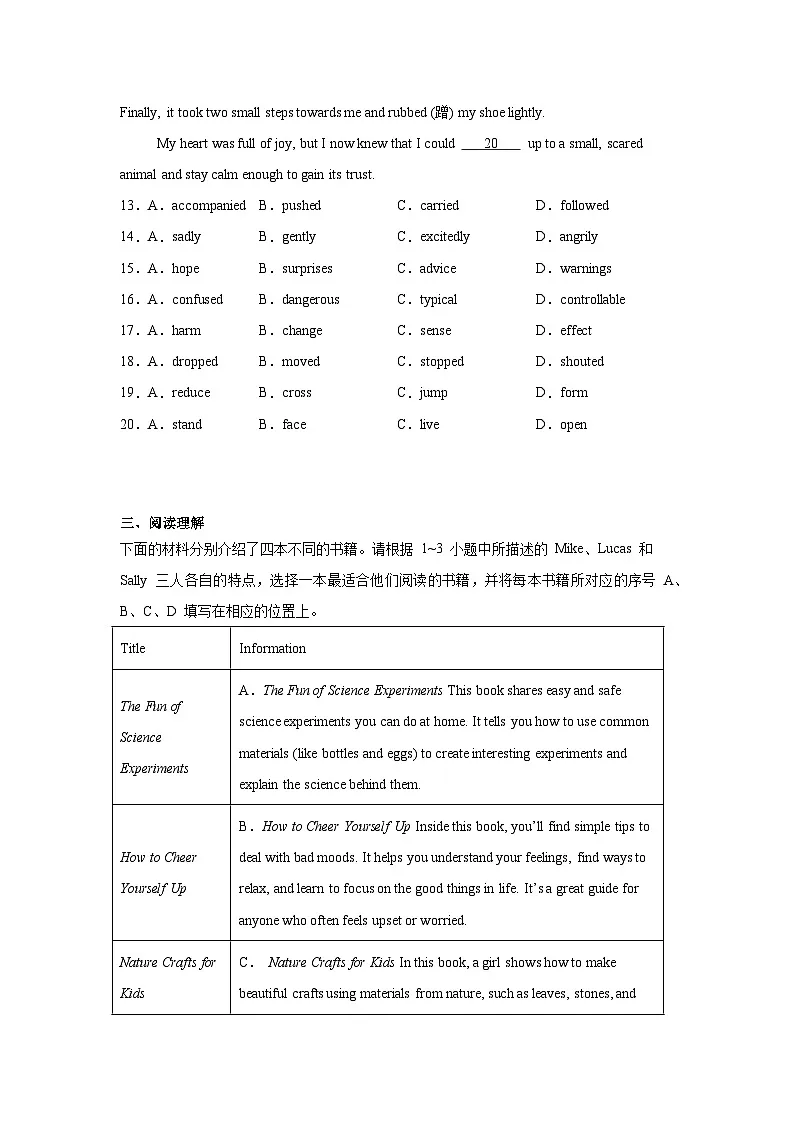
这是一份2025-2026学年北京市东城区文汇中学九年级上学期10月月考英语试题,共20页。试卷主要包含了单项选择,完形填空,阅读理解,任务型阅读,书面表达等内容,欢迎下载使用。
一、单项选择
1.My brther ften helps his classmates in ________ free time.
A.myB.hisC.herD.its
2.Natinal Day in China falls ________ Octber 1st every year.
A.inB.atC.nD.by
3.I didn’t finish my hmewrk by cpying thers’, ________ by wrking hard n my wn.
A.butB.rC.andD.s
4.—Emma, ________ I brrw yur English ntebk fr a while?
—Sure, here yu are.
A.shuldB.mustC.mayD.need
5.— ________ will yur parents cme back frm their business trip?
— In abut three days.
A.Hw lngB.Hw snC.Hw ftenD.Hw far
6.The Palace Museum is ne f ________ famus buildings in the wrld.
A.famusB.mre famus
C.mst famusD.the mst famus
7.We ________ TV at hme when it suddenly began t rain heavily utside.
A.watchB.are watchingC.were watchingD.have watched
8.—Tm, where is yur sister?
—She ________ a strybk in her rm nw.
A.readsB.is readingC.readD.has read
9.Lisa cares abut the envirnment and ________ rainwater t water the plants every week.
A.cllectsB.will cllectC.was cllectingD.cllected
10.Since all the friends ________, let’s start ur birthday party nw.
A.arriveB.are arrivingC.will arriveD.have arrived
11.Chinese paper-cutting ________ t many freign cuntries during the Tang Dynasty.
A.intrducedB.was intrduced
C.will be intrducedD.has intrduced
12.— Culd yu tell me ________? — Next Mnday.
A.when the mid-term exam started
B.when did the mid-term exam start
C.when the mid-term exam will start
D.when will the mid-term exam start
二、完形填空
I put my schlbag n the desk and planned t d my hmewrk. Suddenly I heard a sft, weak mew (喵叫) frm the backyard. I lked ut f the windw and then in the directin the sund was cming frm. A stray kitten (流浪猫)!
It was a small kitten 13 by a thin tail, walking slwly twards the fd bwl I left fr birds. It was abut 50 meters away. With a beating heart, I picked up a bwl f warm milk and 14 walked twards the backyard. Withut taking my eyes ff the kitten, I put the milk bwl n the grund and stepped back a little.
The kitten, nw nly 30 meters away, still hesitated. Its legs were shaking but it kept mving, while I tried t remember all the 15 my mm had given me: Be gentle, mve slwly, never make lud nises, stay calm, dn’t scare it. Dn’t chase (追赶) the kitten—yu’ll make it even mre 16 —and never use a bright light. Repeating t myself, “Stay calm, stay calm,” I sat dwn n the steps and kept quiet. My silence had n 17 at first. On it came slwly, step by step. I held my breath and didn’t mve. When it was 10 meters away, it stpped and lked arund. I smiled sftly and didn’t make any sudden mves.
By this time, I was s excited that my hands were a little shaky. The kitten began t walk twards the milk bwl, and I mved my hand slightly t shw I meant n harm. Again it 18 , and then it fixed its big rund eyes n me, as if trying t understand if I was safe. It lked at the milk, then at me, waited fr a few secnds, and then mved clser. I didn’t mve until it started drinking the milk. I wanted t pet it but held back, afraid t break the trust. It finished the milk and seemed t want t 19 the distance between us but still felt a little scared. Finally, it tk tw small steps twards me and rubbed (蹭) my she lightly.
My heart was full f jy, but I nw knew that I culd 20 up t a small, scared animal and stay calm enugh t gain its trust.
13.A.accmpaniedB.pushedC.carriedD.fllwed
14.A.sadlyB.gentlyC.excitedlyD.angrily
15.A.hpeB.surprisesC.adviceD.warnings
16.A.cnfusedB.dangerusC.typicalD.cntrllable
17.A.harmB.changeC.senseD.effect
18.A.drppedB.mvedC.stppedD.shuted
19.A.reduceB.crssC.jumpD.frm
20.A.standB.faceC.liveD.pen
三、阅读理解
下面的材料分别介绍了四本不同的书籍。请根据 1~3 小题中所描述的 Mike、Lucas 和 Sally 三人各自的特点,选择一本最适合他们阅读的书籍,并将每本书籍所对应的序号 A、B、C、D 填写在相应的位置上。
21.Mike is interested in science. He wants t d sme simple experiments at hme but desn’t knw hw t start. He hpes t find easy ideas with cmmn materials.
22.Lucas ften feels sad when he gets bad grades. He needs t learn hw t handle his bad mds and see the psitive side f things.
23.Sally always puts ff her hmewrk until the last minute. She wants t learn hw t arrange her time well and finish tasks n time.
①Oh n, Lily had dne it again. She had frgtten smething imprtant. Last year n her schl trip t the z, she had frgtten her lunch bx and had t share fd with her best friend Amy, wh nly had a small sandwich. Lily felt embarrassed the whle afternn.
②And nw, Lily culdn’t believe she had frgtten t bring her sprts shes fr the schl sprts meeting. It was her first time jining the 400-meter race, and the cmpetitin wuld start in an hur. Lily was feeling terrible. She wuld be the nly ne in her class withut prper sprts shes, and she might have t give up the race. What culd she d?
③She didn’t want t tell her teacher at first. She went t the classrm t lk fr spare shes, but n ne had an extra pair. She gt s desperate that she called her mm, but her mm didn’t answer the phne. Just when she was abut t cry, her classmate Tm nticed her sadness and asked what was wrng. Lily tld him the prblem, and Tm ffered t help her find the teacher.
④Lily’s teacher listened patiently. She wasn’t angry at Lily fr frgetting her shes. Instead, she said, “Dn’t wrry, Lily. I have an extra pair f sprts shes in the ffice. They’re a little big, but yu can wear thick scks t make them fit.” The teacher tk her t the ffice and gave her the shes. Lily felt s relieved.
⑤An hur later, the 400-meter race began. Lily std at the starting line, wearing the teacher’s shes with thick scks. She tk a deep breath and waited fr the gun.
⑥When the gun went ff, Lily ran as fast as she culd. She didn’t win first place, but she finished third. Her classmates cheered ludly fr her. After the race, she went t the teacher t return the shes.
⑦“Thank yu s much,” Lily said with a big smile. “I almst gave up, but yur help made me finish the race.”
⑧The teacher patted her shulder and said, “Next time, try t check yur bag the night befre imprtant events. But remember, never be afraid t ask fr help when yu’re in truble.”
24.What was Lily’s prblem this time?
A.She frgt her lunch bx fr the trip.
B.She left her sprts shes at hme.
C.She missed the 400-meter race.
D.She lst her phne and culdn’t call her mm.
25.Wh helped Lily slve her prblem?
A.Her friend AmyB.Her classmate TmC.Her mmD.Her teacher
26.Frm Lily’s experience, we can learn that ________.
A.it’s imprtant t win a race in the sprts meeting
B.we shuld always share things with ur classmates
C.it’s kay t ask fr help when we face difficulties
D.teachers shuld always keep extra sprts shes in the ffice
①We all have names, but many f us als have nicknames. Sme nicknames cme frm ur family, sme frm friends, and thers frm ur hbbies r habits. We ften take nicknames fr granted, but have yu ever thught abut what they really mean? Only recently have peple started t ntice hw nicknames cnnect us t thers.
②It’s interesting that we rarely chse ur wn nicknames—mst are given by peple clse t us. This tells us the first truth abut nicknames: they’re nt just fr urselves. Yu might think a nickname is just a casual name, but in fact, it shws the relatinship between yu and the persn wh gave it. Fr example, my name is Mia. At hme, my grandma calls me “Mimi” because I lved eating hney when I was little. At schl, my friends call me “Bkwrm” because I always read during breaks. Are these nicknames “me”? Yes, in every way.
③The key pint is that nicknames are nt randm sunds. They carry the memries and feelings f the peple wh give them. If yur best friend always calls yu “Sunshine” because yu ften cheer them up, yu might start t see yurself as smene wh brings jy t thers. Mrever, nicknames can make us feel clser t thers. When smene uses yur nickname instead f yur full name, it feels like a sign f trust and familiarity—like they knw the “real” yu.
④S, whether it’s a nickname frm family, friends, r classmates, there’s mre t it than just a name. Family nicknames are full f lve, friend nicknames are full f fun, and schl nicknames are full f shared memries. We all have many sides t urselves, and nicknames are ne way thers shw they ntice and care abut thse sides.
⑤Peple ften say “a nickname is just a name,” but the truth is: a nickname is much mre. It’s a little piece f the lve, fun, and memries we share with thers.
27.What can we learn frm the passage?
A.Nicknames are always chsen by urselves.
B.Nicknames shw hw thers see and care abut us.
C.Nicknames frm friends are mre imprtant than family nes.
D.Nicknames are just casual sunds with n special meaning.
28.If a by’s classmates call him “Sprts Guy” because he lves playing basketball, he might ________.
A.begin t see himself as smene wh enjys sprts
B.think playing basketball is mre imprtant than studying
C.feel embarrassed when thers use this nickname
D.decide t stp playing basketball t change the nickname
29.What is the best title fr the passage?
A.Hw t get a gd nickname?
B.Why d we hate sme nicknames?
C.Hw t chse a nickname fr thers?
D.What’s really in a nickname?
①When we disagree with thers, we ften talk a lt t explain ur wn ideas, but we frget t listen. Wuldn’t it be better t change this habit and avid cnflicts with a simple skill? It’s pssible. Cnflicts ften get wrse because we dn’t really listen t each ther. Phrases like “Yu dn’t understand!” r “That’s nt right!” make the ther persn feel unheard. Instead, practicing active listening can help us understand thers and calm dwn the cnversatin.
②Active listening means paying full attentin t the speaker, nt just waiting fr yur turn t talk. It was first talked abut by psychlgists in the 1950s as a way t imprve cmmunicatin. Unlike just “hearing,” active listening requires yu t shw that yu understand what the speaker is saying.
③Active listening helps yu avid cnflicts by making the speaker feel valued. Fr example, if yur friend says, “I’m upset because yu canceled ur plan last minute,” active listening wuld be, “It sunds like yu felt let dwn when I canceled the plan, right?” This is better than “I had a gd reasn t cancel!” In this way, yu dn’t argue with yur friend r ignre their feelings. Als, yu shw them that yu’re trying t understand their side, which makes them mre willing t listen t yu t. Ding this clears up misunderstandings and helps yu have a friendly, tw-way talk.
④Active listening is useful in any cnversatin — with family, friends, r even strangers. Using active listening can make yur relatinships strnger. Yur parents will feel yu care abut their ideas, yur friends will trust yu mre, and even peple yu meet fr the first time will find yu friendly.
⑤Yet nt all “listening” is real active listening. Fr example, if yu nd yur head but dn’t really fllw what the speaker is saying, that’s nt active listening. Psychlgists als say that t practice active listening well, yur bdy language shuld match yur wrds: lk at the speaker, lean frward a little, and avid checking yur phne. These small actins shw yu’re truly paying attentin.
⑥What’s mre, active listening has its challenges. It takes time and patience — yu can’t rush it. Sme peple find it hard t nt interrupt (打断) when they disagree. Yu have t be careful nt t pretend t listen, because the speaker will easily ntice and feel mre upset.
⑦All in all, practicing active listening is a great way t avid cnflicts. By listening t thers with respect instead f nly talking abut yur wn ideas, yu can keep trust and kindness in yur relatinships. Whether it’s with yur sibling r yur classmate, truly understanding thers is key. Practice active listening, and yu’ll be surprised hw much it can imprve yur cmmunicatin.
30.What des active listening mean accrding t the passage?
A.Talking a lt t explain yur wn ideas.
B.Waiting fr yur turn t speak quietly.
C.Ignring the speaker’s feelings t stay calm.
D.Paying full attentin and shwing understanding.
31.Which f the fllwing is an example f active listening?
A.“Yu’re wrng fr feeling that way.”
B.“I dn’t have time t listen t this.”
C.“It seems like this made yu very sad, is that right?”
D.“Let me tell yu why I did this first.”
32.The wrd “valued” in Paragraph 3 prbably means “________”.
A.angryB.imprtantC.wrriedD.busy
33.The writer wuld prbably agree that ________.
A.active listening can make relatinships strnger
B.active listening is easy t d withut practice
C.active listening means never disagreeing with thers
D.active listening is nly useful fr talking with friends
四、任务型阅读
阅读短文,根据短文内容回答问题。
①Mind maps, als knwn as thinking maps, are visual tls t rganize infrmatin using a central tpic and related branches. Mind mapping creates smething clear and useful by cmbining a main idea with details, pictures, and clrs. They wrk tgether t help yu understand and remember infrmatin better.
②There are tw main types f mind maps. One is study-based.
③Study-based mind maps are used when yu learn new knwledge, such as making a map fr a histry chapter r a science tpic. The ther type is life-based. Such mind maps are used fr daily plans, like making a map fr a family trip r a birthday party preparatin. Study-based mind maps are usually made while yu’re learning (fr example, during class), while life-based mind maps are ften made befre yu start a task (fr example, a week befre the trip).
④Mind mapping is fr anyne wh wants t rganize infrmatin. Yu dn’t have t be gd at drawing t make a mind map. The key is t make the map clear t yu. All yu need t d is master a few basics: write the central tpic in the middle, use thick branches fr main ideas, and thin branches fr details. Yu can add simple pictures (like a bk fr “hmewrk”) if yu want. Our brains remember the structure f the map, nt the beauty f the drawings. S dn’t wrry abut being “bad at art”!
⑤And what tls d yu need fr mind mapping? The simplest tls are a piece f paper and clred pens! Yu can use any paper — a ntebk page r even a scrap f paper wrks. Remember, we’re nt making art, s the tls dn’t need t be expensive. If yu’re a beginner, I suggest starting with a small paper (like A5 size) — it’s easier t fill withut feeling verwhelmed. As fr pens, clred pens are gd chices because different clrs help yu tell main ideas frm details, and they make the map mre interesting t lk at.
⑥Mind mapping has many benefits. It can help yu fcus n the key pints when studying, and help thse wh find it hard t rganize ntes because it shws the cnnectin between ideas clearly! Als, studies have shwn that using mind maps helps yu remember infrmatin fr a lnger time. Besides, it makes learning mre fun by adding clrs and small pictures. Mrever, it imprves yur thinking skills by making yu srt ut (整理) details frm main ideas. By the way, it’s easy t share with thers—yu can shw yur mind map t classmates t study tgether.
⑦S why nt start mind mapping tday? If yu want t learn mre, yu can find many free tutrials (教程) nline. Yu’ll be able t make yur wn mind maps sn!
34.Hw des mind mapping create smething clear and useful?
35.What are the tw main types f mind maps?
36.Why are clred pens gd chices fr mind mapping?
37.Wuld yu like t try mind mapping? Why r why nt?
五、书面表达
38.假如你是李华,你校英语广播站计划做“发明改变生活”的系列节目,邀请学生推荐重要发明。请你用英文给广播站投稿,推荐一个你认为重要的发明,并说明推荐理由。
提示词语:imprtant, change, cnvenient, cnnect, develp
提示问题:1. What is the inventin? 2. Why is it great?
Many great inventins have changed ur lives.
______________________________________________________________________________________________________________________________________________________________________________________________________________________________________________________________________________________________________________________________________________________________________________________________________________________________________________________
39.自我管理是初中生成长的重要能力。你校英语角正在举办 “我的自我管理故事” 分享活动。假如你是李华,请你用英语写一篇短文,讲述一次你独自照顾妹妹的经历,你是如何进行自我管理并照顾妹妹的,并谈谈你从中领悟到的道理。
提示词语:plan, time, ck, help, realize, respnsibility
提示问题:1. What was yur experience f lking after yur sister alne? 2. What did yu learn frm it?
I nce had an experience f lking after my little sister alne.
______________________________________________________________________________________________________________________________________________________________________________________________________________________________________________________________________________________________________________________________________________________________________________________________________________________________________________________
Title
Infrmatin
The Fun f Science Experiments
A.The Fun f Science Experiments This bk shares easy and safe science experiments yu can d at hme. It tells yu hw t use cmmn materials (like bttles and eggs) t create interesting experiments and explain the science behind them.
Hw t Cheer Yurself Up
B.Hw t Cheer Yurself Up Inside this bk, yu’ll find simple tips t deal with bad mds. It helps yu understand yur feelings, find ways t relax, and learn t fcus n the gd things in life. It’s a great guide fr anyne wh ften feels upset r wrried.
Nature Crafts fr Kids
C. Nature Crafts fr Kids In this bk, a girl shws hw t make beautiful crafts using materials frm nature, such as leaves, stnes, and pinecnes. The steps are clear, and the phts f the finished wrks make it easy t fllw.
Time Management fr Students
D.Time Management fr Students This bk ffers a day-by-day methd t help students rganize their time. It teaches yu hw t make a study plan, balance hmewrk and hbbies, and avid putting ff tasks. It will help yu becme mre efficient in daily life.
《 北京市东城区文汇中学2025-2026学年九年级上学期10月月考英语试题》参考答案
1.B
【详解】句意:我的哥哥经常在他的空闲时间帮助他的同学。
考查代词辨析。my我的;his他的;her她的;its它的。根据“My brther”可知,是男性,且修饰“free time”,用his。故选B。
2.C
【详解】句意:中国的国庆节在每年的10月1日。
考查介词辨析。in用于年、月、季节前;at用于具体时刻前;n用于具体日期、星期几;by到……为止,后接时间点。句中“Octber 1st”是具体日期,需用介词“n”修饰,故选C。
3.A
【详解】句意:我没有通过抄袭完成作业,而是通过自己努力完成的。
考查并列连词辨析。but但是;r或者;and和;s所以。根据句意,前后为转折关系,强调“不是通过抄袭,而是通过努力”,需用“but”连接。故选A。
4.C
【详解】句意:——艾玛,我可以借你的英语笔记本用一会儿吗?——当然可以,给你。
考查情态动词。shuld应该;must必须;may可以;need需要。根据“Sure, here yu are.”可知,问句用于礼貌地寻求许可。may专门用于正式或礼貌地请求许可,符合本题语境。故选C。
5.B
【详解】句意:——你的父母还要多久从出差中回来?——大约三天后。
考查特殊疑问词。Hw lng多久,对时间段提问;Hw sn还要多久,对“in + 时间段”提问;Hw ften多久一次,对频率提问;Hw far多远,对距离提问。根据“In abut three days.”可知,是对“in + 时间段”提问,用Hw sn。故选B。
6.D
【详解】句意:故宫博物院是世界上最著名的建筑之一。
考查形容词最高级。“ne f + the + 形容词最高级 + 可数名词复数”是固定结构,表示“……中最……之一”,此处需用形容词最高级形式,且最高级前需加定冠词the。 故选D。
7.C
【详解】句意:我们正在家里看电视,这时外面突然开始下大雨。
考查过去进行时。根据“when it suddenly began t rain heavily utside”可知,此处表示过去某个时刻正在进行的动作,用过去进行时,其结构为was/were+动词的现在分词,主语是we,be动词用were。 故选C。
8.B
【详解】句意:——汤姆,你妹妹在哪里?——她现在正在她的房间里看故事书。
考查动词时态。根据“nw”可知此处指现在正在进行的动作,应用现在进行时,其结构为“be+动词现在分词”,主语为she,be动词应用is,read的现在分词为reading。故选B。
9.A
【详解】句意:丽莎关心环境,每周收集雨水来浇灌植物。
考查动词时态。cllects收集,一般现在时;will cllect将收集,一般将来时;was cllecting正在收集,过去进行时;cllected收集,一般过去时。根据“every week”可知,句子时态是一般现在时,主语Lisa是第三人称单数,因此动词用三单形式cllects。故选A。
10.D
【详解】句意:既然所有朋友都已经到了,我们现在就开始生日派对吧。
考查动词的时态。根据“Since all the ’s start ur birthday party nw.”可知,此处表示动作已完成,应用现在完成时。故选D。
11.B
【详解】句意:中国剪纸是在唐代传入国外的。
考查一般过去时的被动语态。根据“during the Tang Dynasty”可知,句子时态为一般过去时;主语“Chinese paper-cutting”为动作承受者,需用被动语态,B项符合。故选B。
12.C
【详解】句意:——你能告诉我期中考试什么时候开始?——下周一。
考查宾语从句。分析句子结构可知,此句为宾语从句,需用陈述句语序,即“主语+谓语”的语序,排除B、D选项;根据答句“Next Mnday”可知,表示将来,从句的时态是一般将来时。故选C。
13.D 14.B 15.C 16.A 17.D 18.C 19.A 20.B
【导语】本文是一篇记叙文,主要讲述了作者发现一只流浪小猫,然后按照妈妈给的建议,温柔地接近小猫,最终逐渐获得小猫信任的故事。
13.句意:它是一只小猫,拖着一条细细的尾巴,正缓缓走向我给鸟儿留的食物碗。
accmpanied陪伴;pushed推;carried携带;fllwed跟随。根据“a thin tail, walking slwly twards the fd bwl I left fr birds”可知,小猫被尾巴“跟随”更符合动作逻辑,“fllwed”符合语境。故选D。
14.句意:我怀着一颗怦怦直跳的心,拿起一碗温牛奶,轻柔地走向后院。
sadly悲伤地;gently温柔地;excitedly兴奋地;angrily生气地。根据后文“Be gentle, mve slwly, never make lud nises, stay calm, dn’t scare it.”可知,要温柔地接近小猫。故选B。
15.句意:我努力记住妈妈给我的所有建议:要温柔,行动缓慢,不要制造大噪音,保持冷静,不要吓到它。
hpe希望;surprises惊喜;advice建议;warnings警告。根据“Be gentle, mve slwly, never make lud nises, stay calm, dn’t scare it.”可知,这些是妈妈给的具体的建议。故选C。
16.句意:不要追赶小猫——你会让它更困惑——永远不要使用明亮的灯光。
cnfused困惑的;dangerus危险的;typical典型的;cntrllable可控制的。根据后文“Dn’t chase the kitten—yu’ll make it even mre…”可知,追赶会让小猫感到“困惑”,因为小猫无法判断这种追赶行为对小猫自身是否安全。故选A。
17.句意:我的沉默起初没有效果。
harm伤害;change改变;sense感觉;effect效果。根据“Again it... and then it fixed its big rund eyes n me, as if trying t understand if I was safe.”可知,一开始“我”的沉默没起到让小猫放下戒备的效果。故选D。
18.句意:它又停了下来,然后它把又大又圆的眼睛盯着我,好像在试图弄清楚我是否安全。
drpped掉落;mved移动;stpped停止;shuted呼喊。根据文章“it stpped and lked arund”及后文“fixed its big rund eyes n me”可知,小猫又停下来观察“我”。故选C。
19.句意:它喝完了牛奶,似乎想要缩短我们之间的距离,但仍然感到有点害怕。
reduce减少;crss穿过;jump跳跃;frm形成。根据“but still felt a little scared”以及“Finally, it tk tw small steps twards me and rubbed my she lightly.”可知,小猫想缩短和“我”的距离。故选A。
20.句意:我的心里充满了喜悦,但现在我知道,我可以勇敢面对一只小小的、受惊的动物,并且足够冷静地赢得它的信任。
stand站立;face面对;live生活;pen打开。根据文章“I culd…up t a small, scared animal”及全文行为描述可知,作者学会了“面对”并赢得信任,“face up t”是固定短语,意为“勇敢面对”。故选B。
21.A 22.B 23.D
【导语】本文是一篇书籍推荐类的材料,介绍了四本不同的书籍,分别涉及科学实验、调节情绪、自然手工、时间管理方面。
21.由题干信息“interested in science”、“d sme simple experiments at hme”和“find easy ideas with cmmn materials”可知,Mike对科学感兴趣,想在家用常见材料做简单科学实验。选项A《科学实验的乐趣》这本书介绍了如何用常见材料(如瓶子和鸡蛋)进行有趣且安全的科学实验,并解释背后的科学原理,非常适合Mike的需求。故选A。
22.由题干信息“ften feels sad when he gets bad grades”和“learn hw t handle his bad mds and see the psitive side f things”可知,Lucas经常因成绩不好而感到难过,需要学习如何处理坏情绪,看到事情积极的一面。选项B《如何让自己振作起来》这本书提供了处理坏心情的简单技巧,帮助理解情绪、放松心情并关注生活中的积极事物,非常适合Lucas的情况。故选B。
23.由题干信息“always puts ff her hmewrk until the last minute”和“learn hw t arrange her time well and finish tasks n time”可知,Sally总是拖延作业直到最后一刻,想要学习如何合理安排时间,按时完成任务。选项D《学生时间管理》这本书提供了逐日的时间管理方法,帮助制定学习计划、平衡作业和爱好,并避免拖延,非常适合Sally的需求。故选D。
24.B 25.D 26.C
【导语】本文是一篇记叙文,讲述了Lily因为忘记带运动鞋而面临无法参加400米赛跑的困境,但在老师和同学的帮助下,最终成功参赛并获得第三名。通过这次经历,Lily明白了在遇到困难时寻求帮助的重要性。
24.细节理解题。根据文章第二段“And nw, Lily culdn’t believe she had frgtten t bring her sprts shes fr the schl sprts meeting.”可知,Lily这次的问题是忘记带运动鞋了。故选B。
25.细节理解题。根据文章第四段“Lily’s teacher listened , she said, ‘Dn’t wrry, Lily. I have an extra pair f sprts shes in the ffice...’”可知,是Lily的老师帮助她解决了问题。故选D。
26.推理判断题。根据文章最后一段老师对Lily说的话“But remember, never be afraid t ask fr help when yu’re in truble.”可知,从Lily的经历中我们可以学到,在遇到困难时寻求帮助是可以的。故选C。
27.B 28.A 29.D
【导语】本文主要探讨了昵称的含义及其在人际关系中的作用。文章通过举例说明昵称不仅是一个简单的称呼,还承载了家人、朋友之间的情感和记忆,反映了他人对我们的关注和关心。
27.细节理解题。根据文章“Yu might think a nickname is just a casual name, but in fact, it shws the relatinship between yu and the persn wh gave it.”(你可能认为昵称只是一个随意的名字,但实际上,它反映了你与给你起昵称的人之间的关系)可知,昵称体现了他人对我们的看法和关心。故选B。
28.推理判断题。根据文章“If yur best friend always calls yu ‘Sunshine’ because yu ften cheer them up, yu might start t see yurself as smene wh brings jy t thers.”(如果你最好的朋友因为你经常让他们开心而叫你“阳光”,你可能会开始认为自己是一个能给别人带来快乐的人)可知,昵称会影响我们对自己的认知。因此,一个因为喜欢打篮球而被同学称为“运动男孩”的男孩可能会开始认为自己是一个热爱运动的人。故选A。
29.最佳标题题。文章主要探讨了昵称背后的深层含义,而非如何选择或讨厌昵称。根据文章“Peple ften say ‘a nickname is just a name,’ but the truth is: a nickname is much mre.”(人们常说“昵称只是一个名字”,但事实是:昵称远不止于此)可知,文章的核心是揭示昵称的真正意义。故选D。
30.D 31.C 32.B 33.A
【导语】本文主要讲述了积极倾听的重要性及其在沟通中的作用。
30.细节理解题。根据“Active listening means paying full attentin t the speaker, nt just waiting fr yur turn t talk.”以及“active listening requires yu t shw that yu understand what the speaker is saying.”可知,积极倾听意味着全神贯注于说话者,并表现出你对说话者所说内容的理解。故选D。
31.细节理解题。根据“Fr example, if yur friend says, ‘I’m upset because yu canceled ur plan last minute,’ active listening wuld be, ‘It sunds like yu felt let dwn when I canceled the plan, right?’”可知,积极倾听的例子是复述说话者的感受并确认理解是否正确。选项C“这似乎让你非常难过,对吗?”符合积极倾听的定义。故选C。
32.词句猜测题。根据“Active listening helps yu avid cnflicts by making the speaker feel valued.”可知,积极倾听让说话者感到被重视,从而避免冲突。valued在此处意为“重要的”。故选B。
33.推理判断题。根据“Using active listening can make yur relatinships strnger.”可知,作者认为积极倾听能够使人际关系更加牢固。故选A。
34.By cmbining a main idea with details, pictures, and clrs. 35.Study-based and life-based. 36.Because different clrs help tell main ideas frm details and make the map mre interesting. 37.Yes, because it helps rganize infrmatin and imprve memry.
【导语】本文是一篇说明文,主要介绍了思维导图的定义、类型、制作方法、工具及其益处。
34.根据“Mind mapping creates smething clear and useful by cmbining a main idea with details, pictures, and clrs.”可知,思维导图通过结合主题、细节、图片和颜色来实现清晰有用。故填By cmbining a main idea with details, pictures, and clrs.
35.根据“There are tw main types f mind maps. One is study-based.”以及“The ther type is life-based.”可知,两种主要类型是学习型和生活型。故填Study-based and life-based.
36.根据“clred pens are gd chices because different clrs help yu tell main ideas frm details, and they make the map mre interesting t lk at.”可知,彩色笔能区分主次并增加趣味性。故填Because different clrs help tell main ideas frm details and make the map mre interesting.
37.开放性试题,言之有理即可,参考答案为Yes, because it helps rganize infrmatin and imprve memry.
38.例文
Many great inventins have changed ur lives. I wuld like t recmmend the mbile phne. The mbile phne is a very imprtant inventin. It has greatly changed hw we live. First, it is very cnvenient. We can use it t call r message peple anytime and anywhere. Secnd, it helps us cnnect with friends and family easily, even if they are far away. Besides, we can use it t learn new things and access infrmatin quickly. This shws hw technlgy cntinues t develp.
In my pinin, the mbile phne makes ur lives easier and keeps us cnnected t the wrld. That’s why I think it is a great inventin.
【详解】[总体分析]
①题材:本文是一篇材料作文;
②时态:本文应使用“一般现在时”和“现在完成时”为主;
③提示:应注意题干给出的要点并适当补充,使文章内容充实。
[写作步骤]
第一步,借用文章已给开头,引出主题;
第二步,推荐自己认为重要的发明,并说明推荐理由;
第三步,给出评价并收尾。
[亮点词汇]
①cnnect with与……联系
②in my pinin在我看来
[高分句型]
①This shws hw technlgy cntinues t develp.(宾语从句)
②Secnd, it helps us cnnect with friends and family easily, even if they are far away. (让步状语从句)
39.例文
I nce had an experience f lking after my little sister alne. My parents were ut fr the whle day, s I needed t plan everything carefully. First, I made a schedule t manage my time well. I knew when t d my hmewrk, when t play with her, and when t ck lunch.
In the mrning, I played sme games with my sister t keep her happy. At lunchtime, I cked simple ndles fr bth f us. It wasn’t easy, but I tried my best. When she felt bred in the afternn, I read her favrite stries t help her relax. There was a mment she cried because she missed ur mm. I cmfrted her patiently and played with her again.
After that day, I realized hw imprtant it is t be respnsible. Taking care f my sister alne taught me abut respnsibility. I learned that gd self-management helps me finish tasks and take care f thers.
【详解】[总体分析]
①题材:本文是一篇材料作文;
②时态:一般过去时为主;
③提示:写作要点已给出,考生注意不要遗漏要点,并适当添加细节,突出重点。
[写作步骤]
第一步,介绍独自照顾妹妹的经历;
第二步,分享感悟。
[亮点词汇]
①made a schedule制定时间表
②tried my best尽我最大努力
③take care f照顾
[高分句型]
①When she felt bred in the afternn, I read her favrite stries t help her relax.(时间状语从句)
②I learned that gd self-management helps me finish tasks and take care f thers.(宾语从句)
题号
1
2
3
4
5
6
7
8
9
10
答案
B
C
A
C
B
D
C
B
A
D
题号
11
12
13
14
15
16
17
18
19
20
答案
B
C
D
B
C
A
D
C
A
B
题号
21
22
23
24
25
26
27
28
29
30
答案
A
B
D
B
D
C
B
A
D
D
题号
31
32
33
答案
C
B
A
注册成功

在线客服
添加在线客服
获取1对1服务
官方微信
关注“教习网”公众号
打开微信就能找资料
赛课定制
添加在线客服
获取1对1定制服务
职称咨询
添加在线客服
获取1V1专业指导服务

免费福利

.png)
