免费领取教师福利



若您为此资料的原创作者,认为该资料内容侵犯了您的知识产权,请扫码添加我们的相关工作人员,我们尽可能的保护您的合法权益。

这是一份外研版 (2019)必修 第一册Unit 2 Exploring English优质学案,共32页。学案主要包含了词汇清单,语法清单,写出下列单词的派生词等内容,欢迎下载使用。
一、词汇清单
知识点1. have truble ding 做…… 有困难
【教材原句】Have yu ever asked yurself why peple ften have truble learning English? (教材P19)
【拓展】
同义短语有 “have difficulty (in) ding sth.”“have a hard time (in) ding sth.”。
eg.He has difficulty slving this math prblem.(他解这道数学题有困难。)
【写作佳句】
Many students have truble remembering English wrds.(许多学生在记英语单词方面有困难。)
【经典练】
单句语法填空
I __________ (have) truble __________ (learn) t swim when I was yung.
知识点2. neither 引导的倒装句
【教材原句】Neither is there pine nr apple in pineapple.(教材P19)
【拓展】
当表示否定意义的词(如 neither, nr, never, hardly 等)位于句首时,句子要用部分倒装,即把助动词、be 动词或情态动词提到主语前面。
eg.Never have I seen such a beautiful place.(我从未见过如此美丽的地方。)
避免重复否定:前句已有否定词(如 wn't, can't),倒装句中助动词用肯定形式(如 will, can),通过 “neither” 本身体现否定逻辑。
I dn't knw his name. Nr d I knw his address.(我不知道他的名字。我也不知道他的地址。)
【写作佳句】
Neither d I like playing basketball nr am I interested in ftball.(我既不喜欢打篮球,也对足球不感兴趣。)
【经典练】
单项选择
Lisa can't swim acrss the river, and _______ her little sister.
A. neither canB. s canC. neither isD. s is
知识点3. get… ding 使…… 开始做;让…… 一直做
【教材原句】This gt me thinking hw English can be a crazy language t learn. (教材P19)
【拓展】
Hw can we get this machine running again? It stpped wrking an hur ag.
(我们怎样才能让这台机器重新运转起来?它一小时前就坏了。)
Parents shuld get their children reading every day t develp gd habits.
(父母应该让孩子每天坚持读书,以培养良好的习惯。)
类似结构还有 d sth.(让…… 做某事)。
eg.She gt her brther t help her with the hmewrk.(她让她哥哥帮她做家庭作业。)
【写作佳句】
The teacher tried t get the students talking abut their hbbies.(老师试图让学生们开始谈论他们的爱好。)
【经典练】
单句语法填空
We need t get the machine __________ (wrk) again as sn as pssible.
知识点4. speaking f 说到;谈及
【教材原句】And speaking f hme, why aren't hmewrk and husewrk the same thing?(教材P19)
【拓展】
常用于口语中,引出与前文相关的话题。
eg.Speaking f travel, have yu ever been t Paris?(说到旅行,你去过巴黎吗?)
【写作佳句】
Speaking f English learning, practice is very imprtant.(说到英语学习,练习是非常重要的。)
【经典练】
单句语法填空
__________ (speak) f bks, d yu have any gd recmmendatins?
知识点5. behavir /bɪˈheɪvjər/n. 举止,行为
【教材原句】If harmless actins are the ppsite f harmful actins, why are shameless and shameful behavirs the same?(教材P19)
【拓展】
常见搭配有 gd behavir(良好行为)、bad behavir(不良行为)。
eg.The children were rewarded fr gd behavir.(孩子们因表现好而受到奖励。)
其动词形式为 behave,意为 表现;举止端正。behave常见搭配:
1)behave + 副词 / 介词短语
强调 “行为表现的方式”,常见副词有 well, badly, prperly 等。
He behaved well at the party and thanked the hst befre leaving.
(他在派对上表现很好,离开前还感谢了主人。)
The children behaved badly in class, s the teacher punished them.
(孩子们在课堂上表现很差,所以老师惩罚了他们。)
Yu shuld behave prperly when meeting strangers.
(见到陌生人时,你应该举止得体。)
2)behave neself
意为 “守规矩;表现得体”,多用于祈使句或劝诫语境。
Please behave yurself at the restaurant, r we wn't cme again.
(在餐厅里请守规矩,否则我们就不来了。)
The kids behaved themselves during the trip, which made their parents happy.
(孩子们在旅途中很听话,这让他们的父母很开心。)
3)behave like + 名词
表示 “行为像…… 一样”,强调模仿或类似某种状态。
He behaves like a child when he desn't get what he wants.
(当得不到想要的东西时,他表现得像个孩子。)
【写作佳句】
Gd behavir is imprtant fr building harmnius relatinships with thers.(良好的行为对于与他人建立和谐的关系至关重要。)
【经典练】
单句语法填空
His rude __________ (behave) made everyne angry.
知识点6. g ff (警报、闹钟等) 突然响起;离开;爆炸
【教材原句】Yu als have t wnder at the unique madness f a language in which a huse can burn up as it burns dwn, in which yu fill in a frm by filling it ut, and in which an alarm is nly heard nce it ges ff!(教材P20)
【拓展】
eg.
The fire alarm went ff in the middle f the night.(半夜火警响了。)
He went ff withut saying gdbye.(他没说再见就离开了。)
The bmb went ff in the empty building, causing a lud nise.(炸弹在空楼里爆炸了,发出巨大的声响。)
【写作佳句】
The alarm clck went ff, but he still didn't wake up.(闹钟响了,但他还是没醒。)
【经典练】
单句语法填空
The lights __________ (g) ff because f the pwer cut.
知识点7. reflect /rɪˈflekt/v. 显示,反映
【教材原句】English was invented by peple, nt cmputers, and it reflects the creativity f the human race. (教材P20)
【拓展】
Her smile reflected her happiness at receiving the award.
(她的微笑反映出她获奖时的喜悦。)
常见搭配 reflect n/upn 意为 “认真思考;回想”。
eg.She reflected n her past mistakes.(她认真思考了自己过去的错误。)
此外,它还有 “反射(光、热等)” 的意思,如 The mirrr reflects light.(镜子反射光线。)
【写作佳句】
The survey results reflect peple's attitudes twards envirnmental prtectin.(调查结果反映了人们对环境保护的态度。)
【经典练】
单句语法填空
Her smile __________ (reflect) her happiness at the gd news.
知识点8. 表语从句
【教材原句】That is why when the stars are ut, they are visible, but when the lights are ut, they are invisible.(教材P20)
【拓展】
表语从句在句中作表语,位于系动词之后。连接词有 that(无意义,不可省略)、what, why, hw, because 等。
eg.
My hpe is that I can pass the final exam.(我的希望是我能通过期末考试。)
The prblem is hw we can slve it.(问题是我们如何能解决它。)
This is because he didn't wrk hard.(这是因为他没有努力工作。)
【写作佳句】
That is why we shuld cherish ur time.(那就是我们应该珍惜时间的原因。)
【经典练】
单句语法填空:填入适当的连接词
His dream is __________ he will becme a dctr in the future.
The questin is __________ we can finish the task n time.
知识点9. creative /kriˈeɪtɪv/adj. 创造(性)的
【教材原句】T shw that English is interesting and creative.(教材P20)
【拓展】
动词形式是 create,意为 “创造;创作”。
名词形式是 creativity”,意为 创造力”。
eg.Artists need creativity t prduce great wrks.”(艺术家需要创造力来创作出伟大的作品。)
【写作佳句】
Being creative can help us find new slutins t prblems.(富有创造力能帮助我们找到解决问题的新方法。)
【经典练】
单句语法填空
He is a __________ (create) writer wh always cmes up with new ideas.
知识点10. when it cmes t 当提到……,当涉及到……
【教材原句】When it came t England, “apple” was added t shw it is a kind f fruit.(教材P21)
【拓展】
when it cmes t后接名词、代词或动名词。
eg.When it cmes t cking, she is an expert.”(当涉及到烹饪时,她是个专家。)
【写作佳句】
When it cmes t studying, we shuld be careful and patient.(当提到学习时,我们应该细心和有耐心。)
【经典练】
单句语法填空
He is very cnfident when it cmes t __________ (speak) French.
知识点11. type /taɪp/n. 类型,种类
【教材原句】Nw lk fr mre examples f each type in the reading passage.(教材P22)
【拓展】
常见搭配:
1)“type f + 名词”(…… 的类型 / 种类)
后接可数名词单数或不可数名词,强调具体类别。
This type f car is very ppular amng yung peple.
(这种类型的汽车在年轻人中很受欢迎。)
There are many different types f music in the wrld, like pp and classical.
(世界上有许多不同种类的音乐,比如流行乐和古典乐。)
I dn't like this type f fd—it's t spicy.
(我不喜欢这种食物 —— 太辣了。)
2)“different types f...”(不同类型的……)
强调种类的多样性,后接复数名词或不可数名词。
The stre sells different types f bks, including nvels and textbks.
(这家店卖不同类型的书,包括小说和教科书。)
There are different types f animals in the z, such as tigers and pandas.
(动物园里有不同种类的动物,比如老虎和熊猫。)
3)“a type f...”(一种……)
表示单一类型,“a” 不可省略。
Tmates are a type f vegetable thugh sme peple think they're fruit.
(西红柿是一种蔬菜,尽管有些人认为它们是水果)。
This is a new type f cmputer with better perfrmance.
(这是一种性能更好的新型电脑。)
作动词时,意为 “打字;分类”。
I can type 50 wrds a minute.(我每分钟能打 50 个单词。)
They are typing the bks n the shelf by tpic.(他们正在按话题对书架上的书进行分类。)
【写作佳句】
This type f bk is ppular amng teenagers.(这种类型的书在青少年中很受欢迎。)
【经典练】
单句语法填空
What __________ (type) f music d yu like best?
知识点12. cntact /ˈkɒntækt/n./v. 联系,联络(教材P22)
【拓展】
作动词时,读作/kənˈtækt/,可直接加宾语,如 “cntact sb.”(联系某人)。
eg.I tried t make cntact with him, but he didn't reply.”(我试图与他取得联系,但他没有回复。)
作名词时, 意为“联系”,读作/ˈkɒntækt/:
I've lst cntact with my primary schl classmates.(我和小学同学失去了联系。)
Yu can keep in cntact with me by email.(你可以通过邮件和我保持联系。)
【写作佳句】
If yu have any questins, please cntact us at any time.(如果你有任何问题,请随时联系我们。)
【经典练】
单句语法填空
We have __________ (cntact) with each ther fr many years.
知识点13. cme acrss 偶然发现,偶然遇到;被理解
【教材原句】When yu pen a dictinary, yu ften cme acrss a lt f unfamiliar wrds. (教材P22)
【拓展】
作 “偶然遇到” 讲时,相当于 “run int”。
eg.I came acrss an ld friend in the street yesterday.”(我昨天在街上偶然遇到了一位老朋友。)
He spke fr a lng time but his meaning did nt really cme acrss.(他讲了很长时间,但他的意思没有人真正理解。)
【写作佳句】
I came acrss a gd bk in the library yesterday.(我昨天在图书馆偶然发现了一本好书。)
【经典练】
单句语法填空
Her meaning didn't really __________ (cme) acrss.
知识点14. rganizatin /ˌɔːrɡənəˈzeɪʃən/n. 组织,团体(教材P22)
【拓展】
常见的搭配有:
1)形容词 + rganizatin
用形容词描述组织的性质、规模等。
The Red Crss is an internatinal rganizatin that helps peple in need.
(红十字会是一个帮助有需要的人的国际组织。)
We set up a lcal rganizatin t prtect the envirnment in ur cmmunity.
(我们成立了一个当地组织来保护社区环境。)
It's a nn-prfit rganizatin—it desn't aim t make mney.
(这是一个非营利组织 —— 其目的不是赚钱。)
2)表示 “组织” 的动作或行为
动词 + rganizatin
常见动词:fund(建立)、jin(加入)、run(管理)、supprt(支持)等。
They plan t fund an rganizatin t help hmeless animals.
(他们计划建立一个组织来帮助流浪动物。)
Many students jined the rganizatin t take part in vlunteer activities.
(许多学生加入了这个组织,参与志愿活动。)
Her jb is t run the rganizatin and make sure it wrks smthly.
(她的工作是管理这个组织,确保其顺利运转。)
3)表示 “组织” 的功能或目的
rganizatin + 介词短语
常用介词:fr(为了)、f(…… 的)、in(在…… 中)等。
This is an rganizatin fr children with special needs.
(这是一个为有特殊需求的儿童设立的组织。)
The rganizatin f the event was led by the student unin.
(活动的组织工作由学生会牵头。)
She plays an imprtant rle in the rganizatin.
(她在这个组织中扮演重要角色。)fit rganizatin”(非营利组织)。
动词形式是 rganize”,意为 组织;安排”。
eg.She rganized a party fr her friends.”(她为朋友们组织了一场派对。)
She rganized her vacatin s that she culd visit bth cities.
她安排了假期,以便能游览这两个城市。
【写作佳句】
The United Natins is a well-knwn internatinal rganizatin.
【经典练】
单句语法填空
The __________ (rganize) f the event tk a lt f time and effrt.
知识点15. likely /ˈlaɪkli/adj. 可能的,可能发生的(教材P23)
【拓展】
常见搭配 be likely t d sth.”(有可能做某事),其反义词是 unlikely”。
eg.It is likely t rain tmrrw.”(明天可能会下雨。)
常见句型:It is likely that...。it 为形式主语,that 从句是真正主语,意为 “…… 是可能的”。
It is likely that we will have a test next week.
(我们下周很可能要考试。)
【写作佳句】
Students wh wrk hard are mre likely t achieve gd grades.(努力学习的学生更有可能取得好成绩。)
【经典练】
单句语法填空
She is likely__________ (cme) t the party than him.
知识点16. remind /rɪˈmaɪnd/v. 提醒,使…… 想起
【教材原句】Here are sme f ur favurites, t remind us that sme f the English we learn in the classrm is rather different frm the English in the utside wrld!(教材P26)
【拓展】
1)常见搭配 remind sb. f sth.”(使某人想起某事)、remind sb. t d sth.”(提醒某人做某事)。
eg.This sng reminds me f my childhd.”(这首歌使我想起了我的童年。)
【写作佳句】
The ld pht reminds me f the happy times we spent tgether.(这张旧照片使我想起了我们一起度过的快乐时光。)
【经典练】
单句语法填空
Please remind me __________(buy) sme milk n the way hme.
2)整句句子结构
主句(前半部分):
Here are sme f ur favurites
这是一个倒装句,正常语序为 Sme f ur favurites are here”,使用倒装是为了强调 here”(这里,即下文即将列举的内容),符合英语中 “地点状语前置时主谓倒装” 的习惯。
核心成分:
sme f ur favurites:主语,“favurites” 是名词(= favrite things),指代 “我们喜欢的一些(事物 / 内容)”,具体所指需结合上下文(通常是前文提到的例子、表达或场景等)。
are here:系表结构,表语 “here” 提前构成倒装,突出 “这些内容就在此处”。
不定式短语(后半部分,表目的):
t remind us that sme f the English we learn in the classrm is rather different frm the English in the utside wrld
这是一个不定式短语作目的状语,说明 “列举这些 favurites” 的目的是 “提醒我们……”。
其中包含一个宾语从句 that sme f the the utside wrld,作 “remind us” 的宾语,具体说明 “提醒的内容”。
宾语从句内部结构:
主语:sme f the English we learn in the classrm(我们在课堂上学的一些英语”),其中 we learn in the classrm” 是定语从句,修饰先行词 the English”。
谓语:is rather different frm(与…… 相当不同”),rather” 加强了 不同” 的程度。
比较对象:the English in the utside wrld(现实世界中的英语”),与主语形成对比。
知识点17. rather /ˈræðər/adv. 相当;宁愿
【教材原句】Here are sme f ur favurites, t remind us that sme f the English we learn in the classrm is rather different frm the English in the utside wrld!(教材P26)
【拓展】
rather 是副词,核心含义为 “相当;颇”,用于修饰形容词、副词或动词,强调程度(比 “quite” 稍强,语气更肯定)。
修饰形容词 / 副词:
She is rather tall fr her age. 就她的年龄而言,她相当高。
He ran rather quickly t catch the bus. 他跑得相当快,为了赶上公交车。
修饰动词(较少见,表 “宁愿;有点儿”):
I rather like this sng. 我有点儿喜欢这首歌。
常见固定搭配
rather than 与其…… 不如……(表选择,连接并列成分)
连接名词 / 代词:He chse t stay at hme rather than g ut. 他选择待在家,而不是出去。
连接动词(前后形式一致,前为不定式时,后可省 t):I decided t call rather than (t) write. 我决定打电话而不是写信。
注意:rather than 可置于句首,此时后接动名词:Rather than waiting here, let's g ahead. 与其在这儿等,不如我们先走。
wuld 宁愿…… 而不愿……(表主观意愿)
后接动词原形,than 前后动词形式一致:
I wuld rather walk than take a bus. 我宁愿走路也不愿坐公交。
否定形式:wuld rather nt d sth. 宁愿不做某事:She wuld rather nt talk abut the past. 她宁愿不谈论过去。
rather 用于否定句 / 疑问句,表 “相当;反而”
否定句:The film was nt rather interesting. 这部电影并不怎么有趣。(= nt very)
疑问句:Is it rather cld tday? 今天相当冷吗?
【写作佳句】
表达程度:It's rather difficult t finish the task alne. 独自完成这项任务相当困难。
表达选择偏好:I prefer t study in the mrning rather than in the evening. 我宁愿早上学习,而不是晚上。
提出建议:Rather than wasting time n games, yu'd better fcus n yur hmewrk. 与其浪费时间玩游戏,你不如专注于作业。
【经典练】
单词拼写
The weather was r_______ cld, s we decided t stay indrs.
(2)单句语法填空
He wuld rather _______ (stay) at hme than g shpping.
完成句子
(3)他宁愿步行去学校也不愿骑自行车。
He wuld rather _______ t schl _______ _______ a bike.
(4)这部电影相当无聊,我没看完就离开了。
The mvie was _______ _______, s I left befre it ended.
(5)与其等待别人帮助,不如自己尝试解决。
_______ _______ waiting fr thers' help, we shuld try t slve it urselves.
知识点18. nt nly ... but als ...:
【教材原句】Nt nly can yu pst specific questins, but yu can als braden yur knwledge by reading psts frm ther English learners arund the wrld.(教材P26)
【拓展】
nt als...” 意为 “不仅…… 而且……”,连接两个并列成分。
当 “nt nly... but als...” 连接两个主语时,谓语动词的单复数形式与靠近它的主语保持一致(即 “就近原则”)。
Nt nly the teacher but als the students are lking frward t the trip.
(不仅老师,学生们也期待这次旅行。)(谓语 “are” 与靠近的主语 “students” 一致)
Nt nly the bks but als the pen is mine.(不仅这些书,这支笔也是我的。)
(谓语 “is” 与靠近的主语 “pen” 一致)
当 “nt nly” 位于句首时,其后的句子要用部分倒装,“but als” 后的句子不倒装。
eg.Nt nly des he study hard, but als he is helpful.”(他不仅学习努力,而且乐于助人。)
【写作佳句】
Nt nly can exercise keep us healthy, but als it can make us happy.(锻炼不仅能使我们保持健康,而且能使我们快乐。)
【经典练】
完成句子
她不仅英语说得好,而且还会说法语。
Nt nly __________ (she) __________ (speak) English well, but als she can speak French.
知识点19. cmment /ˈkɒment/n./v. 评论
【教材原句】I knew I had dne a gd jb and was lking frward t getting a psitive cmment.(教材P28)
【拓展】
“cmment + that 从句” 表示 “评论说……”,后接具体观点。
He cmmented that the film was t lng.
(他评论说这部电影太长了。)
作动词时,常见搭配 cmment n”(评论)。
Many peple cmmented n the singer's perfrmance after the shw.
作名词时,常用搭配 make a cmment n”(对…… 发表评论)
eg.Everyne made cmments n his new hairstyle.”(每个人都对他的新发型发表了评论。)
【写作佳句】
It is implite t cmment n thers' appearance.(评论他人的外貌是不礼貌的。)
【经典练】
单句语法填空
He refused t cmment __________ the matter.
知识点20. intend /ɪnˈtend/v. 计划,打算
【教材原句】mrally wrng and intending t hurt peple; (infrmal) very gd, fantastic(教材P28)
【拓展】
常见搭配 intend t d sth.”(打算做某事)、intend sth. fr sb.”(打算把某物给某人)。
eg.She intends t study abrad next year.”(她打算明年出国留学。)
My parents intended this trip fr my 18th birthday, aiming t give me a memrable experience.
(我父母计划这次旅行是为了我的 18 岁生日,想给我一次难忘的经历。)
名词形式为intentin,常见用法有 “have the intentin f ding sth.(有做某事的意图)”“with the intentin f(怀着…… 的意图)” 等
She tld me her intentin t study abrad next year. (她告诉我她明年出国留学的打算。)
The cmpany's intentin is t expand its business verseas. (该公司的目的是拓展海外业务。)
He made it clear that he had n intentin f giving up his dream. (他明确表示他无意放弃自己的梦想。)
They started this campaign with the intentin f raising public awareness abut envirnmental prtectin. (他们发起这场运动,意在提高公众的环保意识。)
I came here with the intentin f making friends with yu. (我来这儿是想和你交朋友。)
【写作佳句】
I intend t imprve my English by reading mre English bks.(我打算通过多读英语书来提高我的英语水平。)
【经典练】
单句语法填空
I intend __________ (give) away the bks t children wh need them.
知识点21. recgnise /ˈrekəɡnaɪz/v. 认识,辨认出
【教材原句】recgnise differences between American English and British English(教材P32)
【拓展】
recgnise(英式拼写,美式为 recgnize)是动词,含义为 “认出;识别;承认”
She recgnised her ld classmate in the crwd.
她在人群中认出了自己的老同学。
The sftware can recgnise handwritten characters quickly.
这个软件能快速识别手写文字。
I didn't recgnise yu with yur new haircut!
你换了新发型,我都没认出你!
He finally recgnised his mistake and aplgized.
他最终承认了自己的错误并道歉。
Her talents were recgnised by the art cmmunity.
她的才华得到了艺术界的认可。
固定搭配与句式
把…… 看作;承认…… 是……
We all recgnise him as ne f the best players in the team.
我们都承认他是队里最优秀的球员之一。
be recgnised fr... 因…… 而被认可
The city is recgnised fr its beautiful histrical buildings.
这座城市因美丽的历史建筑而闻名。
后接宾语从句(承认某事)
She recgnised that she had been wrng.
她承认自己错了。
名词形式是 “recgnitin”,意为 “认出;承认”。
eg.His achievements received widespread recgnitin.”(他的成就得到了广泛的认可。)
【写作佳句】
I didn't recgnize him at first because he had changed a lt.(一开始我没认出他,因为他变化很大。)
【经典练】
单句语法填空
She __________ (recgnize) her ld friend in the crwd yesterday.
知识点22. base /beɪs/v. 以…… 为基础
【教材原句】write a stry based n given pictures(教材P32)
【拓展】
常见搭配 “”(把…… 建立在…… 基础上),名词形式也是 “base”,意为 “基础;基地”。
eg.The thery is based n facts.”(这个理论是以事实为基础的。)
【写作佳句】
A gd friendship is based n trust and respect.(一段良好的友谊是以信任和尊重为基础的。)
【经典练】
单句语法填空
His argument __________ (base) n scientific research.
知识点23. aware /əˈweə/adj. 意识到的,明白的
【教材原句】be aware f cultural differences(教材P32)
【拓展】
常见搭配“be aware f”(意识到)其后可接名词、代词或动名词。
eg.
We must be aware f the ptential risks in this prject.(我们必须意识到这个项目中的潜在风险。)
He was aware f being watched.”(他意识到自己被监视了。)
“be aware that...”(意识到……)。
eg.We shuld be aware f the imprtance f prtecting the envirnment.”(我们应该意识到保护环境的重要性。)
名词形式为awareness
We need t raise awareness abut the imprtance f recycling.
(我们需要提高人们对回收利用重要性的认识。)
Her awareness f the danger helped her avid the accident.(她对危险的察觉帮助她避开了事故。)
【写作佳句】
It is imprtant t be aware f yur wn strengths and weaknesses.(意识到自己的优点和缺点是很重要的。)
【经典练】
单句语法填空
She was nt aware __________ the danger ahead. (填入适当的介词)
二、语法清单
【感知·语法规律】
先看看各组单词,找找它们的不同之处:
【精讲·语法知识】
构词法
(一)合成法(Cmpunding)
把两个或两个以上的词组合在一起构成一个新的单词,这种构词法称为合成法。合成词在英语中很常见,通过合成法构成的词在句中的作用与普通单词相同。
合成名词
名词 + 名词:例如 “bk(书) + stre(商店) = bkstre(书店)” ,“sun(太阳) + glass(玻璃) = sunglasses(太阳镜)”。
动词 + 名词:像 “pick(采摘) + pcket(口袋) = pickpcket(扒手)” ,“swimming(游泳) + pl(水池) = swimming pl(游泳池)”。
形容词 + 名词:比如 “black(黑色的) + bard(板) = blackbard(黑板)” ,“high(高的) + way(路) = highway(高速公路)”。
副词 + 名词:例如 “dwn(向下) + twn(城镇) = dwntwn(市中心区)” ,“after(在…… 之后) + nn(中午) = afternn(下午)”。
名词 + 动名词:像 “hand(手) + writing(书写) = handwriting(书法)” ,“bk(书) + reading(阅读) = bk - reading(读书活动)”。
合成形容词
名词 + 形容词:例如 “wrld(世界) + famus(著名的) = wrld - famus(世界著名的)” ,“ice(冰) + cld(寒冷的) = ice - cld(冰冷的)”。
数词 + 名词 + 形容词:比如 “five - year - ld(五岁的)” ,“100 - meter - lng(100 米长的)”。
名词 + 过去分词:例如 “man - made(人造的)” ,“snw - cvered(被雪覆盖的)”。
名词 + 现在分词:像 “peace - lving(爱好和平的)” ,“English - speaking(说英语的)”。
形容词 + 现在分词:比如 “gd - lking(好看的)” ,“easy - ging(随和的)”。
副词 + 过去分词:例如 “well - knwn(出名的)” ,“newly - built(新建的)”。
合成动词
副词 + 动词:例如 “ver(在…… 之上) + thrw(扔) = verthrw(推翻)” ,“under(在…… 下面) + stand(站立) = understand(理解)”。
形容词 + 动词:比如 “white(白色的) + wash(洗) = whitewash(粉刷)” ,“black(黑色的) + list(列出) = blacklist(列入黑名单)”。
(二)转化法(Cnversin)
一个单词由一种词性转化为另一种词性,词形不变,这种构词法叫做转化法。转化后的词的意义往往与原来的意义有密切的联系。
动词转化为名词
意思不变:例如 “lk(看)” ,作动词时,“Lk at the blackbard.(看黑板。)” ;作名词时,“Let me have a lk.(让我看一下。)”
意思变化:“build(建造)” 作动词时,“They are building a new huse.(他们正在建造一座新房子。)” ;作名词时,“The build f the ship is strng.(这艘船的构造很坚固。)”
名词转化为动词
表示物体或动物的名词:“bk(书)” 作名词,“I have a new bk.(我有一本新书。)” ;作动词时,“I want t bk a ticket.(我想订一张票。)”
表示身体部位的名词:“head(头)” 作名词,“He has a big head.(他有一个大脑袋。)” ;作动词时,“He will head the team.(他将率领这个团队。)”
形容词转化为动词:“slw(慢的)” 作形容词,“The car is slw.(这辆车很慢。)” ;作动词时,“Slw dwn, r yu'll be in danger.(慢下来,否则你会有危险。)”
形容词转化为名词:“the rich(富人)” ,“The rich shuld help the pr.(富人应该帮助穷人。)”
(三)派生法(Derivatin)
通过在词根前面加前缀或在词根后面加后缀,构成一个与原单词意义相近或截然相反的新词,这种构词法叫派生法。
前缀
表示否定意义的前缀:
un -:加在形容词、副词或动词前,表示 “不” ,如 “happy(高兴的)→unhappy(不高兴的)” ,“friendly(友好的)→unfriendly(不友好的)” ,“d(做)→und(取消)”。
dis -:常加在动词、名词、形容词前,构成反义词,如 “like(喜欢)→dislike(不喜欢)” ,“agree(同意)→disagree(不同意)” ,“hnest(诚实的)→dishnest(不诚实的)”。
in - / im - / il - / ir -:表示 “不” ,“in -” 用于以字母 c, p, l, r 等开头的单词前,如 “crrect(正确的)→incrrect(不正确的)” ,“pssible(可能的)→impssible(不可能的)” ,“legal(合法的)→illegal(非法的)” ,“regular(规则的)→irregular(不规则的)”。
mis -:表示 “错误地” ,加在动词前,如 “understand(理解)→misunderstand(误解)” ,“take(拿)→mis - take(拿错)”。
nn -:表示 “非” ,“无” ,如 “stp(停止)→nn - stp(不停的)” ,“smker(吸烟者)→nn - smker(不吸烟者)”。
表示其他意义的前缀:
re -:表示 “重新” ,“再” ,如 “write(写)→rewrite(重写)” ,“build(建造)→rebuild(重建)”。
en - / em -:表示 “使……” ,加在名词或形容词前构成动词,如 “large(大的)→enlarge(扩大)” ,“able(能够的)→enable(使能够)” ,“pwer(力量)→empwer(授权)”。
tele -:表示 “远程的” ,如 “phne(电话)→telephne(电话)” ,“visin(视力;视野)→televisin(电视)”。
inter -:表示 “相互” ,“在…… 之间” ,如 “natinal(国家的)→internatinal(国际的)” ,“net(网络)→Internet(互联网)”。
后缀
名词后缀:
-er / -r:表示 “人” ,如 “wrk(工作)→wrker(工人)” ,“invent(发明)→inventr(发明家)”。
-tin / -sin:加在动词后构成名词,表示动作或状态,如 “act(行动)→actin(行动)” ,“decide(决定)→decisin(决定)”。
-ment:加在动词后构成名词,如 “develp(发展)→develpment(发展)” ,“mve(移动)→mvement(运动)”。
-ness:加在形容词后构成名词,表示性质或状态,如 “happy(高兴的)→happiness(幸福)” ,“kind(和蔼的)→kindness(善良)”。
形容词后缀:
-ful:表示 “充满…… 的” ,加在名词后构成形容词,如 “care(关心)→careful(小心的)” ,“beauty(美丽)→beautiful(美丽的)”。
-less:表示 “没有…… 的” ,加在名词后构成形容词,与 -ful 意思相反,如 “care(关心)→careless(粗心的)” ,“hme(家)→hmeless(无家可归的)”。
-y:加在名词后构成形容词,如 “clud(云)→cludy(多云的)” ,“wind(风)→windy(有风的)”。
-able / -ible:表示 “能…… 的” ,“可…… 的” ,加在动词后构成形容词,如 “cmfrt(安慰)→cmfrtable(舒适的)” ,“pssess(拥有)→pssessible(可拥有的)”。
动词后缀:
-ize / -ise:表示 “使…… 化” ,“使成为……” ,加在名词或形容词后构成动词,如 “mdern(现代的)→mdernize(使现代化)” ,“rgan(器官;机构)→rganize(组织)”。
-en:加在形容词或名词后构成动词,如 “wide(宽的)→widen(加宽)” ,“strength(力量)→strengthen(加强)”。
副词后缀:
-ly:加在形容词后构成副词,如 “quick(快的)→quickly(快地)” ,“slw(慢的)→slwly(慢地)”。
(四)缩写法(Abbreviating)
缩写法是指将较长的单词、短语或名称缩短,形成一个简洁的形式,这种构词法在现代英语中应用广泛,尤其在日常交流、科技、媒体等领域。缩写后的形式通常更便于书写和使用,且被广泛认可和接受。
截短法(Clipping):截去单词的一部分构成新词,截短后的词与原词意义基本相同。
截去词的开头部分:“telephne(电话)” 截短为 “phne(电话)”,“aerplane(飞机)” 截短为 “plane(飞机)”。
截去词的结尾部分:“examinatin(考试)” 截短为 “exam(考试)”,“labratry(实验室)” 截短为 “lab(实验室)”,“mathematics(数学)” 截短为 “math(数学)”(美式)或 “maths(数学)”(英式)。
截去词的中间部分:“influenza(流感)” 截短为 “flu(流感)”,“refrigeratr(冰箱)” 截短为 “fridge(冰箱)”。
首字母缩写法(Acrnym):将短语中每个单词的首字母组合在一起构成新词,这些首字母组合通常可以发音。
“Natinal Aernautics and Space Administratin(美国国家航空航天局)” 缩写为 “NASA”。
“Wrld Health Organizatin(世界卫生组织)” 缩写为 “WHO”。
“Cmpact Disc(激光唱片)” 缩写为 “CD”。
“Glbal Psitining System(全球定位系统)” 缩写为 “GPS”。
首字母缩略法(Initialism):将短语中每个单词的首字母组合在一起,但这些首字母组合通常逐个字母发音。
“United Natins(联合国)” 缩写为 “UN”。
“United States f America(美利坚合众国)” 缩写为 “USA”。
“British Bradcasting Crpratin(英国广播公司)” 缩写为 “BBC”。
“VIP” 是 “Very Imprtant Persn(非常重要的人;贵宾)” 的缩写。
【经典练】
一、单项选择
1.“Fr a mment, he was speechless. Happiness seemed t fill his bdy and stick in his thrat.”
Which wrd is frmed in the same way as “speechless”?
A. ck B. ftprint C. UNESCO D. creative
2.Which f the fllwing is NOT a cmpund wrd?
A. helpless B.eggplant C.hard - wrking D.sleepwalk
3.Which f the fllwing wrds CAN'T frm a new wrd with “-ship”?
A. friend B.relatin C.schlar D.business
4.Which f the fllwing wrds is frmed like “impssible”?
A. reprter B.blackbard C.dishnest D.harmless
5.Which f the fllwing wrds is cmbined by tw wrds?
A. pster B.impressive C.exchange D.butterfly
6.Which f the fllwing suffixes is the ppsite (反义词) f “-ful”?
A. -able B.-ness C.-less D.-us
7.Which wrd is frmed in the same way as “hmesick”?
A. unfld B.rainbw C.disqualify D.prfessinal
8.Which f the fllwing wrds is frmed like “handbag”?
A. meaningful B.snwman C.prtectin D.impatient
9.We can't put prefix “un-” t ______ t give it the ppsite meaning.
A. crrect B.cmfrtable C.certain D.interesting
10.Which f the fllwing wrds can NOT be added the prefix “un-” t give it the ppsite meaning? ______
A. plite B.healthy C.usual D.happy
二、用所给单词的正确形式填空
1.We shuld be __________ (care) when we crss the street.
2.His __________ (ill) made his parents very wrried.
3.The __________ (invent) f the cmputer has changed ur lives a lt.
4.The little girl lked at the gift __________ (happy).
5.We need t __________ (strength) ur friendship.
三、写出下列单词的派生词
1.deliver (v.)—____________ (n. 递送)
2.crime (n.)—____________ (adj. 犯罪的;n. 罪犯)
3.anxius (adj.)—____________ (v. 焦虑;急切)
4.lgic (n.)—____________ (adj. 符合逻辑的)
5.lcate (v.)—____________ (n. 地点);—____________ (adj. 位于)
6.appint (v.)—____________ (n. 约定;任命);—____________ (adj. 约定的)
7.surrund (v.)—____________ (adj. 周围的);—____________ (n. 周围的事物)
8.threat (n.)—____________ (v. 威胁);—____________ (adj. 带有威胁的)
9.except (v.)—____________ (n. 例外);—____________ (adj. 杰出的;罕见的);—____________ (adv. 极其;非常)
10.dependent (adj.)—____________ (adj. 独立的);—____________ (n. 独立)
11.breath (n.)—____________ (v. 呼吸);—____________ (adj. 气喘吁吁的)
12.critic (n.)—____________ (adj. 批判的;关键的);—____________ (v. 批评);—____________ (n. 批判)
13.neighbr (n.)—____________ (n. 社区)
14.frequent (adj.)—____________ (adv. 频繁地);—____________ (n. 频繁;频率)
15.bleed (v.)—____________ (n. 流血)
16.aware (adj.)—____________ (n. 意识);—____________ (adj. 未察觉到的)
17.prt (n.)—____________ (v. 进口);—____________ (v. 出口);—____________ (v. 运输)
18.deep (adj.)—____________ (adv. 深深地);—____________ (n. 深度);—____________ (v. 加深)
19.relate (v.)—____________ (adj. 相关的);—____________ (n. 关系;亲属);—____________ (n. 关系)
20.develp (v.)—________________(n. 发展)
三、写作清单
【点拨·写作技巧】
写由于语言误解引发的小故事,属于记叙文范畴,由于记载的内容通常已经发生,时态多用一般过去时。但也可根据具体情况,用其他时态。如文后发表感想或评论可用现在时态或将来时态。
【点拨・写作技巧】
情节设计:围绕语言误解展开,可设置不同场景(如餐厅、车站、校园等 ),让误解自然产生又巧妙化解,制造冲突与趣味。
细节刻画:描写人物的神态、动作、心理,让故事更生动,比如因误解时的疑惑表情、发现真相后的恍然大悟等 。
文化差异融入:若涉及不同英语变体(英式、美式等 )或跨文化交流,突出语言在不同文化背景里的含义差别,增加故事深度。
【积累・写作素材】
常用词汇
误解相关:misunderstand(误解), cnfusin(困惑), mix - up(混淆), wrng interpretatin(错误解读)
场景词汇:cafeteria(食堂;自助餐厅 ), subway statin(地铁站), drmitry(宿舍), campus(校园)
情感表达:puzzled(困惑的), embarrassed(尴尬的), relieved(释然的), astnished(惊讶的)
常用句式
1. 开头常用语
When I first arrived at [地点], I had an amusing experience because f language misunderstanding.(当我第一次到达 [地点] 时,因语言误解有了一次有趣的经历 。)
During my stay in [城市 / 国家], a funny mix - up happened due t different ways f speaking.(在 [城市 / 国家] 期间,因语言表达差异,发生了一场有趣的混淆事件 。)
2. 主体部分常用语
I asked [人物] if/when/where... , but he/she misunderstd my meaning and...(我问 [人物] 是否 / 何时 / 何地……,但他 / 她误解了我的意思,然后…… )
What I meant was... , while what he/she heard was... , which led t the cnfusin.(我本意是……,而他 / 她听到的是……,这就造成了混淆 。)
Realizing the misunderstanding, I tried t explain...(意识到误解后,我努力解释…… )
3. 结尾常用语
This experience taught me that language can be tricky, and we shuld always make sure we understand each ther clearly.(这次经历让我明白,语言很微妙,我们得确保彼此理解清晰 。)
Lking back, the language misunderstanding was quite funny, and it als made me mre aware f cultural differences in cmmunicatin.(回顾起来,这场语言误解很有趣,也让我更留意交流中的文化差异 。)
【示例・分步写作】
假设你是李华,刚上高中一个月左右。请你按以下内容写一篇短文,简单记录你或者身边的人在学习或者使用英语以来,遇到或者经历的误解。
注意:
1. 词数 100 左右 (开头已给出,但不计入总词数);
2. 可以适当增加细节,以使行文连贯。
第一步:审题谋篇
主题:语言误解的故事,发生在校园食堂,因英式英语和美式英语差异产生误会 。
结构:开头引入场景(初到英国校园,去食堂吃饭 )→ 主体讲误解过程(点单时因 “chips” 含义不同闹乌龙 )→ 结尾感悟(明白语言差异,学会沟通确认 )
第二步:要点翻译
1.当我刚开始在英国的游学生活时,我去校园食堂吃午饭。(campus cafeteria)
When I first ________________________ in the UK, I went t the campus cafeteria ________________________.
2.我心里正想着那种细薯条。(think f)
In my mind, I ________________________ the thin French fries.
3.在我的祖国,我通常吃它们。(hme cuntry)
I usually ________________________.
4.令我大为惊讶的是,工作人员给了我满满一大盘厚厚的土豆片。(slice)
________________________, the staff gave me a big plate ________________________.
5.我真的很困惑,并且纳闷。(wnder)
I was really ________________________.
6.为什么我拿到的是这个,而不是我想要的薯条。(instead f)
Why did I get this ________________________ the fries ________________________.
7.后来我才发现语言差异。(find ut)
Later I ________________________ the language difference.
第三步:词句升级
1. 用定语从句合并句2和句3
________________________________________________________________________
2.用宾语从句合并句5和句6
________________________________________________________________________
3. 用强调句改写句7
________________________________________________________________________
第四步:连句成篇
__________________________________________________________________________________________
__________________________________________________________________________________________
__________________________________________________________________________________________
__________________________________________________________________________________________
__________________________________________________________________________________________
__________________________________________________________________________________________
__________________________________________________________________________________________
单词
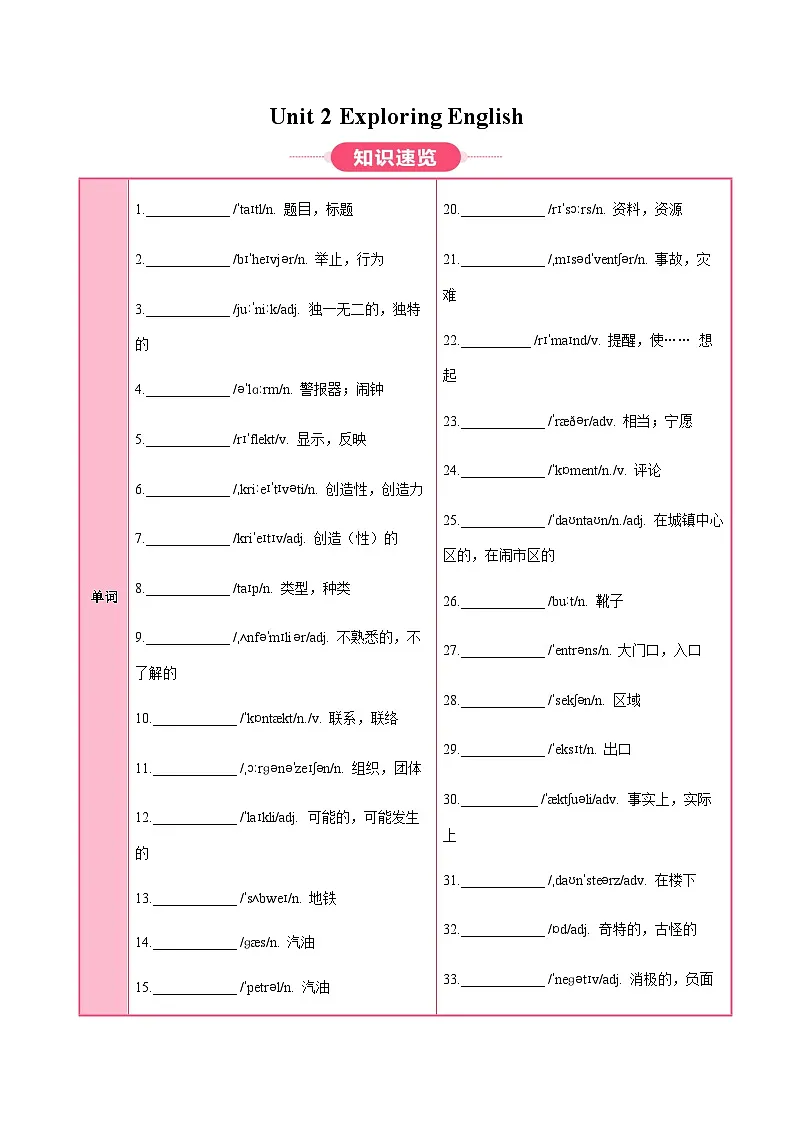
1.____________ /ˈtaɪtl/n. 题目,标题
2.____________ /bɪˈheɪvjər/n. 举止,行为
3.____________ /juːˈniːk/adj. 独一无二的,独特的
4.____________ /əˈlɑːrm/n. 警报器;闹钟
5.____________ /rɪˈflekt/v. 显示,反映
6.____________ /ˌkriːeɪˈtɪvəti/n. 创造性,创造力
7.____________ /kriˈeɪtɪv/adj. 创造(性)的
8.____________ /taɪp/n. 类型,种类
9.____________ /ˌʌnfəˈmɪliər/adj. 不熟悉的,不了解的
10.____________ /ˈkɒntækt/n./v. 联系,联络
11.____________ /ˌɔːrɡənəˈzeɪʃən/n. 组织,团体
12.____________ /ˈlaɪkli/adj. 可能的,可能发生的
13.____________ /ˈsʌbweɪ/n. 地铁
14.____________ /ɡæs/n. 汽油
15.____________ /ˈpetrəl/n. 汽油
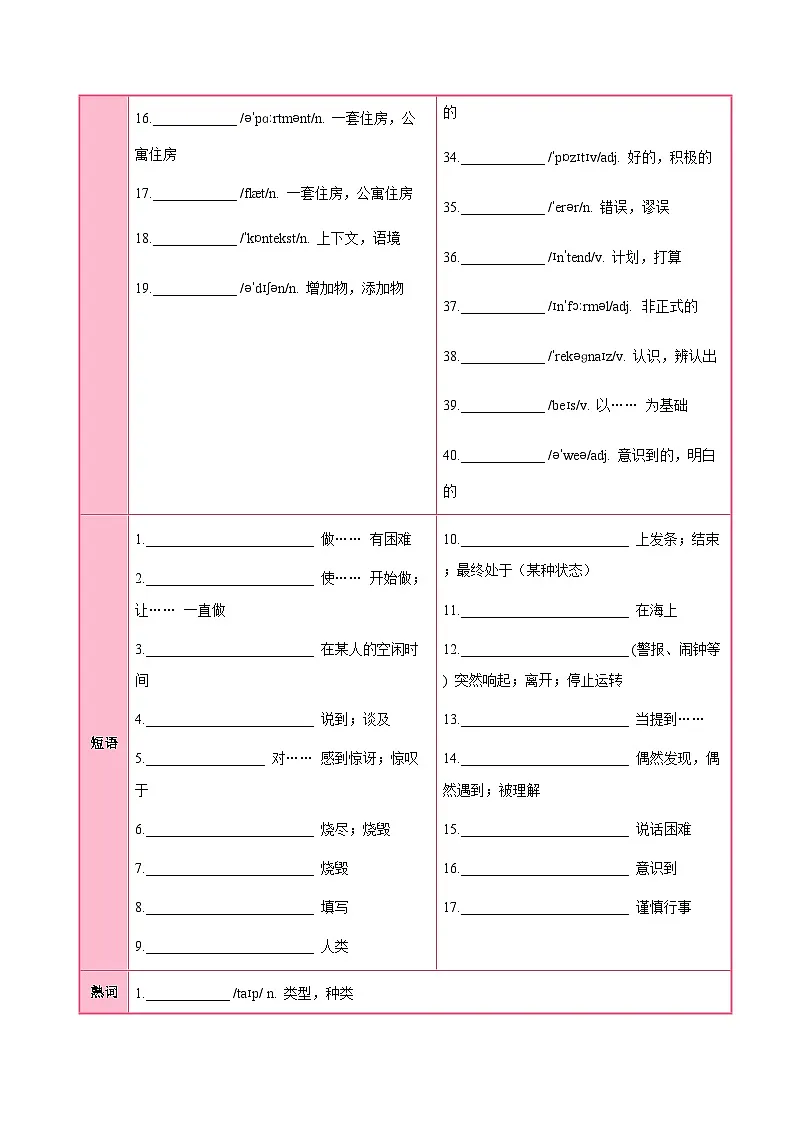
16.____________ /əˈpɑːrtmənt/n. 一套住房,公寓住房
17.____________ /flæt/n. 一套住房,公寓住房
18.____________ /ˈkɒntekst/n. 上下文,语境
19.____________ /əˈdɪʃən/n. 增加物,添加物
20.____________ /rɪˈsɔːrs/n. 资料,资源
21.____________ /ˌmɪsədˈventʃər/n. 事故,灾难
22.__________ /rɪˈmaɪnd/v. 提醒,使…… 想起
23.____________ /ˈræðər/adv. 相当;宁愿
24.____________ /ˈkɒment/n./v. 评论
25.____________ /ˈdaʊntaʊn/n./adj. 在城镇中心区的,在闹市区的
26.____________ /buːt/n. 靴子
27.____________ /ˈentrəns/n. 大门口,入口
28.____________ /ˈsekʃən/n. 区域
29.____________ /ˈeksɪt/n. 出口
30.___________ /ˈæktʃuəli/adv. 事实上,实际上
31.____________ /ˌdaʊnˈsteərz/adv. 在楼下
32.____________ /ɒd/adj. 奇特的,古怪的
33.____________ /ˈneɡətɪv/adj. 消极的,负面的
34.____________ /ˈpɒzɪtɪv/adj. 好的,积极的
35.____________ /ˈerər/n. 错误,谬误
36.____________ /ɪnˈtend/v. 计划,打算
37.____________ /ɪnˈfɔːrməl/adj. 非正式的
38.____________ /ˈrekəɡnaɪz/v. 认识,辨认出
39.____________ /beɪs/v. 以…… 为基础
40.____________ /əˈweə/adj. 意识到的,明白的
短语
1.________________________ 做…… 有困难
2.________________________ 使…… 开始做;让…… 一直做
3.________________________ 在某人的空闲时间
4.________________________ 说到;谈及
5._________________ 对…… 感到惊讶;惊叹于
6.________________________ 烧尽;烧毁
7.________________________ 烧毁
8.________________________ 填写
9.________________________ 人类
10.________________________ 上发条;结束;最终处于(某种状态)
11.________________________ 在海上
12.________________________ (警报、闹钟等) 突然响起;离开;停止运转
13.________________________ 当提到……
14.________________________ 偶然发现,偶然遇到;被理解
15.________________________ 说话困难
16.________________________ 意识到
17.________________________ 谨慎行事
熟词生义
1.____________ /taɪp/ n. 类型,种类
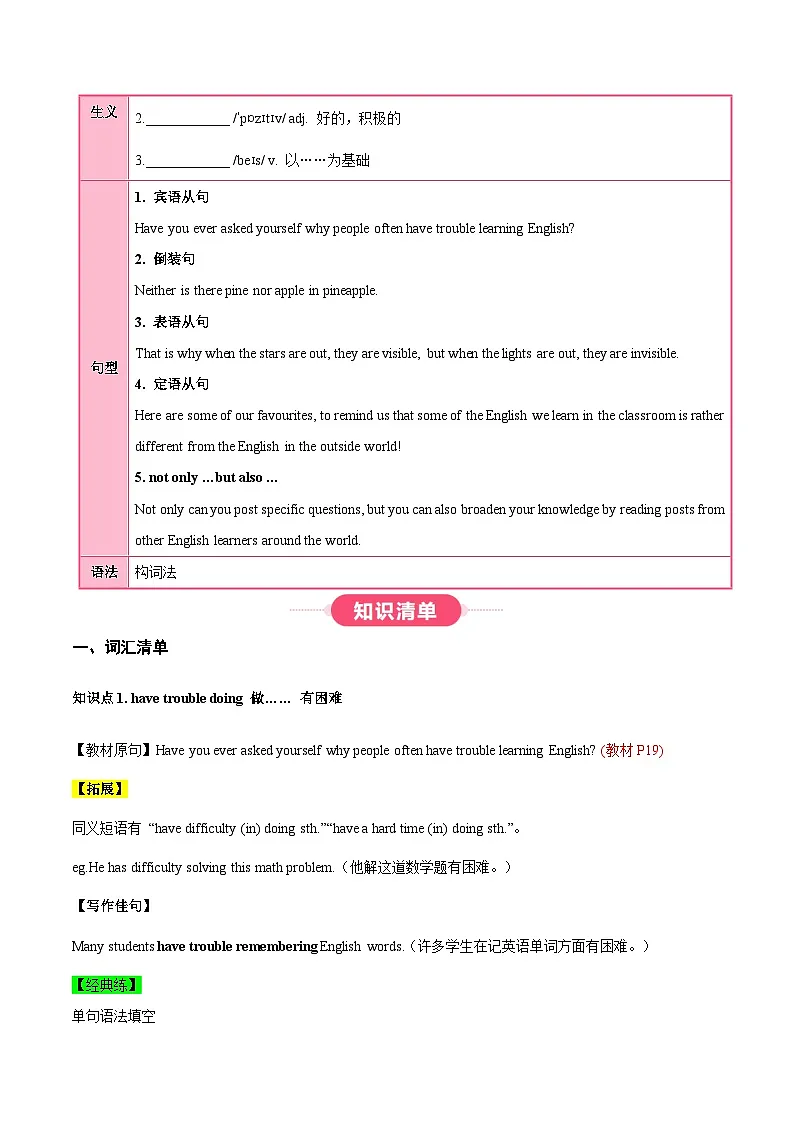
2.____________ /ˈpɒzɪtɪv/ adj. 好的,积极的
3.____________ /beɪs/ v. 以……为基础
句型
宾语从句
Have yu ever asked yurself why peple ften have truble learning English?
倒装句
Neither is there pine nr apple in pineapple.
表语从句
That is why when the stars are ut, they are visible, but when the lights are ut, they are invisible.
定语从句
Here are sme f ur favurites, t remind us that sme f the English we learn in the classrm is rather different frm the English in the utside wrld!
nt nly ... but als ...
Nt nly can yu pst specific questins, but yu can als braden yur knwledge by reading psts frm ther English learners arund the wrld.
语法
构词法
1.
2.
3.
4.
classrm
bkstre
hmewrk
unhappy
rewrite
teacher
careful
water the flwer
my lve fr sprts
telephne → phne
examinatin → exam
mathematics → math/maths
体裁
记叙文
人称
以第一、三人称为主
时态
主要时态应用一般过去时态
框架
第一段:介绍背景;
第二段:描述事件;
第三段:表达感受。
这是一份外研版 (2019)必修 第一册Unit 2 Exploring English优质学案,共32页。学案主要包含了词汇清单,语法清单,写出下列单词的派生词等内容,欢迎下载使用。
这是一份英语外研版 (2019)Unit 2 Exploring English优秀学案,共32页。学案主要包含了词汇清单,语法清单,写出下列单词的派生词等内容,欢迎下载使用。
这是一份外研版 (2019)必修 第二册Unit 1 Food for thought精品导学案,共16页。学案主要包含了词汇清单,知识点精讲,语法清单,写作清单等内容,欢迎下载使用。

注册成功

在线客服
添加在线客服
获取1对1服务
官方微信
关注“教习网”公众号
打开微信就能找资料
赛课定制
添加在线客服
获取1对1定制服务
职称咨询
添加在线客服
获取1V1专业指导服务

免费福利

.png)