 免费领取教师福利

若您为此资料的原创作者,认为该资料内容侵犯了您的知识产权,请扫码添加我们的相关工作人员,我们尽可能的保护您的合法权益。

这是一份【二轮专题】第9讲非谓语动词-高考英语语法精讲课件,共25页。PPT课件主要包含了高考链接,年命题要点,年备考建议等内容,欢迎下载使用。
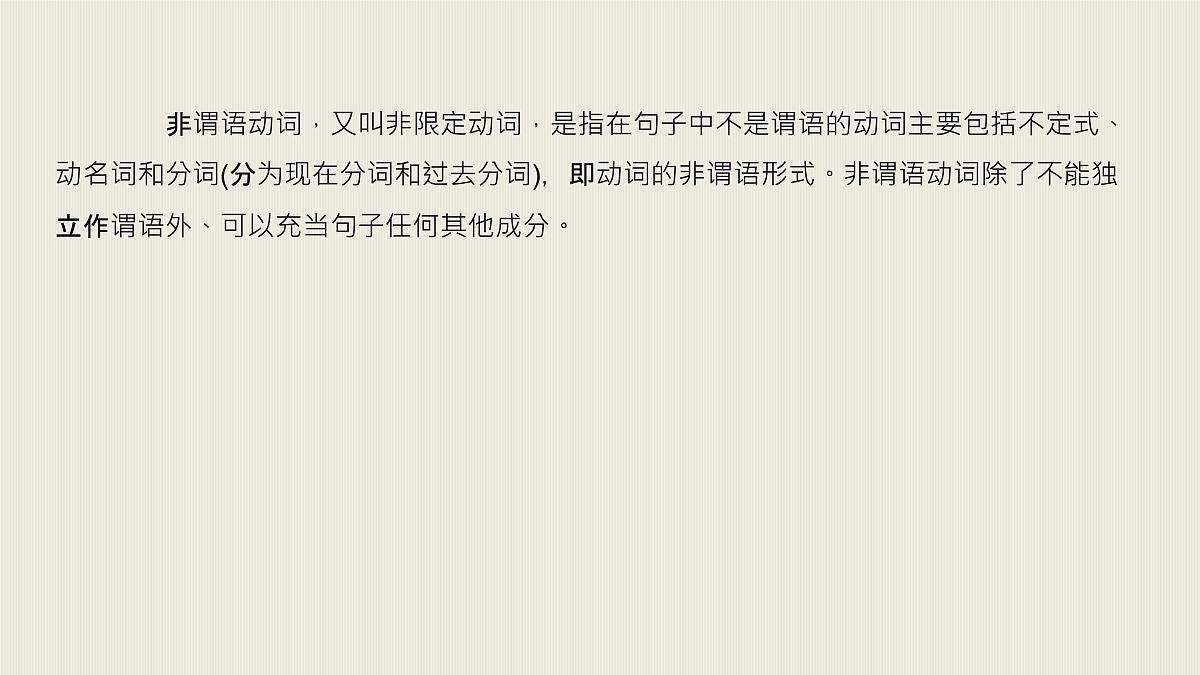
非谓语动词,又叫非限定动词,是指在句子中不是谓语的动词主要包括不定式、动名词和分词(分为现在分词和过去分词),即动词的非谓语形式。非谓语动词除了不能独立作谓语外、可以充当句子任何其他成分。
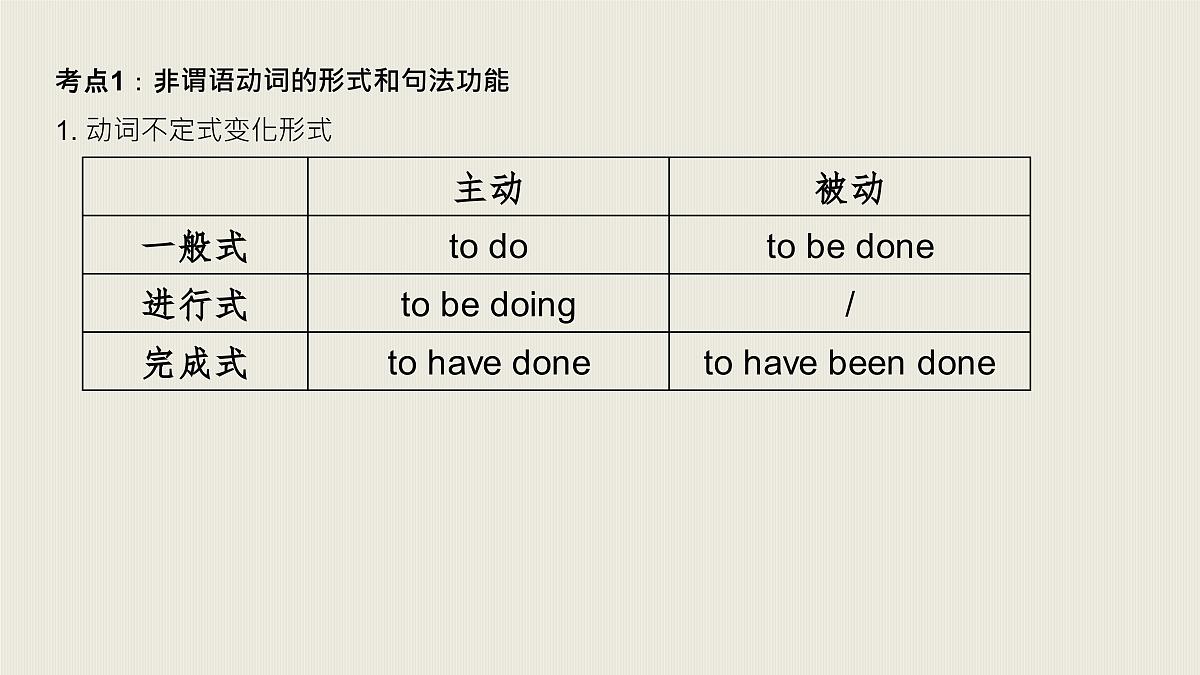
考点1:非谓语动词的形式和句法功能1. 动词不定式变化形式
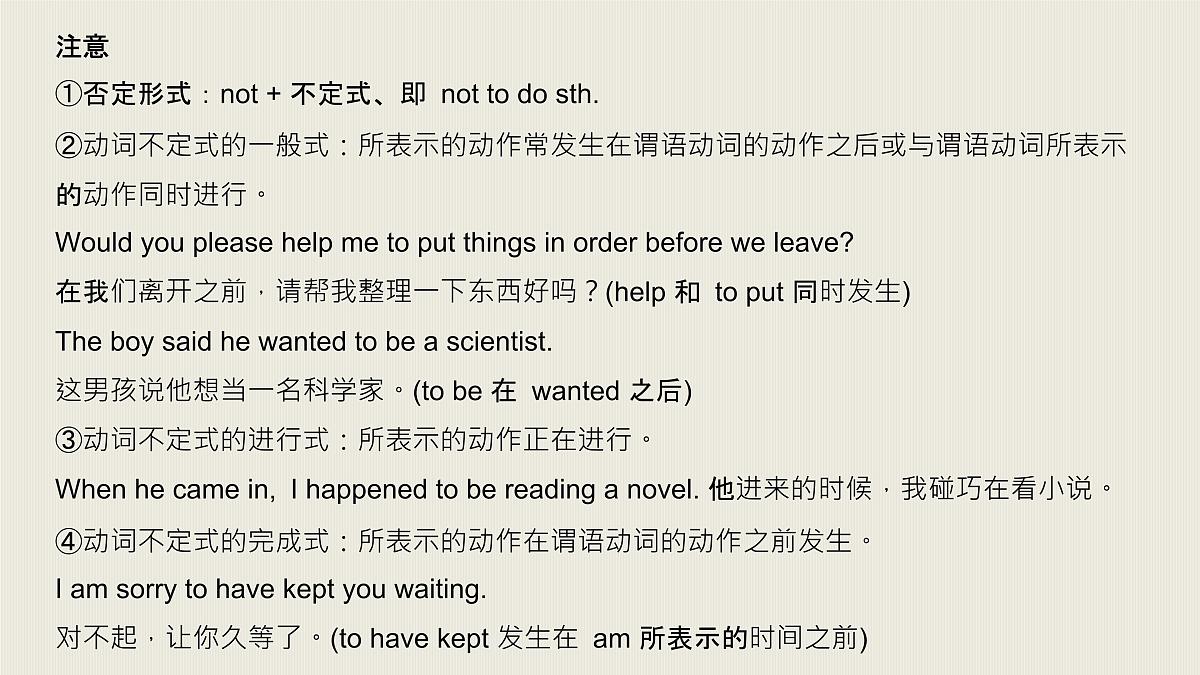
注意①否定形式:nt + 不定式、即 nt t d sth.②动词不定式的一般式:所表示的动作常发生在谓语动词的动作之后或与谓语动词所表示的动作同时进行。Wuld yu please help me t put things in rder befre we leave?在我们离开之前,请帮我整理一下东西好吗?(help 和 t put 同时发生)The by said he wanted t be a scientist.这男孩说他想当一名科学家。(t be 在 wanted 之后)③动词不定式的进行式:所表示的动作正在进行。When he came in, I happened t be reading a nvel. 他进来的时候,我碰巧在看小说。④动词不定式的完成式:所表示的动作在谓语动词的动作之前发生。I am srry t have kept yu waiting.对不起,让你久等了。(t have kept 发生在 am 所表示的时间之前)
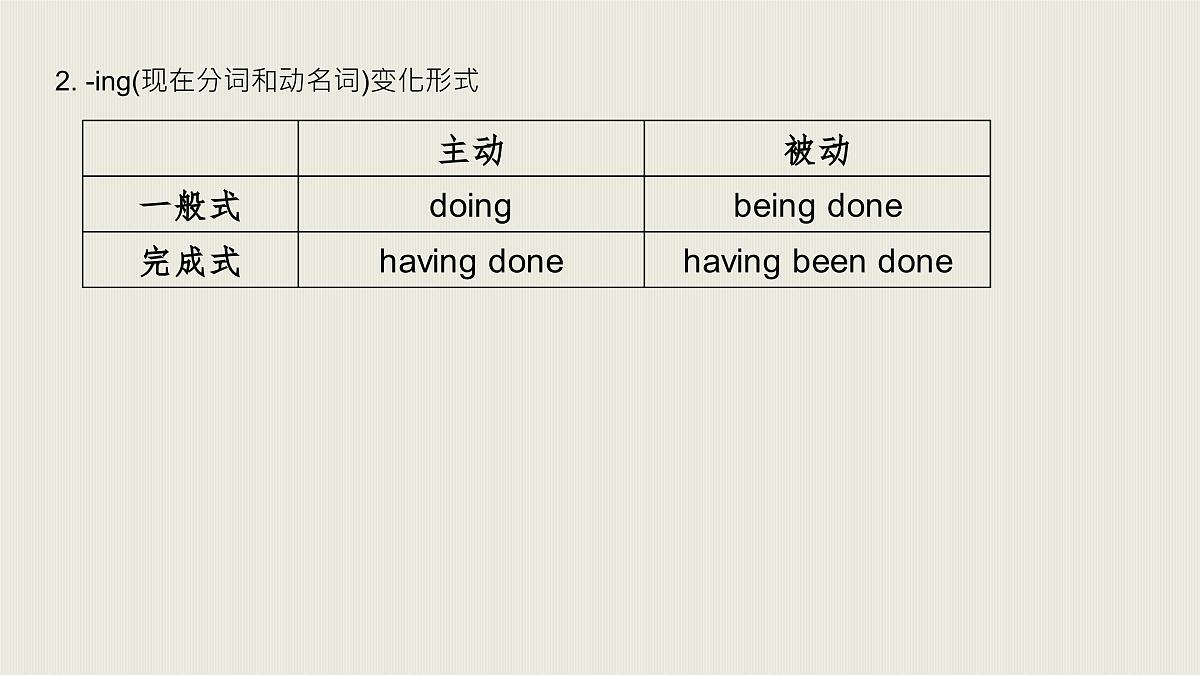
2. -ing(现在分词和动名词)变化形式
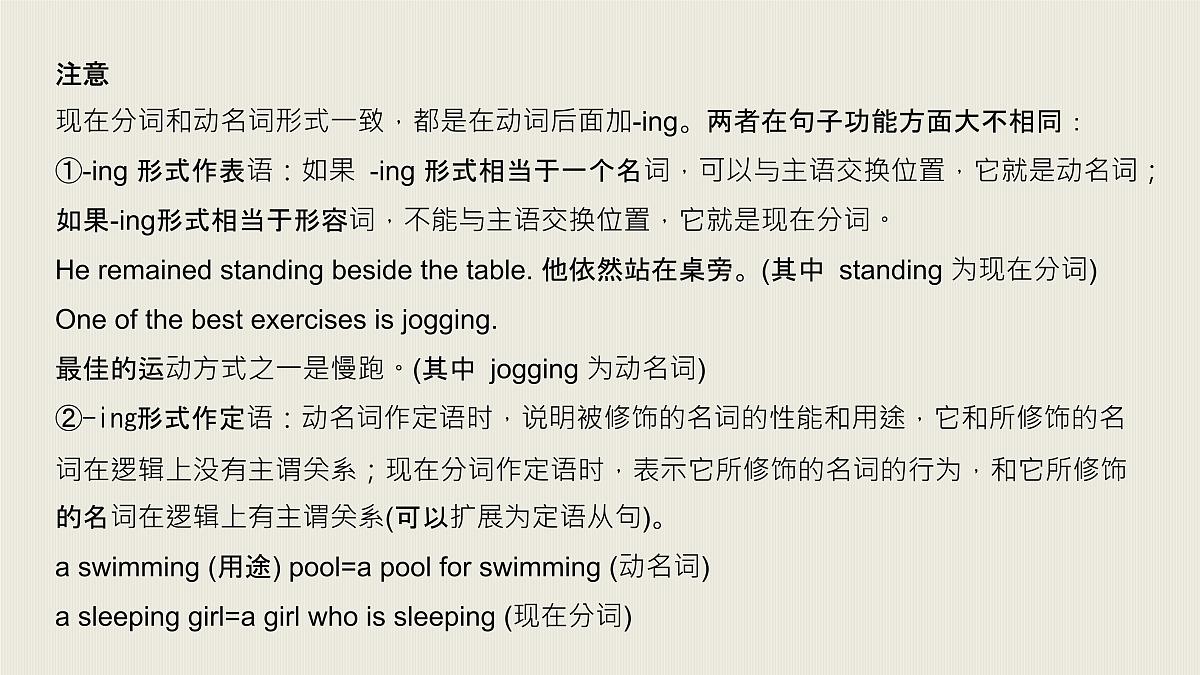
注意现在分词和动名词形式一致,都是在动词后面加-ing。两者在句子功能方面大不相同:①-ing 形式作表语:如果 -ing 形式相当于一个名词,可以与主语交换位置,它就是动名词;如果-ing形式相当于形容词,不能与主语交换位置,它就是现在分词。He remained standing beside the table. 他依然站在桌旁。(其中 standing 为现在分词)One f the best exercises is jgging.最佳的运动方式之一是慢跑。(其中 jgging 为动名词)②-ing 形式作定语:动名词作定语时,说明被修饰的名词的性能和用途,它和所修饰的名词在逻辑上没有主谓关系;现在分词作定语时,表示它所修饰的名词的行为,和它所修饰的名词在逻辑上有主谓关系(可以扩展为定语从句)。a swimming (用途) pl=a pl fr swimming (动名词)a sleeping girl=a girl wh is sleeping (现在分词)
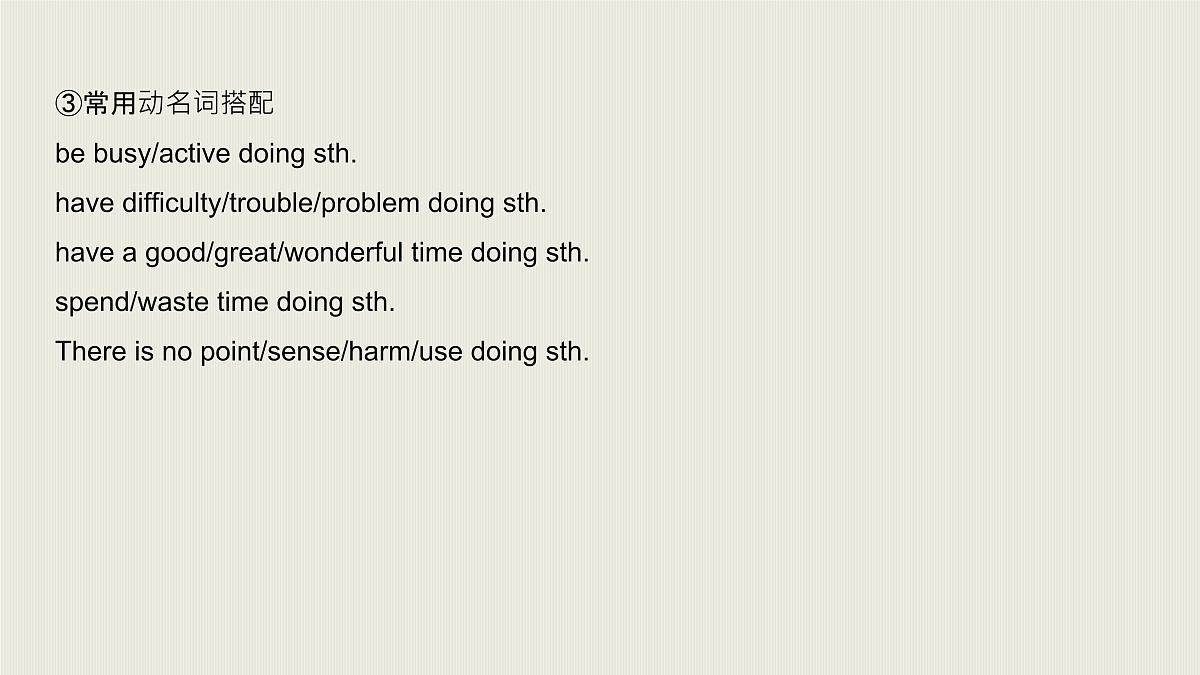
③常用动名词搭配be busy/active ding sth.have difficulty/truble/prblem ding sth.have a gd/great/wnderful time ding sth.spend/waste time ding sth.There is n pint/sense/harm/use ding sth.
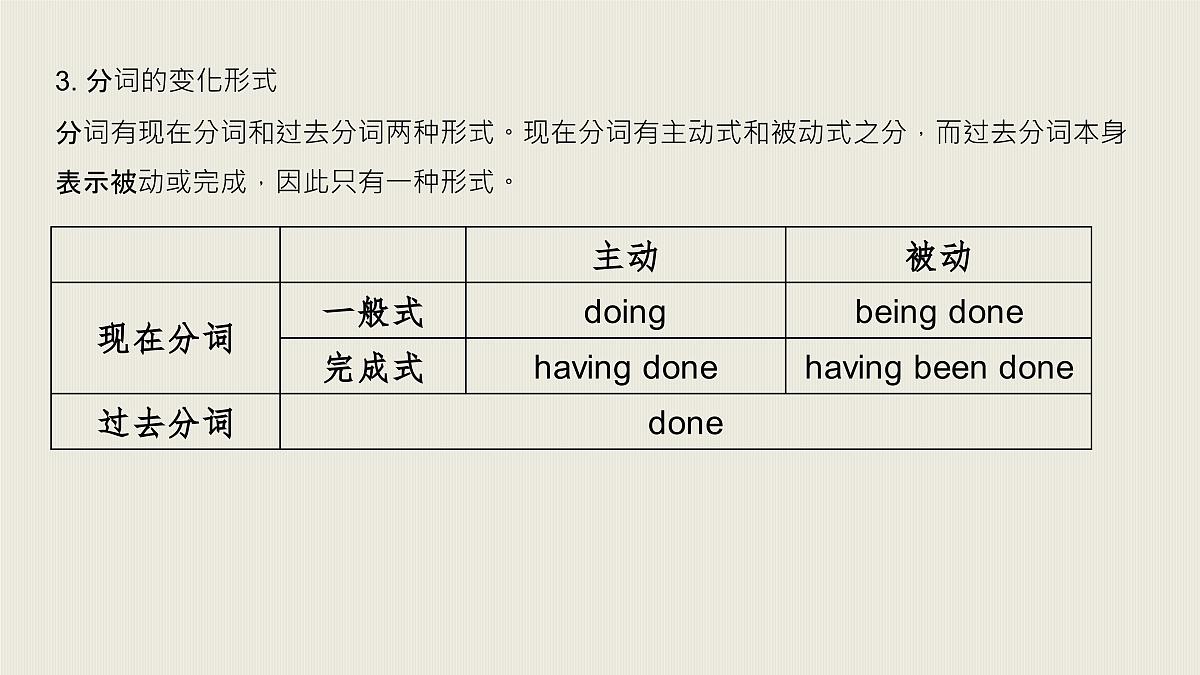
3. 分词的变化形式分词有现在分词和过去分词两种形式。现在分词有主动式和被动式之分,而过去分词本身表示被动或完成,因此只有一种形式。
现在分词和过去分词在句中所充当的句子功能相似,但是两者的形式不同,在表意方面也有很大区别。①在语态方面,现在分词与所修饰的名词之间是主动的逻辑关系,而过去分词多由及物动词变来,与所修饰的名词之间是被动的逻辑关系,不及物动词的过去分词不表示被动,只表示完成。This is an exciting mvie. 这是一部令人激动的电影。(exciting 表主动,为现在分词)We feel excited. 我们倍感激动。(excited 表被动,为过去分词)They picked up a lt f fallen leaves.他们捡了很多落叶。(fallen 表完成,为过去分词)②在时间方面,现在分词所表示的动作往往正在进行,而过去分词所表示的动作,往往已经完成。通过分词的不同形式,我们可以判定动作的状态是正在发生还是已经完成。the changing wrld 正在变化着的世界the changed wrld 已经起了变化的世界
4. 非谓语动词句法功能
考点2:非谓语动词作主语1. 动名词和动词不定式作主语 动名词作主语往往表示普通的、一般的行为,不定式作主语常表示某次具体的行为。Cllecting infrmatin abut children's health is his jb.收集有关儿童健康的信息是他的工作。T see is t believe. 百闻不如一见。It's very kind f yu t have given us s much help.你给了我们那么多的帮助真是太好了。
2. 用形式主语it 代替动词不定式或动名词作主语的情况 动词不定式和动名词作主语时,常用it作形式主语,放在原主语的位置上。(1) 用形式主语it代替不定式作主语的常见句型有:A. It's difficult (imprtant,necessary) fr sb. t d sth. 某人做某事有困难(很重要,有必要)。B. It's kind (friendly,plite,careless,rude,cruel,clever,flish,brave) f sb. t d sth.某人做某事是善良的(友善的,礼貌的,粗心大意的,粗鲁的,残忍的,聪明的,愚蠢的,勇敢的)。
注意不定式的逻辑主语一般由介词fr 引导,但下列表示人的性格行为特征的形容词作表语时,不定式的逻辑主语则由f引导:brave,curageus,careful,careless,clever,wise,flish,silly,stupid,gd,nice,kind,thughtful,cnsiderate,greedy,generus,hnest,mdest,plite,rude,cruel,selfish,lazy,wicked,wrng。Experts say walking is ne f the best ways fr a persn t stay healthy.专家说步行是一个人保持健康的最佳方式之一。It's clever f yu t have invented such a device. 你发明这样的装置很是聪明。(2) 用形式主语it代替动名词作主语的常见句型有:A. It's n gd (use,fun) ding sth.B. It’s (a) waste f time ne's ding sth.
考点3:非谓语动词作宾语动名词和动词不定式可作宾语,主要有下面四种类型:1. 只接不定式作宾语,而不能接动名词作宾语的动词affrd (付得起),apply (申请),arrange (安排),agree (同意),ffer (提出),intend (打算),plan (计划),demand (要求),ask (要求),prmise (答应),help (帮忙),prepare (准备),decide (决定),refuse (拒绝), chse (选择), wish (希望),want (想要),expect (期待,期望),pretend (假装),manage (设法),determine (决心)
2. 只接动名词作宾语,而不能接不定式作宾语的动词Admit (承认 ),advise (建议), allw (允许), appreciate (感激),avid (避免 ),cnsider (考虑 ), delay (推迟), deny (否认), dislike (不喜欢), enjy (喜爱),escape (逃脱),excuse (原谅),finish (完成), frbid (禁止),give up (放弃),imagine (想象 ),Keep (保持),mentin (提及), mind (介意), miss (没赶上), permit (允许),practise (练习),prhibit (禁止), put ff (推迟), risk (冒险),suggest (建议)
3. 用既可接不定式作宾语,也可接动名词作宾语且意思一致的动词有些动词既可接动名词作宾语,又可接不定式作宾语,且两者意思基本相同: like (喜欢), lve (喜欢), hate (憎恨), prefer (宁可), begin (开始), start (开始), cntinue (继续)等。
4. 既可接不定式作宾语,也可接动名词作宾语但意思不一致的动词有的动词既可接不定式作宾语,也可接动名词作宾语,两者意思不同,要注意区别:(1) remember (记得), frget (忘记),regret (后悔) 接不定式指该不定式所表示的动作还未发生,后接动名词(有时可用完成式),则指该动名词所表示的动作已经发生。I regret saying what I said, and I'll remember never t say it again.我懊悔刚才所说的话,并且牢记再也不讲了。(2) try 接不定式表示设法做某事,接动名词表示做某事试试(看有什么效果)。Yu shuldn't try t leave the restaurant withut paying. Yu shuld try cmmunicatingwith the manager. 你不应该试图不付账就离开饭店。你应该尝试和经理沟通一下。(3) Mean 接不定式表示打算(想要)做某事,接动名词表示意味着(要)做某事。If we mean t catch the early bus, that means getting up befre five.要想赶早班车,我们就得在5点钟以前起床。
(4) stp 接动名词表示停止做某事,接不定式表示停下正在做的事去做另一事(注意:接不定式时,不定式不是宾语,而是目的状语)。The cmputer stpped wrking, and I had t stp t get smene t mend it.电脑坏了,我不得不停下来去找人修理电脑。(5) can't help 接动名词表示禁不住去做某事,接不定式表示不能帮助做某事。She's a beautiful girl, and yu can’t help liking her. Hwever, I can't help t run after her. 她是一个漂亮的姑娘,你会禁不住喜欢她的。但我不能帮忙去追求她。(6) g n 接不定式表示做完某事后接着做另一件事,接动名词表示继续做正在做的事。The minister went n writing fr tw hurs, and then went n t talk abut freign plicy.部长一连写了两个小时,接着就畅谈外交政策。
注意动词用作介词的宾语时,要用动名词形式,不能用不定式。但是,当非谓语动词位于 but,except 后作宾语时,习惯上要用不定式,当其前有动词 d 时,则不定式不带 t;若其前没有动词 d,则不定式通常带 t。She was late because f missing the bus. 她迟到了,因为没有赶上公共汽车。We had n chice but t wait. 我们除了等待之外别无选择。I culd d nthing except agree. 我除了同意,没有别的办法。
考点4:非谓语动词作表语1. 动词不定式和动名词作表语不定式和动名词作表语相当于名词作表语,表示主语的内容,主语和表语可以对调。My jb is teaching. Teaching is my jb. 我的工作是教书。My jb is t teach. → T teach is my jb. 我的工作是教书。
2. 分词作表语分词作表语相当于形容词作表语,主语和表语不可对调。分词作表语时总是放在系动词之后,构成系表结构,表示主语所处的状态。-ing 形式通常表示主动或进行,过去分词则表示被动或完成。I think the shp is clsed at this time f day. 我觉得商店每天这个时候关门。The stry sunds interesting. 这个故事听起来很有趣。
注意现在分词或过去分词常用作表语的动词有:interest,mve,discurage,amuse,astnish, frighten,excite,inspire,please,satisfy,tire,wrry,surprise,bre,disappint,encurage,puzzle,shck 等。通常修饰人用过去分词,意为”某人感觉的”常构成“be+过去分词+介词+宾语”的结构;修饰物时则用现在分词形式,意为“令人…的”,常用来表示事物或人的特点、属性等。I am interested in English. 我对英语感兴趣。His perfrmance is satisfying. 他的表现是令人满意的。
考点5:非谓语动词作定语动词不定式、动名词和分词都可作定语。动名词和单独的分词作定语,往往位于所修饰的中心词之前;动词不定式和分词短语作定语,需位于中心词后面,即充当后置定语。
1. 动词不定式作定语①不定式在句中作定语时通常为后置定语,即放在被修饰名词或代词后。I have nthing t say abut this questin. 在这个问题上,我没有什么话要说。He was the first guest t arrive. 他是第一个到达的客人。②不定式与其所修饰的词构成逻辑上的被动关系,而该不定式为不及物动词时,其后须加上适当的介词,构成及物动词短语。可转换成:介词 + which + t d 作定语。I need a piece f paper t write n. 我需要一张写字用的纸。→ I need a piece f paper n which t write.
③不定式常作下列名词的定语:attempt,ability,anything,chance,desire,determinatin,decisin,effrt,failure,intentin,need,pprtunity,plan,prmise, pressure,right,tendency,time,way 等。They have nw an pprtunity t g abrad t study further.他们现在有机会出国深造。由 nly,last,next,序数词或形容词的最高级修饰的名词常用不定式作定语。Mr. Wang is always the first man t arrive at the ffice and the last man t leave.王先生总是最先到办公室,并最后一个离开。④在一些固定句型中,习惯上使用不定式。It’s yur turn t speak nw. 该轮到你说了。It's time t g t schl. 该上学了。
2. 动名词作定语动名词作定语不以短语的形式出现,而且总是位于被修饰名词之前(在许多情况下构成合成名词,用以表示被修饰名词的用途、目的和场合:reading rm 阅览室 perating table 手术台swimming pl 游泳池 singing cmpetitin 歌咏比赛drinking water 饮用水 washing machine 洗衣机
3. 分词作定语单个的分词作定语可以置于被修饰词语之前,但若是分词短语作定语则应置于被修饰名词之后。如被修饰的名词是smething,anything,everything,nthing等,分词放在被修饰名词的后面面。We can see the rising sun. 我们可以看到东升的旭日。The by hurt by the car was sent t the hspital immediately.被车伤着的男孩被立即送到了医院。There is nthing interesting. 没什么有趣的事。分词短语作定语时,通常放在被修饰的名词之后,它的作用相当于一个定语从句。This will be the best nvel f its kind ever written (=that has ever been written).这将是这类小说中写得最好的。The man waiting fr yu (=wh is waiting fr yu) is yur friend.正在等你的人是你的朋友。
考点6:非谓语动词作状语动词不定式和分词可作状语。两者作状语时应和句子主语含有逻辑上的主动或被动关系,否则应使用独立主格结构。
1. 动词不定式作状语动词不定式作状语可表示目的、原因及结果等,其逻辑主语就是句子的主语,因此动词不定式作状语往往用主动式。We eat t live, but we dn't live t eat.我们吃饭是为了活着,但是活着不是为了吃饭。(目的状语)She burst int tears t hear the bad news. 听到这个坏消息后她痛哭流涕。(原因状语)表目的的不定式还常与s as或in rder连用,构成 s as (nt) t d sth. 和 in rder (nt)t d sth. 的动词不定式结构,在句中充当目的状语。s as t d sth. 不可用于句首。T get there in time, we gt up very early. 为了及时赶到那里,我们早早地起床了。=In rder t get there in time, we gt up very early.=We gt up very early (in rder/s as) t get there in time.
nly t d sth. 表示一个与主语愿望相反的或出乎主语意料的结果,或用来暗示最初的未能实现的动作。I wrked hard, nly t fail at last. 我努力工作,结果最后却失败了。注意有时,不定式还可独立修饰一个句子,表明说话人的态度。常见的此类不定式有:t tell yu the truth (说实话),t be hnest (老实说 ),t be frank (坦率地说),T be fair (公平地讲)等。T tell yu the truth, I dn’t like that film. 说实话,我不喜欢那部电影。
2. 分词作状语现在分词和过去分词作状语,多说明动作发生的方式或伴随情况。主主语在逻辑上与分词如果是主动关系,则用现在分词,如果是被动关系则用过去分词。分词可以位于句首、句中或者句末,其作用相当于一个相应的状语从句。Hearing the bad news, she burst int tears. 听到这个坏消息,她痛哭流涕。(时间状语)→ When/As she heard the bad news, she burst int tears. (时间状语从句)Given mre time, we culd have dne it better.如果再多给些时间,我们可以做得更好。(条件状语)→ If we are given mre time, we culd have dne it better. (条件状语从句)
①现在分词作结果状语多位于句末,表示谓语动词本身的动作造成的结果,其作用相当于一个定语从句。It rained heavily, causing severe flding in that cuntry.大雨膀沱,造成那个国家洪水泛滥。→ It rained heavily, which caused severe flding in that cuntry.②如果不定式或分词表示的动作在谓语动词表示的动作。之前发生,该不定式或分词需用完成式。I'm srry t have given yu s much truble. 对不起给你添了这么多麻烦。Having finished my hmewrk, I went t play ftball. 完成了作业后,我出去踢球了。After I finished my hmewrk, I went t play ftball.
3. 含有非谓语动词的独立主格结构 非谓语动词作状语,它的逻辑主语应和句子主语保持一致。但有时非谓语动词带有自己的逻辑主语,在句中作状语,这种现象称为独立主格结构。独立主格结构没有主语和谓语,在语法上不是句子,一般有逗号与主句分开。有时可以用 with 引出。 独立主格结构由名词或代词加上其他成分(分词、不定式、名词、代词、形容词副词或介词短语)构成。这种结构通常在句子中起方式、时间、原因、条件等状语或状语从句的作用,主要用于书面语。使用非谓语动词形式的独立主格结构可以改为状语从句。(1) “名词(代词)+过去分词”The signal given, the bus started. 信号发出后,公共汽车就启动了。 After the signal was given, the bus started.
(2) “名词(代词)+现在分词”Tday being Mnday, the library isn’t pen. 今天星期一,图书馆不开放。 As (Since) tday is Mnday, the library isn't pen.Summer cming, it gets htter and htter. 随着夏天的到来,天气越来越热了。As summer cmes, it gets htter and htter.(3) “名词(代词)+不定式”With s many peple t help him, he is sure t succeed.有如此多的人来帮助他,他一定会成功的。 As s many peple help him, he is sure t succeed.
4. “连词+非谓语动词”作状语 可以看作非谓语动词前面加连词,也可以是状语从句的主语与主句主语一致或者是 it,并且从句谓语中含有 be,把 be 和主语一起省略后的省略句。The flwers his friend gave him will die unless watered (=unless they are watered) every day. 他的朋友送给他的花,如果不每天浇水就会死的。(water 和 flwers之间是被动关系)Althugh answering (=Althugh Tm answered) all the questins in the test, Tm did ntget a gd grade. 尽管在考试中回答了所有的问题,汤姆也没有得到好成绩。(answer和Tm之间是主动关系)
考点7:非谓语动词作补足语 在主动语态句子中,动词不定式和分词可作宾语补足语,构成“v.+宾语+宾语补足语”的结构,当这个主动语态的句子变成被动语态,即原宾语成为句子主语时,其补足语称作主语补足语。Father will nt allw us t play n the street. 父亲不让我们在街上玩耍。(宾语补足语)We will nt be allwed t play n the street. 我们不被允许在街上玩耍。(主语补足语)
1. 动词(短语)+宾语+带t 的不定式(作宾语补足语)有些动词(短语)后跟带t 的不定式作补语,即:动词(短语)+宾语+ t d sth.,拥有这种结构的常见动词(短语)有:advise,appint,allw,ask,beg,cause,encurage,expect, frbid,frce,get,intend,invite,like,lve,rder,persuade,prefer,require,teach, tell,want,warn,wish,call n,depend n等。
2. 感官动词+宾语+宾语补足语感官动词see,watch,bserve,ntice,lk at,hear,listen t,smell,taste,feel 等的宾语补足语有3种形式,即动词原形(省略t的不定式,变成被动语态要加上 t )、现在分词和过去分词。现在分词表示示主动或正在进行,过去分词表示被动或完成,动词原形表示主动和完成。(1) 不带t的不定式充当感官动词补语。I heard her sing an English sng just nw.刚才我听见她唱了一首英文歌。(省略t的不定式作宾语补足语)She was heard t sing an English sng just nw.刚才她被听到唱了一首英文歌。(带t的不定式作主语补足语)
(2) 现在分词充当感官动词补语。I heard her singing an English sng when I passed by her rm yesterday.昨天经过她房间时,我听见她在唱英文歌。(宾语补足语)She was heard singing an English sng by me when I passed by her rm yesterday.昨天我经过她房间时,她被我听到在唱英文歌。(主语补足语)(3) 过去分词充当感官动词补语。I heard the English sng sung many times.我多次听到有人唱这首英文歌。(宾语补足语)The English sng was heard sung many times.这首英文歌多次被听到唱。(主语补足语)
3. 使役动词·+宾语++非谓语动词(作宾语补足语) 常见使役动词 let,make,have,get +宾语+非谓语动词(作宾语补足语)(1) let sb./sth. d意为“让某人/某物做…”Let them stay in the classrm and d their exercises themselves.让他们留在教室里面自己做练习。(2) make sb./sth. d 意为“使/让某人/某物做…”,变被动语态时,不定式需带t。The teacher made the students stay after class. 老师让这些学生下课后留下来。The students were made t stay after class. 这些学生被要求下课后留下来。(3) make sb./sth. dne意为“让/使某人或某事被……”He raised his vice t make himself heard. 他提高了嗓门,以便让自己被人听到。Can yu easily make yurself understd in English? 你能使用英文把意思表达清楚吗?
(4) have sb./sth. d 意为““让某人或某物做…”。She had her children ck dinner fr her. 她让孩子们为她做饭。(5 )have sb./sth. dne 意为“让某人/某事被…”。I had my hair cut last Saturday. 上周六我理了发。(6) get sb. t d sth. 意为“让某人做某事”,注意t不可省略。Hw can we get all the emplyees t arrive n time?我们如何才能让所有员工都准时抵达?(7) get sb./sth. dne 意为“让某人/某事被…”We're getting ur huse painted this weekend. 我们这周末要请人粉刷房屋。
4. find/leave/keep + 宾语+非谓语动词(作宾语补足语) 动词 find,leave,keep 也可以接非谓语动词作补足语。She fund a wallet lying n the grund.她发现一只钱包在地上。(现在分词作宾语补足语)They fund the street lined with peple.他们发现大街两侧都站着人。(过去分词作宾语补足语)He measured the clth and fund it (t be) the exact size.他量了一下布,发现大小正好合适。(不定式作宾语补足语, t be 可省略 )Fr mst f the day he can still be fund wrking smewhere in the plant. 白天大部分时间人们还发现他在厂里某个地方工作。(被动语态,现在分词作主语补足语)This methd was fund t be practicable.大家发现这方法很可行。(被动语态,动词不定式作主语补足语)
注意不及物动词的过去分词作宾补表示完成或状态。I lked dwn at my neck and fund my necklace gne. (状态)I was surprised t find my hmetwn changed s much. (完成)
5. catch+宾语+现在分词(作宾语补足语)catch可接现在分词作宾语补足语,构成catch sb. ding的结构,意为“撞见某人正在做某事'”,其被动形式为:sb. be caught ding sth.。Next time I catch yu stealing frm thers' pckets, I'll turn yu in t the plice.下次再让我看到你偷别人口袋里的东西,我就把你送到警察局。(作宾语补足语)She was caught cheating in the exam. 她考试作弊被抓到了。(作主语补足语)
6. with+宾语+非谓语动词(作宾语补足语)(1) with+宾语+不定式”通常表示不定式动作尚未发生或在当时看来尚未发生。With all this wrk t d, I wn’t have time t g ut.有这么多工作要做,我就没有时间出去了。(2) “with+宾语+现在分词”指动作正在进行或在当时看来已是一种在持续的状态。He sn fell asleep with the light still burning. 他很快就睡着了,灯还亮着。注意正如进行时态有时可以表示将来意义一样,有时“现在分词”也可表示将来意义。With winter cming n, it's time t buy warm clthes.冬天就要到了,该买暖和衣裳了。(3) “with+宾语+过去分词”指与其前的名词或代词为被动关系。She sat with her head bent. 她低着头坐在那里。
7. 不定式作主语补足语的常见结构些动词用于被动语态中,后面常接不定式作主语补足语,构成如下结构:Sb./Sth. + be said/believed/knwn/reprted/cnsidered/fund/thught t d/t have dne/t be dne/t have been dne. 例如:Shakespeare is cnsidered t be ne f the greatest writers.莎士比亚被认为是最伟大的作家之一。(=It is cnsidered that Shakespeare is ne f the greatest writers.)He was said t have been cheated in the street. 据说,他在大街上被骗了。(=It was said that he has been cheated in the street.)
1. 【2025年新高考全国Ⅰ卷·语法填空】题目:The latest ______ (engineer) techniques are applied t create this prtective functinal structure.答案与解析:✅ engineering此处需形容词修饰名词“techniques”,“engineering”(工程学的)为动名词作定语,表用途。
2. 【2025年新高考全国Ⅱ卷·语法填空】题目:Visitrs walking thrugh the garden were amazed ______ (find) the cnnectin between the writers.答案与解析:✅ t find“amazed”后接不定式作原因状语(be amazed t d sth),表情感原因。
3. 【2025年全国甲卷·语法填空】题目:Natinal parks tend ______ (catch) ur attentin due t their large size.答案与解析:✅ t catch固定搭配“tend t d”(倾向于做某事),不定式作宾语。
4. 【2025年浙江卷1月·语法填空】题目:Buying extra ______ (benefit) frm price reductins desn’t make sense.答案与解析:✅ t benefit不定式"t benefit"作目的状语,解释"buying extra"的目的。
5. 【2025年北京西城区高三一模·短文改错】题目:I regretted nt t take my dctr’s advice.答案与解析:✅ nt t take nt taking"regret ding"表后悔做过的事;"regret t d"表遗憾将要做的事。此处指"未听从建议"的过去行为,用动名词。
6. 【2025年江苏南京二模·语法填空】题目:______ (see) frm the hill, the city lks like a garden.答案与解析:✅ Seen过去分词作状语,逻辑主语"the city"与"see"为被动关系(城市被看)。
7. 【2025年广东深圳三模·语法填空】题目:The questin ______ (discuss) yesterday has been slved.答案与解析:✅ discussed过去分词作后置定语,表被动完成(问题被讨论)。
8. 【2025年湖北武汉一模·语法填空】题目:He std there, ______ (stare) at the painting silently.答案与解析:✅ staring现在分词作伴随状语,逻辑主语"He"与"stare"为主动关系。
9. 【2025年山东青岛二模·语法填空】题目:The by pretended ______ (read) when his mther entered.答案与解析:✅ t be reading不定式进行式"t be ding"强调动作与谓语同时发生(假装正在读书)。
10. 【2025年四川成都三模·语法填空】题目:The car ______ (repair) nw belngs t Mr. Smith. 答案与解析: ✅ being repaired现在分词被动式作定语,表“正在被修理”的动作。
11. 【2025年天津和平区高三一模·语法填空】题目:She is the first wman ______ (elect) t the cmmittee.答案与解析:✅ t be elected序数词(first)后接不定式作定语,逻辑主语"wman"与"elect"为被动关系,表将来动作(将被选举),用不定式被动式"t be elected"。
12. 【2025年湖南长郡中学高三二模·语法填空】题目:______ (wrk) hard, yu will pass the exam.答案与解析:✅ Wrking现在分词作条件状语,逻辑主语"yu"与"wrk"为主动关系,相当于"If yu wrk hard"。
13. 【2025年福建厦门高三三模·语法填空】题目:I can't imagine ______ (live) withut the Internet.答案与解析:✅ living动词"imagine"后需接动名词作宾语(imagine ding sth),表"想象做某事"。
14. 【2025年河北石家庄高三一模·语法填空】题目:The bk ______ (write) by M Yan is ppular.答案与解析:✅ written过去分词作后置定语,修饰"bk",逻辑主语"bk"与"write"为被动完成关系(书被写)。
15. 【2025年重庆巴蜀中学高三二模·语法填空】题目:The teacher had the students ______ (clean) the classrm.答案与解析:✅ clean使役动词"have"表"让某人做某事"时,接省略t的不定式(have sb d sth)。
16. 【2025年浙江杭州高三三模·语法填空】题目:______ (finish) his hmewrk, he went ut t play.答案与解析:✅ Having finished现在分词完成式作时间状语,强调"finish"动作先于谓语"went"发生,且逻辑主语"he"与"finish"为主动关系。
17. 【2025年江苏苏锡常镇高三一模·语法填空】题目:The huse ______ (build) next year will be a museum.答案与解析:✅ t be built不定式被动式作定语修饰"huse",表将来被动动作(房子将被建造)。
18. 【2025年辽宁沈阳高三二模·语法填空】题目:He is t yung ______ (send) abrad alne.答案与解析:✅ t be sent""结构后接不定式,逻辑主语"He"与"send"为被动关系(被送出国),需用不定式被动式。
19. 【2025年陕西西安交大附中高三模考·语法填空】题目:The children sat n the grass, ______ (listen) t a stry.答案与解析:✅ listening现在分词作伴随状语,逻辑主语"children"与"listen"为主动关系,表与谓语"sat"同时发生的动作。
20. 【2025年河南郑州外国语高三模考·语法填空】题目:______ (expse) t sunlight fr t lng may harm yur skin.答案与解析:✅ Being expsed动名词被动式作主语,逻辑主语"yu"与"expse"为被动关系(被暴晒),强调被动状态。
1. 语境化考查:90%的题目需通过分析逻辑主语、时态、语态解题,如第6题"Seen"(被动)、第16题"Having finished"(动作先后)。2. 固定搭配高频:不定式:tend t d, be amazed t d, 动名词:imagine ding, regret ding69。3. 分词辨析关键:现在分词→主动/进行(第8题"staring")过去分词→被动/完成(第7题"discussed")被动进行→being dne(第10题"being repaired")。
1. 三步解题法:Step 1:确定句中已有谓语→填非谓语;Step 2:分析逻辑关系→主动用ding,被动用dne;Step 3:判断动作时间→将来用t d,完成用having dne210。2. 重点记忆清单:只接动名词的动词:avid, enjy, imagine, resist;只接不定式的动词:affrd, plan, refuse, demand;接ding/t d意义不同的词:frget, remember, regret, try69。3. 写作迁移训练:在作文中刻意使用非谓语结构提升语言复杂度,如:"Seen frm the windw, the garden lks beautiful."(状语)"The plicy aimed at reducing pllutin is effective."(定语)。
一、单句改错(仅限1处)1. Seen my grandparents and aunt chat happily nline, my parents and I felt a sense f cntentment.2. The chair lks rather hard, but in fact it is very cmfrtable t sit.3. Wrking hard, and yu will make it.4. The by wanted t ride his bicycle in the street, but his mther tld him nt.5. We hurriedly ended ur meeting, left many prblems t be settled.
非谓语动词综合巩固练习
6. Paul desn‘t have t be made learn, because he always wrks hard.7. Suddenly there appeared a yung lady dressing in green.8. During the examinatin we are asked staying in ur seats and keep eyes n ur wrk.9. They kept me lcking in a rm and I was rescued by the plice tw days later.10. Our schl prvides all the senir students with easy access t read bks.
二、在空白处填写1个适当的单词或括号内单词的正确形式。1. ①She tld me the bk _________(call) Pride and Prejudice. ②She starred in a TV play ________(call) Katerina.2. ①We have prepared a simple dish, mainly ________(cnsist) f rice and vegetables. ②It's easy fr us t prepare the dish, because it mainly ________(cnsist) f rice and vegetables.3. ①_________(knw) basic first aid techniques will help yu respnd quickly t emergencies. ②________(knw) basic first aid techniques, and yu will respnd quickly t emergencies.
4. ①The bridge _______(build) in 2012 helps prmte turism in this area. ②The bridge __________ (build) nw will help prmte turism in this area. ③The bridge ___________(build) next year will help prmte turism in this area.5. ①_______(see) frm the tp f the hill, I find the city mre beautiful. ②_______(see) frm the tp f the hill, the city lks mre beautiful t us.6.①She gt t the railway statin in a hurry, nly ___________(tell) the train had already gne. ②Last Friday a strm swept thrugh tw villages in the New Territries, _____(destry) furteen hmes.7.①With the wrk ________(finish), he went ut t play. ②With a lt f wrk _______(d), he had t stay at hme. ③With the price f huses _______(g) up, many peple can't affrd a new huse.
being built
8. ①_______(face) with the difficulty, I usually chse t refer t relevant learning materials r Web pages. ②_______ (face) the difficulty, I usually chse t refer t relevant learning materials r Webpages.9.①Thugh ______(tell) f the danger, he still risked his life in saving the by. ②When _______(wait) at the bus stp, I heard smene behind me shuting ludly,“Help!”10. ①__________(climb) up thrugh the branches, I seized him, gave him a sclding and ________(drp) him sftly t the grund. ② I gently picked up the baby bird, climbed up the ladder and, ________(stretch) my arm ut as far as I culd, placed it in the nest.
11.①_______ (make) it easier t get in tuch with us, yu'd better keep this card at hand. ②________(rder) ver a week ag, the bks are expected t arrive any time nw.12.①—Can I smke here? —Srry. We dn’t allw ________(smke) here. ②My parents dn't allw me ________(g) ut at night. ③Passengers are nt allwed _________(smke).13.①He was busy writing a stry, nly _________(stp) nce in a while t smke a cigarette. ②I hurried t the supermarket, nly ________(find) it was clsed.
14.① In the past he ften made his sister _______(cry), but nw he is ften made _______(cry) by his sister. ②My father himself made sme candles _______(give) light in the past.15. With tears filling his eyes, Tm shuted ut the wrds ________(hide) in his hearts fr years.16. Dn't sit there ________(d) nthing. Cme and help me with this table.17. I like getting up very early in summer. The mrning air is s gd _________(breathe).18. Yu can’t imagine what difficulty we had _________(walk) hme in the snwstrm.19. He is very ppular amng his students as he always tries t make them __________(interest) in his lecture.20. The meeting rm _________(be) very crwded, he had t stand.
三、单项选择1. —Cme n, please give me sme ideas abut the priect. —Srry. With s much wrk my mind, I almst break dwn. A. filled B. filling C. t fill D. fills2. Pr by! His _______ lks and ________ hands suggested he was very afraid. A. frightening; trembling B. frightened; trembling C. frightening; trembled D. frightened; trembled3. All the staff in ur cmpany are cnsidering ________ t the city center fr the fashin shw. A. ging B. having gne C. t have gne D. t g4. Technlgically _______, this new design des better than any earlier design f the same kind. A. speaking B. spken C. speak D. t speak
5. Having finished her wn painting, Mary went n _______ thers in the art class. A. helping B. t help C. with help D. having helped6. It is n use ________ him t give up smking. He wn't listen! A. t persuade B. trying t persuade C. persuading D. try t persuadev7. I have a lt f readings _______ befre the end f this term. A. cmpleting B. t cmplete C. cmpleted D. being cmpleted8. Accrding t a recent U.S. survey, children spend up t 25 hurs a week ______ TV. A. watching B. t watching C. t watch D. watch 9. The newly-discvered evidence led t the criminal _________ t five years in prisn. A. t be sentenced B. being sentenced C. sentenced D. be sentenced
10. —What is yur daughter ding nw? —She is n the phne, _______with ne f her schlmates. A. t chat B. chatting C. chatted D. being chatted11. _________, tears came t her eyes. A. Reading the letter B. While reading the letter C. As she was reading the letter D. T read the letter12. —What made her unhappy? —___________ A. Because she lst her wallet B. She lst her wallet C. Lsing her wallet D. T lse her wallet13. The head teacher insisted that every minute ___ made full use f _____fr the mid-exam. A. be; t prepare B. was; preparing C. be; preparing D. was; t prepare
14. _______ in thught, he almst ran int the car in frnt f him. A. Lsing B. Having lst C. Lst D. T lse15. The experiment shws that prper amunts f exercise, if _______ regularly, can imprve urhealth. A. being carried ut B. carrying ut C. carried ut D. t carry ut
四、阅读下列短文,在空白处填写1个适当的单词或括号内单词的正确形式。 A primary schl has put up signs t warn parents t greet their children with a smile at the end f the day rather than staring at their screens. It has becme a cmmn sight at the schl gates t see children running up t their parents, nly ________(find) them lking thrugh a text message r scrlling thrugh Facebk. Nw the headmistress at St Jseph's RC Primary Schl, in Middlesbrugh, has set up the signs at all three entrances t the schl, ______(say) “Greet yur child with a smile, nt a mbile. She said:“We are trying __________(develp) ur speaking and listening in schl and we thught it was a really simple way ________(get) the message acrss. It wasn't an issue amng ur parents, it just emphasizes that ________(speak) and listening helps the children t have discussins. “
这是一份【二轮专题】第9讲非谓语动词-高考英语语法精讲课件,共25页。PPT课件主要包含了高考链接,年命题要点,年备考建议等内容,欢迎下载使用。
这是一份【二轮专题】第9讲非谓语动词-高考英语语法精讲课件(含语法动画视频),文件包含二轮专题第9讲非谓语动词-高考英语语法精讲课件pptx、不定式mp4、不定式的作用mp4、分词mp4、分词的作用mp4、分词结构mp4、动名词与不定式mp4、动名词的作用mp4、动名词的惯用语mp4、原型不定式及句型mp4、现在分词与不定式mp4、现在分词与动名词mp4、现在分词与过去分词mp4等13份课件配套教学资源,其中PPT共60页, 欢迎下载使用。
这是一份二轮复习专题09习 非谓语动词 高考英语语法专项讲练课件,共21页。PPT课件主要包含了非谓语动词,不定式 to do,过去分词 done,区 别等内容,欢迎下载使用。
注册成功

在线客服
添加在线客服
获取1对1服务
官方微信
关注“教习网”公众号
打开微信就能找资料
赛课定制
添加在线客服
获取1对1定制服务
职称咨询
添加在线客服
获取1V1专业指导服务

免费福利

.png)

.png)
